CONSUMER’S EQUILIBRIUM
AND UTILITY ANALYSIS
ANOOP SAINI
CONSUMER'S EQUILIBRIUM MEANS A STATE OF MAXIMUM SATISFACTION. A
SITUATION WHERE A CONSUMER SPENDS HIS GIVEN INCOME PURCHASING
ONE OR MORE COMMODITIES SO THAT HE GETS MAXIMUM SATISFACTION AND
HAS NO URGE TO CHANGE THIS LEVEL OF CONSUMPTION, GIVEN THE PRICES
OF COMMODITIES, IS KNOWN AS THE CONSUMER'S EQUILIBRIUM.
CONDITIONS OF CONSUMER’S EQUILIBRIUM:
CONSUMER UTILITY APPROACH CAN BE UNDERSTOOD BY TWO WAYS:
1. CARDINAL APPROACH (UTILITY ANALYSIS): ACCORDING TO THIS APPROACH
UTILITY CAN BE MEASURED. “UTILS” IS THE UNIT OF UTILITY.
2. ORDINAL APPROACH (INDIFFERENCE CURVE ANALYSIS): ACCORDING TO THIS
APPROACH UTILITY CANNOT BE MEASURED BUT CAN BE EXPRESSED IN
ORDER OR RANKING.
MEANING OF UTILITY:
UTILITY:
UTILITY IS THE POWER OR CAPACITY OF A COMMODITY TO SATISFY
HUMAN WANTS. ALTERNATIVELY, UTILITY OF A COMMODITY MEANS
THE AMOUNT OF SATISFACTION THAT A PERSON GETS FROM
CONSUMPTION OF A GOOD OR SERVICE.
EXAMPLES:
BOOK FOR READING &
CAR FOR DRIVING
MEASUREMENT OF UTILITY:
TWO TYPES OF UTILITY ARE THERE:
1. CARDINAL UTILITY
2. ORDINAL UTILITY
CARDINAL UTILITY:
IT STATES THAT THE SATISFACTION THE CONSUMER DERIVES BY CONSUMING
GOODS AND SERVICES CAN BE MEASURED WITH A NUMBER.
CARDINAL UTILITY IS A QUANTITATIVE METHOD THAT IS USED TO MEASURE
CONSUMPTION SATISFACTION.
ORDINAL UTILITY:
IT STATES THAT THE SATISFACTION THE CONSUMER DERIVES
FROM THE CONSUMPTION OF GOODS AND SERVICES CANNOT BE
MEASURED IN NUMBERS.
ORDINAL UTILITY USES A RANKING SYSTEM IN WHICH A RANK IS
PROVIDED TO THE SATISFACTION THAT IS DERIVED FROM
CONSUMPTION.
ORDINAL UTILITY IS A QUALITATIVE METHOD THAT IS USED TO
MEASURE CONSUMPTION SATISFACTION.
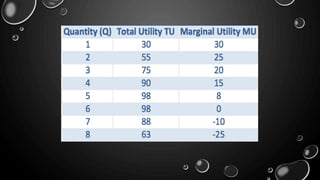
TOTAL UTILITY (TU) AND MARGINAL UTILITY
(MU):
TOTAL UTILITY: IT IS THE SUM TOTAL OF UTILITY DERIVED FROM THE
CONSUMPTION OF ALL THE UNITS OF A COMMODITY. FOR EXAMPLE, IF 2 UNITS OF A
COMMODITY ARE CONSUMED AND 1ST UNITS GIVES SATISFACTION OF 10 UNITS,
WHILE THE 2ND UNIT GIVES YOU SATISFACTION OD 9. SO THE TOTAL UTILITY HERE
WOULD BE 10+9= 19 UTILS (UNITS OF UTILITY).
MARGINAL UTILITY: IT REFERS TO ADDITIONAL UTILITY ON ACCOUNT OF THE
CONSUMPTION OF AN ADDITIONAL UNITS OF A COMMODITY. FOR EXAMPLE, IF 10
UNITS OF A COMMODITY GIVE SATISFACTION OF 100 UTILS, AND 11 UNITS OF A
COMMODITY GIVE SATISFACTION OF 105 UTILS, THEN ADDITIONAL UTILITY IS 5 UTILS.
(105-100=5)
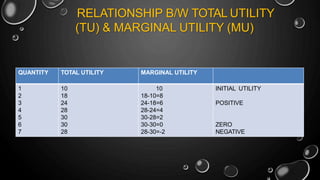
RELATIONSHIP B/W TOTAL UTILITY
(TU) & MARGINAL UTILITY (MU)
QUANTITY TOTAL UTILITY MARGINAL UTILITY
1 10 10 INITIAL UTILITY
2 18 18-10=8
3 24 24-18=6 POSITIVE
4 28 28-24=4
5 30 30-28=2
6 30 30-30=0 ZERO
7 28 28-30=-2 NEGATIVE
LAW OF DIMINISHING MARGINAL UTLITY
MEANING:
The law of diminishing marginal utility states that, “as a
consumer consumes more and more units of a specific
commodity, utility from the successive units goes on
diminishing”.
“ALSO KNOWN AS GOSSEN’S FIRST LAW”.
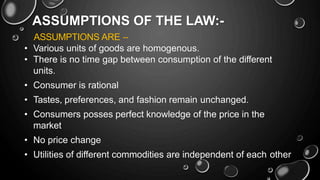
ASSUMPTIONS OF THE LAW:-
ASSUMPTIONS ARE –
• Various units of goods are homogenous.
• There is no time gap between consumption of the different
units.
• Consumer is rational
• Tastes, preferences, and fashion remain unchanged.
• Consumers posses perfect knowledge of the price in the
market
• No price change
• Utilities of different commodities are independent of each other
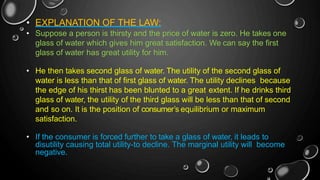
• EXPLANATION OF THE LAW:
• Suppose a person is thirsty and the price of water is zero. He takes one
glass of water which gives him great satisfaction. We can say the first
glass of water has great utility for him.
• He then takes second glass of water. The utility of the second glass of
water is less than that of first glass of water. The utility declines because
the edge of his thirst has been blunted to a great extent. If he drinks third
glass of water, the utility of the third glass will be less than that of second
and so on. It is the position of consumer’s equilibrium or maximum
satisfaction.
• If the consumer is forced further to take a glass of water, it leads to
disutility causing total utility-to decline. The marginal utility will become
negative.
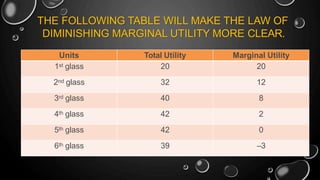
THE FOLLOWING TABLE WILL MAKE THE LAW OF
DIMINISHING MARGINAL UTILITY MORE CLEAR.
Units Total Utility Marginal Utility
1st glass 20 20
2nd glass 32 12
3rd glass 40 8
4th glass 42 2
5th glass 42 0
6th glass 39 –3
THE GRAPH WILL MAKE THE LAW OF
DIMINISHING MARGINAL UTILITY MORE CLEAR
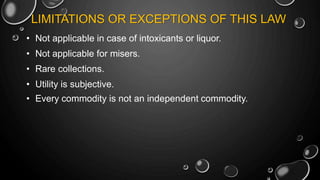
LIMITATIONS OR EXCEPTIONS OF THIS LAW
• Not applicable in case of intoxicants or liquor.
• Not applicable for misers.
• Rare collections.
• Utility is subjective.
• Every commodity is not an independent commodity.
INDIFFERENCE CURVE
ANALYSIS
ANOOP SAINI
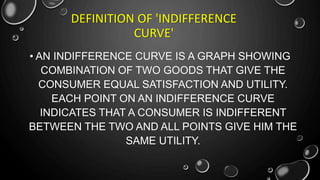
DEFINITION OF 'INDIFFERENCE
CURVE'
• AN INDIFFERENCE CURVE IS A GRAPH SHOWING
COMBINATION OF TWO GOODS THAT GIVE THE
CONSUMER EQUAL SATISFACTION AND UTILITY.
EACH POINT ON AN INDIFFERENCE CURVE
INDICATES THAT A CONSUMER IS INDIFFERENT
BETWEEN THE TWO AND ALL POINTS GIVE HIM THE
SAME UTILITY.
ASSUMPTIONS OF IC ANALYSIS
Rational Consumer
Ordinal Utility
Diminishing Marginal Rate of Substitution.
.
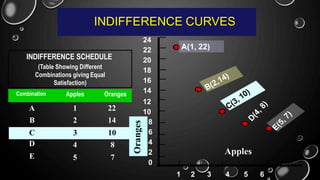
INDIFFERENCE CURVES
A(1, 22)
Apples
1 2 3 4 5 6
8
6
4
2
0
24
22
20
18
16
14
12
10
INDIFFERENCE SCHEDULE
(Table Showing Different
Combinations giving Equal
Satisfaction)
Combination Apples Oranges
Oranges
A 1 22
B 2 14
C 3 10
D
E
4
5
8
7
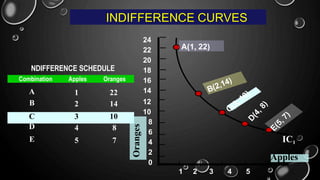
INDIFFERENCE CURVES
NDIFFERENCE SCHEDULE
Combination Apples Oranges
A
B
1
2
22
14
C 3 10
D
E
4
5
8
7
8
6
4
2
0
1 2 3 4 5
A(1, 22)
24
22
20
18
16
14
12
10
Oranges IC1
Apples
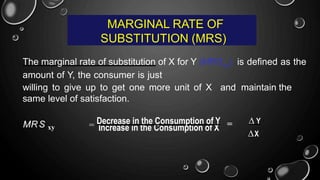
MARGINAL RATE OF
SUBSTITUTION (MRS)
MRS xy Increase in the Consumption of X
The marginal rate of substitution of X for Y (MRSxy) is defined as the
amount of Y, the consumer is just
willing to give up to get one more unit of X and maintain the
same level of satisfaction.
= Decrease in the Consumption of Y = ∆ Y
∆X
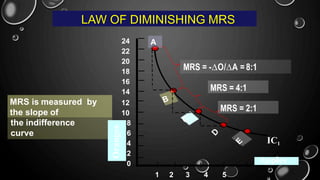
LAW OF DIMINISHING MRS
MRS is measured by
the slope of
the indifference
curve
MRS = -O/A = 8:1
12
10
8
6
4
2
0
1 2 3 4 5
A
24
22
20
18
16
14
Oranges
IC1
Apples
MRS = 2:1
MRS = 4:1
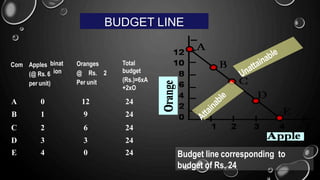
BUDGET LINE or BUDGETCONSTRAINTS
(What is Attainable)
Budget constraints limit an individual’s ability to consume
in light of the prices they must pay for various goods and
services.
Budget line or Price Line: Shows all possible combinations
of two goods that the consumer can buy if he spends the
whole of his given sum of money on his purchases at the
given prices.
BUDGET LINE
Com Apples binat
(@ Rs. 6 ion
per unit)
Oranges
@ Rs. 2
Per unit
Total
budget
(Rs.)=6xA
+2xO
A 0 12 24
B 1 9 24
C 2 6 24
D 3 3 24
E 4 0 24 Budget line corresponding to
budget of Rs. 24
CONSUMER EQUILIBRIUM
Consumers choose a combination of goods that will maximize
the satisfaction they can achieve, given the limited budget
available to them.
The maximising combination must satisfy two conditions:
It must be located on the budget line.
Must give the consumer the most preferred combination
of goods and services.
•THANK YOU………

Consumer’s equilibrium and utility analysis.pptx

  • 1.
  • 2.
    CONSUMER'S EQUILIBRIUM MEANSA STATE OF MAXIMUM SATISFACTION. A SITUATION WHERE A CONSUMER SPENDS HIS GIVEN INCOME PURCHASING ONE OR MORE COMMODITIES SO THAT HE GETS MAXIMUM SATISFACTION AND HAS NO URGE TO CHANGE THIS LEVEL OF CONSUMPTION, GIVEN THE PRICES OF COMMODITIES, IS KNOWN AS THE CONSUMER'S EQUILIBRIUM. CONDITIONS OF CONSUMER’S EQUILIBRIUM: CONSUMER UTILITY APPROACH CAN BE UNDERSTOOD BY TWO WAYS: 1. CARDINAL APPROACH (UTILITY ANALYSIS): ACCORDING TO THIS APPROACH UTILITY CAN BE MEASURED. “UTILS” IS THE UNIT OF UTILITY. 2. ORDINAL APPROACH (INDIFFERENCE CURVE ANALYSIS): ACCORDING TO THIS APPROACH UTILITY CANNOT BE MEASURED BUT CAN BE EXPRESSED IN ORDER OR RANKING.
  • 3.
    MEANING OF UTILITY: UTILITY: UTILITYIS THE POWER OR CAPACITY OF A COMMODITY TO SATISFY HUMAN WANTS. ALTERNATIVELY, UTILITY OF A COMMODITY MEANS THE AMOUNT OF SATISFACTION THAT A PERSON GETS FROM CONSUMPTION OF A GOOD OR SERVICE. EXAMPLES: BOOK FOR READING & CAR FOR DRIVING
  • 4.
    MEASUREMENT OF UTILITY: TWOTYPES OF UTILITY ARE THERE: 1. CARDINAL UTILITY 2. ORDINAL UTILITY CARDINAL UTILITY: IT STATES THAT THE SATISFACTION THE CONSUMER DERIVES BY CONSUMING GOODS AND SERVICES CAN BE MEASURED WITH A NUMBER. CARDINAL UTILITY IS A QUANTITATIVE METHOD THAT IS USED TO MEASURE CONSUMPTION SATISFACTION.
  • 5.
    ORDINAL UTILITY: IT STATESTHAT THE SATISFACTION THE CONSUMER DERIVES FROM THE CONSUMPTION OF GOODS AND SERVICES CANNOT BE MEASURED IN NUMBERS. ORDINAL UTILITY USES A RANKING SYSTEM IN WHICH A RANK IS PROVIDED TO THE SATISFACTION THAT IS DERIVED FROM CONSUMPTION. ORDINAL UTILITY IS A QUALITATIVE METHOD THAT IS USED TO MEASURE CONSUMPTION SATISFACTION.
  • 6.
    TOTAL UTILITY (TU)AND MARGINAL UTILITY (MU): TOTAL UTILITY: IT IS THE SUM TOTAL OF UTILITY DERIVED FROM THE CONSUMPTION OF ALL THE UNITS OF A COMMODITY. FOR EXAMPLE, IF 2 UNITS OF A COMMODITY ARE CONSUMED AND 1ST UNITS GIVES SATISFACTION OF 10 UNITS, WHILE THE 2ND UNIT GIVES YOU SATISFACTION OD 9. SO THE TOTAL UTILITY HERE WOULD BE 10+9= 19 UTILS (UNITS OF UTILITY). MARGINAL UTILITY: IT REFERS TO ADDITIONAL UTILITY ON ACCOUNT OF THE CONSUMPTION OF AN ADDITIONAL UNITS OF A COMMODITY. FOR EXAMPLE, IF 10 UNITS OF A COMMODITY GIVE SATISFACTION OF 100 UTILS, AND 11 UNITS OF A COMMODITY GIVE SATISFACTION OF 105 UTILS, THEN ADDITIONAL UTILITY IS 5 UTILS. (105-100=5)
  • 8.
    RELATIONSHIP B/W TOTALUTILITY (TU) & MARGINAL UTILITY (MU) QUANTITY TOTAL UTILITY MARGINAL UTILITY 1 10 10 INITIAL UTILITY 2 18 18-10=8 3 24 24-18=6 POSITIVE 4 28 28-24=4 5 30 30-28=2 6 30 30-30=0 ZERO 7 28 28-30=-2 NEGATIVE
  • 9.
    LAW OF DIMINISHINGMARGINAL UTLITY MEANING: The law of diminishing marginal utility states that, “as a consumer consumes more and more units of a specific commodity, utility from the successive units goes on diminishing”. “ALSO KNOWN AS GOSSEN’S FIRST LAW”.
  • 10.
    ASSUMPTIONS OF THELAW:- ASSUMPTIONS ARE – • Various units of goods are homogenous. • There is no time gap between consumption of the different units. • Consumer is rational • Tastes, preferences, and fashion remain unchanged. • Consumers posses perfect knowledge of the price in the market • No price change • Utilities of different commodities are independent of each other
  • 11.
    • EXPLANATION OFTHE LAW: • Suppose a person is thirsty and the price of water is zero. He takes one glass of water which gives him great satisfaction. We can say the first glass of water has great utility for him. • He then takes second glass of water. The utility of the second glass of water is less than that of first glass of water. The utility declines because the edge of his thirst has been blunted to a great extent. If he drinks third glass of water, the utility of the third glass will be less than that of second and so on. It is the position of consumer’s equilibrium or maximum satisfaction. • If the consumer is forced further to take a glass of water, it leads to disutility causing total utility-to decline. The marginal utility will become negative.
  • 12.
    THE FOLLOWING TABLEWILL MAKE THE LAW OF DIMINISHING MARGINAL UTILITY MORE CLEAR. Units Total Utility Marginal Utility 1st glass 20 20 2nd glass 32 12 3rd glass 40 8 4th glass 42 2 5th glass 42 0 6th glass 39 –3
  • 13.
    THE GRAPH WILLMAKE THE LAW OF DIMINISHING MARGINAL UTILITY MORE CLEAR
  • 14.
    LIMITATIONS OR EXCEPTIONSOF THIS LAW • Not applicable in case of intoxicants or liquor. • Not applicable for misers. • Rare collections. • Utility is subjective. • Every commodity is not an independent commodity.
  • 15.
  • 16.
    DEFINITION OF 'INDIFFERENCE CURVE' •AN INDIFFERENCE CURVE IS A GRAPH SHOWING COMBINATION OF TWO GOODS THAT GIVE THE CONSUMER EQUAL SATISFACTION AND UTILITY. EACH POINT ON AN INDIFFERENCE CURVE INDICATES THAT A CONSUMER IS INDIFFERENT BETWEEN THE TWO AND ALL POINTS GIVE HIM THE SAME UTILITY.
  • 17.
    ASSUMPTIONS OF ICANALYSIS Rational Consumer Ordinal Utility Diminishing Marginal Rate of Substitution. .
  • 18.
    INDIFFERENCE CURVES A(1, 22) Apples 12 3 4 5 6 8 6 4 2 0 24 22 20 18 16 14 12 10 INDIFFERENCE SCHEDULE (Table Showing Different Combinations giving Equal Satisfaction) Combination Apples Oranges Oranges A 1 22 B 2 14 C 3 10 D E 4 5 8 7
  • 19.
    INDIFFERENCE CURVES NDIFFERENCE SCHEDULE CombinationApples Oranges A B 1 2 22 14 C 3 10 D E 4 5 8 7 8 6 4 2 0 1 2 3 4 5 A(1, 22) 24 22 20 18 16 14 12 10 Oranges IC1 Apples
  • 20.
    MARGINAL RATE OF SUBSTITUTION(MRS) MRS xy Increase in the Consumption of X The marginal rate of substitution of X for Y (MRSxy) is defined as the amount of Y, the consumer is just willing to give up to get one more unit of X and maintain the same level of satisfaction. = Decrease in the Consumption of Y = ∆ Y ∆X
  • 21.
    LAW OF DIMINISHINGMRS MRS is measured by the slope of the indifference curve MRS = -O/A = 8:1 12 10 8 6 4 2 0 1 2 3 4 5 A 24 22 20 18 16 14 Oranges IC1 Apples MRS = 2:1 MRS = 4:1
  • 22.
    BUDGET LINE orBUDGETCONSTRAINTS (What is Attainable) Budget constraints limit an individual’s ability to consume in light of the prices they must pay for various goods and services. Budget line or Price Line: Shows all possible combinations of two goods that the consumer can buy if he spends the whole of his given sum of money on his purchases at the given prices.
  • 23.
    BUDGET LINE Com Applesbinat (@ Rs. 6 ion per unit) Oranges @ Rs. 2 Per unit Total budget (Rs.)=6xA +2xO A 0 12 24 B 1 9 24 C 2 6 24 D 3 3 24 E 4 0 24 Budget line corresponding to budget of Rs. 24
  • 24.
    CONSUMER EQUILIBRIUM Consumers choosea combination of goods that will maximize the satisfaction they can achieve, given the limited budget available to them. The maximising combination must satisfy two conditions: It must be located on the budget line. Must give the consumer the most preferred combination of goods and services.
  • 25.