Package Of
Practices- Isabgol
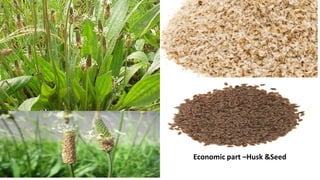
Economic part –Husk &Seed
ISABGOL
•BOTANICAL NAME –Plantago ovata
•FAMILY- Plantaginacea
•NATIVE PLACE- Persia
•ECONOMIC PART- Husk , Seed
•Chromosome number (2n)- 8
•local Name –Blond Psyllium,spogel seed
,Snigdhabijab
• ACTIVE PRINCIPLE- Mucilage, Xylose and Arbinose
• Type of flower- Protogynous
• Type of Fruit - Capsule
• Medicinal Property –laxative property, used against irritation in
gastrointestinal , Constipation dysentery, Cooling and demulcent used
to cure inflammation of mucous membrane .
• Isabgol is a stemless annual herb .
• Husk (odourless & tasteless) yield a colloidal mucilage
consisting of xylose ,arabinose and galacturonic acid .
• The husk has the property of absorbing and retaining water
and it works as an anti diarrhoeal drug .
• It is beneficial in dysenteries of amoebic and bacillary origin
Origin and Distribution -
• It is indigenous to the Persia and west asia , extending up to
the Sutlej ,sind ,and west Pakistan, Mexico.
• it has been introduced in India and cultivated specially in
Gujrat and some parts of Rajasthan
• Varieties- Gujrat Isabgol-1, Gujrat Isabgol-2 ,Hariyana
isabgol-5, Jawahar isabgol-4,Niharika
•SOIL- It is an irrigated crop which grow well on light soil
.Isabgol grow in sandy to sandy loam soil having PH range of
7-8 . soil are well drained and rich is organic matter .
•CLIMATE –Isabgol is predominantly grown as cold season
crop . It is require cool climate and dry weather .the
temperature is require for seed germination is 20-30 degree
Celsius ,
•Land preparation –Field must be free from weed and clods
, have fine tilth for good germination . the land is laid in to
flat body of convenient size i.e. 1.0x3.0 meter or 2.5x2.5
meter .
•Propagation - It is propagated by seed .
•Seed rate - 4kg/hectare
•Time of sowing - November –mid December
•Planting distance –Seed should be sown in lines line 30cm
apart .
•Manuring – The FYM of 10-15 tonnes per hectare applied
during land preparation . Isabgol does not require
application of heavy dose of fertilizer . A fertilizer dose
consisting of 50kg N, 25kgP2O5 , 30kg k2O/ha gives as a
basal dose . the second split of N as a top dressing after one
month of sowing.
• Irrigation – After sowing light irrigation is essential .
The seed normally germinate 6-7 days . If germination
is poor, second irrigation may be given . Last irrigation
should be given at the time when maximum number of
spike have reached milk stage.
•Weeding- periodical weeding and hoeing is required . The
medicinal plant have to be grown without fertilizer and use
of pesticides . Organic manure like FYM, vermicompost ,
green manure , etc. may be used as per requirement of the
species . To prevent disease , bio-pesticide ,could be
prepared from neem , dhatura etc.
• Pests.
White grubs and termite damage the crop by cutting off the root which
can be controlled by broad casting phorate 10G @10kg/ha . Aphid also
attack the crop and can be controlled by spraying 0.2% Dimethoate.
Disease-
Downy mildew is the major disease caused by Peronospora plantaginis
.It is controlled by Bordeaux mixture or Dithane M-45 or any copper
fungicide @2-2.5g/l can be spray.
•Harvesting –The crop mature during March -April .The crop
ready for harvesting 110-130 days after sowing . Spike turn
brownish ,at the time of harvest ,the atmosphere must be
dry and not moisture in plant . Plant should be cut from
ground level.
•Processing – The harvest plant are threshed and winnowed
and seed repeatedly sifted until clean. Seed are fed to a
series of shellers and remove only the husk . It separated by
fan and sieve .
• The husk:seed ratio -25:75
•Yield – 8-10 q/ha or 1 tonnes/ha
THANKS

Isabgol - plantago ovata

  • 1.
  • 2.
  • 3.
    ISABGOL •BOTANICAL NAME –Plantagoovata •FAMILY- Plantaginacea •NATIVE PLACE- Persia •ECONOMIC PART- Husk , Seed •Chromosome number (2n)- 8 •local Name –Blond Psyllium,spogel seed ,Snigdhabijab
  • 4.
    • ACTIVE PRINCIPLE-Mucilage, Xylose and Arbinose • Type of flower- Protogynous • Type of Fruit - Capsule • Medicinal Property –laxative property, used against irritation in gastrointestinal , Constipation dysentery, Cooling and demulcent used to cure inflammation of mucous membrane .
  • 5.
    • Isabgol isa stemless annual herb . • Husk (odourless & tasteless) yield a colloidal mucilage consisting of xylose ,arabinose and galacturonic acid . • The husk has the property of absorbing and retaining water and it works as an anti diarrhoeal drug . • It is beneficial in dysenteries of amoebic and bacillary origin
  • 6.
    Origin and Distribution- • It is indigenous to the Persia and west asia , extending up to the Sutlej ,sind ,and west Pakistan, Mexico. • it has been introduced in India and cultivated specially in Gujrat and some parts of Rajasthan • Varieties- Gujrat Isabgol-1, Gujrat Isabgol-2 ,Hariyana isabgol-5, Jawahar isabgol-4,Niharika
  • 7.
    •SOIL- It isan irrigated crop which grow well on light soil .Isabgol grow in sandy to sandy loam soil having PH range of 7-8 . soil are well drained and rich is organic matter . •CLIMATE –Isabgol is predominantly grown as cold season crop . It is require cool climate and dry weather .the temperature is require for seed germination is 20-30 degree Celsius ,
  • 8.
    •Land preparation –Fieldmust be free from weed and clods , have fine tilth for good germination . the land is laid in to flat body of convenient size i.e. 1.0x3.0 meter or 2.5x2.5 meter .
  • 9.
    •Propagation - Itis propagated by seed . •Seed rate - 4kg/hectare •Time of sowing - November –mid December •Planting distance –Seed should be sown in lines line 30cm apart .
  • 10.
    •Manuring – TheFYM of 10-15 tonnes per hectare applied during land preparation . Isabgol does not require application of heavy dose of fertilizer . A fertilizer dose consisting of 50kg N, 25kgP2O5 , 30kg k2O/ha gives as a basal dose . the second split of N as a top dressing after one month of sowing.
  • 11.
    • Irrigation –After sowing light irrigation is essential . The seed normally germinate 6-7 days . If germination is poor, second irrigation may be given . Last irrigation should be given at the time when maximum number of spike have reached milk stage.
  • 12.
    •Weeding- periodical weedingand hoeing is required . The medicinal plant have to be grown without fertilizer and use of pesticides . Organic manure like FYM, vermicompost , green manure , etc. may be used as per requirement of the species . To prevent disease , bio-pesticide ,could be prepared from neem , dhatura etc.
  • 13.
    • Pests. White grubsand termite damage the crop by cutting off the root which can be controlled by broad casting phorate 10G @10kg/ha . Aphid also attack the crop and can be controlled by spraying 0.2% Dimethoate. Disease- Downy mildew is the major disease caused by Peronospora plantaginis .It is controlled by Bordeaux mixture or Dithane M-45 or any copper fungicide @2-2.5g/l can be spray.
  • 14.
    •Harvesting –The cropmature during March -April .The crop ready for harvesting 110-130 days after sowing . Spike turn brownish ,at the time of harvest ,the atmosphere must be dry and not moisture in plant . Plant should be cut from ground level.
  • 15.
    •Processing – Theharvest plant are threshed and winnowed and seed repeatedly sifted until clean. Seed are fed to a series of shellers and remove only the husk . It separated by fan and sieve . • The husk:seed ratio -25:75 •Yield – 8-10 q/ha or 1 tonnes/ha
  • 16.