Topic : Bioaeshthetic Planning
Sub. To –
Dr. Sonia
Sub. By –
Arvind Verma
• Conscious plan of the Flora (Plants) and Fauna
(Animals) with the objective of beautifying the country.
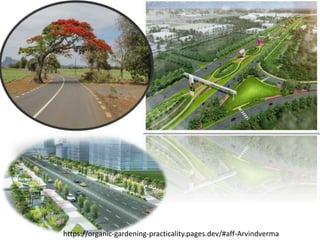
• It includes the planting of ornamental flowering trees
along the city roads, in parks, public places, and
compound & houses both in towns & villages. It also
includes the development of 'nature parks' for the
preservation of beautiful non-carnivorous animals &
the creation of bird sanctuaries.
Bioaeshthetic Planning
•The term bioaesthetic planning is coined by Poff.
Lanceolate Hogbean.
• M. S. Randhawa was the flag bearer of Bio-
aesthetic planning (created garden city of
Chandigarh) along with Le Corbusier.
• The objective of a bioaesthetic planning for
India is the encouragement of planting of
selected ornamental flowering trees in our towns
& villages.
The bio-aesthetic planners are master artists whose
canvas is an entire country & whose pigments are
beautiful flowering plants.
They paint the canvas of countryside in vibrant
colors like blue, orange, red, yellow, scarlet & pink.
With colorful flowering trees, they decorate the
sidewalks of the roads, platforms of railway
stations, the canal banks, the compounds of houses
& the public buildings.
https://organic-gardening-practicality.pages.dev/#aff-Arvindverma
Principle
• Ecotourism is about uniting conservation, communities,
and sustainable travel.
• Build environmental and cultural awareness and respect.
• Provide positive experiences for both visitors and hosts.
• Provide direct financial benefits for conservation.
• Provide financial benefits and empowerment for local
people.
• Raise sensitivity to host countries’ political,
environmental, and social climate.
• Support international human rights and labour
agreements
https://organic-gardening-practicality.pages.dev/#aff-Arvindverma
Places suitable for Bioaeshthetic
Planning
• Industrial areas.
• Highway,
• Banks of rivers and canals,
• Public Schools,
• Religious places,
• Railway stations,
• Around water bodies
• Bus stands,
• Air Ports
• Modern buildings,
• Historical buildings
• Govt. offices.
• Hospitals, Educational
institutes
• Courts, bungalows,
Commercial buildings
• Banks and Post offices
• National park, Wild life
centaury
• Urban areas & villages
• Private houses
• Panchyatghars
• Town, roads, Parks
• Public buildings
https://organic-gardening-practicality.pages.dev/#aff-Arvindverma
Areas for Bio-aesthetic Planning
• Public places which belong to the community as a
whole, rather than to individuals, should be given
priority in bic- aesthetic planning.
• Public parks and gardens.
• Public places such as hospitals, banks, courts, post
offices, university campuses, schools, colleges, cak
bungalows, etc.
• National, state, district, block and village roads.
• Airports, railway tracks, bus stands, bus terminals,
railway stations, railway junctions, highways and canal
banks.
• Religious places such as temples, mosques,
churches, gurdwaras, etc.
• Village panchayat ghars, community lands,
chaupals, etc.
• Burning ghats, cemeteries, etc.
• Private hotels, shopping complexes, private
residential colonies, etc.
• Individual home gardens.
https://organic-gardening-practicality.pages.dev/#aff-Arvindverma
Benefits of Bio-aesthetic Planning
• Bio-aesthetic planning not only beautifies the
environment but also makes it more livable and
ecologically stable.
• It improves microclimate, mitigates pollution, helps
in noise abatement,
• Creates habitat for many animal species, adds
variety of form, colour and texture to the
environment and
• Brings about positive changes in human behavior .
Temperature and energy use :
• Plants can be successfully used to mitigate heat. Their leaves
intercept, reflect, absorb and transmit solar radiations.
• Trees are called nature’s air conditioners because they lower
air temperature, shade buildings in the summer and block
winter winds.
• Thus, trees can reduce building energy use and cooling costs
• A single large tree can produce the cooling effect of 10 room
size air conditioners operating 24 hours/day.
https://organic-gardening-practicality.pages.dev/#aff-Arvindverma
Air quality:
• Plants help in controlling air pollution through acting
as biological and physically nets.
• They cleanse the air by intercepting and slowing dust
and other particulate materials causing them to fall
out, and by absorbing pollutant gases.
• Fragrance of many flowers mask unpleasant odours
there by imparting freshness to air.
Tree suitable to reduce air pollution:
• Tropics
• Acacia auriculiformis(Auri)
• Albizia lebbeck (Siris)
• Ailanthus excelsa(Heaven tree)
• Alstonia macrophylla(Hard milkwood)
• A. scholaris (Devil tree)
• Azadirachta indica (Neem)
• Butea frondosa(Flame of forest)
• Cassia fistula (Amaltas)
• C. marginat(Cassia Rose tree)
• Madhuca indica(Butter tree)
• Parkinsonia aculeata(Ram babul )
• Polyalthia longifolia
• Putranjiva roxburgi(Lucky bean tree)
Temperate areas
•
• Acer platanoides(Norway
maple)
• A. saccharinum(Silver maple)
• A. negundo (Box elder)
• Betula pendula(Silver birch)
• Forsythia suspense(Golden bell)
• Ligustrum vulgare(Common
privet)
• Platanus orientalis(Oriental
plane tree)
• Pyracantha coccinea(scarlet
firethorn)
• Quercus palustris(Pin Oak)
• Q. rubra (N. Red Oak)
• Robinia pseudocacia(Black
locust)
Precipitation and Humidity:
• Plants intercept precipitation and slow it’s decent
to soil surface thus increasing infiltration and
reducing runoff and soil erosion.
• Pubescence on leaves help in water entrapment.
• Plants with horizontal branching and rough bark are
most effective.
• Humidity is increased in hot and dry season by
means of transpiration.
https://organic-gardening-practicality.pages.dev/#aff-Arvindverma
Noise abatement :
• A noise level above 80 decibels creates tension and
increase in blood pressure.
• Urban residential areas can be protected by a row
of dense shrubs backed by row of tall trees, total 20
feet wide.
• Plants having thick and fleshy leaves with petioles,
which allow the higher degree of flexibility and
vibration are best suited for use as noise screens.
Tree suitable to redue noise pollution:
• Tropics
• Alstonia scholaris (Devil tree)
• Azadirachta indica(Neem)
• Butea monosperma(Flame of forest)
• Erythrina variegata(Indian coral tree)
• Eucalyptus citriodora(Lemon scented gum)
• Grevillea robusta(Silky oak)
• Kigelia pinnata (Sausage Tree)
• Madhuca indica(Butter tree)
• Mangifera indica (Mango)
• Morus alba(White mulberry)
• Pterspermum acerifolium(Bayur tree)
• Terminalia arjuna (Arjun tree)
Temperate areas
•
• Alnus viridis(Green alder)
• A. crispa (Japanese holly)
• Betula nana (Dwarf birch)
• Braya purpurascens(Purplish
braya)
• Dryas integrifolia (Mountain
avens)
• Salix planifolia(Tea leaf
willow)
Wind protection and air movement:
• Trees perpendicular to wind direction may reduce
the wind speed up to distance of 2-5 times the
height of the tallest tree on windward side and 30-
40 times on the leeward side.
• Trees can be planted to funnel or baffle wind away
from areas – both vertical and horizontal
concentration of foliage can modify air movement
patterns.
https://organic-gardening-practicality.pages.dev/#aff-Arvindverma
Ecological benefits:
• Biodiversity maintains ecological balance and
continues evolutionary processes.
• The indirect ecosystem services provided through
biodiversity are photosynthesis, pollination,
transpiration, chemical cycling, nutrient cycling, soil
maintenance, climate regulation, air, water system
management, waste treatment and pest control.
Aesthetic value :
• Trees change skyline, add variety of form, colour
and texture to otherwise dull and monotonous
cities.
• They soften the harshness of concrete structures,
complement architectural lines, inframe views and
provide background settings to buildings.
• Plants can be very effectively used to screen
undesirable and disturbing sight lines.
https://organic-gardening-practicality.pages.dev/#aff-Arvindverma

(Bio aesthetic planning) aims and objectives

  • 1.
    Topic : BioaeshtheticPlanning Sub. To – Dr. Sonia Sub. By – Arvind Verma
  • 2.
    • Conscious planof the Flora (Plants) and Fauna (Animals) with the objective of beautifying the country. • It includes the planting of ornamental flowering trees along the city roads, in parks, public places, and compound & houses both in towns & villages. It also includes the development of 'nature parks' for the preservation of beautiful non-carnivorous animals & the creation of bird sanctuaries. Bioaeshthetic Planning
  • 3.
    •The term bioaestheticplanning is coined by Poff. Lanceolate Hogbean. • M. S. Randhawa was the flag bearer of Bio- aesthetic planning (created garden city of Chandigarh) along with Le Corbusier. • The objective of a bioaesthetic planning for India is the encouragement of planting of selected ornamental flowering trees in our towns & villages.
  • 4.
    The bio-aesthetic plannersare master artists whose canvas is an entire country & whose pigments are beautiful flowering plants. They paint the canvas of countryside in vibrant colors like blue, orange, red, yellow, scarlet & pink. With colorful flowering trees, they decorate the sidewalks of the roads, platforms of railway stations, the canal banks, the compounds of houses & the public buildings. https://organic-gardening-practicality.pages.dev/#aff-Arvindverma
  • 5.
    Principle • Ecotourism isabout uniting conservation, communities, and sustainable travel. • Build environmental and cultural awareness and respect. • Provide positive experiences for both visitors and hosts. • Provide direct financial benefits for conservation. • Provide financial benefits and empowerment for local people. • Raise sensitivity to host countries’ political, environmental, and social climate. • Support international human rights and labour agreements
  • 6.
  • 8.
    Places suitable forBioaeshthetic Planning • Industrial areas. • Highway, • Banks of rivers and canals, • Public Schools, • Religious places, • Railway stations, • Around water bodies • Bus stands, • Air Ports • Modern buildings, • Historical buildings • Govt. offices. • Hospitals, Educational institutes • Courts, bungalows, Commercial buildings • Banks and Post offices • National park, Wild life centaury • Urban areas & villages • Private houses • Panchyatghars • Town, roads, Parks • Public buildings
  • 9.
  • 10.
    Areas for Bio-aestheticPlanning • Public places which belong to the community as a whole, rather than to individuals, should be given priority in bic- aesthetic planning. • Public parks and gardens. • Public places such as hospitals, banks, courts, post offices, university campuses, schools, colleges, cak bungalows, etc. • National, state, district, block and village roads. • Airports, railway tracks, bus stands, bus terminals, railway stations, railway junctions, highways and canal banks.
  • 11.
    • Religious placessuch as temples, mosques, churches, gurdwaras, etc. • Village panchayat ghars, community lands, chaupals, etc. • Burning ghats, cemeteries, etc. • Private hotels, shopping complexes, private residential colonies, etc. • Individual home gardens. https://organic-gardening-practicality.pages.dev/#aff-Arvindverma
  • 12.
    Benefits of Bio-aestheticPlanning • Bio-aesthetic planning not only beautifies the environment but also makes it more livable and ecologically stable. • It improves microclimate, mitigates pollution, helps in noise abatement, • Creates habitat for many animal species, adds variety of form, colour and texture to the environment and • Brings about positive changes in human behavior .
  • 13.
    Temperature and energyuse : • Plants can be successfully used to mitigate heat. Their leaves intercept, reflect, absorb and transmit solar radiations. • Trees are called nature’s air conditioners because they lower air temperature, shade buildings in the summer and block winter winds. • Thus, trees can reduce building energy use and cooling costs • A single large tree can produce the cooling effect of 10 room size air conditioners operating 24 hours/day. https://organic-gardening-practicality.pages.dev/#aff-Arvindverma
  • 14.
    Air quality: • Plantshelp in controlling air pollution through acting as biological and physically nets. • They cleanse the air by intercepting and slowing dust and other particulate materials causing them to fall out, and by absorbing pollutant gases. • Fragrance of many flowers mask unpleasant odours there by imparting freshness to air.
  • 15.
    Tree suitable toreduce air pollution: • Tropics • Acacia auriculiformis(Auri) • Albizia lebbeck (Siris) • Ailanthus excelsa(Heaven tree) • Alstonia macrophylla(Hard milkwood) • A. scholaris (Devil tree) • Azadirachta indica (Neem) • Butea frondosa(Flame of forest) • Cassia fistula (Amaltas) • C. marginat(Cassia Rose tree) • Madhuca indica(Butter tree) • Parkinsonia aculeata(Ram babul ) • Polyalthia longifolia • Putranjiva roxburgi(Lucky bean tree) Temperate areas • • Acer platanoides(Norway maple) • A. saccharinum(Silver maple) • A. negundo (Box elder) • Betula pendula(Silver birch) • Forsythia suspense(Golden bell) • Ligustrum vulgare(Common privet) • Platanus orientalis(Oriental plane tree) • Pyracantha coccinea(scarlet firethorn) • Quercus palustris(Pin Oak) • Q. rubra (N. Red Oak) • Robinia pseudocacia(Black locust)
  • 16.
    Precipitation and Humidity: •Plants intercept precipitation and slow it’s decent to soil surface thus increasing infiltration and reducing runoff and soil erosion. • Pubescence on leaves help in water entrapment. • Plants with horizontal branching and rough bark are most effective. • Humidity is increased in hot and dry season by means of transpiration. https://organic-gardening-practicality.pages.dev/#aff-Arvindverma
  • 17.
    Noise abatement : •A noise level above 80 decibels creates tension and increase in blood pressure. • Urban residential areas can be protected by a row of dense shrubs backed by row of tall trees, total 20 feet wide. • Plants having thick and fleshy leaves with petioles, which allow the higher degree of flexibility and vibration are best suited for use as noise screens.
  • 18.
    Tree suitable toredue noise pollution: • Tropics • Alstonia scholaris (Devil tree) • Azadirachta indica(Neem) • Butea monosperma(Flame of forest) • Erythrina variegata(Indian coral tree) • Eucalyptus citriodora(Lemon scented gum) • Grevillea robusta(Silky oak) • Kigelia pinnata (Sausage Tree) • Madhuca indica(Butter tree) • Mangifera indica (Mango) • Morus alba(White mulberry) • Pterspermum acerifolium(Bayur tree) • Terminalia arjuna (Arjun tree) Temperate areas • • Alnus viridis(Green alder) • A. crispa (Japanese holly) • Betula nana (Dwarf birch) • Braya purpurascens(Purplish braya) • Dryas integrifolia (Mountain avens) • Salix planifolia(Tea leaf willow)
  • 19.
    Wind protection andair movement: • Trees perpendicular to wind direction may reduce the wind speed up to distance of 2-5 times the height of the tallest tree on windward side and 30- 40 times on the leeward side. • Trees can be planted to funnel or baffle wind away from areas – both vertical and horizontal concentration of foliage can modify air movement patterns. https://organic-gardening-practicality.pages.dev/#aff-Arvindverma
  • 20.
    Ecological benefits: • Biodiversitymaintains ecological balance and continues evolutionary processes. • The indirect ecosystem services provided through biodiversity are photosynthesis, pollination, transpiration, chemical cycling, nutrient cycling, soil maintenance, climate regulation, air, water system management, waste treatment and pest control.
  • 21.
    Aesthetic value : •Trees change skyline, add variety of form, colour and texture to otherwise dull and monotonous cities. • They soften the harshness of concrete structures, complement architectural lines, inframe views and provide background settings to buildings. • Plants can be very effectively used to screen undesirable and disturbing sight lines.
  • 22.