Advances in production technology
OF
P. VASUDEV NAIK
Assistant professor & Ph D scholar
(Hort)
By
22 September 2015 P. V. NAIK
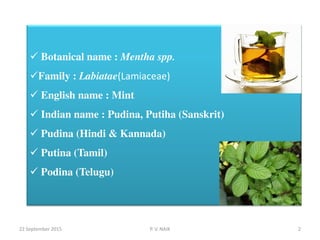
 Botanical name : Mentha spp.
Family : Labiatae(Lamiaceae)
 English name : Mint
 Indian name : Pudina, Putiha (Sanskrit)
 Pudina (Hindi & Kannada)
 Putina (Tamil)
 Podina (Telugu)
22 September 2015 2P. V. NAIK
• Genus Mentha there are several commercially
grown species, varying in their major chemical
content, aroma and end use. Their oils and
derived aroma compounds are traded world-
wide.
22 September 2015 3P. V. NAIK
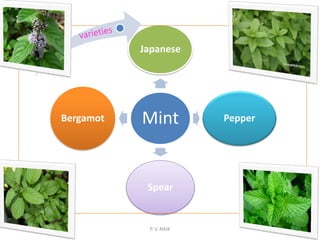
The four most commonly cultivated species are
Ø Japanese Mint/Menthol Mint (M.arvensis)
Ø Peppermint (M.piperita)
Ø Spearmint (M. spicata)
Ø Bergamot mint (M. citrata)
22 September 2015 4P. V. NAIK
Silent feature of mint crop
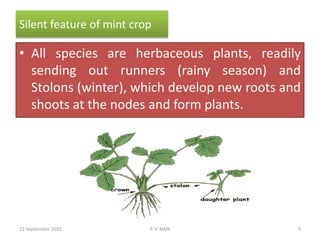
• All species are herbaceous plants, readily
sending out runners (rainy season) and
Stolons (winter), which develop new roots and
shoots at the nodes and form plants.
22 September 2015 5P. V. NAIK
• The entire aerial shoots together with foliage
is a source of essential oil rich in menthol,
Carvone, Linalool and Linanyl acetate having
use in pharmaceutical preparations and
flavour industry.
22 September 2015 6P. V. NAIK
• For the past four decades, mints are
commercially cultivated in India. Of these, the
Japanese Mint, yielding menthol is grown
extensively in northern India.
• Other major producing countries are China. USA
and Brazil and to a smaller extent Thailand and
Vietnam.
22 September 2015 7P. V. NAIK
Origin
• The cultivation of mint originated from Brazil
and China.
• Subsequently, China and India overtook Brazil
and more recently India has taken the leading
position in cultivation of this essential oil
yielding plant.
22 September 2015 8P. V. NAIK
Botanical Description
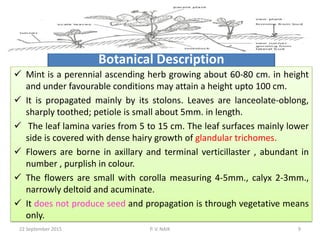
 Mint is a perennial ascending herb growing about 60-80 cm. in height
and under favourable conditions may attain a height upto 100 cm.
 It is propagated mainly by its stolons. Leaves are lanceolate-oblong,
sharply toothed; petiole is small about 5mm. in length.
 The leaf lamina varies from 5 to 15 cm. The leaf surfaces mainly lower
side is covered with dense hairy growth of glandular trichomes.
 Flowers are borne in axillary and terminal verticillaster , abundant in
number , purplish in colour.
 The flowers are small with corolla measuring 4-5mm., calyx 2-3mm.,
narrowly deltoid and acuminate.
 It does not produce seed and propagation is through vegetative means
only.
22 September 2015 9P. V. NAIK
Economic Importance
Japanese Mint (Mentha arvensis sub sp haplocalyx
var. piperascense) is an aromatic perennial herb,
grown as an annual in sub-tropical parts of north
India.
The over-ground herb (foliage) on distillation yields
an essential oil, containing high (75 – 80%) menthol
content. The oil has a bitter cooling taste, harsh
odour and is the principal source of menthol.
It is used in combating cold, used as an ingredient in
cough drops and related pharmaceuticals,
dentifrices, cosmetics, mouth washes, scenting of
tobacco products and flavouring of beverages.22 September 2015 10P. V. NAIK
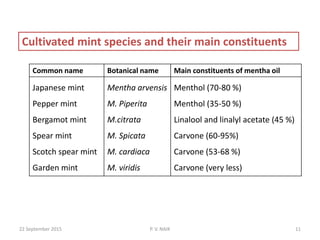
Common name Botanical name Main constituents of mentha oil
Japanese mint
Pepper mint
Bergamot mint
Spear mint
Scotch spear mint
Garden mint
Mentha arvensis
M. Piperita
M.citrata
M. Spicata
M. cardiaca
M. viridis
Menthol (70-80 %)
Menthol (35-50 %)
Linalool and linalyl acetate (45 %)
Carvone (60-95%)
Carvone (53-68 %)
Carvone (very less)
Cultivated mint species and their main constituents
22 September 2015 11P. V. NAIK
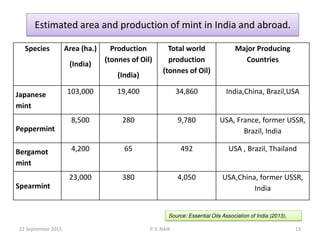
Area and Production
• At present, Japnese mint is cultivated in India on
about 103,000 ha. of land with estimated
production of 19,400 tonnes of mint oil which
accounts for about 55% of total menthol mint
production in the world.
Source: Essential Oils Association of India (2013),
22 September 2015 12P. V. NAIK
Estimated area and production of mint in India and abroad.
Species Area (ha.)
(India)
Production
(tonnes of Oil)
(India)
Total world
production
(tonnes of Oil)
Major Producing
Countries
Japanese
mint
103,000 19,400 34,860 India,China, Brazil,USA
Peppermint
8,500 280 9,780 USA, France, former USSR,
Brazil, India
Bergamot
mint
4,200 65 492 USA , Brazil, Thailand
Spearmint
23,000 380 4,050 USA,China, former USSR,
India
Source: Essential Oils Association of India (2013),
22 September 2015 13P. V. NAIK
MARKET ANALYSIS AND STRATEGY
Demand and Supply Patterns
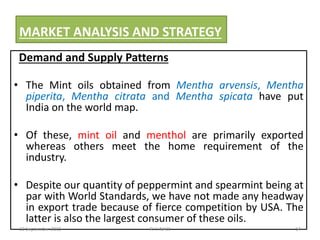
• The Mint oils obtained from Mentha arvensis, Mentha
piperita, Mentha citrata and Mentha spicata have put
India on the world map.
• Of these, mint oil and menthol are primarily exported
whereas others meet the home requirement of the
industry.
• Despite our quantity of peppermint and spearmint being at
par with World Standards, we have not made any headway
in export trade because of fierce competition by USA. The
latter is also the largest consumer of these oils.
22 September 2015 14P. V. NAIK
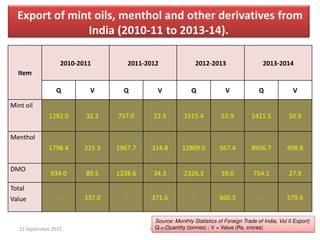
Export of mint oils, menthol and other derivatives from
India (2010-11 to 2013-14).
Item
2010-2011 2011-2012 2012-2013 2013-2014
Q V Q V Q V Q V
Mint oil
1292.0 32.2 757.0 22.5 1515.4 53.9 1421.5 50.9
Menthol
1798.4 215.3 1967.7 314.8 12809.0 567.4 8956.7 498.8
DMO
934.0 89.5 1238.6 34.3 2326.3 39.0 754.1 27.9
Total
Value - 337.0 - 371.6 - 660.3 - 579.6
Source: Monthly Statistics of Foreign Trade of India, Vol II Export)
Q = Quantity (tonnes) ; V = Value (Rs. crores)22 September 2015 P. V. NAIK
• Fluctuations in price are common. Currently it
varies between ₹.550-650/Kg for oil and
₹.900-1200/Kg for menthol (July-August and
October) but the price is also governed by
demand and price prevailing in importing
countries and speculations on volumes and
crop condition within India.
22 September 2015 16P. V. NAIK
Analysis and Future Strategy
India has attained position of primary and dominant
source of mint oil and menthol in the world market,
replacing China to a great extent due to (lower) price
structure and comparable quality.
At present, the growth in demand of oil and menthol
in world trade is slow and unless its demand rises
significantly in flavouring sector (where natural
products are preferred), there is little scope for any
major expansion in cultivation area.
22 September 2015 17P. V. NAIK
 However, because of rising input cost and expensive labour
in South China, its cultivation there could presumably shrink
and consequently Indian mint may find increasing larger
market in next several years. There can be significant
increase in area of cultivation due to this.
 The country has evolved a number of new high yielding
varieties which has helped to maintain India in a lead
position. At present, India produces 4000 – 5000 tonnes of
DMO (dementholized oil) annually which is sold at a low
price.
 This has several minor constituents which could be
fractionated and marketed at higher price. Similarly, some
low value constituents of the DMO could be synthesized into
high value end products to help industry realize better value
of the primary product.
Analysis and Future Strategy...
22 September 2015 18P. V. NAIK
 At present, Cis – 3 hexanol is fractionated from DMO
and exported at a high price. Its production started in
1994-95 and this pushed price of DMO from ₹.50 to 90
in that year itself.
 There is scope for producing L-limonene, 3–octonol,
pure menthone and isomenthone. Similarly, L-menthol,
neo-menthol, isomenthone can be converted into high
value menthol and esters of menthol, like methyl
isovalerate, menthol lactate, methyl salicylate which
fetches better price in trade.
 All this can sustain a high level of cultivation and
support export trade. The market demand for pure L-
menthol, iso-menthone, L-limonene, neo-menthol and
pinene is high.
Analysis and Future Strategy...
22 September 2015 19P. V. NAIK
22 September 2015 20P. V. NAIK
Agro-climatic Requirements
• Mint can be cultivated both in tropical and sub-tropical areas.
• The mean temperature between 20-400 C during major part of
the growing period and rainfall between 100-110 cm. (light
showers at planting stage and ample sunshine at the time of harvesting)
is ideal for its cultivation.
• Well drained loam or sandy loam soils rich in organic matter
having pH between 6 and 8.2 are ideally suited for its
cultivation.
• It can also be cultivated on both red and black soil. In case of
acidic soil having pH less than 5.5, liming is recommended.
22 September 2015 21P. V. NAIK
Mint
Japanese
Pepper
Spear
Bergamot
22 September 2015 22P. V. NAIK
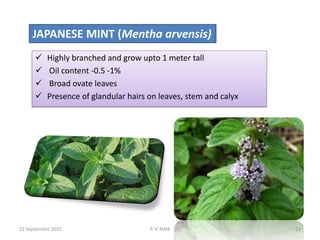
JAPANESE MINT (Mentha arvensis)
 Highly branched and grow upto 1 meter tall
 Oil content -0.5 -1%
 Broad ovate leaves
 Presence of glandular hairs on leaves, stem and calyx
22 September 2015 23P. V. NAIK
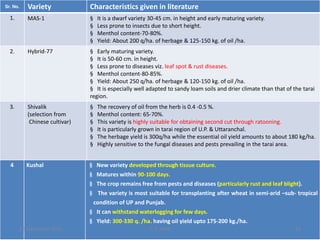
Sr. No. Variety Characteristics given in literature
1. MAS-1 § It is a dwarf variety 30-45 cm. in height and early maturing variety.
§ Less prone to insects due to short height.
§ Menthol content-70-80%.
§ Yield: About 200 q/ha. of herbage & 125-150 kg. of oil /ha.
2. Hybrid-77 § Early maturing variety.
§ It is 50-60 cm. in height.
§ Less prone to diseases viz. leaf spot & rust diseases.
§ Menthol content-80-85%.
§ Yield: About 250 q/ha. of herbage & 120-150 kg. of oil /ha.
§ It is especially well adapted to sandy loam soils and drier climate than that of the tarai
region.
3. Shivalik
(selection from
Chinese cultivar)
§ The recovery of oil from the herb is 0.4 -0.5 %.
§ Menthol content: 65-70%.
§ This variety is highly suitable for obtaining second cut through ratooning.
§ It is particularly grown in tarai region of U.P. & Uttaranchal.
§ The herbage yield is 300q/ha while the essential oil yield amounts to about 180 kg/ha.
§ Highly sensitive to the fungal diseases and pests prevailing in the tarai area.
4 Kushal § New variety developed through tissue culture.
§ Matures within 90-100 days.
§ The crop remains free from pests and diseases (particularly rust and leaf blight).
§ The variety is most suitable for transplanting after wheat in semi-arid –sub- tropical
condition of UP and Punjab.
§ It can withstand waterlogging for few days.
§ Yield: 300-330 q. /ha. having oil yield upto 175-200 kg./ha.
22 September 2015 24P. V. NAIK
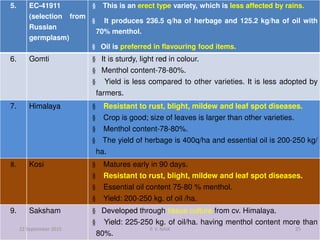
5. EC-41911
(selection from
Russian
germplasm)
§ This is an erect type variety, which is less affected by rains.
§ It produces 236.5 q/ha of herbage and 125.2 kg/ha of oil with
70% menthol.
§ Oil is preferred in flavouring food items.
6. Gomti § It is sturdy, light red in colour.
§ Menthol content-78-80%.
§ Yield is less compared to other varieties. It is less adopted by
farmers.
7. Himalaya § Resistant to rust, blight, mildew and leaf spot diseases.
§ Crop is good; size of leaves is larger than other varieties.
§ Menthol content-78-80%.
§ The yield of herbage is 400q/ha and essential oil is 200-250 kg/
ha.
8. Kosi § Matures early in 90 days.
§ Resistant to rust, blight, mildew and leaf spot diseases.
§ Essential oil content 75-80 % menthol.
§ Yield: 200-250 kg. of oil /ha.
9. Saksham § Developed through tissue culture from cv. Himalaya.
§ Yield: 225-250 kg. of oil/ha. having menthol content more than
80%.
22 September 2015 25P. V. NAIK
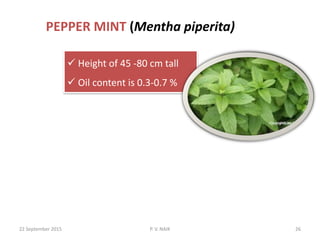
PEPPER MINT (Mentha piperita)
 Height of 45 -80 cm tall
 Oil content is 0.3-0.7 %
22 September 2015 26P. V. NAIK
3. CIM-Indus
It yields high menthoferan to meet
industrial demand in perfumery and pharma
sector (US Patent filed NF 449/2002).
4. CIM – Madhuras
• A sweet smelling genotype of peppermint.
• Used in food additives, flavors and
pharmaceutical formulations.
22 September 2015 27P. V. NAIK
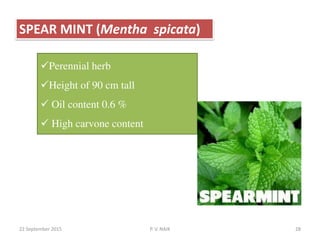
SPEAR MINT (Mentha spicata)
Perennial herb
Height of 90 cm tall
 Oil content 0.6 %
 High carvone content
22 September 2015 28P. V. NAIK
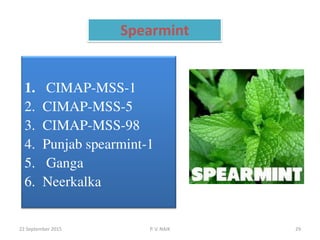
1. CIMAP-MSS-1
2. CIMAP-MSS-5
3. CIMAP-MSS-98
4. Punjab spearmint-1
5. Ganga
6. Neerkalka
22 September 2015 29P. V. NAIK
Spearmint
1. MSS-1 (released CIMAP, Lucknow)
• This is a selection from the spearmint cultivars
introduced from USA.
• It gives a fresh herbage of 535 q and yield 253
kg of oil per hectare in 3 cuttings containing
60 per cent carvone.
22 September 2015 30P. V. NAIK
2. MSS-5
• It is a selection from MSS-1 (CIMAP,
Lucknow).
• This variety has an yield potential of 600 q
fresh herb and 349 kg/ha of oil from 3 cuttings.
• The carvone percentage in the oil is 70.
22 September 2015 31P. V. NAIK
3. Punjab spearmint-1
• This variety is a clonal selection made at
CIMAP, Lucknow.
• This variety has a erect growth habit with
quadrangular purple green hairy stem.
• It produces 209 q/ha of herb having 0.57 per
cent oil and can yield 119.29 t/ha oil with 68
per cent carvone.
22 September 2015 32P. V. NAIK
4. Ganga
A multipurpose culinary variety of Mentha
spicata var. Viridis leading to number of
products like disinfectant antimicrobials (NF
135/2000 US patent filed).
5. Neerkalka
Inter-specific hybrid between Mentha
arvensis and Mentha spicata with novel oil
quality, use in oral / dental care (US Patent PP
12,030).
22 September 2015 33P. V. NAIK
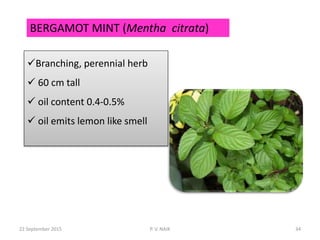
BERGAMOT MINT (Mentha citrata)
Branching, perennial herb
 60 cm tall
 oil content 0.4-0.5%
 oil emits lemon like smell
22 September 2015 34P. V. NAIK
1. Kiran
• This is a mutant selection developed by
mutation through gamma irradiation at
CIMAP, Lucknow.
• It has high quality oil content.
• This variety can yield 239 kg of oil per hectare
with 48 per cent linalool.
22 September 2015 35P. V. NAIK
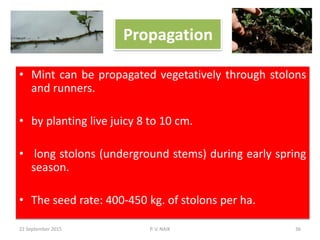
Propagation
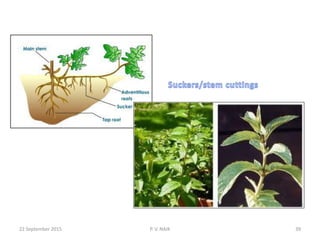
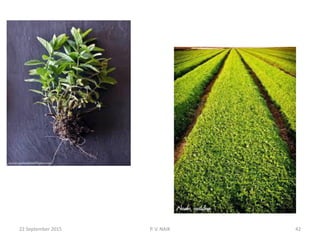
• Mint can be propagated vegetatively through stolons
and runners.
• by planting live juicy 8 to 10 cm.
• long stolons (underground stems) during early spring
season.
• The seed rate: 400-450 kg. of stolons per ha.
22 September 2015 36P. V. NAIK
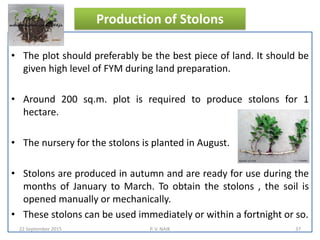
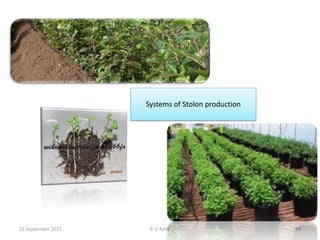
Production of Stolons
• The plot should preferably be the best piece of land. It should be
given high level of FYM during land preparation.
• Around 200 sq.m. plot is required to produce stolons for 1
hectare.
• The nursery for the stolons is planted in August.
• Stolons are produced in autumn and are ready for use during the
months of January to March. To obtain the stolons , the soil is
opened manually or mechanically.
• These stolons can be used immediately or within a fortnight or so.
22 September 2015 37P. V. NAIK
22 September 2015 P. V. NAIK 38
Systems of Stolon production
22 September 2015 P. V. NAIK 39
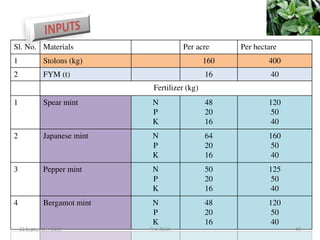
Sl. No. Materials Per acre Per hectare
1 Stolons (kg) 160 400
2 FYM (t) 16 40
Fertilizer (kg)
1 Spear mint N
P
K
48
20
16
120
50
40
2 Japanese mint N
P
K
64
20
16
160
50
40
3 Pepper mint N
P
K
50
20
16
125
50
40
4 Bergamot mint N
P
K
48
20
16
120
50
40
22 September 2015 40P. V. NAIK
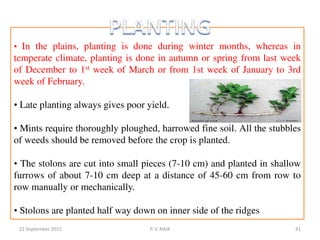
• In the plains, planting is done during winter months, whereas in
temperate climate, planting is done in autumn or spring from last week
of December to 1st week of March or from 1st week of January to 3rd
week of February.
• Late planting always gives poor yield.
• Mints require thoroughly ploughed, harrowed fine soil. All the stubbles
of weeds should be removed before the crop is planted.
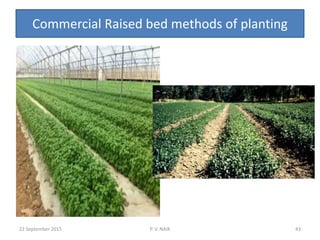
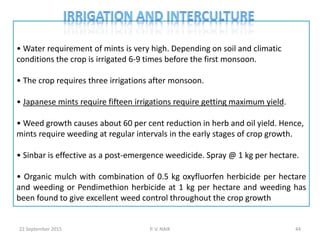
• The stolons are cut into small pieces (7-10 cm) and planted in shallow
furrows of about 7-10 cm deep at a distance of 45-60 cm from row to
row manually or mechanically.
• Stolons are planted half way down on inner side of the ridges
22 September 2015 41P. V. NAIK
22 September 2015 P. V. NAIK 42
Commercial Raised bed methods of planting
22 September 2015 P. V. NAIK 43
• Water requirement of mints is very high. Depending on soil and climatic
conditions the crop is irrigated 6-9 times before the first monsoon.
• The crop requires three irrigations after monsoon.
• Japanese mints require fifteen irrigations require getting maximum yield.
• Weed growth causes about 60 per cent reduction in herb and oil yield. Hence,
mints require weeding at regular intervals in the early stages of crop growth.
• Sinbar is effective as a post-emergence weedicide. Spray @ 1 kg per hectare.
• Organic mulch with combination of 0.5 kg oxyfluorfen herbicide per hectare
and weeding or Pendimethion herbicide at 1 kg per hectare and weeding has
been found to give excellent weed control throughout the crop growth
22 September 2015 44P. V. NAIK
Crop Rotation
 The rotation of mint crop with other food crops is
found to be a good way of controlling weeds.
Continuous cropping of any of the mints is not
advisable.
 The best rotation is Mint : Rice and Mint : Potatoes
and Mint : Vegetables : Peas etc. depending upon
cropping system followed in the region
22 September 2015 45P. V. NAIK
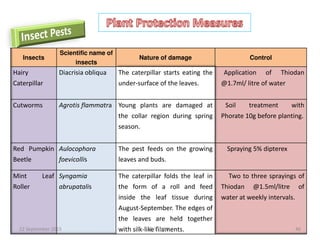
Insects
Scientific name of
insects
Nature of damage Control
Hairy
Caterpillar
Diacrisia obliqua The caterpillar starts eating the
under-surface of the leaves.
Application of Thiodan
@1.7ml/ litre of water
Cutworms Agrotis flammatra Young plants are damaged at
the collar region during spring
season.
Soil treatment with
Phorate 10g before planting.
Red Pumpkin
Beetle
Aulocophora
foevicollis
The pest feeds on the growing
leaves and buds.
Spraying 5% dipterex
Mint Leaf
Roller
Syngamia
abrupatalis
The caterpillar folds the leaf in
the form of a roll and feed
inside the leaf tissue during
August-September. The edges of
the leaves are held together
with silk-like filaments.
Two to three sprayings of
Thiodan @1.5ml/litre of
water at weekly intervals.
22 September 2015 46P. V. NAIK
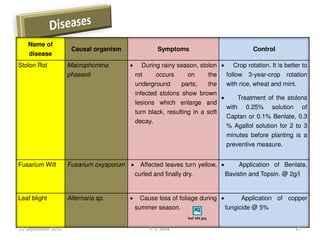
Name of
disease
Causal organism Symptoms Control
Stolon Rot Macrophomina
phaseoli
 During rainy season, stolon
rot occurs on the
underground parts; the
infected stolons show brown
lesions which enlarge and
turn black, resulting in a soft
decay.
 Crop rotation. It is better to
follow 3-year-crop rotation
with rice, wheat and mint.
 Treatment of the stolons
with 0.25% solution of
Captan or 0.1% Benlate, 0.3
% Agallol solution for 2 to 3
minutes before planting is a
preventive measure.
Fusarium Wilt Fusarium oxysporum  Affected leaves turn yellow,
curled and finally dry.
 Application of Benlate,
Bavistin and Topsin. @ 2g/l
Leaf blight Alternaria sp.  Cause loss of foliage during
summer season.
 Application of copper
fungicide @ 5%
22 September 2015 47P. V. NAIK
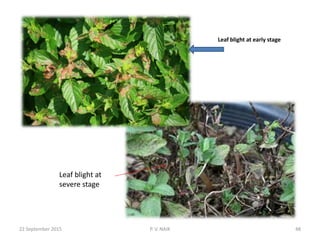
Leaf blight at early stage
22 September 2015 P. V. NAIK 48
Leaf blight at
severe stage
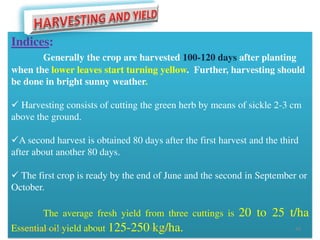
Indices:
Generally the crop are harvested 100-120 days after planting
when the lower leaves start turning yellow. Further, harvesting should
be done in bright sunny weather.
 Harvesting consists of cutting the green herb by means of sickle 2-3 cm
above the ground.
A second harvest is obtained 80 days after the first harvest and the third
after about another 80 days.
 The first crop is ready by the end of June and the second in September or
October.
The average fresh yield from three cuttings is 20 to 25 t/ha
Essential oil yield about 125-250 kg/ha.22 September 2015 49P. V. NAIK
22 September 2015 P. V. NAIK 50
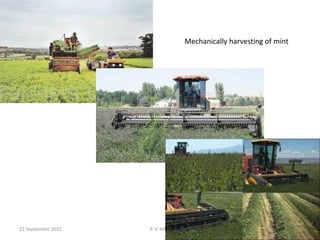
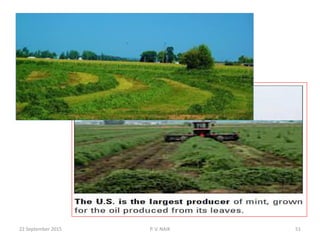
Mechanically harvesting of mint
22 September 2015 51P. V. NAIK
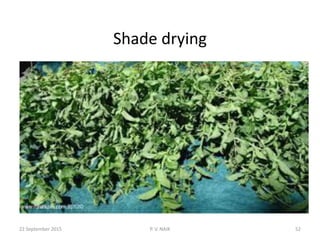
Shade drying
22 September 2015 P. V. NAIK 52
22 September 2015 P. V. NAIK 53
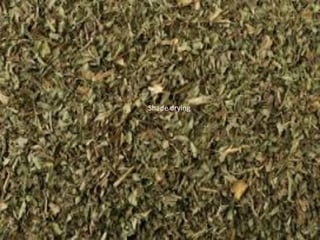
Shade drying
o Harvested herb may be wilted in shade for a few hours
o Both fresh and dry herb used for distillation
o To get better result herbage should be shade dried for a
day before it is distilled
o Steam distillation usually preferred and duration of
distillation is 1.5-2 hours
o Impurities present in oil can removed by filtration
o Moisture present in oil can be removed by application
of anhydrous sodium sulphate
o GI or aluminium containers are suitable for long time
storage
EXTRACTION AND UTILIZATION
22 September 2015 54P. V. NAIK
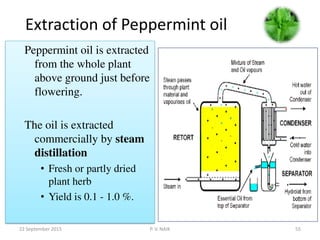
Extraction of Peppermint oil
Peppermint oil is extracted
from the whole plant
above ground just before
flowering.
The oil is extracted
commercially by steam
distillation
• Fresh or partly dried
plant herb
• Yield is 0.1 - 1.0 %.
22 September 2015 55P. V. NAIK
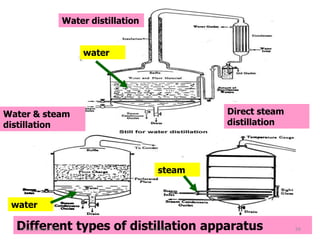
Different types of distillation apparatus
Water distillation
Direct steam
distillation
Water & steam
distillation
steam
water
water
22 September 2015 56P. V. NAIK
Steam distillation
22 September 2015 57P. V. NAIK
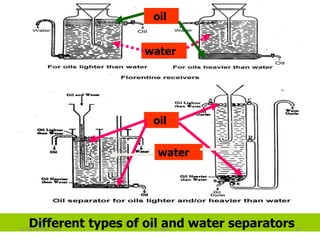
Different types of oil and water separators
water
oil
water
oil
22 September 2015 58P. V. NAIK
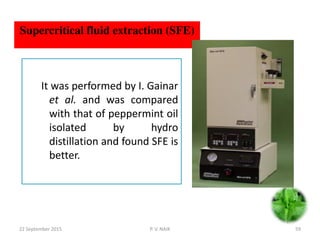
It was performed by I. Gainar
et al. and was compared
with that of peppermint oil
isolated by hydro
distillation and found SFE is
better.
22 September 2015 59P. V. NAIK
Supercritical fluid extraction (SFE)
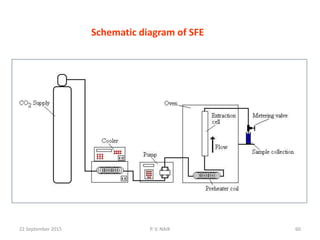
Schematic diagram of SFE
22 September 2015 60P. V. NAIK
Microwave extraction
• The process is based on heat generated by ionic
conduction and/ or dipole rotation, and its efficiency
depends on the dielectric properties of the material.
• The extraction occurs when the water inside the plant
absorbs energy coming from the microwaves and
increases the pressure inside the material causing the
cell structure to break allowing the solvent to
penetrate into the matrix (Wang and Weller, 2006;
Chan et al., 2011; Eskilsson and Björklund, 2000;
Routray and Orsat, 2012).
22 September 2015 P. V. NAIK 61
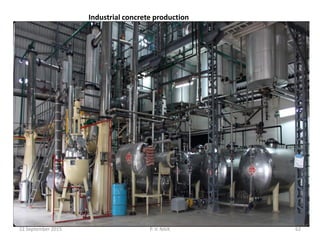
Industrial concrete production
22 September 2015 62P. V. NAIK
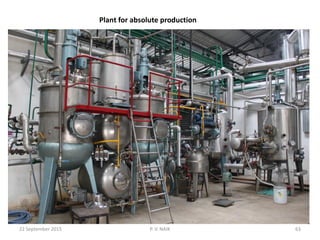
Plant for absolute production
22 September 2015 63P. V. NAIK
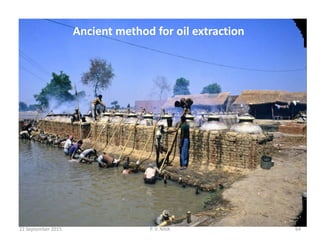
Ancient method for oil extraction
22 September 2015 64P. V. NAIK
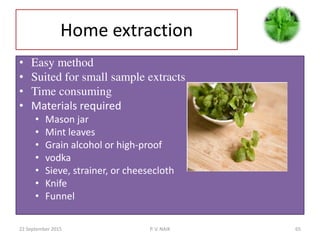
Home extraction
• Easy method
• Suited for small sample extracts
• Time consuming
• Materials required
• Mason jar
• Mint leaves
• Grain alcohol or high-proof
• vodka
• Sieve, strainer, or cheesecloth
• Knife
• Funnel
22 September 2015 65P. V. NAIK
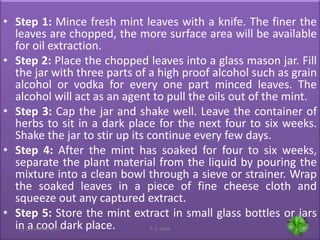
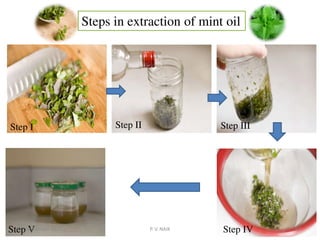
• Step 1: Mince fresh mint leaves with a knife. The finer the
leaves are chopped, the more surface area will be available
for oil extraction.
• Step 2: Place the chopped leaves into a glass mason jar. Fill
the jar with three parts of a high proof alcohol such as grain
alcohol or vodka for every one part minced leaves. The
alcohol will act as an agent to pull the oils out of the mint.
• Step 3: Cap the jar and shake well. Leave the container of
herbs to sit in a dark place for the next four to six weeks.
Shake the jar to stir up its continue every few days.
• Step 4: After the mint has soaked for four to six weeks,
separate the plant material from the liquid by pouring the
mixture into a clean bowl through a sieve or strainer. Wrap
the soaked leaves in a piece of fine cheese cloth and
squeeze out any captured extract.
• Step 5: Store the mint extract in small glass bottles or jars
in a cool dark place. 6622 September 2015 P. V. NAIK
Steps in extraction of mint oil
Step I Step II Step III
Step IVStep V 6722 September 2015 P. V. NAIK
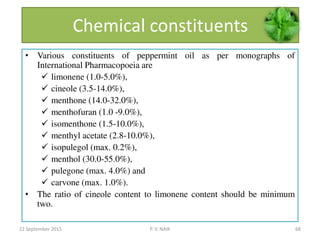
Chemical constituents
• Various constituents of peppermint oil as per monographs of
International Pharmacopoeia are
 limonene (1.0-5.0%),
 cineole (3.5-14.0%),
 menthone (14.0-32.0%),
 menthofuran (1.0 -9.0%),
 isomenthone (1.5-10.0%),
 menthyl acetate (2.8-10.0%),
 isopulegol (max. 0.2%),
 menthol (30.0-55.0%),
 pulegone (max. 4.0%) and
 carvone (max. 1.0%).
• The ratio of cineole content to limonene content should be minimum
two.
22 September 2015 68P. V. NAIK
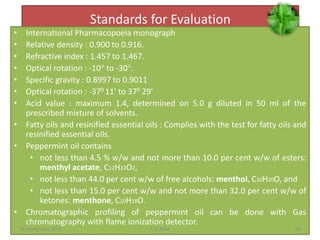
Standards for Evaluation
• International Pharmacopoeia monograph
• Relative density : 0.900 to 0.916.
• Refractive index : 1.457 to 1.467.
• Optical rotation : -10° to -30°.
• Specific gravity : 0.8997 to 0.9011
• Optical rotation : -370 11’ to 370 29’
• Acid value : maximum 1.4, determined on 5.0 g diluted in 50 ml of the
prescribed mixture of solvents.
• Fatty oils and resinified essential oils : Complies with the test for fatty oils and
resinified essential oils.
• Peppermint oil contains
• not less than 4.5 % w/w and not more than 10.0 per cent w/w of esters:
menthyl acetate, C12H22O2,
• not less than 44.0 per cent w/w of free alcohols: menthol, C10H20O, and
• not less than 15.0 per cent w/w and not more than 32.0 per cent w/w of
ketones: menthone, C10H18O.
• Chromatographic profiling of peppermint oil can be done with Gas
chromatography with flame ionization detector.
22 September 2015 69P. V. NAIK
Adultration
• Peppermint oil can be adulterated by addition of
much cheaper cornmint oil (Mentha arvensis).
• Peppermint oil blends well with: Although most
essential oils blend well with one another,
peppermint oil blends particularly well with
benzoic, eucalyptus, lavender, marjoram, lemon
and rosemary.
• Synthetic analogues of menthol can be prepared
in the labs
22 September 2015 70P. V. NAIK
Storage
Store in well-filled, tightly-closed, light-resistant
containers in a cool place.
Good quality PVC drum with screw caps: Short
term storage.
Galvanized iron drums or aluminium containers:
Long term storage.
22 September 2015 71P. V. NAIK
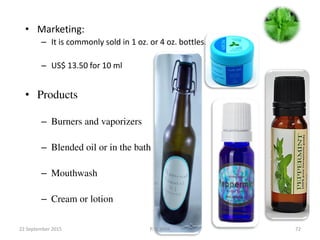
• Marketing:
– It is commonly sold in 1 oz. or 4 oz. bottles.
– US$ 13.50 for 10 ml
• Products
– Burners and vaporizers
– Blended oil or in the bath
– Mouthwash
– Cream or lotion
22 September 2015 P. V. NAIK 72
22 September 2015 73P. V. NAIK
22 September 2015 74P. V. NAIK
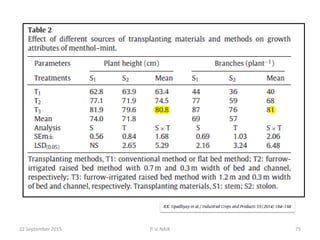
22 September 2015 P. V. NAIK 75
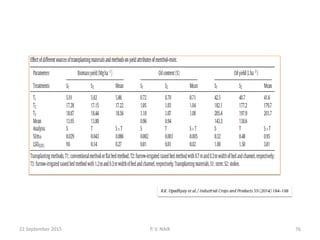
22 September 2015 76P. V. NAIK
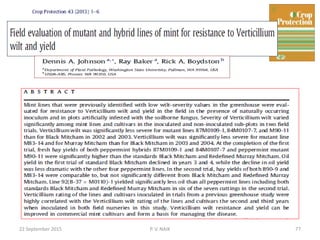
22 September 2015 77P. V. NAIK
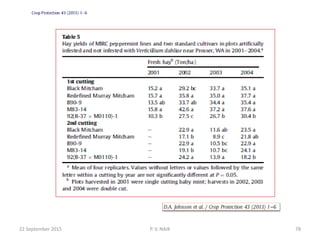
22 September 2015 78P. V. NAIK
22 September 2015 79P. V. NAIK
22 September 2015 80P. V. NAIK
22 September 2015 81P. V. NAIK
22 September 2015 82P. V. NAIK
22 September 2015 83P. V. NAIK
22 September 2015 84P. V. NAIK
22 September 2015 85P. V. NAIK
22 September 2015 86P. V. NAIK
22 September 2015 87P. V. NAIK
22 September 2015 88P. V. NAIK
22 September 2015 89P. V. NAIK
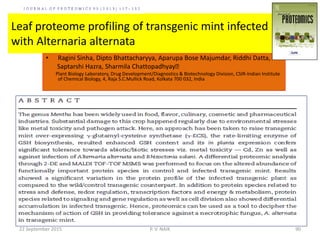
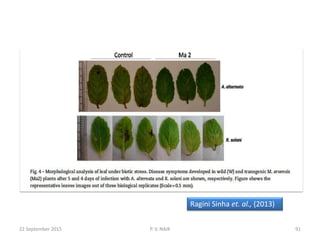
Leaf proteome profiling of transgenic mint infected
with Alternaria alternata
• Ragini Sinha, Dipto Bhattacharyya, Aparupa Bose Majumdar, Riddhi Datta,
Saptarshi Hazra, Sharmila Chattopadhyay฀
Plant Biology Laboratory, Drug Development/Diagnostics & Biotechnology Division, CSIR-Indian Institute
of Chemical Biology, 4, Raja S.C.Mullick Road, Kolkata 700 032, India
22 September 2015 90P. V. NAIK
Ragini Sinha et. al., (2013)
22 September 2015 91P. V. NAIK
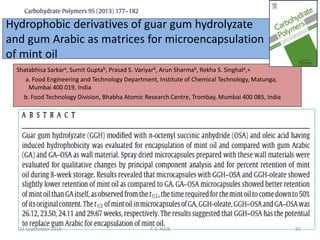
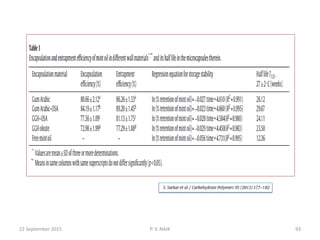
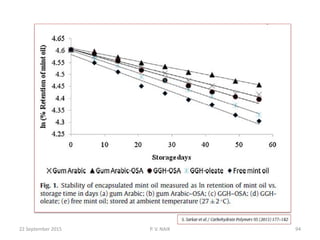
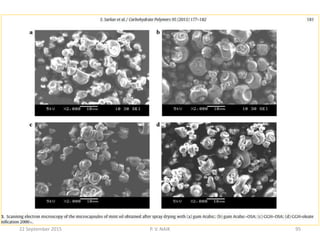
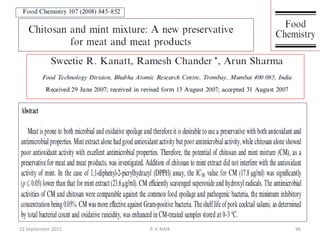
Hydrophobic derivatives of guar gum hydrolyzate
and gum Arabic as matrices for microencapsulation
of mint oil
Shatabhisa Sarkara, Sumit Guptab, Prasad S. Variyarb, Arun Sharmab, Rekha S. Singhala,∗
a. Food Engineering and Technology Department, Institute of Chemical Technology, Matunga,
Mumbai 400 019, India
b. Food Technology Division, Bhabha Atomic Research Centre, Trombay, Mumbai 400 085, India
22 September 2015 92P. V. NAIK
22 September 2015 93P. V. NAIK
22 September 2015 94P. V. NAIK
22 September 2015 95P. V. NAIK
22 September 2015 96P. V. NAIK
22 September 2015 97P. V. NAIK
22 September 2015 98P. V. NAIK
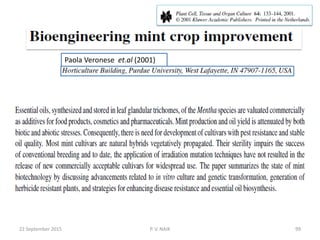
Paola Veronese et.al (2001)
22 September 2015 99P. V. NAIK
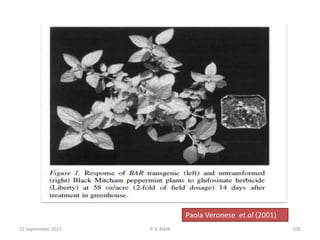
Paola Veronese et.al (2001)
22 September 2015 100P. V. NAIK
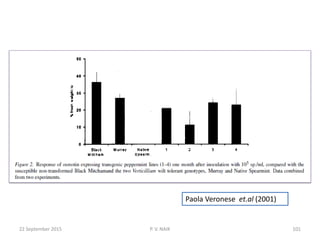
Paola Veronese et.al (2001)
22 September 2015 101P. V. NAIK
22 September 2015 102P. V. NAIK
22 September 2015 103P. V. NAIK
22 September 2015 104P. V. NAIK
22 September 2015 P. V. NAIK 105
SOURCES OF INFORMATION
• Central Institute of Medicinal and Aromatic Plants,
Lucknow
• G. B. Pant University of Agriculture & Technology, Pant
Nagar – 263 145, District – Udham Singh Nagar,
Uttaranchal
• National Medicinal Plants Board, New
• Indian Horticulture Research Institute, Bangaluru.
22 September 2015 106P. V. NAIK
1. Dr. K Umesh, Professor of PMA, College of
Horticulture, Bangaluru.
2. Dr. Himabindu, Principle Scientiest, IIHR, Bangaluru
3. Dr V.K Rao, Principle Scientiest, IIHR, Bangaluru
4. Mr. Mahanthesh jogi P.hD (Hort) scholar.,
5. Mr. Udachappa pujare P.hD (Hort) scholar.,
6. Mr. saidulu, P.hD (Hort) scholar.,
7. www.google.com.
22 September 2015 107P. V. NAIK
22 September 2015 P. V. NAIK 108

Mint ppt

  • 1.
    Advances in productiontechnology OF P. VASUDEV NAIK Assistant professor & Ph D scholar (Hort) By 22 September 2015 P. V. NAIK
  • 2.
     Botanical name: Mentha spp. Family : Labiatae(Lamiaceae)  English name : Mint  Indian name : Pudina, Putiha (Sanskrit)  Pudina (Hindi & Kannada)  Putina (Tamil)  Podina (Telugu) 22 September 2015 2P. V. NAIK
  • 3.
    • Genus Menthathere are several commercially grown species, varying in their major chemical content, aroma and end use. Their oils and derived aroma compounds are traded world- wide. 22 September 2015 3P. V. NAIK
  • 4.
    The four mostcommonly cultivated species are Ø Japanese Mint/Menthol Mint (M.arvensis) Ø Peppermint (M.piperita) Ø Spearmint (M. spicata) Ø Bergamot mint (M. citrata) 22 September 2015 4P. V. NAIK
  • 5.
    Silent feature ofmint crop • All species are herbaceous plants, readily sending out runners (rainy season) and Stolons (winter), which develop new roots and shoots at the nodes and form plants. 22 September 2015 5P. V. NAIK
  • 6.
    • The entireaerial shoots together with foliage is a source of essential oil rich in menthol, Carvone, Linalool and Linanyl acetate having use in pharmaceutical preparations and flavour industry. 22 September 2015 6P. V. NAIK
  • 7.
    • For thepast four decades, mints are commercially cultivated in India. Of these, the Japanese Mint, yielding menthol is grown extensively in northern India. • Other major producing countries are China. USA and Brazil and to a smaller extent Thailand and Vietnam. 22 September 2015 7P. V. NAIK
  • 8.
    Origin • The cultivationof mint originated from Brazil and China. • Subsequently, China and India overtook Brazil and more recently India has taken the leading position in cultivation of this essential oil yielding plant. 22 September 2015 8P. V. NAIK
  • 9.
    Botanical Description  Mintis a perennial ascending herb growing about 60-80 cm. in height and under favourable conditions may attain a height upto 100 cm.  It is propagated mainly by its stolons. Leaves are lanceolate-oblong, sharply toothed; petiole is small about 5mm. in length.  The leaf lamina varies from 5 to 15 cm. The leaf surfaces mainly lower side is covered with dense hairy growth of glandular trichomes.  Flowers are borne in axillary and terminal verticillaster , abundant in number , purplish in colour.  The flowers are small with corolla measuring 4-5mm., calyx 2-3mm., narrowly deltoid and acuminate.  It does not produce seed and propagation is through vegetative means only. 22 September 2015 9P. V. NAIK
  • 10.
    Economic Importance Japanese Mint(Mentha arvensis sub sp haplocalyx var. piperascense) is an aromatic perennial herb, grown as an annual in sub-tropical parts of north India. The over-ground herb (foliage) on distillation yields an essential oil, containing high (75 – 80%) menthol content. The oil has a bitter cooling taste, harsh odour and is the principal source of menthol. It is used in combating cold, used as an ingredient in cough drops and related pharmaceuticals, dentifrices, cosmetics, mouth washes, scenting of tobacco products and flavouring of beverages.22 September 2015 10P. V. NAIK
  • 11.
    Common name Botanicalname Main constituents of mentha oil Japanese mint Pepper mint Bergamot mint Spear mint Scotch spear mint Garden mint Mentha arvensis M. Piperita M.citrata M. Spicata M. cardiaca M. viridis Menthol (70-80 %) Menthol (35-50 %) Linalool and linalyl acetate (45 %) Carvone (60-95%) Carvone (53-68 %) Carvone (very less) Cultivated mint species and their main constituents 22 September 2015 11P. V. NAIK
  • 12.
    Area and Production •At present, Japnese mint is cultivated in India on about 103,000 ha. of land with estimated production of 19,400 tonnes of mint oil which accounts for about 55% of total menthol mint production in the world. Source: Essential Oils Association of India (2013), 22 September 2015 12P. V. NAIK
  • 13.
    Estimated area andproduction of mint in India and abroad. Species Area (ha.) (India) Production (tonnes of Oil) (India) Total world production (tonnes of Oil) Major Producing Countries Japanese mint 103,000 19,400 34,860 India,China, Brazil,USA Peppermint 8,500 280 9,780 USA, France, former USSR, Brazil, India Bergamot mint 4,200 65 492 USA , Brazil, Thailand Spearmint 23,000 380 4,050 USA,China, former USSR, India Source: Essential Oils Association of India (2013), 22 September 2015 13P. V. NAIK
  • 14.
    MARKET ANALYSIS ANDSTRATEGY Demand and Supply Patterns • The Mint oils obtained from Mentha arvensis, Mentha piperita, Mentha citrata and Mentha spicata have put India on the world map. • Of these, mint oil and menthol are primarily exported whereas others meet the home requirement of the industry. • Despite our quantity of peppermint and spearmint being at par with World Standards, we have not made any headway in export trade because of fierce competition by USA. The latter is also the largest consumer of these oils. 22 September 2015 14P. V. NAIK
  • 15.
    Export of mintoils, menthol and other derivatives from India (2010-11 to 2013-14). Item 2010-2011 2011-2012 2012-2013 2013-2014 Q V Q V Q V Q V Mint oil 1292.0 32.2 757.0 22.5 1515.4 53.9 1421.5 50.9 Menthol 1798.4 215.3 1967.7 314.8 12809.0 567.4 8956.7 498.8 DMO 934.0 89.5 1238.6 34.3 2326.3 39.0 754.1 27.9 Total Value - 337.0 - 371.6 - 660.3 - 579.6 Source: Monthly Statistics of Foreign Trade of India, Vol II Export) Q = Quantity (tonnes) ; V = Value (Rs. crores)22 September 2015 P. V. NAIK
  • 16.
    • Fluctuations inprice are common. Currently it varies between ₹.550-650/Kg for oil and ₹.900-1200/Kg for menthol (July-August and October) but the price is also governed by demand and price prevailing in importing countries and speculations on volumes and crop condition within India. 22 September 2015 16P. V. NAIK
  • 17.
    Analysis and FutureStrategy India has attained position of primary and dominant source of mint oil and menthol in the world market, replacing China to a great extent due to (lower) price structure and comparable quality. At present, the growth in demand of oil and menthol in world trade is slow and unless its demand rises significantly in flavouring sector (where natural products are preferred), there is little scope for any major expansion in cultivation area. 22 September 2015 17P. V. NAIK
  • 18.
     However, becauseof rising input cost and expensive labour in South China, its cultivation there could presumably shrink and consequently Indian mint may find increasing larger market in next several years. There can be significant increase in area of cultivation due to this.  The country has evolved a number of new high yielding varieties which has helped to maintain India in a lead position. At present, India produces 4000 – 5000 tonnes of DMO (dementholized oil) annually which is sold at a low price.  This has several minor constituents which could be fractionated and marketed at higher price. Similarly, some low value constituents of the DMO could be synthesized into high value end products to help industry realize better value of the primary product. Analysis and Future Strategy... 22 September 2015 18P. V. NAIK
  • 19.
     At present,Cis – 3 hexanol is fractionated from DMO and exported at a high price. Its production started in 1994-95 and this pushed price of DMO from ₹.50 to 90 in that year itself.  There is scope for producing L-limonene, 3–octonol, pure menthone and isomenthone. Similarly, L-menthol, neo-menthol, isomenthone can be converted into high value menthol and esters of menthol, like methyl isovalerate, menthol lactate, methyl salicylate which fetches better price in trade.  All this can sustain a high level of cultivation and support export trade. The market demand for pure L- menthol, iso-menthone, L-limonene, neo-menthol and pinene is high. Analysis and Future Strategy... 22 September 2015 19P. V. NAIK
  • 20.
    22 September 201520P. V. NAIK
  • 21.
    Agro-climatic Requirements • Mintcan be cultivated both in tropical and sub-tropical areas. • The mean temperature between 20-400 C during major part of the growing period and rainfall between 100-110 cm. (light showers at planting stage and ample sunshine at the time of harvesting) is ideal for its cultivation. • Well drained loam or sandy loam soils rich in organic matter having pH between 6 and 8.2 are ideally suited for its cultivation. • It can also be cultivated on both red and black soil. In case of acidic soil having pH less than 5.5, liming is recommended. 22 September 2015 21P. V. NAIK
  • 22.
  • 23.
    JAPANESE MINT (Menthaarvensis)  Highly branched and grow upto 1 meter tall  Oil content -0.5 -1%  Broad ovate leaves  Presence of glandular hairs on leaves, stem and calyx 22 September 2015 23P. V. NAIK
  • 24.
    Sr. No. VarietyCharacteristics given in literature 1. MAS-1 § It is a dwarf variety 30-45 cm. in height and early maturing variety. § Less prone to insects due to short height. § Menthol content-70-80%. § Yield: About 200 q/ha. of herbage & 125-150 kg. of oil /ha. 2. Hybrid-77 § Early maturing variety. § It is 50-60 cm. in height. § Less prone to diseases viz. leaf spot & rust diseases. § Menthol content-80-85%. § Yield: About 250 q/ha. of herbage & 120-150 kg. of oil /ha. § It is especially well adapted to sandy loam soils and drier climate than that of the tarai region. 3. Shivalik (selection from Chinese cultivar) § The recovery of oil from the herb is 0.4 -0.5 %. § Menthol content: 65-70%. § This variety is highly suitable for obtaining second cut through ratooning. § It is particularly grown in tarai region of U.P. & Uttaranchal. § The herbage yield is 300q/ha while the essential oil yield amounts to about 180 kg/ha. § Highly sensitive to the fungal diseases and pests prevailing in the tarai area. 4 Kushal § New variety developed through tissue culture. § Matures within 90-100 days. § The crop remains free from pests and diseases (particularly rust and leaf blight). § The variety is most suitable for transplanting after wheat in semi-arid –sub- tropical condition of UP and Punjab. § It can withstand waterlogging for few days. § Yield: 300-330 q. /ha. having oil yield upto 175-200 kg./ha. 22 September 2015 24P. V. NAIK
  • 25.
    5. EC-41911 (selection from Russian germplasm) §This is an erect type variety, which is less affected by rains. § It produces 236.5 q/ha of herbage and 125.2 kg/ha of oil with 70% menthol. § Oil is preferred in flavouring food items. 6. Gomti § It is sturdy, light red in colour. § Menthol content-78-80%. § Yield is less compared to other varieties. It is less adopted by farmers. 7. Himalaya § Resistant to rust, blight, mildew and leaf spot diseases. § Crop is good; size of leaves is larger than other varieties. § Menthol content-78-80%. § The yield of herbage is 400q/ha and essential oil is 200-250 kg/ ha. 8. Kosi § Matures early in 90 days. § Resistant to rust, blight, mildew and leaf spot diseases. § Essential oil content 75-80 % menthol. § Yield: 200-250 kg. of oil /ha. 9. Saksham § Developed through tissue culture from cv. Himalaya. § Yield: 225-250 kg. of oil/ha. having menthol content more than 80%. 22 September 2015 25P. V. NAIK
  • 26.
    PEPPER MINT (Menthapiperita)  Height of 45 -80 cm tall  Oil content is 0.3-0.7 % 22 September 2015 26P. V. NAIK
  • 27.
    3. CIM-Indus It yieldshigh menthoferan to meet industrial demand in perfumery and pharma sector (US Patent filed NF 449/2002). 4. CIM – Madhuras • A sweet smelling genotype of peppermint. • Used in food additives, flavors and pharmaceutical formulations. 22 September 2015 27P. V. NAIK
  • 28.
    SPEAR MINT (Menthaspicata) Perennial herb Height of 90 cm tall  Oil content 0.6 %  High carvone content 22 September 2015 28P. V. NAIK
  • 29.
    1. CIMAP-MSS-1 2. CIMAP-MSS-5 3.CIMAP-MSS-98 4. Punjab spearmint-1 5. Ganga 6. Neerkalka 22 September 2015 29P. V. NAIK Spearmint
  • 30.
    1. MSS-1 (releasedCIMAP, Lucknow) • This is a selection from the spearmint cultivars introduced from USA. • It gives a fresh herbage of 535 q and yield 253 kg of oil per hectare in 3 cuttings containing 60 per cent carvone. 22 September 2015 30P. V. NAIK
  • 31.
    2. MSS-5 • Itis a selection from MSS-1 (CIMAP, Lucknow). • This variety has an yield potential of 600 q fresh herb and 349 kg/ha of oil from 3 cuttings. • The carvone percentage in the oil is 70. 22 September 2015 31P. V. NAIK
  • 32.
    3. Punjab spearmint-1 •This variety is a clonal selection made at CIMAP, Lucknow. • This variety has a erect growth habit with quadrangular purple green hairy stem. • It produces 209 q/ha of herb having 0.57 per cent oil and can yield 119.29 t/ha oil with 68 per cent carvone. 22 September 2015 32P. V. NAIK
  • 33.
    4. Ganga A multipurposeculinary variety of Mentha spicata var. Viridis leading to number of products like disinfectant antimicrobials (NF 135/2000 US patent filed). 5. Neerkalka Inter-specific hybrid between Mentha arvensis and Mentha spicata with novel oil quality, use in oral / dental care (US Patent PP 12,030). 22 September 2015 33P. V. NAIK
  • 34.
    BERGAMOT MINT (Menthacitrata) Branching, perennial herb  60 cm tall  oil content 0.4-0.5%  oil emits lemon like smell 22 September 2015 34P. V. NAIK
  • 35.
    1. Kiran • Thisis a mutant selection developed by mutation through gamma irradiation at CIMAP, Lucknow. • It has high quality oil content. • This variety can yield 239 kg of oil per hectare with 48 per cent linalool. 22 September 2015 35P. V. NAIK
  • 36.
    Propagation • Mint canbe propagated vegetatively through stolons and runners. • by planting live juicy 8 to 10 cm. • long stolons (underground stems) during early spring season. • The seed rate: 400-450 kg. of stolons per ha. 22 September 2015 36P. V. NAIK
  • 37.
    Production of Stolons •The plot should preferably be the best piece of land. It should be given high level of FYM during land preparation. • Around 200 sq.m. plot is required to produce stolons for 1 hectare. • The nursery for the stolons is planted in August. • Stolons are produced in autumn and are ready for use during the months of January to March. To obtain the stolons , the soil is opened manually or mechanically. • These stolons can be used immediately or within a fortnight or so. 22 September 2015 37P. V. NAIK
  • 38.
    22 September 2015P. V. NAIK 38 Systems of Stolon production
  • 39.
    22 September 2015P. V. NAIK 39
  • 40.
    Sl. No. MaterialsPer acre Per hectare 1 Stolons (kg) 160 400 2 FYM (t) 16 40 Fertilizer (kg) 1 Spear mint N P K 48 20 16 120 50 40 2 Japanese mint N P K 64 20 16 160 50 40 3 Pepper mint N P K 50 20 16 125 50 40 4 Bergamot mint N P K 48 20 16 120 50 40 22 September 2015 40P. V. NAIK
  • 41.
    • In theplains, planting is done during winter months, whereas in temperate climate, planting is done in autumn or spring from last week of December to 1st week of March or from 1st week of January to 3rd week of February. • Late planting always gives poor yield. • Mints require thoroughly ploughed, harrowed fine soil. All the stubbles of weeds should be removed before the crop is planted. • The stolons are cut into small pieces (7-10 cm) and planted in shallow furrows of about 7-10 cm deep at a distance of 45-60 cm from row to row manually or mechanically. • Stolons are planted half way down on inner side of the ridges 22 September 2015 41P. V. NAIK
  • 42.
    22 September 2015P. V. NAIK 42
  • 43.
    Commercial Raised bedmethods of planting 22 September 2015 P. V. NAIK 43
  • 44.
    • Water requirementof mints is very high. Depending on soil and climatic conditions the crop is irrigated 6-9 times before the first monsoon. • The crop requires three irrigations after monsoon. • Japanese mints require fifteen irrigations require getting maximum yield. • Weed growth causes about 60 per cent reduction in herb and oil yield. Hence, mints require weeding at regular intervals in the early stages of crop growth. • Sinbar is effective as a post-emergence weedicide. Spray @ 1 kg per hectare. • Organic mulch with combination of 0.5 kg oxyfluorfen herbicide per hectare and weeding or Pendimethion herbicide at 1 kg per hectare and weeding has been found to give excellent weed control throughout the crop growth 22 September 2015 44P. V. NAIK
  • 45.
    Crop Rotation  Therotation of mint crop with other food crops is found to be a good way of controlling weeds. Continuous cropping of any of the mints is not advisable.  The best rotation is Mint : Rice and Mint : Potatoes and Mint : Vegetables : Peas etc. depending upon cropping system followed in the region 22 September 2015 45P. V. NAIK
  • 46.
    Insects Scientific name of insects Natureof damage Control Hairy Caterpillar Diacrisia obliqua The caterpillar starts eating the under-surface of the leaves. Application of Thiodan @1.7ml/ litre of water Cutworms Agrotis flammatra Young plants are damaged at the collar region during spring season. Soil treatment with Phorate 10g before planting. Red Pumpkin Beetle Aulocophora foevicollis The pest feeds on the growing leaves and buds. Spraying 5% dipterex Mint Leaf Roller Syngamia abrupatalis The caterpillar folds the leaf in the form of a roll and feed inside the leaf tissue during August-September. The edges of the leaves are held together with silk-like filaments. Two to three sprayings of Thiodan @1.5ml/litre of water at weekly intervals. 22 September 2015 46P. V. NAIK
  • 47.
    Name of disease Causal organismSymptoms Control Stolon Rot Macrophomina phaseoli  During rainy season, stolon rot occurs on the underground parts; the infected stolons show brown lesions which enlarge and turn black, resulting in a soft decay.  Crop rotation. It is better to follow 3-year-crop rotation with rice, wheat and mint.  Treatment of the stolons with 0.25% solution of Captan or 0.1% Benlate, 0.3 % Agallol solution for 2 to 3 minutes before planting is a preventive measure. Fusarium Wilt Fusarium oxysporum  Affected leaves turn yellow, curled and finally dry.  Application of Benlate, Bavistin and Topsin. @ 2g/l Leaf blight Alternaria sp.  Cause loss of foliage during summer season.  Application of copper fungicide @ 5% 22 September 2015 47P. V. NAIK
  • 48.
    Leaf blight atearly stage 22 September 2015 P. V. NAIK 48 Leaf blight at severe stage
  • 49.
    Indices: Generally the cropare harvested 100-120 days after planting when the lower leaves start turning yellow. Further, harvesting should be done in bright sunny weather.  Harvesting consists of cutting the green herb by means of sickle 2-3 cm above the ground. A second harvest is obtained 80 days after the first harvest and the third after about another 80 days.  The first crop is ready by the end of June and the second in September or October. The average fresh yield from three cuttings is 20 to 25 t/ha Essential oil yield about 125-250 kg/ha.22 September 2015 49P. V. NAIK
  • 50.
    22 September 2015P. V. NAIK 50 Mechanically harvesting of mint
  • 51.
    22 September 201551P. V. NAIK
  • 52.
    Shade drying 22 September2015 P. V. NAIK 52
  • 53.
    22 September 2015P. V. NAIK 53 Shade drying
  • 54.
    o Harvested herbmay be wilted in shade for a few hours o Both fresh and dry herb used for distillation o To get better result herbage should be shade dried for a day before it is distilled o Steam distillation usually preferred and duration of distillation is 1.5-2 hours o Impurities present in oil can removed by filtration o Moisture present in oil can be removed by application of anhydrous sodium sulphate o GI or aluminium containers are suitable for long time storage EXTRACTION AND UTILIZATION 22 September 2015 54P. V. NAIK
  • 55.
    Extraction of Peppermintoil Peppermint oil is extracted from the whole plant above ground just before flowering. The oil is extracted commercially by steam distillation • Fresh or partly dried plant herb • Yield is 0.1 - 1.0 %. 22 September 2015 55P. V. NAIK
  • 56.
    Different types ofdistillation apparatus Water distillation Direct steam distillation Water & steam distillation steam water water 22 September 2015 56P. V. NAIK
  • 57.
  • 58.
    Different types ofoil and water separators water oil water oil 22 September 2015 58P. V. NAIK
  • 59.
    It was performedby I. Gainar et al. and was compared with that of peppermint oil isolated by hydro distillation and found SFE is better. 22 September 2015 59P. V. NAIK Supercritical fluid extraction (SFE)
  • 60.
    Schematic diagram ofSFE 22 September 2015 60P. V. NAIK
  • 61.
    Microwave extraction • Theprocess is based on heat generated by ionic conduction and/ or dipole rotation, and its efficiency depends on the dielectric properties of the material. • The extraction occurs when the water inside the plant absorbs energy coming from the microwaves and increases the pressure inside the material causing the cell structure to break allowing the solvent to penetrate into the matrix (Wang and Weller, 2006; Chan et al., 2011; Eskilsson and Björklund, 2000; Routray and Orsat, 2012). 22 September 2015 P. V. NAIK 61
  • 62.
    Industrial concrete production 22September 2015 62P. V. NAIK
  • 63.
    Plant for absoluteproduction 22 September 2015 63P. V. NAIK
  • 64.
    Ancient method foroil extraction 22 September 2015 64P. V. NAIK
  • 65.
    Home extraction • Easymethod • Suited for small sample extracts • Time consuming • Materials required • Mason jar • Mint leaves • Grain alcohol or high-proof • vodka • Sieve, strainer, or cheesecloth • Knife • Funnel 22 September 2015 65P. V. NAIK
  • 66.
    • Step 1:Mince fresh mint leaves with a knife. The finer the leaves are chopped, the more surface area will be available for oil extraction. • Step 2: Place the chopped leaves into a glass mason jar. Fill the jar with three parts of a high proof alcohol such as grain alcohol or vodka for every one part minced leaves. The alcohol will act as an agent to pull the oils out of the mint. • Step 3: Cap the jar and shake well. Leave the container of herbs to sit in a dark place for the next four to six weeks. Shake the jar to stir up its continue every few days. • Step 4: After the mint has soaked for four to six weeks, separate the plant material from the liquid by pouring the mixture into a clean bowl through a sieve or strainer. Wrap the soaked leaves in a piece of fine cheese cloth and squeeze out any captured extract. • Step 5: Store the mint extract in small glass bottles or jars in a cool dark place. 6622 September 2015 P. V. NAIK
  • 67.
    Steps in extractionof mint oil Step I Step II Step III Step IVStep V 6722 September 2015 P. V. NAIK
  • 68.
    Chemical constituents • Variousconstituents of peppermint oil as per monographs of International Pharmacopoeia are  limonene (1.0-5.0%),  cineole (3.5-14.0%),  menthone (14.0-32.0%),  menthofuran (1.0 -9.0%),  isomenthone (1.5-10.0%),  menthyl acetate (2.8-10.0%),  isopulegol (max. 0.2%),  menthol (30.0-55.0%),  pulegone (max. 4.0%) and  carvone (max. 1.0%). • The ratio of cineole content to limonene content should be minimum two. 22 September 2015 68P. V. NAIK
  • 69.
    Standards for Evaluation •International Pharmacopoeia monograph • Relative density : 0.900 to 0.916. • Refractive index : 1.457 to 1.467. • Optical rotation : -10° to -30°. • Specific gravity : 0.8997 to 0.9011 • Optical rotation : -370 11’ to 370 29’ • Acid value : maximum 1.4, determined on 5.0 g diluted in 50 ml of the prescribed mixture of solvents. • Fatty oils and resinified essential oils : Complies with the test for fatty oils and resinified essential oils. • Peppermint oil contains • not less than 4.5 % w/w and not more than 10.0 per cent w/w of esters: menthyl acetate, C12H22O2, • not less than 44.0 per cent w/w of free alcohols: menthol, C10H20O, and • not less than 15.0 per cent w/w and not more than 32.0 per cent w/w of ketones: menthone, C10H18O. • Chromatographic profiling of peppermint oil can be done with Gas chromatography with flame ionization detector. 22 September 2015 69P. V. NAIK
  • 70.
    Adultration • Peppermint oilcan be adulterated by addition of much cheaper cornmint oil (Mentha arvensis). • Peppermint oil blends well with: Although most essential oils blend well with one another, peppermint oil blends particularly well with benzoic, eucalyptus, lavender, marjoram, lemon and rosemary. • Synthetic analogues of menthol can be prepared in the labs 22 September 2015 70P. V. NAIK
  • 71.
    Storage Store in well-filled,tightly-closed, light-resistant containers in a cool place. Good quality PVC drum with screw caps: Short term storage. Galvanized iron drums or aluminium containers: Long term storage. 22 September 2015 71P. V. NAIK
  • 72.
    • Marketing: – Itis commonly sold in 1 oz. or 4 oz. bottles. – US$ 13.50 for 10 ml • Products – Burners and vaporizers – Blended oil or in the bath – Mouthwash – Cream or lotion 22 September 2015 P. V. NAIK 72
  • 73.
    22 September 201573P. V. NAIK
  • 74.
    22 September 201574P. V. NAIK
  • 75.
    22 September 2015P. V. NAIK 75
  • 76.
    22 September 201576P. V. NAIK
  • 77.
    22 September 201577P. V. NAIK
  • 78.
    22 September 201578P. V. NAIK
  • 79.
    22 September 201579P. V. NAIK
  • 80.
    22 September 201580P. V. NAIK
  • 81.
    22 September 201581P. V. NAIK
  • 82.
    22 September 201582P. V. NAIK
  • 83.
    22 September 201583P. V. NAIK
  • 84.
    22 September 201584P. V. NAIK
  • 85.
    22 September 201585P. V. NAIK
  • 86.
    22 September 201586P. V. NAIK
  • 87.
    22 September 201587P. V. NAIK
  • 88.
    22 September 201588P. V. NAIK
  • 89.
    22 September 201589P. V. NAIK
  • 90.
    Leaf proteome profilingof transgenic mint infected with Alternaria alternata • Ragini Sinha, Dipto Bhattacharyya, Aparupa Bose Majumdar, Riddhi Datta, Saptarshi Hazra, Sharmila Chattopadhyay฀ Plant Biology Laboratory, Drug Development/Diagnostics & Biotechnology Division, CSIR-Indian Institute of Chemical Biology, 4, Raja S.C.Mullick Road, Kolkata 700 032, India 22 September 2015 90P. V. NAIK
  • 91.
    Ragini Sinha et.al., (2013) 22 September 2015 91P. V. NAIK
  • 92.
    Hydrophobic derivatives ofguar gum hydrolyzate and gum Arabic as matrices for microencapsulation of mint oil Shatabhisa Sarkara, Sumit Guptab, Prasad S. Variyarb, Arun Sharmab, Rekha S. Singhala,∗ a. Food Engineering and Technology Department, Institute of Chemical Technology, Matunga, Mumbai 400 019, India b. Food Technology Division, Bhabha Atomic Research Centre, Trombay, Mumbai 400 085, India 22 September 2015 92P. V. NAIK
  • 93.
    22 September 201593P. V. NAIK
  • 94.
    22 September 201594P. V. NAIK
  • 95.
    22 September 201595P. V. NAIK
  • 96.
    22 September 201596P. V. NAIK
  • 97.
    22 September 201597P. V. NAIK
  • 98.
    22 September 201598P. V. NAIK
  • 99.
    Paola Veronese et.al(2001) 22 September 2015 99P. V. NAIK
  • 100.
    Paola Veronese et.al(2001) 22 September 2015 100P. V. NAIK
  • 101.
    Paola Veronese et.al(2001) 22 September 2015 101P. V. NAIK
  • 102.
    22 September 2015102P. V. NAIK
  • 103.
    22 September 2015103P. V. NAIK
  • 104.
    22 September 2015104P. V. NAIK
  • 105.
    22 September 2015P. V. NAIK 105
  • 106.
    SOURCES OF INFORMATION •Central Institute of Medicinal and Aromatic Plants, Lucknow • G. B. Pant University of Agriculture & Technology, Pant Nagar – 263 145, District – Udham Singh Nagar, Uttaranchal • National Medicinal Plants Board, New • Indian Horticulture Research Institute, Bangaluru. 22 September 2015 106P. V. NAIK
  • 107.
    1. Dr. KUmesh, Professor of PMA, College of Horticulture, Bangaluru. 2. Dr. Himabindu, Principle Scientiest, IIHR, Bangaluru 3. Dr V.K Rao, Principle Scientiest, IIHR, Bangaluru 4. Mr. Mahanthesh jogi P.hD (Hort) scholar., 5. Mr. Udachappa pujare P.hD (Hort) scholar., 6. Mr. saidulu, P.hD (Hort) scholar., 7. www.google.com. 22 September 2015 107P. V. NAIK
  • 108.
    22 September 2015P. V. NAIK 108