Process and Procedure
Definition: A Primer


Mike Bandor
Member of the Technical Staff
Acquisition Support Program
mbandor@sei.cmu.edu


                                © 2007 Carnegie Mellon University
Overview

What is a “process”?
Definitions
Varieties of Processes & Procedures
Why Do They Need to be Defined?
Components
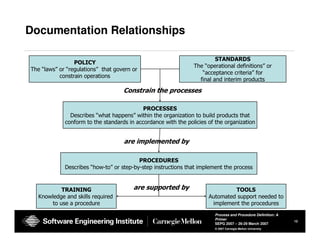
Documentation Relationships
Documentation Methods
Documenting Processes Example
Documenting Procedures Example
Group Exercise
References


                                      Process and Procedure Definition: A
                                      Primer
                                                                            2
                                      SEPG 2007 – 26-29 March 2007
                                      © 2007 Carnegie Mellon University
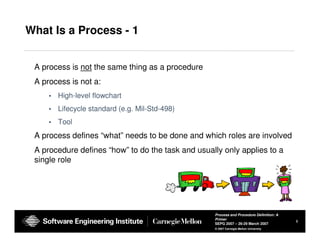
What Is a Process - 1


 A process is not the same thing as a procedure
 A process is not a:
     •   High-level flowchart
     •   Lifecycle standard (e.g. Mil-Std-498)
     •   Tool
 A process defines “what” needs to be done and which roles are involved
 A procedure defines “how” to do the task and usually only applies to a
 single role


                                                   Process and Procedure Definition: A
                                                   Primer
                                                                                         3
                                                   SEPG 2007 – 26-29 March 2007
                                                   © 2007 Carnegie Mellon University
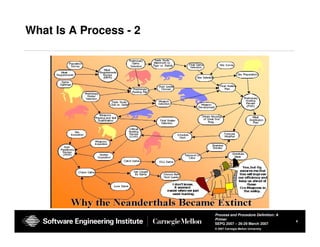
What Is A Process - 2


                        Process and Procedure Definition: A
                        Primer
                                                              4
                        SEPG 2007 – 26-29 March 2007
                        © 2007 Carnegie Mellon University
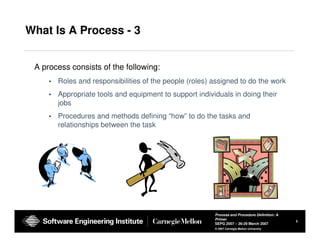
What Is A Process - 3


 A process consists of the following:
     •   Roles and responsibilities of the people (roles) assigned to do the work
     •   Appropriate tools and equipment to support individuals in doing their
         jobs
     •   Procedures and methods defining “how” to do the tasks and
         relationships between the task


                                                          Process and Procedure Definition: A
                                                          Primer
                                                                                                5
                                                          SEPG 2007 – 26-29 March 2007
                                                          © 2007 Carnegie Mellon University
Definitions – 1

Dictionary.com:
   •   A systematic series of actions directed to some end: to devise a
       process for homogenizing milk.
   •   A continuous action, operation, or series of changes taking place in a
       definite manner: the process of decay
Capability Maturity Model Integration (CMMI) V1.2:
   •   In the CMMI Product Suite, activities that can be recognized as
       implementations of practices in a CMMI model. These activities can be
       mapped to one or more practices in CMMI process areas to allow a
       model to be useful for process improvement and process appraisal.
       (See also “process area,” “subprocess,” and “process element.”)


                                                           Process and Procedure Definition: A
                                                           Primer
                                                                                                 6
                                                           SEPG 2007 – 26-29 March 2007
                                                           © 2007 Carnegie Mellon University
Definitions – 2

Process Description (as defined by the CMMI V1.2):
   •   A documented expression of a set of activities performed to achieve a
       given purpose.
   •   A process description provides an operational definition of the major
       components of a process. The description specifies, in a complete,
       precise, and verifiable manner, the requirements, design, behavior, or
       other characteristics of a process. It also may include procedures for
       determining whether these provisions have been satisfied. Process
       descriptions can be found at the activity, project, or organizational level.


                                                             Process and Procedure Definition: A
                                                             Primer
                                                                                                   7
                                                             SEPG 2007 – 26-29 March 2007
                                                             © 2007 Carnegie Mellon University
Definitions – 3

Managed Process (as defined by the CMMI V1.2)
   •   A performed process that is planned and executed in accordance with
       policy; employs skilled people having adequate resources to produce
       controlled outputs; involves relevant stakeholders; is monitored,
       controlled, and reviewed; and is evaluated for adherence to its process
       description. (See also “performed process.”)


Defined Process (as defined by the CMMI V1.2)
   •   A managed process that is tailored from the organization’s set of
       standard processes according to the organization’s tailoring guidelines;
       has a maintained process description; and contributes work products,
       measures, and other process improvement information to the
       organizational process assets. (See also “managed process.”)


                                                           Process and Procedure Definition: A
                                                           Primer
                                                                                                 8
                                                           SEPG 2007 – 26-29 March 2007
                                                           © 2007 Carnegie Mellon University
Varieties of Processes
& Procedures - 1

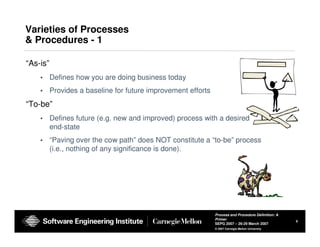
“As-is”
    •     Defines how you are doing business today
    •     Provides a baseline for future improvement efforts
“To-be”
    •     Defines future (e.g. new and improved) process with a desired
          end-state
    •     “Paving over the cow path” does NOT constitute a “to-be” process
          (i.e., nothing of any significance is done).


                                                               Process and Procedure Definition: A
                                                               Primer
                                                                                                     9
                                                               SEPG 2007 – 26-29 March 2007
                                                               © 2007 Carnegie Mellon University
Why Define Processes
& Procedures - 1

 Consider the following questions:
     •   Is the process important for the business goals?
     •   Is there only one person who knows how to do the task?
     •   Do many people perform the task, but one way is preferred?
 If you can answer “Yes” to any one of these questions, then you NEED
 to define your processes!


                                                            Process and Procedure Definition: A
                                                            Primer
                                                                                                  10
                                                            SEPG 2007 – 26-29 March 2007
                                                            © 2007 Carnegie Mellon University
Why Define Processes
& Procedures - 2

 Benefits of defining your processes and procedures:
    •   Provides visibility into areas of quality, productivity, cost and schedule
    •   Improves communication and understanding
    •   Aids in the planning & execution of plans
    •   Provides the ability to capture Lessons Learned
    •   Helps facilitate the analysis/execution of organization-wide processes
    •   Provides basis for training & skills assessment


                                                           Process and Procedure Definition: A
                                                           Primer
                                                                                                 11
                                                           SEPG 2007 – 26-29 March 2007
                                                           © 2007 Carnegie Mellon University
Documentation Relationships

                                                                         STANDARDS
                 POLICY
                                                                The “operational definitions” or
The “laws” or “regulations” that govern or
                                                                   “acceptance criteria” for
           constrain operations
                                                                  final and interim products
                                    Constrain the processes

                                            PROCESSES
               Describes “what happens” within the organization to build products that
             conform to the standards in accordance with the policies of the organization


                                    are implemented by

                                          PROCEDURES
             Describes “how-to” or step-by-step instructions that implement the process


            TRAINING                    are supported by                       TOOLS
   Knowledge and skills required                                      Automated support needed to
        to use a procedure                                             implement the procedures
                                                                        Process and Procedure Definition: A
                                                                        Primer
                                                                                                              12
                                                                        SEPG 2007 – 26-29 March 2007
                                                                        © 2007 Carnegie Mellon University
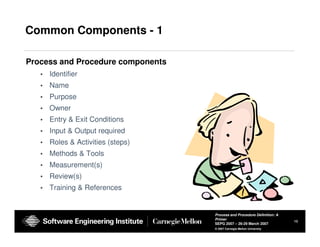
Common Components - 1

Process and Procedure components
   •   Identifier
   •   Name
   •   Purpose
   •   Owner
   •   Entry & Exit Conditions
   •   Input & Output required
   •   Roles & Activities (steps)
   •   Methods & Tools
   •   Measurement(s)
   •   Review(s)
   •   Training & References


                                    Process and Procedure Definition: A
                                    Primer
                                                                          13
                                    SEPG 2007 – 26-29 March 2007
                                    © 2007 Carnegie Mellon University
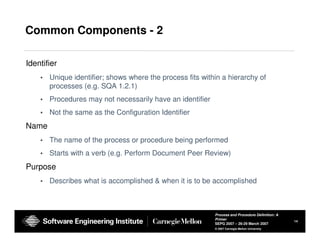
Common Components - 2

Identifier
    •   Unique identifier; shows where the process fits within a hierarchy of
        processes (e.g. SQA 1.2.1)
    •   Procedures may not necessarily have an identifier
    •   Not the same as the Configuration Identifier
Name
    •   The name of the process or procedure being performed
    •   Starts with a verb (e.g. Perform Document Peer Review)
Purpose
    •   Describes what is accomplished & when it is to be accomplished


                                                            Process and Procedure Definition: A
                                                            Primer
                                                                                                  14
                                                            SEPG 2007 – 26-29 March 2007
                                                            © 2007 Carnegie Mellon University
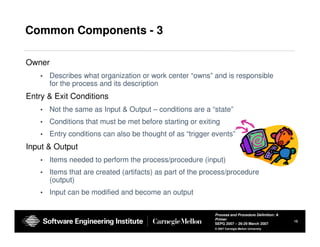
Common Components - 3

Owner
    •   Describes what organization or work center “owns” and is responsible
        for the process and its description
Entry & Exit Conditions
    •   Not the same as Input & Output – conditions are a “state”
    •   Conditions that must be met before starting or exiting
    •   Entry conditions can also be thought of as “trigger events”
Input & Output
    •   Items needed to perform the process/procedure (input)
    •   Items that are created (artifacts) as part of the process/procedure
        (output)
    •   Input can be modified and become an output

                                                            Process and Procedure Definition: A
                                                            Primer
                                                                                                  15
                                                            SEPG 2007 – 26-29 March 2007
                                                            © 2007 Carnegie Mellon University
Common Components - 4

Roles & Activities (steps)
    •   Activities define what steps are being performed
    •   Roles define who is performing the step
    •   Procedures are usually defined for a single role
    •   Process activities are defined at a high-level and decomposed into
        lower levels (e.g. each step may be a sub-process)
Methods & Tools
    •   Lists what tools (e.g. MS Word, Test Director, etc.) is used


                                                            Process and Procedure Definition: A
                                                            Primer
                                                                                                  16
                                                            SEPG 2007 – 26-29 March 2007
                                                            © 2007 Carnegie Mellon University
Common Components - 5

Measurement(s)
   •   What measurement(s) are performed as part of this process or
       procedure (e.g. number of defects found, review time, etc.)
Review(s)
   •   Lists what reviews are accomplished as part of the process or
       procedure (e.g. Branch Chief Review, QA Rep Review, etc.)


                                                         Process and Procedure Definition: A
                                                         Primer
                                                                                               17
                                                         SEPG 2007 – 26-29 March 2007
                                                         © 2007 Carnegie Mellon University
Common Components - 6

Training
   •   What training is needed in order to perform the process or procedure
References
   •   Lists reference material (e.g. checklists, AFIs, user manuals, etc.)
       necessary


                                                            Process and Procedure Definition: A
                                                            Primer
                                                                                                  18
                                                            SEPG 2007 – 26-29 March 2007
                                                            © 2007 Carnegie Mellon University
Documentation Methods - 1


 Different methods can be used
    •   Graphical
         —   Flowcharts
         —   Cross-functional diagrams
         —   Integrated Definition for Functional Modeling (IDEF) diagrams
    •   Narrative description
         —   Entry-Task-Verification/Validation-eXit (ETVX)


                                                         Process and Procedure Definition: A
                                                         Primer
                                                                                               19
                                                         SEPG 2007 – 26-29 March 2007
                                                         © 2007 Carnegie Mellon University
Documentation Methods - 2

                                                                                   Start
                                            Problem Solving
                                               Flowchart

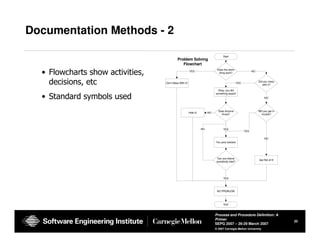
  • Flowcharts show activities,
                                                                              Does the damn
                                                        YES                                                NO
                                                                               thing work?


    decisions, etc                Don’t Mess With It!                                          YES
                                                                                                                Did you mess
                                                                                                                   with it?

                                                                               Okay, you did
                                                                             something stupid!
  • Standard symbols used                                                                                            NO


                                                                               Does Anyone                      Will you get in
                                                        Hide It!        NO
                                                                                 Know?                             trouble?


                                                                   NO              YES
                                                                                                     YES

                                                                                                                     NO
                                                                             You poor bastard


                                                                               Can you blame
                                                                                                                Get Rid of It!
                                                                              somebody else?


                                                                                   YES


                                                                              NO PROBLEM!


                                                                                   End


                                                                             Process and Procedure Definition: A
                                                                             Primer
                                                                                                                                  20
                                                                             SEPG 2007 – 26-29 March 2007
                                                                             © 2007 Carnegie Mellon University
Documentation Methods - 3

 Bill Paying Process
  Postal Service


                                                                     Deliver mail to                                        Deliver mail to
                                               Pickup mail from
                                                                   consumer at billing                 Pickup mail            company
                                                   company
                                                                       address                                            processing facility
  Consumer


                                                                                                    Place bill payment
                                                                     Retrieve mail       Pay Bill
                                                                                                         in mail
  Creditor


                   Get current                                                                                                                      Update
                                                                                                                          Retrieve mail from
                     account     Create Bill    Put bill in mail                                                                                 account with
                                                                                                                          processing facility
                   information                                                                                                                     payment


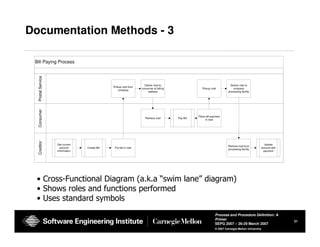
 • Cross-Functional Diagram (a.k.a “swim lane” diagram)
 • Shows roles and functions performed
 • Uses standard symbols
                                                                                                                 Process and Procedure Definition: A
                                                                                                                 Primer
                                                                                                                                                                21
                                                                                                                 SEPG 2007 – 26-29 March 2007
                                                                                                                 © 2007 Carnegie Mellon University
Documentation Methods - 4

                                                                       Standards,
                                                                       Plans (SQA, PP, CM, TP),
                                                                       Templates,
                                                                       Processes,                              NOTE: A0 is comprised of sub-
                                                                       Waivers,                                  processes A1 through A5
                                                                       Existing Checklists

 • IDEF Diagrams                                                                              Metrics,


 • International standard          Draft Procduct
                                                               Audit (A0)                     Acceptable Product,
                                                                                              Updated SQA Database,
                                                                                              Completed Report


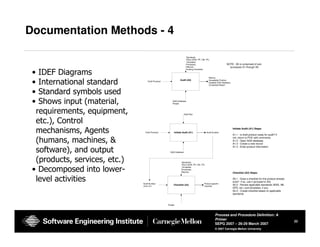
 • Standard symbols used
 • Shows input (material,                               SQA Database,
                                                        People


  requirements, equipment,                                           SQA Plan


  etc.), Control
  mechanisms, Agents             Draft Procduct          Initiate Audit (A1)               Audit Number
                                                                                                                      Initiate Audit (A1) Steps:

                                                                                                                      A1.1 - Is draft product ready for audit? If

  (humans, machines, &
                                                                                                                      not, return to POC with comments.
                                                                                                                      A1.2 - Open SQA database
                                                                                                                      A1.3 - Create a new record
                                                                                                                      A1.4 - Enter product information
  software), and output                               SQA Database


  (products, services, etc.)                                    Standards,
                                                                Plans (SQA, PP, CM, TP),


 • Decomposed into lower-                                       Templates,
                                                                Processes,
                                                                Waivers                                               Checklist (A2) Steps:


  level activities             Audit Number                                              Product specific
                                                                                                                      A2.1 - Does a checklist for this product already
                                                                                                                      exist? If so, use it (proceed to A3).
                               (from A1)
                                                         Checklist (A2)                  checklist
                                                                                                                      A2.2 - Review applicable standards (IEEE, Mil,
                                                                                                                      DPD, etc.) and templates, if any.
                                                                                                                      A2.3 - Create checklist based on applicable
                                                                                                                      standards


                                                    People


                                                                                                     Process and Procedure Definition: A
                                                                                                     Primer
                                                                                                                                                                         22
                                                                                                     SEPG 2007 – 26-29 March 2007
                                                                                                     © 2007 Carnegie Mellon University
Documentation Methods - 5

                                 PROCESS


                                    TASK

    ENTRY                                                                          EXIT


                                VALIDATION


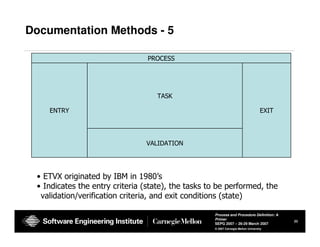
 • ETVX originated by IBM in 1980’s
 • Indicates the entry criteria (state), the tasks to be performed, the
  validation/verification criteria, and exit conditions (state)

                                                    Process and Procedure Definition: A
                                                    Primer
                                                                                          23
                                                    SEPG 2007 – 26-29 March 2007
                                                    © 2007 Carnegie Mellon University
Documentation Samples

Implementation Samples:
   •   Process Specification Template Sample
        —   Tailored versions of ETVX format
   •   Can be supplemented with additional documentation (flowcharts, cross-
       functional diagrams, etc.)
   •   Procedure Specification Template Sample
        —   Similar to Process Specification Template
        —   Intended for greater level of detail
   •   Procedural Checklist Template Sample
        —   Used in cases where a checklist is a better implementation (e.g.
            discrete tasks that have to be performed and verified)


                                                           Process and Procedure Definition: A
                                                           Primer
                                                                                                 24
                                                           SEPG 2007 – 26-29 March 2007
                                                           © 2007 Carnegie Mellon University
Documenting Processes Example - 1

Specific Guidance
   •   Process Title: includes the unique identifier (e.g. SQA 1.2.1) as well as
       the name of the process
   •   Version: use form of “x.x” for version control
   •   Revised: Date of last revision
   •   Owner: owner of the process (office symbol)
   •   CID: Configuration ID (used by Configuration Management)
        —   Not the same as the Identifier
        —   Left blank while in draft form
        —   Needs CID assigned once approved


                                                            Process and Procedure Definition: A
                                                            Primer
                                                                                                  25
                                                            SEPG 2007 – 26-29 March 2007
                                                            © 2007 Carnegie Mellon University
Documenting Processes Example - 2

Specific Guidance (cont)
   •   Purpose: self explanatory
   •   Entry & Exit Conditions: self explanatory
   •   Input: self explanatory
   •   Output: artifacts produced
        —   High-level definition uses bullet format
        —   Lower-level definition uses legal-style format; matches process step
            numbering
        —   At the high-level definition, only show the final products from the
            lower-level processes (not intermediate products)


                                                             Process and Procedure Definition: A
                                                             Primer
                                                                                                   26
                                                             SEPG 2007 – 26-29 March 2007
                                                             © 2007 Carnegie Mellon University
Documenting Processes Example - 3


 Specific Guidance (cont)
    •   Process Steps:
         —   Numbering should match identifier sequence (e.g. if process
             ID is 2.0, then first process step is 2.1, etc.)
         —   Starts with a verb phrase (e.g. perform, conduct, create, etc.)
         —   Do not exceed 3 levels of decompositions (e.g. x.x.x.x is
             maximum depth)
         —   If process steps exceed 8-10, then decomposition needs to be
             reexamined
         —   Include procedure names when referencing procedures
         —   Processes may call other pre-defined processes (include
             process identifier in the step)

                                                           Process and Procedure Definition: A
                                                           Primer
                                                                                                 27
                                                           SEPG 2007 – 26-29 March 2007
                                                           © 2007 Carnegie Mellon University
Documenting Processes Example - 4

Specific Guidance (cont)
     • Roles: list roles (not people) performing the activities

        —   Role list in template is tailorable (provided as a sample)
     • Activities: (listed across the top; includes the numbering)

        —   Use the pre-defined list of activities
        —   Key activity being performed should be annotated with a bold-face
            font


     TIP: The table information can be used as the basis for a cross-
     functional diagram


                                                              Process and Procedure Definition: A
                                                              Primer
                                                                                                    28
                                                              SEPG 2007 – 26-29 March 2007
                                                              © 2007 Carnegie Mellon University
Documenting Processes Example - 5


 Specific Guidance (cont)
    •   Methods & Tools: self explanatory (don’t forget about the MS Office
        software)
    •   Measurements:
         —   List of measurements that should be taken
         —   Don’t list all possible measurements
         —   Not a set of standard process metrics (varies from process-to-
             process)
    •   Reviews: list any reviews from the process steps (defined as part of the
        process)


                                                         Process and Procedure Definition: A
                                                         Primer
                                                                                               29
                                                         SEPG 2007 – 26-29 March 2007
                                                         © 2007 Carnegie Mellon University
Documenting Processes Example - 6


   Specific Guidance (cont)
    •   Training: list any specific training needed to perform the process
    •   References
         —   List any references used (standards, checklists, guides, etc.)
         —   Check against Input section!


   TIP: Whiteboard sessions work very well for initial definition
   sessions!


                                                          Process and Procedure Definition: A
                                                          Primer
                                                                                                30
                                                          SEPG 2007 – 26-29 March 2007
                                                          © 2007 Carnegie Mellon University
Documenting Procedures Example - 1

Procedure Specifications
   •   Uses the Procedure Specification Template as standard format
   •   Provides specific information for each entry in the specification
   •   Format is slightly different than process definition
        —   Assumed to be a single role but can include multiple roles if the
            situation calls for it
        —   Greater level of detail in a single definition
   •   Checklist variant of the template can also be used where a checklist
       makes more sense (e.g. Database Administration steps, etc.)


                                                              Process and Procedure Definition: A
                                                              Primer
                                                                                                    31
                                                              SEPG 2007 – 26-29 March 2007
                                                              © 2007 Carnegie Mellon University
Documenting Procedures Example - 2

 Specific Guidance
 The same guidance used for processes is used for procedures with the
 following exceptions:
     •   Roles
          —   List of Role or Roles involved in performing the tasks
     •   Summary of Tasks
          —   List of Task (summary) to be performed
          —   Uses legal-style numbering
          —   Start with 1.1 (1.0 is assumed with the title of the procedure)


                                                             Process and Procedure Definition: A
                                                             Primer
                                                                                                   32
                                                             SEPG 2007 – 26-29 March 2007
                                                             © 2007 Carnegie Mellon University
Documenting Procedures Example - 3

 Specific Guidance (cont)
    •   Procedure Steps
         —   For each task (from Summary of Tasks) provide the detailed steps
             (in order) to accomplish the specified task
         —   Provide as much as the “click on…” and “enter xxx” detail as
             necessary
         —   Task steps will be prefaced with “Step” and sequentially numbered
             -- Numbering for each task step will restart with each task
         —   Only 1 action will be performed per step
         —   If additional info is needed to clarify the step (e.g. if a message
             appears, etc.) make sure it is included
         —   If more than 1 role is involved in the task, be sure you identify which
             role performs the specific steps


                                                             Process and Procedure Definition: A
                                                             Primer
                                                                                                   33
                                                             SEPG 2007 – 26-29 March 2007
                                                             © 2007 Carnegie Mellon University
Group Exercise

As a group, define the “going to work” process
    •   Use the whiteboard to capture the information
    •   Give some thought to “trigger events”, input needed, activities being
        performed (keep in mind gender differences in the process steps), etc.
    •   Have fun!


                                                           Process and Procedure Definition: A
                                                           Primer
                                                                                                 34
                                                           SEPG 2007 – 26-29 March 2007
                                                           © 2007 Carnegie Mellon University
References

Hanavan, P., (2003). Systems Engineering Process Group Concepts. Training
  material provided to ESC/HR at Randolph AFB, TX, by Martin Process
  Solutions, Inc. (MPSI)
Kulpa, M., & Johnson, K. (2003). Interpreting the CMMI(R): A Process
  Improvement Approach. Boca Raton, Florida: CRC Press LLC
Patterson, B. (2002, November). Business Process Mapping: Navigating in
  Troubled Waters. Proceedings of the First International Conference of
  Software Process Improvement., College Park, Maryland.


                                                         Process and Procedure Definition: A
                                                         Primer
                                                                                               36
                                                         SEPG 2007 – 26-29 March 2007
                                                         © 2007 Carnegie Mellon University
Contact Information


                          Mike Bandor
                 Member of the Technical Staff
                  Acquisition Support Program
               Software Engineering Institute (SEI)
                   Carnegie Mellon University
                     mbandor@sei.cmu.edu
                         210-380-5563

       http://www.sei.cmu.edu/programs/acquisition-support/


                                                      Process and Procedure Definition: A
                                                      Primer
                                                                                            37
                                                      SEPG 2007 – 26-29 March 2007
                                                      © 2007 Carnegie Mellon University

Processes and Procedures

  • 1.
    Process and Procedure Definition:A Primer Mike Bandor Member of the Technical Staff Acquisition Support Program mbandor@sei.cmu.edu © 2007 Carnegie Mellon University
  • 2.
    Overview What is a“process”? Definitions Varieties of Processes & Procedures Why Do They Need to be Defined? Components Documentation Relationships Documentation Methods Documenting Processes Example Documenting Procedures Example Group Exercise References Process and Procedure Definition: A Primer 2 SEPG 2007 – 26-29 March 2007 © 2007 Carnegie Mellon University
  • 3.
    What Is aProcess - 1 A process is not the same thing as a procedure A process is not a: • High-level flowchart • Lifecycle standard (e.g. Mil-Std-498) • Tool A process defines “what” needs to be done and which roles are involved A procedure defines “how” to do the task and usually only applies to a single role Process and Procedure Definition: A Primer 3 SEPG 2007 – 26-29 March 2007 © 2007 Carnegie Mellon University
  • 4.
    What Is AProcess - 2 Process and Procedure Definition: A Primer 4 SEPG 2007 – 26-29 March 2007 © 2007 Carnegie Mellon University
  • 5.
    What Is AProcess - 3 A process consists of the following: • Roles and responsibilities of the people (roles) assigned to do the work • Appropriate tools and equipment to support individuals in doing their jobs • Procedures and methods defining “how” to do the tasks and relationships between the task Process and Procedure Definition: A Primer 5 SEPG 2007 – 26-29 March 2007 © 2007 Carnegie Mellon University
  • 6.
    Definitions – 1 Dictionary.com: • A systematic series of actions directed to some end: to devise a process for homogenizing milk. • A continuous action, operation, or series of changes taking place in a definite manner: the process of decay Capability Maturity Model Integration (CMMI) V1.2: • In the CMMI Product Suite, activities that can be recognized as implementations of practices in a CMMI model. These activities can be mapped to one or more practices in CMMI process areas to allow a model to be useful for process improvement and process appraisal. (See also “process area,” “subprocess,” and “process element.”) Process and Procedure Definition: A Primer 6 SEPG 2007 – 26-29 March 2007 © 2007 Carnegie Mellon University
  • 7.
    Definitions – 2 ProcessDescription (as defined by the CMMI V1.2): • A documented expression of a set of activities performed to achieve a given purpose. • A process description provides an operational definition of the major components of a process. The description specifies, in a complete, precise, and verifiable manner, the requirements, design, behavior, or other characteristics of a process. It also may include procedures for determining whether these provisions have been satisfied. Process descriptions can be found at the activity, project, or organizational level. Process and Procedure Definition: A Primer 7 SEPG 2007 – 26-29 March 2007 © 2007 Carnegie Mellon University
  • 8.
    Definitions – 3 ManagedProcess (as defined by the CMMI V1.2) • A performed process that is planned and executed in accordance with policy; employs skilled people having adequate resources to produce controlled outputs; involves relevant stakeholders; is monitored, controlled, and reviewed; and is evaluated for adherence to its process description. (See also “performed process.”) Defined Process (as defined by the CMMI V1.2) • A managed process that is tailored from the organization’s set of standard processes according to the organization’s tailoring guidelines; has a maintained process description; and contributes work products, measures, and other process improvement information to the organizational process assets. (See also “managed process.”) Process and Procedure Definition: A Primer 8 SEPG 2007 – 26-29 March 2007 © 2007 Carnegie Mellon University
  • 9.
    Varieties of Processes &Procedures - 1 “As-is” • Defines how you are doing business today • Provides a baseline for future improvement efforts “To-be” • Defines future (e.g. new and improved) process with a desired end-state • “Paving over the cow path” does NOT constitute a “to-be” process (i.e., nothing of any significance is done). Process and Procedure Definition: A Primer 9 SEPG 2007 – 26-29 March 2007 © 2007 Carnegie Mellon University
  • 10.
    Why Define Processes &Procedures - 1 Consider the following questions: • Is the process important for the business goals? • Is there only one person who knows how to do the task? • Do many people perform the task, but one way is preferred? If you can answer “Yes” to any one of these questions, then you NEED to define your processes! Process and Procedure Definition: A Primer 10 SEPG 2007 – 26-29 March 2007 © 2007 Carnegie Mellon University
  • 11.
    Why Define Processes &Procedures - 2 Benefits of defining your processes and procedures: • Provides visibility into areas of quality, productivity, cost and schedule • Improves communication and understanding • Aids in the planning & execution of plans • Provides the ability to capture Lessons Learned • Helps facilitate the analysis/execution of organization-wide processes • Provides basis for training & skills assessment Process and Procedure Definition: A Primer 11 SEPG 2007 – 26-29 March 2007 © 2007 Carnegie Mellon University
  • 12.
    Documentation Relationships STANDARDS POLICY The “operational definitions” or The “laws” or “regulations” that govern or “acceptance criteria” for constrain operations final and interim products Constrain the processes PROCESSES Describes “what happens” within the organization to build products that conform to the standards in accordance with the policies of the organization are implemented by PROCEDURES Describes “how-to” or step-by-step instructions that implement the process TRAINING are supported by TOOLS Knowledge and skills required Automated support needed to to use a procedure implement the procedures Process and Procedure Definition: A Primer 12 SEPG 2007 – 26-29 March 2007 © 2007 Carnegie Mellon University
  • 13.
    Common Components -1 Process and Procedure components • Identifier • Name • Purpose • Owner • Entry & Exit Conditions • Input & Output required • Roles & Activities (steps) • Methods & Tools • Measurement(s) • Review(s) • Training & References Process and Procedure Definition: A Primer 13 SEPG 2007 – 26-29 March 2007 © 2007 Carnegie Mellon University
  • 14.
    Common Components -2 Identifier • Unique identifier; shows where the process fits within a hierarchy of processes (e.g. SQA 1.2.1) • Procedures may not necessarily have an identifier • Not the same as the Configuration Identifier Name • The name of the process or procedure being performed • Starts with a verb (e.g. Perform Document Peer Review) Purpose • Describes what is accomplished & when it is to be accomplished Process and Procedure Definition: A Primer 14 SEPG 2007 – 26-29 March 2007 © 2007 Carnegie Mellon University
  • 15.
    Common Components -3 Owner • Describes what organization or work center “owns” and is responsible for the process and its description Entry & Exit Conditions • Not the same as Input & Output – conditions are a “state” • Conditions that must be met before starting or exiting • Entry conditions can also be thought of as “trigger events” Input & Output • Items needed to perform the process/procedure (input) • Items that are created (artifacts) as part of the process/procedure (output) • Input can be modified and become an output Process and Procedure Definition: A Primer 15 SEPG 2007 – 26-29 March 2007 © 2007 Carnegie Mellon University
  • 16.
    Common Components -4 Roles & Activities (steps) • Activities define what steps are being performed • Roles define who is performing the step • Procedures are usually defined for a single role • Process activities are defined at a high-level and decomposed into lower levels (e.g. each step may be a sub-process) Methods & Tools • Lists what tools (e.g. MS Word, Test Director, etc.) is used Process and Procedure Definition: A Primer 16 SEPG 2007 – 26-29 March 2007 © 2007 Carnegie Mellon University
  • 17.
    Common Components -5 Measurement(s) • What measurement(s) are performed as part of this process or procedure (e.g. number of defects found, review time, etc.) Review(s) • Lists what reviews are accomplished as part of the process or procedure (e.g. Branch Chief Review, QA Rep Review, etc.) Process and Procedure Definition: A Primer 17 SEPG 2007 – 26-29 March 2007 © 2007 Carnegie Mellon University
  • 18.
    Common Components -6 Training • What training is needed in order to perform the process or procedure References • Lists reference material (e.g. checklists, AFIs, user manuals, etc.) necessary Process and Procedure Definition: A Primer 18 SEPG 2007 – 26-29 March 2007 © 2007 Carnegie Mellon University
  • 19.
    Documentation Methods -1 Different methods can be used • Graphical — Flowcharts — Cross-functional diagrams — Integrated Definition for Functional Modeling (IDEF) diagrams • Narrative description — Entry-Task-Verification/Validation-eXit (ETVX) Process and Procedure Definition: A Primer 19 SEPG 2007 – 26-29 March 2007 © 2007 Carnegie Mellon University
  • 20.
    Documentation Methods -2 Start Problem Solving Flowchart • Flowcharts show activities, Does the damn YES NO thing work? decisions, etc Don’t Mess With It! YES Did you mess with it? Okay, you did something stupid! • Standard symbols used NO Does Anyone Will you get in Hide It! NO Know? trouble? NO YES YES NO You poor bastard Can you blame Get Rid of It! somebody else? YES NO PROBLEM! End Process and Procedure Definition: A Primer 20 SEPG 2007 – 26-29 March 2007 © 2007 Carnegie Mellon University
  • 21.
    Documentation Methods -3 Bill Paying Process Postal Service Deliver mail to Deliver mail to Pickup mail from consumer at billing Pickup mail company company address processing facility Consumer Place bill payment Retrieve mail Pay Bill in mail Creditor Get current Update Retrieve mail from account Create Bill Put bill in mail account with processing facility information payment • Cross-Functional Diagram (a.k.a “swim lane” diagram) • Shows roles and functions performed • Uses standard symbols Process and Procedure Definition: A Primer 21 SEPG 2007 – 26-29 March 2007 © 2007 Carnegie Mellon University
  • 22.
    Documentation Methods -4 Standards, Plans (SQA, PP, CM, TP), Templates, Processes, NOTE: A0 is comprised of sub- Waivers, processes A1 through A5 Existing Checklists • IDEF Diagrams Metrics, • International standard Draft Procduct Audit (A0) Acceptable Product, Updated SQA Database, Completed Report • Standard symbols used • Shows input (material, SQA Database, People requirements, equipment, SQA Plan etc.), Control mechanisms, Agents Draft Procduct Initiate Audit (A1) Audit Number Initiate Audit (A1) Steps: A1.1 - Is draft product ready for audit? If (humans, machines, & not, return to POC with comments. A1.2 - Open SQA database A1.3 - Create a new record A1.4 - Enter product information software), and output SQA Database (products, services, etc.) Standards, Plans (SQA, PP, CM, TP), • Decomposed into lower- Templates, Processes, Waivers Checklist (A2) Steps: level activities Audit Number Product specific A2.1 - Does a checklist for this product already exist? If so, use it (proceed to A3). (from A1) Checklist (A2) checklist A2.2 - Review applicable standards (IEEE, Mil, DPD, etc.) and templates, if any. A2.3 - Create checklist based on applicable standards People Process and Procedure Definition: A Primer 22 SEPG 2007 – 26-29 March 2007 © 2007 Carnegie Mellon University
  • 23.
    Documentation Methods -5 PROCESS TASK ENTRY EXIT VALIDATION • ETVX originated by IBM in 1980’s • Indicates the entry criteria (state), the tasks to be performed, the validation/verification criteria, and exit conditions (state) Process and Procedure Definition: A Primer 23 SEPG 2007 – 26-29 March 2007 © 2007 Carnegie Mellon University
  • 24.
    Documentation Samples Implementation Samples: • Process Specification Template Sample — Tailored versions of ETVX format • Can be supplemented with additional documentation (flowcharts, cross- functional diagrams, etc.) • Procedure Specification Template Sample — Similar to Process Specification Template — Intended for greater level of detail • Procedural Checklist Template Sample — Used in cases where a checklist is a better implementation (e.g. discrete tasks that have to be performed and verified) Process and Procedure Definition: A Primer 24 SEPG 2007 – 26-29 March 2007 © 2007 Carnegie Mellon University
  • 25.
    Documenting Processes Example- 1 Specific Guidance • Process Title: includes the unique identifier (e.g. SQA 1.2.1) as well as the name of the process • Version: use form of “x.x” for version control • Revised: Date of last revision • Owner: owner of the process (office symbol) • CID: Configuration ID (used by Configuration Management) — Not the same as the Identifier — Left blank while in draft form — Needs CID assigned once approved Process and Procedure Definition: A Primer 25 SEPG 2007 – 26-29 March 2007 © 2007 Carnegie Mellon University
  • 26.
    Documenting Processes Example- 2 Specific Guidance (cont) • Purpose: self explanatory • Entry & Exit Conditions: self explanatory • Input: self explanatory • Output: artifacts produced — High-level definition uses bullet format — Lower-level definition uses legal-style format; matches process step numbering — At the high-level definition, only show the final products from the lower-level processes (not intermediate products) Process and Procedure Definition: A Primer 26 SEPG 2007 – 26-29 March 2007 © 2007 Carnegie Mellon University
  • 27.
    Documenting Processes Example- 3 Specific Guidance (cont) • Process Steps: — Numbering should match identifier sequence (e.g. if process ID is 2.0, then first process step is 2.1, etc.) — Starts with a verb phrase (e.g. perform, conduct, create, etc.) — Do not exceed 3 levels of decompositions (e.g. x.x.x.x is maximum depth) — If process steps exceed 8-10, then decomposition needs to be reexamined — Include procedure names when referencing procedures — Processes may call other pre-defined processes (include process identifier in the step) Process and Procedure Definition: A Primer 27 SEPG 2007 – 26-29 March 2007 © 2007 Carnegie Mellon University
  • 28.
    Documenting Processes Example- 4 Specific Guidance (cont) • Roles: list roles (not people) performing the activities — Role list in template is tailorable (provided as a sample) • Activities: (listed across the top; includes the numbering) — Use the pre-defined list of activities — Key activity being performed should be annotated with a bold-face font TIP: The table information can be used as the basis for a cross- functional diagram Process and Procedure Definition: A Primer 28 SEPG 2007 – 26-29 March 2007 © 2007 Carnegie Mellon University
  • 29.
    Documenting Processes Example- 5 Specific Guidance (cont) • Methods & Tools: self explanatory (don’t forget about the MS Office software) • Measurements: — List of measurements that should be taken — Don’t list all possible measurements — Not a set of standard process metrics (varies from process-to- process) • Reviews: list any reviews from the process steps (defined as part of the process) Process and Procedure Definition: A Primer 29 SEPG 2007 – 26-29 March 2007 © 2007 Carnegie Mellon University
  • 30.
    Documenting Processes Example- 6 Specific Guidance (cont) • Training: list any specific training needed to perform the process • References — List any references used (standards, checklists, guides, etc.) — Check against Input section! TIP: Whiteboard sessions work very well for initial definition sessions! Process and Procedure Definition: A Primer 30 SEPG 2007 – 26-29 March 2007 © 2007 Carnegie Mellon University
  • 31.
    Documenting Procedures Example- 1 Procedure Specifications • Uses the Procedure Specification Template as standard format • Provides specific information for each entry in the specification • Format is slightly different than process definition — Assumed to be a single role but can include multiple roles if the situation calls for it — Greater level of detail in a single definition • Checklist variant of the template can also be used where a checklist makes more sense (e.g. Database Administration steps, etc.) Process and Procedure Definition: A Primer 31 SEPG 2007 – 26-29 March 2007 © 2007 Carnegie Mellon University
  • 32.
    Documenting Procedures Example- 2 Specific Guidance The same guidance used for processes is used for procedures with the following exceptions: • Roles — List of Role or Roles involved in performing the tasks • Summary of Tasks — List of Task (summary) to be performed — Uses legal-style numbering — Start with 1.1 (1.0 is assumed with the title of the procedure) Process and Procedure Definition: A Primer 32 SEPG 2007 – 26-29 March 2007 © 2007 Carnegie Mellon University
  • 33.
    Documenting Procedures Example- 3 Specific Guidance (cont) • Procedure Steps — For each task (from Summary of Tasks) provide the detailed steps (in order) to accomplish the specified task — Provide as much as the “click on…” and “enter xxx” detail as necessary — Task steps will be prefaced with “Step” and sequentially numbered -- Numbering for each task step will restart with each task — Only 1 action will be performed per step — If additional info is needed to clarify the step (e.g. if a message appears, etc.) make sure it is included — If more than 1 role is involved in the task, be sure you identify which role performs the specific steps Process and Procedure Definition: A Primer 33 SEPG 2007 – 26-29 March 2007 © 2007 Carnegie Mellon University
  • 34.
    Group Exercise As agroup, define the “going to work” process • Use the whiteboard to capture the information • Give some thought to “trigger events”, input needed, activities being performed (keep in mind gender differences in the process steps), etc. • Have fun! Process and Procedure Definition: A Primer 34 SEPG 2007 – 26-29 March 2007 © 2007 Carnegie Mellon University
  • 35.
    References Hanavan, P., (2003).Systems Engineering Process Group Concepts. Training material provided to ESC/HR at Randolph AFB, TX, by Martin Process Solutions, Inc. (MPSI) Kulpa, M., & Johnson, K. (2003). Interpreting the CMMI(R): A Process Improvement Approach. Boca Raton, Florida: CRC Press LLC Patterson, B. (2002, November). Business Process Mapping: Navigating in Troubled Waters. Proceedings of the First International Conference of Software Process Improvement., College Park, Maryland. Process and Procedure Definition: A Primer 36 SEPG 2007 – 26-29 March 2007 © 2007 Carnegie Mellon University
  • 36.
    Contact Information Mike Bandor Member of the Technical Staff Acquisition Support Program Software Engineering Institute (SEI) Carnegie Mellon University mbandor@sei.cmu.edu 210-380-5563 http://www.sei.cmu.edu/programs/acquisition-support/ Process and Procedure Definition: A Primer 37 SEPG 2007 – 26-29 March 2007 © 2007 Carnegie Mellon University