Pramod Kumar Sharma
itpksharma@gmail.com
8285332793
Presentation OutlinePresentation OutlinePresentation OutlinePresentation Outline
What is the Project.
What is Project Management.
What is PM Methodology.
Sample of Project Management.
Project Management Steps.
Project Management Core functions.
Why Project Fail?
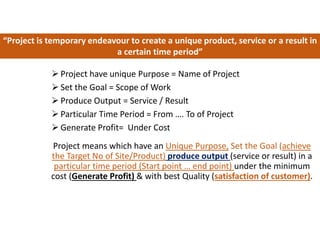
Project means which have an Unique Purpose, Set the Goal (achieve
the Target No of Site/Product) produce output (service or result) in a
particular time period (Start point … end point) under the minimum
cost (Generate Profit) & with best Quality (satisfaction of customer).
“Project is temporary endeavour to create a unique product, service or a result in
a certain time period”
 Project have unique Purpose = Name of Project
 Set the Goal = Scope of Work
 Produce Output = Service / Result
 Particular Time Period = From …. To of Project
 Generate Profit= Under Cost
Project AttributesProject AttributesProject AttributesProject Attributes
• Project has unique Purpose
• Project is Temporary
• Project is developed using progressive elaboration.
• A project requires resources
• Project should have a primary customer or sponsor
• Project involves uncertainty
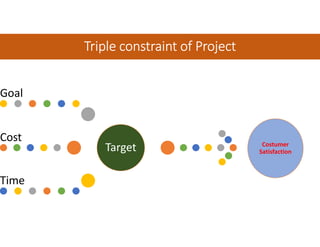
Triple constraint of ProjectTriple constraint of ProjectTriple constraint of ProjectTriple constraint of Project
Target
Goal
Cost
Time
Costumer
Satisfaction
“Goal“Goal“Goal“Goal is a dream with ais a dream with ais a dream with ais a dream with a deadline”deadline”deadline”deadline”
NapoleonNapoleonNapoleonNapoleon HillHillHillHill
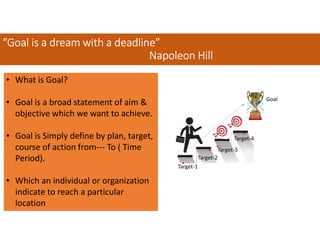
• What is Goal?
• Goal is a broad statement of aim &
objective which we want to achieve.
• Goal is Simply define by plan, target,
course of action from--- To ( Time
Period).
• Which an individual or organization
indicate to reach a particular
location
Target-1
Target-2
Target-3
Target-4
Goal
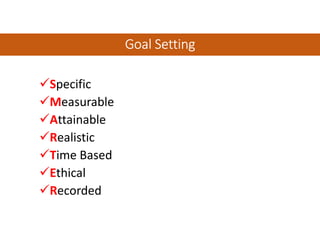
Goal SettingGoal SettingGoal SettingGoal Setting
Specific
Measurable
Attainable
Realistic
Time Based
Ethical
Recorded
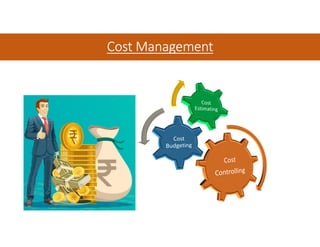
CostCostCostCost ManagementManagementManagementManagement
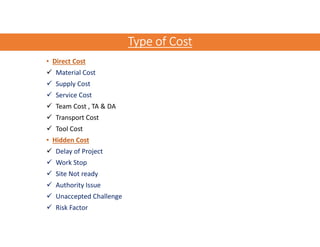
Type of CostType of CostType of CostType of Cost
• Direct Cost
 Material Cost
 Supply Cost
 Service Cost
 Team Cost , TA & DA
 Transport Cost
 Tool Cost
• Hidden Cost
 Delay of Project
 Work Stop
 Site Not ready
 Authority Issue
 Unaccepted Challenge
 Risk Factor
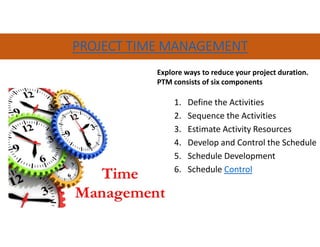
PROJECT TIME MANAGEMENTPROJECT TIME MANAGEMENTPROJECT TIME MANAGEMENTPROJECT TIME MANAGEMENT
1. Define the Activities
2. Sequence the Activities
3. Estimate Activity Resources
4. Develop and Control the Schedule
5. Schedule Development
6. Schedule Control
Explore ways to reduce your project duration.
PTM consists of six components
PROJECT TIME MANAGEMENTPROJECT TIME MANAGEMENTPROJECT TIME MANAGEMENTPROJECT TIME MANAGEMENT
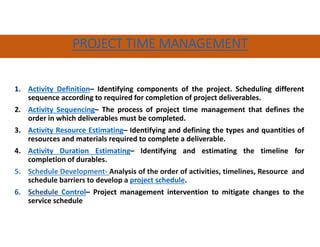
1. Activity Definition– Identifying components of the project. Scheduling different
sequence according to required for completion of project deliverables.
2. Activity Sequencing– The process of project time management that defines the
order in which deliverables must be completed.
3. Activity Resource Estimating– Identifying and defining the types and quantities of
resources and materials required to complete a deliverable.
4. Activity Duration Estimating– Identifying and estimating the timeline for
completion of durables.
5. Schedule Development- Analysis of the order of activities, timelines, Resource and
schedule barriers to develop a project schedule.
6. Schedule Control– Project management intervention to mitigate changes to the
service schedule
Quick Steps for Better Time ManagementQuick Steps for Better Time ManagementQuick Steps for Better Time ManagementQuick Steps for Better Time Management
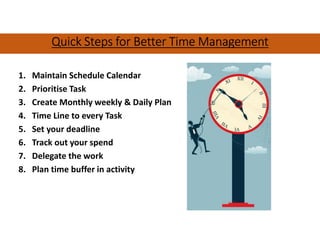
1. Maintain Schedule Calendar
2. Prioritise Task
3. Create Monthly weekly & Daily Plan
4. Time Line to every Task
5. Set your deadline
6. Track out your spend
7. Delegate the work
8. Plan time buffer in activity
Project ManagementProject ManagementProject ManagementProject Management
ोजे मैनेजमट िव ान, कला और कौशल का एक संयोजन है, जो उपकरण, तकनीक
और जनश के सव!"म उपयोग के िलए एक योजना बनाता है। िनि&त समय अविध के
भीतर ल* को ा+ कर
Project Management is a combination of science, art & skill, which
make a plan, for best use of tools, techniques & manpower. For
Achieve the target within a certain time period
Initiating of
the Project
Planning of
the Project
Executing
the Project
Monitoring
&
Controlling
of the
Project
Closing of
the Project
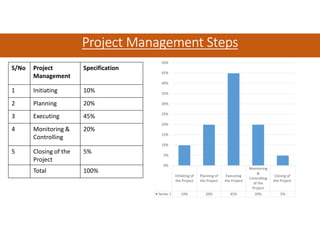
Series 1 10% 20% 45% 20% 5%
0%
5%
10%
15%
20%
25%
30%
35%
40%
45%
50%
S/No Project
Management
Specification
1 Initiating 10%
2 Planning 20%
3 Executing 45%
4 Monitoring &
Controlling
20%
5 Closing of the
Project
5%
Total 100%
ProjectProjectProjectProject Management StepsManagement StepsManagement StepsManagement Steps
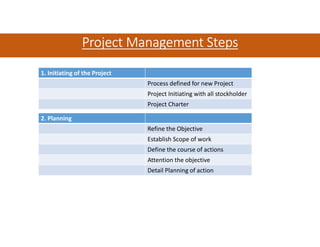
1. Initiating of the Project
Process defined for new Project
Project Initiating with all stockholder
Project Charter
2. Planning
Refine the Objective
Establish Scope of work
Define the course of actions
Attention the objective
Detail Planning of action
ProjectProjectProjectProject Management StepsManagement StepsManagement StepsManagement Steps
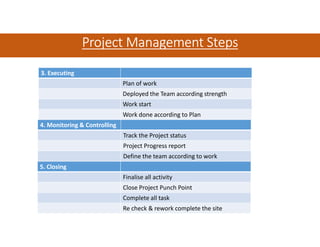
3. Executing
Plan of work
Deployed the Team according strength
Work start
Work done according to Plan
4. Monitoring & Controlling
Track the Project status
Project Progress report
Define the team according to work
5. Closing
Finalise all activity
Close Project Punch Point
Complete all task
Re check & rework complete the site
ProjectProjectProjectProject Management StepsManagement StepsManagement StepsManagement Steps
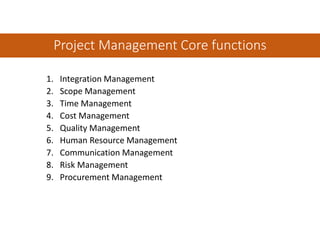
Project Management Core functions
1. Integration Management
2. Scope Management
3. Time Management
4. Cost Management
5. Quality Management
6. Human Resource Management
7. Communication Management
8. Risk Management
9. Procurement Management
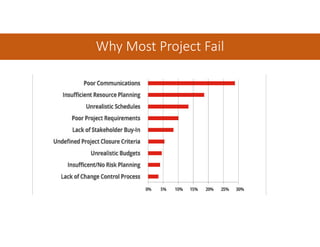
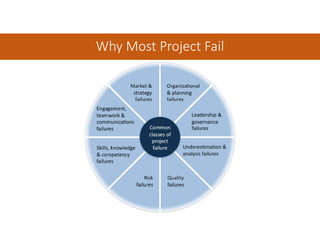
Why Most Project Fail
Pramod Kumar Sharma
itpksharma@gmail.com
8285332793

Project & Project managment

  • 1.
  • 2.
    Presentation OutlinePresentation OutlinePresentationOutlinePresentation Outline What is the Project. What is Project Management. What is PM Methodology. Sample of Project Management. Project Management Steps. Project Management Core functions. Why Project Fail?
  • 4.
    Project means whichhave an Unique Purpose, Set the Goal (achieve the Target No of Site/Product) produce output (service or result) in a particular time period (Start point … end point) under the minimum cost (Generate Profit) & with best Quality (satisfaction of customer). “Project is temporary endeavour to create a unique product, service or a result in a certain time period”  Project have unique Purpose = Name of Project  Set the Goal = Scope of Work  Produce Output = Service / Result  Particular Time Period = From …. To of Project  Generate Profit= Under Cost
  • 5.
    Project AttributesProject AttributesProjectAttributesProject Attributes • Project has unique Purpose • Project is Temporary • Project is developed using progressive elaboration. • A project requires resources • Project should have a primary customer or sponsor • Project involves uncertainty
  • 6.
    Triple constraint ofProjectTriple constraint of ProjectTriple constraint of ProjectTriple constraint of Project Target Goal Cost Time Costumer Satisfaction
  • 7.
    “Goal“Goal“Goal“Goal is adream with ais a dream with ais a dream with ais a dream with a deadline”deadline”deadline”deadline” NapoleonNapoleonNapoleonNapoleon HillHillHillHill • What is Goal? • Goal is a broad statement of aim & objective which we want to achieve. • Goal is Simply define by plan, target, course of action from--- To ( Time Period). • Which an individual or organization indicate to reach a particular location Target-1 Target-2 Target-3 Target-4 Goal
  • 8.
    Goal SettingGoal SettingGoalSettingGoal Setting Specific Measurable Attainable Realistic Time Based Ethical Recorded
  • 9.
  • 10.
    Type of CostTypeof CostType of CostType of Cost • Direct Cost  Material Cost  Supply Cost  Service Cost  Team Cost , TA & DA  Transport Cost  Tool Cost • Hidden Cost  Delay of Project  Work Stop  Site Not ready  Authority Issue  Unaccepted Challenge  Risk Factor
  • 11.
    PROJECT TIME MANAGEMENTPROJECTTIME MANAGEMENTPROJECT TIME MANAGEMENTPROJECT TIME MANAGEMENT 1. Define the Activities 2. Sequence the Activities 3. Estimate Activity Resources 4. Develop and Control the Schedule 5. Schedule Development 6. Schedule Control Explore ways to reduce your project duration. PTM consists of six components
  • 12.
    PROJECT TIME MANAGEMENTPROJECTTIME MANAGEMENTPROJECT TIME MANAGEMENTPROJECT TIME MANAGEMENT 1. Activity Definition– Identifying components of the project. Scheduling different sequence according to required for completion of project deliverables. 2. Activity Sequencing– The process of project time management that defines the order in which deliverables must be completed. 3. Activity Resource Estimating– Identifying and defining the types and quantities of resources and materials required to complete a deliverable. 4. Activity Duration Estimating– Identifying and estimating the timeline for completion of durables. 5. Schedule Development- Analysis of the order of activities, timelines, Resource and schedule barriers to develop a project schedule. 6. Schedule Control– Project management intervention to mitigate changes to the service schedule
  • 13.
    Quick Steps forBetter Time ManagementQuick Steps for Better Time ManagementQuick Steps for Better Time ManagementQuick Steps for Better Time Management 1. Maintain Schedule Calendar 2. Prioritise Task 3. Create Monthly weekly & Daily Plan 4. Time Line to every Task 5. Set your deadline 6. Track out your spend 7. Delegate the work 8. Plan time buffer in activity
  • 14.
    Project ManagementProject ManagementProjectManagementProject Management ोजे मैनेजमट िव ान, कला और कौशल का एक संयोजन है, जो उपकरण, तकनीक और जनश के सव!"म उपयोग के िलए एक योजना बनाता है। िनि&त समय अविध के भीतर ल* को ा+ कर Project Management is a combination of science, art & skill, which make a plan, for best use of tools, techniques & manpower. For Achieve the target within a certain time period
  • 15.
    Initiating of the Project Planningof the Project Executing the Project Monitoring & Controlling of the Project Closing of the Project Series 1 10% 20% 45% 20% 5% 0% 5% 10% 15% 20% 25% 30% 35% 40% 45% 50% S/No Project Management Specification 1 Initiating 10% 2 Planning 20% 3 Executing 45% 4 Monitoring & Controlling 20% 5 Closing of the Project 5% Total 100% ProjectProjectProjectProject Management StepsManagement StepsManagement StepsManagement Steps
  • 16.
    1. Initiating ofthe Project Process defined for new Project Project Initiating with all stockholder Project Charter 2. Planning Refine the Objective Establish Scope of work Define the course of actions Attention the objective Detail Planning of action ProjectProjectProjectProject Management StepsManagement StepsManagement StepsManagement Steps
  • 17.
    3. Executing Plan ofwork Deployed the Team according strength Work start Work done according to Plan 4. Monitoring & Controlling Track the Project status Project Progress report Define the team according to work 5. Closing Finalise all activity Close Project Punch Point Complete all task Re check & rework complete the site ProjectProjectProjectProject Management StepsManagement StepsManagement StepsManagement Steps
  • 18.
    Project Management Corefunctions 1. Integration Management 2. Scope Management 3. Time Management 4. Cost Management 5. Quality Management 6. Human Resource Management 7. Communication Management 8. Risk Management 9. Procurement Management
  • 19.
  • 20.
  • 21.