Downloaded 492 times






![Bounded-Buffer – Shared-Memory Solution Shared data #define BUFFER_SIZE 10 typedef struct { . . . } item; item buffer[BUFFER_SIZE]; int in = 0; int out = 0; Solution is correct, but can only use BUFFER_SIZE-1 elements](https://image.slidesharecdn.com/ch3-090420015452-phpapp01/85/Chapter-3-Processes-25-320.jpg)
![Bounded-Buffer – Insert() Method while (true) { /* Produce an item */ while (((in = (in + 1) % BUFFER SIZE count) == out) ; /* do nothing -- no free buffers */ buffer[in] = item; in = (in + 1) % BUFFER SIZE; }](https://image.slidesharecdn.com/ch3-090420015452-phpapp01/85/Chapter-3-Processes-26-320.jpg)
![Bounded Buffer – Remove() Method while (true) { while (in == out) ; // do nothing -- nothing to consume // remove an item from the buffer item = buffer[out]; out = (out + 1) % BUFFER SIZE; return item; }](https://image.slidesharecdn.com/ch3-090420015452-phpapp01/85/Chapter-3-Processes-27-320.jpg)
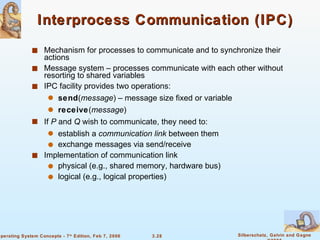


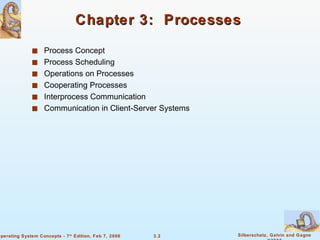
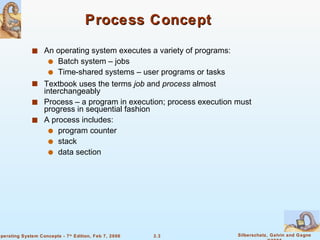
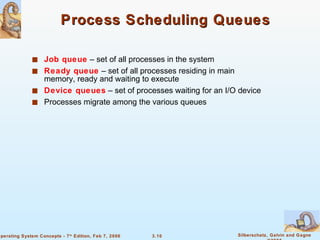
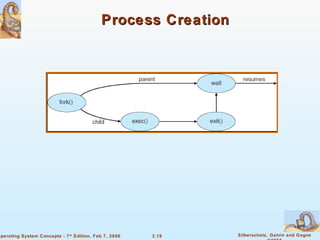
Chapter 3 discusses processes and process scheduling in operating systems. Key points include: - A process includes the program code, program counter, stack, data, and process state information stored in a process control block (PCB). - The operating system uses queues like ready queues and I/O queues to schedule processes between running, waiting, and ready states using long-term and short-term schedulers. - Processes can cooperate through interprocess communication (IPC) using message passing or shared memory. Common IPC examples are producer-consumer problems and client-server systems.


