Process And 
Process States
CONTENT: 
 Introduction 
 Process 
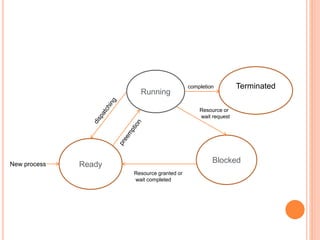
 Process States 
 Process State Transition 
 State Transition Description 
 Suspended Process
PROCESS 
 Process is a Programme in an Execution State. 
 It is Asynchronous and Dispatchable unit. 
 In all multiprogramming system that can 
support thousands of users follow the concept 
of process. 
 Creation and Deletion of both user and system 
process. 
 The scheduling of that process provision of 
mechanism or synchronisation.
PROCESS STATES 
 The process state is an indicator of the nature 
of the current activity in a process. 
 The notion of process state is introduced to 
simplify control of process by the operating 
system.
Running 
Ready 
completion Terminated 
Blocked 
New process 
Resource granted or 
wait completed 
Resource or 
wait request
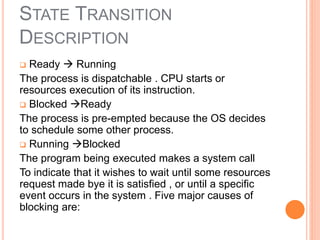
STATE TRANSITION 
DESCRIPTION 
 Ready  Running 
The process is dispatchable . CPU starts or 
resources execution of its instruction. 
 Blocked Ready 
The process is pre-empted because the OS decides 
to schedule some other process. 
 Running Blocked 
The program being executed makes a system call 
To indicate that it wishes to wait until some resources 
request made bye it is satisfied , or until a specific 
event occurs in the system . Five major causes of 
blocking are:
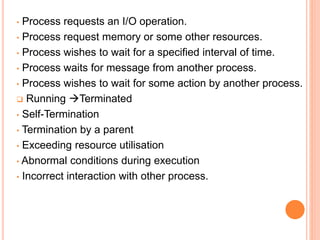
• Process requests an I/O operation. 
• Process request memory or some other resources. 
• Process wishes to wait for a specified interval of time. 
• Process waits for message from another process. 
• Process wishes to wait for some action by another process. 
 Running Terminated 
• Self-Termination 
• Termination by a parent 
• Exceeding resource utilisation 
• Abnormal conditions during execution 
• Incorrect interaction with other process.
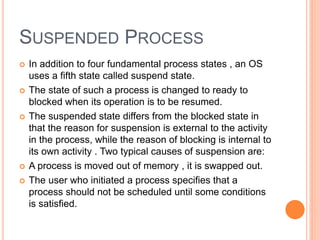
SUSPENDED PROCESS 
 In addition to four fundamental process states , an OS 
uses a fifth state called suspend state. 
 The state of such a process is changed to ready to 
blocked when its operation is to be resumed. 
 The suspended state differs from the blocked state in 
that the reason for suspension is external to the activity 
in the process, while the reason of blocking is internal to 
its own activity . Two typical causes of suspension are: 
 A process is moved out of memory , it is swapped out. 
 The user who initiated a process specifies that a 
process should not be scheduled until some conditions 
is satisfied.
 Two suspend states called ready swapped and 
blocked swapped. 
 Transitions from the ready to ready swapped state 
and blocked to blocked swapped state are caused 
by a swap-out action. 
 The blocked swapped transition takes place if the 
request for which the process was waiting is 
granted even while the process is in a suspended 
state.
Ready 
Swapped 
Blocked 
Swapped 
B 
Resource granted or 
wait complete 
Swap out Swap in 
Swap out Swap in
THANK YOU
ANY QUERIES?

Process in operating system

  • 1.
  • 2.
    CONTENT:  Introduction  Process  Process States  Process State Transition  State Transition Description  Suspended Process
  • 3.
    PROCESS  Processis a Programme in an Execution State.  It is Asynchronous and Dispatchable unit.  In all multiprogramming system that can support thousands of users follow the concept of process.  Creation and Deletion of both user and system process.  The scheduling of that process provision of mechanism or synchronisation.
  • 4.
    PROCESS STATES The process state is an indicator of the nature of the current activity in a process.  The notion of process state is introduced to simplify control of process by the operating system.
  • 5.
    Running Ready completionTerminated Blocked New process Resource granted or wait completed Resource or wait request
  • 6.
    STATE TRANSITION DESCRIPTION  Ready  Running The process is dispatchable . CPU starts or resources execution of its instruction.  Blocked Ready The process is pre-empted because the OS decides to schedule some other process.  Running Blocked The program being executed makes a system call To indicate that it wishes to wait until some resources request made bye it is satisfied , or until a specific event occurs in the system . Five major causes of blocking are:
  • 7.
    • Process requestsan I/O operation. • Process request memory or some other resources. • Process wishes to wait for a specified interval of time. • Process waits for message from another process. • Process wishes to wait for some action by another process.  Running Terminated • Self-Termination • Termination by a parent • Exceeding resource utilisation • Abnormal conditions during execution • Incorrect interaction with other process.
  • 8.
    SUSPENDED PROCESS In addition to four fundamental process states , an OS uses a fifth state called suspend state.  The state of such a process is changed to ready to blocked when its operation is to be resumed.  The suspended state differs from the blocked state in that the reason for suspension is external to the activity in the process, while the reason of blocking is internal to its own activity . Two typical causes of suspension are:  A process is moved out of memory , it is swapped out.  The user who initiated a process specifies that a process should not be scheduled until some conditions is satisfied.
  • 9.
     Two suspendstates called ready swapped and blocked swapped.  Transitions from the ready to ready swapped state and blocked to blocked swapped state are caused by a swap-out action.  The blocked swapped transition takes place if the request for which the process was waiting is granted even while the process is in a suspended state.
  • 10.
    Ready Swapped Blocked Swapped B Resource granted or wait complete Swap out Swap in Swap out Swap in
  • 11.
  • 12.