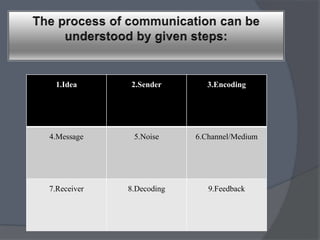
1.Idea 2.Sender 3.Encoding
4.Message 5.Noise 6.Channel/Medium
7.Receiver 8.Decoding 9.Feedback
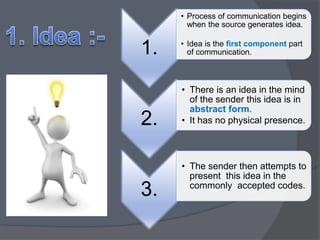
1.
• Process of communication begins
when the source generates idea.
• Idea is the first component part
of communication.
2.
• There is an idea in the mind
of the sender this idea is in
abstract form.
• It has no physical presence.
3.
• The sender then attempts to
present this idea in the
commonly accepted codes.
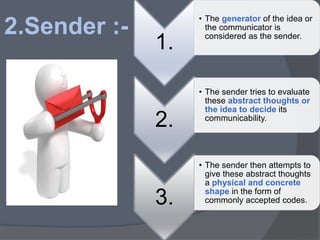
2.Sender :-
1.
• The generator of the idea or
the communicator is
considered as the sender.
2.
• The sender tries to evaluate
these abstract thoughts or
the idea to decide its
communicability.
3.
• The sender then attempts to
give these abstract thoughts
a physical and concrete
shape in the form of
commonly accepted codes.
1.
• The process of coding the
abstract ideas in to
commonly accepted
human language is known
as encoding.
2.
• The process of encoding
is shaped by the sender
socio-cultural out-look.
3.
• It is also modified by the
sender’s attitude ,ability,
psyche, personality and
philosophy.
1.
• The encoded idea is termed
as message.
2.
• An idea is abstract entity
where as message is the
physical output derived from
that ‘abstract entity’.
3.
• A message can be some
information,ideas,feelings and
appropriate way to transmit
this message to the proposed
receiver.
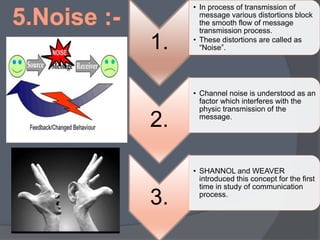
1.
• In process of transmission of
message various distortions block
the smooth flow of message
transmission process.
• These distortions are called as
“Noise”.
2.
• Channel noise is understood as an
factor which interferes with the
physic transmission of the
message.
3.
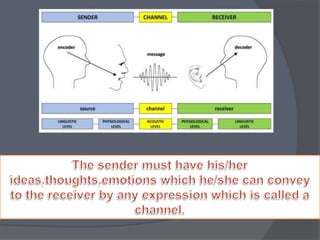
• SHANNOL and WEAVER
introduced this concept for the first
time in study of communication
process.
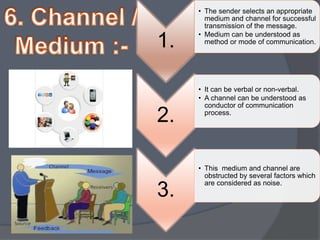
1.
• The sender selects an appropriate
medium and channel for successful
transmission of the message.
• Medium can be understood as
method or mode of communication.
2.
• It can be verbal or non-verbal.
• A channel can be understood as
conductor of communication
process.
3.
• This medium and channel are
obstructed by several factors which
are considered as noise.
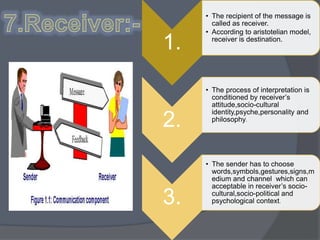
1.
• The recipient of the message is
called as receiver.
• According to aristotelian model,
receiver is destination.
2.
• The process of interpretation is
conditioned by receiver’s
attitude,socio-cultural
identity,psyche,personality and
philosophy.
3.
• The sender has to choose
words,symbols,gestures,signs,m
edium and channel which can
acceptable in receiver’s socio-
cultural,socio-political and
psychological context.
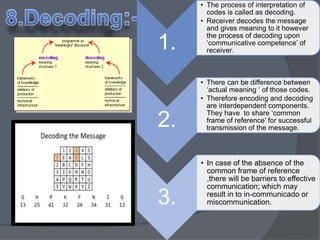
1.
• The process of interpretation of
codes is called as decoding.
• Receiver decodes the message
and gives meaning to it however
the process of decoding upon
‘communicative competence’ of
receiver.
2.
• There can be difference between
‘actual meaning ‘ of those codes.
• Therefore encoding and decoding
are interdependent components.
They have to share ‘common
frame of reference’ for successful
transmission of the message.
3.
• In case of the absence of the
common frame of reference
,there will be barriers to effective
communication; which may
result in to in-communicado or
miscommunication.
1.
• The response given by the receiver
to the sender is considered as
feedback.
• The sender needs response of the
receiver in order to decide
effectiveness of communication.
2.
• Feedback plays a very vital role in
the process of communication.
• If the appropriate feedback is given
by the receiver to the sender then
the sender can modify his strategy
of communication.
3.
• The sender also get clues about
which medium will facilitate the
process of communication.
• The receiver transmits the feedback
choosing appropriate medium and
channel to the receiver.
Process of communication skills

Process of communication skills

  • 6.
    1.Idea 2.Sender 3.Encoding 4.Message5.Noise 6.Channel/Medium 7.Receiver 8.Decoding 9.Feedback
  • 7.
    1. • Process ofcommunication begins when the source generates idea. • Idea is the first component part of communication. 2. • There is an idea in the mind of the sender this idea is in abstract form. • It has no physical presence. 3. • The sender then attempts to present this idea in the commonly accepted codes.
  • 8.
    2.Sender :- 1. • Thegenerator of the idea or the communicator is considered as the sender. 2. • The sender tries to evaluate these abstract thoughts or the idea to decide its communicability. 3. • The sender then attempts to give these abstract thoughts a physical and concrete shape in the form of commonly accepted codes.
  • 9.
    1. • The processof coding the abstract ideas in to commonly accepted human language is known as encoding. 2. • The process of encoding is shaped by the sender socio-cultural out-look. 3. • It is also modified by the sender’s attitude ,ability, psyche, personality and philosophy.
  • 10.
    1. • The encodedidea is termed as message. 2. • An idea is abstract entity where as message is the physical output derived from that ‘abstract entity’. 3. • A message can be some information,ideas,feelings and appropriate way to transmit this message to the proposed receiver.
  • 11.
    1. • In processof transmission of message various distortions block the smooth flow of message transmission process. • These distortions are called as “Noise”. 2. • Channel noise is understood as an factor which interferes with the physic transmission of the message. 3. • SHANNOL and WEAVER introduced this concept for the first time in study of communication process.
  • 12.
    1. • The senderselects an appropriate medium and channel for successful transmission of the message. • Medium can be understood as method or mode of communication. 2. • It can be verbal or non-verbal. • A channel can be understood as conductor of communication process. 3. • This medium and channel are obstructed by several factors which are considered as noise.
  • 13.
    1. • The recipientof the message is called as receiver. • According to aristotelian model, receiver is destination. 2. • The process of interpretation is conditioned by receiver’s attitude,socio-cultural identity,psyche,personality and philosophy. 3. • The sender has to choose words,symbols,gestures,signs,m edium and channel which can acceptable in receiver’s socio- cultural,socio-political and psychological context.
  • 14.
    1. • The processof interpretation of codes is called as decoding. • Receiver decodes the message and gives meaning to it however the process of decoding upon ‘communicative competence’ of receiver. 2. • There can be difference between ‘actual meaning ‘ of those codes. • Therefore encoding and decoding are interdependent components. They have to share ‘common frame of reference’ for successful transmission of the message. 3. • In case of the absence of the common frame of reference ,there will be barriers to effective communication; which may result in to in-communicado or miscommunication.
  • 15.
    1. • The responsegiven by the receiver to the sender is considered as feedback. • The sender needs response of the receiver in order to decide effectiveness of communication. 2. • Feedback plays a very vital role in the process of communication. • If the appropriate feedback is given by the receiver to the sender then the sender can modify his strategy of communication. 3. • The sender also get clues about which medium will facilitate the process of communication. • The receiver transmits the feedback choosing appropriate medium and channel to the receiver.