Introduction to Statistics – Chapter 1 
Applied Research Methods in Social Sciences – Faculty of Political Sciences - University Babeș-Bolyai Cluj 
Beca Marușa 
Page 1 of 11 
PROBLEMS – Homework 1 
TABLE OF CONTENTS 
Answer ex 1 ................................................................................................................................................... 2 
Answer ex 2 ................................................................................................................................................... 2 
Answer ex 3 ................................................................................................................................................... 2 
Answer ex 4 ................................................................................................................................................... 2 
Answer ex 5 ................................................................................................................................................... 3 
Answer ex 6 ................................................................................................................................................... 4 
Answer ex 7 ................................................................................................................................................... 4 
Answer ex 8 ................................................................................................................................................... 4 
Answer ex 9 ................................................................................................................................................... 4 
Answer ex 10 ................................................................................................................................................. 5 
Answer ex 11 ................................................................................................................................................. 5 
Answer ex 12 ................................................................................................................................................. 6 
Answer ex 13 ................................................................................................................................................. 6 
Answer ex 14 ................................................................................................................................................. 6 
Answer ex 15 ................................................................................................................................................. 7 
Answer ex 16 ................................................................................................................................................. 7 
Answer ex 17 ................................................................................................................................................. 8 
Answer ex 18 ................................................................................................................................................. 8 
Answer ex 19 ................................................................................................................................................. 9 
Answer ex 20 ................................................................................................................................................. 9 
Answer ex 21 ............................................................................................................................................... 10 
Answer ex 22 ............................................................................................................................................... 11 
Answer ex 23 ............................................................................................................................................... 11
Introduction to Statistics – Chapter 1 
Applied Research Methods in Social Sciences – Faculty of Political Sciences - University Babeș-Bolyai Cluj 
Beca Marușa 
Page 2 of 11 
1. A researcher is investigating the effectiveness of a treatment for adolescent boys who are taking medication for depression. A group of 30 boys is selected and half receive the new treatment in addition to their medication and the other half continue to take their medication without any treatment. For this study, 
a. Identify the population. b. Identify the sample. 
Answer ex 1 
a. Population = all adolescent boys who are taking medication for depression 
b. Sample = 30 adolescent boys who are taking medication for depression 
2. Define the terms population, sample, parameter, and statistic. 
Answer ex 2 
A population is the entire set of the individuals of interest for a particular research question. A sample is a set of individuals selected from a population, usually intended to represent the population in a research study. A parameter is a value, usually a numerical value, that describes a population. A parameter is usually derived from measurements of the individuals in the population. A statistic is a value, usually a numerical value, that describes a sample. A statistic is usually derived from measurements of the individuals in the sample. 
3. Statistical methods are classified into two major categories: descriptive and inferential. Describe the general purpose for the statistical methods in each category. 
Answer ex 3 
Descriptive statistics are statistical procedures used to summarize, organize, and simplify data. Inferential statistics consist of techniques that allow us to study samples and then make generalizations about the populations from which they were selected. 
4. Define the concept of sampling error and explain why this phenomenon creates a problem to be addressed by inferential statistics. 
Answer ex 4 
Sampling error is the naturally occurring discrepancy, or error, that exists between a sample statistic and the corresponding population parameter. If the sample data show a difference between the two methods of studying there are two ways to interpret the results: 1. There actually is no difference between the two studying methods, and the sample difference is due to chance (sampling error).
Introduction to Statistics – Chapter 1 
Applied Research Methods in Social Sciences – Faculty of Political Sciences - University Babeș-Bolyai Cluj 
Beca Marușa 
Page 3 of 11 
2. There really is a difference between the two methods, and the sample data accurately reflect this difference. The goal of inferential statistics is to help researchers decide between the two interpretations. 
5. Describe the data for a correlational research study. Explain how these data are different from the data obtained in experimental and nonexperimental studies, which also evaluate relationships between two variables. 
Answer ex 5 
In the correlational method, two different variables are observed to determine whether there is a relationship between them. A research study that simply measures two different variables for each individual is an example of the correlational method, or the correlational research strategy. One method for examining the relationship between variables is to observe the two variables as they exist naturally for a set of individuals. That is, simply measure the two variables for each individual. In the experimental method, one variable is manipulated while another variable is observed and measured. To establish a cause-and-effect relationship between the two variables, an experiment attempts to control all other variables to prevent them from influencing the results. In correlational research variables are not manipulated, but are only measured. The purpose is to identify the relationship between the variables. For example, correlation between the set of variables -- such as blood pressure and cholesterol level -- is examined. In experimental research, variables are manipulated, and the effects of this manipulation is measured upon the dependent variable. In experimental research a treatment is deliberately imposed on a group of objects or participants. In other words, blood pressure can be artificially increased by a researcher; and then cholesterol level is recorded, showing increase or decrease. If changes that are made in variable A lead to changes in variable B, then the conclusion that “A influences B” can be made. Causal relations between variables can only be conclusively demonstrated by experimental data. Data from correlational research cannot prove causality: correlation does not equal causation. 
6. What is the goal for an experimental research study? Identify the two elements that are necessary for an experiment to achieve its goal.
Introduction to Statistics – Chapter 1 
Applied Research Methods in Social Sciences – Faculty of Political Sciences - University Babeș-Bolyai Cluj 
Beca Marușa 
Page 4 of 11 
Answer ex 6 
In the experimental method, one variable is manipulated while another variable is observed and measured. To establish a cause-and-effect relationship between the two variables, an experiment attempts to control all other variables to prevent them from influencing the results. First, the researcher must manipulate one of the two variables being studied. Second, all other variables that might influence the results must be controlled. 
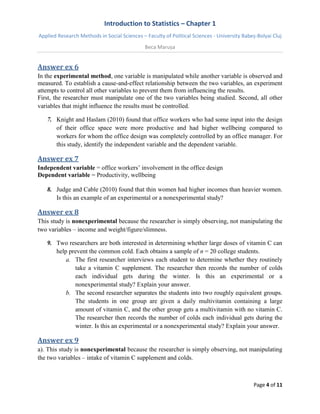
7. Knight and Haslam (2010) found that office workers who had some input into the design of their office space were more productive and had higher wellbeing compared to workers for whom the office design was completely controlled by an office manager. For this study, identify the independent variable and the dependent variable. 
Answer ex 7 
Independent variable = office workers’ involvement in the office design Dependent variable = Productivity, wellbeing 
8. Judge and Cable (2010) found that thin women had higher incomes than heavier women. Is this an example of an experimental or a nonexperimental study? 
Answer ex 8 
This study is nonexperimental because the researcher is simply observing, not manipulating the two variables – income and weight/figure/slimness. 
9. Two researchers are both interested in determining whether large doses of vitamin C can help prevent the common cold. Each obtains a sample of n = 20 college students. 
a. The first researcher interviews each student to determine whether they routinely take a vitamin C supplement. The researcher then records the number of colds each individual gets during the winter. Is this an experimental or a nonexperimental study? Explain your answer. 
b. The second researcher separates the students into two roughly equivalent groups. The students in one group are given a daily multivitamin containing a large amount of vitamin C, and the other group gets a multivitamin with no vitamin C. The researcher then records the number of colds each individual gets during the winter. Is this an experimental or a nonexperimental study? Explain your answer. 
Answer ex 9 
a). This study is nonexperimental because the researcher is simply observing, not manipulating the two variables – intake of vitamin C supplement and colds.
Introduction to Statistics – Chapter 1 
Applied Research Methods in Social Sciences – Faculty of Political Sciences - University Babeș-Bolyai Cluj 
Beca Marușa 
Page 5 of 11 
b). This study is experimental because the researcher manipulates one variable – intake of vitamin C supplement and observes and measures the other variable – colds. Also, the researcher controls other variables that might influence the results like the weather. 
10. Weinstein, McDermott, and Roediger (2010) conducted an experiment to evaluate the effectiveness of different study strategies. One part of the study asked students to prepare for a test by reading a passage. In one condition, students generated and answered questions after reading the passage. In a second condition, students simply read the passage a second time. All students were then given a test on the passage material and the researchers recorded the number of correct answers. 
a. Identify the dependent variable for this study. 
b. Is the dependent variable discrete or continuous? 
c. What scale of measurement (nominal, ordinal, interval, or ratio) is used to measure the dependent variable? 
Answer ex 10 
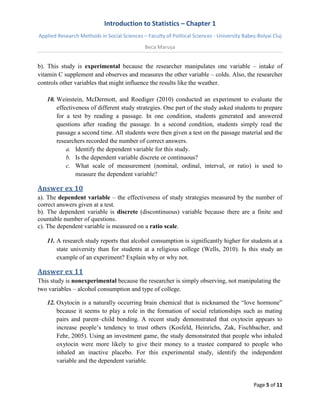
a). The dependent variable – the effectiveness of study strategies measured by the number of correct answers given at a test. b). The dependent variable is discrete (discontinuous) variable because there are a finite and countable number of questions. c). The dependent variable is measured on a ratio scale. 
11. A research study reports that alcohol consumption is significantly higher for students at a state university than for students at a religious college (Wells, 2010). Is this study an example of an experiment? Explain why or why not. 
Answer ex 11 
This study is nonexperimental because the researcher is simply observing, not manipulating the two variables – alcohol consumption and type of college. 
12. Oxytocin is a naturally occurring brain chemical that is nicknamed the “love hormone” because it seems to play a role in the formation of social relationships such as mating pairs and parent–child bonding. A recent study demonstrated that oxytocin appears to increase people’s tendency to trust others (Kosfeld, Heinrichs, Zak, Fischbacher, and Fehr, 2005). Using an investment game, the study demonstrated that people who inhaled oxytocin were more likely to give their money to a trustee compared to people who inhaled an inactive placebo. For this experimental study, identify the independent variable and the dependent variable.
Introduction to Statistics – Chapter 1 
Applied Research Methods in Social Sciences – Faculty of Political Sciences - University Babeș-Bolyai Cluj 
Beca Marușa 
Page 6 of 11 
Answer ex 12 
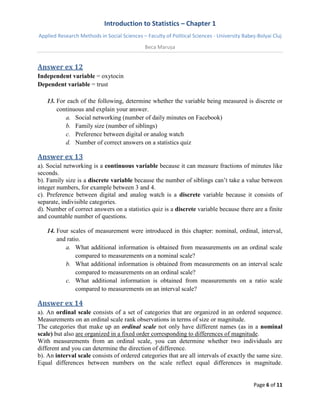
Independent variable = oxytocin Dependent variable = trust 
13. For each of the following, determine whether the variable being measured is discrete or continuous and explain your answer. 
a. Social networking (number of daily minutes on Facebook) 
b. Family size (number of siblings) 
c. Preference between digital or analog watch 
d. Number of correct answers on a statistics quiz 
Answer ex 13 
a). Social networking is a continuous variable because it can measure fractions of minutes like seconds. b). Family size is a discrete variable because the number of siblings can’t take a value between integer numbers, for example between 3 and 4. c). Preference between digital and analog watch is a discrete variable because it consists of separate, indivisible categories. d). Number of correct answers on a statistics quiz is a discrete variable because there are a finite and countable number of questions. 
14. Four scales of measurement were introduced in this chapter: nominal, ordinal, interval, and ratio. 
a. What additional information is obtained from measurements on an ordinal scale compared to measurements on a nominal scale? 
b. What additional information is obtained from measurements on an interval scale compared to measurements on an ordinal scale? 
c. What additional information is obtained from measurements on a ratio scale compared to measurements on an interval scale? 
Answer ex 14 
a). An ordinal scale consists of a set of categories that are organized in an ordered sequence. Measurements on an ordinal scale rank observations in terms of size or magnitude. The categories that make up an ordinal scale not only have different names (as in a nominal scale) but also are organized in a fixed order corresponding to differences of magnitude. With measurements from an ordinal scale, you can determine whether two individuals are different and you can determine the direction of difference. 
b). An interval scale consists of ordered categories that are all intervals of exactly the same size. Equal differences between numbers on the scale reflect equal differences in magnitude.
Introduction to Statistics – Chapter 1 
Applied Research Methods in Social Sciences – Faculty of Political Sciences - University Babeș-Bolyai Cluj 
Beca Marușa 
Page 7 of 11 
However, the zero point on an interval scale is arbitrary and does not indicate a zero amount of the variable being measured. An interval scale consist of a series of ordered categories (like an ordinal scale) with the additional requirement that the categories form a series of intervals that are all exactly the same size. Thus, the scale of measurement consists of a series of equal intervals, such as inches on a ruler. c). A ratio scale is an interval scale with the additional feature of an absolute zero point. With a ratio scale, ratios of numbers do reflect ratios of magnitude. The factor that differentiates an interval scale from a ratio scale is the nature of the zero point. An interval scale has an arbitrary zero point. A ratio scale is anchored by a zero point that is not arbitrary but rather is a meaningful value representing none (a complete absence) of the variable being measured. 
15. In an experiment examining the effects Tai Chi on arthritis pain, Callahan (2009) selected a large sample of individuals with doctor-diagnosed arthritis. Half of the participants immediately began a Tai Chi course and the other half (the control group) waited 8 weeks before beginning the program. At the end of 8 weeks, the individuals who had experienced Tai Chi had less arthritis pain that those who had not participated in the course. 
a. Identify the independent variable for this study. 
b. What scale of measurement is used for the independent variable? 
c. Identify the dependent variable for this study. 
d. What scale of measurement is used for the dependent variable? 
Answer ex 15 
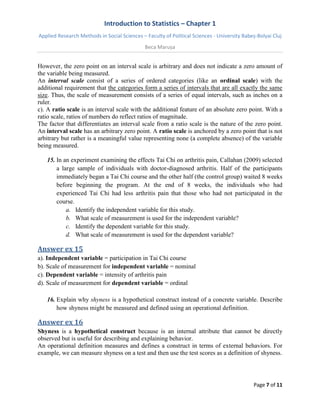
a). Independent variable = participation in Tai Chi course b). Scale of measurement for independent variable = nominal c). Dependent variable = intensity of arthritis pain d). Scale of measurement for dependent variable = ordinal 
16. Explain why shyness is a hypothetical construct instead of a concrete variable. Describe how shyness might be measured and defined using an operational definition. 
Answer ex 16 
Shyness is a hypothetical construct because is an internal attribute that cannot be directly observed but is useful for describing and explaining behavior. An operational definition measures and defines a construct in terms of external behaviors. For example, we can measure shyness on a test and then use the test scores as a definition of shyness.
Introduction to Statistics – Chapter 1 
Applied Research Methods in Social Sciences – Faculty of Political Sciences - University Babeș-Bolyai Cluj 
Beca Marușa 
Page 8 of 11 
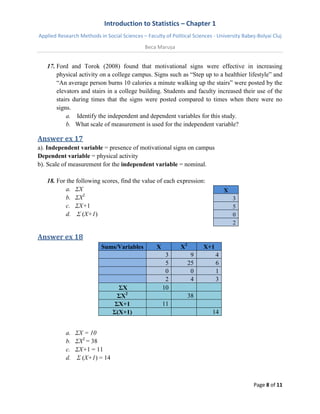
17. Ford and Torok (2008) found that motivational signs were effective in increasing physical activity on a college campus. Signs such as “Step up to a healthier lifestyle” and “An average person burns 10 calories a minute walking up the stairs” were posted by the elevators and stairs in a college building. Students and faculty increased their use of the stairs during times that the signs were posted compared to times when there were no signs. 
a. Identify the independent and dependent variables for this study. 
b. What scale of measurement is used for the independent variable? 
Answer ex 17 
a). Independent variable = presence of motivational signs on campus Dependent variable = physical activity b). Scale of measurement for the independent variable = nominal. 
18. For the following scores, find the value of each expression: 
a. ΣX 
b. ΣX2 
c. ΣX+1 
d. Σ (X+1) 
X 3 5 0 2 
Answer ex 18 Sums/Variables X X2 X+1 3 9 4 5 25 6 0 0 1 2 4 3 ΣX 10 ΣX2 38 ΣX+1 11 Σ(X+1) 14 
a. ΣX = 10 
b. ΣX2 = 38 
c. ΣX+1 = 11 
d. Σ (X+1) = 14
Introduction to Statistics – Chapter 1 
Applied Research Methods in Social Sciences – Faculty of Political Sciences - University Babeș-Bolyai Cluj 
Beca Marușa 
Page 9 of 11 
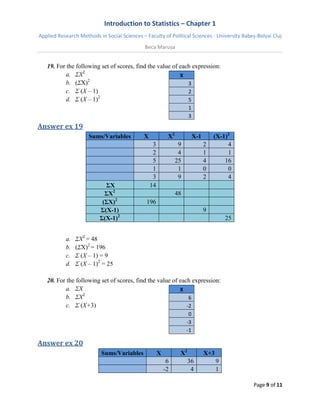
19. For the following set of scores, find the value of each expression: 
a. ΣX2 
b. (ΣX)2 
c. Σ (X – 1) 
d. Σ (X – 1)2 
X 3 2 5 1 3 
Answer ex 19 Sums/Variables X X2 X-1 (X-1)2 3 9 2 4 2 4 1 1 5 25 4 16 1 1 0 0 3 9 2 4 ΣX 14 ΣX2 48 (ΣX)2 196 Σ(X-1) 9 Σ(X-1)2 25 
a. ΣX2 = 48 
b. (ΣX)2 = 196 
c. Σ (X – 1) = 9 
d. Σ (X – 1)2 = 25 
20. For the following set of scores, find the value of each expression: 
a. ΣX 
b. ΣX2 
c. Σ (X+3) 
X 6 -2 0 -3 -1 
Answer ex 20 Sums/Variables X X2 X+3 6 36 9 -2 4 1
Introduction to Statistics – Chapter 1 
Applied Research Methods in Social Sciences – Faculty of Political Sciences - University Babeș-Bolyai Cluj 
Beca Marușa 
Page 10 of 11 
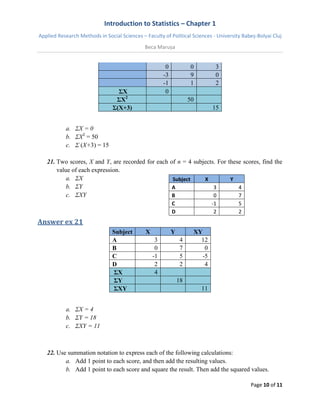
0 0 3 -3 9 0 -1 1 2 ΣX 0 ΣX2 50 Σ(X+3) 15 
a. ΣX = 0 
b. ΣX2 = 50 
c. Σ (X+3) = 15 
21. Two scores, X and Y, are recorded for each of n = 4 subjects. For these scores, find the value of each expression. 
a. ΣX 
b. ΣY 
c. ΣXY 
Subject X Y 
A 
3 
4 
B 
0 
7 
C 
-1 
5 
D 
2 
2 
Answer ex 21 Subject X Y XY 
A 
3 
4 
12 
B 
0 
7 
0 
C 
-1 
5 
-5 
D 
2 
2 
4 ΣX 4 ΣY 18 ΣXY 11 
a. ΣX = 4 
b. ΣY = 18 
c. ΣXY = 11 
22. Use summation notation to express each of the following calculations: 
a. Add 1 point to each score, and then add the resulting values. 
b. Add 1 point to each score and square the result. Then add the squared values.
Introduction to Statistics – Chapter 1 
Applied Research Methods in Social Sciences – Faculty of Political Sciences - University Babeș-Bolyai Cluj 
Beca Marușa 
Page 11 of 11 
c. Add the scores and square the sum. Then subtract 3 points from the squared value. 
Answer ex 22 
a. Add 1 point to each score, and then add the resulting values. - Σ (X+1) 
b. Add 1 point to each score and square the result. Then add the squared values. – 
Σ (X+1)2 
c. Add the scores and square the sum. Then subtract 3 points from the squared value. – (ΣX)2-3 
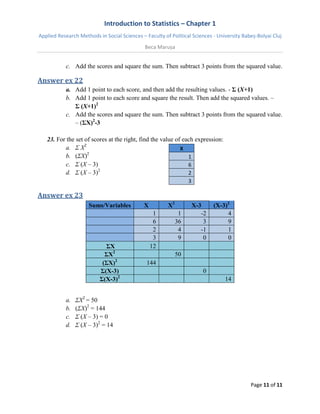
23. For the set of scores at the right, find the value of each expression: 
a. Σ X2 
b. (ΣX)2 
c. Σ (X – 3) 
d. Σ (X – 3)2 
X 1 6 2 3 
Answer ex 23 Sums/Variables X X2 X-3 (X-3)2 1 1 -2 4 6 36 3 9 2 4 -1 1 3 9 0 0 ΣX 12 ΣX2 50 (ΣX)2 144 Σ(X-3) 0 Σ(X-3)2 14 
a. ΣX2 = 50 
b. (ΣX)2 = 144 
c. Σ (X – 3) = 0 
d. Σ (X – 3)2 = 14

Problems statistics 1

  • 1.
    Introduction to Statistics– Chapter 1 Applied Research Methods in Social Sciences – Faculty of Political Sciences - University Babeș-Bolyai Cluj Beca Marușa Page 1 of 11 PROBLEMS – Homework 1 TABLE OF CONTENTS Answer ex 1 ................................................................................................................................................... 2 Answer ex 2 ................................................................................................................................................... 2 Answer ex 3 ................................................................................................................................................... 2 Answer ex 4 ................................................................................................................................................... 2 Answer ex 5 ................................................................................................................................................... 3 Answer ex 6 ................................................................................................................................................... 4 Answer ex 7 ................................................................................................................................................... 4 Answer ex 8 ................................................................................................................................................... 4 Answer ex 9 ................................................................................................................................................... 4 Answer ex 10 ................................................................................................................................................. 5 Answer ex 11 ................................................................................................................................................. 5 Answer ex 12 ................................................................................................................................................. 6 Answer ex 13 ................................................................................................................................................. 6 Answer ex 14 ................................................................................................................................................. 6 Answer ex 15 ................................................................................................................................................. 7 Answer ex 16 ................................................................................................................................................. 7 Answer ex 17 ................................................................................................................................................. 8 Answer ex 18 ................................................................................................................................................. 8 Answer ex 19 ................................................................................................................................................. 9 Answer ex 20 ................................................................................................................................................. 9 Answer ex 21 ............................................................................................................................................... 10 Answer ex 22 ............................................................................................................................................... 11 Answer ex 23 ............................................................................................................................................... 11
  • 2.
    Introduction to Statistics– Chapter 1 Applied Research Methods in Social Sciences – Faculty of Political Sciences - University Babeș-Bolyai Cluj Beca Marușa Page 2 of 11 1. A researcher is investigating the effectiveness of a treatment for adolescent boys who are taking medication for depression. A group of 30 boys is selected and half receive the new treatment in addition to their medication and the other half continue to take their medication without any treatment. For this study, a. Identify the population. b. Identify the sample. Answer ex 1 a. Population = all adolescent boys who are taking medication for depression b. Sample = 30 adolescent boys who are taking medication for depression 2. Define the terms population, sample, parameter, and statistic. Answer ex 2 A population is the entire set of the individuals of interest for a particular research question. A sample is a set of individuals selected from a population, usually intended to represent the population in a research study. A parameter is a value, usually a numerical value, that describes a population. A parameter is usually derived from measurements of the individuals in the population. A statistic is a value, usually a numerical value, that describes a sample. A statistic is usually derived from measurements of the individuals in the sample. 3. Statistical methods are classified into two major categories: descriptive and inferential. Describe the general purpose for the statistical methods in each category. Answer ex 3 Descriptive statistics are statistical procedures used to summarize, organize, and simplify data. Inferential statistics consist of techniques that allow us to study samples and then make generalizations about the populations from which they were selected. 4. Define the concept of sampling error and explain why this phenomenon creates a problem to be addressed by inferential statistics. Answer ex 4 Sampling error is the naturally occurring discrepancy, or error, that exists between a sample statistic and the corresponding population parameter. If the sample data show a difference between the two methods of studying there are two ways to interpret the results: 1. There actually is no difference between the two studying methods, and the sample difference is due to chance (sampling error).
  • 3.
    Introduction to Statistics– Chapter 1 Applied Research Methods in Social Sciences – Faculty of Political Sciences - University Babeș-Bolyai Cluj Beca Marușa Page 3 of 11 2. There really is a difference between the two methods, and the sample data accurately reflect this difference. The goal of inferential statistics is to help researchers decide between the two interpretations. 5. Describe the data for a correlational research study. Explain how these data are different from the data obtained in experimental and nonexperimental studies, which also evaluate relationships between two variables. Answer ex 5 In the correlational method, two different variables are observed to determine whether there is a relationship between them. A research study that simply measures two different variables for each individual is an example of the correlational method, or the correlational research strategy. One method for examining the relationship between variables is to observe the two variables as they exist naturally for a set of individuals. That is, simply measure the two variables for each individual. In the experimental method, one variable is manipulated while another variable is observed and measured. To establish a cause-and-effect relationship between the two variables, an experiment attempts to control all other variables to prevent them from influencing the results. In correlational research variables are not manipulated, but are only measured. The purpose is to identify the relationship between the variables. For example, correlation between the set of variables -- such as blood pressure and cholesterol level -- is examined. In experimental research, variables are manipulated, and the effects of this manipulation is measured upon the dependent variable. In experimental research a treatment is deliberately imposed on a group of objects or participants. In other words, blood pressure can be artificially increased by a researcher; and then cholesterol level is recorded, showing increase or decrease. If changes that are made in variable A lead to changes in variable B, then the conclusion that “A influences B” can be made. Causal relations between variables can only be conclusively demonstrated by experimental data. Data from correlational research cannot prove causality: correlation does not equal causation. 6. What is the goal for an experimental research study? Identify the two elements that are necessary for an experiment to achieve its goal.
  • 4.
    Introduction to Statistics– Chapter 1 Applied Research Methods in Social Sciences – Faculty of Political Sciences - University Babeș-Bolyai Cluj Beca Marușa Page 4 of 11 Answer ex 6 In the experimental method, one variable is manipulated while another variable is observed and measured. To establish a cause-and-effect relationship between the two variables, an experiment attempts to control all other variables to prevent them from influencing the results. First, the researcher must manipulate one of the two variables being studied. Second, all other variables that might influence the results must be controlled. 7. Knight and Haslam (2010) found that office workers who had some input into the design of their office space were more productive and had higher wellbeing compared to workers for whom the office design was completely controlled by an office manager. For this study, identify the independent variable and the dependent variable. Answer ex 7 Independent variable = office workers’ involvement in the office design Dependent variable = Productivity, wellbeing 8. Judge and Cable (2010) found that thin women had higher incomes than heavier women. Is this an example of an experimental or a nonexperimental study? Answer ex 8 This study is nonexperimental because the researcher is simply observing, not manipulating the two variables – income and weight/figure/slimness. 9. Two researchers are both interested in determining whether large doses of vitamin C can help prevent the common cold. Each obtains a sample of n = 20 college students. a. The first researcher interviews each student to determine whether they routinely take a vitamin C supplement. The researcher then records the number of colds each individual gets during the winter. Is this an experimental or a nonexperimental study? Explain your answer. b. The second researcher separates the students into two roughly equivalent groups. The students in one group are given a daily multivitamin containing a large amount of vitamin C, and the other group gets a multivitamin with no vitamin C. The researcher then records the number of colds each individual gets during the winter. Is this an experimental or a nonexperimental study? Explain your answer. Answer ex 9 a). This study is nonexperimental because the researcher is simply observing, not manipulating the two variables – intake of vitamin C supplement and colds.
  • 5.
    Introduction to Statistics– Chapter 1 Applied Research Methods in Social Sciences – Faculty of Political Sciences - University Babeș-Bolyai Cluj Beca Marușa Page 5 of 11 b). This study is experimental because the researcher manipulates one variable – intake of vitamin C supplement and observes and measures the other variable – colds. Also, the researcher controls other variables that might influence the results like the weather. 10. Weinstein, McDermott, and Roediger (2010) conducted an experiment to evaluate the effectiveness of different study strategies. One part of the study asked students to prepare for a test by reading a passage. In one condition, students generated and answered questions after reading the passage. In a second condition, students simply read the passage a second time. All students were then given a test on the passage material and the researchers recorded the number of correct answers. a. Identify the dependent variable for this study. b. Is the dependent variable discrete or continuous? c. What scale of measurement (nominal, ordinal, interval, or ratio) is used to measure the dependent variable? Answer ex 10 a). The dependent variable – the effectiveness of study strategies measured by the number of correct answers given at a test. b). The dependent variable is discrete (discontinuous) variable because there are a finite and countable number of questions. c). The dependent variable is measured on a ratio scale. 11. A research study reports that alcohol consumption is significantly higher for students at a state university than for students at a religious college (Wells, 2010). Is this study an example of an experiment? Explain why or why not. Answer ex 11 This study is nonexperimental because the researcher is simply observing, not manipulating the two variables – alcohol consumption and type of college. 12. Oxytocin is a naturally occurring brain chemical that is nicknamed the “love hormone” because it seems to play a role in the formation of social relationships such as mating pairs and parent–child bonding. A recent study demonstrated that oxytocin appears to increase people’s tendency to trust others (Kosfeld, Heinrichs, Zak, Fischbacher, and Fehr, 2005). Using an investment game, the study demonstrated that people who inhaled oxytocin were more likely to give their money to a trustee compared to people who inhaled an inactive placebo. For this experimental study, identify the independent variable and the dependent variable.
  • 6.
    Introduction to Statistics– Chapter 1 Applied Research Methods in Social Sciences – Faculty of Political Sciences - University Babeș-Bolyai Cluj Beca Marușa Page 6 of 11 Answer ex 12 Independent variable = oxytocin Dependent variable = trust 13. For each of the following, determine whether the variable being measured is discrete or continuous and explain your answer. a. Social networking (number of daily minutes on Facebook) b. Family size (number of siblings) c. Preference between digital or analog watch d. Number of correct answers on a statistics quiz Answer ex 13 a). Social networking is a continuous variable because it can measure fractions of minutes like seconds. b). Family size is a discrete variable because the number of siblings can’t take a value between integer numbers, for example between 3 and 4. c). Preference between digital and analog watch is a discrete variable because it consists of separate, indivisible categories. d). Number of correct answers on a statistics quiz is a discrete variable because there are a finite and countable number of questions. 14. Four scales of measurement were introduced in this chapter: nominal, ordinal, interval, and ratio. a. What additional information is obtained from measurements on an ordinal scale compared to measurements on a nominal scale? b. What additional information is obtained from measurements on an interval scale compared to measurements on an ordinal scale? c. What additional information is obtained from measurements on a ratio scale compared to measurements on an interval scale? Answer ex 14 a). An ordinal scale consists of a set of categories that are organized in an ordered sequence. Measurements on an ordinal scale rank observations in terms of size or magnitude. The categories that make up an ordinal scale not only have different names (as in a nominal scale) but also are organized in a fixed order corresponding to differences of magnitude. With measurements from an ordinal scale, you can determine whether two individuals are different and you can determine the direction of difference. b). An interval scale consists of ordered categories that are all intervals of exactly the same size. Equal differences between numbers on the scale reflect equal differences in magnitude.
  • 7.
    Introduction to Statistics– Chapter 1 Applied Research Methods in Social Sciences – Faculty of Political Sciences - University Babeș-Bolyai Cluj Beca Marușa Page 7 of 11 However, the zero point on an interval scale is arbitrary and does not indicate a zero amount of the variable being measured. An interval scale consist of a series of ordered categories (like an ordinal scale) with the additional requirement that the categories form a series of intervals that are all exactly the same size. Thus, the scale of measurement consists of a series of equal intervals, such as inches on a ruler. c). A ratio scale is an interval scale with the additional feature of an absolute zero point. With a ratio scale, ratios of numbers do reflect ratios of magnitude. The factor that differentiates an interval scale from a ratio scale is the nature of the zero point. An interval scale has an arbitrary zero point. A ratio scale is anchored by a zero point that is not arbitrary but rather is a meaningful value representing none (a complete absence) of the variable being measured. 15. In an experiment examining the effects Tai Chi on arthritis pain, Callahan (2009) selected a large sample of individuals with doctor-diagnosed arthritis. Half of the participants immediately began a Tai Chi course and the other half (the control group) waited 8 weeks before beginning the program. At the end of 8 weeks, the individuals who had experienced Tai Chi had less arthritis pain that those who had not participated in the course. a. Identify the independent variable for this study. b. What scale of measurement is used for the independent variable? c. Identify the dependent variable for this study. d. What scale of measurement is used for the dependent variable? Answer ex 15 a). Independent variable = participation in Tai Chi course b). Scale of measurement for independent variable = nominal c). Dependent variable = intensity of arthritis pain d). Scale of measurement for dependent variable = ordinal 16. Explain why shyness is a hypothetical construct instead of a concrete variable. Describe how shyness might be measured and defined using an operational definition. Answer ex 16 Shyness is a hypothetical construct because is an internal attribute that cannot be directly observed but is useful for describing and explaining behavior. An operational definition measures and defines a construct in terms of external behaviors. For example, we can measure shyness on a test and then use the test scores as a definition of shyness.
  • 8.
    Introduction to Statistics– Chapter 1 Applied Research Methods in Social Sciences – Faculty of Political Sciences - University Babeș-Bolyai Cluj Beca Marușa Page 8 of 11 17. Ford and Torok (2008) found that motivational signs were effective in increasing physical activity on a college campus. Signs such as “Step up to a healthier lifestyle” and “An average person burns 10 calories a minute walking up the stairs” were posted by the elevators and stairs in a college building. Students and faculty increased their use of the stairs during times that the signs were posted compared to times when there were no signs. a. Identify the independent and dependent variables for this study. b. What scale of measurement is used for the independent variable? Answer ex 17 a). Independent variable = presence of motivational signs on campus Dependent variable = physical activity b). Scale of measurement for the independent variable = nominal. 18. For the following scores, find the value of each expression: a. ΣX b. ΣX2 c. ΣX+1 d. Σ (X+1) X 3 5 0 2 Answer ex 18 Sums/Variables X X2 X+1 3 9 4 5 25 6 0 0 1 2 4 3 ΣX 10 ΣX2 38 ΣX+1 11 Σ(X+1) 14 a. ΣX = 10 b. ΣX2 = 38 c. ΣX+1 = 11 d. Σ (X+1) = 14
  • 9.
    Introduction to Statistics– Chapter 1 Applied Research Methods in Social Sciences – Faculty of Political Sciences - University Babeș-Bolyai Cluj Beca Marușa Page 9 of 11 19. For the following set of scores, find the value of each expression: a. ΣX2 b. (ΣX)2 c. Σ (X – 1) d. Σ (X – 1)2 X 3 2 5 1 3 Answer ex 19 Sums/Variables X X2 X-1 (X-1)2 3 9 2 4 2 4 1 1 5 25 4 16 1 1 0 0 3 9 2 4 ΣX 14 ΣX2 48 (ΣX)2 196 Σ(X-1) 9 Σ(X-1)2 25 a. ΣX2 = 48 b. (ΣX)2 = 196 c. Σ (X – 1) = 9 d. Σ (X – 1)2 = 25 20. For the following set of scores, find the value of each expression: a. ΣX b. ΣX2 c. Σ (X+3) X 6 -2 0 -3 -1 Answer ex 20 Sums/Variables X X2 X+3 6 36 9 -2 4 1
  • 10.
    Introduction to Statistics– Chapter 1 Applied Research Methods in Social Sciences – Faculty of Political Sciences - University Babeș-Bolyai Cluj Beca Marușa Page 10 of 11 0 0 3 -3 9 0 -1 1 2 ΣX 0 ΣX2 50 Σ(X+3) 15 a. ΣX = 0 b. ΣX2 = 50 c. Σ (X+3) = 15 21. Two scores, X and Y, are recorded for each of n = 4 subjects. For these scores, find the value of each expression. a. ΣX b. ΣY c. ΣXY Subject X Y A 3 4 B 0 7 C -1 5 D 2 2 Answer ex 21 Subject X Y XY A 3 4 12 B 0 7 0 C -1 5 -5 D 2 2 4 ΣX 4 ΣY 18 ΣXY 11 a. ΣX = 4 b. ΣY = 18 c. ΣXY = 11 22. Use summation notation to express each of the following calculations: a. Add 1 point to each score, and then add the resulting values. b. Add 1 point to each score and square the result. Then add the squared values.
  • 11.
    Introduction to Statistics– Chapter 1 Applied Research Methods in Social Sciences – Faculty of Political Sciences - University Babeș-Bolyai Cluj Beca Marușa Page 11 of 11 c. Add the scores and square the sum. Then subtract 3 points from the squared value. Answer ex 22 a. Add 1 point to each score, and then add the resulting values. - Σ (X+1) b. Add 1 point to each score and square the result. Then add the squared values. – Σ (X+1)2 c. Add the scores and square the sum. Then subtract 3 points from the squared value. – (ΣX)2-3 23. For the set of scores at the right, find the value of each expression: a. Σ X2 b. (ΣX)2 c. Σ (X – 3) d. Σ (X – 3)2 X 1 6 2 3 Answer ex 23 Sums/Variables X X2 X-3 (X-3)2 1 1 -2 4 6 36 3 9 2 4 -1 1 3 9 0 0 ΣX 12 ΣX2 50 (ΣX)2 144 Σ(X-3) 0 Σ(X-3)2 14 a. ΣX2 = 50 b. (ΣX)2 = 144 c. Σ (X – 3) = 0 d. Σ (X – 3)2 = 14