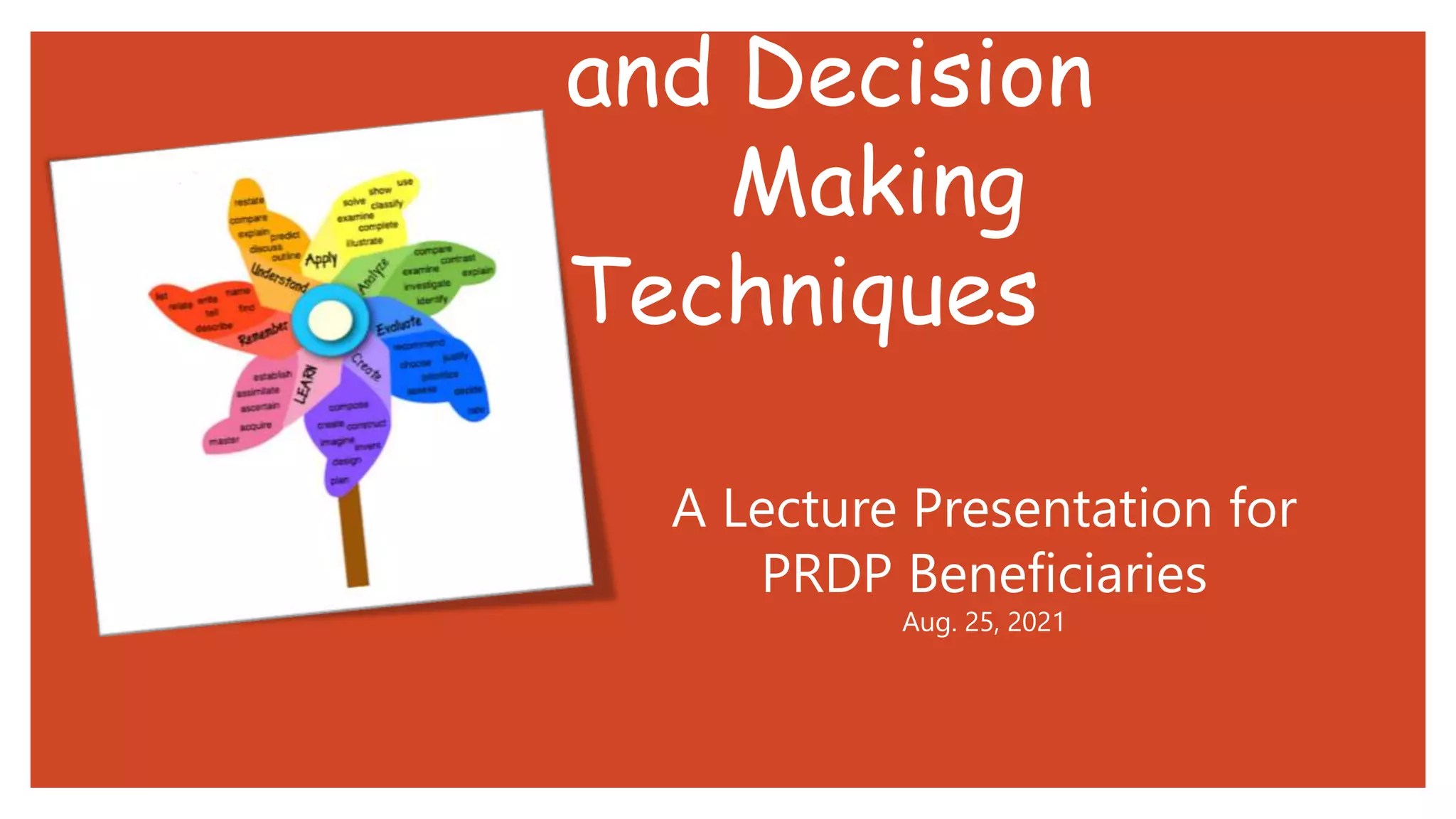
and Decision
Making
Techniques
A Lecture Presentation for
PRDP Beneficiaries
Aug. 25, 2021
• Differentiate an issue, problem and challenges
• Use analytical tool and processes namely fishbone, Five
whys, and tree diagram problem analysis and decision
making
Objectives
• Frameworks a basic structure underlying a
system, concept
• Process a series of actions or steps taken in
order to achieve a particular end
• Problem Solving Tools
Problem Solving and Decision-Making Techniques
a) Definition and characteristics of Issues, Problems, Challenges
b) Problem Solving Frameworks
- Organizational
- Personal
b) Tools in Problem Solving (problems, identification and
analysis)
b) Sustainability Mechanism for Resolution
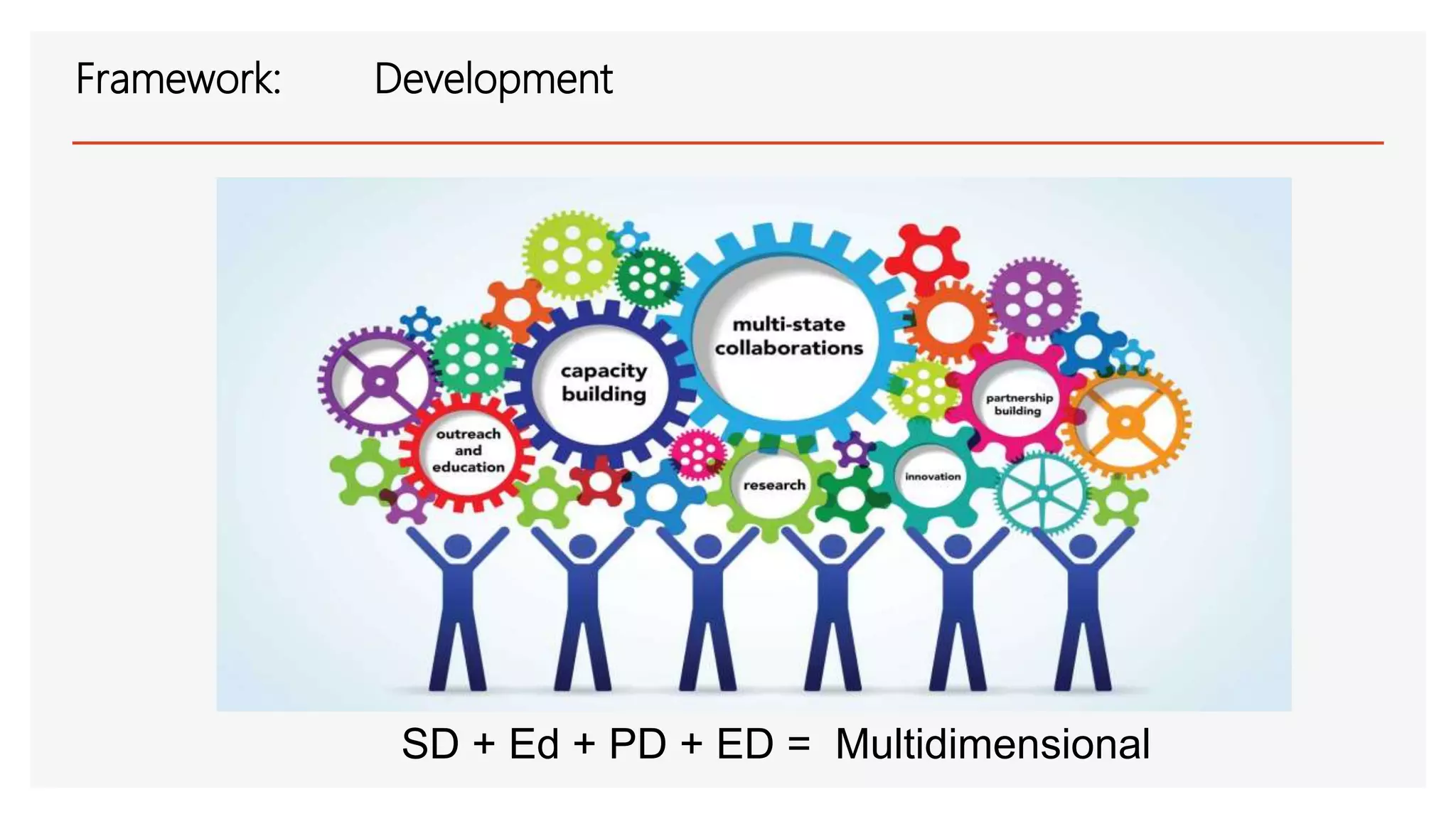
Framework: Development
SD + Ed + PD + ED = Multidimensional
Process
IDEA: I = Identify
D= Develop
E= Execute
A= Assess
Introduction
• Another day, another journey, another problem and
another decision to make.
• Most executives, managers and supervisors need to
assess problems and make decision frequently
• Some of this problems are “routine” while others are
very complex, difficult and unclear
Unpredicted problems
may occur in any team or
process. However, problems
are just symptoms of deeper
issues. Fixing a problem
quickly may be a convenient
solution, however, it doesn’t
protect your work process
from recurring mistakes. This is
why your team needs to focus
on finding the root cause and
tackle it properly
Finding the root cause and tackle it properly
What is the difference
between issues,
problems and
challenges
Issues : Over population
Deforestation, wildlife trade, air and
water pollution, human diets, climate
change and other issues have all fed into a
breakdown of our natural systems, leading
to new and fatal diseases, such as the
current pandemic
Human-Caused
Environmental Degradation
Challenges:
• Food Security
• Increase productivity
• Increase Income
• Improve quality of life
Personal Problems
Stress Unhappiness o How do you respond to the situation?
o Control of your personal
stress/unhappiness
o Attitude is the way, you approach problem
as it arises
o People are overwhelm from stress – talk
whose to blame, damage caused, Not
helpful
o Concentrate your energies of what can be
done to solve the problem,
o Think of more solutions ( ideas – most/less important)
o Think of better solutions (effective)
o Think of more creative solutions
o More problems solved, more competent you have
become
Worry
Anxiety
Mindset: Change your thinking
• Break habit of
procrastination
• Do it now
• Push the trigger to
your subconscious
mind
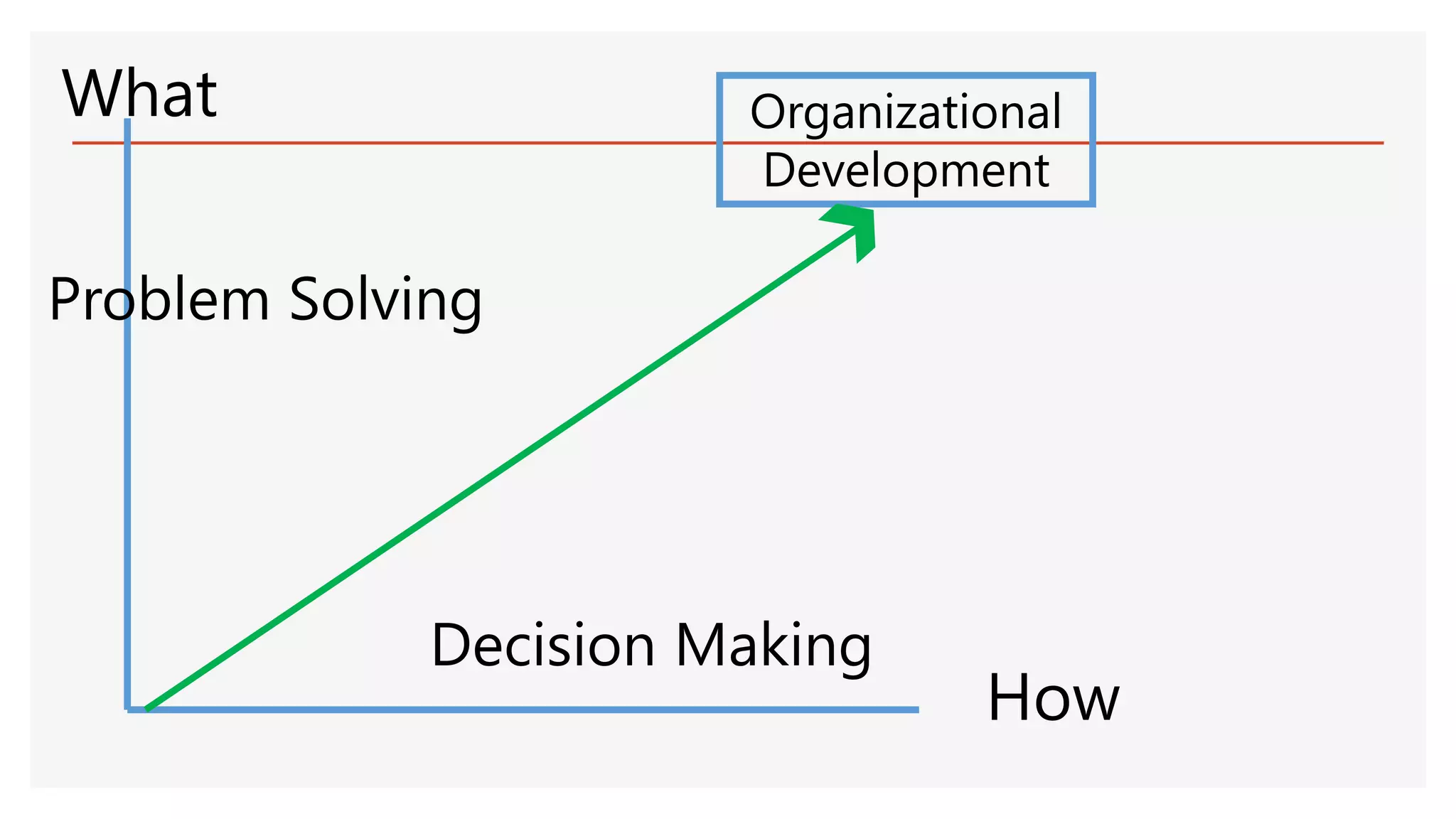
Organizational
Development
What
How
Problem Solving
Decision Making
Relationship
Dimension
Task
Dimension
Samuel Certo, Supervision p230-234
Do right things in the
right way and you will
get the things you desire
Transformation of
the Philippine
Agriculture
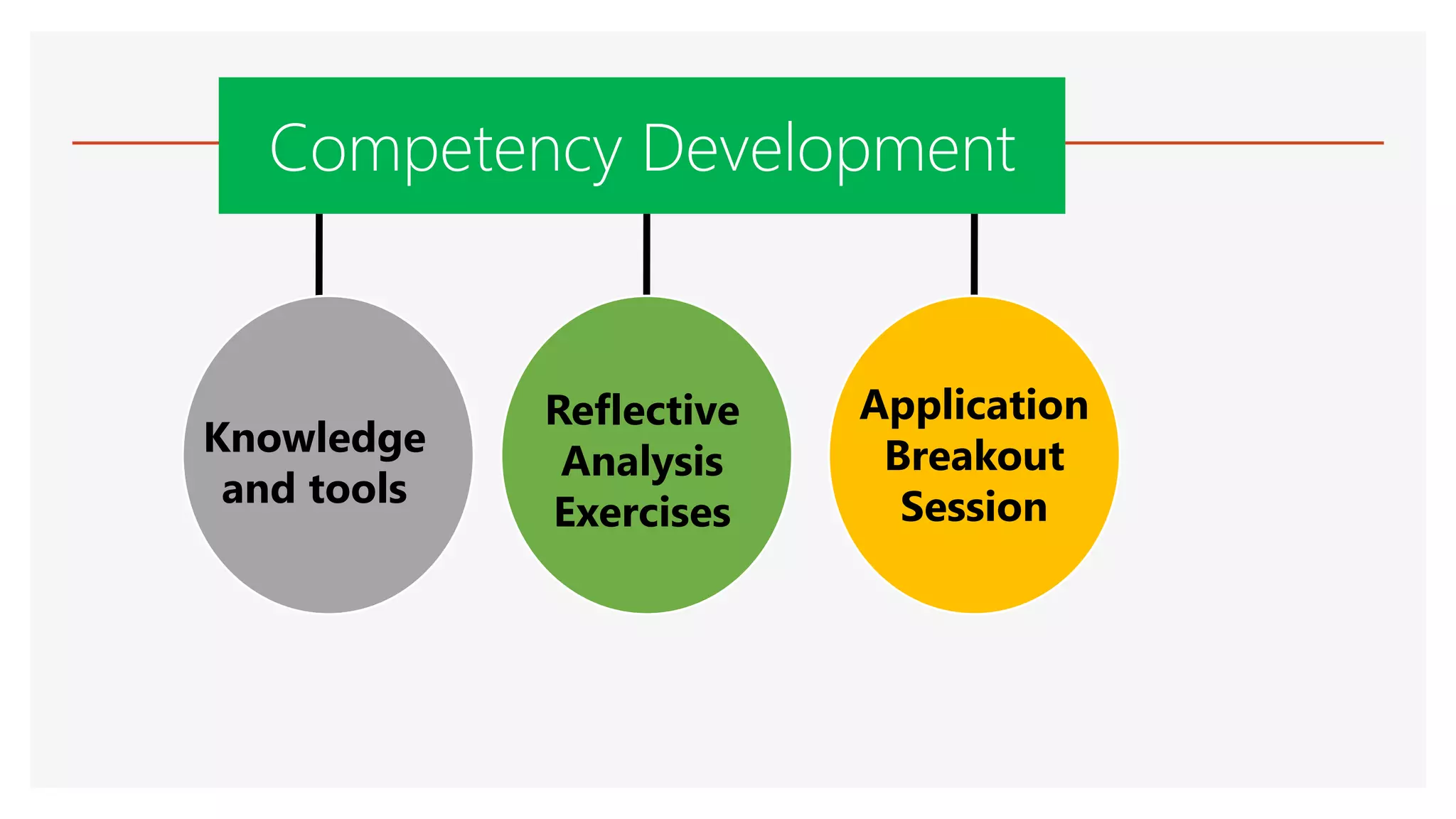
Competency Development
Knowledge
and tools
Reflective
Analysis
Exercises
Application
Breakout
Session
Management Competencies
Analytical
thinking
Problem
Solving
Decision
Making
the process of finding solutions
to difficult or complex issues
From
Good
to
Great
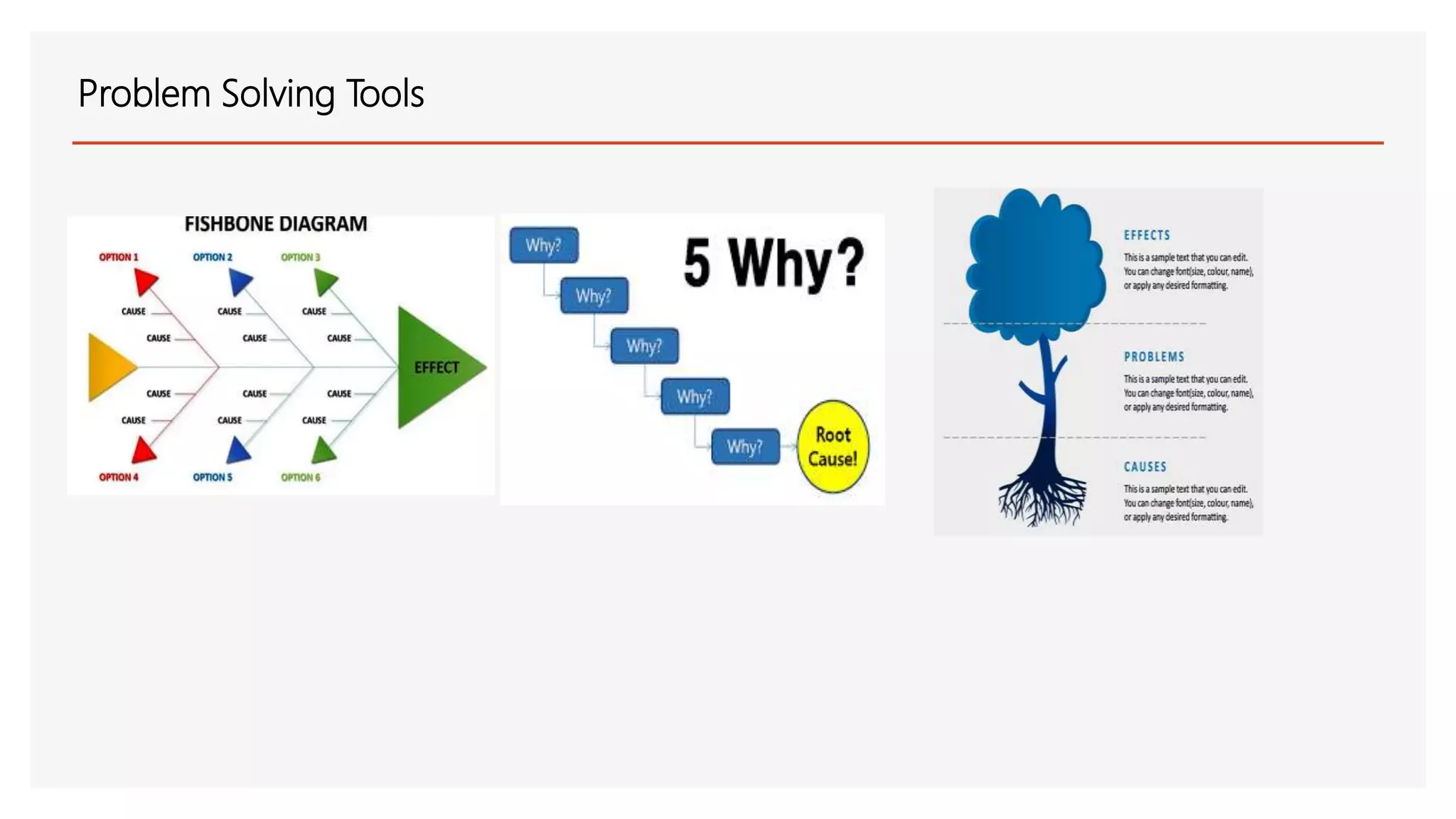
Problem Solving Tools
Dr. Kaoru Ishikawa, a Japanese
quality control expert, is credited
with inventing the fishbone diagram
to help employees avoid solutions
that merely address the symptoms
of a much larger problem.
In management, the
first concern of the company
is the happiness of people
who are connected with it, If
the people do not feel
happy and can not be made
happy, the company does
not deserve to exist
Quality controls
starts and ends
with trainings
Fishbone Analysis
Goal
To illustrate in a graphical way the
relationship between a given outcome
and all the factors that influence the
outcome
Outcomes
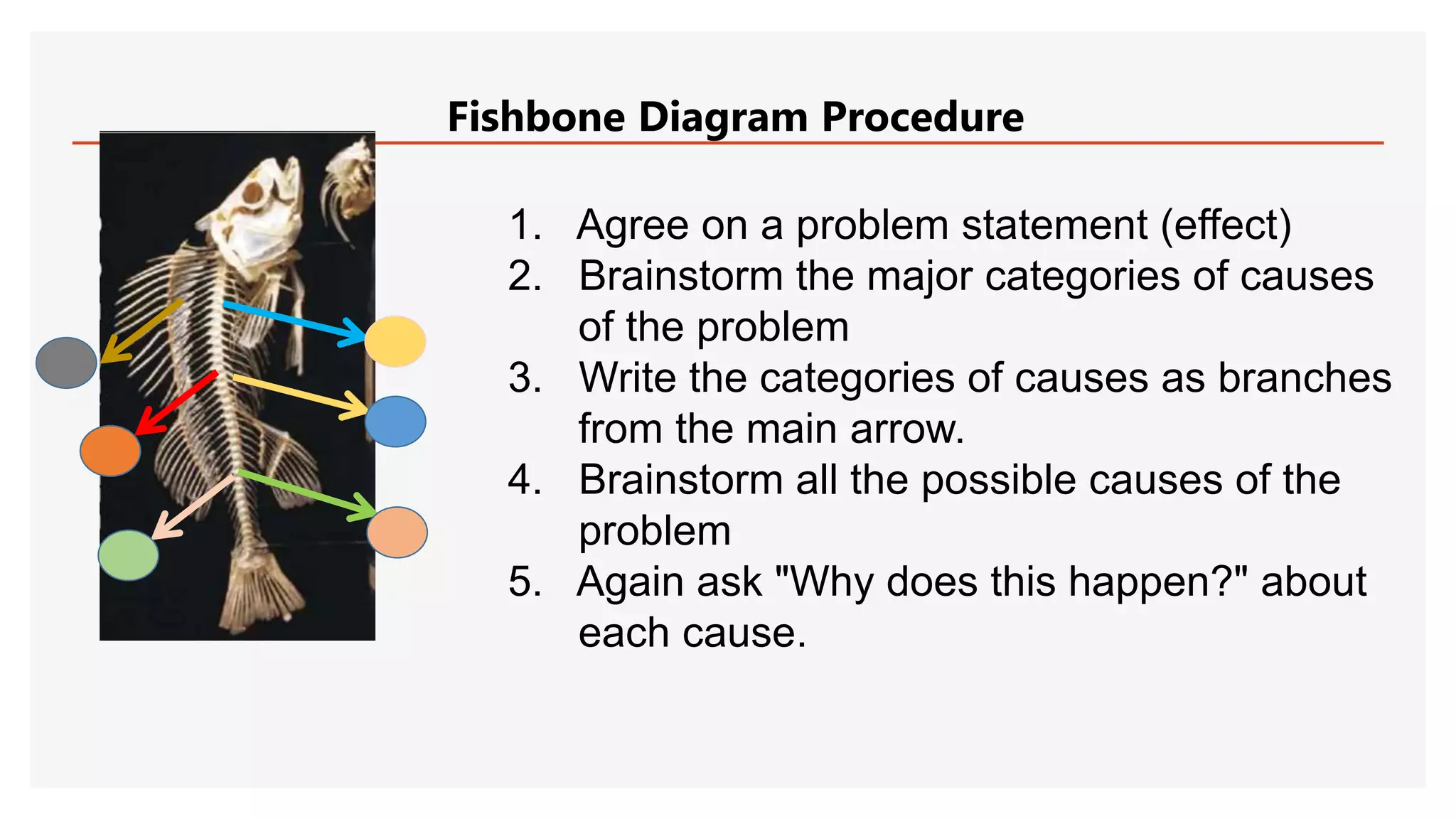
Fishbone Diagram Procedure
1. Agree on a problem statement (effect)
2. Brainstorm the major categories of causes
of the problem
3. Write the categories of causes as branches
from the main arrow.
4. Brainstorm all the possible causes of the
problem
5. Again ask "Why does this happen?" about
each cause.
https://www.slideshare.net/HemantKumar98/fish-bone-diagram-a-problem-solving-tool
Problems Encountered by
Cooperatives/Associations
Limited
Resources
Leaders
are
hesistan
t to lead
Lack of
know how
to run the
organzatio
n
No
Developmen
t Plan
No
Operationa
l Policies
Poor
Governance
and
Management
No
trainings Members
not
engaged
Lack of
internal
control
High
past
dues
Governmen
t
Regulations
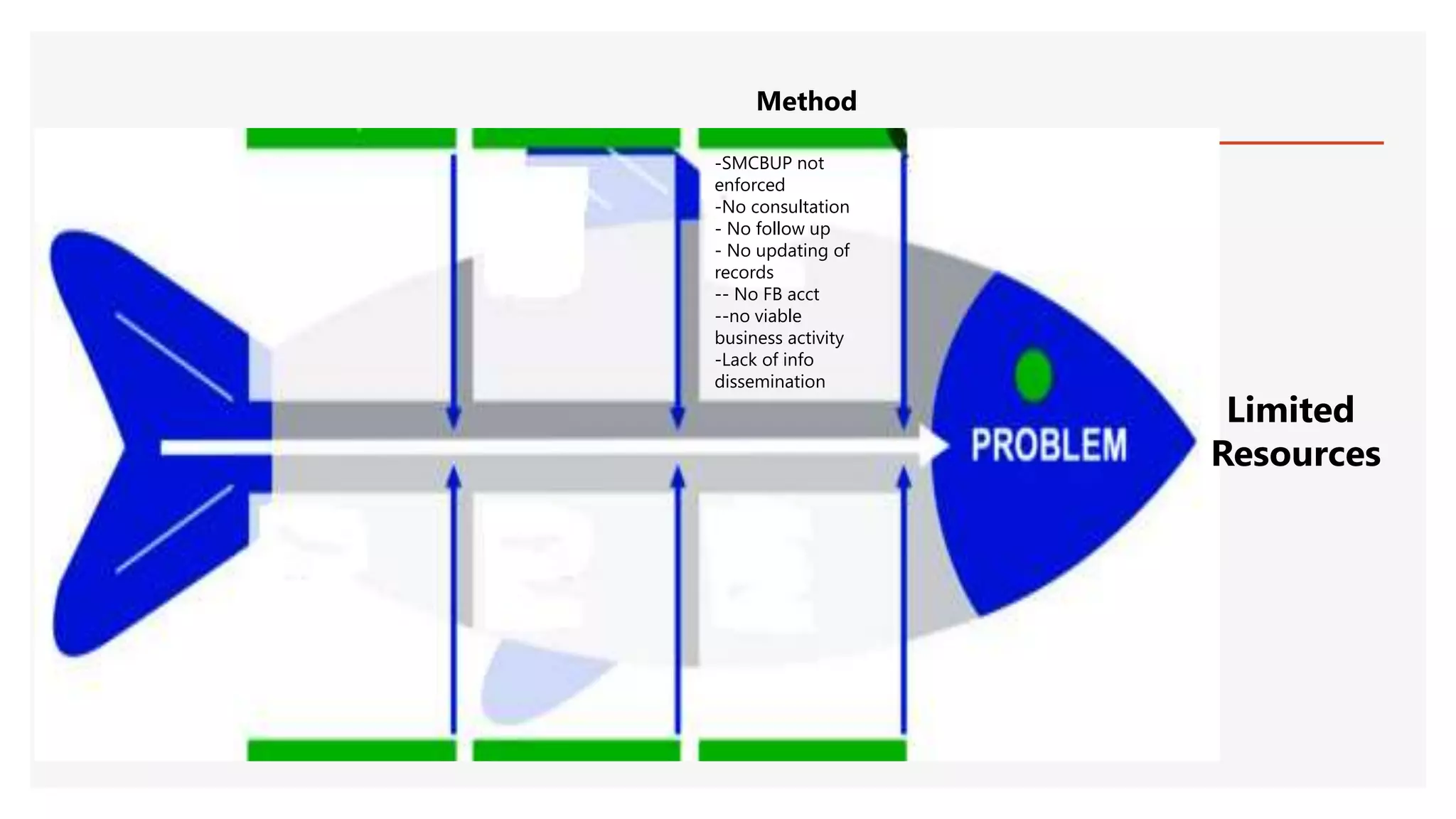
Limited
Resources
-SMCBUP not
enforced
-No consultation
- No follow up
- No updating of
records
-- No FB acct
--no viable
business activity
-Lack of info
dissemination
Method
Limited
Resources
-SMCBUP not
enforced
-No consultation
- No follow up
- No updating of
records
-- No FB acct
--no viable
business activity
-Lack of info
dissemination
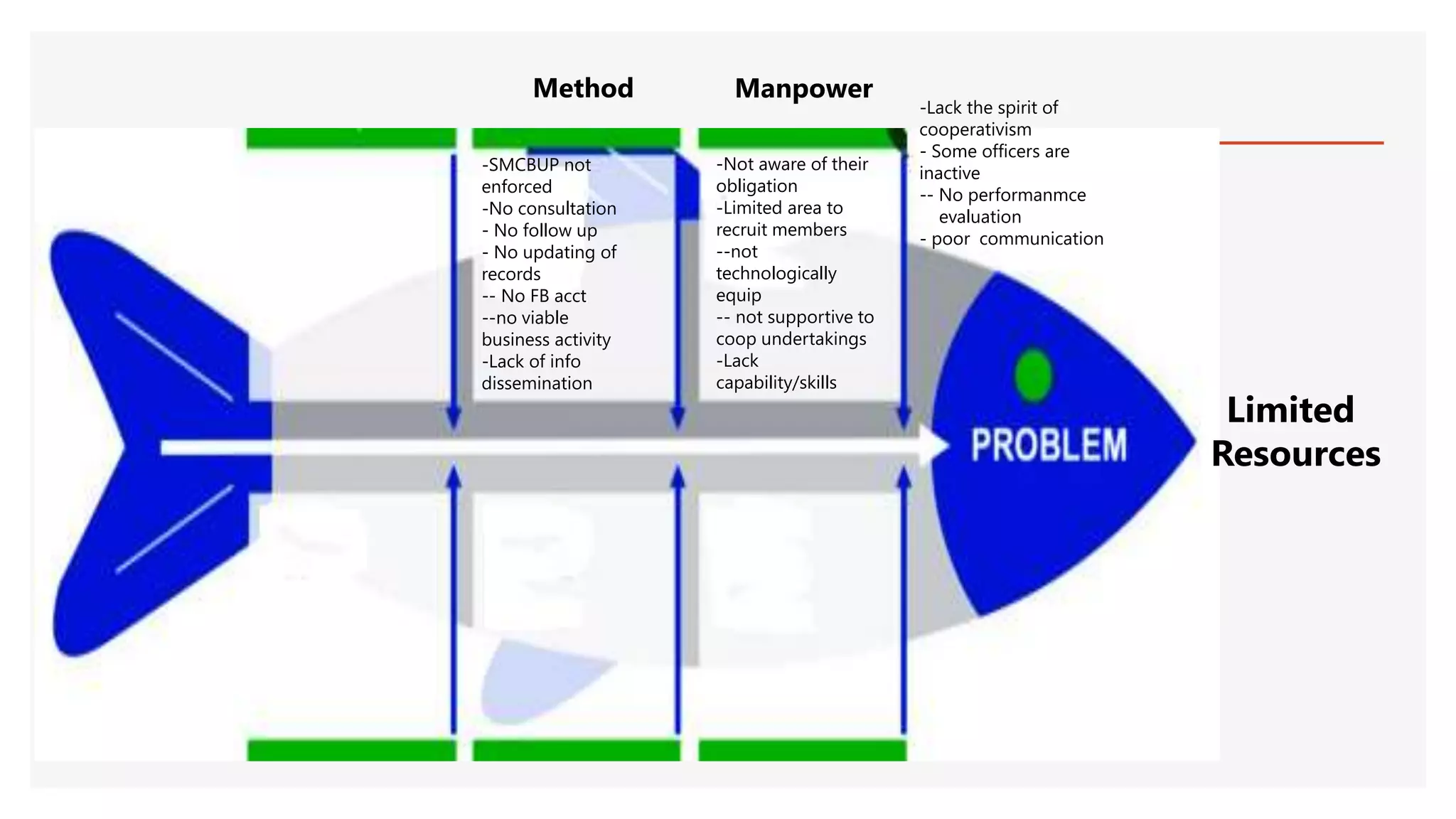
Method Manpower
-Not aware of their
obligation
-Limited area to
recruit members
--not
technologically
equip
-- not supportive to
coop undertakings
-Lack
capability/skills
-Lack the spirit of
cooperativism
- Some officers are
inactive
-- No performanmce
evaluation
- poor communication
Limited
Resources
-SMCBUP not
enforced
-No consultation
- No follow up
- No updating of
records
-- No FB acct
--no viable
business activity
-Lack of info
dissemination
Method Manpower
-Not aware of their
obligation
-Limited area to
recruit members
--not
technologically
equip
-- not supportive to
coop undertakings
-Lack
capability/skills
-Lack the spirit of
cooperativism
- Some officers are
inactive
-- No performanmce
evaluation
- poor communication
Machine
-Lack of
equipments
for office use
- No access
to internet
provider
- poor
internet
connectivity
Material
-No report
-No regular
meeting
- No
information
materials on
the programs
/projects
Machines are
expensive for
small farmers
Limited
Resources
-SMCBUP not
enforced
-No consultation
- No follow up
- No updating of
records
-- No FB acct
--no viable
business activity
-Lack of info
dissemination
Method Manpower
-Not aware of their
obligation
-Limited area to
recruit members
--not
technologically
equip
-- not supportive to
coop undertakings
-Lack
capability/skills
-Lack the spirit of
cooperativism
- Some officers are
inactive
-- No performanmce
evaluation
- poor communication
Machine
-Lack of
equipment
for office use
- No access
to internet
provider
- poor
internet
connectivity
Material
-No report
-No regular
meeting
- No
information
materials on
the programs
/projects
Measurement
-No FS to know
the status of
the
organization
- Not familiar
with subscribed
capital
-- No
Subscription
agreement
Limited
Resources
-SMCBUP not
enforced
-No consultation
- No follow up
- No updating of
records
-- No FB acct
--no viable
business activity
-Lack of info
dissemination
Method Manpower
-Not aware of their
obligation
-Limited area to
recruit members
--not
technologically
equip
-- not supportive to
coop undertakings
-Lack
capability/skills
-Lack the spirit of
cooperativism
- Some officers are
inactive
-- No performanmce
evaluation
- poor communication
Machine
-Lack of
equipment's
for office use
- No access
to internet
provider
- poor
internet
connectivity
Material
-No report
-No regular
meeting
- No
information
materials on
the programs
/projects
Measurement
-No FS to know
the status of
the
organization
- Not familiar
with subscribed
capital
-- No
Subscription
agreement
Environment
-Due to pandemic
members are
restricted to go out
-- No Transportation
-- No other means
of income
-- Limited
opportunity in the
community
--No coop
office/space
-Additional cost for
health protocols
-Government
regulations and
- Costly auditors
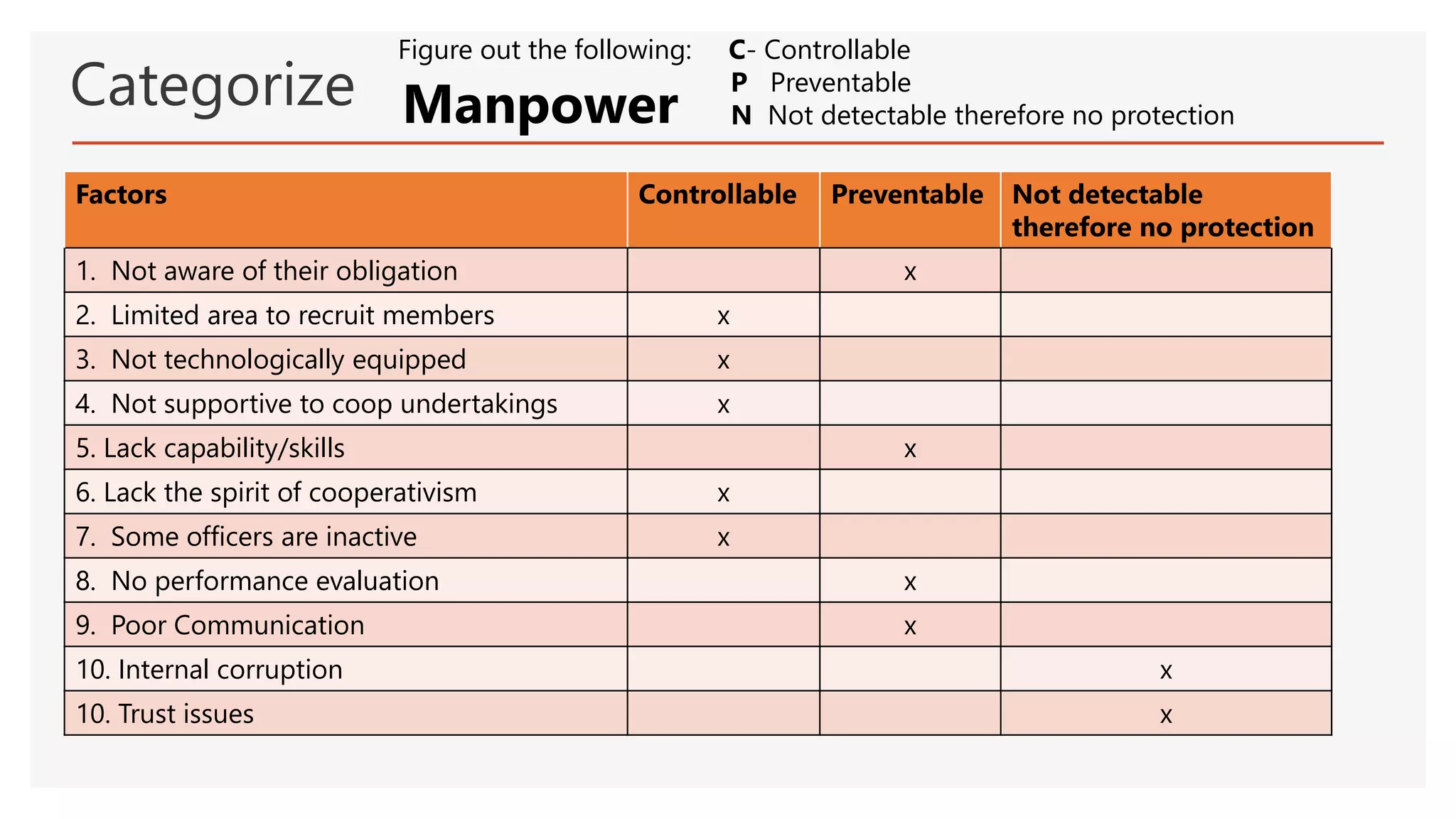
Factors Controllable Preventable Not detectable
therefore no protection
1. Not aware of their obligation x
2. Limited area to recruit members x
3. Not technologically equipped x
4. Not supportive to coop undertakings x
5. Lack capability/skills x
6. Lack the spirit of cooperativism x
7. Some officers are inactive x
8. No performance evaluation x
9. Poor Communication x
10. Internal corruption x
10. Trust issues x
Figure out the following: C- Controllable
P Preventable
N Not detectable therefore no protection
Manpower
Categorize
CRITERIA
Pt
OPTIONS
1 2 3 4 5 6 7 8
Acceptability 10 10 10 7 10 5
Relevance 10 10 10 10 10 5
Doability/Viability 30 25 20 15 5 5
Cost-Effective 20 20 20 15 10 5
Impact 15 15 15 15 15 15
Sustainability 15 10 10 5 5 15
TOTAL 100 90 85 67 55 50
Identifying the best option by using criteria
Option 1. Coaching the members on SMCBUP.
Option 2. Assists members to fill up subscription forms
Option 3 Conduct training on the duties and responsibilities of members
Option 4 Request CDA to conduct fundamentals on Cooperative
Option 5 Avail loan
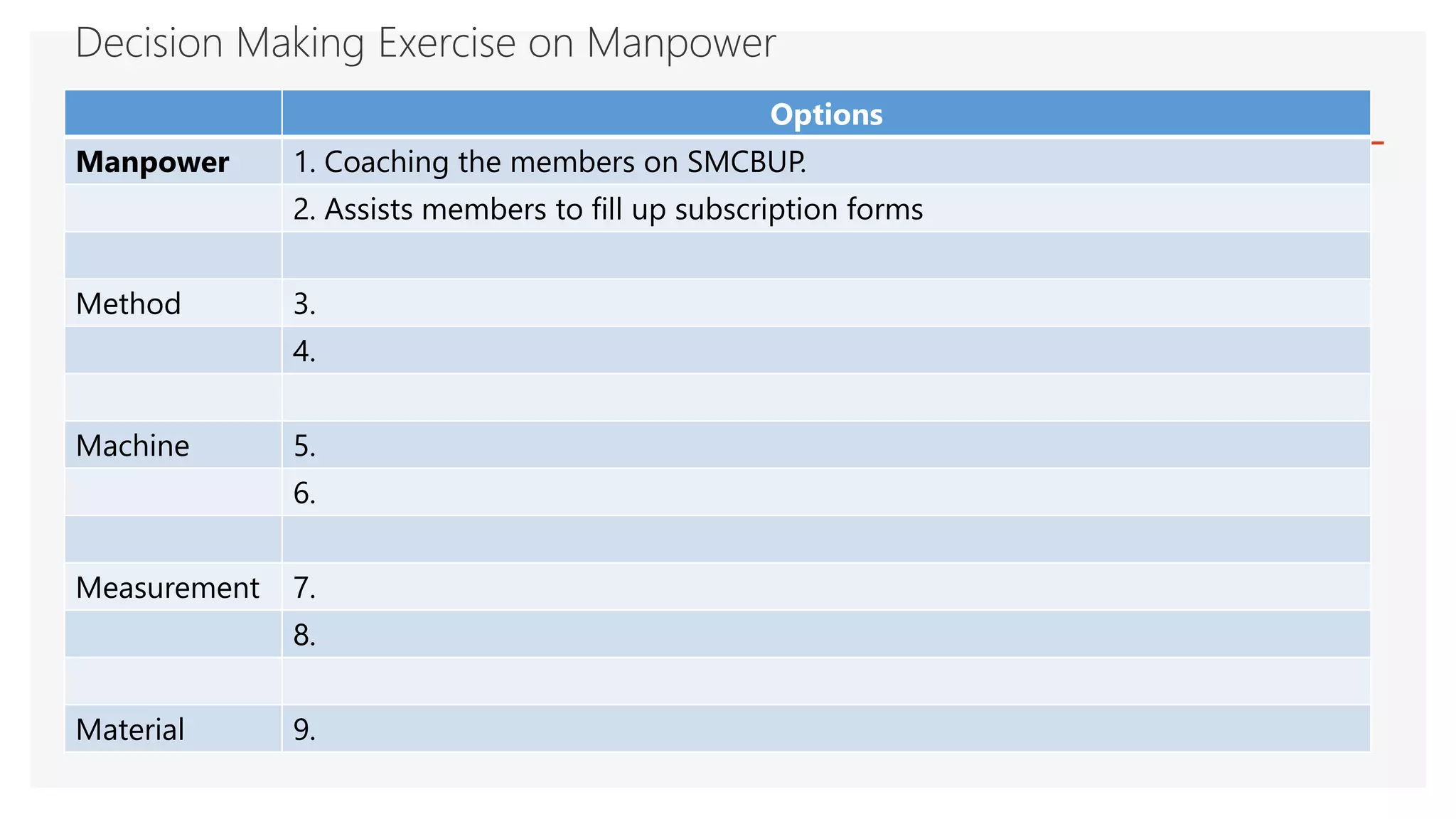
Options
Manpower 1. Coaching the members on SMCBUP.
2. Assists members to fill up subscription forms
Method 3.
4.
Machine 5.
6.
Measurement 7.
8.
Material 9.
Decision Making Exercise on Manpower
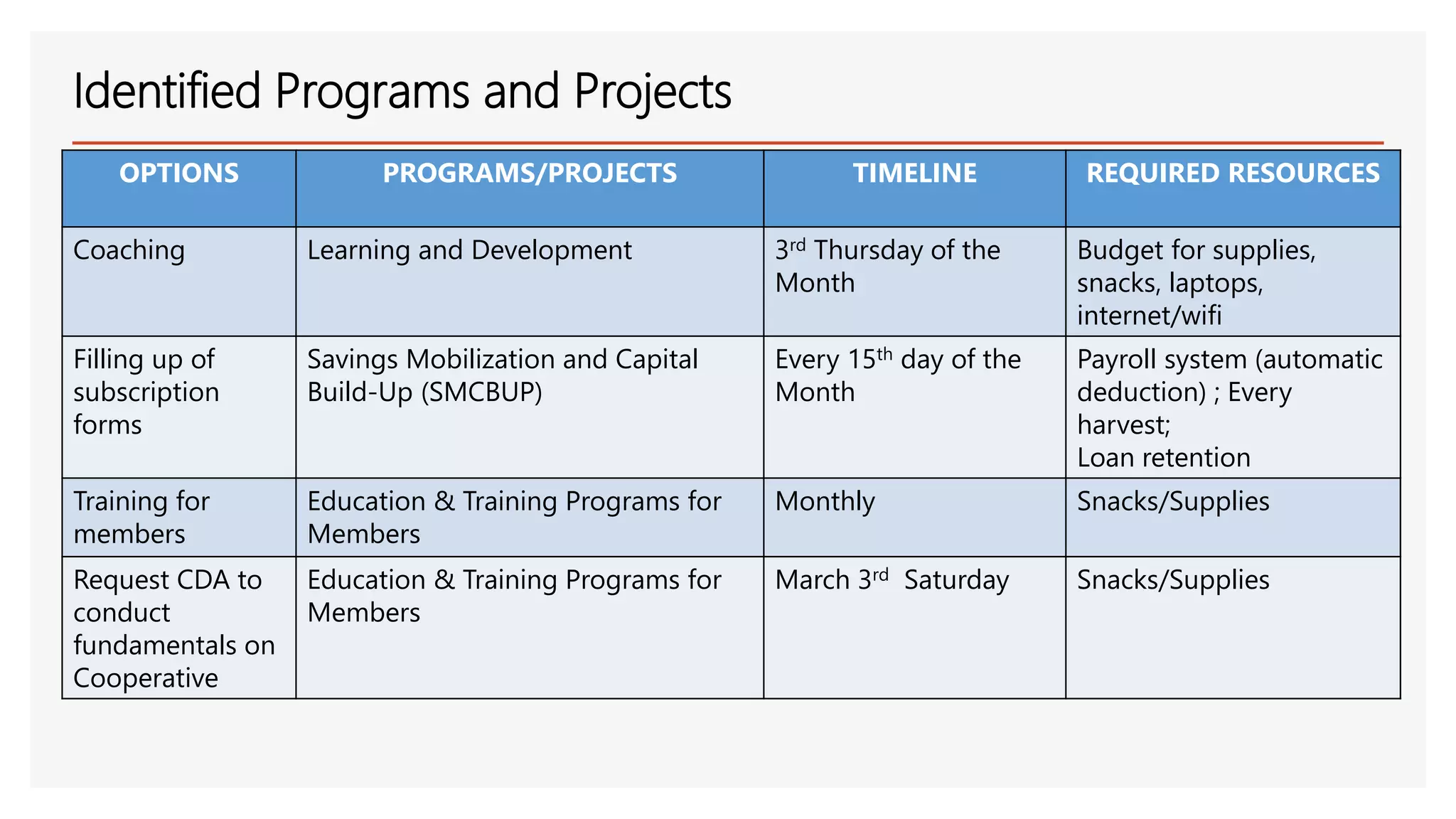
OPTIONS PROGRAMS/PROJECTS TIMELINE REQUIRED RESOURCES
Coaching Learning and Development 3rd Thursday of the
Month
Budget for supplies,
snacks, laptops,
internet/wifi
Filling up of
subscription
forms
Savings Mobilization and Capital
Build-Up (SMCBUP)
Every 15th day of the
Month
Payroll system (automatic
deduction) ; Every
harvest;
Loan retention
Training for
members
Education & Training Programs for
Members
Monthly Snacks/Supplies
Request CDA to
conduct
fundamentals on
Cooperative
Education & Training Programs for
Members
March 3rd Saturday Snacks/Supplies
Identified Programs and Projects
Lesson:
Congratulations ! You are
now a Problem Solver
Not Problem Maker
1. A simple Root Cause Analysis (RCA)
2. Easy to teach
3. Easy to use
4. Introduce people to problem solving
5. Prevents bad aid solution
The 5 Whys
Analysis
Origins of the 5 Whys Technique
Sakichi Toyoda, the Japanese industrialist, inventor, and
founder of Toyota Industries, developed the 5 Whys
technique in the 1930s. It became popular in the 1970s, and
Toyota still uses it to solve problems today
Toyota has a "go and see" philosophy. This means that its
decision making is based on an in-depth understanding of
what's actually happening on the shop floor, rather than on
what someone in a boardroom thinks might be happening.
The 5 Whys technique is true to this tradition, and it is most
effective when the answers come from people who have
hands-on experience of the process or problem in question.
The method is remarkably simple: when a problem occurs,
you drill down to its root cause by asking "Why?" five times.
Then, when a counter-measure becomes apparent, you follow
it through to prevent the issue from recurring.
Solutions
Why?
Why?
Why?
Why?
Why?
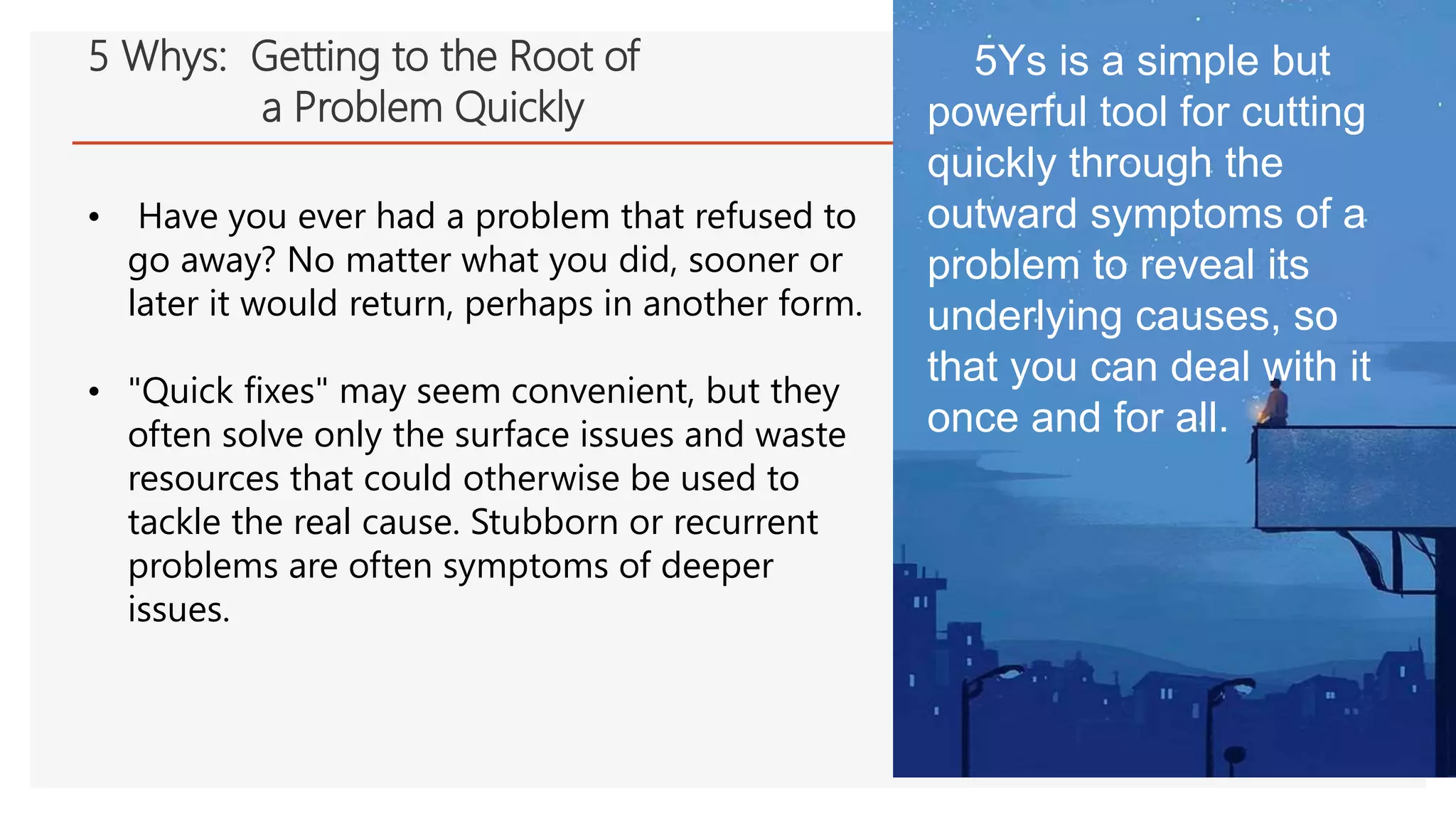
• Have you ever had a problem that refused to
go away? No matter what you did, sooner or
later it would return, perhaps in another form.
• "Quick fixes" may seem convenient, but they
often solve only the surface issues and waste
resources that could otherwise be used to
tackle the real cause. Stubborn or recurrent
problems are often symptoms of deeper
issues.
5 Whys: Getting to the Root of
a Problem Quickly
5Ys is a simple but
powerful tool for cutting
quickly through the
outward symptoms of a
problem to reveal its
underlying causes, so
that you can deal with it
once and for all.
When applying the 5 Whys
technique, you want to get to
the problem's essence and
then fix it. Actually, the 5 Whys
may show you that the source
of the problem is quite
unexpected.
Often, issues that are
considered a technical problem
actually turn out to be human
and process problems.
This is why finding
and eliminating the
root cause is crucial if
you want to avoid
iteration of failures.
Slow Internet Connectivity
If wifi is used
there is
frequent
disconnection
The modem
provided by
Converse is
a defective
modem
Ask
company to
change
modem,
1. File complaint to
converge
2. Switch off
converge wifi to
netgear (HO)
same model of
modem was
provided –
problem
persists
the root cause analysis process should include people
with practical experience. Logically, they can give
you the most valuable information regarding any
problem that appears in their area of expertise.
One of the key factors for successful implementation
of the technique is to make an informed decision.
This means that the decision-making process should
be based on an insightful understanding of what is
actually happening on the work floor.
Why?
https://kanbanize.com/lean-management/improvement/5-whys-analysis-tool
Here is an
example of
applying the 5
Whys.
Sometimes it
is less than 5
whys or more
Solution: buy
batteries for the
alarm clock
Lesson
From Problem Solver
To Versatile Problem
Solver
Focus on finding
solution. Looking
means and ways
to help
Problem Tree Analysis
• A strategic way to identify the focal (main) problem and
its causes and effects from the project teams. Stakeholders
and beneficiaries
Tree diagram is a new management planning tool that depicts the
hierarchy of tasks and subtasks needed to complete and objective
• When an issue is known or being addressed in broad
generalities and you must move to specific details, such as
when developing logical steps to achieve an objective
• When developing actions to carry out a solution or other plan
• When analyzing processes in detail
• When probing for the root cause of a problem
• When evaluating implementation issues for several potential
solutions
When to use tree diagram?
1. Implementation requires more time than was planned
2. Inadequate leadership and direction
3. Coordination and implementation not effective enough
4. Insufficient capabilities of officers
5. Inadequate training of staff
6. Insufficient information system
problems
7. Unclear statement of overall goals
8. Responsibilities are not clearly defined
9. Slow communication from officers
10. Passive membership
problems
problems
What to do?
Its effects
Main problem
Causes
Branches
Trunk
Roots
Trunk: Demand of Products has Decreased
• I can’t make new products that buyers wants
• Don’t have the tools and skills necessary to
create a new product
• I’m isolated
• I don’t know how to access them
• I don’t know which products are in demand
• I don’t know what products to make
• Don’t have knowledge of the market or links
of the market
Roots: Causes
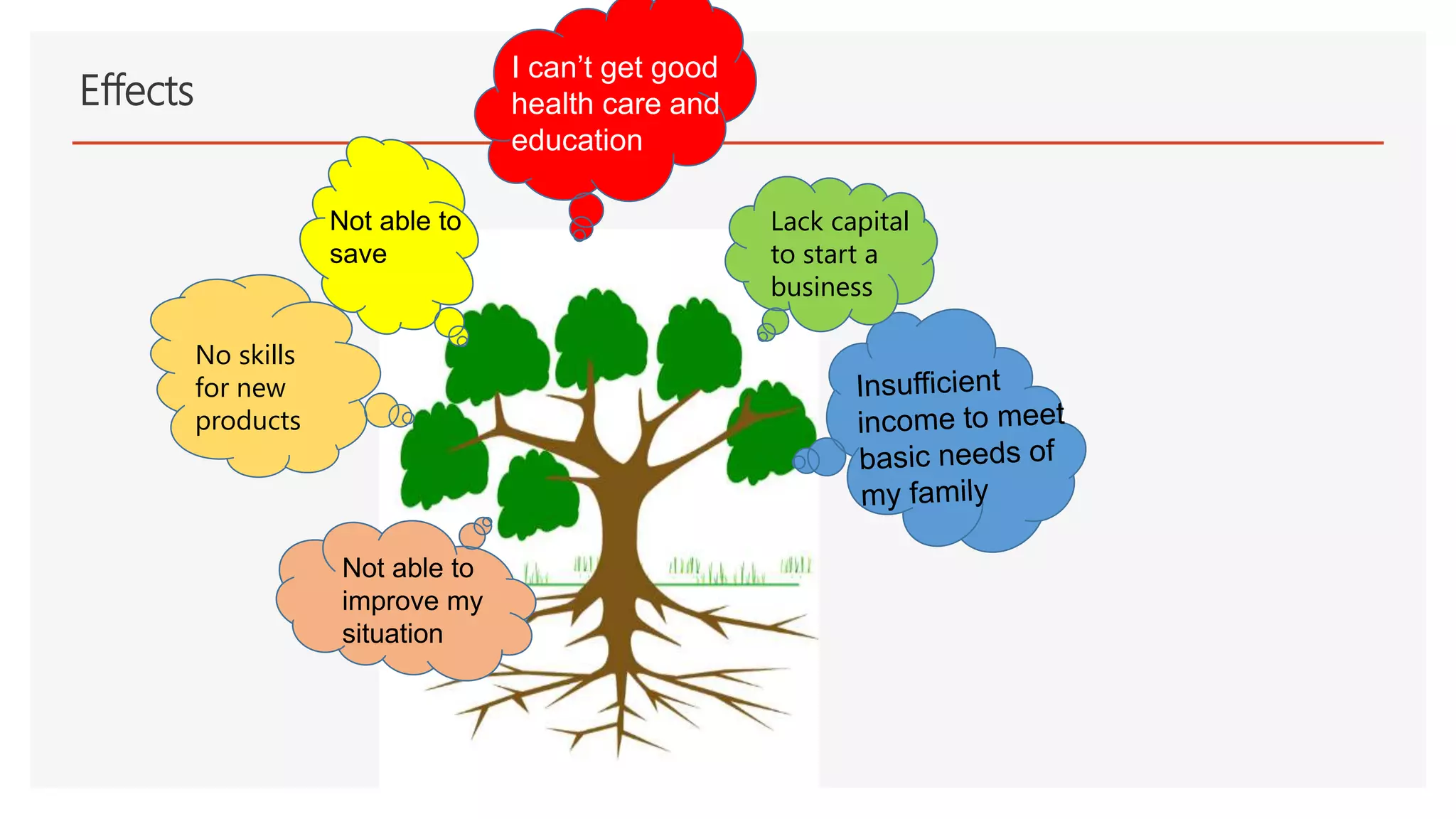
Effects
I can’t get good
health care and
education
Not able to
save
Not able to
improve my
situation
No skills
for new
products
Lack capital
to start a
business
Problem Tree to Problem Objective
• A process by which we turn causes into
means and effects into ends so cause and
effects becomes means and problems
becomes objectives.
• Not only the focal problem but all the
problems of the tree and eventually at the
end of the process we will have objectives
tree instead of a problem tree
Restate the Problems Tree – Objective Tree
I’m a members of the cooperative/Association
I have market linkages thru my membership
I’m aware of market demands
I have access to new resources and skills
I know how to make a new one and improved
products
Positive Solutions Already Happened
• Increase demand and stable of my product
• Families basic needs are being met
• Sufficient income
• Healthy children and are in school
• I have savings
• Improved quality of life
Outcomes - Results
Lesson
Congratulations ! You
are now a Solution
Oriented Person
Applying
solutions
most
appropriate
to mitigate
the effects of
the
problems
Find
meaning
to solve
problems
Implementing
the solutions
Taking
actions to
resolve a
particular
situation
Solution oriented people
in the organization are
valuable assets
“Mind-sets are
those collection of beliefs
and thoughts that make
up the mental attitude,
inclination, habit or
disposition that
predetermines a person's
interpretations and
responses to events,
circumstances and
situations.”
Where do we go
from here?
Fill your mind with
positive thoughts, if
not negative thoughts
will grow without any
encouragement
Mind vacuum
not empty, put
efforts to plant
positive
thoughts
Brian Tracy
Mental diet – feed mental protein.
Read educational bools that will
increase your knowledge, feed
minds of ideas that are uplifting, to
make you happier
Choose positive people to
associate with
All improvement begins in your
mental picture
Sustainability Mechanism for
Resolution
1. Learn, Unlearn, Relearn
2. Unfreezing, Improve
organization, refreezing
3. Keeping the community
motivated
Learn, Unlearn, Relearn
• Learn: acquire knowledge, skills, improve competencies.
• Unlearn: Obsolete knowledge, bad practices
lack of innovation, fear of the
unknown
• Relearn – Continual improvement Culture, invest in
Learning, Learn new tools, change is normal,
expect, embrace, accept it.
• Be part of the solution.
Kurt Lewin’s Force Field Theory
Time
P
E
R
F
O
R
M
A
N
C
E
Forces : Resistance
to Change
Forces : For Change
Solution:
a. Increase forces for
change by pushing,
motivating to change
will take place
b. Reduce resitancies
c. Inc/Dec (both)
Unfreezing
Improve
ourselves
Refreezing
P
E
R
F
O
R
M
A
N
C
E
Forces : Resistance
to Change
Unfreezing Improve
ourselves
Refreezing
Tools &
mechanisms
to unfreeze
from the
current state
Provide
environment
for the
change to
happen
Identify obstacles to overcome:
Conclusion
Identify obstacles to overcome:
a. Identify the knowledge and skills you will need
b. Select the most important goal
c. Identify tasks by sequencing and priority till completion and to make use of your valuable use
of your time
d. Identify people whose help and cooperation you will require
e. Take action
f. Keep tract of your progress
g. Make adjustment along the way
h. Make sure you are doing something on what you aspire in your life and to be more productive
and successful
Rule: Each minute spent in planning save ten minutes in execution
Life will test us with
setbacks but it is not
permanent, open your
doors for opportunities
waiting to be tapped
I can do things you can not, You can do things
I can not, TOGETHER we can do better and
do great thing
Mother Teresa
Feedback Write in the chat box (numbers) of your learnings Ex: 1, 4, 6
1. Fishbone Analysis
2. 5 Whys Analysis
3. Problem Tree
4. Problem Objective
5. Decision Making analysis
6. Chronic Procrastination
7. Mental Diet
8. Sustainability Mechanisms
9. Learn, Unlearn, Relearn Concept
10. Unfreezing, Improve Organization, Refreezing
Break out Session
A. Fishbone Analysis ; Facilitator Ms. Joi Pia Sison Santos
Fishbone Diagram Procedure
1. Agree on a problem statement (effect)
2. Brainstorm the major categories of causes
of the problem
3. Write the categories of causes (6Ms, 8Ps,5Ss) as
branches
from the main arrow.
4. Brainstorm all the possible causes of the
problem
5. Again ask "Why does this happen?" about
each cause.
6. Categorize sub problems as : C- Controllable
P Preventable
N Not detectable therefore no
protection
7. Identifying the best option by using criteria
8. Summary Decision Making Options
9. Identified Programs and Projects
10. Present your output
Cont. Fishbone Diagram Procedure
https://www.slideshare.net/HemantKumar98/fish-bone-diagram-a-problem-solving-tool
Factors (Sub Causes) Controllable Preventable Not detectable
therefore no protection
Figure out the following: C- Controllable
P Preventable
N Not detectable therefore no protection
2. Categorize
CRITERIA
Pt
OPTIONS
1 2 3 4 5 6 7 8
Acceptability
Relevance
Doability/Viability
Cost-Effective
Impact
Sustainability
TOTAL
3. Identifying the best option by using criteria
Option 1..
Option 2.
Option 3
Option 4
Option 5
Options
Manpower 1.
2.
Method 3.
4.
Machine 5.
6.
Measurement 7.
8.
Material 9.
5. Summary Decision Making Options
OPTIONS PROGRAMS/PROJECTS TIMELINE REQUIRED RESOURCES
6. Identified Programs and Projects
The 5 Whys Analysis : Facilitator Dir. Jun Defensor
How to Conduct a 5 Whys Analysis in 5 Steps
1. Gather a team. Collect the team members
who are knowledgeable about the process
that is to be examined
2. Define the problem
3. Ask “why?” five times
4. Take corrective action
5. Monitor and share your results
6. Report the 5 whys Analysis
Counter-measure
Its effects
Main problem
Causes
Branches
Trunk
Roots
Problem Tree Facilitator: Dir. Ma. Lourdes P. Pacao
Trunk: State the problem
Roots: Causes
State the Effects
Restate the Problems Tree – Objective Tree
Positive Solutions Already Happened
Outcomes - Results
References
• http://www.differencebetween.net/language/difference-between-issue-and-
problem/
• https://www.youtube.com/watch?v=DCjC_cG4vF4
• https://www.youtube.com/watch?v=-j-_Y7D35H4
• https://www.youtube.com/watch?v=aj74ebMn55w
• https://www.youtube.com/watch?v=LAqnfgUNZjU
Problem Solving and Decision Making Tools and Techniques

Problem Solving and Decision Making Tools and Techniques

  • 1.
    and Decision Making Techniques A LecturePresentation for PRDP Beneficiaries Aug. 25, 2021
  • 2.
    • Differentiate anissue, problem and challenges • Use analytical tool and processes namely fishbone, Five whys, and tree diagram problem analysis and decision making Objectives
  • 3.
    • Frameworks abasic structure underlying a system, concept • Process a series of actions or steps taken in order to achieve a particular end • Problem Solving Tools
  • 4.
    Problem Solving andDecision-Making Techniques a) Definition and characteristics of Issues, Problems, Challenges b) Problem Solving Frameworks - Organizational - Personal b) Tools in Problem Solving (problems, identification and analysis) b) Sustainability Mechanism for Resolution
  • 5.
    Framework: Development SD +Ed + PD + ED = Multidimensional
  • 6.
    Process IDEA: I =Identify D= Develop E= Execute A= Assess
  • 7.
    Introduction • Another day,another journey, another problem and another decision to make. • Most executives, managers and supervisors need to assess problems and make decision frequently • Some of this problems are “routine” while others are very complex, difficult and unclear
  • 8.
    Unpredicted problems may occurin any team or process. However, problems are just symptoms of deeper issues. Fixing a problem quickly may be a convenient solution, however, it doesn’t protect your work process from recurring mistakes. This is why your team needs to focus on finding the root cause and tackle it properly Finding the root cause and tackle it properly
  • 10.
    What is thedifference between issues, problems and challenges
  • 11.
    Issues : Overpopulation Deforestation, wildlife trade, air and water pollution, human diets, climate change and other issues have all fed into a breakdown of our natural systems, leading to new and fatal diseases, such as the current pandemic Human-Caused Environmental Degradation Challenges: • Food Security • Increase productivity • Increase Income • Improve quality of life
  • 12.
    Personal Problems Stress Unhappinesso How do you respond to the situation? o Control of your personal stress/unhappiness o Attitude is the way, you approach problem as it arises o People are overwhelm from stress – talk whose to blame, damage caused, Not helpful o Concentrate your energies of what can be done to solve the problem, o Think of more solutions ( ideas – most/less important) o Think of better solutions (effective) o Think of more creative solutions o More problems solved, more competent you have become Worry Anxiety
  • 13.
    Mindset: Change yourthinking • Break habit of procrastination • Do it now • Push the trigger to your subconscious mind
  • 14.
  • 15.
    Relationship Dimension Task Dimension Samuel Certo, Supervisionp230-234 Do right things in the right way and you will get the things you desire Transformation of the Philippine Agriculture
  • 16.
  • 17.
  • 18.
  • 19.
  • 20.
    Dr. Kaoru Ishikawa,a Japanese quality control expert, is credited with inventing the fishbone diagram to help employees avoid solutions that merely address the symptoms of a much larger problem. In management, the first concern of the company is the happiness of people who are connected with it, If the people do not feel happy and can not be made happy, the company does not deserve to exist Quality controls starts and ends with trainings Fishbone Analysis
  • 21.
    Goal To illustrate ina graphical way the relationship between a given outcome and all the factors that influence the outcome Outcomes
  • 22.
    Fishbone Diagram Procedure 1.Agree on a problem statement (effect) 2. Brainstorm the major categories of causes of the problem 3. Write the categories of causes as branches from the main arrow. 4. Brainstorm all the possible causes of the problem 5. Again ask "Why does this happen?" about each cause.
  • 23.
  • 24.
    Problems Encountered by Cooperatives/Associations Limited Resources Leaders are hesistan tto lead Lack of know how to run the organzatio n No Developmen t Plan No Operationa l Policies Poor Governance and Management No trainings Members not engaged Lack of internal control High past dues Governmen t Regulations
  • 25.
    Limited Resources -SMCBUP not enforced -No consultation -No follow up - No updating of records -- No FB acct --no viable business activity -Lack of info dissemination Method
  • 26.
    Limited Resources -SMCBUP not enforced -No consultation -No follow up - No updating of records -- No FB acct --no viable business activity -Lack of info dissemination Method Manpower -Not aware of their obligation -Limited area to recruit members --not technologically equip -- not supportive to coop undertakings -Lack capability/skills -Lack the spirit of cooperativism - Some officers are inactive -- No performanmce evaluation - poor communication
  • 27.
    Limited Resources -SMCBUP not enforced -No consultation -No follow up - No updating of records -- No FB acct --no viable business activity -Lack of info dissemination Method Manpower -Not aware of their obligation -Limited area to recruit members --not technologically equip -- not supportive to coop undertakings -Lack capability/skills -Lack the spirit of cooperativism - Some officers are inactive -- No performanmce evaluation - poor communication Machine -Lack of equipments for office use - No access to internet provider - poor internet connectivity Material -No report -No regular meeting - No information materials on the programs /projects Machines are expensive for small farmers
  • 28.
    Limited Resources -SMCBUP not enforced -No consultation -No follow up - No updating of records -- No FB acct --no viable business activity -Lack of info dissemination Method Manpower -Not aware of their obligation -Limited area to recruit members --not technologically equip -- not supportive to coop undertakings -Lack capability/skills -Lack the spirit of cooperativism - Some officers are inactive -- No performanmce evaluation - poor communication Machine -Lack of equipment for office use - No access to internet provider - poor internet connectivity Material -No report -No regular meeting - No information materials on the programs /projects Measurement -No FS to know the status of the organization - Not familiar with subscribed capital -- No Subscription agreement
  • 29.
    Limited Resources -SMCBUP not enforced -No consultation -No follow up - No updating of records -- No FB acct --no viable business activity -Lack of info dissemination Method Manpower -Not aware of their obligation -Limited area to recruit members --not technologically equip -- not supportive to coop undertakings -Lack capability/skills -Lack the spirit of cooperativism - Some officers are inactive -- No performanmce evaluation - poor communication Machine -Lack of equipment's for office use - No access to internet provider - poor internet connectivity Material -No report -No regular meeting - No information materials on the programs /projects Measurement -No FS to know the status of the organization - Not familiar with subscribed capital -- No Subscription agreement Environment -Due to pandemic members are restricted to go out -- No Transportation -- No other means of income -- Limited opportunity in the community --No coop office/space -Additional cost for health protocols -Government regulations and - Costly auditors
  • 30.
    Factors Controllable PreventableNot detectable therefore no protection 1. Not aware of their obligation x 2. Limited area to recruit members x 3. Not technologically equipped x 4. Not supportive to coop undertakings x 5. Lack capability/skills x 6. Lack the spirit of cooperativism x 7. Some officers are inactive x 8. No performance evaluation x 9. Poor Communication x 10. Internal corruption x 10. Trust issues x Figure out the following: C- Controllable P Preventable N Not detectable therefore no protection Manpower Categorize
  • 31.
    CRITERIA Pt OPTIONS 1 2 34 5 6 7 8 Acceptability 10 10 10 7 10 5 Relevance 10 10 10 10 10 5 Doability/Viability 30 25 20 15 5 5 Cost-Effective 20 20 20 15 10 5 Impact 15 15 15 15 15 15 Sustainability 15 10 10 5 5 15 TOTAL 100 90 85 67 55 50 Identifying the best option by using criteria Option 1. Coaching the members on SMCBUP. Option 2. Assists members to fill up subscription forms Option 3 Conduct training on the duties and responsibilities of members Option 4 Request CDA to conduct fundamentals on Cooperative Option 5 Avail loan
  • 32.
    Options Manpower 1. Coachingthe members on SMCBUP. 2. Assists members to fill up subscription forms Method 3. 4. Machine 5. 6. Measurement 7. 8. Material 9. Decision Making Exercise on Manpower
  • 33.
    OPTIONS PROGRAMS/PROJECTS TIMELINEREQUIRED RESOURCES Coaching Learning and Development 3rd Thursday of the Month Budget for supplies, snacks, laptops, internet/wifi Filling up of subscription forms Savings Mobilization and Capital Build-Up (SMCBUP) Every 15th day of the Month Payroll system (automatic deduction) ; Every harvest; Loan retention Training for members Education & Training Programs for Members Monthly Snacks/Supplies Request CDA to conduct fundamentals on Cooperative Education & Training Programs for Members March 3rd Saturday Snacks/Supplies Identified Programs and Projects
  • 34.
    Lesson: Congratulations ! Youare now a Problem Solver Not Problem Maker
  • 35.
    1. A simpleRoot Cause Analysis (RCA) 2. Easy to teach 3. Easy to use 4. Introduce people to problem solving 5. Prevents bad aid solution The 5 Whys Analysis
  • 36.
    Origins of the5 Whys Technique Sakichi Toyoda, the Japanese industrialist, inventor, and founder of Toyota Industries, developed the 5 Whys technique in the 1930s. It became popular in the 1970s, and Toyota still uses it to solve problems today Toyota has a "go and see" philosophy. This means that its decision making is based on an in-depth understanding of what's actually happening on the shop floor, rather than on what someone in a boardroom thinks might be happening. The 5 Whys technique is true to this tradition, and it is most effective when the answers come from people who have hands-on experience of the process or problem in question. The method is remarkably simple: when a problem occurs, you drill down to its root cause by asking "Why?" five times. Then, when a counter-measure becomes apparent, you follow it through to prevent the issue from recurring. Solutions Why? Why? Why? Why? Why?
  • 37.
    • Have youever had a problem that refused to go away? No matter what you did, sooner or later it would return, perhaps in another form. • "Quick fixes" may seem convenient, but they often solve only the surface issues and waste resources that could otherwise be used to tackle the real cause. Stubborn or recurrent problems are often symptoms of deeper issues. 5 Whys: Getting to the Root of a Problem Quickly 5Ys is a simple but powerful tool for cutting quickly through the outward symptoms of a problem to reveal its underlying causes, so that you can deal with it once and for all.
  • 38.
    When applying the5 Whys technique, you want to get to the problem's essence and then fix it. Actually, the 5 Whys may show you that the source of the problem is quite unexpected. Often, issues that are considered a technical problem actually turn out to be human and process problems. This is why finding and eliminating the root cause is crucial if you want to avoid iteration of failures. Slow Internet Connectivity If wifi is used there is frequent disconnection The modem provided by Converse is a defective modem Ask company to change modem, 1. File complaint to converge 2. Switch off converge wifi to netgear (HO) same model of modem was provided – problem persists
  • 39.
    the root causeanalysis process should include people with practical experience. Logically, they can give you the most valuable information regarding any problem that appears in their area of expertise. One of the key factors for successful implementation of the technique is to make an informed decision. This means that the decision-making process should be based on an insightful understanding of what is actually happening on the work floor. Why?
  • 40.
    https://kanbanize.com/lean-management/improvement/5-whys-analysis-tool Here is an exampleof applying the 5 Whys. Sometimes it is less than 5 whys or more Solution: buy batteries for the alarm clock
  • 41.
    Lesson From Problem Solver ToVersatile Problem Solver Focus on finding solution. Looking means and ways to help
  • 42.
  • 43.
    • A strategicway to identify the focal (main) problem and its causes and effects from the project teams. Stakeholders and beneficiaries Tree diagram is a new management planning tool that depicts the hierarchy of tasks and subtasks needed to complete and objective
  • 44.
    • When anissue is known or being addressed in broad generalities and you must move to specific details, such as when developing logical steps to achieve an objective • When developing actions to carry out a solution or other plan • When analyzing processes in detail • When probing for the root cause of a problem • When evaluating implementation issues for several potential solutions When to use tree diagram?
  • 45.
    1. Implementation requiresmore time than was planned 2. Inadequate leadership and direction 3. Coordination and implementation not effective enough 4. Insufficient capabilities of officers 5. Inadequate training of staff 6. Insufficient information system problems 7. Unclear statement of overall goals 8. Responsibilities are not clearly defined 9. Slow communication from officers 10. Passive membership problems problems
  • 46.
  • 47.
  • 48.
    Trunk: Demand ofProducts has Decreased • I can’t make new products that buyers wants • Don’t have the tools and skills necessary to create a new product • I’m isolated • I don’t know how to access them • I don’t know which products are in demand • I don’t know what products to make • Don’t have knowledge of the market or links of the market Roots: Causes
  • 49.
    Effects I can’t getgood health care and education Not able to save Not able to improve my situation No skills for new products Lack capital to start a business
  • 50.
    Problem Tree toProblem Objective • A process by which we turn causes into means and effects into ends so cause and effects becomes means and problems becomes objectives. • Not only the focal problem but all the problems of the tree and eventually at the end of the process we will have objectives tree instead of a problem tree
  • 51.
    Restate the ProblemsTree – Objective Tree I’m a members of the cooperative/Association I have market linkages thru my membership I’m aware of market demands I have access to new resources and skills I know how to make a new one and improved products Positive Solutions Already Happened
  • 52.
    • Increase demandand stable of my product • Families basic needs are being met • Sufficient income • Healthy children and are in school • I have savings • Improved quality of life Outcomes - Results
  • 53.
    Lesson Congratulations ! You arenow a Solution Oriented Person Applying solutions most appropriate to mitigate the effects of the problems Find meaning to solve problems Implementing the solutions Taking actions to resolve a particular situation Solution oriented people in the organization are valuable assets
  • 54.
    “Mind-sets are those collectionof beliefs and thoughts that make up the mental attitude, inclination, habit or disposition that predetermines a person's interpretations and responses to events, circumstances and situations.” Where do we go from here?
  • 55.
    Fill your mindwith positive thoughts, if not negative thoughts will grow without any encouragement Mind vacuum not empty, put efforts to plant positive thoughts Brian Tracy Mental diet – feed mental protein. Read educational bools that will increase your knowledge, feed minds of ideas that are uplifting, to make you happier Choose positive people to associate with All improvement begins in your mental picture
  • 56.
    Sustainability Mechanism for Resolution 1.Learn, Unlearn, Relearn 2. Unfreezing, Improve organization, refreezing 3. Keeping the community motivated
  • 57.
    Learn, Unlearn, Relearn •Learn: acquire knowledge, skills, improve competencies. • Unlearn: Obsolete knowledge, bad practices lack of innovation, fear of the unknown • Relearn – Continual improvement Culture, invest in Learning, Learn new tools, change is normal, expect, embrace, accept it. • Be part of the solution.
  • 58.
    Kurt Lewin’s ForceField Theory Time P E R F O R M A N C E Forces : Resistance to Change Forces : For Change Solution: a. Increase forces for change by pushing, motivating to change will take place b. Reduce resitancies c. Inc/Dec (both) Unfreezing Improve ourselves Refreezing
  • 59.
    P E R F O R M A N C E Forces : Resistance toChange Unfreezing Improve ourselves Refreezing Tools & mechanisms to unfreeze from the current state Provide environment for the change to happen
  • 60.
  • 61.
    Conclusion Identify obstacles toovercome: a. Identify the knowledge and skills you will need b. Select the most important goal c. Identify tasks by sequencing and priority till completion and to make use of your valuable use of your time d. Identify people whose help and cooperation you will require e. Take action f. Keep tract of your progress g. Make adjustment along the way h. Make sure you are doing something on what you aspire in your life and to be more productive and successful Rule: Each minute spent in planning save ten minutes in execution
  • 62.
    Life will testus with setbacks but it is not permanent, open your doors for opportunities waiting to be tapped
  • 64.
    I can dothings you can not, You can do things I can not, TOGETHER we can do better and do great thing Mother Teresa
  • 65.
    Feedback Write inthe chat box (numbers) of your learnings Ex: 1, 4, 6 1. Fishbone Analysis 2. 5 Whys Analysis 3. Problem Tree 4. Problem Objective 5. Decision Making analysis 6. Chronic Procrastination 7. Mental Diet 8. Sustainability Mechanisms 9. Learn, Unlearn, Relearn Concept 10. Unfreezing, Improve Organization, Refreezing
  • 66.
    Break out Session A.Fishbone Analysis ; Facilitator Ms. Joi Pia Sison Santos Fishbone Diagram Procedure 1. Agree on a problem statement (effect) 2. Brainstorm the major categories of causes of the problem 3. Write the categories of causes (6Ms, 8Ps,5Ss) as branches from the main arrow. 4. Brainstorm all the possible causes of the problem 5. Again ask "Why does this happen?" about each cause.
  • 67.
    6. Categorize subproblems as : C- Controllable P Preventable N Not detectable therefore no protection 7. Identifying the best option by using criteria 8. Summary Decision Making Options 9. Identified Programs and Projects 10. Present your output Cont. Fishbone Diagram Procedure
  • 68.
  • 70.
    Factors (Sub Causes)Controllable Preventable Not detectable therefore no protection Figure out the following: C- Controllable P Preventable N Not detectable therefore no protection 2. Categorize
  • 71.
    CRITERIA Pt OPTIONS 1 2 34 5 6 7 8 Acceptability Relevance Doability/Viability Cost-Effective Impact Sustainability TOTAL 3. Identifying the best option by using criteria Option 1.. Option 2. Option 3 Option 4 Option 5
  • 72.
    Options Manpower 1. 2. Method 3. 4. Machine5. 6. Measurement 7. 8. Material 9. 5. Summary Decision Making Options
  • 73.
    OPTIONS PROGRAMS/PROJECTS TIMELINEREQUIRED RESOURCES 6. Identified Programs and Projects
  • 74.
    The 5 WhysAnalysis : Facilitator Dir. Jun Defensor How to Conduct a 5 Whys Analysis in 5 Steps 1. Gather a team. Collect the team members who are knowledgeable about the process that is to be examined 2. Define the problem 3. Ask “why?” five times 4. Take corrective action 5. Monitor and share your results 6. Report the 5 whys Analysis
  • 75.
  • 76.
    Its effects Main problem Causes Branches Trunk Roots ProblemTree Facilitator: Dir. Ma. Lourdes P. Pacao
  • 77.
    Trunk: State theproblem Roots: Causes
  • 78.
  • 79.
    Restate the ProblemsTree – Objective Tree Positive Solutions Already Happened
  • 80.
  • 81.
    References • http://www.differencebetween.net/language/difference-between-issue-and- problem/ • https://www.youtube.com/watch?v=DCjC_cG4vF4 •https://www.youtube.com/watch?v=-j-_Y7D35H4 • https://www.youtube.com/watch?v=aj74ebMn55w • https://www.youtube.com/watch?v=LAqnfgUNZjU