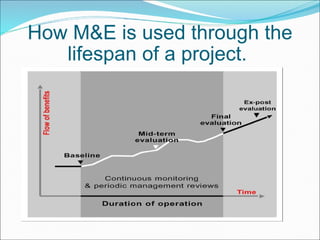
Result-based management (RBM) is an approach that focuses an organization's efforts and resources on expected results through improved accountability, effectiveness, and sustainability. Central to RBM is the results chain, which stipulates the necessary sequence to achieve desired objectives from inputs and activities to outcomes and impacts. Monitoring is the ongoing collection of data on indicators to track progress and inform management, focusing on lower results. Evaluation assesses overall performance through events like surveys and studies, focusing on outcomes and impacts. Well-defined indicators are needed to measure achievement at each level of the results chain throughout the lifespan of a project.
What is ResultBased Management (RBM)? RBM is a participatory and team-based management approach that seeks to: Focus an organization's efforts and resources on expected results. Improve effectiveness and sustainability of operations. Improve accountability for resources used. In WFP RBM represents a shift away from focusing on inputs and activities towards the measurement of results. This means focusing on changes in the behaviour and livelihoods of beneficiaries.
3.
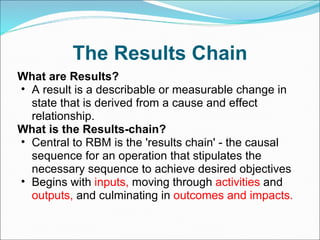
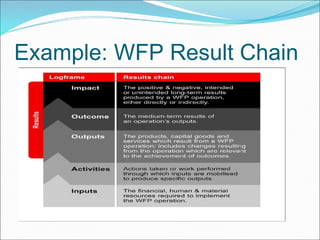
The Results ChainWhat are Results? A result is a describable or measurable change in state that is derived from a cause and effect relationship. What is the Results-chain? Central to RBM is the 'results chain' - the causal sequence for an operation that stipulates the necessary sequence to achieve desired objectives Begins with inputs, moving through activities and outputs, and culminating in outcomes and impacts.
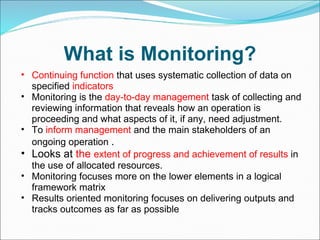
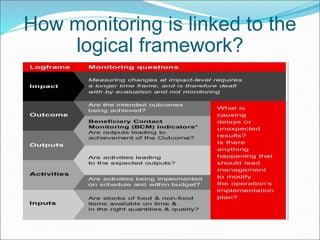
What is Monitoring?Continuing function that uses systematic collection of data on specified indicators Monitoring is the day-to-day management task of collecting and reviewing information that reveals how an operation is proceeding and what aspects of it, if any, need adjustment. To inform management and the main stakeholders of an ongoing operation . Looks at the extent of progress and achievement of results in the use of allocated resources. Monitoring focuses more on the lower elements in a logical framework matrix Results oriented monitoring focuses on delivering outputs and tracks outcomes as far as possible
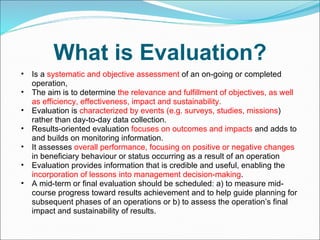
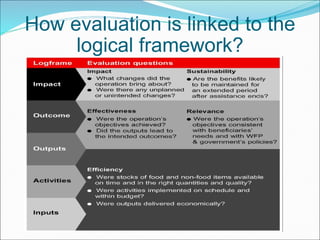
What is Evaluation?Is a systematic and objective assessment of an on-going or completed operation, The aim is to determine the relevance and fulfillment of objectives, as well as efficiency, effectiveness, impact and sustainability. Evaluation is characterized by events (e.g. surveys, studies, missions ) rather than day-to-day data collection. Results-oriented evaluation focuses on outcomes and impacts and adds to and builds on monitoring information. It assesses overall performance, focusing on positive or negative changes in beneficiary behaviour or status occurring as a result of an operation Evaluation provides information that is credible and useful, enabling the incorporation of lessons into management decision-making . A mid-term or final evaluation should be scheduled: a) to measure mid-course progress toward results achievement and to help guide planning for subsequent phases of an operations or b) to assess the operation’s final impact and sustainability of results.
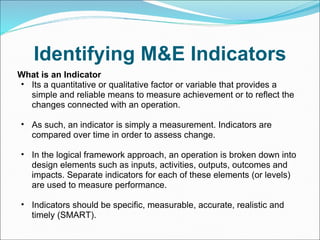
Identifying M&E IndicatorsWhat is an Indicator Its a quantitative or qualitative factor or variable that provides a simple and reliable means to measure achievement or to reflect the changes connected with an operation. As such, an indicator is simply a measurement. Indicators are compared over time in order to assess change. In the logical framework approach, an operation is broken down into design elements such as inputs, activities, outputs, outcomes and impacts. Separate indicators for each of these elements (or levels) are used to measure performance. Indicators should be specific, measurable, accurate, realistic and timely (SMART).
11.
Beneficiary Contact Monitoring(BCM) What is BCM? ‘ BCM’ is defined as a systematic investigation to monitor beneficiaries’ perceptions of an operation. Focuses on beneficiary access to, use of and satisfaction with outputs by seeking feedback directly from the women, men and children who are the target group for an operation. Concerns the transition between outputs and outcomes. Provides managers with an indication of progress towards the achievement of an operation’s outcomes. It applies the following logic: If members of the target group do not have access to operation outputs, they will not experience any benefit. If members of the target group have access to, but have chosen not to use, the outputs, they will not experience any benefit. If members of the target group are using operation outputs, but are not satisfied with the services or facilities they are receiving, they are UNLIKELY to use them in the longer term.
12.
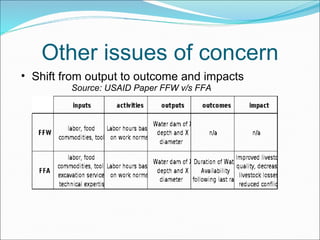
Other issues ofconcern Shift from output to outcome and impacts Source: USAID Paper FFW v/s FFA
13.
Other issues ofconcern: Cont’ Embedding FFA activities within the broader livelihood systems. comprehensive mapping of water resources in FFA targeted and neighboring districts. socio-economic mapping of water resources within the broader livelihood system, including an assessment of how current water resources are being used. Consider the 4 pillars of food security. These are food availability, food access, food utilization and resilience . Comprehensive food security programming acts like an umbrella pulling these altogether.