Presented by Abhijeet Birari
UNIT II
PROBLEM IDENTIFICATION
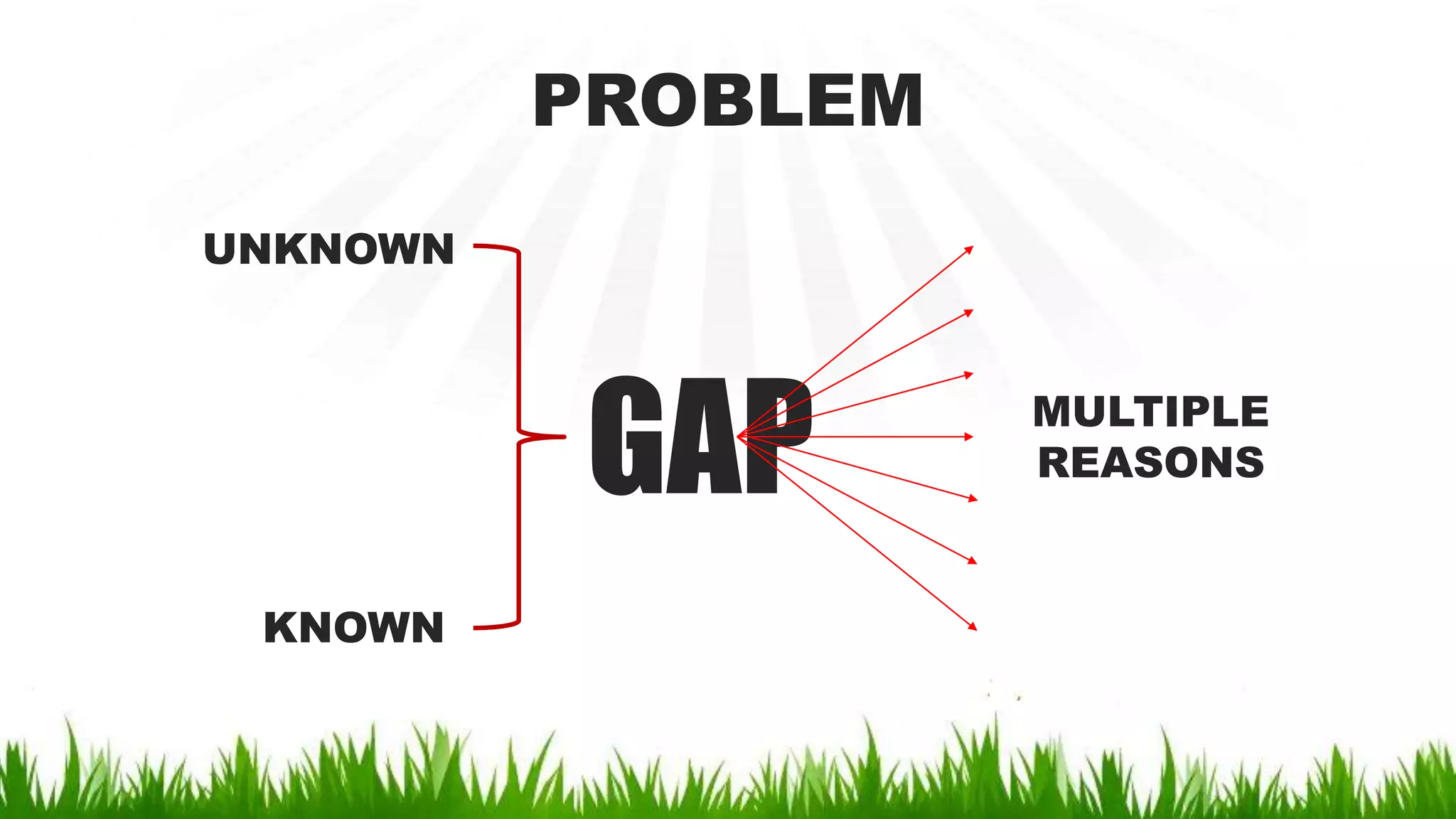
PROBLEM
KNOWN
UNKNOWN
GAP MULTIPLE
REASONS
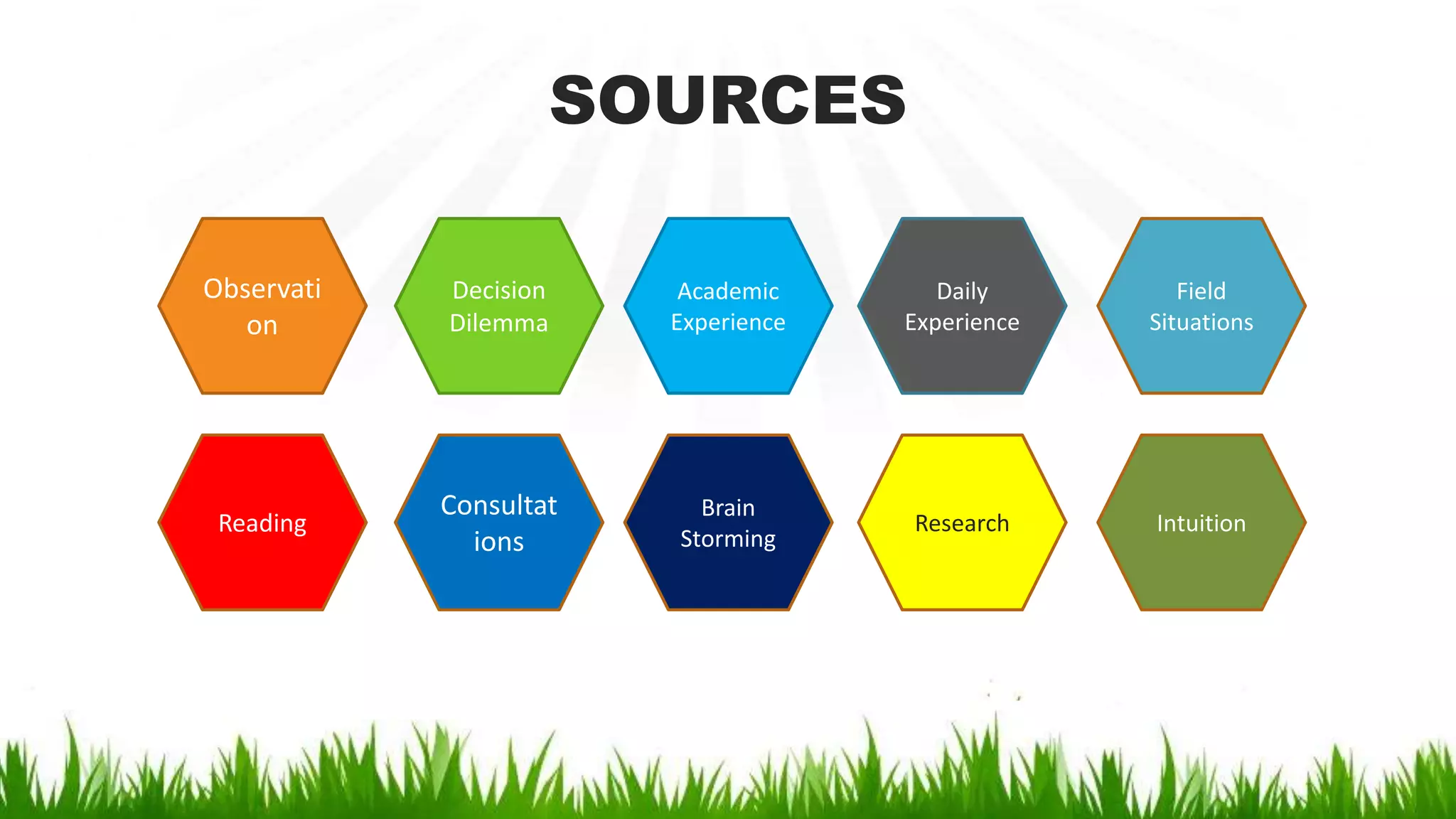
SOURCES OF PROBLEMS
SOURCES
Decision
Dilemma
Academic
Experience
Daily
Experience
Field
Situations
Consultat
ions
Brain
Storming
Research Intuition
Observati
on
Reading
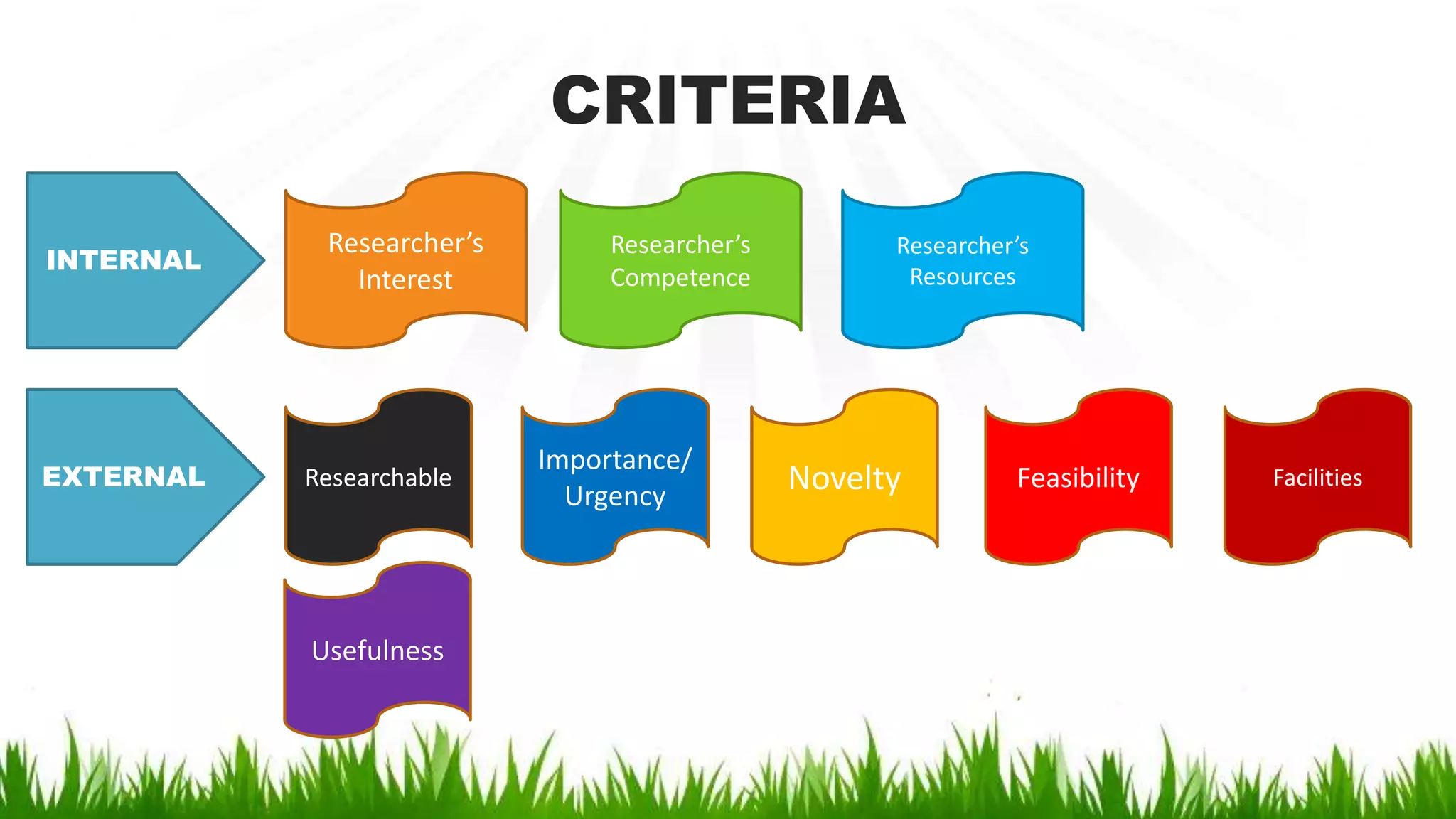
CRITERIA FOR SELECTION
CRITERIA
Researcher’s
Competence
Researcher’s
Resources
Importance/
Urgency
Novelty Feasibility Facilities
Researcher’s
Interest
Researchable
INTERNAL
EXTERNAL
Usefulness
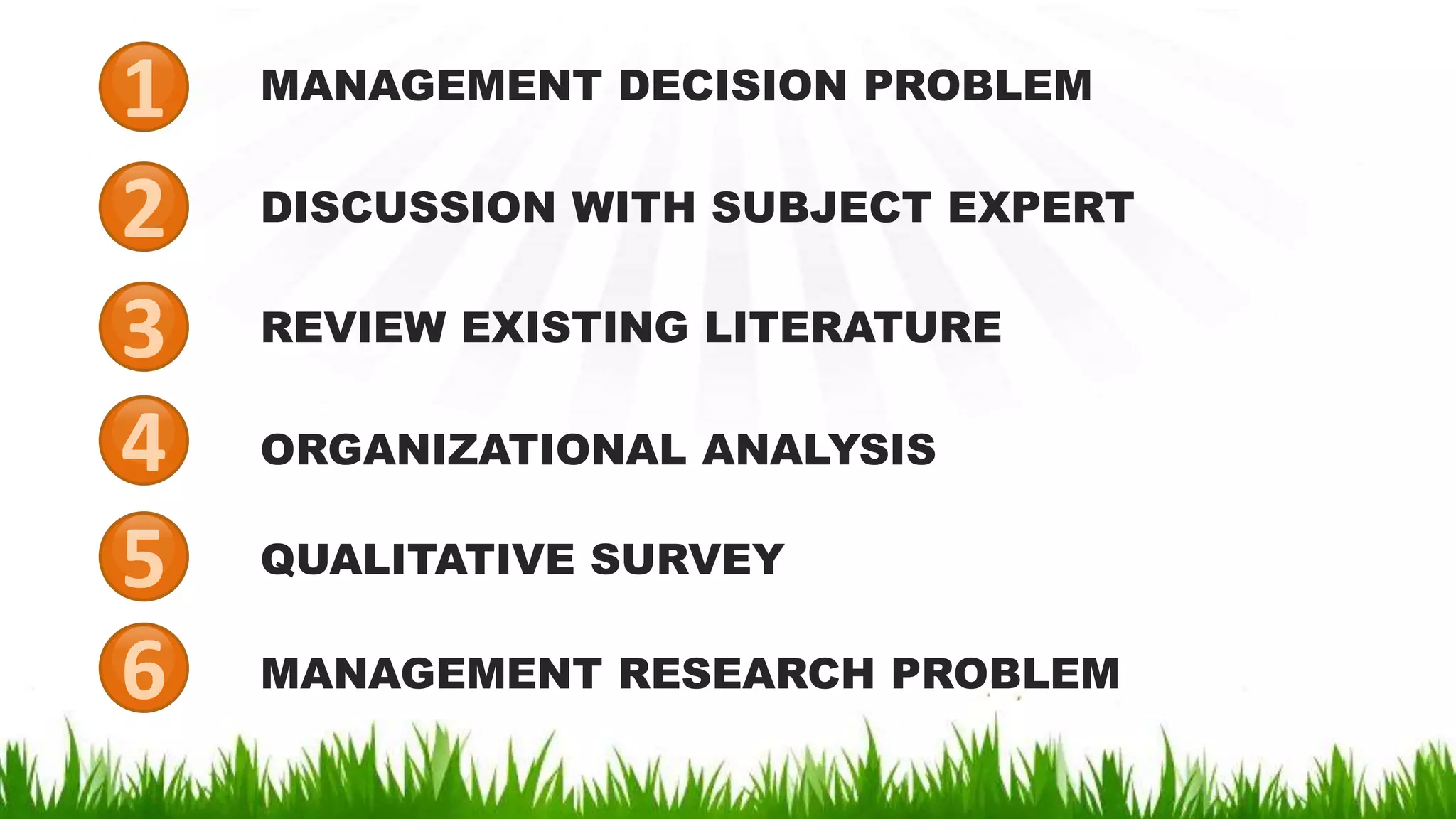
RESEARCH PROBLEM
IDENTIFICATION
MANAGEMENT DECISION PROBLEM1
DISCUSSION WITH SUBJECT EXPERT2
REVIEW EXISTING LITERATURE3
ORGANIZATIONAL ANALYSIS4
QUALITATIVE SURVEY5
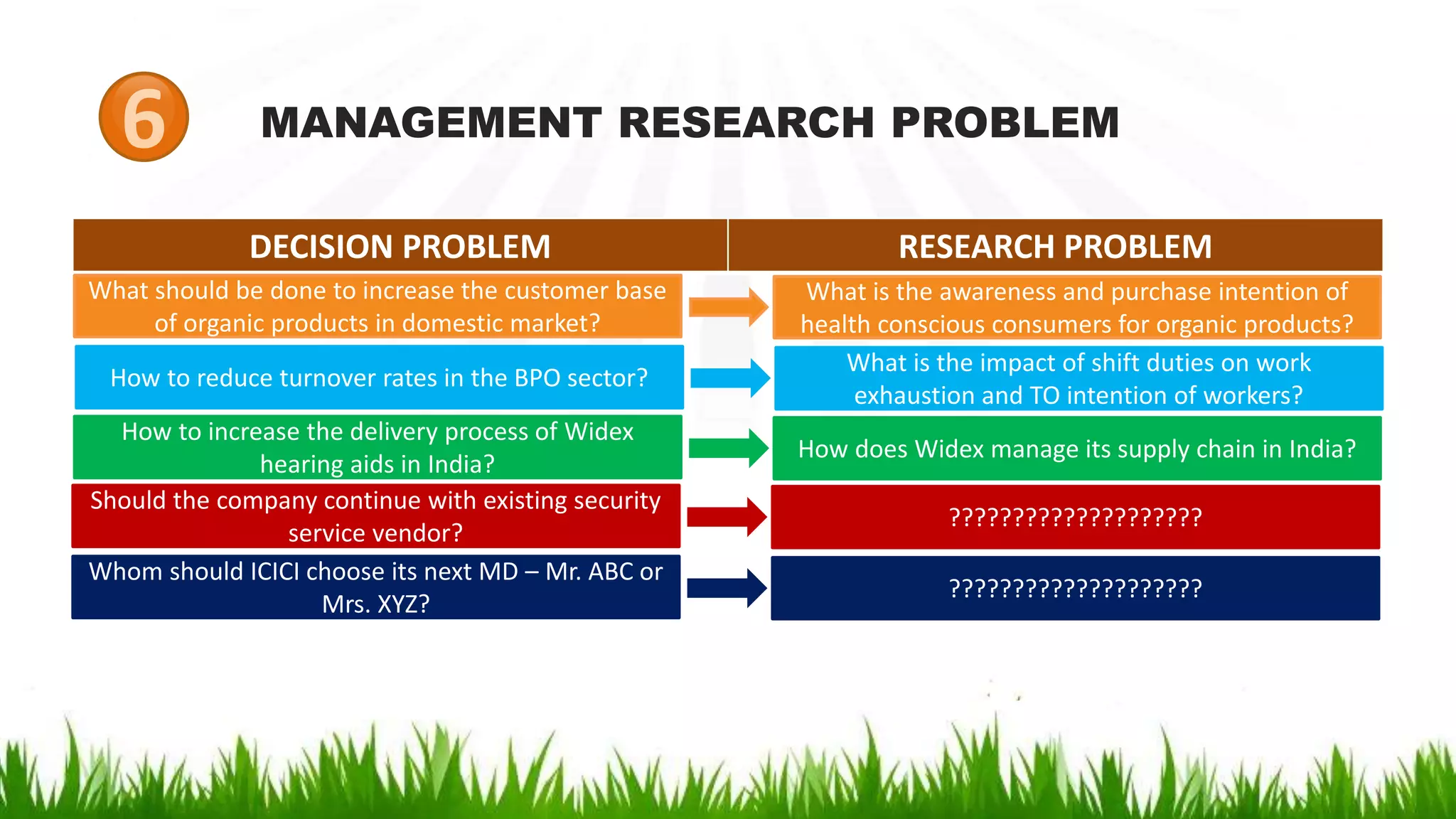
MANAGEMENT RESEARCH PROBLEM6
DECISION PROBLEM RESEARCH PROBLEM
What should be done to increase the customer base
of organic products in domestic market?
What is the awareness and purchase intention of
health conscious consumers for organic products?
How to reduce turnover rates in the BPO sector?
What is the impact of shift duties on work
exhaustion and TO intention of workers?
How to increase the delivery process of Widex
hearing aids in India?
How does Widex manage its supply chain in India?
Should the company continue with existing security
service vendor?
????????????????????
Whom should ICICI choose its next MD – Mr. ABC or
Mrs. XYZ?
????????????????????
MANAGEMENT RESEARCH PROBLEM6
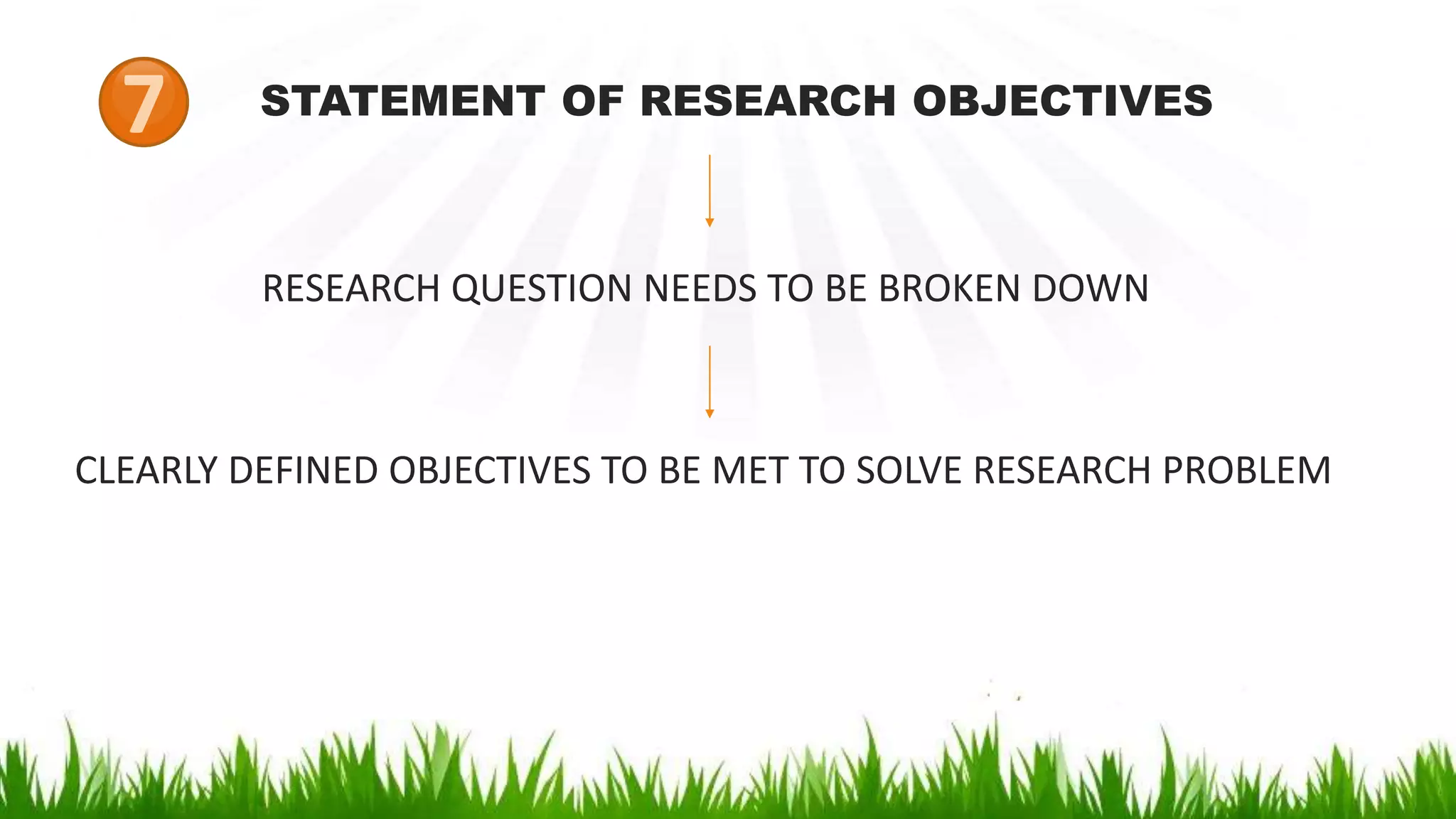
STATEMENT OF RESEARCH OBJECTIVES7
RESEARCH QUESTION NEEDS TO BE BROKEN DOWN
CLEARLY DEFINED OBJECTIVES TO BE MET TO SOLVE RESEARCH PROBLEM
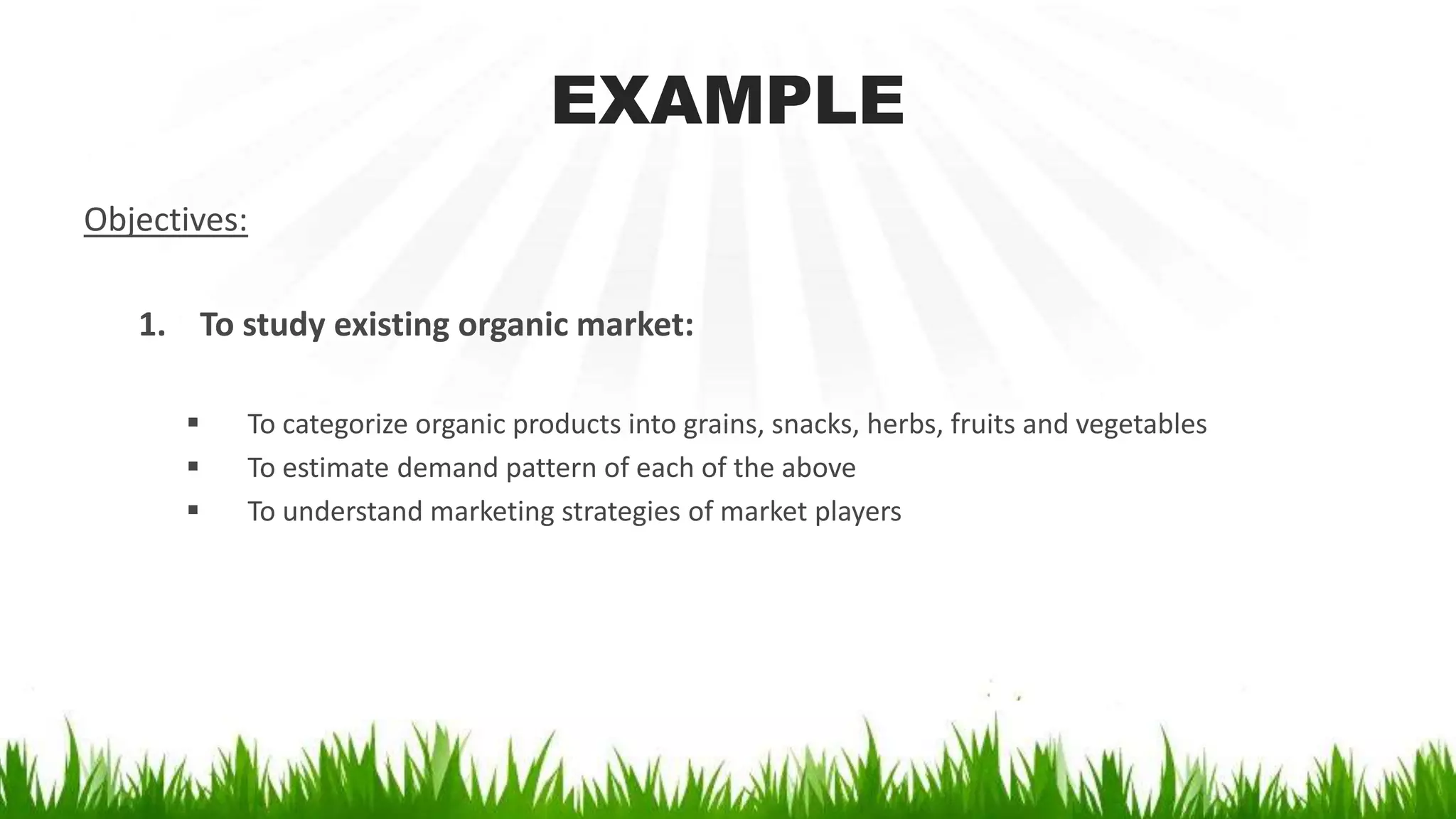
EXAMPLE
Objectives:
1. To study existing organic market:
 To categorize organic products into grains, snacks, herbs, fruits and vegetables
 To estimate demand pattern of each of the above
 To understand marketing strategies of market players
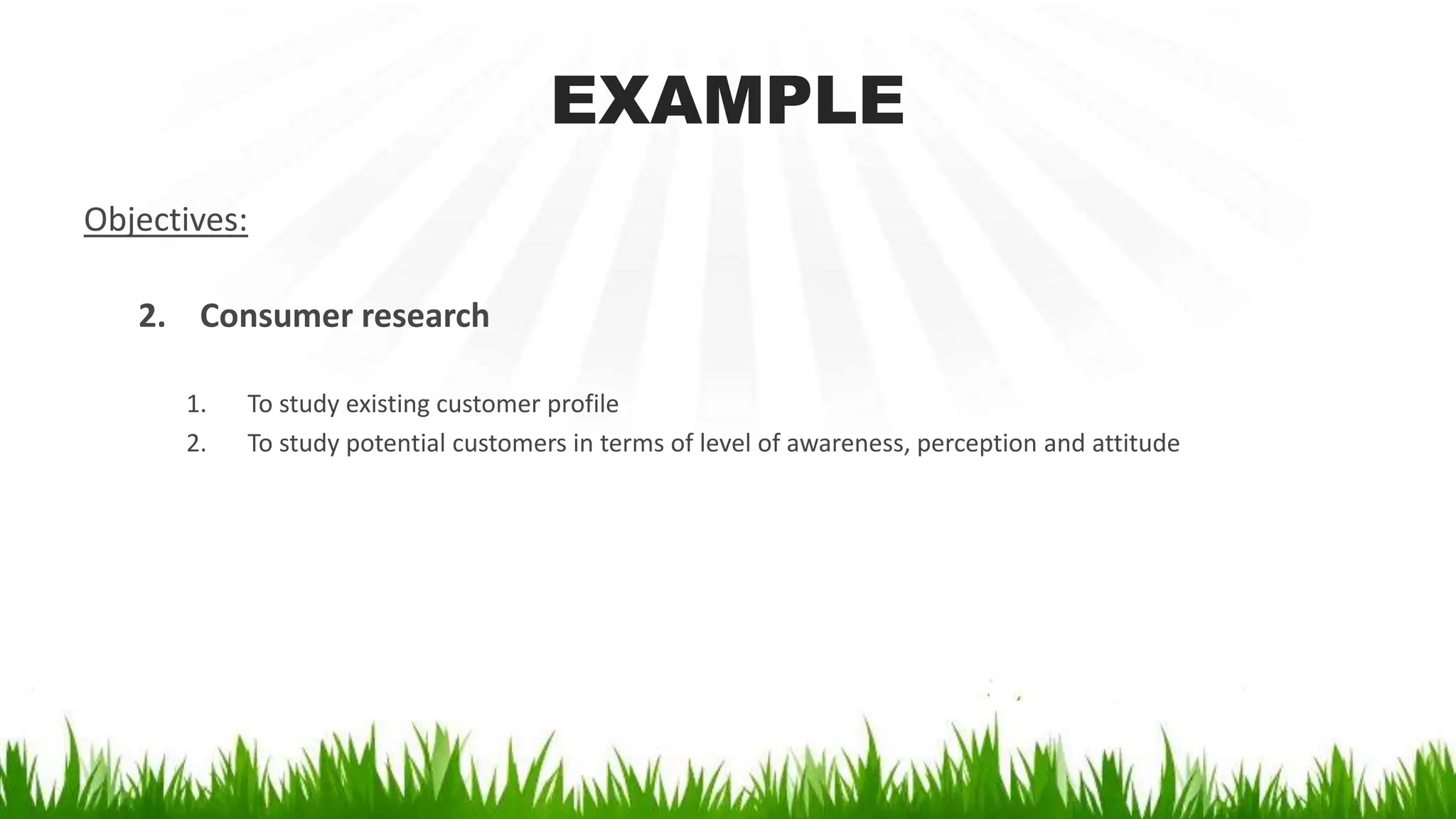
EXAMPLE
Objectives:
2. Consumer research
1. To study existing customer profile
2. To study potential customers in terms of level of awareness, perception and attitude
EXAMPLE
Objectives:
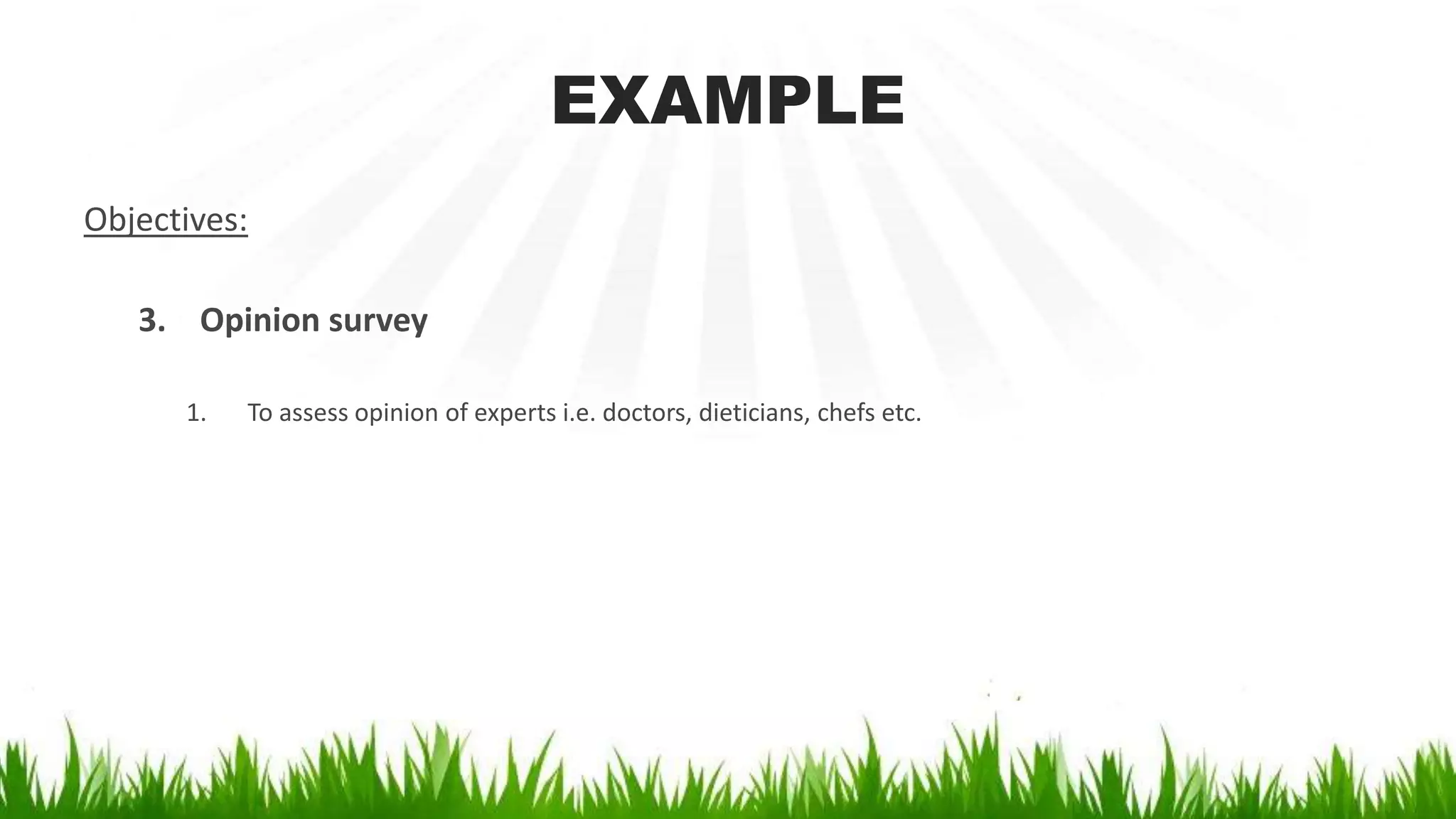
3. Opinion survey
1. To assess opinion of experts i.e. doctors, dieticians, chefs etc.
PROBLEM FORMULATION &
STATEMENT OF OBJECTIVES
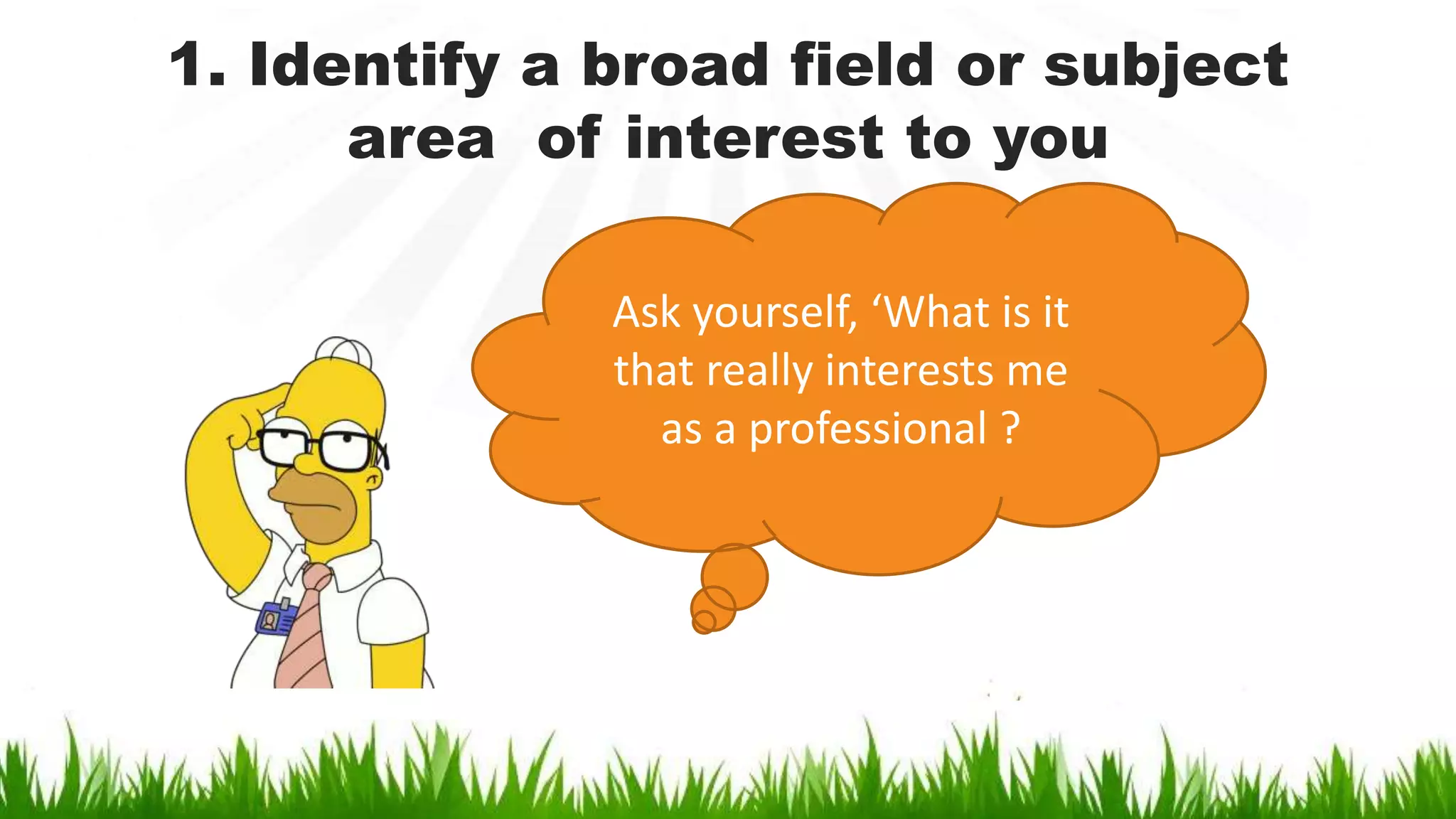
1. Identify a broad field or subject
area of interest to you
Ask yourself, ‘What is it
that really interests me
as a professional ?
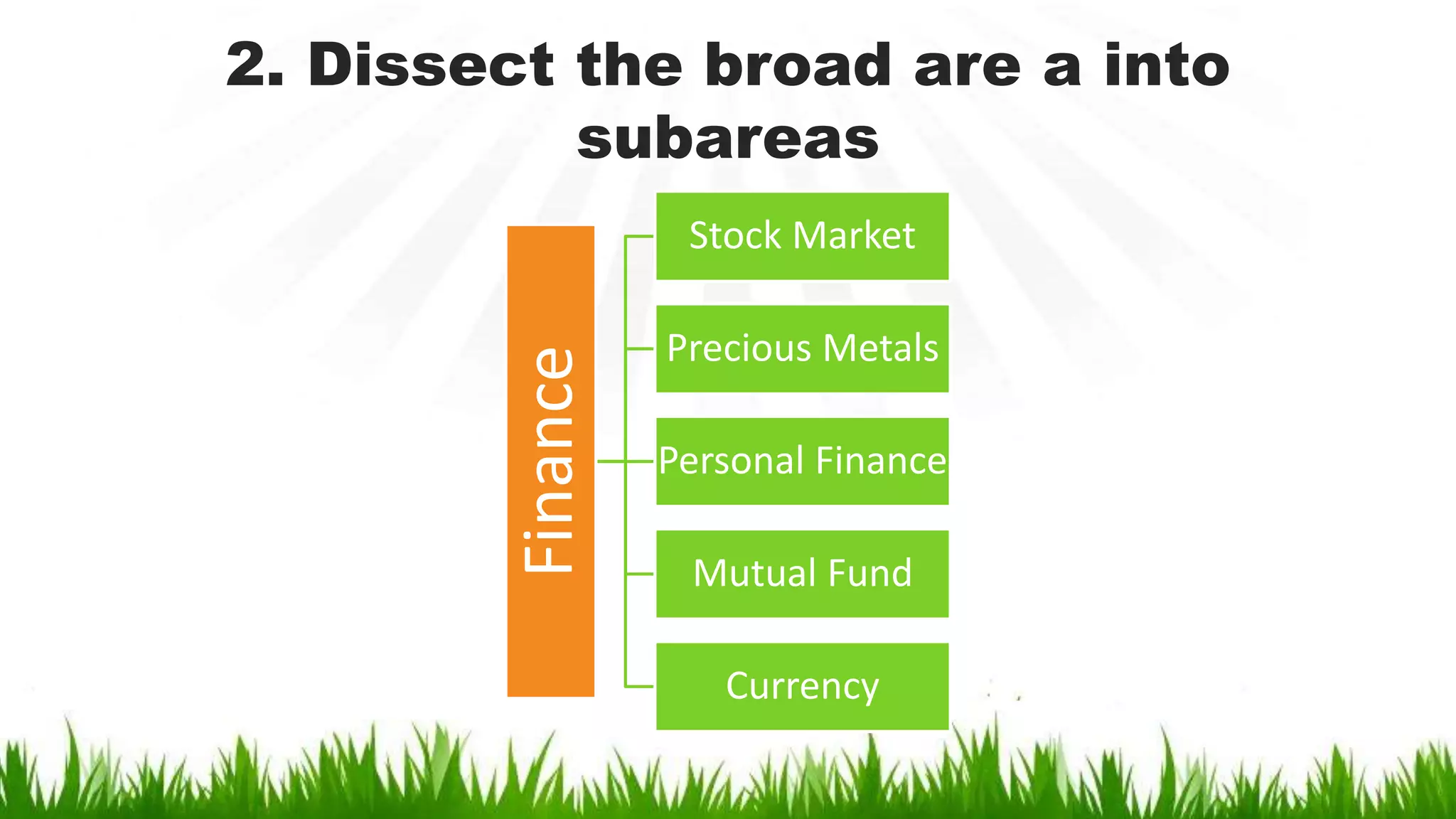
2. Dissect the broad are a into
subareas
Finance
Stock Market
Precious Metals
Personal Finance
Mutual Fund
Currency
3. Select what is of most interest to
you
Finance Stock Market
Precious Metals
Personal Finance
Mutual Fund
Currency
This is it !
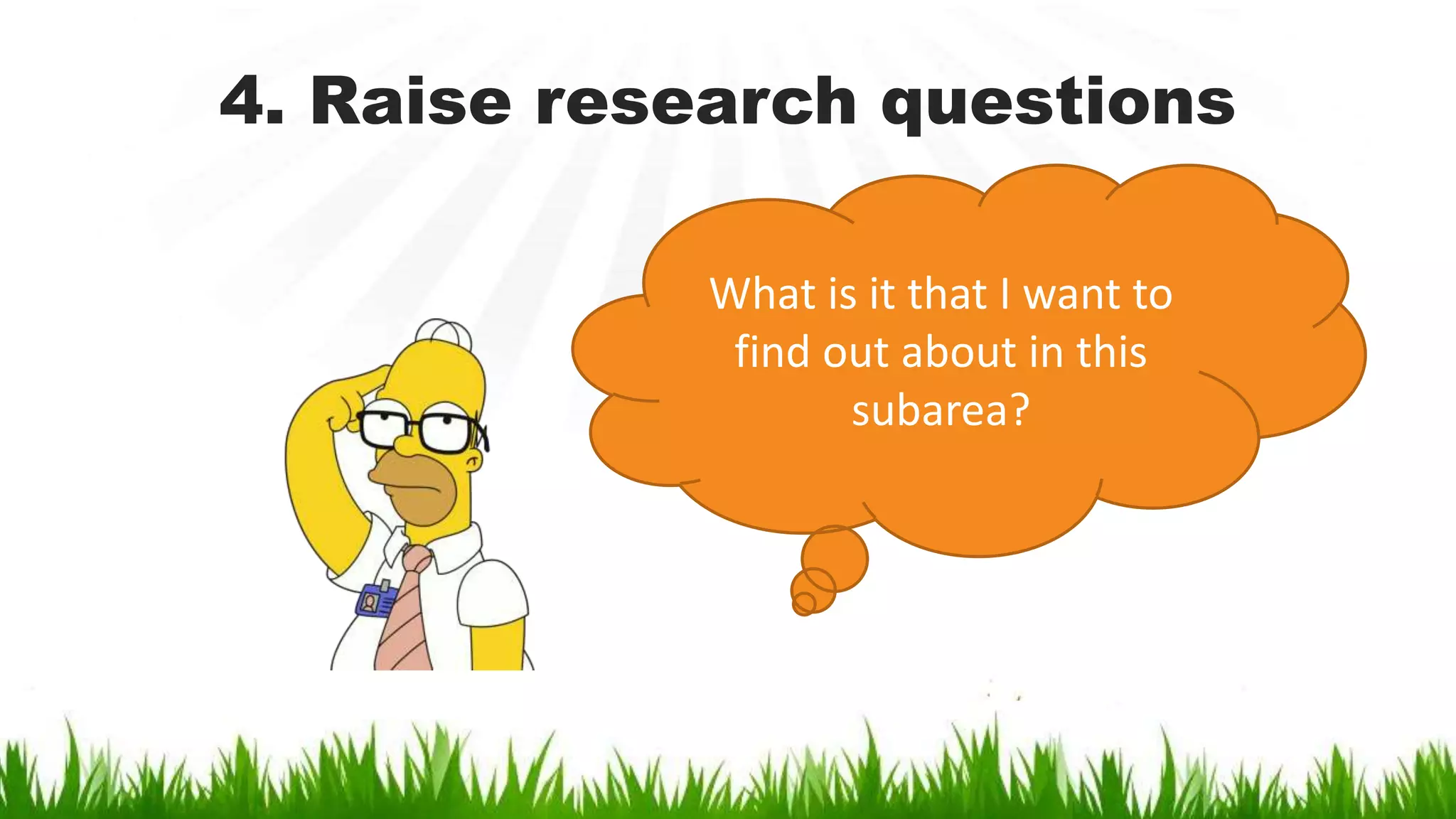
4. Raise research questions
What is it that I want to
find out about in this
subarea?
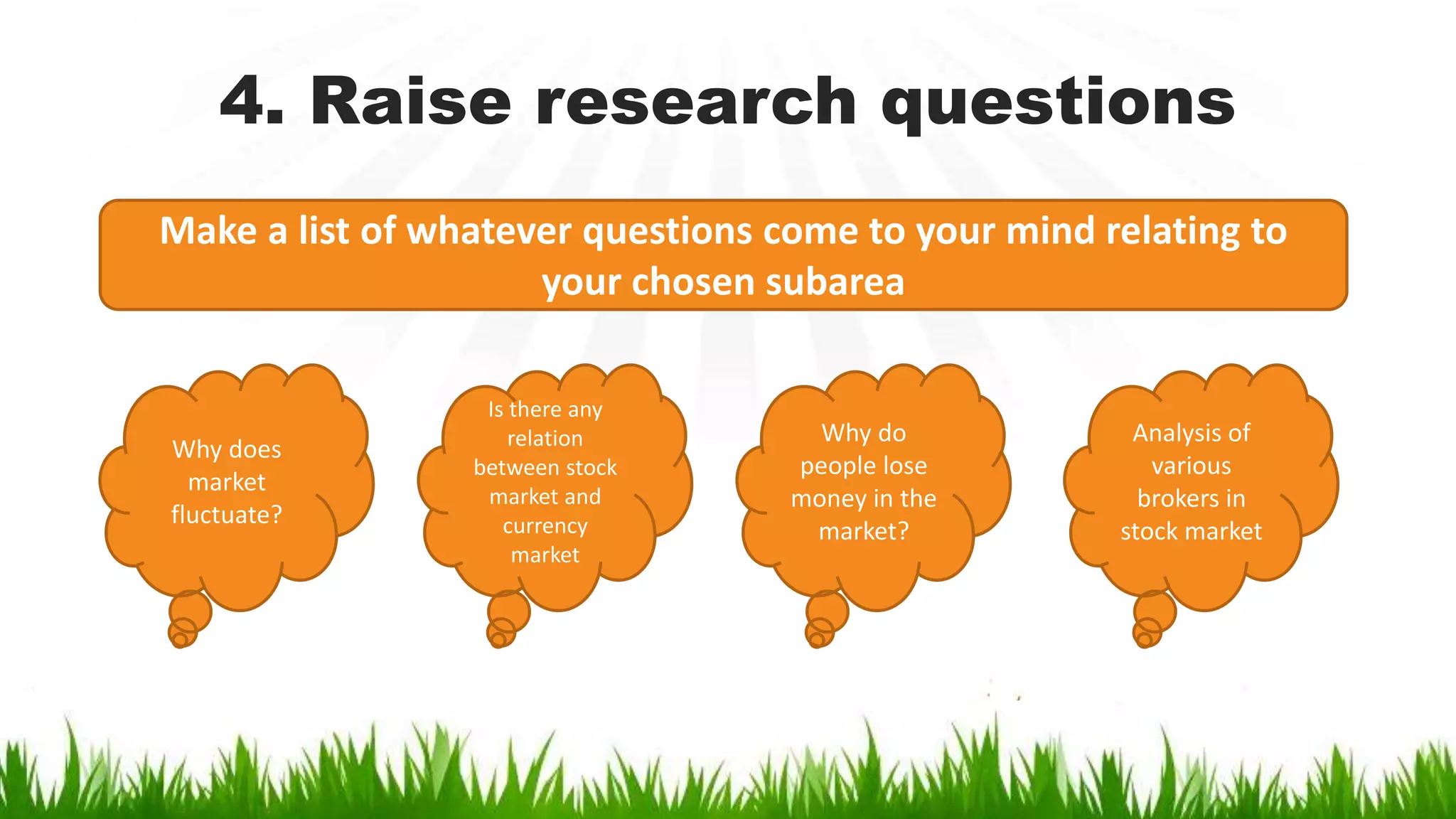
4. Raise research questions
Make a list of whatever questions come to your mind relating to
your chosen subarea
Why does
market
fluctuate?
Is there any
relation
between stock
market and
currency
market
Why do
people lose
money in the
market?
Analysis of
various
brokers in
stock market
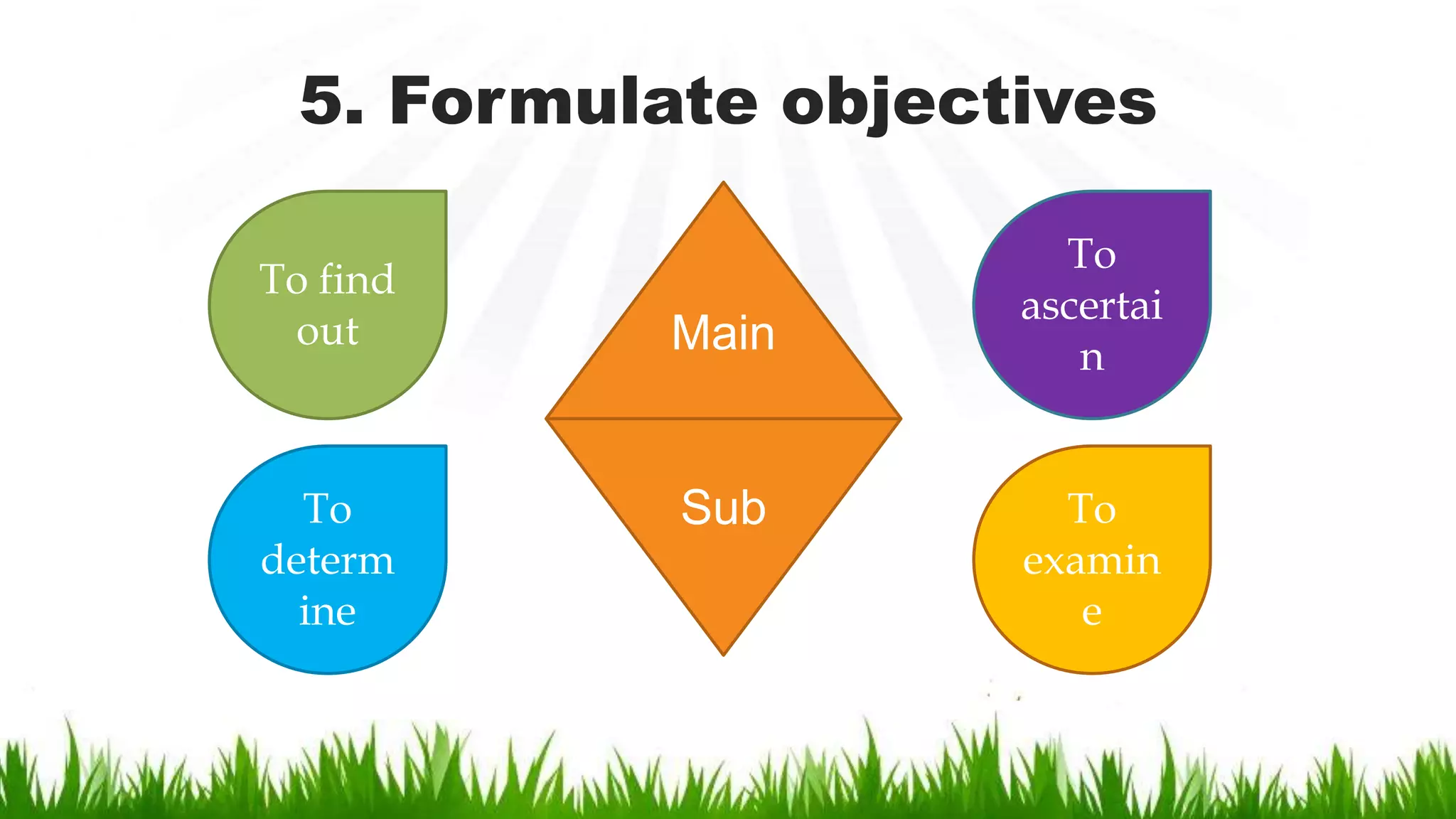
5. Formulate objectives
To find
out
To
ascertai
n
To
determ
ine
To
examin
e
Main
Sub
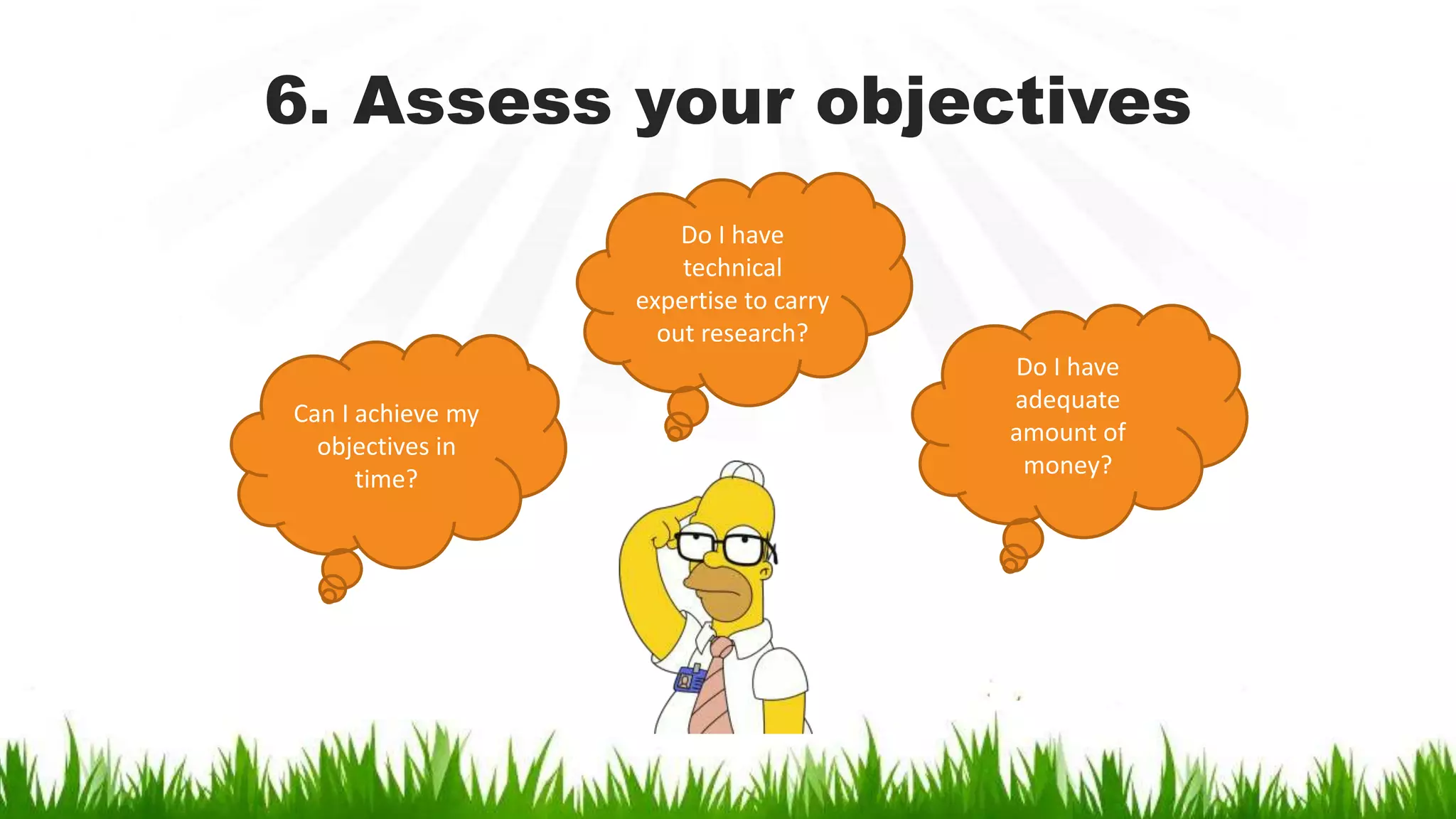
6. Assess your objectives
Can I achieve my
objectives in
time?
Do I have
adequate
amount of
money?
Do I have
technical
expertise to carry
out research?
7. Double check
Am I really
enthusiastic
about the study?
Do I really have
enough
resources to
undertake study?
PROBLEM SOLVING
PROCESS
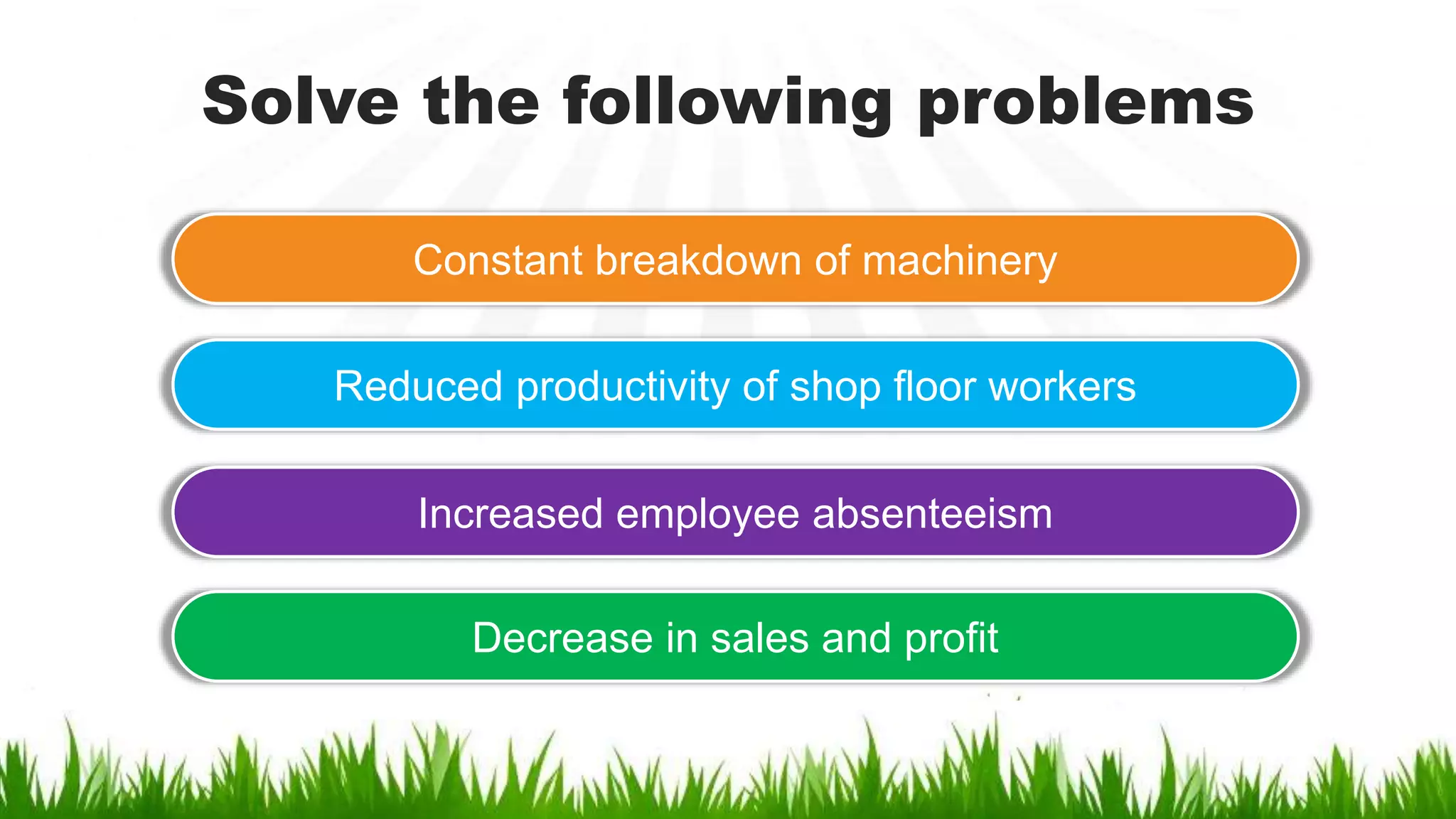
Solve the following problems
Constant breakdown of machinery
Reduced productivity of shop floor workers
Increased employee absenteeism
Decrease in sales and profit
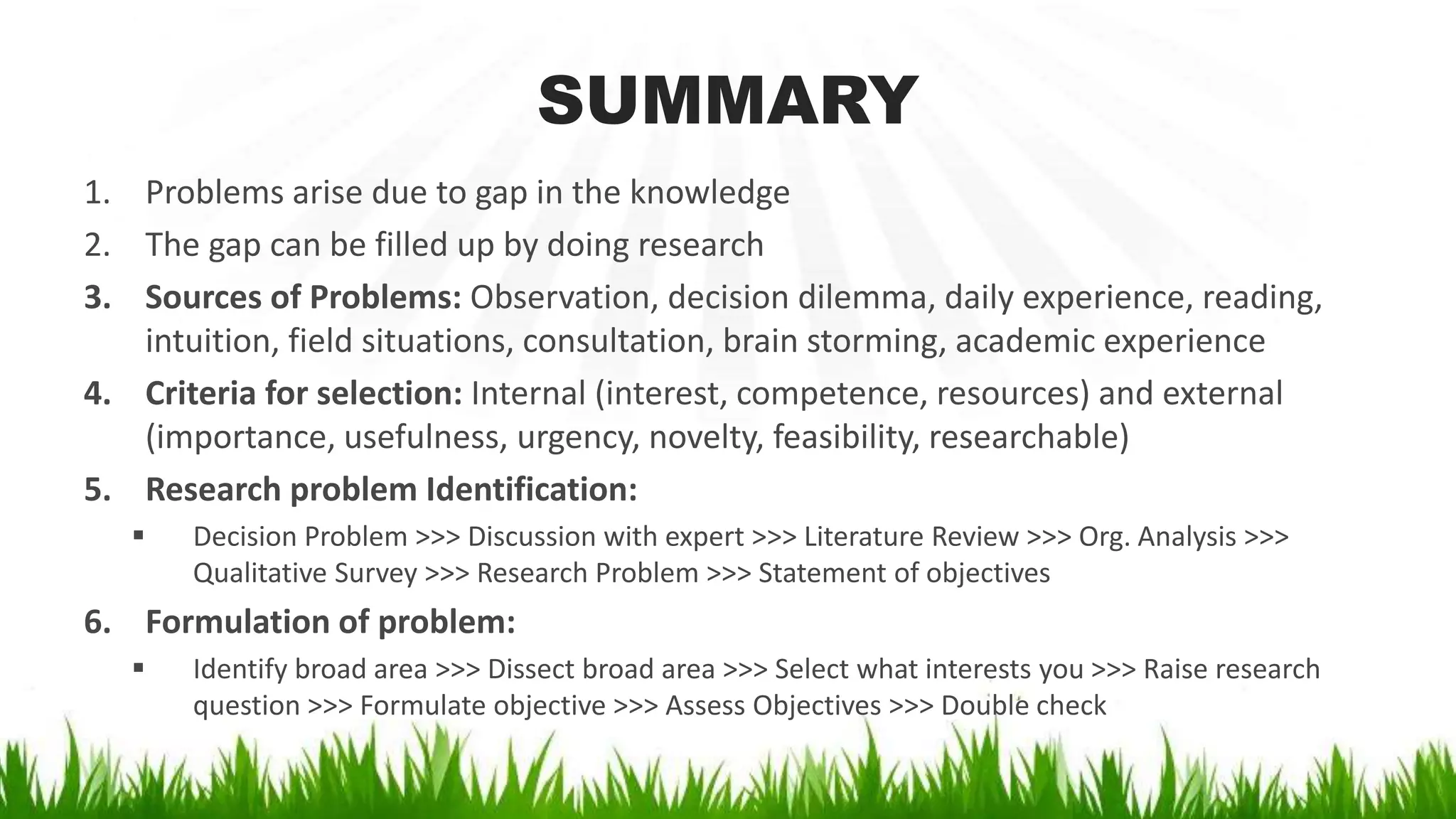
SUMMARY
SUMMARY
1. Problems arise due to gap in the knowledge
2. The gap can be filled up by doing research
3. Sources of Problems: Observation, decision dilemma, daily experience, reading,
intuition, field situations, consultation, brain storming, academic experience
4. Criteria for selection: Internal (interest, competence, resources) and external
(importance, usefulness, urgency, novelty, feasibility, researchable)
5. Research problem Identification:
 Decision Problem >>> Discussion with expert >>> Literature Review >>> Org. Analysis >>>
Qualitative Survey >>> Research Problem >>> Statement of objectives
6. Formulation of problem:
 Identify broad area >>> Dissect broad area >>> Select what interests you >>> Raise research
question >>> Formulate objective >>> Assess Objectives >>> Double check
SUMMARY
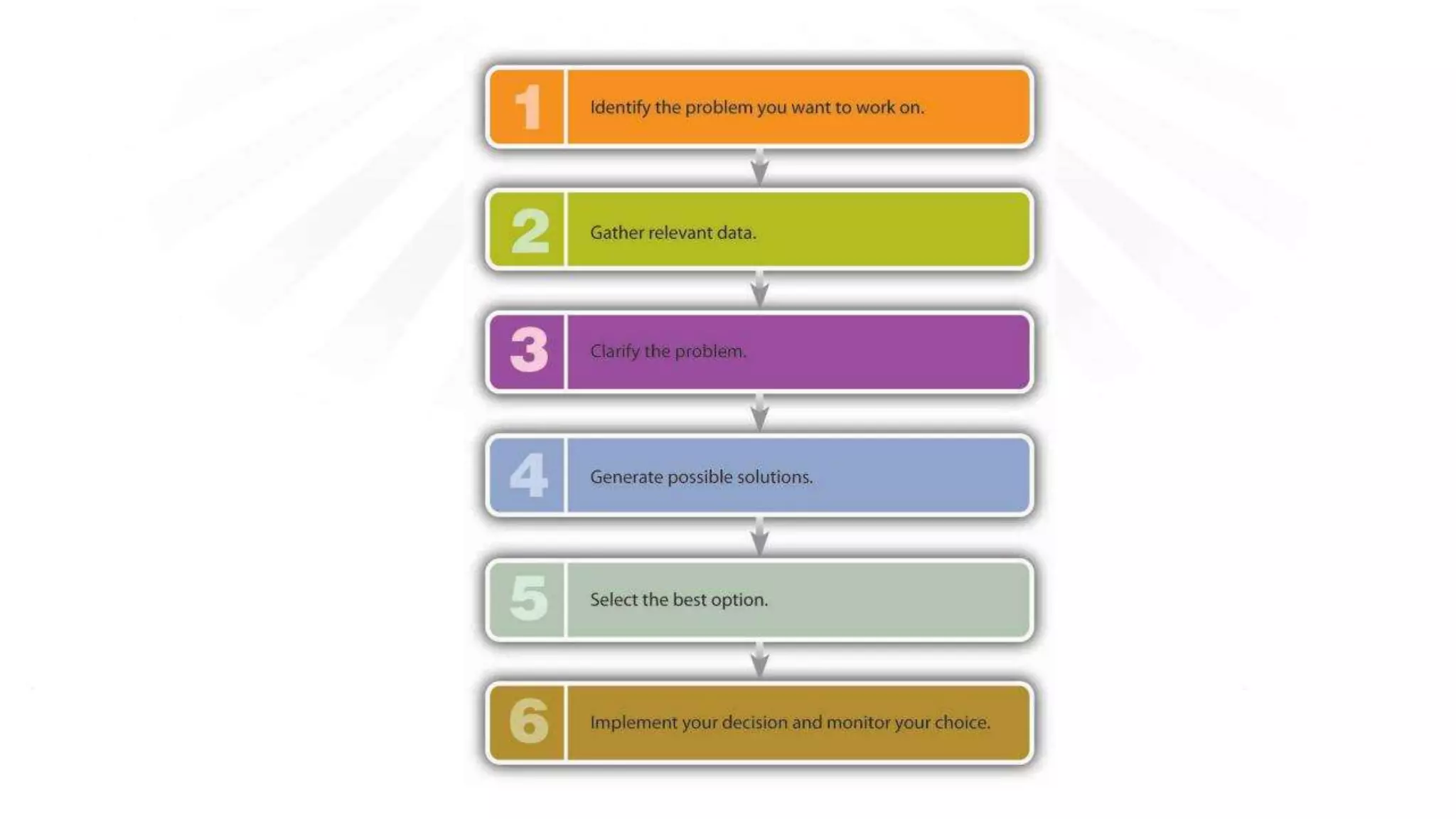
7. Problem Solving Process:
 Identify problem >>> Gather Data >>> Clarify problem >>> Generate possible solutions >>>
Select >>> Implement & monitor
THANK YOU

Research problem identification

Editor's Notes

  • #2 This presentation demonstrates the new capabilities of PowerPoint and it is best viewed in Slide Show. These slides are designed to give you great ideas for the presentations you’ll create in PowerPoint 2010! For more sample templates, click the File tab, and then on the New tab, click Sample Templates.
  • #15 Ranjit kumar
  • #24 Ranjit kumar
  • #27 Ranjit kumar