 Chapter Objectives
 Define a research proposal and explain its importance
 Define a research problem and explain its importance in a study.
 Identify criteria for deciding whether a problem can and should be
researched.
 Learn the elements in writing a “statement of the problem” section.
 Identify strategies useful in writing a “statement of the problem”
section
 Identify problem areas that are likely to be studied in organizations.
2.1. Definition of research proposal
There are different terminologies depending on why the
research is carried out.
Research outline
Synopsis of research
Plan of research
Project proposal
Thesis plan etc
Cont’d
 It is an overall plan, scheme, structure and strategy designed
to obtain answers to the research questions or problems that
make up your research study.
 is the detailed plan of study.
 A kind of blueprint that researchers prepare before actually
carrying out research.
 A written document that showing how the research will be
carried out.
 It is a systematically prepared outline starting the manner in
which you plan to carry out your research.
2.2. Importance of Research Proposal
It provides a systematic plan of procedures for the researcher to follow.
To convince your audience.
It reduces the possibility of costly mistakes.
To contract with your client.
Serves as a contract between the researcher and sponsors
It gives the research supervisor a basis for guiding the researcher while
conducting the study.
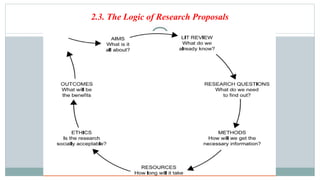
2.3. The Logic of Research Proposals
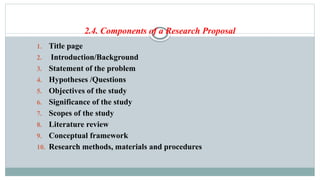
2.4. Components of a Research Proposal
1. Title page
2. Introduction/Background
3. Statement of the problem
4. Hypotheses /Questions
5. Objectives of the study
6. Significance of the study
7. Scopes of the study
8. Literature review
9. Conceptual framework
10. Research methods, materials and procedures
1. Research topic
 Be brief and avoid wasting words, eliminate unnecessary words such as "An
Approach to" or "A study of”, “An investigation on”…
 Should not be too long (recommended if it is between 12- 15 words).
 Use a single title or a double title. An example of a double title is “Master of Business
Administration Program: Roles and Contributions in Creating Entrepreneurial
Orientation.”
 Put your name, the name of your department/faculty/college, the name of your
advisor(s) and date of delivery under the title.
 Title is a label: it is not a sentence.
 Titles should almost never contain abbreviations.
 Should not include terms of unscientific, argumentative, emotional, or biased nature.
 The title page has no page number and it is not counted in any page numbering.
Where to Look for Potential Topics?
 Your own professional interests. What excites and energizes you? What
career goals could be enhanced by studying a particular topic?
 Faculty members, professional colleagues, and fellow students. Listen to
their suggestions about potential topics.
 Professional journals in your field. This is where you can find out the hot
topics of the day and for the near future.
 Theses and/dissertations. Review previously written theses.
 Oral defenses. Attend as many of these as you can. It opens your eyes to
what happens during a thesis defense.
 Current theories. Have any new theories come out in your field, or are
existing theories being questioned?
Cont’d
The Internet.
Conferences and seminars.
Outside agencies or professional organizations that conduct
research.
Leading scholars in your interest areas.
Your current job setting. Are there problems that need solutions in
your workplace? Your boss might have a pet topic that could
enhance your career opportunities.
References in your field. Many handbooks and bibliographies
exist in most subject areas.
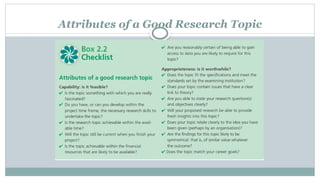
Attributes of a Good Research Topic
2. Background of the study
 The introduction also should address the following points:
 A historical perspective (development, growth, etc.) pertinent to the study
area;
 Philosophical or ideological issues relating to the topic;
 Trends in terms of prevalence, if appropriate;
 Major theories, if any;
 The main issues, problems and advances in the subject area under study;
 Important theoretical and practical issues relating to the central problem
under study;
 The main findings relating to the core issue(s).
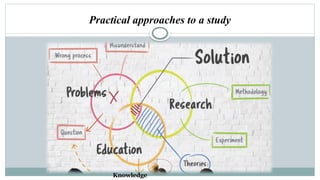
Practical approaches to a study
Knowledge
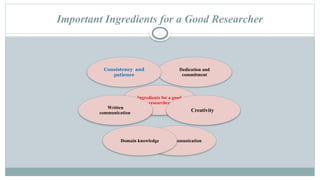
Important Ingredients for a Good Researcher
Ingredients for a good
researcher
Dedication and
commitment
Creativity
Verbal communication
Domain knowledge
Written
communication
Consistency and
patience
3. Definition and Selection of a Research Problem
 The first and important step in any research.
 A business research problem is;
 Any situation where a gap exists between an actual and a desired ideal state.
 Difficulty which a researcher experiences in the context of either a theoretical
or practical situation and wants to obtain a solution for the same.
 initiating force behind a research.
 are the business issues, controversies, or concerns that guide the need for conducting
a study.
 Problem definition is the process of defining and developing a decision
statement and the steps involved in translating it into more precise research
terminology.
 A problem might be defined as the issue that exists in the literature,
theory, or practice that leads to a need for the study and wants to
obtain an explanation of the same.
 A clearly stated problem is research half done.
 Effective problem statements answer the question “Why does this
research need to be conducted.”
Contd.
 Identify the issues that are the basis of your study;
 Specify the various aspects of/ perspectives on these issues;
 Identify the main gaps in the existing body of knowledge;
 Theoretical gap - gap in the theories
 Empirical gap - gap in researches made by others
 Practical gap – gap between principles, strategies, policies, plans and their implementations
 Raise some of the main research questions that you want to answer through your
study;
 Identify what knowledge is available concerning your questions, specifying the
differences of opinion in the literature regarding these questions if differences exist;
 Develop a rationale for your study with particular reference to how your study will
fill the identified gaps.
Examples of problems
1. Long and frequent delays lead to much frustration among customers.
 These feelings may eventually lead to switching behavior, negative word-of-mouth
communication, and customer complaints.
2. Staff turnover is higher than anticipated. Why?
 because they are not satisfied with their jobs.
 because they do not find a challenge in their jobs.
 because they do not have control over their work.
 because they do not have a lot of influence over planning, executing, and evaluating the work they
do.
 Because we have been reluctant to delegate.
3. The current instrument for the assessment of potential employees for
management positions is imperfect.
4. Young workers in the organization show low levels of commitment to the
organization.
Example of translating business problem into problem statement
Problem statement
 Frequent and long delays may translate into much frustration among customers, to switching
behavior, and to negative word-of-mouth communication. These feelings and behaviors eventually
have negative effects on the performance and the profitability of the firm.
Problem Research objective
 The purpose of this study is twofold: (1) to identify the factors that influence the customers’
waiting experience and (2) to investigate the possible impact of waiting on customer satisfaction
and service evaluations.
Research questions
 What are the factors that affect the perceived waiting experience of customers and to what extent
do these factors affect the perception of waiting times?
 What are the affective consequences of waiting and how does affect/ mediate the relationship
between waiting and service evaluations?
 How do situational variables (such as filled time) influence customer reactions to the waiting
experience?
Conditions for a Research Problem
Individual or a group has some difficulty or the problem.
There must be objective(s)/outcome(s) to be attained.
There must be alternative methods/means for achieving
the objective(s).
There must be some doubt remain in the mind of the
researcher while selecting the alternatives.
There must be some environmental conditions, to which
the difficulty pertains.
Characteristics of Problem Statement
 Known fact: It should be based on Known fact which can be used to introduce
the topic.
 gap :It should identify gap from the current solution.
 Interest(Appealing): interest of the researcher should be preserved.
 Exploratory : can be investigated through the collection and analysis of data .
 Note-worthy or novelty : It should contribute for the improvement in the
research subject .
 Feasible : It should fit the researcher’s level of research skills, available
resources, and time restrictions
 ethical :Solution proposed should be ethical and should not harm anybody
 Problem statement should be challenging
 clear : Problem statement should be clear cut defined.
N.B.
 A problem statement is relevant if it is meaningful from a managerial
perspective, an academic perspective, or both.
 From a managerial perspective, research is relevant if it relates to
 a problem that currently exists in an organizational setting or
 an area that a manager believes needs to be improved in the organization.
 From an academic perspective, research is relevant if:
 Nothing is known about a topic,
 Much is known about the topic, but the knowledge is scattered and not integrated,
 Much research on the topic is available, but the results are (partly) contradictory, or
 Established relationships do not hold in certain situations.
Points to consider in selecting a research problem
1. Magnitude, and level of expertise: Too narrow or too vague statements for the
research problem should be avoided.
 E.g. why is productivity in South Africa is much higher than Ethiopia?
2. Avoid the selection of controversial subjects for the research problem.
3. Avoid research subjects that are done by a number of researchers.
4. Relevance: The research problem should be feasible for experimentation/
implementation-.
5. Availability of data: Sufficient numbers of publications/materials should be
available for finding the limitations/weaknesses of the subject- availability of data.
6. The researcher’s qualification, the importance of the subject, costs involved for
experimentation and time factors should be considered.
Contd.
 Interest: A research endeavor is usually time consuming, and involves hard
work and possibly unforeseen problems.
 Ethical issues: How ethical issues can affect the study population and how
ethical problems can be overcome should be thoroughly examined at the
problem-formulation stage.
Statement of the problem section should include;
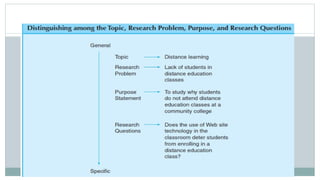
The topic
The research problem
A justification of the importance of the problem as found in the past
research and in practice.
The deficiencies in our existing knowledge about the problem.
The audiences that will benefit from a study of the problem.
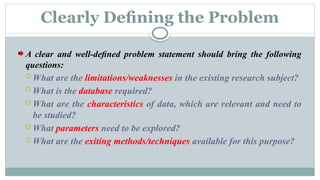
Clearly Defining the Problem
A clear and well-defined problem statement should bring the following
questions:
 What are the limitations/weaknesses in the existing research subject?
 What is the database required?
 What are the characteristics of data, which are relevant and need to
be studied?
 What parameters need to be explored?
 What are the exiting methods/techniques available for this purpose?
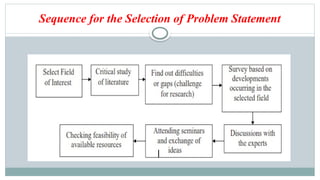
Sequence for the Selection of Problem Statement
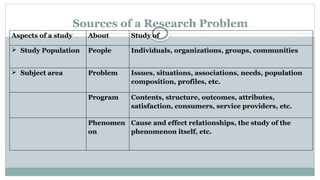
Sources of a Research Problem
Aspects of a study About Study of
 Study Population People Individuals, organizations, groups, communities
 Subject area Problem Issues, situations, associations, needs, population
composition, profiles, etc.
Program Contents, structure, outcomes, attributes,
satisfaction, consumers, service providers, etc.
Phenomen
on
Cause and effect relationships, the study of the
phenomenon itself, etc.
5.The Research Questions/Hypothesis
 Clearly state the research questions in the light of the problems, topic
and the theoretical foundations on which it rests.
 Should be;
Focused (narrow and specific)
Clear (Precise, concrete, and jargon free).
Connected (with established theory and knowledge).
Be Practical (based on your competencies and resources).
Flexible (can change, shift, evolve and develop based on literature,
rethinking, etc).
6. Objectives of the study
 Summarizes what is to be achieved by the study.
 Should be closely related to the statement of the problem.
 Form the basis for judging the remainder of the proposal.
 It sets the stage for showing how one intends to solve or
contribute to the problem, which has been set.
 Objectives should be stated using “measurable action verbs” like To
determine, To compare, To verify, To calculate, To describe
 Avoid words like vague non-action verbs such as: To appreciate … To
understand… To believe
Cont’d
 Are classified into general objectives and specific objectives.
 The general and specific objectives are logically connected to each other.
General Objective
 Broader terms of desired outcomes
Specific Objectives
 Smaller portions of the general objectives.
 Should be
 Specific,
 Measurable,
 Achievable
 Relevant
 Closely related or interlinked
 Show more immediate outcomes
…Contd.
Objective will help researcher to:
 Focus the study
 To collect only necessary data’s
 Organize the study in clearly defined parts
or phases
7. Hypothesis
 A hypothesis is a statement of your assumptions about the
prevalence of a phenomenon or about a relationship between two
variables that you plan to test within the framework of the study.
 a tentative assumption made in order to test its logical or
empirical consequences.
 Should be related to a theoretical base and should be used
whenever there is a basis for prediction.
 If you are going to test hypotheses, list them in this section.
N.B. Hypotheses are not constructed in qualitative research.
…cont.
 Main problems in formulating a working hypothesis
 Formulation of a hypothesis is not an easy task. The main problems
include:
 lack of clear theoretical framework
 lack of ability to utilize that theoretical framework logically
 failure to be acquainted with available research techniques so as to be
able to phrase the hypothesis properly.
… Contd.
 Characteristics of useable hypothesis
conceptually clear: should be stated in simple terms
should have empirical referents
must be specific
should be related to available techniques (Theory and methods not
opposed)
should be related to a body of theory
should be testable
should be limited in scope
Types of hypothesis
 Alternative/ directional hypotheses
is stated in a positive form.
is written in a directional statement indicating the kind of relationship anticipated.
is where the ‘direction’ of the relationship is clearly indicated.
 Null hypotheses.
 is a negative form of the hypothesis;
 is a statement that the phenomenon has occurred because of chance.
 is which simply states that there is no significant relationship between or among the
variables of interest.
 The research study will determine if the null hypothesis is rejected or accepted.
 The null hypothesis is concept oriented and has no direction
Errors in Hypothesis Testing
In hypothesis testing, there are four possible outcomes:
 The hypothesis is true but our test leads to its rejection
 The hypothesis is false but our test leads to acceptance
 The hypothesis is true and our test leads to acceptance
 The hypothesis is false and our test leads to its rejection
The first two lead to an erroneous decision. The first possibility leads to a
Type I error and
The second possibility leads to a Type II error.
 The last two lead to Correct Decision
8. Significance of the study
This entails the contribution of the research.
Who may use the findings?
User organizations (solve practical problems)
The society/the community/the country
Other researchers
Theoretical or conceptual benefits
9. Scope of the study
 Before starting with data collection you have to
identify the universe and the unit of study.
Demarcation of the physical area (Geography) and
social unit of study.
Theoretical/Conceptual
Methodological
Temporal
 THANK YOU VERY MUCH
 END OF CHAPTER

Chapter two - formulation research problem .pptx

  • 1.
     Chapter Objectives Define a research proposal and explain its importance  Define a research problem and explain its importance in a study.  Identify criteria for deciding whether a problem can and should be researched.  Learn the elements in writing a “statement of the problem” section.  Identify strategies useful in writing a “statement of the problem” section  Identify problem areas that are likely to be studied in organizations.
  • 2.
    2.1. Definition ofresearch proposal There are different terminologies depending on why the research is carried out. Research outline Synopsis of research Plan of research Project proposal Thesis plan etc
  • 3.
    Cont’d  It isan overall plan, scheme, structure and strategy designed to obtain answers to the research questions or problems that make up your research study.  is the detailed plan of study.  A kind of blueprint that researchers prepare before actually carrying out research.  A written document that showing how the research will be carried out.  It is a systematically prepared outline starting the manner in which you plan to carry out your research.
  • 4.
    2.2. Importance ofResearch Proposal It provides a systematic plan of procedures for the researcher to follow. To convince your audience. It reduces the possibility of costly mistakes. To contract with your client. Serves as a contract between the researcher and sponsors It gives the research supervisor a basis for guiding the researcher while conducting the study.
  • 5.
    2.3. The Logicof Research Proposals
  • 6.
    2.4. Components ofa Research Proposal 1. Title page 2. Introduction/Background 3. Statement of the problem 4. Hypotheses /Questions 5. Objectives of the study 6. Significance of the study 7. Scopes of the study 8. Literature review 9. Conceptual framework 10. Research methods, materials and procedures
  • 7.
    1. Research topic Be brief and avoid wasting words, eliminate unnecessary words such as "An Approach to" or "A study of”, “An investigation on”…  Should not be too long (recommended if it is between 12- 15 words).  Use a single title or a double title. An example of a double title is “Master of Business Administration Program: Roles and Contributions in Creating Entrepreneurial Orientation.”  Put your name, the name of your department/faculty/college, the name of your advisor(s) and date of delivery under the title.  Title is a label: it is not a sentence.  Titles should almost never contain abbreviations.  Should not include terms of unscientific, argumentative, emotional, or biased nature.  The title page has no page number and it is not counted in any page numbering.
  • 8.
    Where to Lookfor Potential Topics?  Your own professional interests. What excites and energizes you? What career goals could be enhanced by studying a particular topic?  Faculty members, professional colleagues, and fellow students. Listen to their suggestions about potential topics.  Professional journals in your field. This is where you can find out the hot topics of the day and for the near future.  Theses and/dissertations. Review previously written theses.  Oral defenses. Attend as many of these as you can. It opens your eyes to what happens during a thesis defense.  Current theories. Have any new theories come out in your field, or are existing theories being questioned?
  • 9.
    Cont’d The Internet. Conferences andseminars. Outside agencies or professional organizations that conduct research. Leading scholars in your interest areas. Your current job setting. Are there problems that need solutions in your workplace? Your boss might have a pet topic that could enhance your career opportunities. References in your field. Many handbooks and bibliographies exist in most subject areas.
  • 10.
    Attributes of aGood Research Topic
  • 11.
    2. Background ofthe study  The introduction also should address the following points:  A historical perspective (development, growth, etc.) pertinent to the study area;  Philosophical or ideological issues relating to the topic;  Trends in terms of prevalence, if appropriate;  Major theories, if any;  The main issues, problems and advances in the subject area under study;  Important theoretical and practical issues relating to the central problem under study;  The main findings relating to the core issue(s).
  • 12.
    Practical approaches toa study Knowledge
  • 13.
    Important Ingredients fora Good Researcher Ingredients for a good researcher Dedication and commitment Creativity Verbal communication Domain knowledge Written communication Consistency and patience
  • 14.
    3. Definition andSelection of a Research Problem  The first and important step in any research.  A business research problem is;  Any situation where a gap exists between an actual and a desired ideal state.  Difficulty which a researcher experiences in the context of either a theoretical or practical situation and wants to obtain a solution for the same.  initiating force behind a research.  are the business issues, controversies, or concerns that guide the need for conducting a study.  Problem definition is the process of defining and developing a decision statement and the steps involved in translating it into more precise research terminology.
  • 15.
     A problemmight be defined as the issue that exists in the literature, theory, or practice that leads to a need for the study and wants to obtain an explanation of the same.  A clearly stated problem is research half done.  Effective problem statements answer the question “Why does this research need to be conducted.”
  • 16.
    Contd.  Identify theissues that are the basis of your study;  Specify the various aspects of/ perspectives on these issues;  Identify the main gaps in the existing body of knowledge;  Theoretical gap - gap in the theories  Empirical gap - gap in researches made by others  Practical gap – gap between principles, strategies, policies, plans and their implementations  Raise some of the main research questions that you want to answer through your study;  Identify what knowledge is available concerning your questions, specifying the differences of opinion in the literature regarding these questions if differences exist;  Develop a rationale for your study with particular reference to how your study will fill the identified gaps.
  • 17.
    Examples of problems 1.Long and frequent delays lead to much frustration among customers.  These feelings may eventually lead to switching behavior, negative word-of-mouth communication, and customer complaints. 2. Staff turnover is higher than anticipated. Why?  because they are not satisfied with their jobs.  because they do not find a challenge in their jobs.  because they do not have control over their work.  because they do not have a lot of influence over planning, executing, and evaluating the work they do.  Because we have been reluctant to delegate. 3. The current instrument for the assessment of potential employees for management positions is imperfect. 4. Young workers in the organization show low levels of commitment to the organization.
  • 18.
    Example of translatingbusiness problem into problem statement Problem statement  Frequent and long delays may translate into much frustration among customers, to switching behavior, and to negative word-of-mouth communication. These feelings and behaviors eventually have negative effects on the performance and the profitability of the firm. Problem Research objective  The purpose of this study is twofold: (1) to identify the factors that influence the customers’ waiting experience and (2) to investigate the possible impact of waiting on customer satisfaction and service evaluations. Research questions  What are the factors that affect the perceived waiting experience of customers and to what extent do these factors affect the perception of waiting times?  What are the affective consequences of waiting and how does affect/ mediate the relationship between waiting and service evaluations?  How do situational variables (such as filled time) influence customer reactions to the waiting experience?
  • 19.
    Conditions for aResearch Problem Individual or a group has some difficulty or the problem. There must be objective(s)/outcome(s) to be attained. There must be alternative methods/means for achieving the objective(s). There must be some doubt remain in the mind of the researcher while selecting the alternatives. There must be some environmental conditions, to which the difficulty pertains.
  • 20.
    Characteristics of ProblemStatement  Known fact: It should be based on Known fact which can be used to introduce the topic.  gap :It should identify gap from the current solution.  Interest(Appealing): interest of the researcher should be preserved.  Exploratory : can be investigated through the collection and analysis of data .  Note-worthy or novelty : It should contribute for the improvement in the research subject .  Feasible : It should fit the researcher’s level of research skills, available resources, and time restrictions  ethical :Solution proposed should be ethical and should not harm anybody  Problem statement should be challenging  clear : Problem statement should be clear cut defined.
  • 21.
    N.B.  A problemstatement is relevant if it is meaningful from a managerial perspective, an academic perspective, or both.  From a managerial perspective, research is relevant if it relates to  a problem that currently exists in an organizational setting or  an area that a manager believes needs to be improved in the organization.  From an academic perspective, research is relevant if:  Nothing is known about a topic,  Much is known about the topic, but the knowledge is scattered and not integrated,  Much research on the topic is available, but the results are (partly) contradictory, or  Established relationships do not hold in certain situations.
  • 22.
    Points to considerin selecting a research problem 1. Magnitude, and level of expertise: Too narrow or too vague statements for the research problem should be avoided.  E.g. why is productivity in South Africa is much higher than Ethiopia? 2. Avoid the selection of controversial subjects for the research problem. 3. Avoid research subjects that are done by a number of researchers. 4. Relevance: The research problem should be feasible for experimentation/ implementation-. 5. Availability of data: Sufficient numbers of publications/materials should be available for finding the limitations/weaknesses of the subject- availability of data. 6. The researcher’s qualification, the importance of the subject, costs involved for experimentation and time factors should be considered.
  • 23.
    Contd.  Interest: Aresearch endeavor is usually time consuming, and involves hard work and possibly unforeseen problems.  Ethical issues: How ethical issues can affect the study population and how ethical problems can be overcome should be thoroughly examined at the problem-formulation stage.
  • 24.
    Statement of theproblem section should include; The topic The research problem A justification of the importance of the problem as found in the past research and in practice. The deficiencies in our existing knowledge about the problem. The audiences that will benefit from a study of the problem.
  • 25.
    Clearly Defining theProblem A clear and well-defined problem statement should bring the following questions:  What are the limitations/weaknesses in the existing research subject?  What is the database required?  What are the characteristics of data, which are relevant and need to be studied?  What parameters need to be explored?  What are the exiting methods/techniques available for this purpose?
  • 27.
    Sequence for theSelection of Problem Statement
  • 28.
    Sources of aResearch Problem Aspects of a study About Study of  Study Population People Individuals, organizations, groups, communities  Subject area Problem Issues, situations, associations, needs, population composition, profiles, etc. Program Contents, structure, outcomes, attributes, satisfaction, consumers, service providers, etc. Phenomen on Cause and effect relationships, the study of the phenomenon itself, etc.
  • 29.
    5.The Research Questions/Hypothesis Clearly state the research questions in the light of the problems, topic and the theoretical foundations on which it rests.  Should be; Focused (narrow and specific) Clear (Precise, concrete, and jargon free). Connected (with established theory and knowledge). Be Practical (based on your competencies and resources). Flexible (can change, shift, evolve and develop based on literature, rethinking, etc).
  • 30.
    6. Objectives ofthe study  Summarizes what is to be achieved by the study.  Should be closely related to the statement of the problem.  Form the basis for judging the remainder of the proposal.  It sets the stage for showing how one intends to solve or contribute to the problem, which has been set.  Objectives should be stated using “measurable action verbs” like To determine, To compare, To verify, To calculate, To describe  Avoid words like vague non-action verbs such as: To appreciate … To understand… To believe
  • 31.
    Cont’d  Are classifiedinto general objectives and specific objectives.  The general and specific objectives are logically connected to each other. General Objective  Broader terms of desired outcomes Specific Objectives  Smaller portions of the general objectives.  Should be  Specific,  Measurable,  Achievable  Relevant  Closely related or interlinked  Show more immediate outcomes
  • 32.
    …Contd. Objective will helpresearcher to:  Focus the study  To collect only necessary data’s  Organize the study in clearly defined parts or phases
  • 33.
    7. Hypothesis  Ahypothesis is a statement of your assumptions about the prevalence of a phenomenon or about a relationship between two variables that you plan to test within the framework of the study.  a tentative assumption made in order to test its logical or empirical consequences.  Should be related to a theoretical base and should be used whenever there is a basis for prediction.  If you are going to test hypotheses, list them in this section. N.B. Hypotheses are not constructed in qualitative research.
  • 34.
    …cont.  Main problemsin formulating a working hypothesis  Formulation of a hypothesis is not an easy task. The main problems include:  lack of clear theoretical framework  lack of ability to utilize that theoretical framework logically  failure to be acquainted with available research techniques so as to be able to phrase the hypothesis properly.
  • 35.
    … Contd.  Characteristicsof useable hypothesis conceptually clear: should be stated in simple terms should have empirical referents must be specific should be related to available techniques (Theory and methods not opposed) should be related to a body of theory should be testable should be limited in scope
  • 36.
    Types of hypothesis Alternative/ directional hypotheses is stated in a positive form. is written in a directional statement indicating the kind of relationship anticipated. is where the ‘direction’ of the relationship is clearly indicated.  Null hypotheses.  is a negative form of the hypothesis;  is a statement that the phenomenon has occurred because of chance.  is which simply states that there is no significant relationship between or among the variables of interest.  The research study will determine if the null hypothesis is rejected or accepted.  The null hypothesis is concept oriented and has no direction
  • 37.
    Errors in HypothesisTesting In hypothesis testing, there are four possible outcomes:  The hypothesis is true but our test leads to its rejection  The hypothesis is false but our test leads to acceptance  The hypothesis is true and our test leads to acceptance  The hypothesis is false and our test leads to its rejection The first two lead to an erroneous decision. The first possibility leads to a Type I error and The second possibility leads to a Type II error.  The last two lead to Correct Decision
  • 38.
    8. Significance ofthe study This entails the contribution of the research. Who may use the findings? User organizations (solve practical problems) The society/the community/the country Other researchers Theoretical or conceptual benefits
  • 39.
    9. Scope ofthe study  Before starting with data collection you have to identify the universe and the unit of study. Demarcation of the physical area (Geography) and social unit of study. Theoretical/Conceptual Methodological Temporal
  • 40.
     THANK YOUVERY MUCH  END OF CHAPTER

Editor's Notes

  • #30 Analyze= consider the