REGENT EDUCATION & RESEARCH FOUNDATION
NAME: Ajit Rajak
ROLL NO: 26302823012
YEAR: 2ND
SEMESTER: 3RD
SUBJECT NAME: Mathematics-III
SUBJECT CODE: BSM-301
DEPARTMENT: Electrical & Electronics Engineering
TOPIC NAME: Basic Concept of Probability Theory
CONTENT
 Probability Theory
 What is Probability Theory?
 Probability Theory Definition
 Theoretical Probability
 Experimental Probability
 Probability Theory Formulas
 Applications of Probability Theory
 Probability Theory Examples
 Conclusion
Probability Theory
Probability is defined as the chance of happening or occurrences of an event.
Generally, the possibility of analyzing the occurrence of any event with respect
to previous data is called probability. For example, if a fair coin is tossed, what
is the chance that it lands on the head? These types of questions are answered
under probability.
Probability is indeed defined as the likelihood or chance of a specific event
occurring, often expressed as a number between 0 and 1, where 0 indicates
impossibility and 1 indicates certainty. In addition to the definition you provided,
here are a few more perspectives on probability.
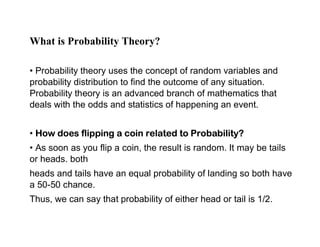
What is Probability Theory?
• Probability theory uses the concept of random variables and
probability distribution to find the outcome of any situation.
Probability theory is an advanced branch of mathematics that
deals with the odds and statistics of happening an event.
• How does flipping a coin related to Probability?
• As soon as you flip a coin, the result is random. It may be tails
or heads. both
heads and tails have an equal probability of landing so both have
a 50-50 chance.
Thus, we can say that probability of either head or tail is 1/2.
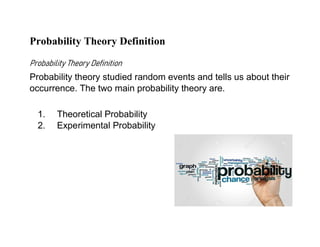
Probability Theory Definition
Probability theory studied random events and tells us about their
occurrence. The two main probability theory are.
1. Theoretical Probability
2. Experimental Probability
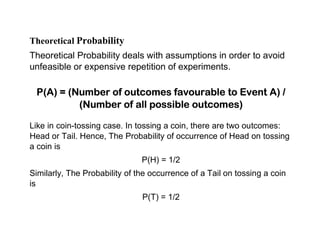
Theoretical Probability
Theoretical Probability deals with assumptions in order to avoid
unfeasible or expensive repetition of experiments.
P(A) = (Number of outcomes favourable to Event A) /
(Number of all possible outcomes)
Like in coin-tossing case. In tossing a coin, there are two outcomes:
Head or Tail. Hence, The Probability of occurrence of Head on tossing
a coin is
P(H) = 1/2
Similarly, The Probability of the occurrence of a Tail on tossing a coin
is
P(T) = 1/2
Experimental Probability
Experimental probability is found by performing a series of experiments and
observing their outcomes. These random experiments are also known as
trials.
P(E) = (Number of times event A happened) / (Total
number of trials)
If we tossed a coin 10 times and recorded heads for 4 times and a tail
6 times then the Probability of Occurrence of Head on tossing a coin:
P(H) = 4/10
Similarly, the Probability of Occurrence of Tails on tossing a coin:
P(T) = 6/10
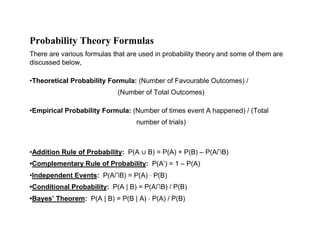
Probability Theory Formulas
There are various formulas that are used in probability theory and some of them are
discussed below,
•Theoretical Probability Formula: (Number of Favourable Outcomes) /
(Number of Total Outcomes)
•Empirical Probability Formula: (Number of times event A happened) / (Total
number of trials)
•Addition Rule of Probability: P(A ∪ B) = P(A) + P(B) – P(A∩B)
•Complementary Rule of Probability: P(A’) = 1 – P(A)
•Independent Events: P(A∩B) = P(A) ⋅ P(B)
•Conditional Probability: P(A | B) = P(A∩B) / P(B)
•Bayes’ Theorem: P(A | B) = P(B | A) ⋅ P(A) / P(B)
Applications of Probability Theory
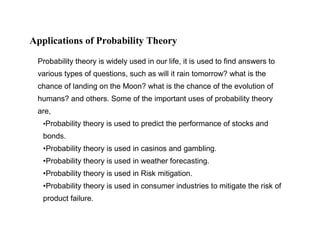
Probability theory is widely used in our life, it is used to find answers to
various types of questions, such as will it rain tomorrow? what is the
chance of landing on the Moon? what is the chance of the evolution of
humans? and others. Some of the important uses of probability theory
are,
•Probability theory is used to predict the performance of stocks and
bonds.
•Probability theory is used in casinos and gambling.
•Probability theory is used in weather forecasting.
•Probability theory is used in Risk mitigation.
•Probability theory is used in consumer industries to mitigate the risk of
product failure.
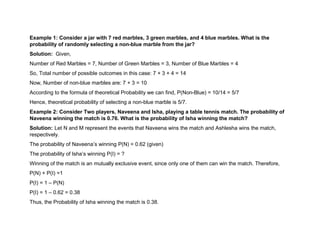
Example 1: Consider a jar with 7 red marbles, 3 green marbles, and 4 blue marbles. What is the
probability of randomly selecting a non-blue marble from the jar?
Solution: Given,
Number of Red Marbles = 7, Number of Green Marbles = 3, Number of Blue Marbles = 4
So, Total number of possible outcomes in this case: 7 + 3 + 4 = 14
Now, Number of non-blue marbles are: 7 + 3 = 10
According to the formula of theoretical Probability we can find, P(Non-Blue) = 10/14 = 5/7
Hence, theoretical probability of selecting a non-blue marble is 5/7.
Example 2: Consider Two players, Naveena and Isha, playing a table tennis match. The probability of
Naveena winning the match is 0.76. What is the probability of Isha winning the match?
Solution: Let N and M represent the events that Naveena wins the match and Ashlesha wins the match,
respectively.
The probability of Naveena’s winning P(N) = 0.62 (given)
The probability of Isha’s winning P(I) = ?
Winning of the match is an mutually exclusive event, since only one of them can win the match. Therefore,
P(N) + P(I) =1
P(I) = 1 – P(N)
P(I) = 1 – 0.62 = 0.38
Thus, the Probability of Isha winning the match is 0.38.
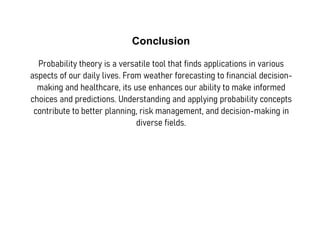
Conclusion
Probability theory is a versatile tool that finds applications in various
aspects of our daily lives. From weather forecasting to financial decision-
making and healthcare, its use enhances our ability to make informed
choices and predictions. Understanding and applying probability concepts
contribute to better planning, risk management, and decision-making in
diverse fields.

Probability theory

  • 1.
    REGENT EDUCATION &RESEARCH FOUNDATION NAME: Ajit Rajak ROLL NO: 26302823012 YEAR: 2ND SEMESTER: 3RD SUBJECT NAME: Mathematics-III SUBJECT CODE: BSM-301 DEPARTMENT: Electrical & Electronics Engineering TOPIC NAME: Basic Concept of Probability Theory
  • 2.
    CONTENT  Probability Theory What is Probability Theory?  Probability Theory Definition  Theoretical Probability  Experimental Probability  Probability Theory Formulas  Applications of Probability Theory  Probability Theory Examples  Conclusion
  • 3.
    Probability Theory Probability isdefined as the chance of happening or occurrences of an event. Generally, the possibility of analyzing the occurrence of any event with respect to previous data is called probability. For example, if a fair coin is tossed, what is the chance that it lands on the head? These types of questions are answered under probability. Probability is indeed defined as the likelihood or chance of a specific event occurring, often expressed as a number between 0 and 1, where 0 indicates impossibility and 1 indicates certainty. In addition to the definition you provided, here are a few more perspectives on probability.
  • 4.
    What is ProbabilityTheory? • Probability theory uses the concept of random variables and probability distribution to find the outcome of any situation. Probability theory is an advanced branch of mathematics that deals with the odds and statistics of happening an event. • How does flipping a coin related to Probability? • As soon as you flip a coin, the result is random. It may be tails or heads. both heads and tails have an equal probability of landing so both have a 50-50 chance. Thus, we can say that probability of either head or tail is 1/2.
  • 5.
    Probability Theory Definition ProbabilityTheory Definition Probability theory studied random events and tells us about their occurrence. The two main probability theory are. 1. Theoretical Probability 2. Experimental Probability
  • 6.
    Theoretical Probability Theoretical Probabilitydeals with assumptions in order to avoid unfeasible or expensive repetition of experiments. P(A) = (Number of outcomes favourable to Event A) / (Number of all possible outcomes) Like in coin-tossing case. In tossing a coin, there are two outcomes: Head or Tail. Hence, The Probability of occurrence of Head on tossing a coin is P(H) = 1/2 Similarly, The Probability of the occurrence of a Tail on tossing a coin is P(T) = 1/2
  • 7.
    Experimental Probability Experimental probabilityis found by performing a series of experiments and observing their outcomes. These random experiments are also known as trials. P(E) = (Number of times event A happened) / (Total number of trials) If we tossed a coin 10 times and recorded heads for 4 times and a tail 6 times then the Probability of Occurrence of Head on tossing a coin: P(H) = 4/10 Similarly, the Probability of Occurrence of Tails on tossing a coin: P(T) = 6/10
  • 8.
    Probability Theory Formulas Thereare various formulas that are used in probability theory and some of them are discussed below, •Theoretical Probability Formula: (Number of Favourable Outcomes) / (Number of Total Outcomes) •Empirical Probability Formula: (Number of times event A happened) / (Total number of trials) •Addition Rule of Probability: P(A ∪ B) = P(A) + P(B) – P(A∩B) •Complementary Rule of Probability: P(A’) = 1 – P(A) •Independent Events: P(A∩B) = P(A) ⋅ P(B) •Conditional Probability: P(A | B) = P(A∩B) / P(B) •Bayes’ Theorem: P(A | B) = P(B | A) ⋅ P(A) / P(B)
  • 9.
    Applications of ProbabilityTheory Probability theory is widely used in our life, it is used to find answers to various types of questions, such as will it rain tomorrow? what is the chance of landing on the Moon? what is the chance of the evolution of humans? and others. Some of the important uses of probability theory are, •Probability theory is used to predict the performance of stocks and bonds. •Probability theory is used in casinos and gambling. •Probability theory is used in weather forecasting. •Probability theory is used in Risk mitigation. •Probability theory is used in consumer industries to mitigate the risk of product failure.
  • 10.
    Example 1: Considera jar with 7 red marbles, 3 green marbles, and 4 blue marbles. What is the probability of randomly selecting a non-blue marble from the jar? Solution: Given, Number of Red Marbles = 7, Number of Green Marbles = 3, Number of Blue Marbles = 4 So, Total number of possible outcomes in this case: 7 + 3 + 4 = 14 Now, Number of non-blue marbles are: 7 + 3 = 10 According to the formula of theoretical Probability we can find, P(Non-Blue) = 10/14 = 5/7 Hence, theoretical probability of selecting a non-blue marble is 5/7. Example 2: Consider Two players, Naveena and Isha, playing a table tennis match. The probability of Naveena winning the match is 0.76. What is the probability of Isha winning the match? Solution: Let N and M represent the events that Naveena wins the match and Ashlesha wins the match, respectively. The probability of Naveena’s winning P(N) = 0.62 (given) The probability of Isha’s winning P(I) = ? Winning of the match is an mutually exclusive event, since only one of them can win the match. Therefore, P(N) + P(I) =1 P(I) = 1 – P(N) P(I) = 1 – 0.62 = 0.38 Thus, the Probability of Isha winning the match is 0.38.
  • 11.
    Conclusion Probability theory isa versatile tool that finds applications in various aspects of our daily lives. From weather forecasting to financial decision- making and healthcare, its use enhances our ability to make informed choices and predictions. Understanding and applying probability concepts contribute to better planning, risk management, and decision-making in diverse fields.