PROBABILITY
Grade 10
◦ Any activity with an unpredictable results is
called an EXPERIMENT.
◦ The results of an experiment are called
OUTCOMES and the set of all possible outcomes
is the SAMPLE SPACE.
◦ Examples: Identify the sample space.
◦ Experiment Sample space n(S)
◦ Flip a coin. S = {H, T} 2
◦ Toss a die. S = {1, 2, 3, 4, 5, 6} 6
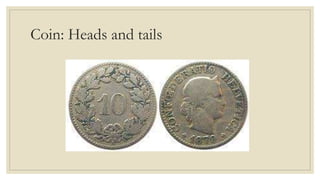
Coin: Heads and tails
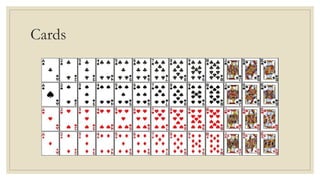
Cards
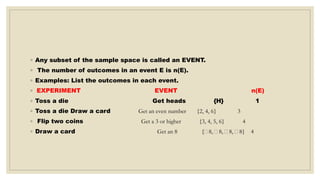
◦ Any subset of the sample space is called an EVENT.
◦ The number of outcomes in an event E is n(E).
◦ Examples: List the outcomes in each event.
◦ EXPERIMENT EVENT n(E)
◦ Toss a die Get heads {H} 1
◦ Toss a die Draw a card Get an even number {2, 4, 6} 3
◦ Flip two coins Get a 3 or higher {3, 4, 5, 6} 4
◦ Draw a card Get an 8 { 8, 8, 8, 8} 4
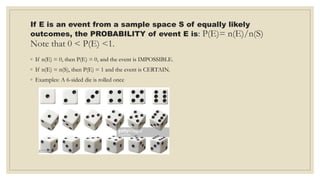
If E is an event from a sample space S of equally likely
outcomes, the PROBABILITY of event E is: P(E)= n(E)/n(S)
Note that 0 < P(E) <1.
◦ If n(E) = 0, then P(E) = 0, and the event is IMPOSSIBLE.
◦ If n(E) = n(S), then P(E) = 1 and the event is CERTAIN.
◦ Examples: A 6-sided die is rolled once
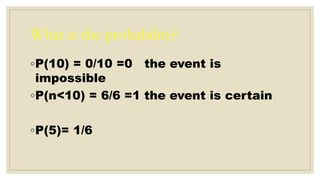
What is the probability?
◦P(10) = 0/10 =0 the event is
impossible
◦P(n<10) = 6/6 =1 the event is certain
◦P(5)= 1/6
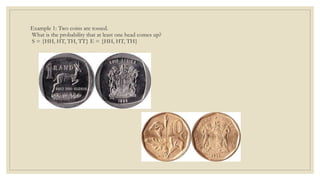
Example 1: Two coins are tossed.
What is the probability that at least one head comes up?
S = {HH, HT, TH, TT} E = {HH, HT, TH}
Probability
◦ P(E) = n(E)/n(S) =3/4
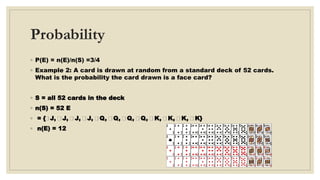
◦ Example 2: A card is drawn at random from a standard deck of 52 cards.
What is the probability the card drawn is a face card?
◦ S = all 52 cards in the deck
◦ n(S) = 52 E
◦ = { J, J, J, J, Q, Q, Q, Q, K, K, K, K}
◦ n(E) = 12
Two events A and B are MUTUALLY EXCLUSIVE if they have no
outcomes in common, A and B = mutually exclusive.
Example: When a die is tossed, which events are mutually exclusive?
A: getting an even number B: getting an odd number C: getting 5 or 6.
◦A: getting an even number B: getting
an odd number C: getting 5 or 6.
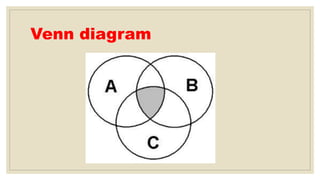
◦Venn diagram is the best way to
represent this. Let us represent this
using a venn diagram
Venn diagram
Union events
◦ If A and B are events, their UNION, written A or B
◦ consisting of all outcomes in A or in B or in both A and B. A B = { J, J,
J, J, Q, K }
◦ Example: A card is drawn at random from a standard deck of 52 cards.
◦ A: getting a club face card B: getting a jack
◦ Use a venn diagram to express this
◦ List the outcomes for the event of getting a club face card or getting a jack
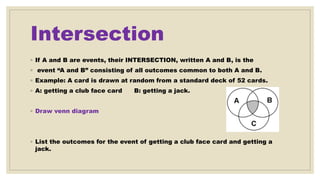
Intersection
◦ If A and B are events, their INTERSECTION, written A and B, is the
◦ event “A and B” consisting of all outcomes common to both A and B.
◦ Example: A card is drawn at random from a standard deck of 52 cards.
◦ A: getting a club face card B: getting a jack.
◦ Draw venn diagram
◦ List the outcomes for the event of getting a club face card and getting a
jack.
Take a short break…we will continue later

Probability

  • 1.
  • 2.
    ◦ Any activitywith an unpredictable results is called an EXPERIMENT. ◦ The results of an experiment are called OUTCOMES and the set of all possible outcomes is the SAMPLE SPACE. ◦ Examples: Identify the sample space. ◦ Experiment Sample space n(S) ◦ Flip a coin. S = {H, T} 2 ◦ Toss a die. S = {1, 2, 3, 4, 5, 6} 6
  • 3.
  • 4.
  • 5.
    ◦ Any subsetof the sample space is called an EVENT. ◦ The number of outcomes in an event E is n(E). ◦ Examples: List the outcomes in each event. ◦ EXPERIMENT EVENT n(E) ◦ Toss a die Get heads {H} 1 ◦ Toss a die Draw a card Get an even number {2, 4, 6} 3 ◦ Flip two coins Get a 3 or higher {3, 4, 5, 6} 4 ◦ Draw a card Get an 8 { 8, 8, 8, 8} 4
  • 6.
    If E isan event from a sample space S of equally likely outcomes, the PROBABILITY of event E is: P(E)= n(E)/n(S) Note that 0 < P(E) <1. ◦ If n(E) = 0, then P(E) = 0, and the event is IMPOSSIBLE. ◦ If n(E) = n(S), then P(E) = 1 and the event is CERTAIN. ◦ Examples: A 6-sided die is rolled once
  • 7.
    What is theprobability? ◦P(10) = 0/10 =0 the event is impossible ◦P(n<10) = 6/6 =1 the event is certain ◦P(5)= 1/6
  • 8.
    Example 1: Twocoins are tossed. What is the probability that at least one head comes up? S = {HH, HT, TH, TT} E = {HH, HT, TH}
  • 9.
    Probability ◦ P(E) =n(E)/n(S) =3/4 ◦ Example 2: A card is drawn at random from a standard deck of 52 cards. What is the probability the card drawn is a face card? ◦ S = all 52 cards in the deck ◦ n(S) = 52 E ◦ = { J, J, J, J, Q, Q, Q, Q, K, K, K, K} ◦ n(E) = 12
  • 10.
    Two events Aand B are MUTUALLY EXCLUSIVE if they have no outcomes in common, A and B = mutually exclusive. Example: When a die is tossed, which events are mutually exclusive? A: getting an even number B: getting an odd number C: getting 5 or 6. ◦A: getting an even number B: getting an odd number C: getting 5 or 6. ◦Venn diagram is the best way to represent this. Let us represent this using a venn diagram
  • 11.
  • 12.
    Union events ◦ IfA and B are events, their UNION, written A or B ◦ consisting of all outcomes in A or in B or in both A and B. A B = { J, J, J, J, Q, K } ◦ Example: A card is drawn at random from a standard deck of 52 cards. ◦ A: getting a club face card B: getting a jack ◦ Use a venn diagram to express this ◦ List the outcomes for the event of getting a club face card or getting a jack
  • 13.
    Intersection ◦ If Aand B are events, their INTERSECTION, written A and B, is the ◦ event “A and B” consisting of all outcomes common to both A and B. ◦ Example: A card is drawn at random from a standard deck of 52 cards. ◦ A: getting a club face card B: getting a jack. ◦ Draw venn diagram ◦ List the outcomes for the event of getting a club face card and getting a jack.
  • 14.
    Take a shortbreak…we will continue later