Basic Biostatistics in Medical Research

      Lecture 1: Basic Concepts

                Leah J. Welty, PhD
    Biostatistics Collaboration Center (BCC)
      Department of Preventive Medicine
        NU Feinberg School of Medicine
Objectives
• Assist participants in interpreting statistics
  published in medical literature

• Highlight different statistical methodology
  for investigators conducting own research

• Facilitate communication between medical
  investigators and biostatisticians
10/1/2009   Biostatistics Collaboration Center (BCC)   Lecture 1: Basic Concepts   2
Lecture 1: Basic Concepts

       Data Types
   Summary Statistics
  One Sample Inference
Data Types

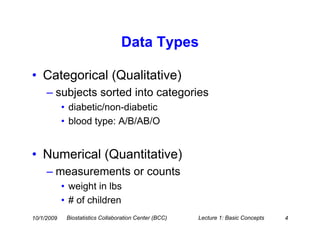
• Categorical (Qualitative)
     – subjects sorted into categories
            • diabetic/non-diabetic
            • blood type: A/B/AB/O


• Numerical (Quantitative)
     – measurements or counts
            • weight in lbs
            • # of children
10/1/2009    Biostatistics Collaboration Center (BCC)   Lecture 1: Basic Concepts   4
Categorical Data

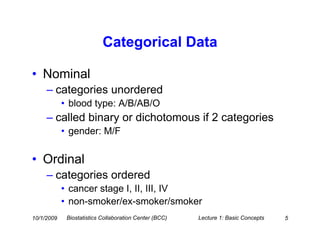
• Nominal
     – categories unordered
            • blood type: A/B/AB/O
     – called binary or dichotomous if 2 categories
            • gender: M/F


• Ordinal
     – categories ordered
            • cancer stage I, II, III, IV
            • non-smoker/ex-smoker/smoker
10/1/2009    Biostatistics Collaboration Center (BCC)   Lecture 1: Basic Concepts   5
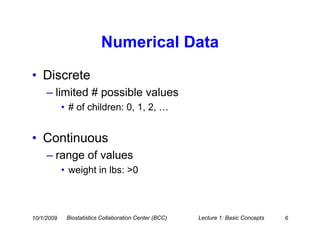
Numerical Data
• Discrete
     – limited # possible values
            • # of children: 0, 1, 2, …


• Continuous
     – range of values
            • weight in lbs: >0


10/1/2009    Biostatistics Collaboration Center (BCC)   Lecture 1: Basic Concepts   6
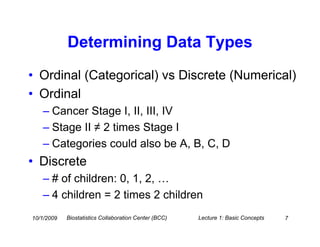
Determining Data Types
• Ordinal (Categorical) vs Discrete (Numerical)
• Ordinal
   – Cancer Stage I, II, III, IV
   – Stage II ≠ 2 times Stage I
   – Categories could also be A, B, C, D
• Discrete
   – # of children: 0, 1, 2, …
   – 4 children = 2 times 2 children
10/1/2009   Biostatistics Collaboration Center (BCC)   Lecture 1: Basic Concepts   7
Determining Data Types


• Type of data determines which types of
  analyses are appropriate

• Continuous vs. Categorical


10/1/2009   Biostatistics Collaboration Center (BCC)   Lecture 1: Basic Concepts   8
Describing Data
• General summary
     – condense information to manageable form
     – numerically
            • ‘center’ of data values
            • spread of data; variability
     – graphically/visually


• What analyses are / are not appropriate

10/1/2009    Biostatistics Collaboration Center (BCC)   Lecture 1: Basic Concepts   9
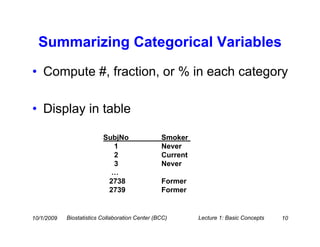
Summarizing Categorical Variables
• Compute #, fraction, or % in each category

• Display in table

                          SubjNo                 Smoker
                            1                    Never
                            2                    Current
                            3                    Never
                            …
                           2738                  Former
                           2739                  Former


10/1/2009   Biostatistics Collaboration Center (BCC)       Lecture 1: Basic Concepts   10
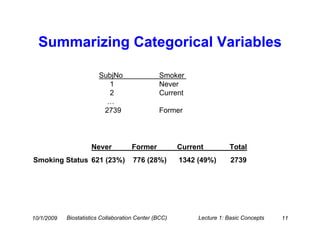
Summarizing Categorical Variables

                        SubjNo                  Smoker
                          1                     Never
                          2                     Current
                          …
                         2739                   Former


                     Never           Former            Current         Total
Smoking Status 621 (23%)              776 (28%)        1342 (49%)       2739


10/1/2009   Biostatistics Collaboration Center (BCC)        Lecture 1: Basic Concepts   11
Summarizing Numerical Variables

• Numeric Summaries
     – center of data
            • mean
            • median
     – spread/variability
            • standard deviation
            • quartiles; inner quartile range
• Graphical Summaries
     – histogram, boxplot
10/1/2009    Biostatistics Collaboration Center (BCC)   Lecture 1: Basic Concepts   12
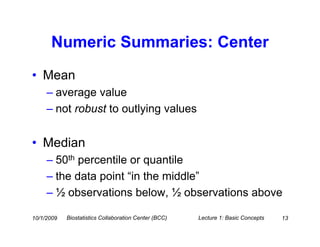
Numeric Summaries: Center
• Mean
     – average value
     – not robust to outlying values


• Median
     – 50th percentile or quantile
     – the data point “in the middle”
     – ½ observations below, ½ observations above

10/1/2009   Biostatistics Collaboration Center (BCC)   Lecture 1: Basic Concepts   13
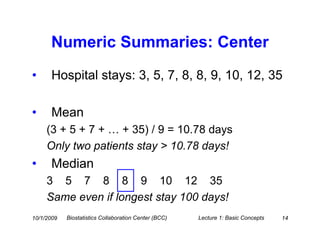
Numeric Summaries: Center
•     Hospital stays: 3, 5, 7, 8, 8, 9, 10, 12, 35

•     Mean
     (3 + 5 + 7 + … + 35) / 9 = 10.78 days
     Only two patients stay > 10.78 days!
•     Median
     3 5 7 8 8 9 10 12 35
     Same even if longest stay 100 days!
10/1/2009   Biostatistics Collaboration Center (BCC)   Lecture 1: Basic Concepts   14
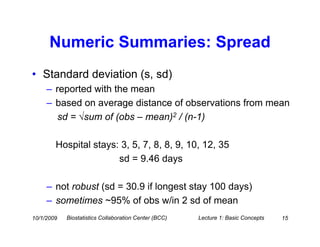
Numeric Summaries: Spread
• Standard deviation (s, sd)
     – reported with the mean
     – based on average distance of observations from mean
        sd = √sum of (obs – mean)2 / (n-1)

        Hospital stays: 3, 5, 7, 8, 8, 9, 10, 12, 35
                       sd = 9.46 days

     – not robust (sd = 30.9 if longest stay 100 days)
     – sometimes ~95% of obs w/in 2 sd of mean
10/1/2009   Biostatistics Collaboration Center (BCC)   Lecture 1: Basic Concepts   15
Numeric Summaries: Spread
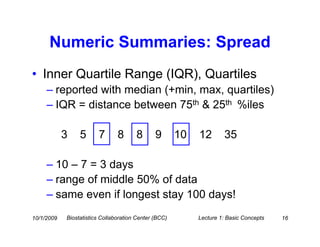
• Inner Quartile Range (IQR), Quartiles
     – reported with median (+min, max, quartiles)
     – IQR = distance between 75th & 25th %iles

            3    5      7       8      8       9       10   12       35

     – 10 – 7 = 3 days
     – range of middle 50% of data
     – same even if longest stay 100 days!
10/1/2009   Biostatistics Collaboration Center (BCC)        Lecture 1: Basic Concepts   16
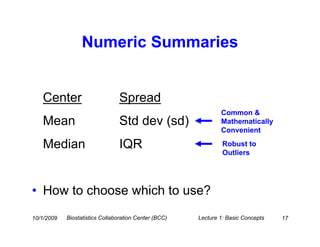
Numeric Summaries


   Center                        Spread
                                                               Common &
   Mean                         Std dev (sd)                   Mathematically
                                                               Convenient

   Median                        IQR                            Robust to
                                                                Outliers


• How to choose which to use?
10/1/2009   Biostatistics Collaboration Center (BCC)   Lecture 1: Basic Concepts   17
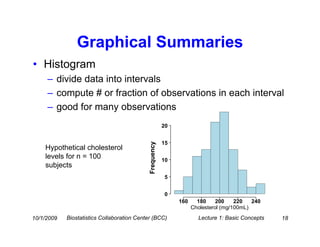
Graphical Summaries
• Histogram
     – divide data into intervals
     – compute # or fraction of observations in each interval
     – good for many observations
                                                         20


                                                         15
                                             Frequency
    Hypothetical cholesterol
    levels for n = 100                                   10
    subjects
                                                         5


                                                         0
                                                              160     180     200    220   240
                                                                    Cholesterol (mg/100mL)
10/1/2009   Biostatistics Collaboration Center (BCC)                  Lecture 1: Basic Concepts   18
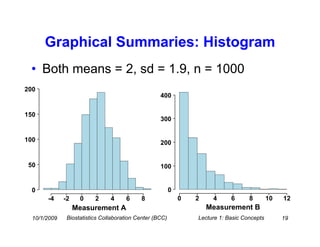
Graphical Summaries: Histogram
 • Both means = 2, sd = 1.9, n = 1000
200
                                                    400

150
                                                    300


100                                                 200


 50                                                 100


  0                                                       0
       -4     -2    0     2     4     6     8                 0   2    4      6      8        10   12
                   Measurement A                                      Measurement B
  10/1/2009    Biostatistics Collaboration Center (BCC)           Lecture 1: Basic Concepts        19
Graphical Summaries: Histogram
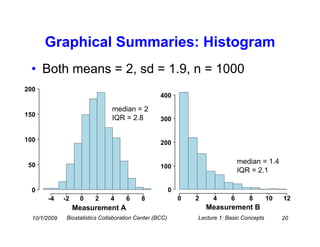
 • Both means = 2, sd = 1.9, n = 1000
200
                                                    400

                                 median = 2
150
                                 IQR = 2.8          300


100                                                 200


 50
                                                                                  median = 1.4
                                                    100
                                                                                  IQR = 2.1

  0                                                       0
       -4     -2    0     2     4     6     8                 0   2    4      6      8        10   12
                   Measurement A                                      Measurement B
  10/1/2009    Biostatistics Collaboration Center (BCC)           Lecture 1: Basic Concepts        20
Graphical Summaries: Boxplots
• Graphical extension of median, IQR

• Useful for comparing two variables

• Help identify ‘outliers’


10/1/2009   Biostatistics Collaboration Center (BCC)   Lecture 1: Basic Concepts   21
Graphical Summaries: Boxplots
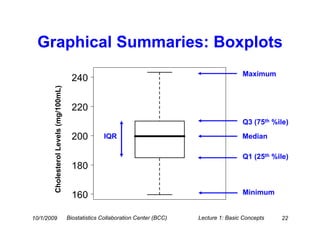
                                                                                                   Maximum
                                          240
        Cholesterol Levels (mg/100mL)


                                          220
                                                                                                   Q3 (75th %ile)

                                          200         IQR                                          Median

                                                                                                   Q1 (25th %ile)
                                          180


                                          160                                                      Minimum


10/1/2009                               Biostatistics Collaboration Center (BCC)   Lecture 1: Basic Concepts   22
Graphical Summaries: Boxplots
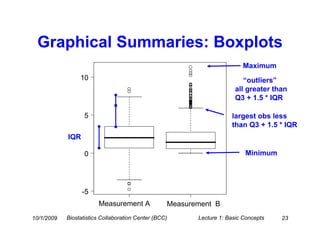
                                                                          Maximum
                 10                                                       “outliers”
                                                                       all greater than
                                                                       Q3 + 1.5 * IQR

                   5                                                  largest obs less
                                                                      than Q3 + 1.5 * IQR
            IQR

                   0                                                       Minimum


                  -5
                             Var 1
                        Measurement A                 Var 2
                                                   Measurement B
10/1/2009   Biostatistics Collaboration Center (BCC)      Lecture 1: Basic Concepts   23
Data Type & Data Summaries
• Type determines appropriate summary

• Characteristics of data determined in
  summary determine appropriate analyses
     – more than just mean, sd
     – e.g. should not use t for strongly skewed data
     – median (IQR) appropriate if skewed, outliers


10/1/2009   Biostatistics Collaboration Center (BCC)   Lecture 1: Basic Concepts   24
Statistical Inference
• Estimation of quantity of interest
     – estimate itself
     – quantify how good an estimate it is

• Hypothesis testing
     – Is there evidence to suggest that the estimate
       is different from another value?

• Today: proportion, mean, median
10/1/2009   Biostatistics Collaboration Center (BCC)   Lecture 1: Basic Concepts   25
Statistical Inference
• Take results obtained in a (random) sample as
  best estimate of what is true for the population

• Estimate may differ from the population value by
  chance, but it should be close

• How good is the estimate?

• If we took more samples, and got even more
  estimates, how would they vary?
10/1/2009   Biostatistics Collaboration Center (BCC)   Lecture 1: Basic Concepts   26
Statistical Inference
• Ex: proportion of persons in a population who
  have health insurance, sample size n = 978

        Sample 1                797/978 = 0.81

     We conclude that the estimated % of people with health
      insurance is 81%.

     How variable is our estimate?


10/1/2009   Biostatistics Collaboration Center (BCC)   Lecture 1: Basic Concepts   27
Sampling Variability
• Need to know the sampling distribution for
  the quantity of interest

• One option: take lots of samples, and
  make a histogram

            Sample 2 782/978 = 0.80
            Sample 3 812/978 = 0.83
10/1/2009   Biostatistics Collaboration Center (BCC)   Lecture 1: Basic Concepts   28
Sampling Variability
• Not practical to keep repeating a study!

• Statistical theory

     – the sampling distributions for means and proportions
       often look “normal”, bell-shaped

     – from a single sample, can calculate the standard error
       (variability) of our estimated mean or proportion

10/1/2009   Biostatistics Collaboration Center (BCC)   Lecture 1: Basic Concepts   29
Standard Error
• Standard error (SE) measures the variability of
  your sample statistic (e.g. a mean or proportion)

• small SE means estimate more precise

• SE is not the same as SD!

• SD measures the variability of the sample data;
  SE measures the variability of the statistic
10/1/2009   Biostatistics Collaboration Center (BCC)   Lecture 1: Basic Concepts   30
Standard Error vs Standard Deviation
• Averages less variable than the individual observations

• Averages over larger n less variable than over smaller n

• Ex: heights

     – most people from 5’0” – 6’2”
     – average height for sample of 100 people ~ between 5’5” – 5’7”


• SE ≤ SD!


10/1/2009   Biostatistics Collaboration Center (BCC)   Lecture 1: Basic Concepts   31
Inference for Sample Proportions
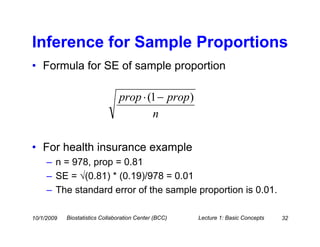
• Formula for SE of sample proportion

                                prop ⋅ (1 − prop )
                                        n

• For health insurance example
     – n = 978, prop = 0.81
     – SE = √(0.81) * (0.19)/978 = 0.01
     – The standard error of the sample proportion is 0.01.

10/1/2009   Biostatistics Collaboration Center (BCC)   Lecture 1: Basic Concepts   32
Sampling Distribution of Sample
               Proportion
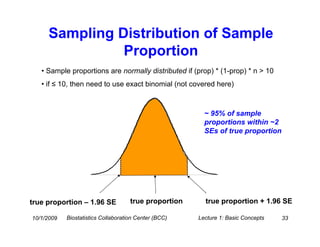
   • Sample proportions are normally distributed if (prop) * (1-prop) * n > 10
   • if ≤ 10, then need to use exact binomial (not covered here)


                                                         ~ 95% of sample
                                                         proportions within ~2
                                                         SEs of true proportion


true proportion – 1.96 SE            true proportion     true proportion + 1.96 SE

10/1/2009   Biostatistics Collaboration Center (BCC)   Lecture 1: Basic Concepts   33
Confidence Interval for Sample
                Proportion
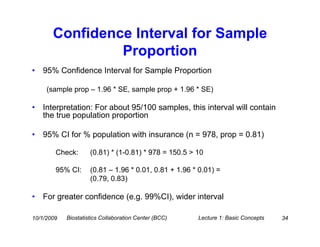
•   95% Confidence Interval for Sample Proportion

     (sample prop – 1.96 * SE, sample prop + 1.96 * SE)

•   Interpretation: For about 95/100 samples, this interval will contain
    the true population proportion

•   95% CI for % population with insurance (n = 978, prop = 0.81)

        Check:       (0.81) * (1-0.81) * 978 = 150.5 > 10

        95% CI:      (0.81 – 1.96 * 0.01, 0.81 + 1.96 * 0.01) =
                     (0.79, 0.83)

•   For greater confidence (e.g. 99%CI), wider interval

10/1/2009   Biostatistics Collaboration Center (BCC)   Lecture 1: Basic Concepts   34
Standard Error for Sample Mean
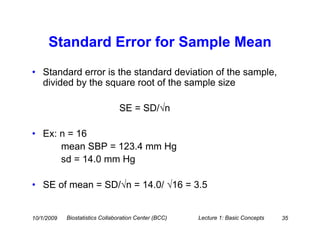
• Standard error is the standard deviation of the sample,
  divided by the square root of the sample size

                                 SE = SD/√n

• Ex: n = 16
      mean SBP = 123.4 mm Hg
      sd = 14.0 mm Hg

• SE of mean = SD/√n = 14.0/ √16 = 3.5


10/1/2009   Biostatistics Collaboration Center (BCC)   Lecture 1: Basic Concepts   35
Sampling Distribution for a Mean
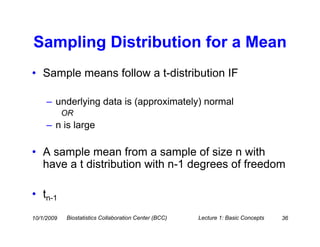
• Sample means follow a t-distribution IF

     – underlying data is (approximately) normal
            OR
     – n is large

• A sample mean from a sample of size n with
  have a t distribution with n-1 degrees of freedom

• tn-1
10/1/2009   Biostatistics Collaboration Center (BCC)   Lecture 1: Basic Concepts   36
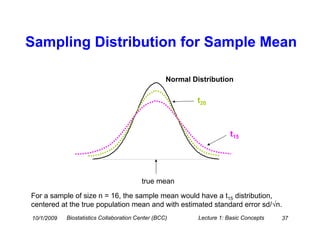
Sampling Distribution for Sample Mean

                                                   Normal Distribution

                                                           t20


                                                                        t15


                                         true mean

For a sample of size n = 16, the sample mean would have a t15 distribution,
centered at the true population mean and with estimated standard error sd/√n.
10/1/2009   Biostatistics Collaboration Center (BCC)        Lecture 1: Basic Concepts   37
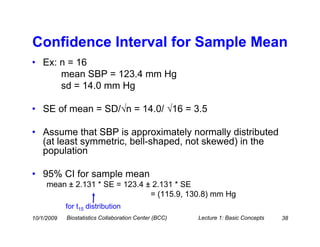
Confidence Interval for Sample Mean
• Ex: n = 16
      mean SBP = 123.4 mm Hg
      sd = 14.0 mm Hg

• SE of mean = SD/√n = 14.0/ √16 = 3.5

• Assume that SBP is approximately normally distributed
  (at least symmetric, bell-shaped, not skewed) in the
  population

• 95% CI for sample mean
     mean ± 2.131 * SE = 123.4 ± 2.131 * SE
                                = (115.9, 130.8) mm Hg
            for t15 distribution
10/1/2009   Biostatistics Collaboration Center (BCC)   Lecture 1: Basic Concepts   38
Confidence Interval for Sample Mean
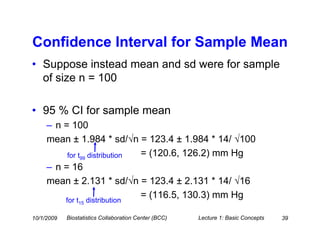
• Suppose instead mean and sd were for sample
  of size n = 100

• 95 % CI for sample mean
     – n = 100
     mean ± 1.984 * sd/√n = 123.4 ± 1.984 * 14/ √100
          for t99 distribution = (120.6, 126.2) mm Hg
     – n = 16
     mean ± 2.131 * sd/√n = 123.4 ± 2.131 * 14/ √16
         for t distribution
                               = (116.5, 130.3) mm Hg
                15


10/1/2009   Biostatistics Collaboration Center (BCC)   Lecture 1: Basic Concepts   39
Confidence Interval for Sample Mean
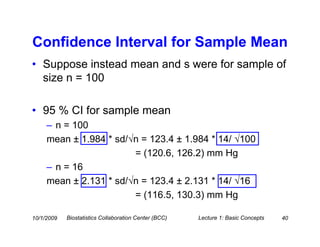
• Suppose instead mean and s were for sample of
  size n = 100

• 95 % CI for sample mean
     – n = 100
     mean ± 1.984 * sd/√n = 123.4 ± 1.984 * 14/ √100
                        = (120.6, 126.2) mm Hg
     – n = 16
     mean ± 2.131 * sd/√n = 123.4 ± 2.131 * 14/ √16
                        = (116.5, 130.3) mm Hg

10/1/2009   Biostatistics Collaboration Center (BCC)   Lecture 1: Basic Concepts   40
Confidence Interval for a Sample
                  Mean
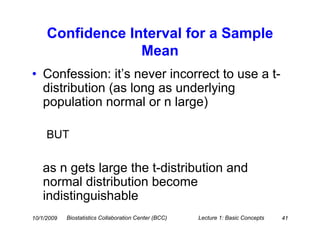
• Confession: it’s never incorrect to use a t-
  distribution (as long as underlying
  population normal or n large)

     BUT

   as n gets large the t-distribution and
   normal distribution become
   indistinguishable
10/1/2009   Biostatistics Collaboration Center (BCC)   Lecture 1: Basic Concepts   41
Hypothesis Testing


•     Confidence intervals tell you
     – best estimate
     – variability of best estimate


•     Hypothesis testing
     – Is there really a difference between my
       observed value and another value?
10/1/2009   Biostatistics Collaboration Center (BCC)   Lecture 1: Basic Concepts   42
Hypothesis Testing
• From our sample of n = 978, we estimated
  that 81% of the people in our population
  had health insurance.
• From previous census records, you know
  that 10 years ago, 78.5% of your
  population had health insurance.
• Has the percent of people with insurance
  really changed?

10/1/2009   Biostatistics Collaboration Center (BCC)   Lecture 1: Basic Concepts   43
Hypothesis Testing
•   Suppose the true percent with health insurance is 78.5%
     – Called the null hypothesis, or H0

•   What is the probability of observing, for a sample of n = 978, a result
    as or more extreme than 81%, given the true percent is 78.5%?
     – Called the p-value, computed using normal distribution for sample
       proportions (and t-distribution for sample means)

•   If probability is small, conclude that supposition might not be right.
     – Reject the null hypothesis in favor of the alternative hypothesis, Ha
       (opposite of the null hypothesis, related to what you think may be true)

•   If the probability is not small, conclude do not have evidence to
    reject the null hypothesis
     – Not the same as ‘accepting’ the null hypothesis, or showing that the null
       hypothesis is true


10/1/2009   Biostatistics Collaboration Center (BCC)   Lecture 1: Basic Concepts   44
Hypothesis Testing
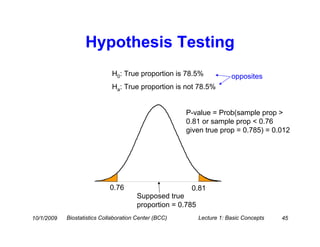
                              H0: True proportion is 78.5%               opposites
                              Ha: True proportion is not 78.5%


                                                       P-value = Prob(sample prop >
                                                       0.81 or sample prop < 0.76
                                                       given true prop = 0.785) = 0.012


                             0.76                       0.81
                                        Supposed true
                                        proportion = 0.785
10/1/2009   Biostatistics Collaboration Center (BCC)         Lecture 1: Basic Concepts   45
Hypothesis Testing
• It is not very likely (p = 0.012) to observe our data if the
  true proportion is 78.5%.

• We conclude that we have sufficient evidence that the
  proportion insured is no longer 78.5%.

• “Two-sided” test: observations as extreme as 0.81
     > 0.81 or < 0.76

• “One-sided” test: observations larger than 0.81
     –   Has the percent of people with insurance really increased?
     –   Ha: True proportion greater than 78.5%
     –   p-value = 0.006 (only area above 0.81)
     –   Only ok if previous research suggests that the prop is larger

10/1/2009   Biostatistics Collaboration Center (BCC)   Lecture 1: Basic Concepts   46
Hypothesis Testing
• Similar for sample means, except that p-values
  are computed using t-distribution, if appropriate

• n = 16 with SBP = 123.4, sd = 14.0 mm Hg

• Previous research suggests that population may
  have lifestyle habits protective for high BP

• Do we have evidence to suggest that our
  population has SBP lower than 125 mm Hg (pre-
  hypertensive)?
10/1/2009   Biostatistics Collaboration Center (BCC)   Lecture 1: Basic Concepts   47
Hypothesis Testing
                        H0: True mean is 125 mm Hg                  almost opposites
                        Ha: True mean is less than 125 mm Hg

• Using t15 distribution, we find a one-sided
  p-value of 0.32

• This too large to reject the null hypothesis
  in favor of the alternative.
    – Usually need p < 0.05 to “reject null” in favor
      of alternative
10/1/2009   Biostatistics Collaboration Center (BCC)   Lecture 1: Basic Concepts   48
Misinterpretations of the p-value
• A p-value of 0.32 (or > 0.05) DOES NOT mean that we
  “accept the null”, or that there is a 32% chance that the
  null is true

     – we haven’t shown that the SBP of this group is equal to 125
     – true value may be 124.5 or 125.1 mmHg

• Can only “reject the null in favor of the alternative” or “fail
  to reject the null”

• If you “fail to reject” that doesn’t mean the alternative
  isn’t true. You may not have had a large enough n!

10/1/2009   Biostatistics Collaboration Center (BCC)   Lecture 1: Basic Concepts   49
Distribution-Free Alternatives
• Recall for the normal distribution to be useful for sample
  proportions, we need n * prop * (1-prop) > 10

     – If not, use exact binomial methods (not covered here)

• For the t-distribution to be useful for sample means, we
  need the underlying population to be normal or n large

     – What if this isn’t the case?
            • data are skewed or n is small
            • e.g. length of hospital stay
     – Use nonparametric methods
            • look at ranks, not mean
            • the median is a nonparametric estimate

10/1/2009    Biostatistics Collaboration Center (BCC)   Lecture 1: Basic Concepts   50
Nonparametric Methods
• nonparametric methods are methods that don’t require
  assuming a particular distribution

• a.k.a distribution-free or rank methods

• nonparametric tests well suited to hypothesis testing

• not as useful for point estimates or CIs

• espeically useful when data are ranks or scores
     – Apgar scores
     – Vision (20/20, 20/40, etc.)

10/1/2009   Biostatistics Collaboration Center (BCC)   Lecture 1: Basic Concepts   51
Nonparametric Methods for Sample
             Median
• Alternative to using sample mean & t-distribution
• Instead do inference for median value
     – CI for median uses ranks
            • n = 16, ~ 95% CI for median
                (4th largest value, 13th largest value)
            • n = 25, ~ 95% CI for median
                (8th largest value, 18th largest value)
            • necessary ranks depend on n and confidence level
                Stat packages or tables


     – Hypothesis test for median: Sign Test

10/1/2009    Biostatistics Collaboration Center (BCC)     Lecture 1: Basic Concepts   52
Sign Test for the Median
• Hypothesis about median, not mean

• Assuming hypothesized value of median is
  correct, expect to observe about half
  sample below median and half above.

• Compute probability for (as or more
  extreme) proportion above median
10/1/2009   Biostatistics Collaboration Center (BCC)   Lecture 1: Basic Concepts   53
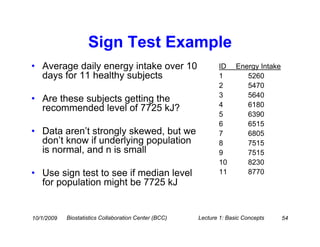
Sign Test Example
• Average daily energy intake over 10                         ID     Energy Intake
  days for 11 healthy subjects                                1         5260
                                                              2         5470
                                                              3         5640
• Are these subjects getting the
                                                              4         6180
  recommended level of 7725 kJ?
                                                              5         6390
                                                              6         6515
• Data aren’t strongly skewed, but we                         7         6805
  don’t know if underlying population                         8         7515
  is normal, and n is small                                   9         7515
                                                              10        8230
• Use sign test to see if median level                        11        8770
  for population might be 7725 kJ


10/1/2009   Biostatistics Collaboration Center (BCC)   Lecture 1: Basic Concepts     54
Sign Test
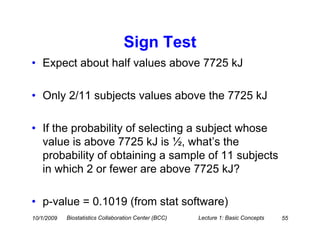
• Expect about half values above 7725 kJ

• Only 2/11 subjects values above the 7725 kJ

• If the probability of selecting a subject whose
  value is above 7725 kJ is ½, what’s the
  probability of obtaining a sample of 11 subjects
  in which 2 or fewer are above 7725 kJ?

• p-value = 0.1019 (from stat software)
10/1/2009   Biostatistics Collaboration Center (BCC)   Lecture 1: Basic Concepts   55
Parametric vs. Nonparametric
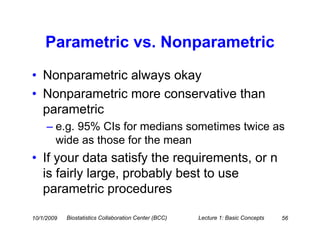
• Nonparametric always okay
• Nonparametric more conservative than
  parametric
     – e.g. 95% CIs for medians sometimes twice as
       wide as those for the mean
• If your data satisfy the requirements, or n
  is fairly large, probably best to use
  parametric procedures

10/1/2009   Biostatistics Collaboration Center (BCC)   Lecture 1: Basic Concepts   56
Useful References
• Intuitive Biostatistics, Harvey Motulsky, Oxford
  University Press, 1995
     – Highly readable, minimally technical

• Practical Statistics for Medical Research,
  Douglas G. Altman, Chapman & Hall, 1991
     – Readable, not too technical

• Fundamentals of Biostatistics, Bernard Rosner,
  Duxbury, 2000
     – Useful reference, somewhat technical

10/1/2009   Biostatistics Collaboration Center (BCC)   Lecture 1: Basic Concepts   57
Next Time


                     Two group comparisons


10/1/2009   Biostatistics Collaboration Center (BCC)   Lecture 1: Basic Concepts   58
Contact BCC
• Please go to our web site at:
  http://www.medschool.northwestern.edu
  /depts/bcc/index.htm


• Fill out our online request form for further
  collaboration!


10/1/2009   Biostatistics Collaboration Center (BCC)   Lecture 1: Basic Concepts   59

Lecture 1 basic concepts2009

  • 1.
    Basic Biostatistics inMedical Research Lecture 1: Basic Concepts Leah J. Welty, PhD Biostatistics Collaboration Center (BCC) Department of Preventive Medicine NU Feinberg School of Medicine
  • 2.
    Objectives • Assist participantsin interpreting statistics published in medical literature • Highlight different statistical methodology for investigators conducting own research • Facilitate communication between medical investigators and biostatisticians 10/1/2009 Biostatistics Collaboration Center (BCC) Lecture 1: Basic Concepts 2
  • 3.
    Lecture 1: BasicConcepts Data Types Summary Statistics One Sample Inference
  • 4.
    Data Types • Categorical(Qualitative) – subjects sorted into categories • diabetic/non-diabetic • blood type: A/B/AB/O • Numerical (Quantitative) – measurements or counts • weight in lbs • # of children 10/1/2009 Biostatistics Collaboration Center (BCC) Lecture 1: Basic Concepts 4
  • 5.
    Categorical Data • Nominal – categories unordered • blood type: A/B/AB/O – called binary or dichotomous if 2 categories • gender: M/F • Ordinal – categories ordered • cancer stage I, II, III, IV • non-smoker/ex-smoker/smoker 10/1/2009 Biostatistics Collaboration Center (BCC) Lecture 1: Basic Concepts 5
  • 6.
    Numerical Data • Discrete – limited # possible values • # of children: 0, 1, 2, … • Continuous – range of values • weight in lbs: >0 10/1/2009 Biostatistics Collaboration Center (BCC) Lecture 1: Basic Concepts 6
  • 7.
    Determining Data Types •Ordinal (Categorical) vs Discrete (Numerical) • Ordinal – Cancer Stage I, II, III, IV – Stage II ≠ 2 times Stage I – Categories could also be A, B, C, D • Discrete – # of children: 0, 1, 2, … – 4 children = 2 times 2 children 10/1/2009 Biostatistics Collaboration Center (BCC) Lecture 1: Basic Concepts 7
  • 8.
    Determining Data Types •Type of data determines which types of analyses are appropriate • Continuous vs. Categorical 10/1/2009 Biostatistics Collaboration Center (BCC) Lecture 1: Basic Concepts 8
  • 9.
    Describing Data • Generalsummary – condense information to manageable form – numerically • ‘center’ of data values • spread of data; variability – graphically/visually • What analyses are / are not appropriate 10/1/2009 Biostatistics Collaboration Center (BCC) Lecture 1: Basic Concepts 9
  • 10.
    Summarizing Categorical Variables •Compute #, fraction, or % in each category • Display in table SubjNo Smoker 1 Never 2 Current 3 Never … 2738 Former 2739 Former 10/1/2009 Biostatistics Collaboration Center (BCC) Lecture 1: Basic Concepts 10
  • 11.
    Summarizing Categorical Variables SubjNo Smoker 1 Never 2 Current … 2739 Former Never Former Current Total Smoking Status 621 (23%) 776 (28%) 1342 (49%) 2739 10/1/2009 Biostatistics Collaboration Center (BCC) Lecture 1: Basic Concepts 11
  • 12.
    Summarizing Numerical Variables •Numeric Summaries – center of data • mean • median – spread/variability • standard deviation • quartiles; inner quartile range • Graphical Summaries – histogram, boxplot 10/1/2009 Biostatistics Collaboration Center (BCC) Lecture 1: Basic Concepts 12
  • 13.
    Numeric Summaries: Center •Mean – average value – not robust to outlying values • Median – 50th percentile or quantile – the data point “in the middle” – ½ observations below, ½ observations above 10/1/2009 Biostatistics Collaboration Center (BCC) Lecture 1: Basic Concepts 13
  • 14.
    Numeric Summaries: Center • Hospital stays: 3, 5, 7, 8, 8, 9, 10, 12, 35 • Mean (3 + 5 + 7 + … + 35) / 9 = 10.78 days Only two patients stay > 10.78 days! • Median 3 5 7 8 8 9 10 12 35 Same even if longest stay 100 days! 10/1/2009 Biostatistics Collaboration Center (BCC) Lecture 1: Basic Concepts 14
  • 15.
    Numeric Summaries: Spread •Standard deviation (s, sd) – reported with the mean – based on average distance of observations from mean sd = √sum of (obs – mean)2 / (n-1) Hospital stays: 3, 5, 7, 8, 8, 9, 10, 12, 35 sd = 9.46 days – not robust (sd = 30.9 if longest stay 100 days) – sometimes ~95% of obs w/in 2 sd of mean 10/1/2009 Biostatistics Collaboration Center (BCC) Lecture 1: Basic Concepts 15
  • 16.
    Numeric Summaries: Spread •Inner Quartile Range (IQR), Quartiles – reported with median (+min, max, quartiles) – IQR = distance between 75th & 25th %iles 3 5 7 8 8 9 10 12 35 – 10 – 7 = 3 days – range of middle 50% of data – same even if longest stay 100 days! 10/1/2009 Biostatistics Collaboration Center (BCC) Lecture 1: Basic Concepts 16
  • 17.
    Numeric Summaries Center Spread Common & Mean Std dev (sd) Mathematically Convenient Median IQR Robust to Outliers • How to choose which to use? 10/1/2009 Biostatistics Collaboration Center (BCC) Lecture 1: Basic Concepts 17
  • 18.
    Graphical Summaries • Histogram – divide data into intervals – compute # or fraction of observations in each interval – good for many observations 20 15 Frequency Hypothetical cholesterol levels for n = 100 10 subjects 5 0 160 180 200 220 240 Cholesterol (mg/100mL) 10/1/2009 Biostatistics Collaboration Center (BCC) Lecture 1: Basic Concepts 18
  • 19.
    Graphical Summaries: Histogram • Both means = 2, sd = 1.9, n = 1000 200 400 150 300 100 200 50 100 0 0 -4 -2 0 2 4 6 8 0 2 4 6 8 10 12 Measurement A Measurement B 10/1/2009 Biostatistics Collaboration Center (BCC) Lecture 1: Basic Concepts 19
  • 20.
    Graphical Summaries: Histogram • Both means = 2, sd = 1.9, n = 1000 200 400 median = 2 150 IQR = 2.8 300 100 200 50 median = 1.4 100 IQR = 2.1 0 0 -4 -2 0 2 4 6 8 0 2 4 6 8 10 12 Measurement A Measurement B 10/1/2009 Biostatistics Collaboration Center (BCC) Lecture 1: Basic Concepts 20
  • 21.
    Graphical Summaries: Boxplots •Graphical extension of median, IQR • Useful for comparing two variables • Help identify ‘outliers’ 10/1/2009 Biostatistics Collaboration Center (BCC) Lecture 1: Basic Concepts 21
  • 22.
    Graphical Summaries: Boxplots Maximum 240 Cholesterol Levels (mg/100mL) 220 Q3 (75th %ile) 200 IQR Median Q1 (25th %ile) 180 160 Minimum 10/1/2009 Biostatistics Collaboration Center (BCC) Lecture 1: Basic Concepts 22
  • 23.
    Graphical Summaries: Boxplots Maximum 10 “outliers” all greater than Q3 + 1.5 * IQR 5 largest obs less than Q3 + 1.5 * IQR IQR 0 Minimum -5 Var 1 Measurement A Var 2 Measurement B 10/1/2009 Biostatistics Collaboration Center (BCC) Lecture 1: Basic Concepts 23
  • 24.
    Data Type &Data Summaries • Type determines appropriate summary • Characteristics of data determined in summary determine appropriate analyses – more than just mean, sd – e.g. should not use t for strongly skewed data – median (IQR) appropriate if skewed, outliers 10/1/2009 Biostatistics Collaboration Center (BCC) Lecture 1: Basic Concepts 24
  • 25.
    Statistical Inference • Estimationof quantity of interest – estimate itself – quantify how good an estimate it is • Hypothesis testing – Is there evidence to suggest that the estimate is different from another value? • Today: proportion, mean, median 10/1/2009 Biostatistics Collaboration Center (BCC) Lecture 1: Basic Concepts 25
  • 26.
    Statistical Inference • Takeresults obtained in a (random) sample as best estimate of what is true for the population • Estimate may differ from the population value by chance, but it should be close • How good is the estimate? • If we took more samples, and got even more estimates, how would they vary? 10/1/2009 Biostatistics Collaboration Center (BCC) Lecture 1: Basic Concepts 26
  • 27.
    Statistical Inference • Ex:proportion of persons in a population who have health insurance, sample size n = 978 Sample 1 797/978 = 0.81 We conclude that the estimated % of people with health insurance is 81%. How variable is our estimate? 10/1/2009 Biostatistics Collaboration Center (BCC) Lecture 1: Basic Concepts 27
  • 28.
    Sampling Variability • Needto know the sampling distribution for the quantity of interest • One option: take lots of samples, and make a histogram Sample 2 782/978 = 0.80 Sample 3 812/978 = 0.83 10/1/2009 Biostatistics Collaboration Center (BCC) Lecture 1: Basic Concepts 28
  • 29.
    Sampling Variability • Notpractical to keep repeating a study! • Statistical theory – the sampling distributions for means and proportions often look “normal”, bell-shaped – from a single sample, can calculate the standard error (variability) of our estimated mean or proportion 10/1/2009 Biostatistics Collaboration Center (BCC) Lecture 1: Basic Concepts 29
  • 30.
    Standard Error • Standarderror (SE) measures the variability of your sample statistic (e.g. a mean or proportion) • small SE means estimate more precise • SE is not the same as SD! • SD measures the variability of the sample data; SE measures the variability of the statistic 10/1/2009 Biostatistics Collaboration Center (BCC) Lecture 1: Basic Concepts 30
  • 31.
    Standard Error vsStandard Deviation • Averages less variable than the individual observations • Averages over larger n less variable than over smaller n • Ex: heights – most people from 5’0” – 6’2” – average height for sample of 100 people ~ between 5’5” – 5’7” • SE ≤ SD! 10/1/2009 Biostatistics Collaboration Center (BCC) Lecture 1: Basic Concepts 31
  • 32.
    Inference for SampleProportions • Formula for SE of sample proportion prop ⋅ (1 − prop ) n • For health insurance example – n = 978, prop = 0.81 – SE = √(0.81) * (0.19)/978 = 0.01 – The standard error of the sample proportion is 0.01. 10/1/2009 Biostatistics Collaboration Center (BCC) Lecture 1: Basic Concepts 32
  • 33.
    Sampling Distribution ofSample Proportion • Sample proportions are normally distributed if (prop) * (1-prop) * n > 10 • if ≤ 10, then need to use exact binomial (not covered here) ~ 95% of sample proportions within ~2 SEs of true proportion true proportion – 1.96 SE true proportion true proportion + 1.96 SE 10/1/2009 Biostatistics Collaboration Center (BCC) Lecture 1: Basic Concepts 33
  • 34.
    Confidence Interval forSample Proportion • 95% Confidence Interval for Sample Proportion (sample prop – 1.96 * SE, sample prop + 1.96 * SE) • Interpretation: For about 95/100 samples, this interval will contain the true population proportion • 95% CI for % population with insurance (n = 978, prop = 0.81) Check: (0.81) * (1-0.81) * 978 = 150.5 > 10 95% CI: (0.81 – 1.96 * 0.01, 0.81 + 1.96 * 0.01) = (0.79, 0.83) • For greater confidence (e.g. 99%CI), wider interval 10/1/2009 Biostatistics Collaboration Center (BCC) Lecture 1: Basic Concepts 34
  • 35.
    Standard Error forSample Mean • Standard error is the standard deviation of the sample, divided by the square root of the sample size SE = SD/√n • Ex: n = 16 mean SBP = 123.4 mm Hg sd = 14.0 mm Hg • SE of mean = SD/√n = 14.0/ √16 = 3.5 10/1/2009 Biostatistics Collaboration Center (BCC) Lecture 1: Basic Concepts 35
  • 36.
    Sampling Distribution fora Mean • Sample means follow a t-distribution IF – underlying data is (approximately) normal OR – n is large • A sample mean from a sample of size n with have a t distribution with n-1 degrees of freedom • tn-1 10/1/2009 Biostatistics Collaboration Center (BCC) Lecture 1: Basic Concepts 36
  • 37.
    Sampling Distribution forSample Mean Normal Distribution t20 t15 true mean For a sample of size n = 16, the sample mean would have a t15 distribution, centered at the true population mean and with estimated standard error sd/√n. 10/1/2009 Biostatistics Collaboration Center (BCC) Lecture 1: Basic Concepts 37
  • 38.
    Confidence Interval forSample Mean • Ex: n = 16 mean SBP = 123.4 mm Hg sd = 14.0 mm Hg • SE of mean = SD/√n = 14.0/ √16 = 3.5 • Assume that SBP is approximately normally distributed (at least symmetric, bell-shaped, not skewed) in the population • 95% CI for sample mean mean ± 2.131 * SE = 123.4 ± 2.131 * SE = (115.9, 130.8) mm Hg for t15 distribution 10/1/2009 Biostatistics Collaboration Center (BCC) Lecture 1: Basic Concepts 38
  • 39.
    Confidence Interval forSample Mean • Suppose instead mean and sd were for sample of size n = 100 • 95 % CI for sample mean – n = 100 mean ± 1.984 * sd/√n = 123.4 ± 1.984 * 14/ √100 for t99 distribution = (120.6, 126.2) mm Hg – n = 16 mean ± 2.131 * sd/√n = 123.4 ± 2.131 * 14/ √16 for t distribution = (116.5, 130.3) mm Hg 15 10/1/2009 Biostatistics Collaboration Center (BCC) Lecture 1: Basic Concepts 39
  • 40.
    Confidence Interval forSample Mean • Suppose instead mean and s were for sample of size n = 100 • 95 % CI for sample mean – n = 100 mean ± 1.984 * sd/√n = 123.4 ± 1.984 * 14/ √100 = (120.6, 126.2) mm Hg – n = 16 mean ± 2.131 * sd/√n = 123.4 ± 2.131 * 14/ √16 = (116.5, 130.3) mm Hg 10/1/2009 Biostatistics Collaboration Center (BCC) Lecture 1: Basic Concepts 40
  • 41.
    Confidence Interval fora Sample Mean • Confession: it’s never incorrect to use a t- distribution (as long as underlying population normal or n large) BUT as n gets large the t-distribution and normal distribution become indistinguishable 10/1/2009 Biostatistics Collaboration Center (BCC) Lecture 1: Basic Concepts 41
  • 42.
    Hypothesis Testing • Confidence intervals tell you – best estimate – variability of best estimate • Hypothesis testing – Is there really a difference between my observed value and another value? 10/1/2009 Biostatistics Collaboration Center (BCC) Lecture 1: Basic Concepts 42
  • 43.
    Hypothesis Testing • Fromour sample of n = 978, we estimated that 81% of the people in our population had health insurance. • From previous census records, you know that 10 years ago, 78.5% of your population had health insurance. • Has the percent of people with insurance really changed? 10/1/2009 Biostatistics Collaboration Center (BCC) Lecture 1: Basic Concepts 43
  • 44.
    Hypothesis Testing • Suppose the true percent with health insurance is 78.5% – Called the null hypothesis, or H0 • What is the probability of observing, for a sample of n = 978, a result as or more extreme than 81%, given the true percent is 78.5%? – Called the p-value, computed using normal distribution for sample proportions (and t-distribution for sample means) • If probability is small, conclude that supposition might not be right. – Reject the null hypothesis in favor of the alternative hypothesis, Ha (opposite of the null hypothesis, related to what you think may be true) • If the probability is not small, conclude do not have evidence to reject the null hypothesis – Not the same as ‘accepting’ the null hypothesis, or showing that the null hypothesis is true 10/1/2009 Biostatistics Collaboration Center (BCC) Lecture 1: Basic Concepts 44
  • 45.
    Hypothesis Testing H0: True proportion is 78.5% opposites Ha: True proportion is not 78.5% P-value = Prob(sample prop > 0.81 or sample prop < 0.76 given true prop = 0.785) = 0.012 0.76 0.81 Supposed true proportion = 0.785 10/1/2009 Biostatistics Collaboration Center (BCC) Lecture 1: Basic Concepts 45
  • 46.
    Hypothesis Testing • Itis not very likely (p = 0.012) to observe our data if the true proportion is 78.5%. • We conclude that we have sufficient evidence that the proportion insured is no longer 78.5%. • “Two-sided” test: observations as extreme as 0.81 > 0.81 or < 0.76 • “One-sided” test: observations larger than 0.81 – Has the percent of people with insurance really increased? – Ha: True proportion greater than 78.5% – p-value = 0.006 (only area above 0.81) – Only ok if previous research suggests that the prop is larger 10/1/2009 Biostatistics Collaboration Center (BCC) Lecture 1: Basic Concepts 46
  • 47.
    Hypothesis Testing • Similarfor sample means, except that p-values are computed using t-distribution, if appropriate • n = 16 with SBP = 123.4, sd = 14.0 mm Hg • Previous research suggests that population may have lifestyle habits protective for high BP • Do we have evidence to suggest that our population has SBP lower than 125 mm Hg (pre- hypertensive)? 10/1/2009 Biostatistics Collaboration Center (BCC) Lecture 1: Basic Concepts 47
  • 48.
    Hypothesis Testing H0: True mean is 125 mm Hg almost opposites Ha: True mean is less than 125 mm Hg • Using t15 distribution, we find a one-sided p-value of 0.32 • This too large to reject the null hypothesis in favor of the alternative. – Usually need p < 0.05 to “reject null” in favor of alternative 10/1/2009 Biostatistics Collaboration Center (BCC) Lecture 1: Basic Concepts 48
  • 49.
    Misinterpretations of thep-value • A p-value of 0.32 (or > 0.05) DOES NOT mean that we “accept the null”, or that there is a 32% chance that the null is true – we haven’t shown that the SBP of this group is equal to 125 – true value may be 124.5 or 125.1 mmHg • Can only “reject the null in favor of the alternative” or “fail to reject the null” • If you “fail to reject” that doesn’t mean the alternative isn’t true. You may not have had a large enough n! 10/1/2009 Biostatistics Collaboration Center (BCC) Lecture 1: Basic Concepts 49
  • 50.
    Distribution-Free Alternatives • Recallfor the normal distribution to be useful for sample proportions, we need n * prop * (1-prop) > 10 – If not, use exact binomial methods (not covered here) • For the t-distribution to be useful for sample means, we need the underlying population to be normal or n large – What if this isn’t the case? • data are skewed or n is small • e.g. length of hospital stay – Use nonparametric methods • look at ranks, not mean • the median is a nonparametric estimate 10/1/2009 Biostatistics Collaboration Center (BCC) Lecture 1: Basic Concepts 50
  • 51.
    Nonparametric Methods • nonparametricmethods are methods that don’t require assuming a particular distribution • a.k.a distribution-free or rank methods • nonparametric tests well suited to hypothesis testing • not as useful for point estimates or CIs • espeically useful when data are ranks or scores – Apgar scores – Vision (20/20, 20/40, etc.) 10/1/2009 Biostatistics Collaboration Center (BCC) Lecture 1: Basic Concepts 51
  • 52.
    Nonparametric Methods forSample Median • Alternative to using sample mean & t-distribution • Instead do inference for median value – CI for median uses ranks • n = 16, ~ 95% CI for median (4th largest value, 13th largest value) • n = 25, ~ 95% CI for median (8th largest value, 18th largest value) • necessary ranks depend on n and confidence level Stat packages or tables – Hypothesis test for median: Sign Test 10/1/2009 Biostatistics Collaboration Center (BCC) Lecture 1: Basic Concepts 52
  • 53.
    Sign Test forthe Median • Hypothesis about median, not mean • Assuming hypothesized value of median is correct, expect to observe about half sample below median and half above. • Compute probability for (as or more extreme) proportion above median 10/1/2009 Biostatistics Collaboration Center (BCC) Lecture 1: Basic Concepts 53
  • 54.
    Sign Test Example •Average daily energy intake over 10 ID Energy Intake days for 11 healthy subjects 1 5260 2 5470 3 5640 • Are these subjects getting the 4 6180 recommended level of 7725 kJ? 5 6390 6 6515 • Data aren’t strongly skewed, but we 7 6805 don’t know if underlying population 8 7515 is normal, and n is small 9 7515 10 8230 • Use sign test to see if median level 11 8770 for population might be 7725 kJ 10/1/2009 Biostatistics Collaboration Center (BCC) Lecture 1: Basic Concepts 54
  • 55.
    Sign Test • Expectabout half values above 7725 kJ • Only 2/11 subjects values above the 7725 kJ • If the probability of selecting a subject whose value is above 7725 kJ is ½, what’s the probability of obtaining a sample of 11 subjects in which 2 or fewer are above 7725 kJ? • p-value = 0.1019 (from stat software) 10/1/2009 Biostatistics Collaboration Center (BCC) Lecture 1: Basic Concepts 55
  • 56.
    Parametric vs. Nonparametric •Nonparametric always okay • Nonparametric more conservative than parametric – e.g. 95% CIs for medians sometimes twice as wide as those for the mean • If your data satisfy the requirements, or n is fairly large, probably best to use parametric procedures 10/1/2009 Biostatistics Collaboration Center (BCC) Lecture 1: Basic Concepts 56
  • 57.
    Useful References • IntuitiveBiostatistics, Harvey Motulsky, Oxford University Press, 1995 – Highly readable, minimally technical • Practical Statistics for Medical Research, Douglas G. Altman, Chapman & Hall, 1991 – Readable, not too technical • Fundamentals of Biostatistics, Bernard Rosner, Duxbury, 2000 – Useful reference, somewhat technical 10/1/2009 Biostatistics Collaboration Center (BCC) Lecture 1: Basic Concepts 57
  • 58.
    Next Time Two group comparisons 10/1/2009 Biostatistics Collaboration Center (BCC) Lecture 1: Basic Concepts 58
  • 59.
    Contact BCC • Pleasego to our web site at: http://www.medschool.northwestern.edu /depts/bcc/index.htm • Fill out our online request form for further collaboration! 10/1/2009 Biostatistics Collaboration Center (BCC) Lecture 1: Basic Concepts 59