PROBABILITY
By: Aakanksha jain
Introduction
In everyday life, we come across statements such as
• It will probably rain today.
• I doubt that he will pass the test.
• Most probably, Kavita will stand first in the annual
examination.
• There is a 50-50 chance of India winning a toss in
today’s match.
Use: Physical Sciences, Commerce, Biological Sciences, Medical
Sciences, Weather Forecasting, etc
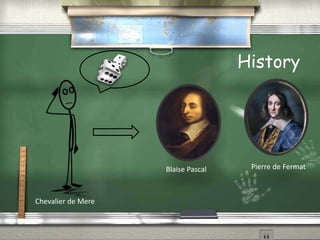
History
Blaise Pascal Pierre de Fermat
Chevalier de Mere
Definition
✏ Probability is the measure ofhow likely
something will occur.
✏ It is the ratio of desired outcomesto total
outcomes.
✏(# desired) / (# total)
✏ Probabilities of all outcomes sumsto 1.
Definitions
Probability is the measure of the likeliness that an event
will occur. Probability is quantified as a number between
0 and 1 (where 0 indicates impossibility and 1 indicates
certainty
• Probability of any event can be expressed as:
0<=P<=1
Terminologies
 Experiment: An operation which can produce some
well defined outcomes, is known as experiment.
Trail: performing a experiment is called trail.
E.g. : Tossing a coin
Event: An event is a possible outcome of the
experiment. Like head coming in a toss.
 Remark: Sum of probabilities of all the elementary
events of an experiment is 1.
Terminologies
Sample space:
It is a set of all possible outcomes of an experiment.
e.g. when we coin is tossed, the possible outcome are Head and
Tail. So sample space is Head and tail .
The event A’, representing ‘not A’, is called the complement
of the event A. We also say that A’ and A are complementary
events. Also
P(A) +P(A’)=1
 The probability of an event (U) which is impossible to occur
is 0. Such an event is called an impossible event
P(U)=0
How do we express probabilities?
Usually, we express probabilities as
fractions.
 The numerator shows the POSSIBLE
number of ways an event can occur.
 The denominator is the TOTAL number
of possible events that could occur.
Let’s look at an example!
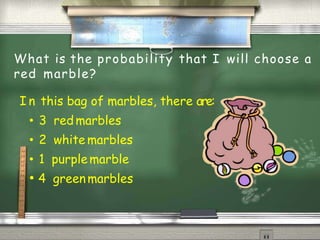
What is the probability that I will choose a
red marble?
I n this bag of marbles, there are:
• 3 red marbles
• 2 white marbles
• 1 purplemarble
• 4 greenmarbles
Ask yourself the following questions:
1. How many red marbles are in the bag?
2. How many marbles are in the bag?
3. If I randomly choose a ball from bag, what
is the probability of getting red ball out of
the bag?
4. If I randomly choose a ball from bag, what
is the probability of getting purple ball out
of the bag?
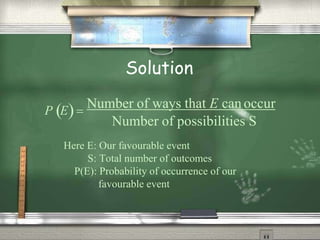
Solution
P E
Number of ways that E can occur
Number of possibilities S
Here E: Our favourable event
S: Total number of outcomes
P(E): Probability of occurrence of our
favourable event
Solution
Answer 1: There are 3 red ball in bag.
Answer 2: There are 10 ball in total in bag
Answer 3:Probability of getting red ball from bag,
when we are randomly choosing the ball....
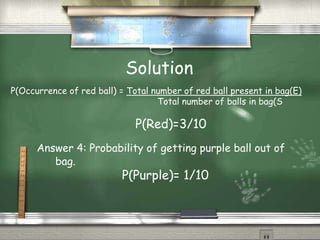
P(Occurrence of red ball) = Total number of red ball present in bag(E)
Total number of balls in bag(S)
Solution
P(Occurrence of red ball) = Total number of red ball present in bag(E)
Total number of balls in bag(S
P(Red)=3/10
Answer 4: Probability of getting purple ball out of
bag.
P(Purple)= 1/10
Practice
✏ If I flip a coin, what isthe probability
I get heads?
✏ What is the probability I gettails?
✏ Remember, to think of howmany possibilities
there are.
Answer
✏ P(heads) =1/2
✏ P(tails) =1/2
✏ If you add these two up, you willget 1,
which means the answers are probably
right.
Two or more events
✏ If there are two or more events, you need
to consider if it is happening at the same
time or one after the other.
“And”
✏ If the two events are happening at the
same time, you need to multiply the two
probabilities together.
✏ Usually, the questions use the word
“and” when describing the outcomes.
The Word And in probability means
Intersection
Q. What is the probability that you roll an
even number and a number greater than 3?
E = rolling an even number
F = rolling a number greater than 3
P(E∩F) = (E∩F) .
Total outcomes
Continue...
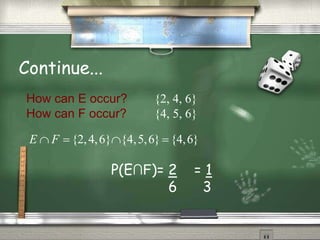
How can E occur? {2, 4, 6}
How can F occur? {4, 5, 6}
E  F  {2,4,6}{4,5,6}{4,6}
P(E∩F)= 2 = 1
6 3
“Or”
✏ If the two events are happening one
after the other, you need to add the two
probabilities.
✏ Usually, the questions use the word “or”
when describing the outcomes.
The Word Or in probability means Union
Q. What is the probability that you roll
an even number or a number greater
than 3?
E = rolling an even number
F = rolling a number greater than 3
Continue...
P(EUF) = (EUF) .
Total outcomes
How can E occur? {2, 4, 6}
How can F occur? {4, 5, 6}
E UF {2,4,6}U{4,5,6}{2,4,5,6}
P(EUF)= 4 = 2
6 3
Practice
✏ If I roll a number cube and flip a coin:
✏ What is the probability I will geta heads
and a 6?
✏ What is the probability I will geta tails or
a 3?
Answers
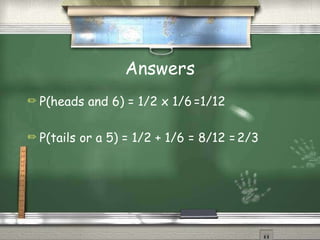
✏ P(heads and 6) = 1/2 x 1/6 =1/12
✏ P(tails or a 5) = 1/2 + 1/6 = 8/12 =2/3
Independent Events
Two events are independent if, the outcome OF event
A has no effect on the outcome of event B.
Example: Event A: It rained on Tuesday
Event B: My chair broke at work
These two events are not at all related to each other.
• When we calculate probabilities for independent
events, we always multiply the probabilities.
LETS TAKE AN EXAMPLE:
Let Event A:Today it will rain in Delhi.
Event B:Today I will reach office late.
C: FIND Possibility of both events A&B
happening together.
GIVEN: P(A)=0.1,P(B)=0.02
Hence ; P(C)=P(A)*P(B)
=0.1*0.02
=0.002
Practice Time
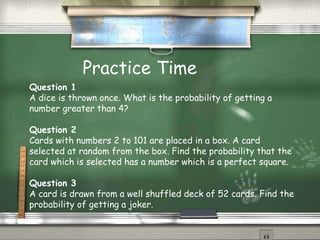
Question 1
A dice is thrown once. What is the probability of getting a
number greater than 4?
Question 2
Cards with numbers 2 to 101 are placed in a box. A card
selected at random from the box. Find the probability that the
card which is selected has a number which is a perfect square.
Question 3
A card is drawn from a well shuffled deck of 52 cards. Find the
probability of getting a joker.
Thank you!

Probability

  • 1.
  • 2.
    Introduction In everyday life,we come across statements such as • It will probably rain today. • I doubt that he will pass the test. • Most probably, Kavita will stand first in the annual examination. • There is a 50-50 chance of India winning a toss in today’s match. Use: Physical Sciences, Commerce, Biological Sciences, Medical Sciences, Weather Forecasting, etc
  • 3.
    History Blaise Pascal Pierrede Fermat Chevalier de Mere
  • 4.
    Definition ✏ Probability isthe measure ofhow likely something will occur. ✏ It is the ratio of desired outcomesto total outcomes. ✏(# desired) / (# total) ✏ Probabilities of all outcomes sumsto 1.
  • 5.
    Definitions Probability is themeasure of the likeliness that an event will occur. Probability is quantified as a number between 0 and 1 (where 0 indicates impossibility and 1 indicates certainty • Probability of any event can be expressed as: 0<=P<=1
  • 6.
    Terminologies  Experiment: Anoperation which can produce some well defined outcomes, is known as experiment. Trail: performing a experiment is called trail. E.g. : Tossing a coin Event: An event is a possible outcome of the experiment. Like head coming in a toss.  Remark: Sum of probabilities of all the elementary events of an experiment is 1.
  • 7.
    Terminologies Sample space: It isa set of all possible outcomes of an experiment. e.g. when we coin is tossed, the possible outcome are Head and Tail. So sample space is Head and tail . The event A’, representing ‘not A’, is called the complement of the event A. We also say that A’ and A are complementary events. Also P(A) +P(A’)=1  The probability of an event (U) which is impossible to occur is 0. Such an event is called an impossible event P(U)=0
  • 8.
    How do weexpress probabilities? Usually, we express probabilities as fractions.  The numerator shows the POSSIBLE number of ways an event can occur.  The denominator is the TOTAL number of possible events that could occur. Let’s look at an example!
  • 9.
    What is theprobability that I will choose a red marble? I n this bag of marbles, there are: • 3 red marbles • 2 white marbles • 1 purplemarble • 4 greenmarbles
  • 10.
    Ask yourself thefollowing questions: 1. How many red marbles are in the bag? 2. How many marbles are in the bag? 3. If I randomly choose a ball from bag, what is the probability of getting red ball out of the bag? 4. If I randomly choose a ball from bag, what is the probability of getting purple ball out of the bag?
  • 11.
    Solution P E Number ofways that E can occur Number of possibilities S Here E: Our favourable event S: Total number of outcomes P(E): Probability of occurrence of our favourable event
  • 12.
    Solution Answer 1: Thereare 3 red ball in bag. Answer 2: There are 10 ball in total in bag Answer 3:Probability of getting red ball from bag, when we are randomly choosing the ball.... P(Occurrence of red ball) = Total number of red ball present in bag(E) Total number of balls in bag(S)
  • 13.
    Solution P(Occurrence of redball) = Total number of red ball present in bag(E) Total number of balls in bag(S P(Red)=3/10 Answer 4: Probability of getting purple ball out of bag. P(Purple)= 1/10
  • 14.
    Practice ✏ If Iflip a coin, what isthe probability I get heads? ✏ What is the probability I gettails? ✏ Remember, to think of howmany possibilities there are.
  • 15.
    Answer ✏ P(heads) =1/2 ✏P(tails) =1/2 ✏ If you add these two up, you willget 1, which means the answers are probably right.
  • 16.
    Two or moreevents ✏ If there are two or more events, you need to consider if it is happening at the same time or one after the other.
  • 17.
    “And” ✏ If thetwo events are happening at the same time, you need to multiply the two probabilities together. ✏ Usually, the questions use the word “and” when describing the outcomes.
  • 18.
    The Word Andin probability means Intersection Q. What is the probability that you roll an even number and a number greater than 3? E = rolling an even number F = rolling a number greater than 3 P(E∩F) = (E∩F) . Total outcomes
  • 19.
    Continue... How can Eoccur? {2, 4, 6} How can F occur? {4, 5, 6} E  F  {2,4,6}{4,5,6}{4,6} P(E∩F)= 2 = 1 6 3
  • 20.
    “Or” ✏ If thetwo events are happening one after the other, you need to add the two probabilities. ✏ Usually, the questions use the word “or” when describing the outcomes.
  • 21.
    The Word Orin probability means Union Q. What is the probability that you roll an even number or a number greater than 3? E = rolling an even number F = rolling a number greater than 3
  • 22.
    Continue... P(EUF) = (EUF). Total outcomes How can E occur? {2, 4, 6} How can F occur? {4, 5, 6} E UF {2,4,6}U{4,5,6}{2,4,5,6} P(EUF)= 4 = 2 6 3
  • 23.
    Practice ✏ If Iroll a number cube and flip a coin: ✏ What is the probability I will geta heads and a 6? ✏ What is the probability I will geta tails or a 3?
  • 24.
    Answers ✏ P(heads and6) = 1/2 x 1/6 =1/12 ✏ P(tails or a 5) = 1/2 + 1/6 = 8/12 =2/3
  • 25.
    Independent Events Two eventsare independent if, the outcome OF event A has no effect on the outcome of event B. Example: Event A: It rained on Tuesday Event B: My chair broke at work These two events are not at all related to each other. • When we calculate probabilities for independent events, we always multiply the probabilities.
  • 26.
    LETS TAKE ANEXAMPLE: Let Event A:Today it will rain in Delhi. Event B:Today I will reach office late. C: FIND Possibility of both events A&B happening together. GIVEN: P(A)=0.1,P(B)=0.02 Hence ; P(C)=P(A)*P(B) =0.1*0.02 =0.002
  • 27.
    Practice Time Question 1 Adice is thrown once. What is the probability of getting a number greater than 4? Question 2 Cards with numbers 2 to 101 are placed in a box. A card selected at random from the box. Find the probability that the card which is selected has a number which is a perfect square. Question 3 A card is drawn from a well shuffled deck of 52 cards. Find the probability of getting a joker.
  • 28.