Various Probability Concepts
Learn to find the probability of an event
by using the definition of probability.
Course 3
10-1 Probability
Vocabulary
experiment
trial
outcome
sample space
event
probability
impossible
certain
Insert Lesson Title Here
Course 3
10-1 Probability
Course 3
10-1 Probability
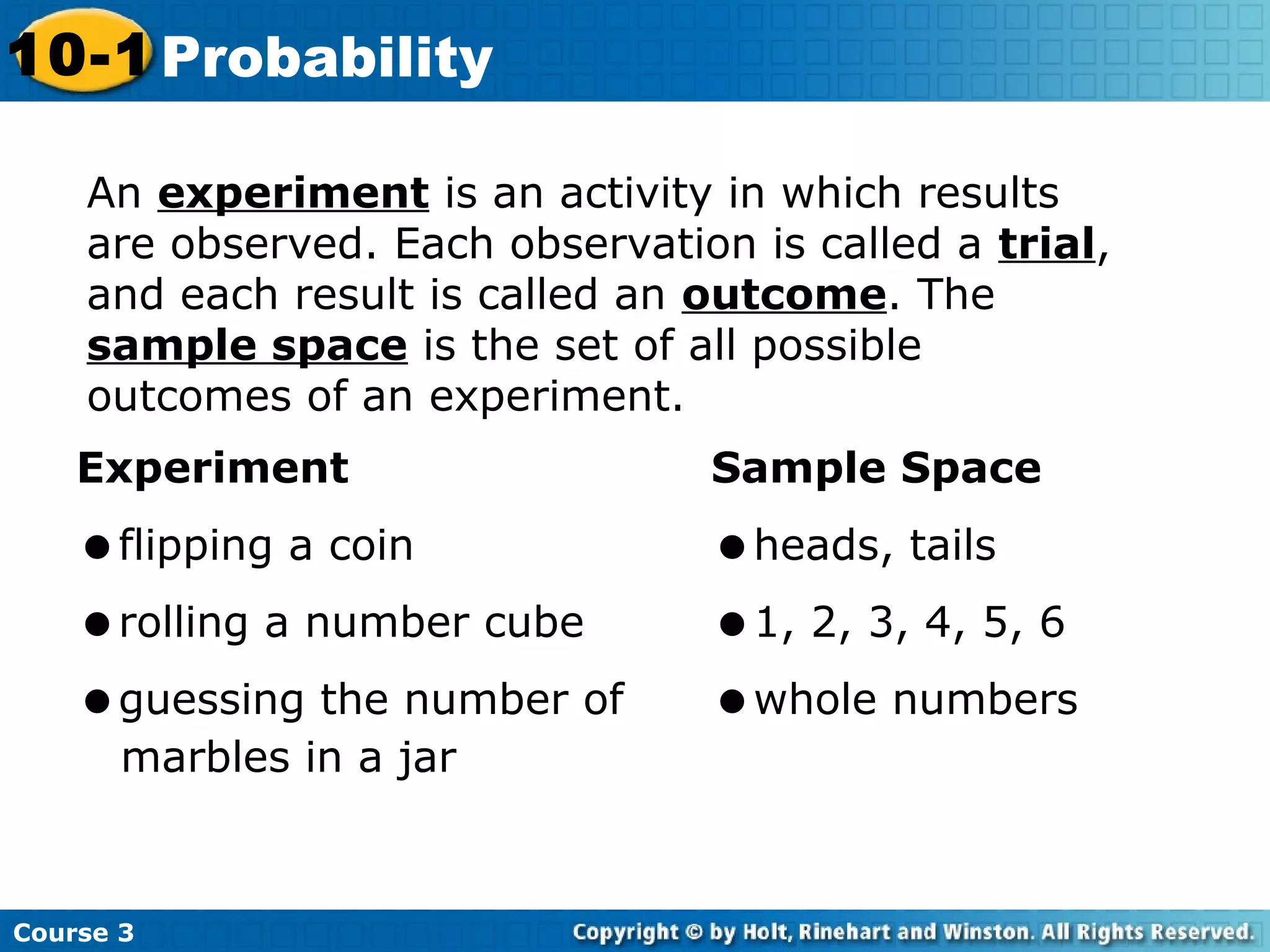
An experiment is an activity in which results
are observed. Each observation is called a trial,
and each result is called an outcome. The
sample space is the set of all possible
outcomes of an experiment.
Experiment Sample Space
flipping a coin heads, tails
rolling a number cube 1, 2, 3, 4, 5, 6
guessing the number of whole numbers
marbles in a jar
Course 3
10-1 Probability
An event is any set of one or more outcomes.
The probability of an event, written P(event),
is a number from 0 (or 0%) to 1 (or 100%) that
tells you how likely the event is to happen.
• A probability of 0 means the event is
impossible, or can never happen.
• A probability of 1 means the event is certain,
or has to happen.
• The probabilities of all the outcomes in the
sample space add up to 1.
Course 3
10-1 Probability
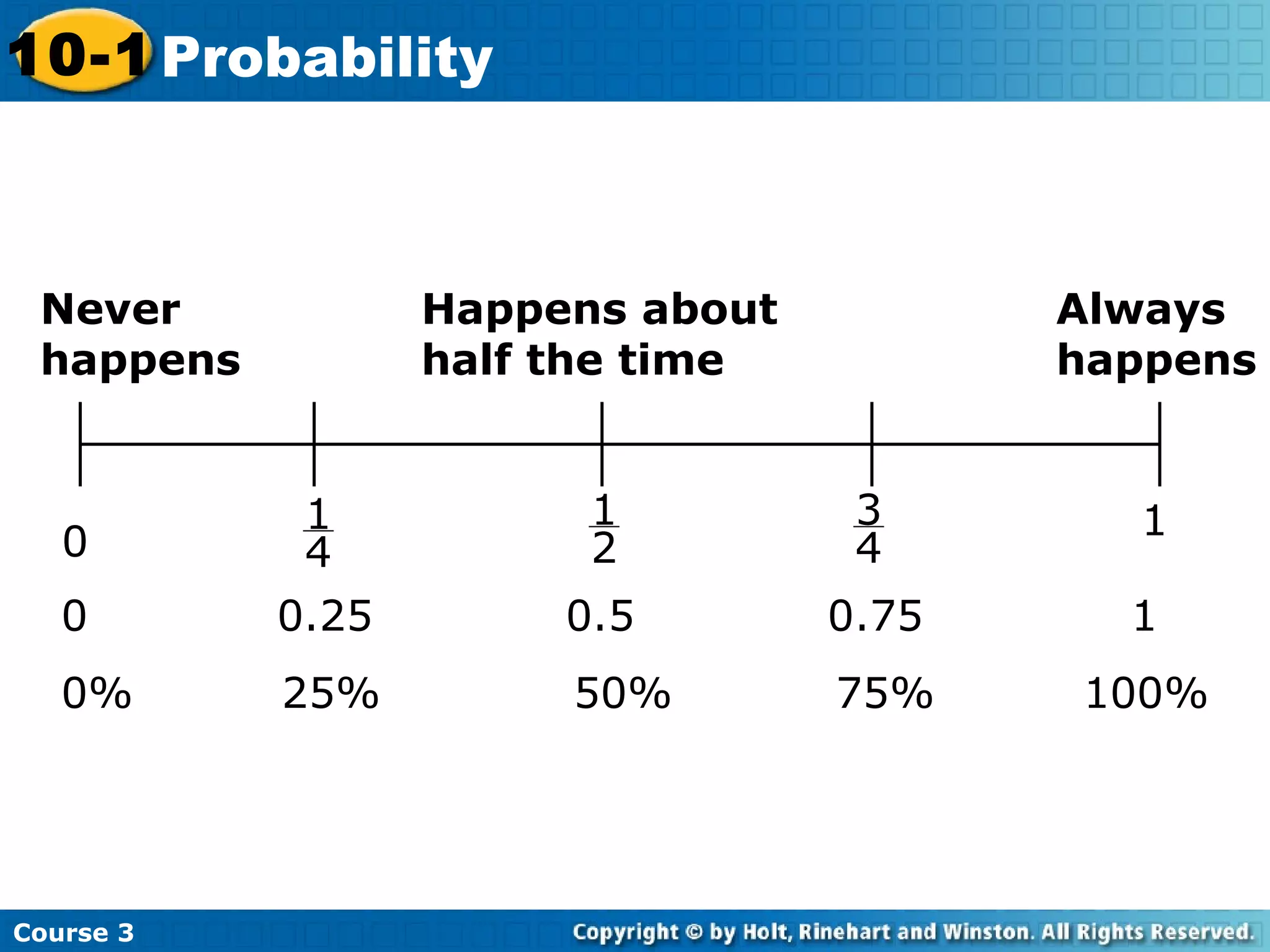
0 0.25 0.5 0.75 1
0% 25% 50% 75% 100%
Never Happens about Always
happens half the time happens
1
4
1
2
3
40
1
Give the probability for each outcome.
Additional Example 1A: Finding Probabilities of
Outcomes in a Sample Space
Course 3
10-1 Probability
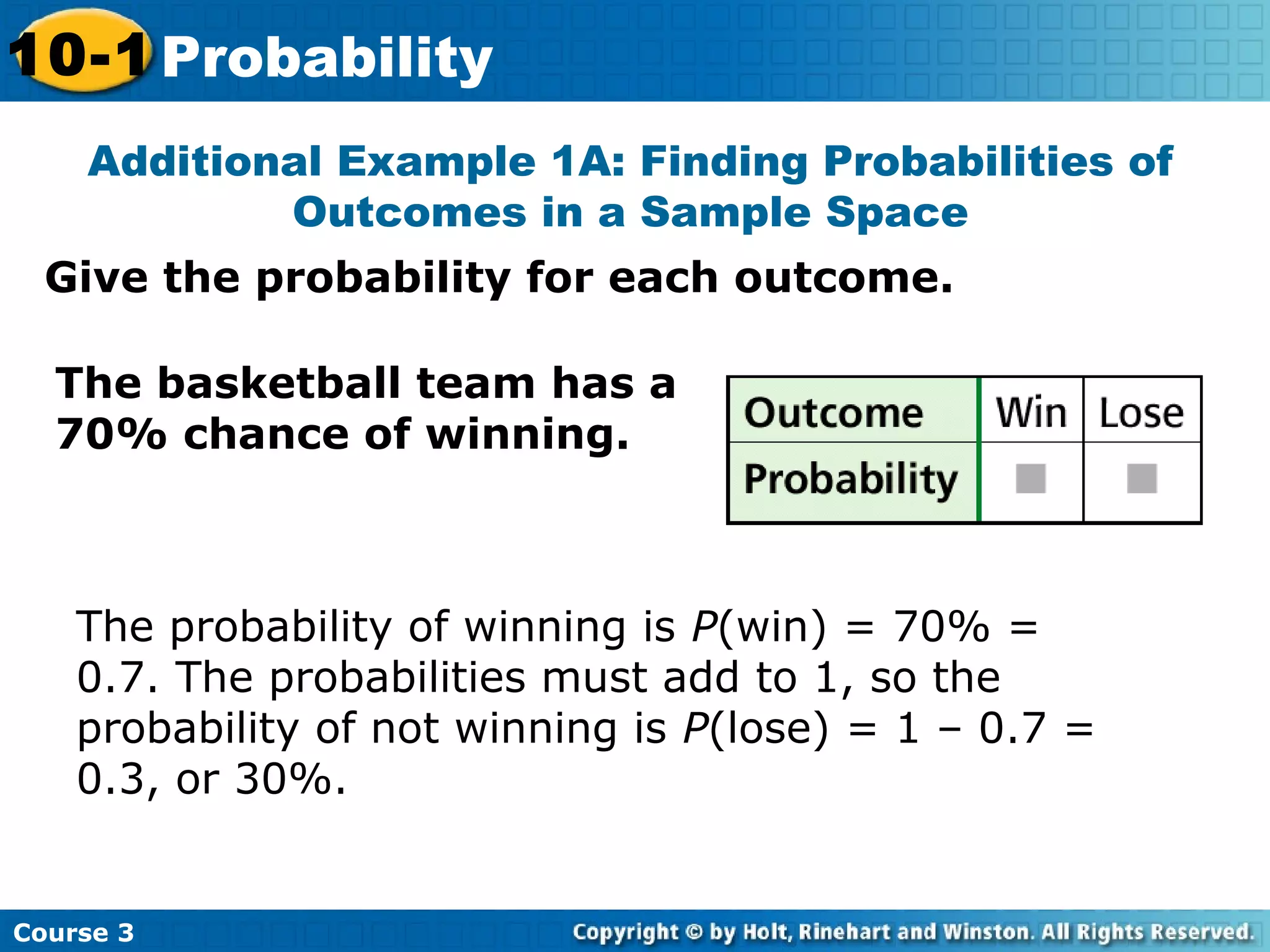
The basketball team has a
70% chance of winning.
The probability of winning is P(win) = 70% =
0.7. The probabilities must add to 1, so the
probability of not winning is P(lose) = 1 – 0.7 =
0.3, or 30%.
Give the probability for each outcome.
Additional Example 1B: Finding Probabilities of
Outcomes in a Sample Space
Course 3
10-1 Probability
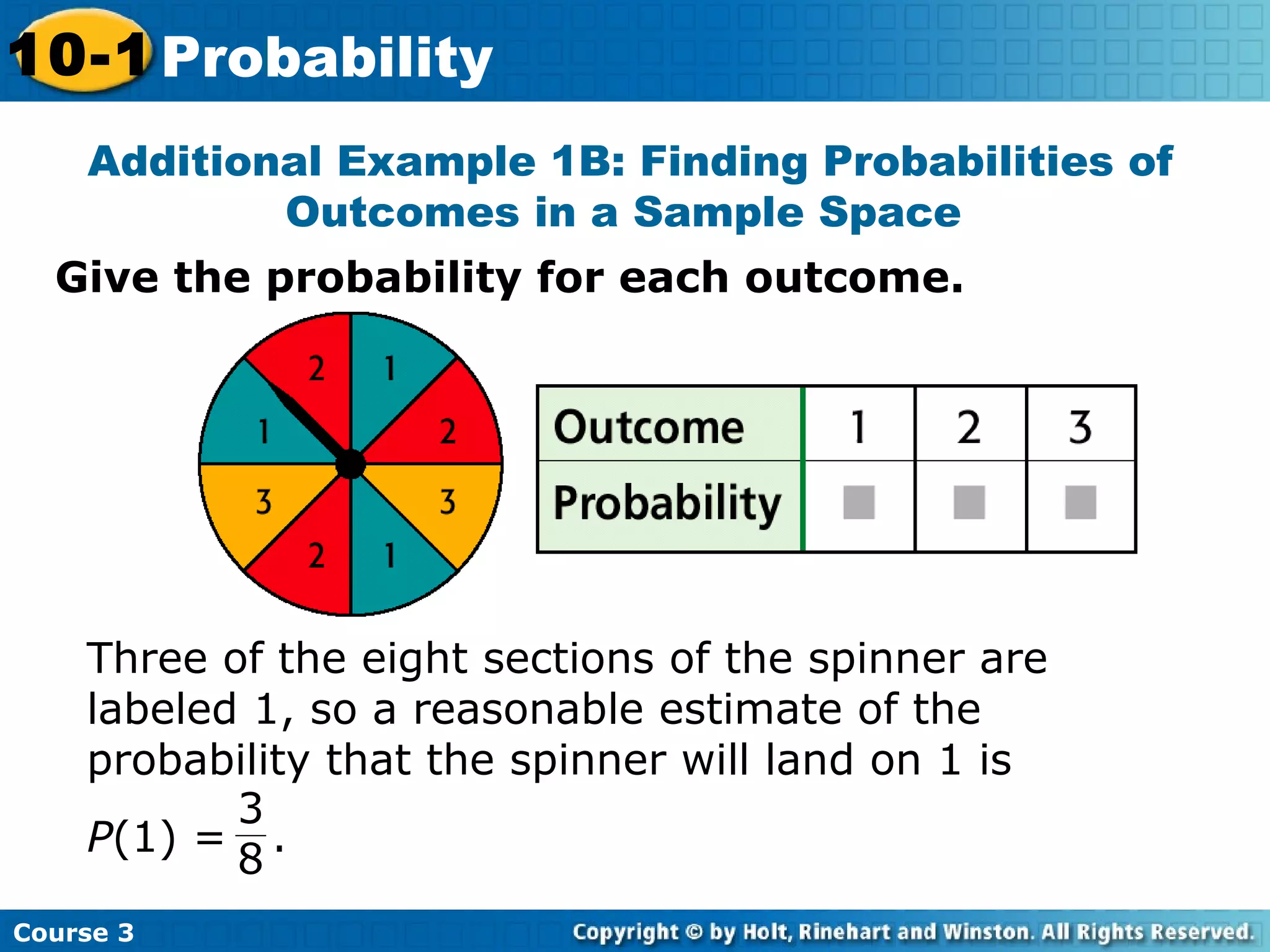
Three of the eight sections of the spinner are
labeled 1, so a reasonable estimate of the
probability that the spinner will land on 1 is
P(1) = .
3
8
Additional Example 1B Continued
Course 3
10-1 Probability
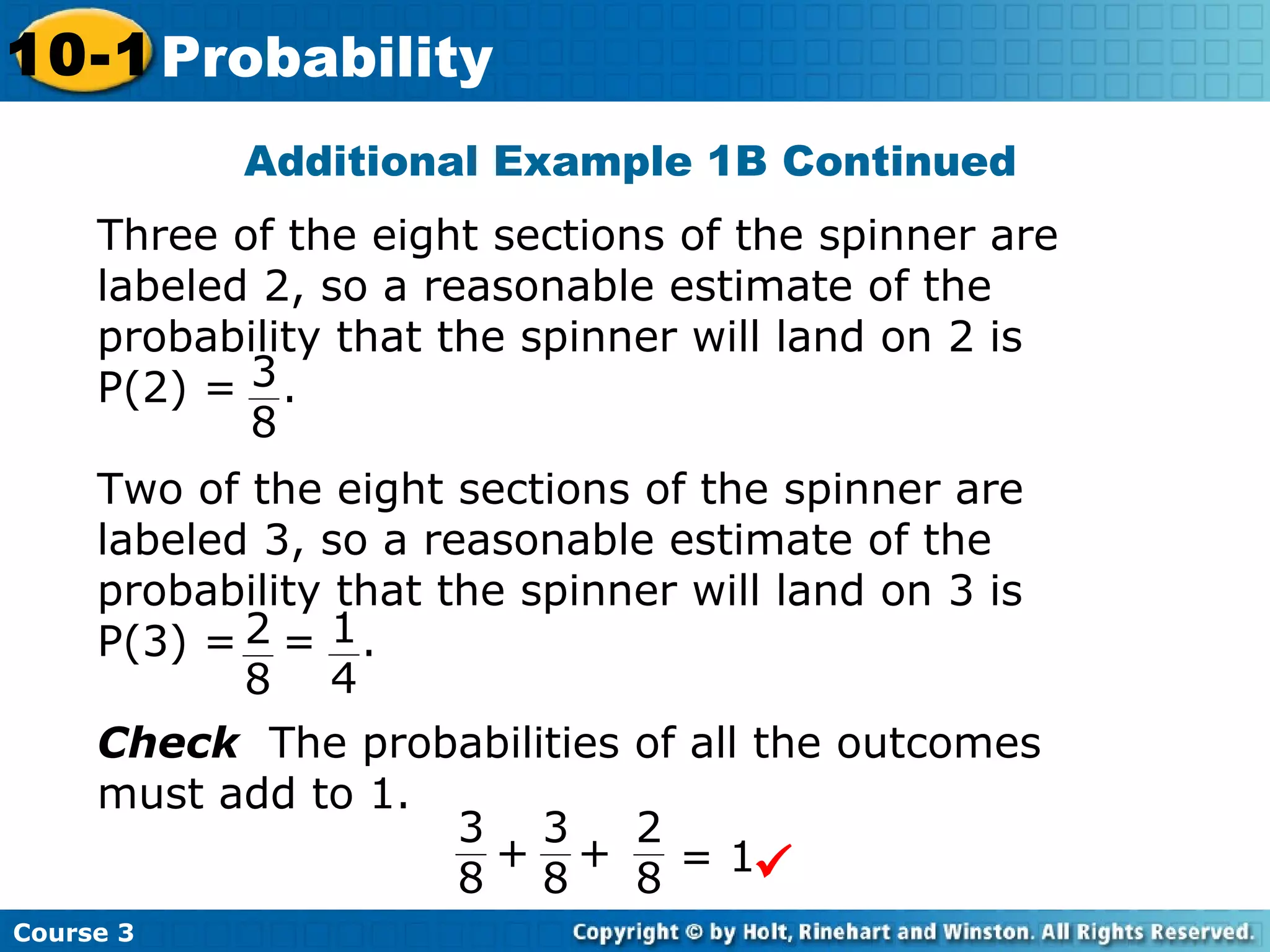
Three of the eight sections of the spinner are
labeled 2, so a reasonable estimate of the
probability that the spinner will land on 2 is
P(2) = .3
8
Two of the eight sections of the spinner are
labeled 3, so a reasonable estimate of the
probability that the spinner will land on 3 is
P(3) = = .2
8
1
4
Check The probabilities of all the outcomes
must add to 1.
3
8
3
8
2
8
++ = 1
Give the probability for each outcome.
Check It Out: Example 1A
Course 3
10-1 Probability
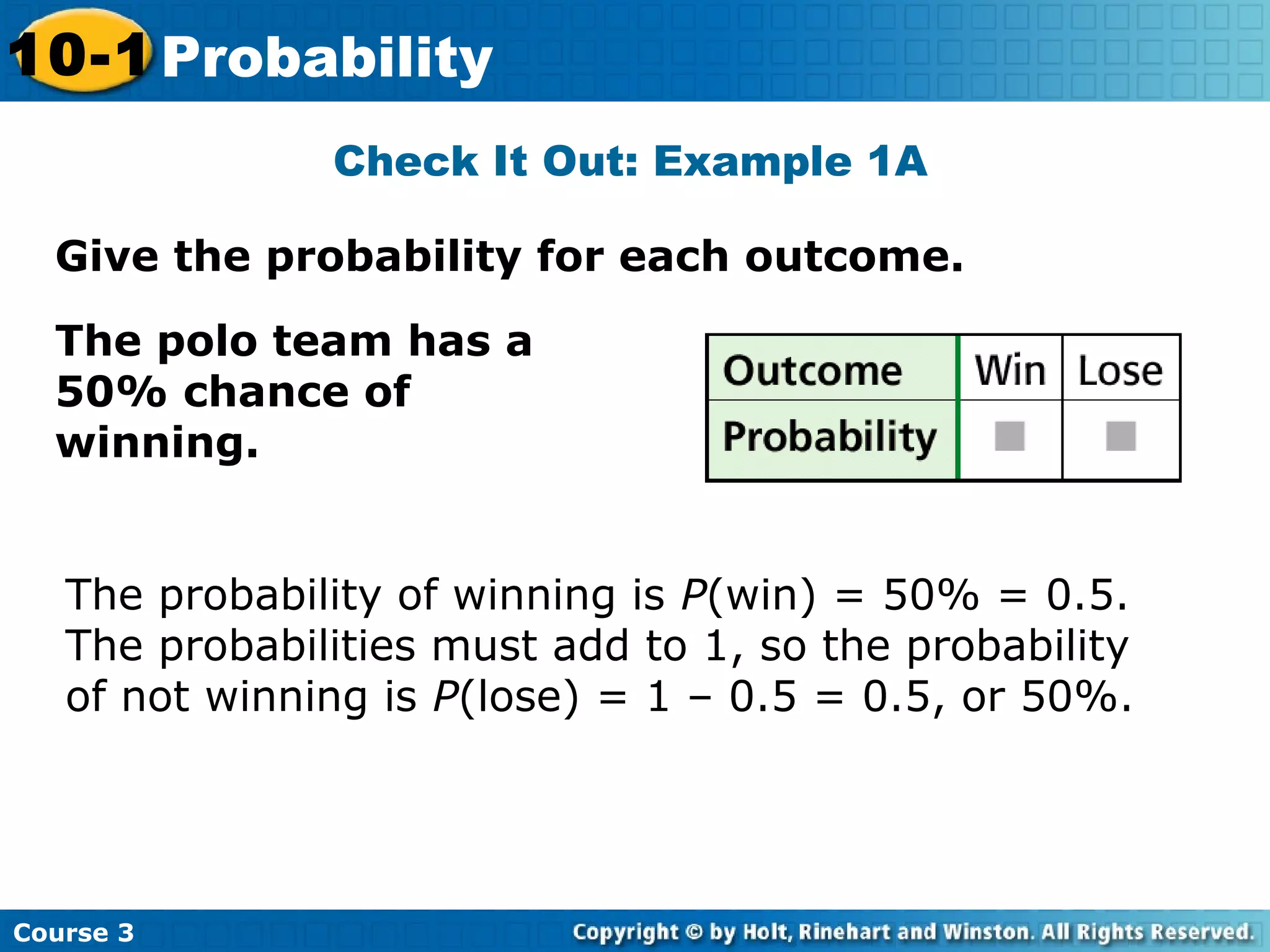
The polo team has a
50% chance of
winning.
The probability of winning is P(win) = 50% = 0.5.
The probabilities must add to 1, so the probability
of not winning is P(lose) = 1 – 0.5 = 0.5, or 50%.
Give the probability for each outcome.
Check It Out: Example 1B
Course 3
10-1 Probability
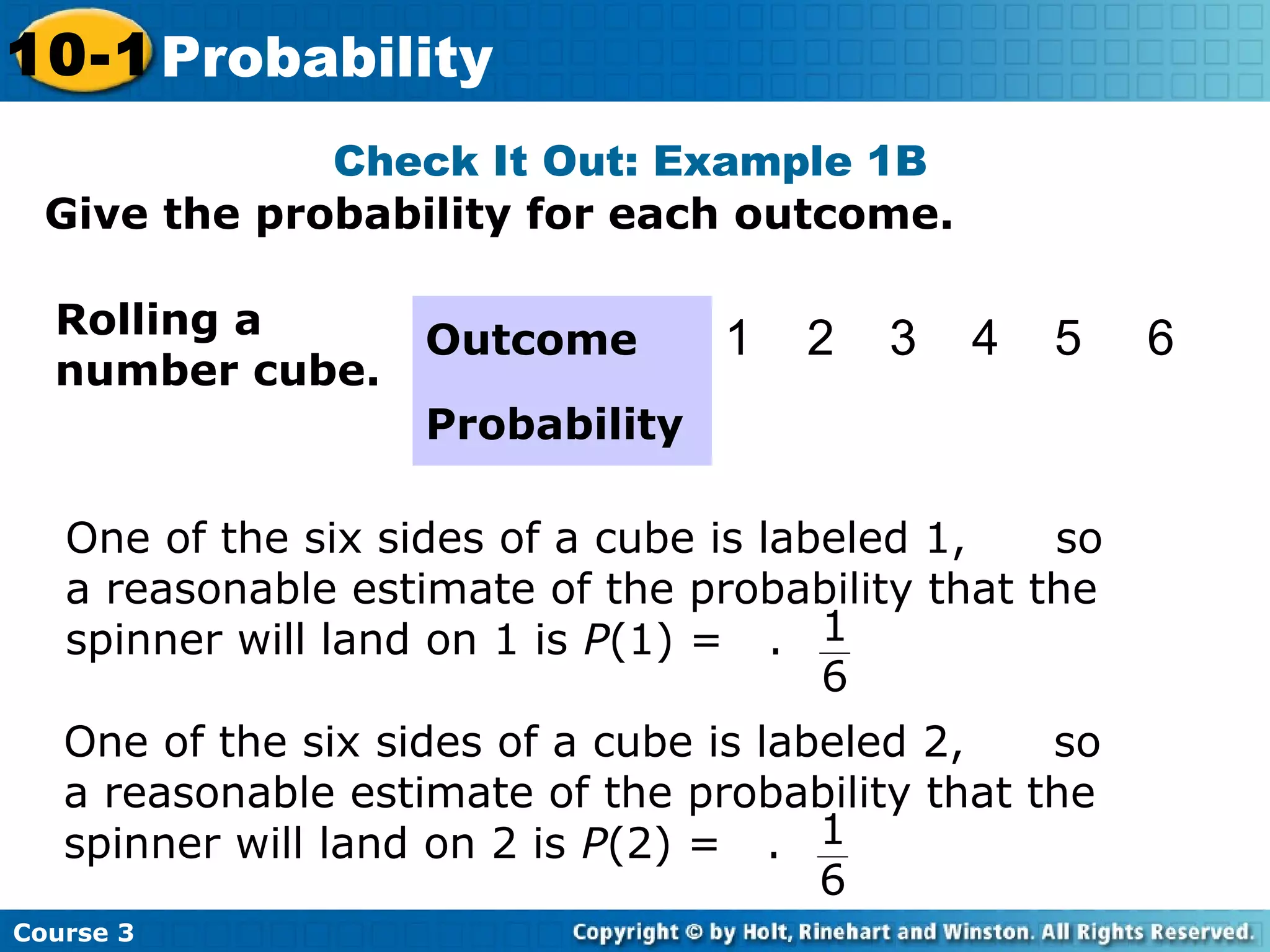
Rolling a
number cube.
One of the six sides of a cube is labeled 1, so
a reasonable estimate of the probability that the
spinner will land on 1 is P(1) = . 1
6
Outcome 1 2 3 4 5 6
Probability
One of the six sides of a cube is labeled 2, so
a reasonable estimate of the probability that the
spinner will land on 2 is P(2) = . 1
6
Check It Out: Example 1B Continued
Course 3
10-1 Probability
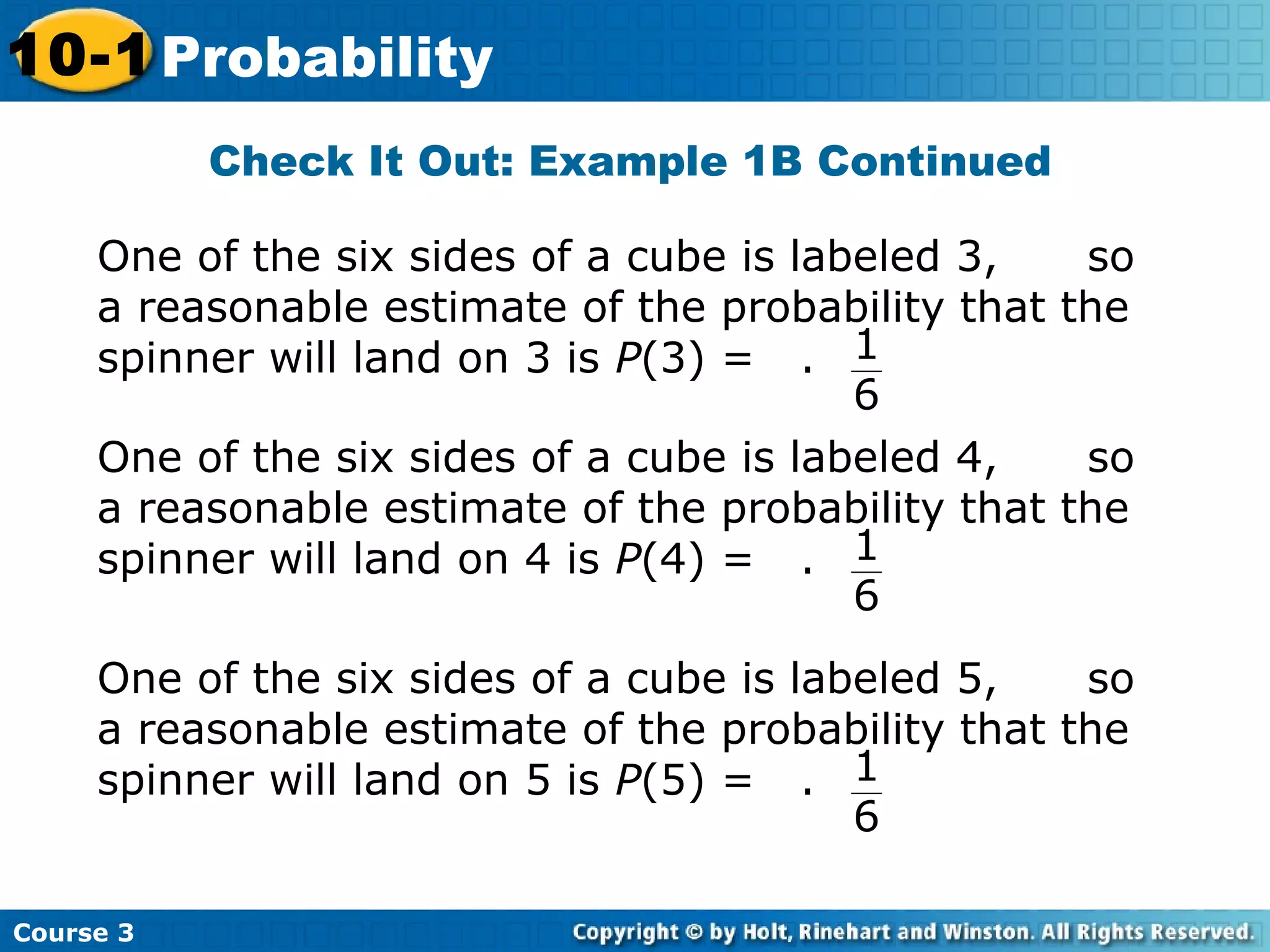
One of the six sides of a cube is labeled 3, so
a reasonable estimate of the probability that the
spinner will land on 3 is P(3) = . 1
6
One of the six sides of a cube is labeled 4, so
a reasonable estimate of the probability that the
spinner will land on 4 is P(4) = . 1
6
One of the six sides of a cube is labeled 5, so
a reasonable estimate of the probability that the
spinner will land on 5 is P(5) = . 1
6
Check It Out: Example 1B Continued
Course 3
10-1 Probability
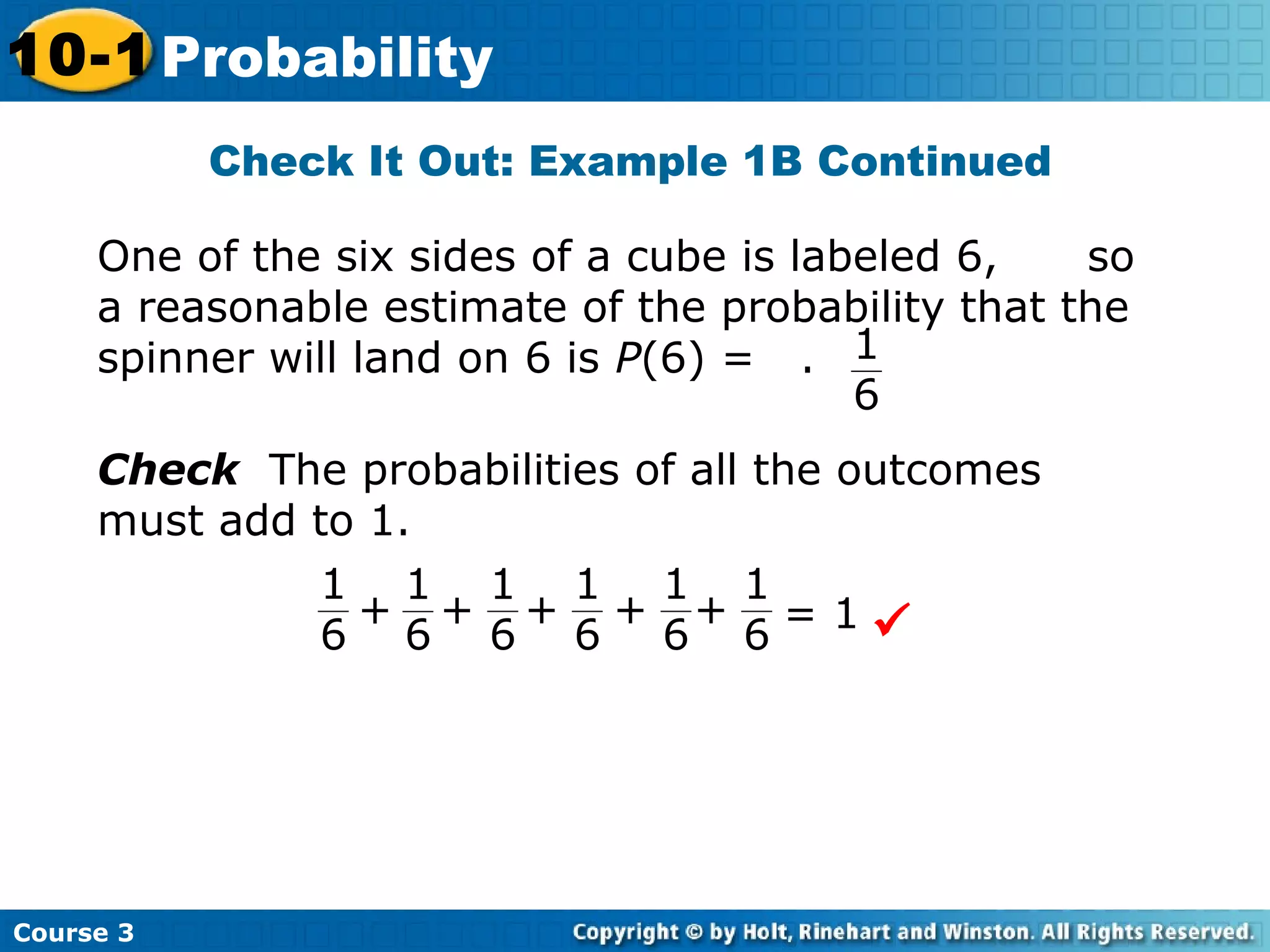
One of the six sides of a cube is labeled 6, so
a reasonable estimate of the probability that the
spinner will land on 6 is P(6) = . 1
6
Check The probabilities of all the outcomes
must add to 1.

1
6
1
6
1
6
++ = 1
1
6
+
1
6
+
1
6
+
Course 3
10-1 Probability
To find the probability of an event, add the
probabilities of all the outcomes included in the
event.
Learn to find the number of possible
outcomes in an experiment.
Course 3
10-8 Counting Principles
Vocabulary
Fundamental Counting Principle
tree diagram
Addition Counting Principle
Insert Lesson Title Here
Course 3
10-8 Counting Principles
Course 3
10-8 Counting Principles
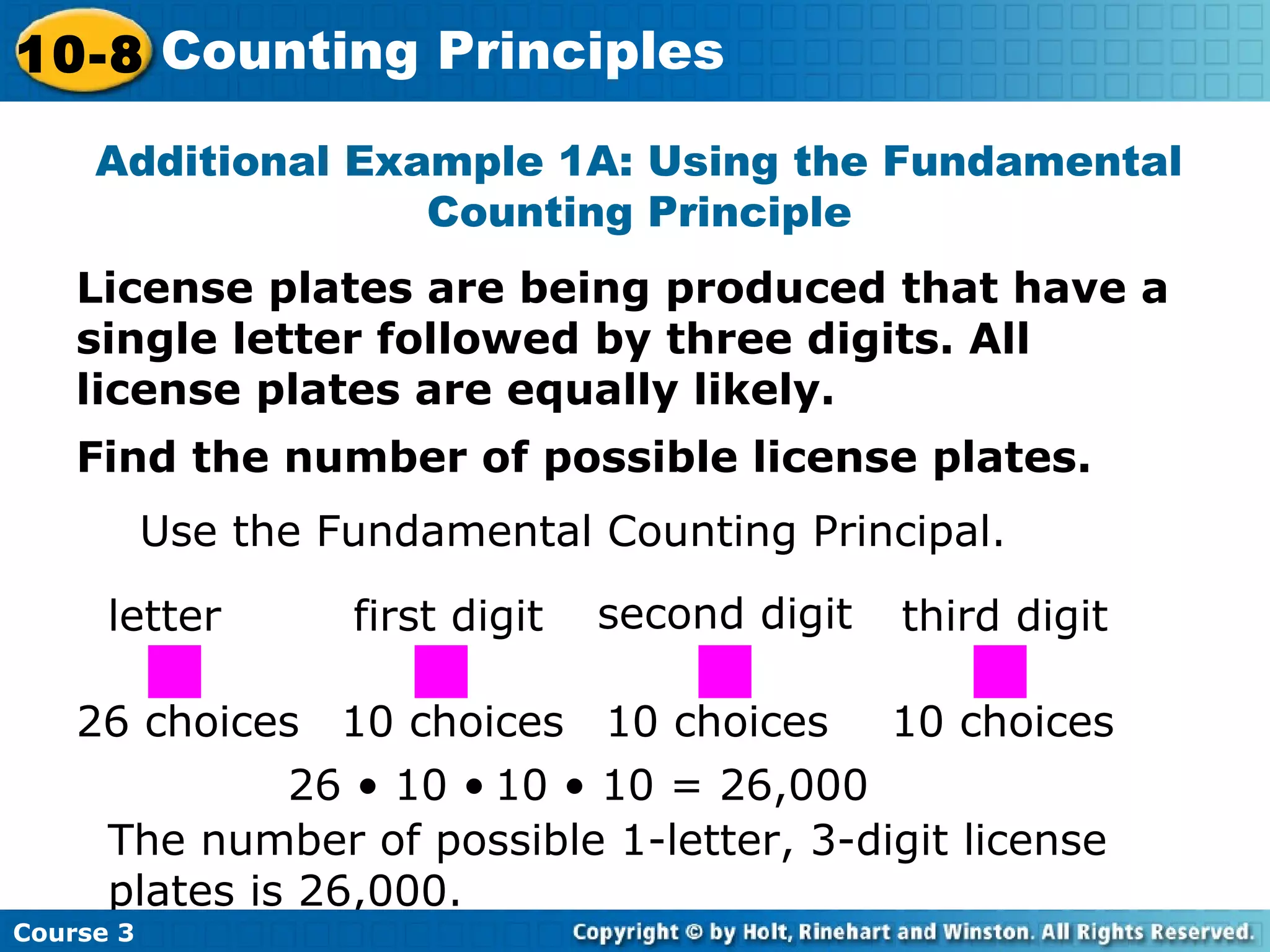
License plates are being produced that have a
single letter followed by three digits. All
license plates are equally likely.
Additional Example 1A: Using the Fundamental
Counting Principle
Find the number of possible license plates.
Use the Fundamental Counting Principal.
letter first digit second digit third digit
26 choices 10 choices 10 choices 10 choices
26 • 10 • 10 • 10 = 26,000
The number of possible 1-letter, 3-digit license
plates is 26,000.
Course 3
10-8 Counting Principles
Additional Example 1B: Using the Fundamental
Counting Principal
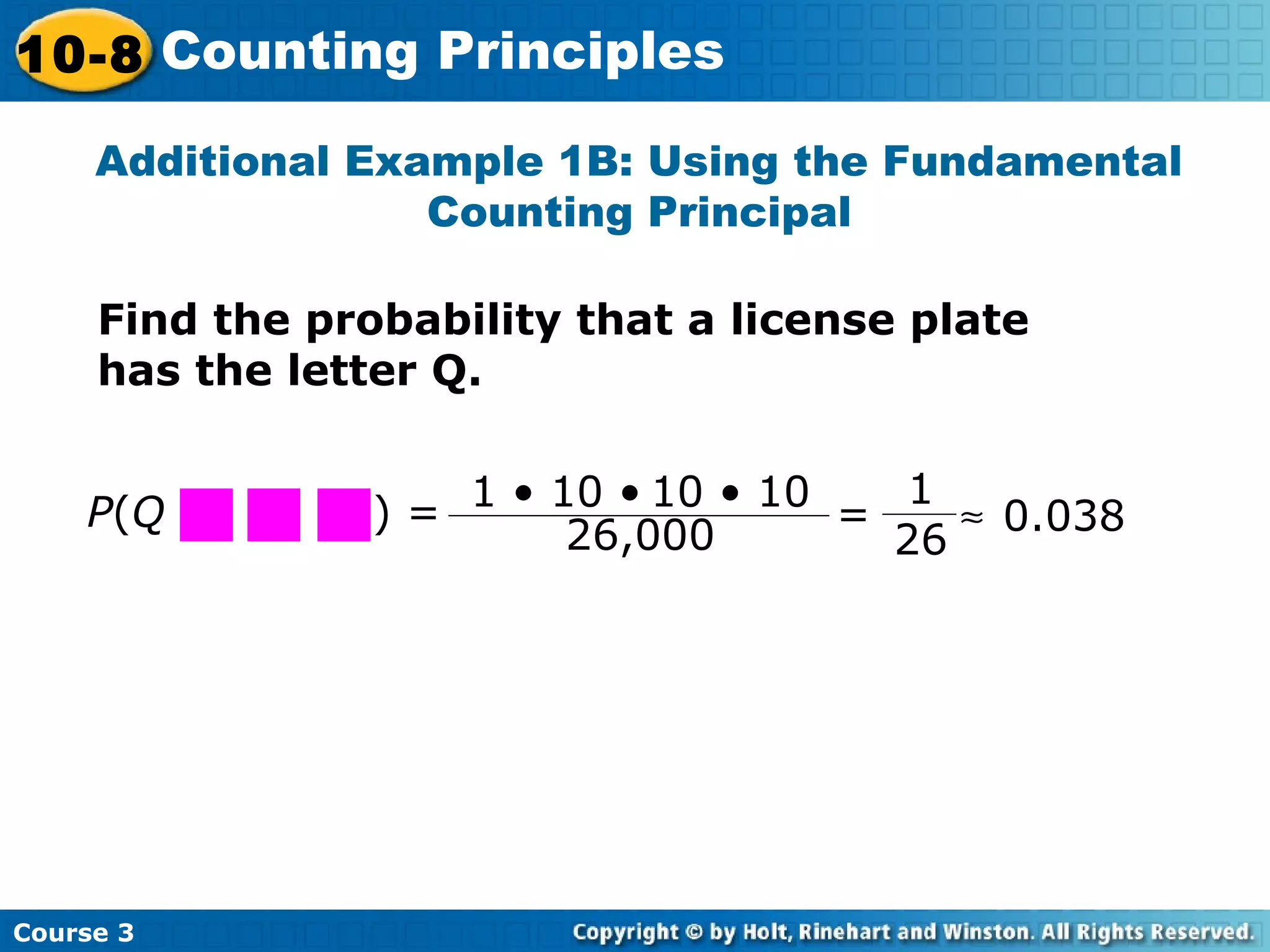
Find the probability that a license plate
has the letter Q.
1 • 10 • 10 • 10
26,000 =
1
26
≈ 0.038P(Q ) =
Course 3
10-8 Counting Principles
Additional Example 1C: Using the Fundamental
Counting Principle
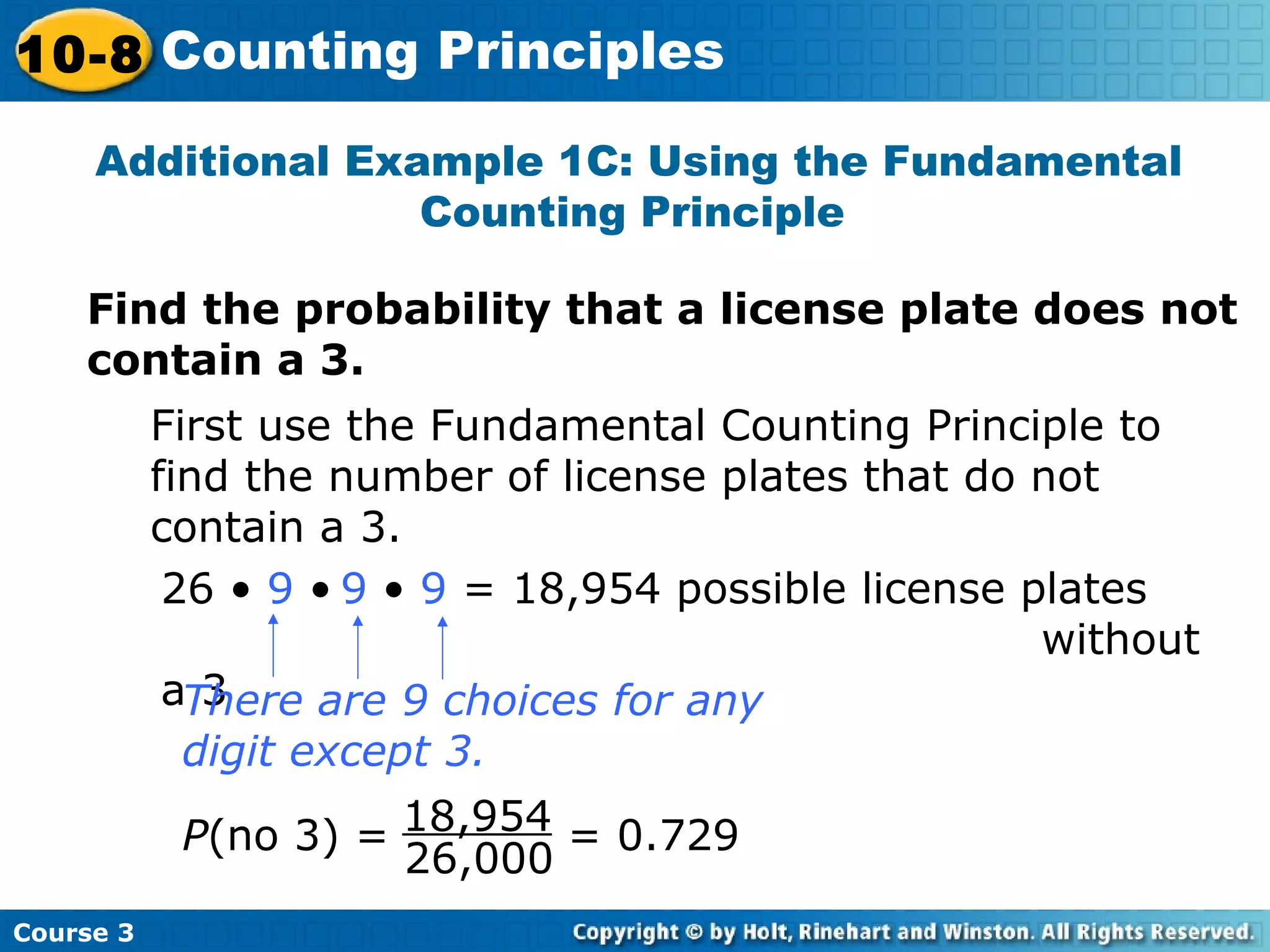
Find the probability that a license plate does not
contain a 3.
First use the Fundamental Counting Principle to
find the number of license plates that do not
contain a 3.
26 • 9 • 9 • 9 = 18,954 possible license plates
without
a 3There are 9 choices for any
digit except 3.
P(no 3) = = 0.729
26,000
18,954
Course 3
10-8 Counting Principles
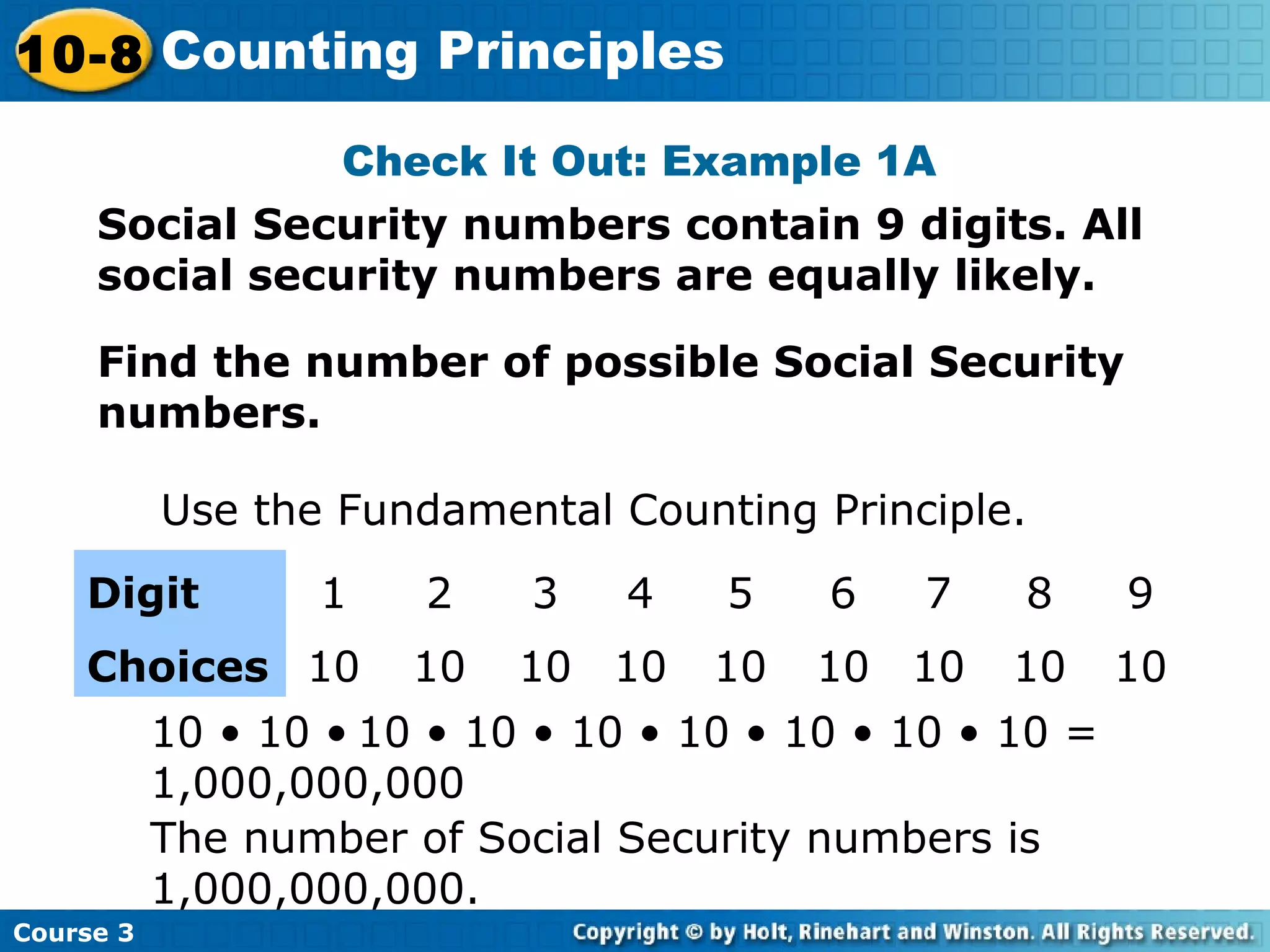
Social Security numbers contain 9 digits. All
social security numbers are equally likely.
Check It Out: Example 1A
Find the number of possible Social Security
numbers.
Use the Fundamental Counting Principle.
Digit 1 2 3 4 5 6 7 8 9
Choices 10 10 10 10 10 10 10 10 10
10 • 10 • 10 • 10 • 10 • 10 • 10 • 10 • 10 =
1,000,000,000
The number of Social Security numbers is
1,000,000,000.
Course 3
10-8 Counting Principles
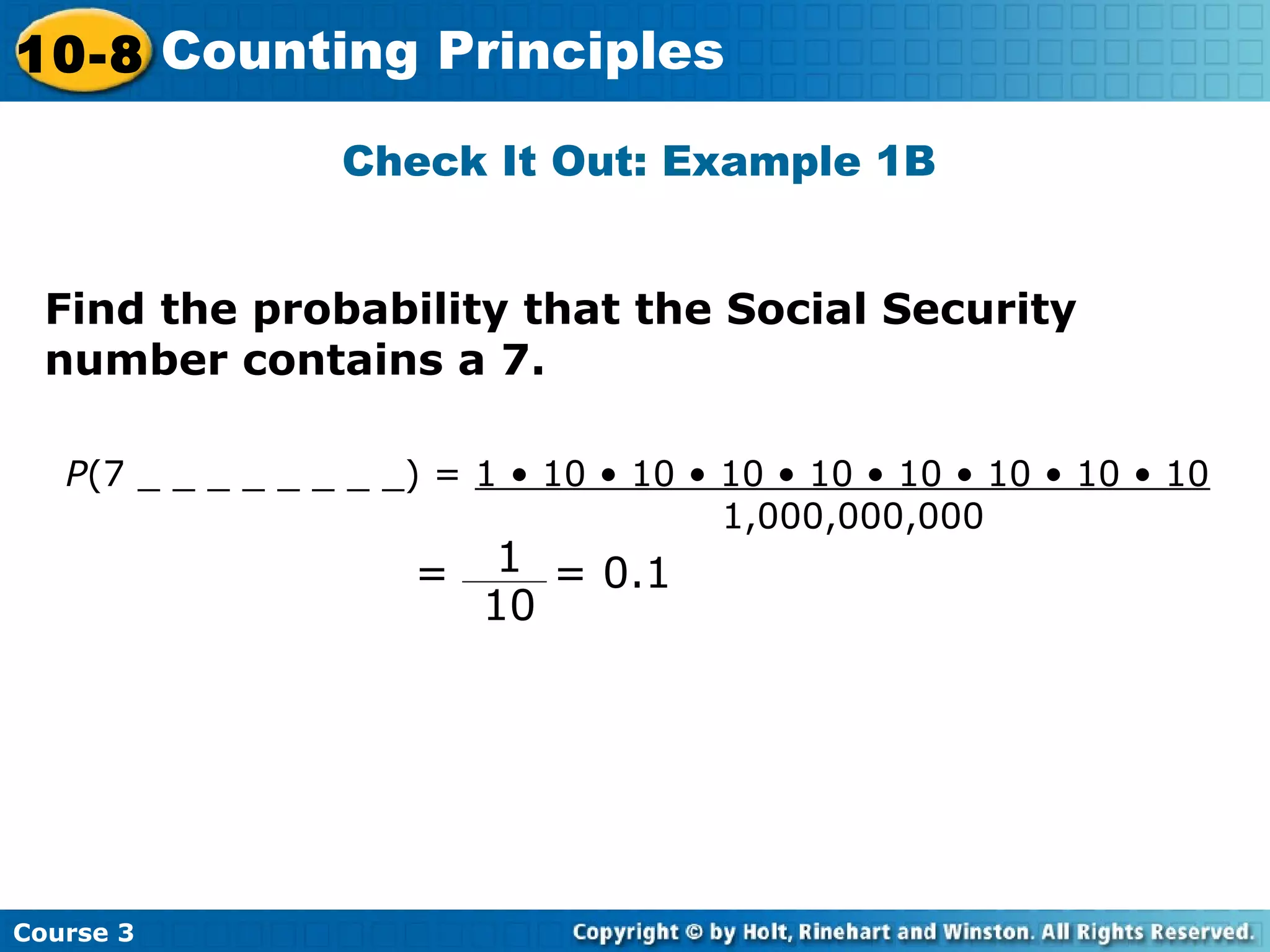
Check It Out: Example 1B
Find the probability that the Social Security
number contains a 7.
P(7 _ _ _ _ _ _ _ _) = 1 • 10 • 10 • 10 • 10 • 10 • 10 • 10 • 10
1,000,000,000
= = 0.1
10
1
Course 3
10-8 Counting Principles
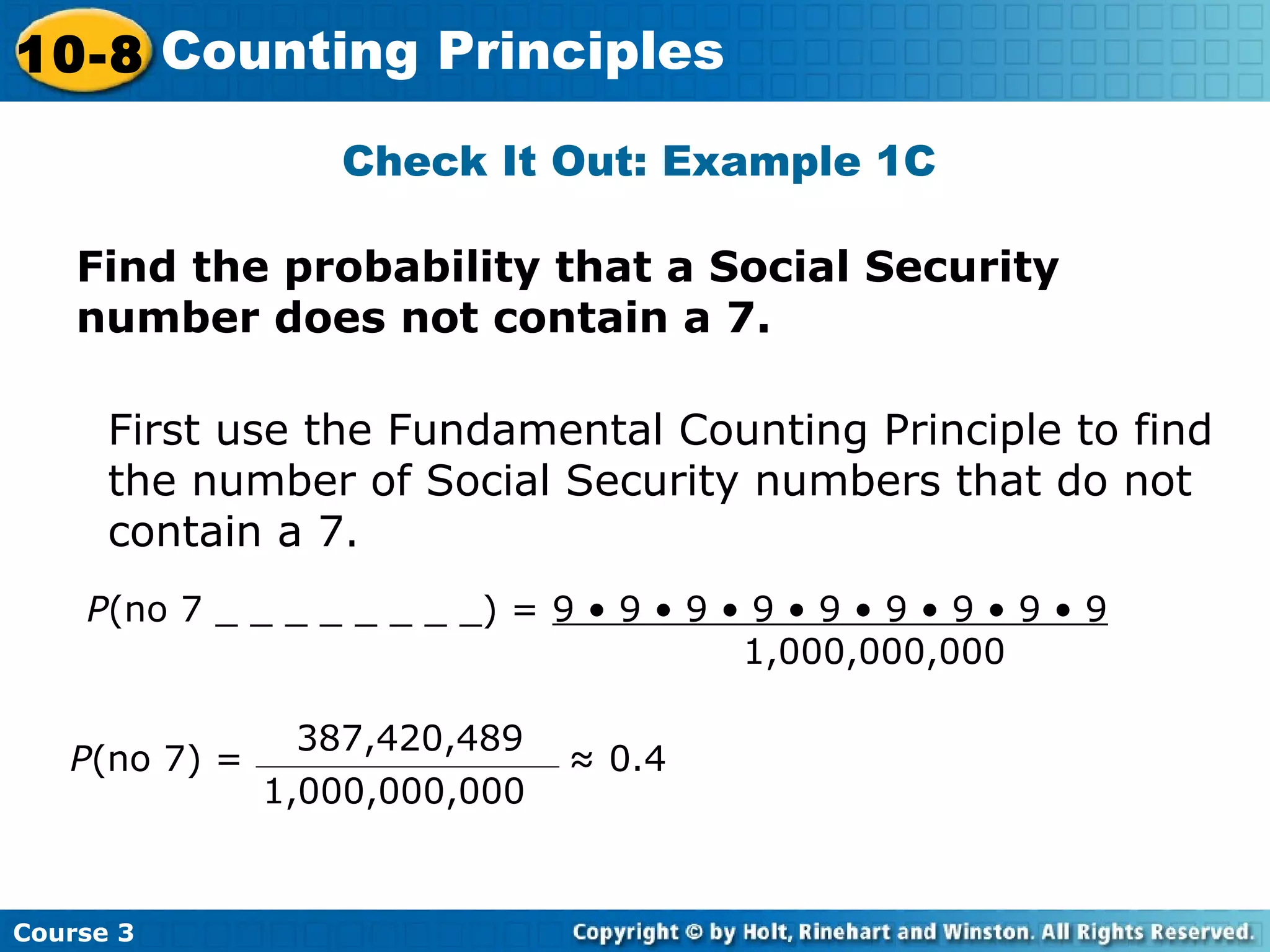
Check It Out: Example 1C
Find the probability that a Social Security
number does not contain a 7.
First use the Fundamental Counting Principle to find
the number of Social Security numbers that do not
contain a 7.
P(no 7 _ _ _ _ _ _ _ _) = 9 • 9 • 9 • 9 • 9 • 9 • 9 • 9 • 9
1,000,000,000
P(no 7) = ≈ 0.4
1,000,000,000
387,420,489
Course 3
10-8 Counting Principles
The Fundamental Counting Principle tells you
only the number of outcomes in some
experiments, not what the outcomes are. A tree
diagram is a way to show all of the possible
outcomes.
Course 3
10-8 Counting Principles
Additional Example 2: Using a Tree Diagram
You have a photo that you want to mat and
frame. You can choose from a blue, purple, red,
or green mat and a metal or wood frame.
Describe all of the ways you could frame this
photo with one mat and one frame.
You can find all of the possible outcomes by
making a tree diagram.
There should be 4 • 2 = 8 different ways to
frame the photo.
Course 3
10-8 Counting Principles
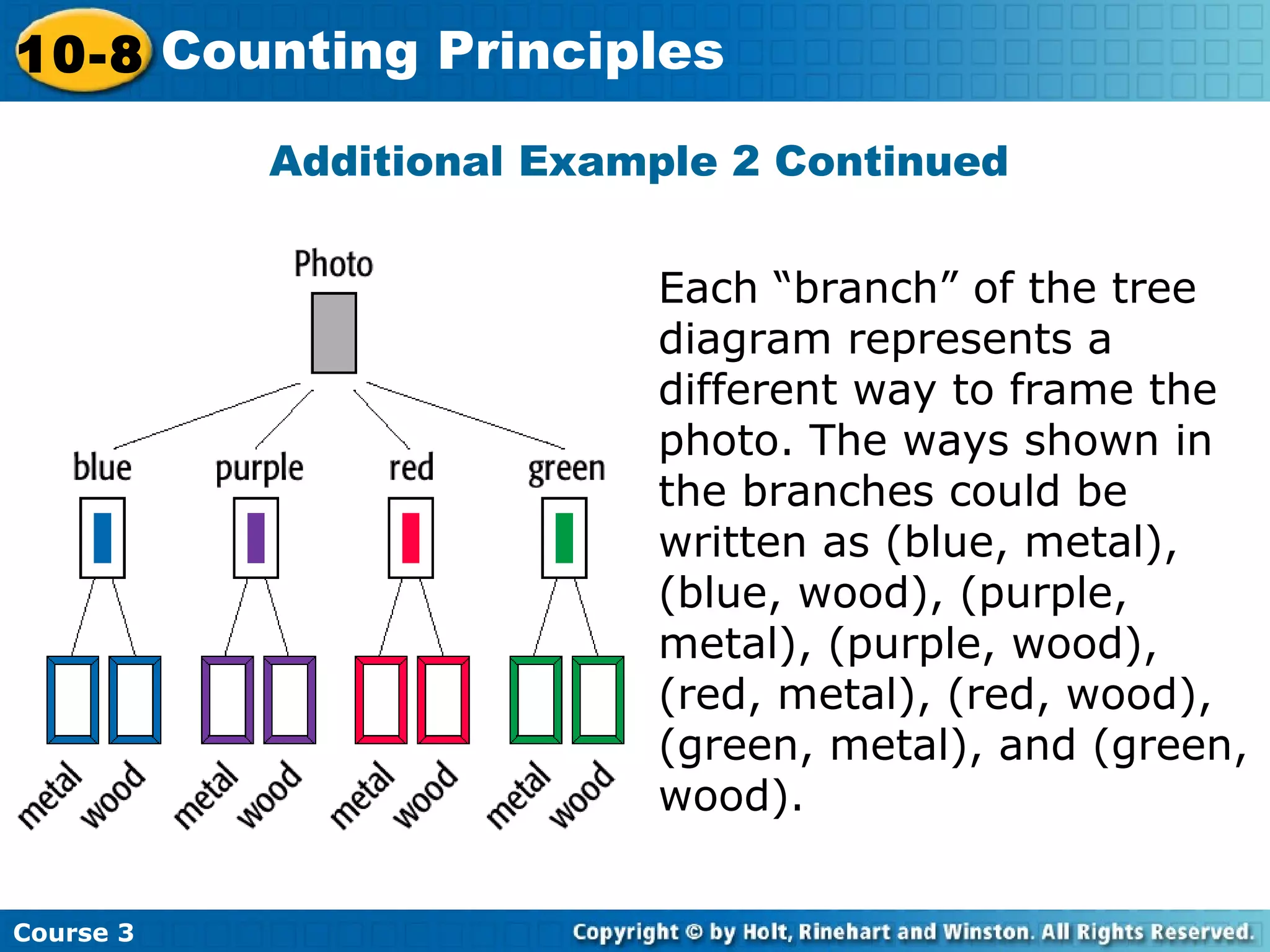
Additional Example 2 Continued
Each “branch” of the tree
diagram represents a
different way to frame the
photo. The ways shown in
the branches could be
written as (blue, metal),
(blue, wood), (purple,
metal), (purple, wood),
(red, metal), (red, wood),
(green, metal), and (green,
wood).
Course 3
10-8 Counting Principles
Check It Out: Example 2
A baker can make yellow or white cakes
with a choice of chocolate, strawberry, or
vanilla icing. Describe all of the possible
combinations of cakes.
You can find all of the possible outcomes by
making a tree diagram.
There should be 2 • 3 = 6 different cakes
available.
Course 3
10-8 Counting Principles
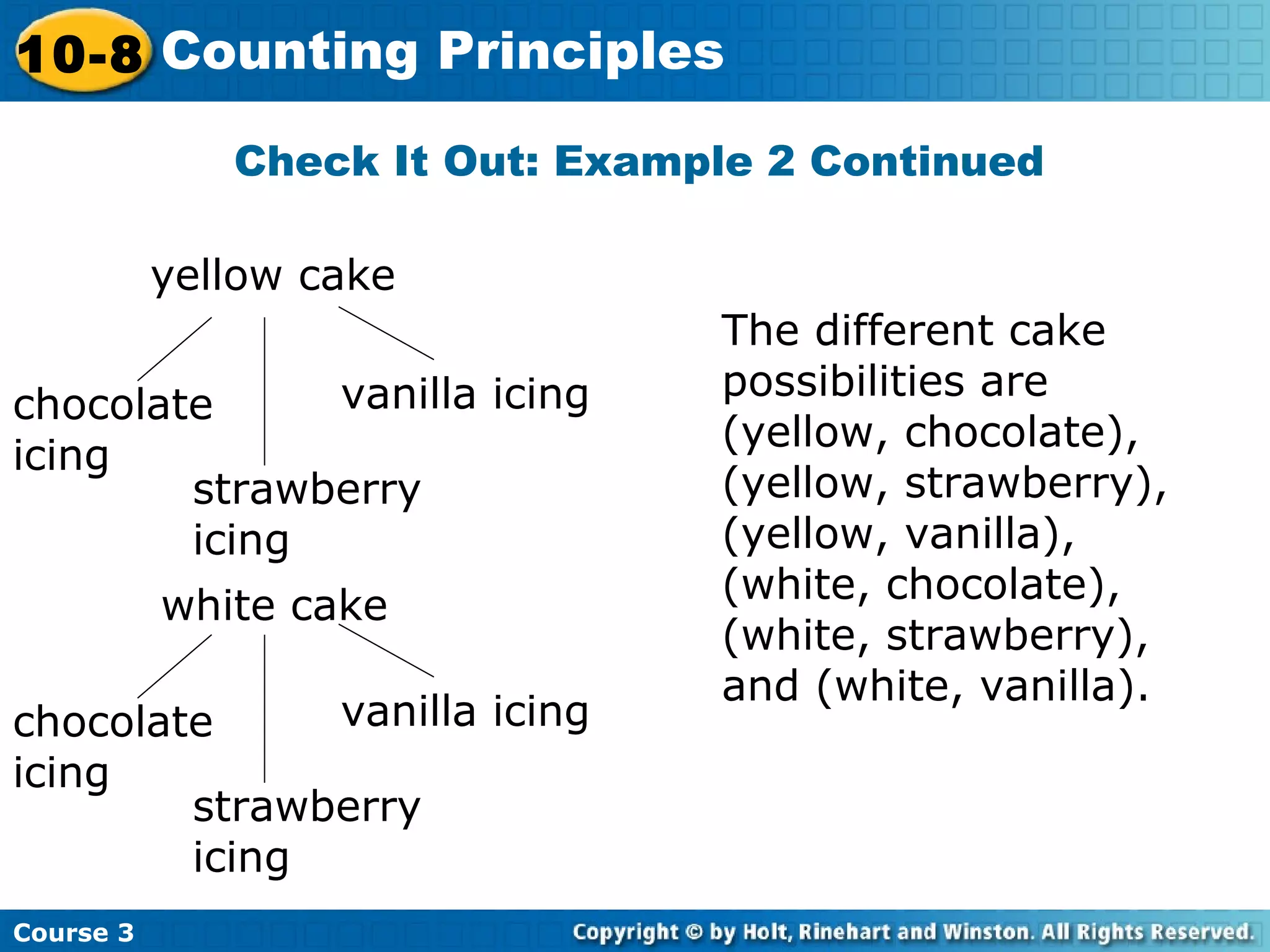
Check It Out: Example 2 Continued
The different cake
possibilities are
(yellow, chocolate),
(yellow, strawberry),
(yellow, vanilla),
(white, chocolate),
(white, strawberry),
and (white, vanilla).
white cake
yellow cake
chocolate
icing
vanilla icing
strawberry
icing
chocolate
icing
vanilla icing
strawberry
icing
Course 3
10-8 Counting Principles
Additional Example 3: Using the Addition Counting
Principle
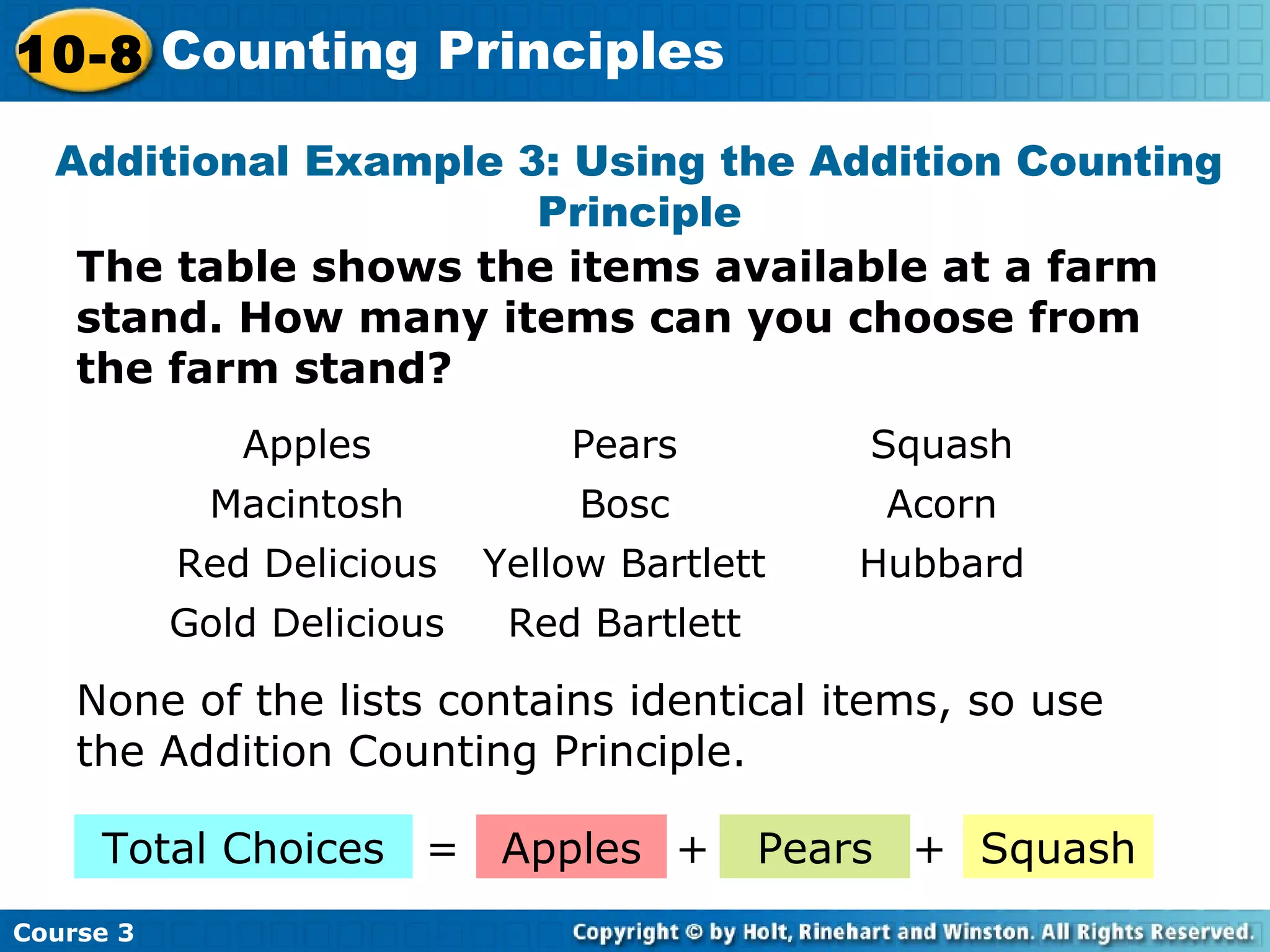
The table shows the items available at a farm
stand. How many items can you choose from
the farm stand?
None of the lists contains identical items, so use
the Addition Counting Principle.
Total Choices
Course 3
10-8 Counting Principles
Apples Pears Squash+= +
Apples Pears Squash
Macintosh Bosc Acorn
Red Delicious Yellow Bartlett Hubbard
Gold Delicious Red Bartlett
Additional Example 3 Continued
Course 3
10-8 Counting Principles
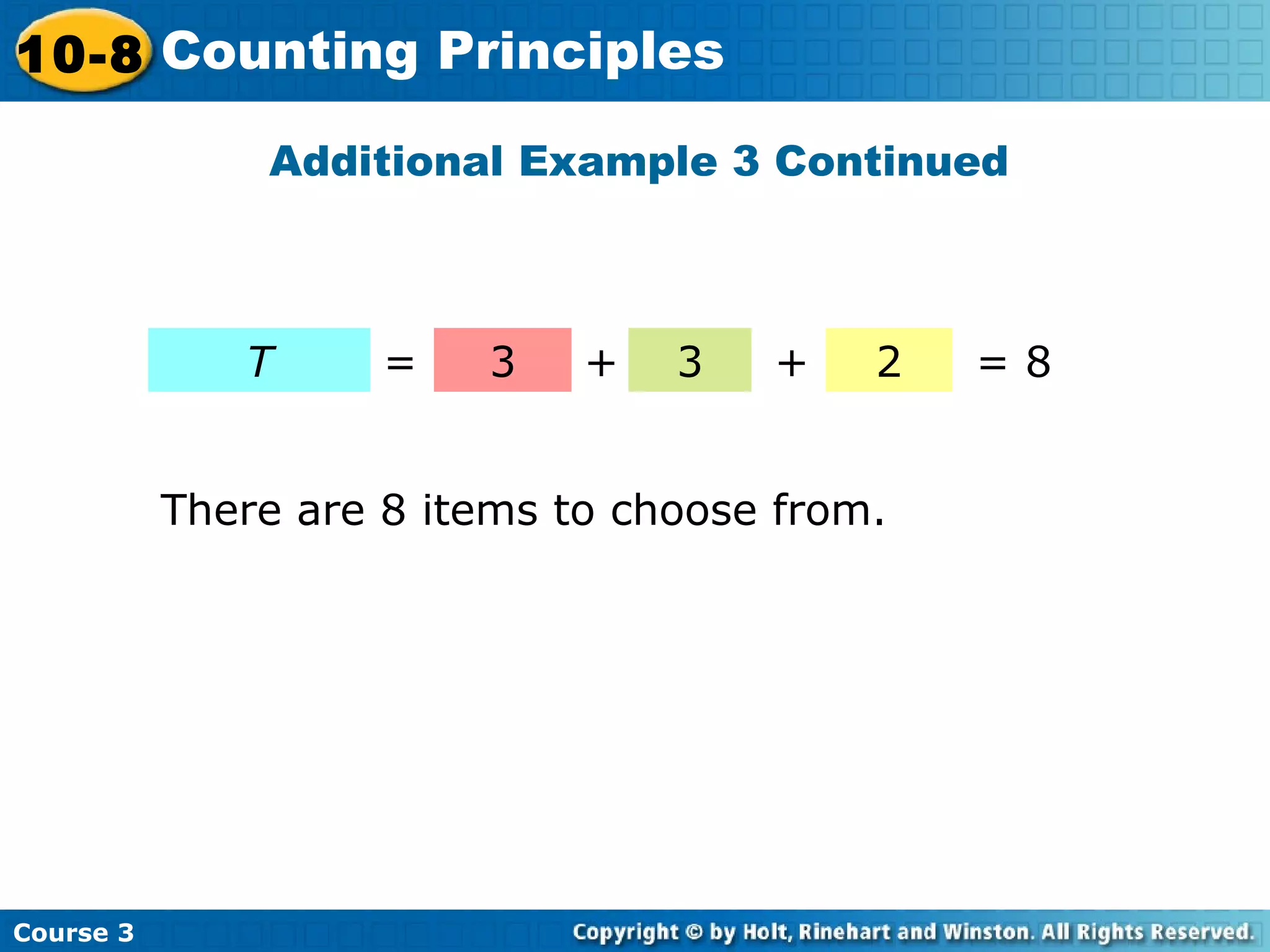
T 3 3 2+= + = 8
There are 8 items to choose from.
Learn to find the probabilities of
independent and dependent events.
Course 3
10-5
Independent and
Dependent Events
Vocabulary
compound events
independent events
dependent events
Insert Lesson Title Here
Course 3
10-5
Independent and
Dependent Events
A compound event is made up of one or
more separate events. To find the probability
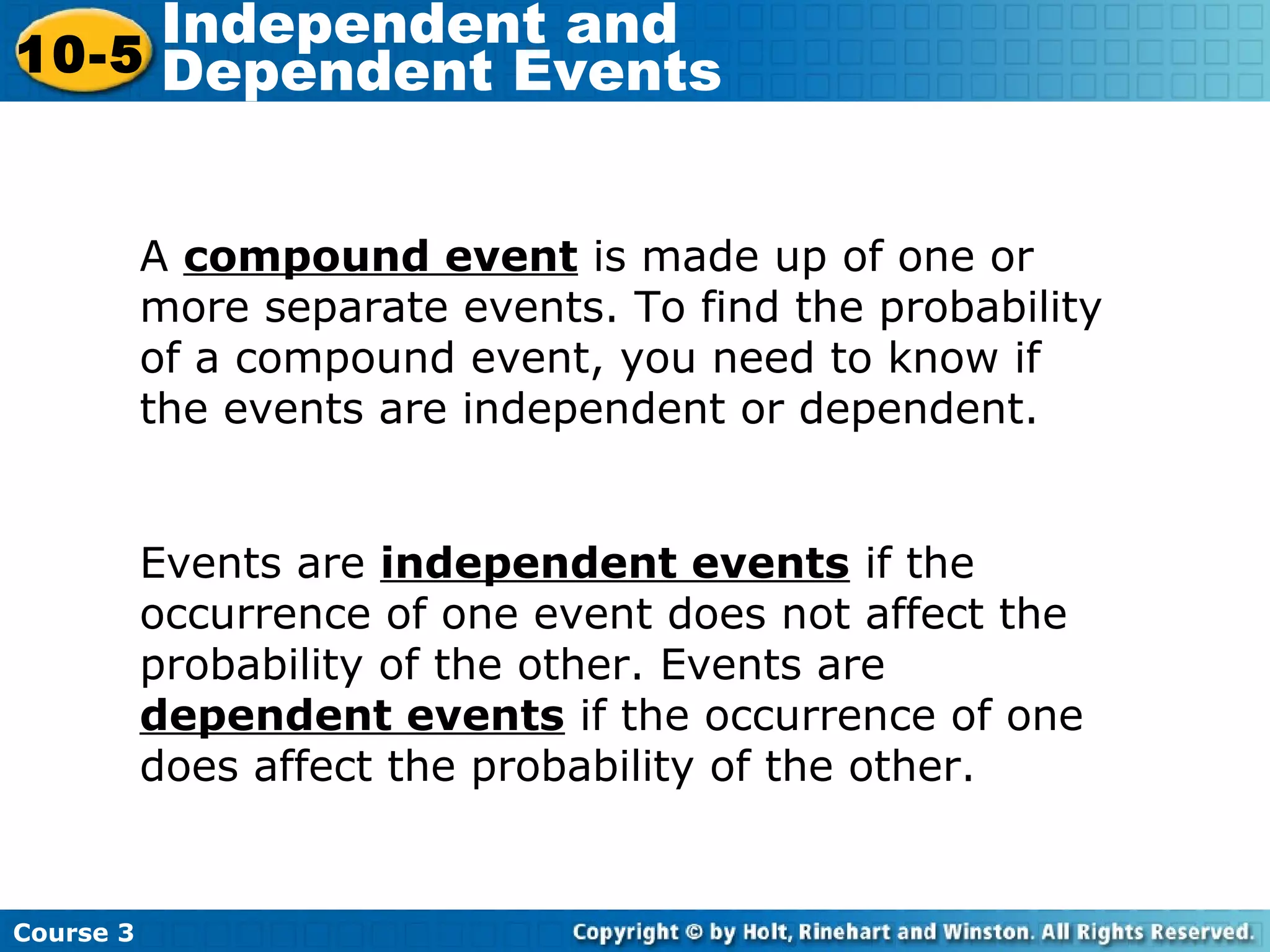
of a compound event, you need to know if
the events are independent or dependent.
Course 3
10-5
Independent and
Dependent Events
Events are independent events if the
occurrence of one event does not affect the
probability of the other. Events are
dependent events if the occurrence of one
does affect the probability of the other.
Determine if the events are dependent or
independent.
A. getting tails on a coin toss and rolling a 6
on a number cube
B. getting 2 red gumballs out of a gumball
machine
Additional Example 1: Classifying Events as
Independent or Dependent
Tossing a coin does not affect rolling a number
cube, so the two events are independent.
After getting one red gumball out of a gumball
machine, the chances for getting the second red
gumball have changed, so the two events are
dependent.
Course 3
10-5
Independent and
Dependent Events
Determine if the events are dependent or
independent.
A. rolling a 6 two times in a row with the same
number cube
B. a computer randomly generating two of the
same numbers in a row
Check It Out: Example 1
The first roll of the number cube does not affect
the second roll, so the events are independent.
The first randomly generated number does not
affect the second randomly generated number, so
the two events are independent.
Course 3
10-5
Independent and
Dependent Events
Course 3
10-5
Independent and
Dependent Events
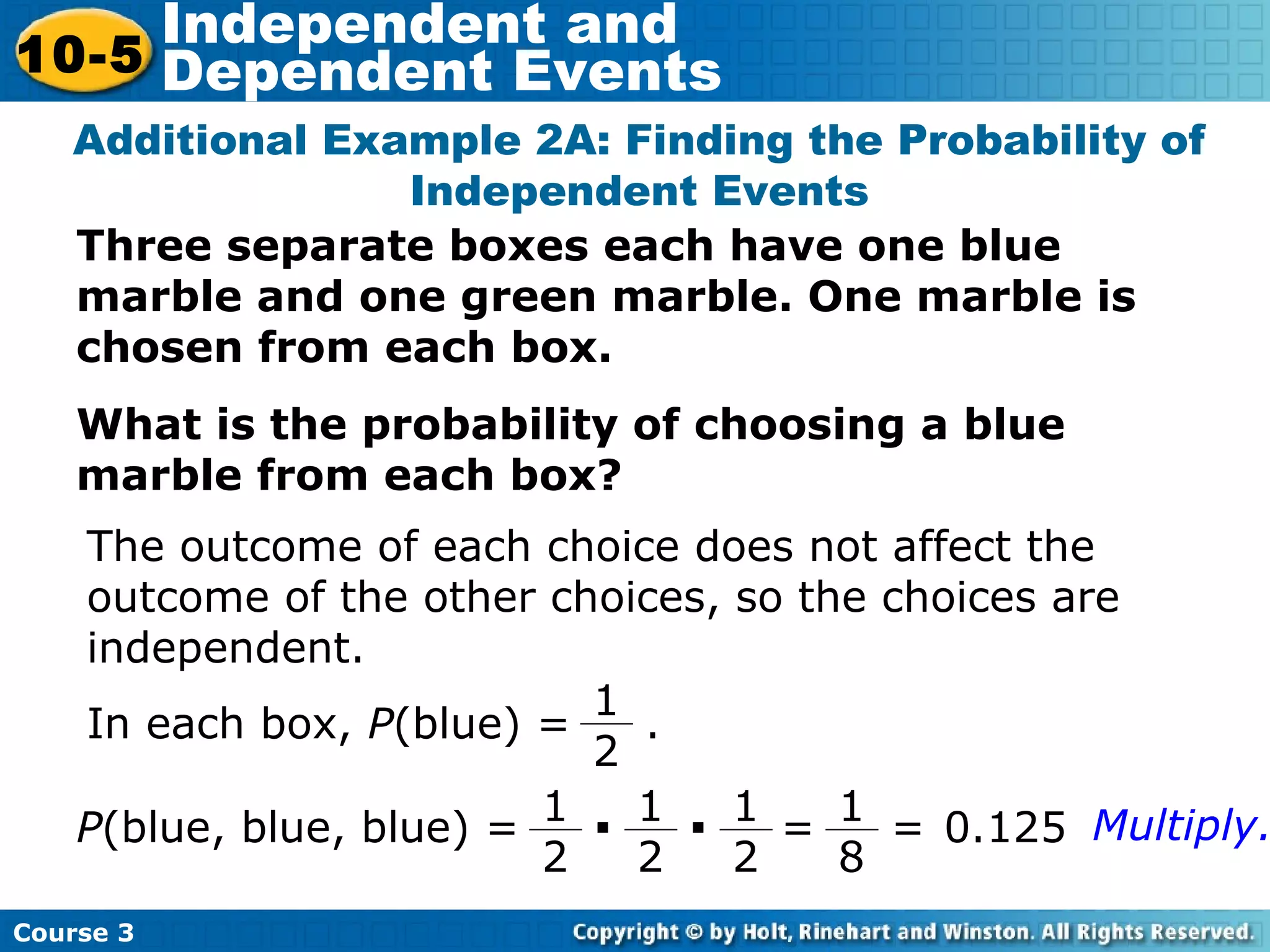
Three separate boxes each have one blue
marble and one green marble. One marble is
chosen from each box.
What is the probability of choosing a blue
marble from each box?
Additional Example 2A: Finding the Probability of
Independent Events
The outcome of each choice does not affect the
outcome of the other choices, so the choices are
independent.
P(blue, blue, blue) =
In each box, P(blue) = .
1
2
1
2
· 1
2
· 1
2
=
1
8
= 0.125 Multiply.
Course 3
10-5
Independent and
Dependent Events
What is the probability of choosing at least
one blue marble?
Additional Example 2C: Finding the Probability of
Independent Events
1 – 0.125 = 0.875
Subtract from 1 to find the probability of
choosing at least one blue marble.
Think: P(at least one blue) + P(not blue,
not blue, not blue) = 1.
In each box, P(not blue) = .
1
2P(not blue, not blue, not blue) =
1
2
· 1
2
· 1
2
= 1
8
= 0.125 Multiply.
Course 3
10-5
Independent and
Dependent Events
Two boxes each contain 4 marbles: red, blue,
green, and black. One marble is chosen from
each box.
What is the probability of choosing a blue
marble from each box?
Check It Out: Example 2A
The outcome of each choice does not affect the
outcome of the other choices, so the choices are
independent.
In each box, P(blue) = .
1
4
P(blue, blue) =
1
4
· 1
4
=
1
16
= 0.0625 Multiply.
Course 3
10-5
Independent and
Dependent Events
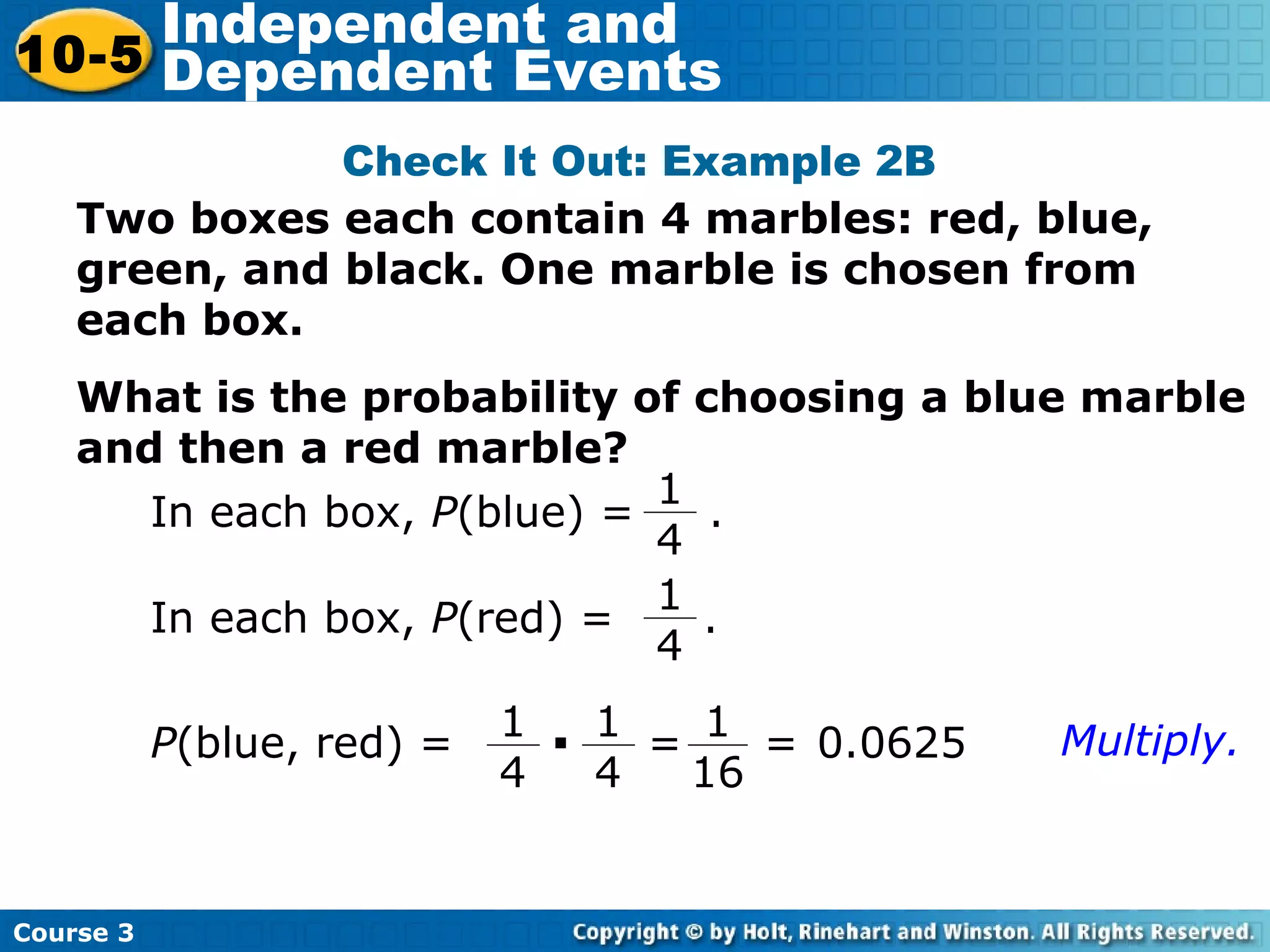
Two boxes each contain 4 marbles: red, blue,
green, and black. One marble is chosen from
each box.
What is the probability of choosing a blue marble
and then a red marble?
Check It Out: Example 2B
In each box, P(blue) = .
1
4
P(blue, red) =
1
4
· 1
4
=
1
16
= 0.0625 Multiply.
In each box, P(red) = .
1
4
Course 3
10-5
Independent and
Dependent Events
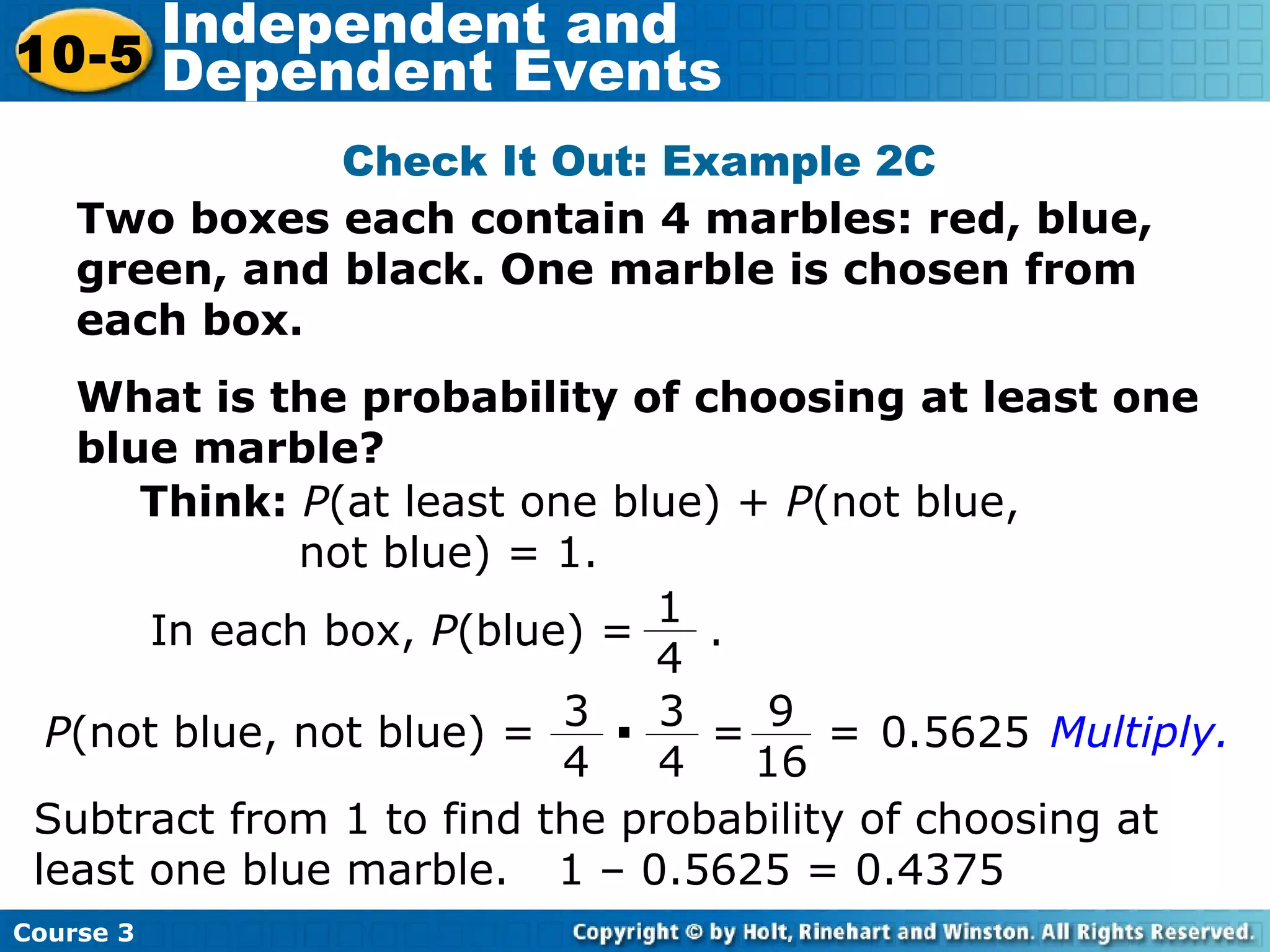
Two boxes each contain 4 marbles: red, blue,
green, and black. One marble is chosen from
each box.
What is the probability of choosing at least one
blue marble?
Check It Out: Example 2C
In each box, P(blue) = .
1
4
P(not blue, not blue) =
3
4
· 3
4
=
9
16
= 0.5625 Multiply.
Think: P(at least one blue) + P(not blue,
not blue) = 1.
1 – 0.5625 = 0.4375
Subtract from 1 to find the probability of choosing at
least one blue marble.
Course 3
10-5
Independent and
Dependent Events
Course 3
10-5
Independent and
Dependent Events
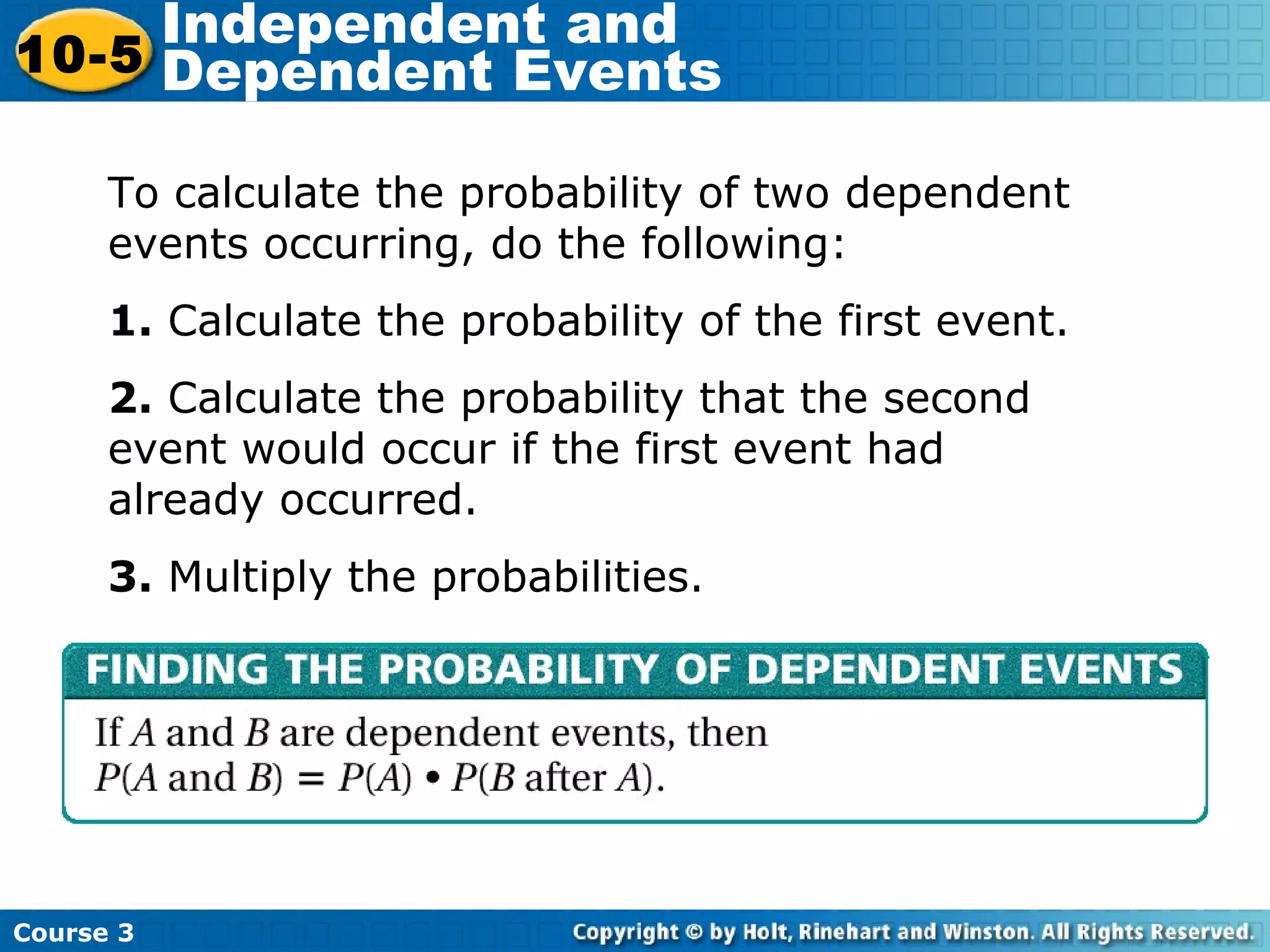
To calculate the probability of two dependent
events occurring, do the following:
1. Calculate the probability of the first event.
2. Calculate the probability that the second
event would occur if the first event had
already occurred.
3. Multiply the probabilities.
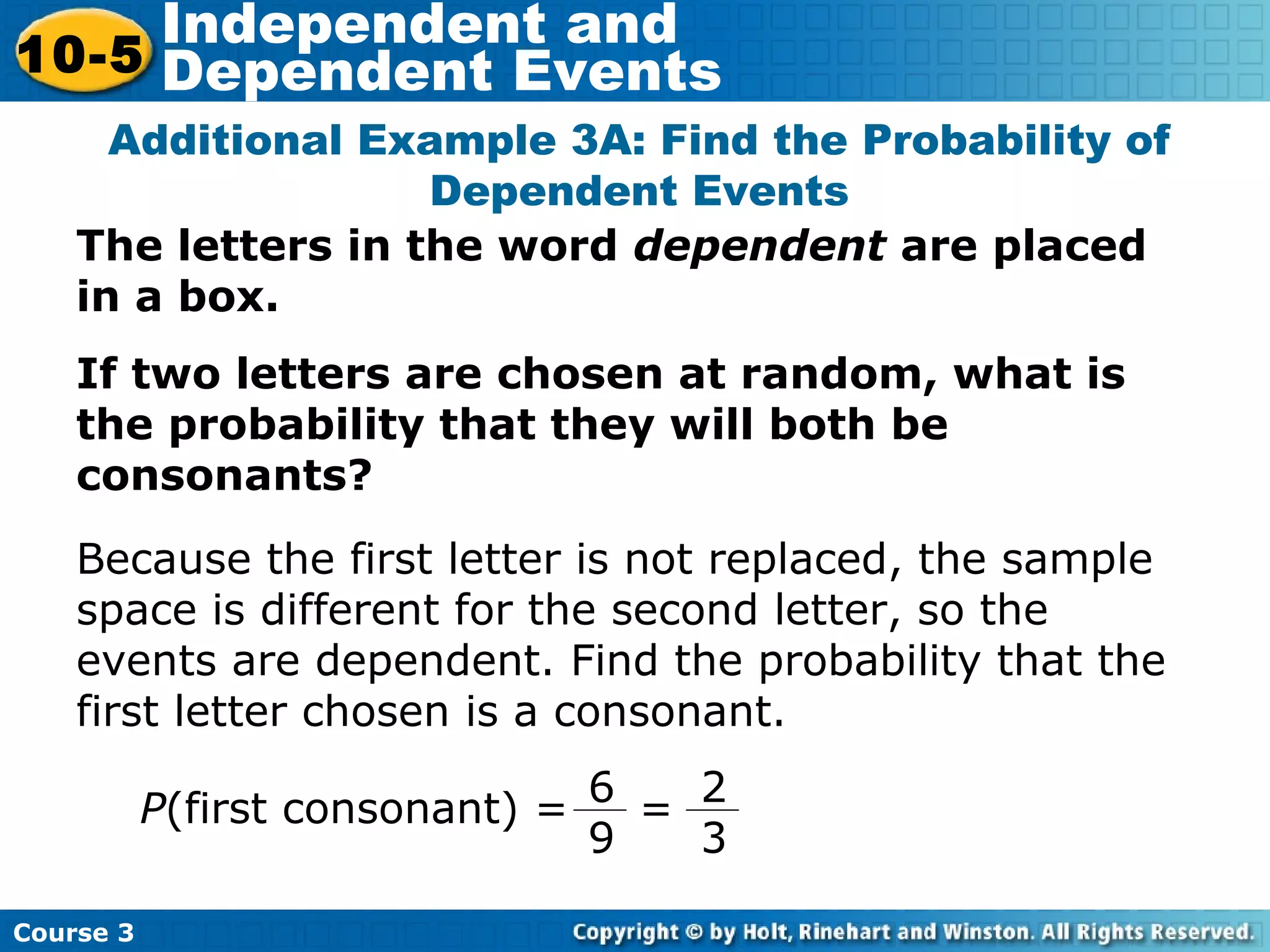
The letters in the word dependent are placed
in a box.
If two letters are chosen at random, what is
the probability that they will both be
consonants?
Additional Example 3A: Find the Probability of
Dependent Events
P(first consonant) =
Course 3
10-5
Independent and
Dependent Events
2
3
6
9
=
Because the first letter is not replaced, the sample
space is different for the second letter, so the
events are dependent. Find the probability that the
first letter chosen is a consonant.
Additional Example 3A Continued
Course 3
10-5
Independent and
Dependent Events
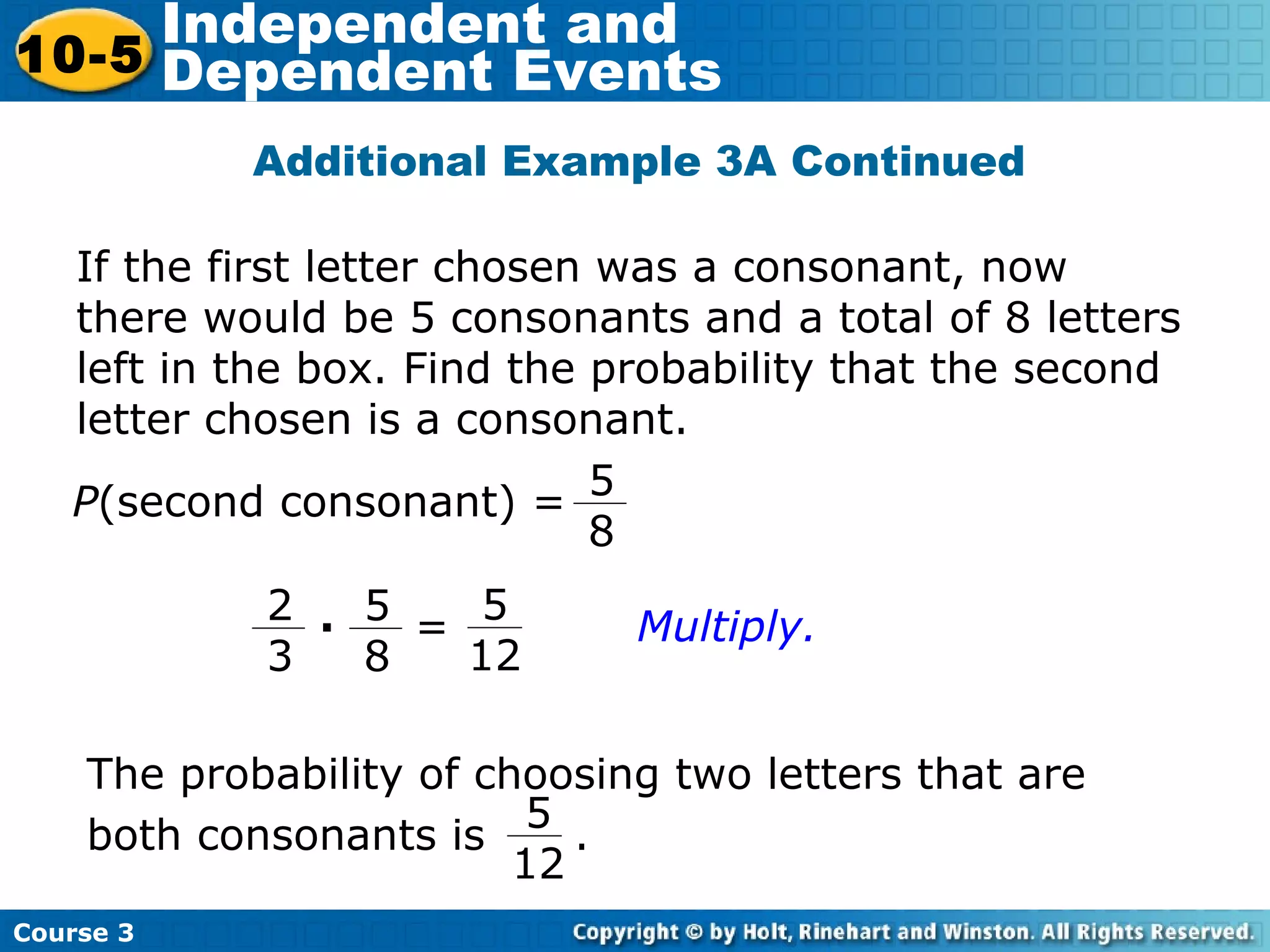
If the first letter chosen was a consonant, now
there would be 5 consonants and a total of 8 letters
left in the box. Find the probability that the second
letter chosen is a consonant.
P(second consonant) =
5
8
5
12
5
8
2
3
· =
The probability of choosing two letters that are
both consonants is .
5
12
Multiply.
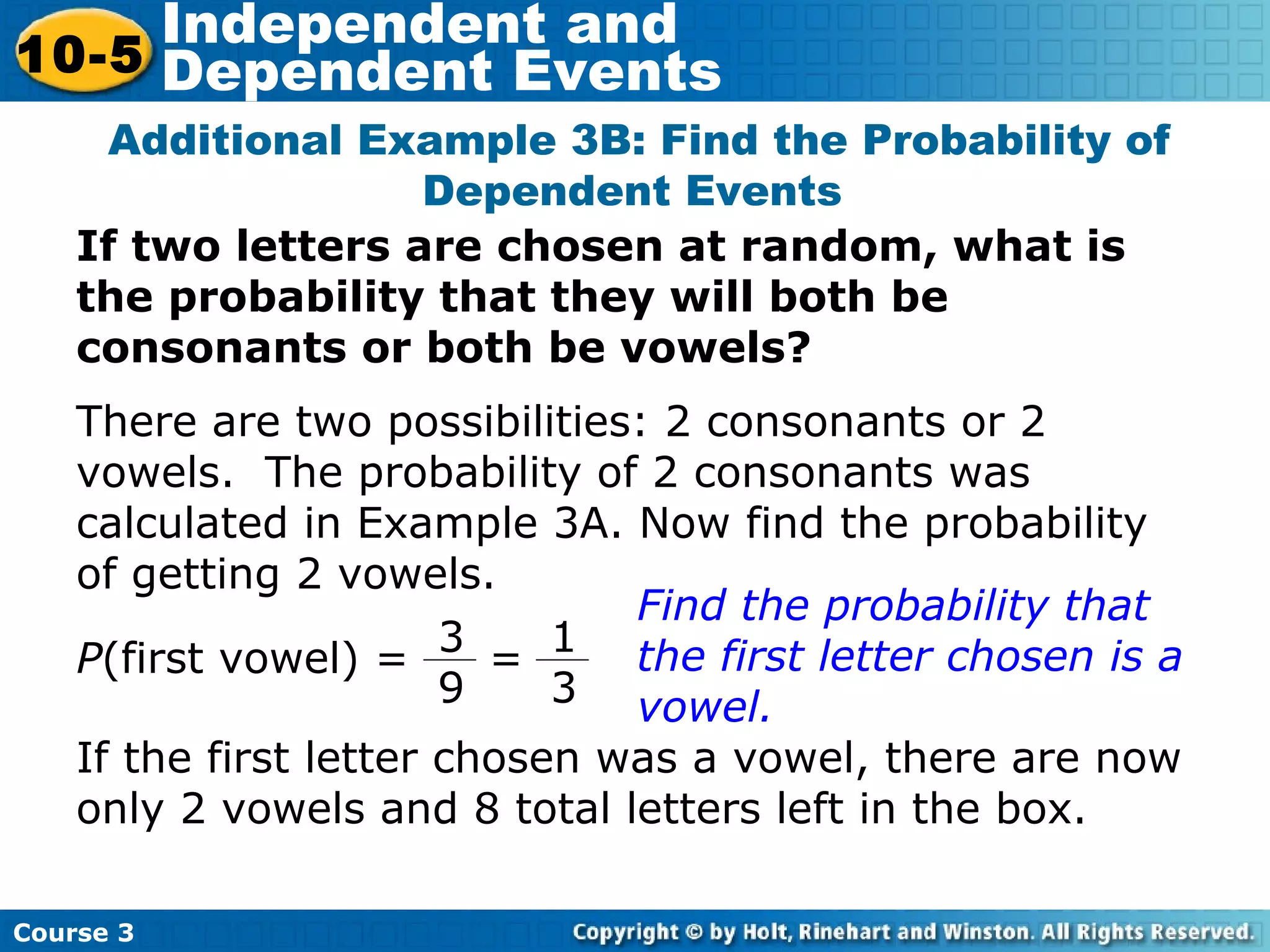
If two letters are chosen at random, what is
the probability that they will both be
consonants or both be vowels?
Additional Example 3B: Find the Probability of
Dependent Events
There are two possibilities: 2 consonants or 2
vowels. The probability of 2 consonants was
calculated in Example 3A. Now find the probability
of getting 2 vowels.
Find the probability that
the first letter chosen is a
vowel.
If the first letter chosen was a vowel, there are now
only 2 vowels and 8 total letters left in the box.
Course 3
10-5
Independent and
Dependent Events
P(first vowel) =
1
3
3
9
=
Additional Example 3B Continued
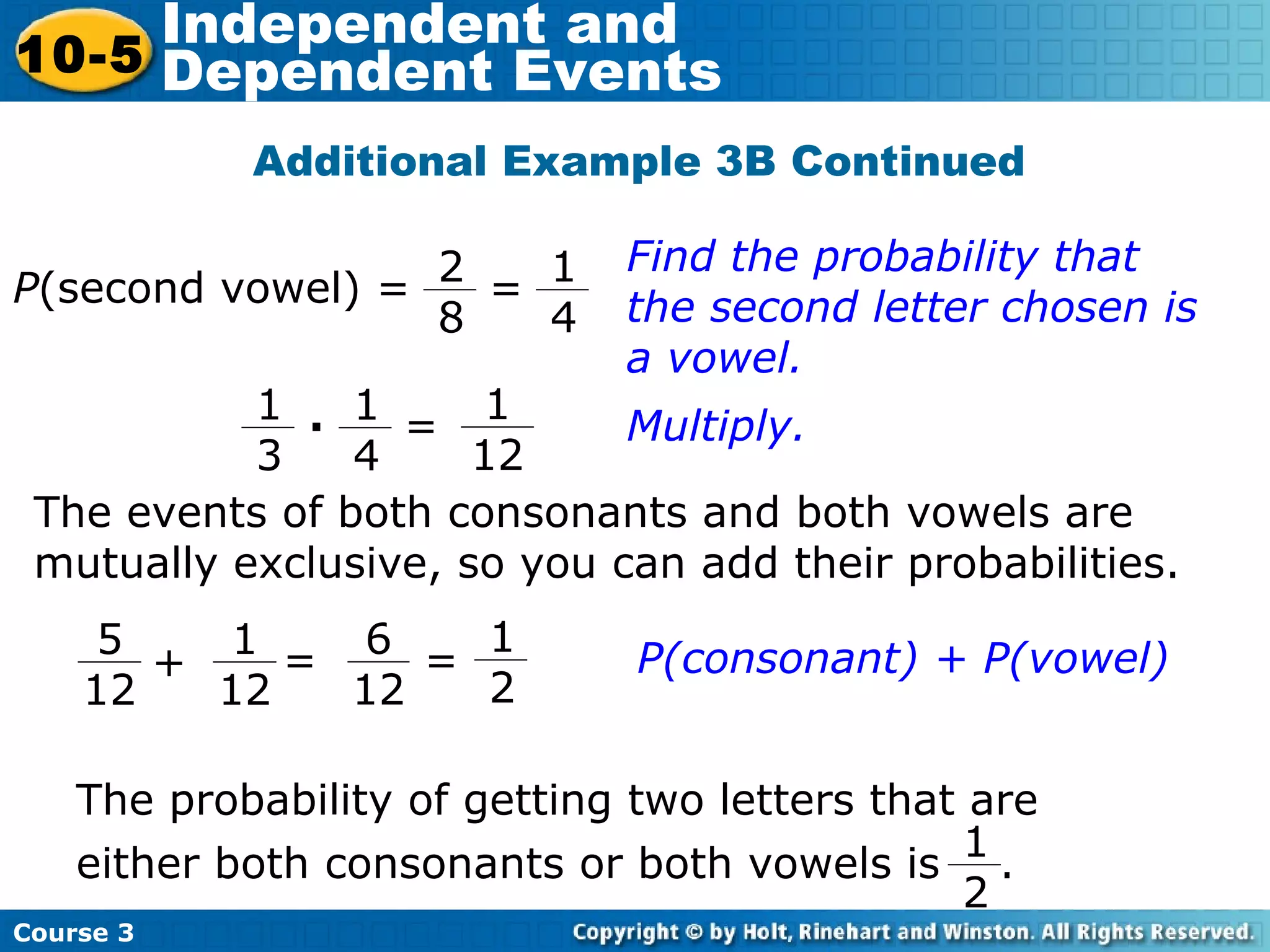
Find the probability that
the second letter chosen is
a vowel.
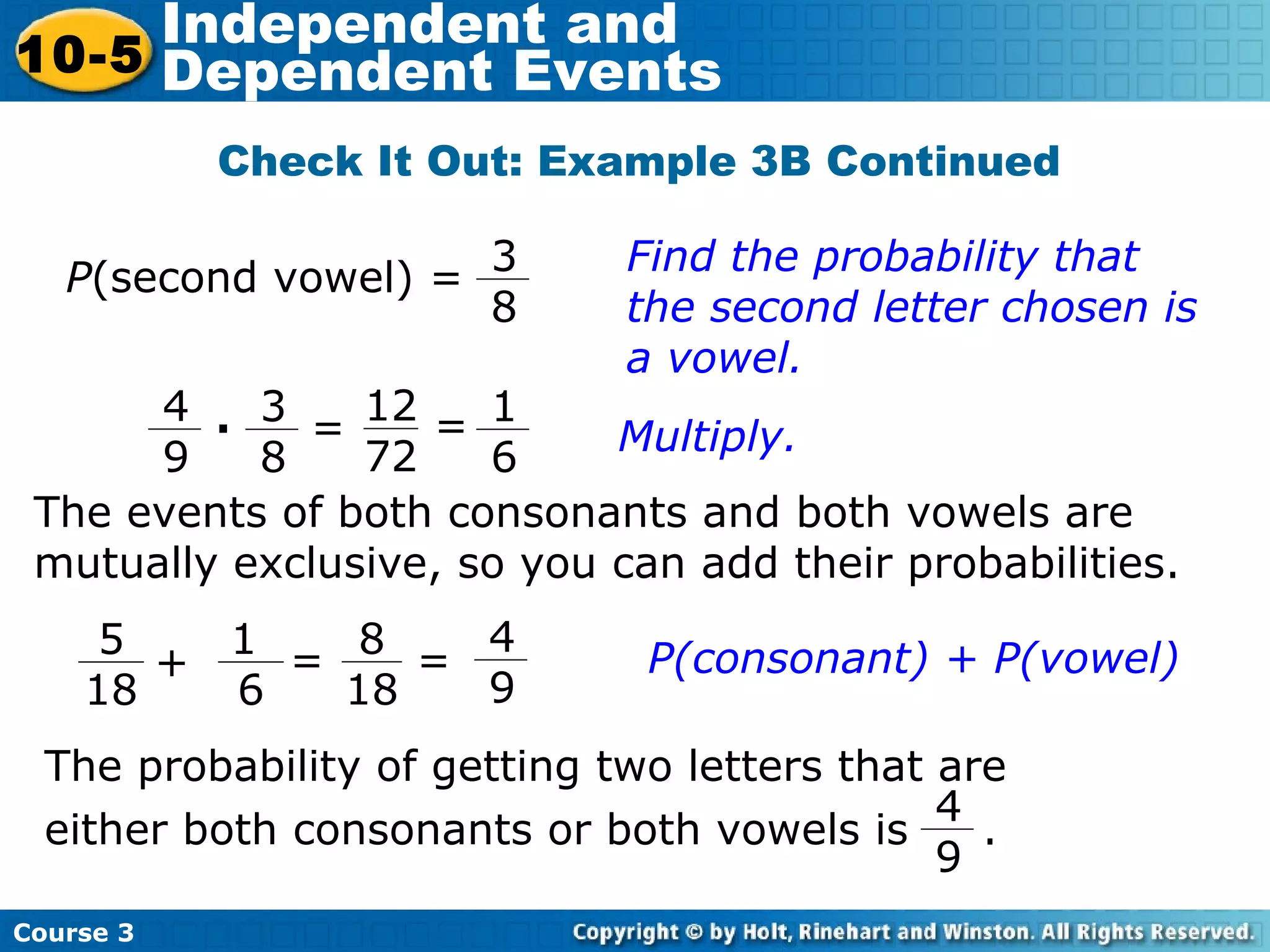
The events of both consonants and both vowels are
mutually exclusive, so you can add their probabilities.
Course 3
10-5
Independent and
Dependent Events
P(second vowel) =
1
4
2
8
=
1
12
1
4
1
3
· = Multiply.
1
2
5
12
1
12
+ =
6
12
=
The probability of getting two letters that are
either both consonants or both vowels is .
1
2
P(consonant) + P(vowel)
Course 3
10-5
Independent and
Dependent Events
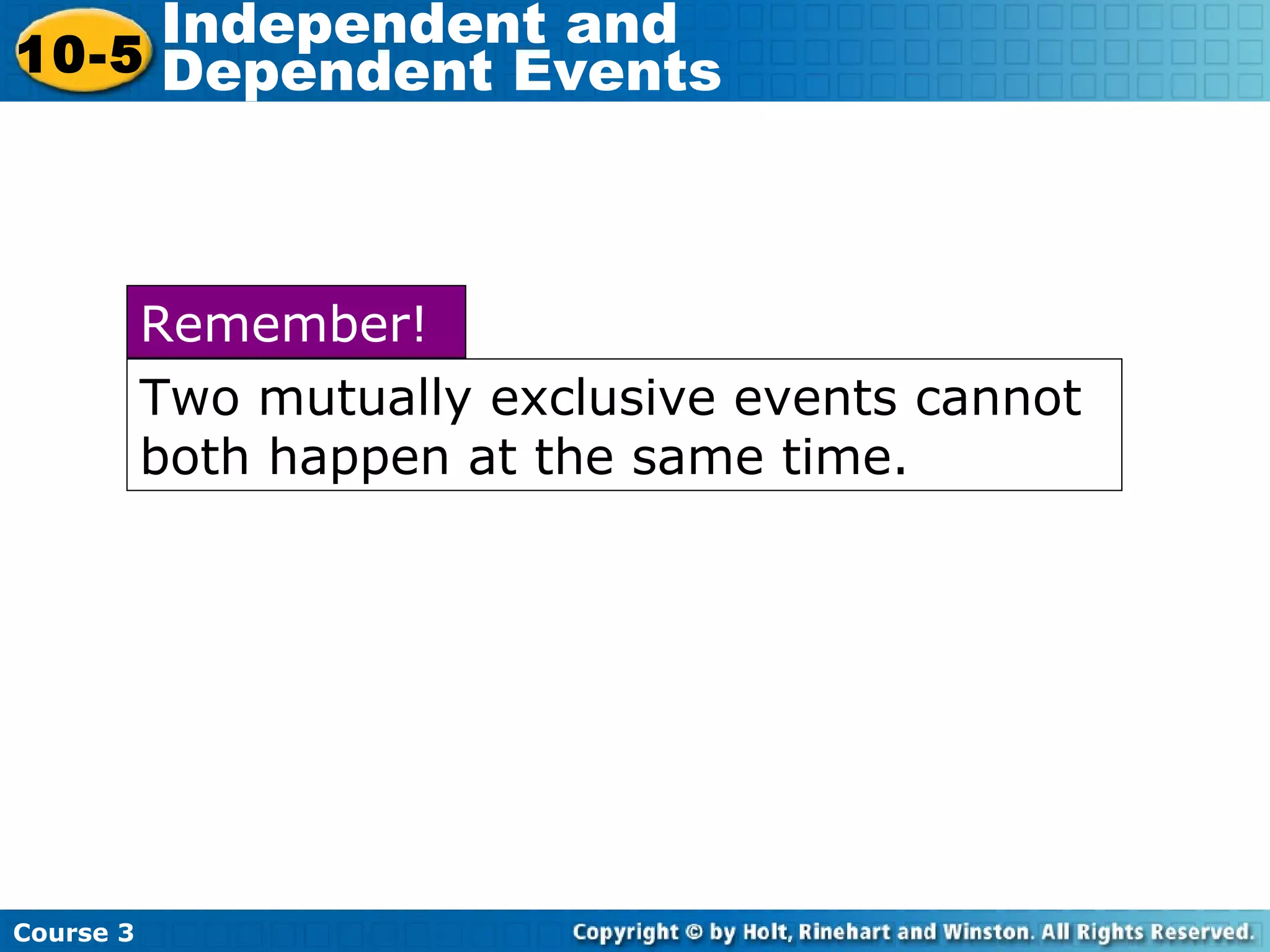
Two mutually exclusive events cannot
both happen at the same time.
Remember!
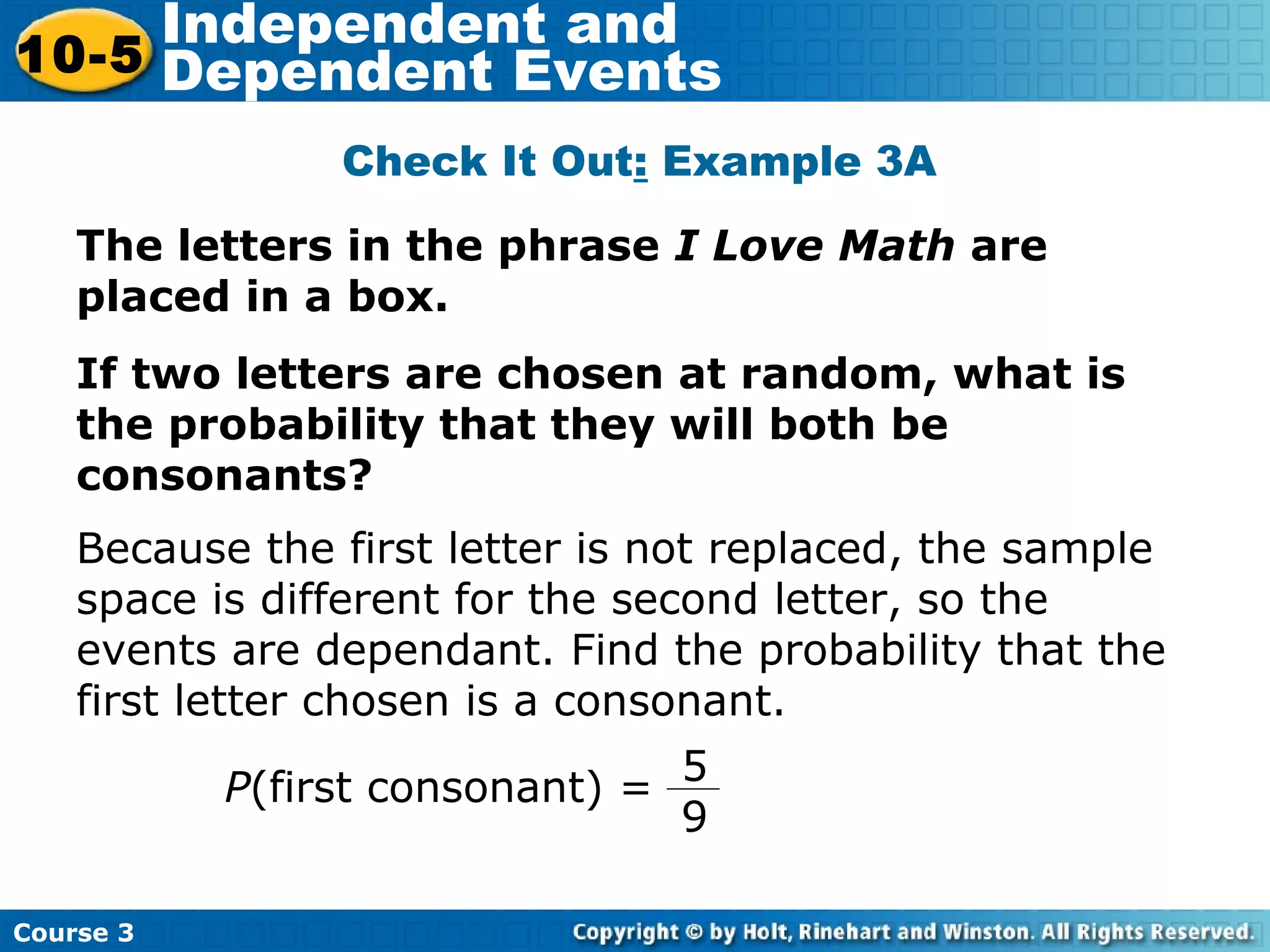
The letters in the phrase I Love Math are
placed in a box.
If two letters are chosen at random, what is
the probability that they will both be
consonants?
Check It Out: Example 3A
Course 3
10-5
Independent and
Dependent Events
P(first consonant) =
5
9
Because the first letter is not replaced, the sample
space is different for the second letter, so the
events are dependant. Find the probability that the
first letter chosen is a consonant.
Check It Out: Example 3A Continued
Course 3
10-5
Independent and
Dependent Events
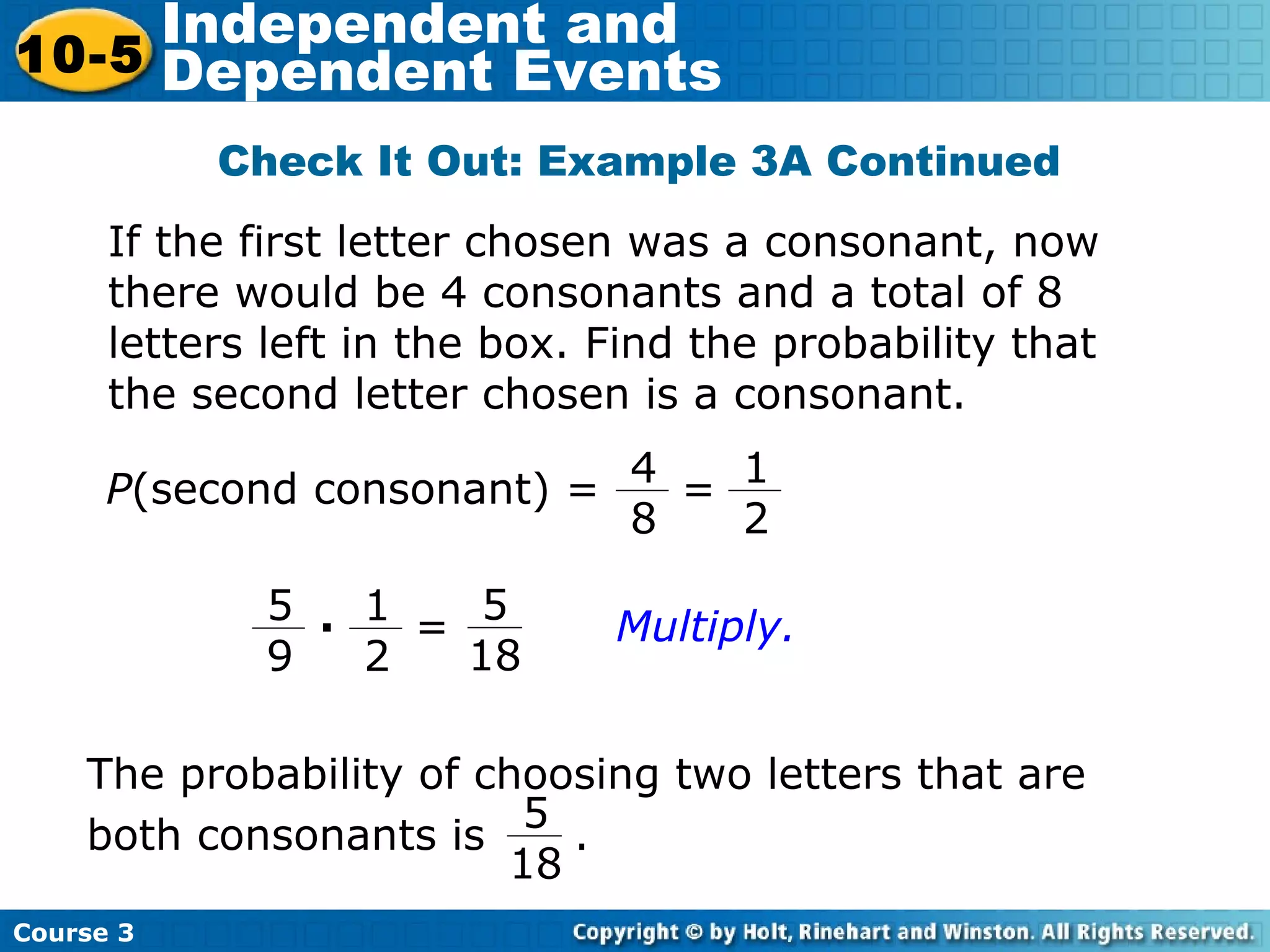
P(second consonant) =
5
18
1
2
5
9
· =
The probability of choosing two letters that are
both consonants is .
5
18
Multiply.
If the first letter chosen was a consonant, now
there would be 4 consonants and a total of 8
letters left in the box. Find the probability that
the second letter chosen is a consonant.
1
2
4
8
=
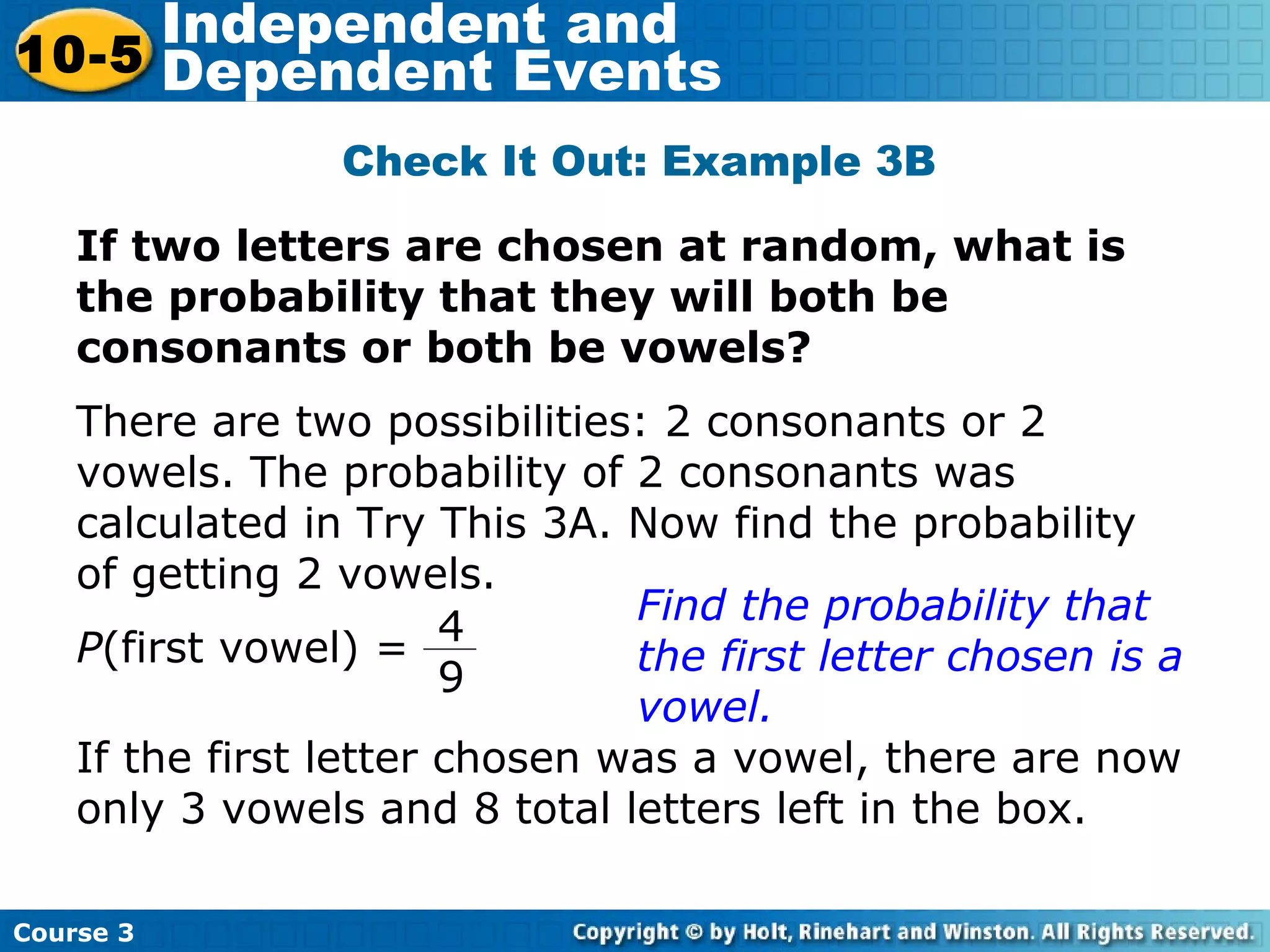
If two letters are chosen at random, what is
the probability that they will both be
consonants or both be vowels?
Check It Out: Example 3B
There are two possibilities: 2 consonants or 2
vowels. The probability of 2 consonants was
calculated in Try This 3A. Now find the probability
of getting 2 vowels.
Find the probability that
the first letter chosen is a
vowel.
If the first letter chosen was a vowel, there are now
only 3 vowels and 8 total letters left in the box.
Course 3
10-5
Independent and
Dependent Events
P(first vowel) =
4
9
Check It Out: Example 3B Continued
Find the probability that
the second letter chosen is
a vowel.
The events of both consonants and both vowels are
mutually exclusive, so you can add their probabilities.
Course 3
10-5
Independent and
Dependent Events
P(second vowel) =
3
8
12
72
3
8
4
9
· = Multiply.
1
6
=
4
9
5
18
1
6
+ =
8
18
= P(consonant) + P(vowel)
The probability of getting two letters that are
either both consonants or both vowels is .
4
9
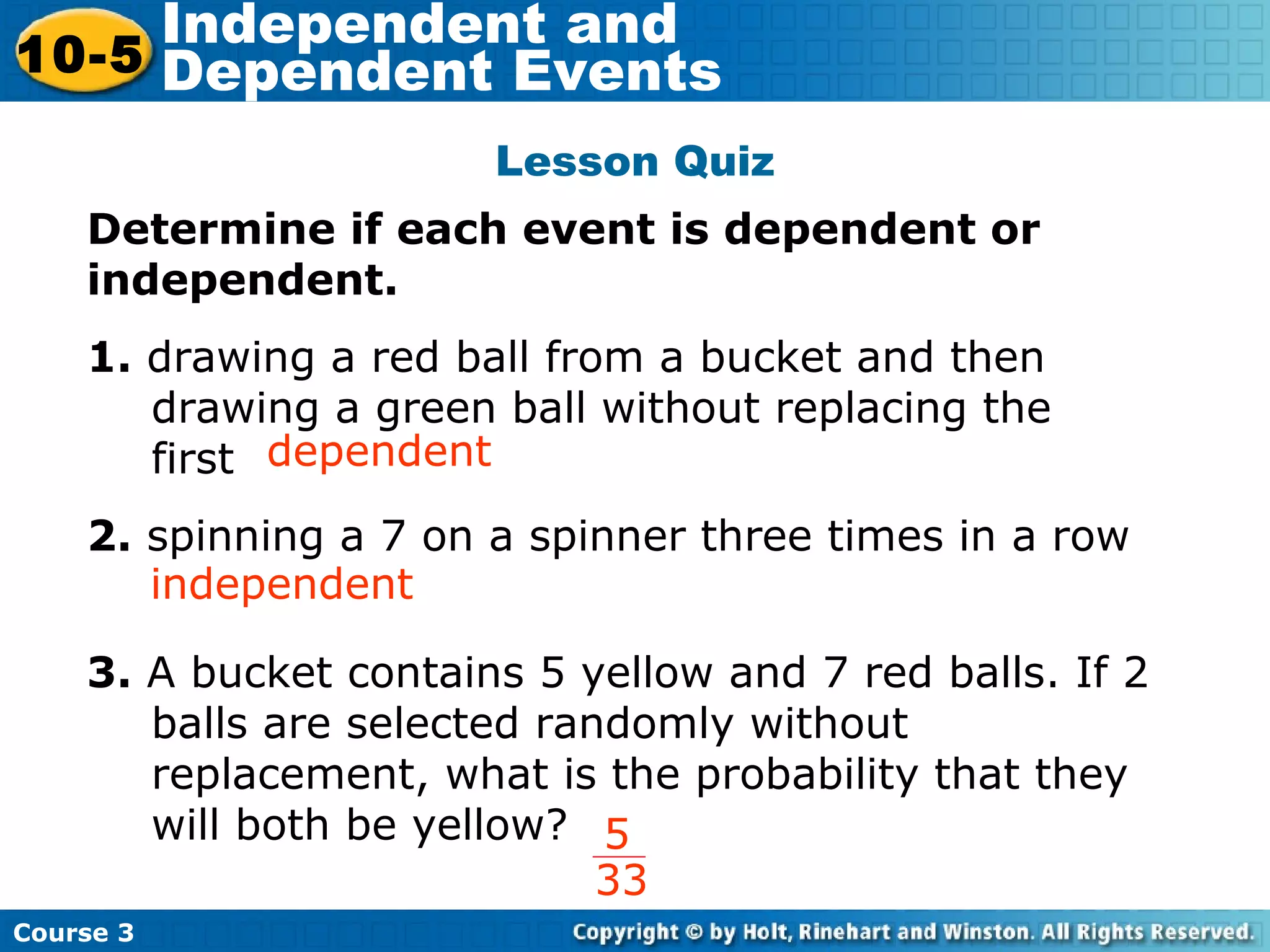
Lesson Quiz
Determine if each event is dependent or
independent.
1. drawing a red ball from a bucket and then
drawing a green ball without replacing the
first
2. spinning a 7 on a spinner three times in a row
3. A bucket contains 5 yellow and 7 red balls. If 2
balls are selected randomly without
replacement, what is the probability that they
will both be yellow?
independent
dependent
Insert Lesson Title Here
5
33
Course 3
10-5
Independent and
Dependent Events

Probability power point combo from holt ch 10

  • 1.
  • 2.
    Learn to findthe probability of an event by using the definition of probability. Course 3 10-1 Probability
  • 3.
  • 4.
    Course 3 10-1 Probability Anexperiment is an activity in which results are observed. Each observation is called a trial, and each result is called an outcome. The sample space is the set of all possible outcomes of an experiment. Experiment Sample Space flipping a coin heads, tails rolling a number cube 1, 2, 3, 4, 5, 6 guessing the number of whole numbers marbles in a jar
  • 5.
    Course 3 10-1 Probability Anevent is any set of one or more outcomes. The probability of an event, written P(event), is a number from 0 (or 0%) to 1 (or 100%) that tells you how likely the event is to happen. • A probability of 0 means the event is impossible, or can never happen. • A probability of 1 means the event is certain, or has to happen. • The probabilities of all the outcomes in the sample space add up to 1.
  • 6.
    Course 3 10-1 Probability 00.25 0.5 0.75 1 0% 25% 50% 75% 100% Never Happens about Always happens half the time happens 1 4 1 2 3 40 1
  • 7.
    Give the probabilityfor each outcome. Additional Example 1A: Finding Probabilities of Outcomes in a Sample Space Course 3 10-1 Probability The basketball team has a 70% chance of winning. The probability of winning is P(win) = 70% = 0.7. The probabilities must add to 1, so the probability of not winning is P(lose) = 1 – 0.7 = 0.3, or 30%.
  • 8.
    Give the probabilityfor each outcome. Additional Example 1B: Finding Probabilities of Outcomes in a Sample Space Course 3 10-1 Probability Three of the eight sections of the spinner are labeled 1, so a reasonable estimate of the probability that the spinner will land on 1 is P(1) = . 3 8
  • 9.
    Additional Example 1BContinued Course 3 10-1 Probability Three of the eight sections of the spinner are labeled 2, so a reasonable estimate of the probability that the spinner will land on 2 is P(2) = .3 8 Two of the eight sections of the spinner are labeled 3, so a reasonable estimate of the probability that the spinner will land on 3 is P(3) = = .2 8 1 4 Check The probabilities of all the outcomes must add to 1. 3 8 3 8 2 8 ++ = 1
  • 10.
    Give the probabilityfor each outcome. Check It Out: Example 1A Course 3 10-1 Probability The polo team has a 50% chance of winning. The probability of winning is P(win) = 50% = 0.5. The probabilities must add to 1, so the probability of not winning is P(lose) = 1 – 0.5 = 0.5, or 50%.
  • 11.
    Give the probabilityfor each outcome. Check It Out: Example 1B Course 3 10-1 Probability Rolling a number cube. One of the six sides of a cube is labeled 1, so a reasonable estimate of the probability that the spinner will land on 1 is P(1) = . 1 6 Outcome 1 2 3 4 5 6 Probability One of the six sides of a cube is labeled 2, so a reasonable estimate of the probability that the spinner will land on 2 is P(2) = . 1 6
  • 12.
    Check It Out:Example 1B Continued Course 3 10-1 Probability One of the six sides of a cube is labeled 3, so a reasonable estimate of the probability that the spinner will land on 3 is P(3) = . 1 6 One of the six sides of a cube is labeled 4, so a reasonable estimate of the probability that the spinner will land on 4 is P(4) = . 1 6 One of the six sides of a cube is labeled 5, so a reasonable estimate of the probability that the spinner will land on 5 is P(5) = . 1 6
  • 13.
    Check It Out:Example 1B Continued Course 3 10-1 Probability One of the six sides of a cube is labeled 6, so a reasonable estimate of the probability that the spinner will land on 6 is P(6) = . 1 6 Check The probabilities of all the outcomes must add to 1.  1 6 1 6 1 6 ++ = 1 1 6 + 1 6 + 1 6 +
  • 14.
    Course 3 10-1 Probability Tofind the probability of an event, add the probabilities of all the outcomes included in the event.
  • 15.
    Learn to findthe number of possible outcomes in an experiment. Course 3 10-8 Counting Principles
  • 16.
    Vocabulary Fundamental Counting Principle treediagram Addition Counting Principle Insert Lesson Title Here Course 3 10-8 Counting Principles
  • 17.
  • 18.
    License plates arebeing produced that have a single letter followed by three digits. All license plates are equally likely. Additional Example 1A: Using the Fundamental Counting Principle Find the number of possible license plates. Use the Fundamental Counting Principal. letter first digit second digit third digit 26 choices 10 choices 10 choices 10 choices 26 • 10 • 10 • 10 = 26,000 The number of possible 1-letter, 3-digit license plates is 26,000. Course 3 10-8 Counting Principles
  • 19.
    Additional Example 1B:Using the Fundamental Counting Principal Find the probability that a license plate has the letter Q. 1 • 10 • 10 • 10 26,000 = 1 26 ≈ 0.038P(Q ) = Course 3 10-8 Counting Principles
  • 20.
    Additional Example 1C:Using the Fundamental Counting Principle Find the probability that a license plate does not contain a 3. First use the Fundamental Counting Principle to find the number of license plates that do not contain a 3. 26 • 9 • 9 • 9 = 18,954 possible license plates without a 3There are 9 choices for any digit except 3. P(no 3) = = 0.729 26,000 18,954 Course 3 10-8 Counting Principles
  • 21.
    Social Security numberscontain 9 digits. All social security numbers are equally likely. Check It Out: Example 1A Find the number of possible Social Security numbers. Use the Fundamental Counting Principle. Digit 1 2 3 4 5 6 7 8 9 Choices 10 10 10 10 10 10 10 10 10 10 • 10 • 10 • 10 • 10 • 10 • 10 • 10 • 10 = 1,000,000,000 The number of Social Security numbers is 1,000,000,000. Course 3 10-8 Counting Principles
  • 22.
    Check It Out:Example 1B Find the probability that the Social Security number contains a 7. P(7 _ _ _ _ _ _ _ _) = 1 • 10 • 10 • 10 • 10 • 10 • 10 • 10 • 10 1,000,000,000 = = 0.1 10 1 Course 3 10-8 Counting Principles
  • 23.
    Check It Out:Example 1C Find the probability that a Social Security number does not contain a 7. First use the Fundamental Counting Principle to find the number of Social Security numbers that do not contain a 7. P(no 7 _ _ _ _ _ _ _ _) = 9 • 9 • 9 • 9 • 9 • 9 • 9 • 9 • 9 1,000,000,000 P(no 7) = ≈ 0.4 1,000,000,000 387,420,489 Course 3 10-8 Counting Principles
  • 24.
    The Fundamental CountingPrinciple tells you only the number of outcomes in some experiments, not what the outcomes are. A tree diagram is a way to show all of the possible outcomes. Course 3 10-8 Counting Principles
  • 25.
    Additional Example 2:Using a Tree Diagram You have a photo that you want to mat and frame. You can choose from a blue, purple, red, or green mat and a metal or wood frame. Describe all of the ways you could frame this photo with one mat and one frame. You can find all of the possible outcomes by making a tree diagram. There should be 4 • 2 = 8 different ways to frame the photo. Course 3 10-8 Counting Principles
  • 26.
    Additional Example 2Continued Each “branch” of the tree diagram represents a different way to frame the photo. The ways shown in the branches could be written as (blue, metal), (blue, wood), (purple, metal), (purple, wood), (red, metal), (red, wood), (green, metal), and (green, wood). Course 3 10-8 Counting Principles
  • 27.
    Check It Out:Example 2 A baker can make yellow or white cakes with a choice of chocolate, strawberry, or vanilla icing. Describe all of the possible combinations of cakes. You can find all of the possible outcomes by making a tree diagram. There should be 2 • 3 = 6 different cakes available. Course 3 10-8 Counting Principles
  • 28.
    Check It Out:Example 2 Continued The different cake possibilities are (yellow, chocolate), (yellow, strawberry), (yellow, vanilla), (white, chocolate), (white, strawberry), and (white, vanilla). white cake yellow cake chocolate icing vanilla icing strawberry icing chocolate icing vanilla icing strawberry icing Course 3 10-8 Counting Principles
  • 29.
    Additional Example 3:Using the Addition Counting Principle The table shows the items available at a farm stand. How many items can you choose from the farm stand? None of the lists contains identical items, so use the Addition Counting Principle. Total Choices Course 3 10-8 Counting Principles Apples Pears Squash+= + Apples Pears Squash Macintosh Bosc Acorn Red Delicious Yellow Bartlett Hubbard Gold Delicious Red Bartlett
  • 30.
    Additional Example 3Continued Course 3 10-8 Counting Principles T 3 3 2+= + = 8 There are 8 items to choose from.
  • 31.
    Learn to findthe probabilities of independent and dependent events. Course 3 10-5 Independent and Dependent Events
  • 32.
    Vocabulary compound events independent events dependentevents Insert Lesson Title Here Course 3 10-5 Independent and Dependent Events
  • 33.
    A compound eventis made up of one or more separate events. To find the probability of a compound event, you need to know if the events are independent or dependent. Course 3 10-5 Independent and Dependent Events Events are independent events if the occurrence of one event does not affect the probability of the other. Events are dependent events if the occurrence of one does affect the probability of the other.
  • 34.
    Determine if theevents are dependent or independent. A. getting tails on a coin toss and rolling a 6 on a number cube B. getting 2 red gumballs out of a gumball machine Additional Example 1: Classifying Events as Independent or Dependent Tossing a coin does not affect rolling a number cube, so the two events are independent. After getting one red gumball out of a gumball machine, the chances for getting the second red gumball have changed, so the two events are dependent. Course 3 10-5 Independent and Dependent Events
  • 35.
    Determine if theevents are dependent or independent. A. rolling a 6 two times in a row with the same number cube B. a computer randomly generating two of the same numbers in a row Check It Out: Example 1 The first roll of the number cube does not affect the second roll, so the events are independent. The first randomly generated number does not affect the second randomly generated number, so the two events are independent. Course 3 10-5 Independent and Dependent Events
  • 36.
  • 37.
    Three separate boxeseach have one blue marble and one green marble. One marble is chosen from each box. What is the probability of choosing a blue marble from each box? Additional Example 2A: Finding the Probability of Independent Events The outcome of each choice does not affect the outcome of the other choices, so the choices are independent. P(blue, blue, blue) = In each box, P(blue) = . 1 2 1 2 · 1 2 · 1 2 = 1 8 = 0.125 Multiply. Course 3 10-5 Independent and Dependent Events
  • 38.
    What is theprobability of choosing at least one blue marble? Additional Example 2C: Finding the Probability of Independent Events 1 – 0.125 = 0.875 Subtract from 1 to find the probability of choosing at least one blue marble. Think: P(at least one blue) + P(not blue, not blue, not blue) = 1. In each box, P(not blue) = . 1 2P(not blue, not blue, not blue) = 1 2 · 1 2 · 1 2 = 1 8 = 0.125 Multiply. Course 3 10-5 Independent and Dependent Events
  • 39.
    Two boxes eachcontain 4 marbles: red, blue, green, and black. One marble is chosen from each box. What is the probability of choosing a blue marble from each box? Check It Out: Example 2A The outcome of each choice does not affect the outcome of the other choices, so the choices are independent. In each box, P(blue) = . 1 4 P(blue, blue) = 1 4 · 1 4 = 1 16 = 0.0625 Multiply. Course 3 10-5 Independent and Dependent Events
  • 40.
    Two boxes eachcontain 4 marbles: red, blue, green, and black. One marble is chosen from each box. What is the probability of choosing a blue marble and then a red marble? Check It Out: Example 2B In each box, P(blue) = . 1 4 P(blue, red) = 1 4 · 1 4 = 1 16 = 0.0625 Multiply. In each box, P(red) = . 1 4 Course 3 10-5 Independent and Dependent Events
  • 41.
    Two boxes eachcontain 4 marbles: red, blue, green, and black. One marble is chosen from each box. What is the probability of choosing at least one blue marble? Check It Out: Example 2C In each box, P(blue) = . 1 4 P(not blue, not blue) = 3 4 · 3 4 = 9 16 = 0.5625 Multiply. Think: P(at least one blue) + P(not blue, not blue) = 1. 1 – 0.5625 = 0.4375 Subtract from 1 to find the probability of choosing at least one blue marble. Course 3 10-5 Independent and Dependent Events
  • 42.
    Course 3 10-5 Independent and DependentEvents To calculate the probability of two dependent events occurring, do the following: 1. Calculate the probability of the first event. 2. Calculate the probability that the second event would occur if the first event had already occurred. 3. Multiply the probabilities.
  • 43.
    The letters inthe word dependent are placed in a box. If two letters are chosen at random, what is the probability that they will both be consonants? Additional Example 3A: Find the Probability of Dependent Events P(first consonant) = Course 3 10-5 Independent and Dependent Events 2 3 6 9 = Because the first letter is not replaced, the sample space is different for the second letter, so the events are dependent. Find the probability that the first letter chosen is a consonant.
  • 44.
    Additional Example 3AContinued Course 3 10-5 Independent and Dependent Events If the first letter chosen was a consonant, now there would be 5 consonants and a total of 8 letters left in the box. Find the probability that the second letter chosen is a consonant. P(second consonant) = 5 8 5 12 5 8 2 3 · = The probability of choosing two letters that are both consonants is . 5 12 Multiply.
  • 45.
    If two lettersare chosen at random, what is the probability that they will both be consonants or both be vowels? Additional Example 3B: Find the Probability of Dependent Events There are two possibilities: 2 consonants or 2 vowels. The probability of 2 consonants was calculated in Example 3A. Now find the probability of getting 2 vowels. Find the probability that the first letter chosen is a vowel. If the first letter chosen was a vowel, there are now only 2 vowels and 8 total letters left in the box. Course 3 10-5 Independent and Dependent Events P(first vowel) = 1 3 3 9 =
  • 46.
    Additional Example 3BContinued Find the probability that the second letter chosen is a vowel. The events of both consonants and both vowels are mutually exclusive, so you can add their probabilities. Course 3 10-5 Independent and Dependent Events P(second vowel) = 1 4 2 8 = 1 12 1 4 1 3 · = Multiply. 1 2 5 12 1 12 + = 6 12 = The probability of getting two letters that are either both consonants or both vowels is . 1 2 P(consonant) + P(vowel)
  • 47.
    Course 3 10-5 Independent and DependentEvents Two mutually exclusive events cannot both happen at the same time. Remember!
  • 48.
    The letters inthe phrase I Love Math are placed in a box. If two letters are chosen at random, what is the probability that they will both be consonants? Check It Out: Example 3A Course 3 10-5 Independent and Dependent Events P(first consonant) = 5 9 Because the first letter is not replaced, the sample space is different for the second letter, so the events are dependant. Find the probability that the first letter chosen is a consonant.
  • 49.
    Check It Out:Example 3A Continued Course 3 10-5 Independent and Dependent Events P(second consonant) = 5 18 1 2 5 9 · = The probability of choosing two letters that are both consonants is . 5 18 Multiply. If the first letter chosen was a consonant, now there would be 4 consonants and a total of 8 letters left in the box. Find the probability that the second letter chosen is a consonant. 1 2 4 8 =
  • 50.
    If two lettersare chosen at random, what is the probability that they will both be consonants or both be vowels? Check It Out: Example 3B There are two possibilities: 2 consonants or 2 vowels. The probability of 2 consonants was calculated in Try This 3A. Now find the probability of getting 2 vowels. Find the probability that the first letter chosen is a vowel. If the first letter chosen was a vowel, there are now only 3 vowels and 8 total letters left in the box. Course 3 10-5 Independent and Dependent Events P(first vowel) = 4 9
  • 51.
    Check It Out:Example 3B Continued Find the probability that the second letter chosen is a vowel. The events of both consonants and both vowels are mutually exclusive, so you can add their probabilities. Course 3 10-5 Independent and Dependent Events P(second vowel) = 3 8 12 72 3 8 4 9 · = Multiply. 1 6 = 4 9 5 18 1 6 + = 8 18 = P(consonant) + P(vowel) The probability of getting two letters that are either both consonants or both vowels is . 4 9
  • 52.
    Lesson Quiz Determine ifeach event is dependent or independent. 1. drawing a red ball from a bucket and then drawing a green ball without replacing the first 2. spinning a 7 on a spinner three times in a row 3. A bucket contains 5 yellow and 7 red balls. If 2 balls are selected randomly without replacement, what is the probability that they will both be yellow? independent dependent Insert Lesson Title Here 5 33 Course 3 10-5 Independent and Dependent Events