10. CIRCLES
RECALL :
🠶 What is a circle?
🠶 A circle is a collection of all points in a plane which are at
a constant distance called radius and from a certain fixed
point called centre.
🠶 A circumference which is a set of all points at a fixed
distance from the centre of the circle.
🠶 The distance from the centre of the circle to the
circumference is called the radius of the circle.
🠶 You can draw a circle using a compass.
Circumference
APPLICATIONS OF CIRCLES IN DAY TO DAY LIFE :
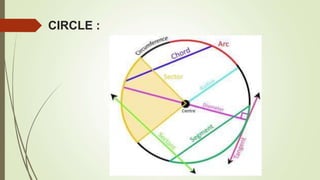
IMPORTANT TERMS RELATED TO CIRCLE :
🠶 Chord of a circle is a line that joins two points
on the circumference of a circle.
🠶 The diameter of a circle is its longest chord.
🠶 An arc of a circle is a continuous part of the
circumference of the circle.
🠶 A sector of a circle is the area/region between
an arc and the center of the circle.
🠶 A chord divides the area of a circle into
two segments. The smaller area is
called Minor segment and the bigger area is
called Major segment.
Introduction to Circles
Circle and line in a plane
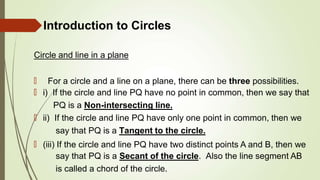
🠶 For a circle and a line on a plane, there can be three possibilities.
🠶 i) If the circle and line PQ have no point in common, then we say that
PQ is a Non-intersecting line.
🠶 ii) If the circle and line PQ have only one point in common, then we
say that PQ is a Tangent to the circle.
🠶 (iii) If the circle and line PQ have two distinct points A and B, then we
say that PQ is a Secant of the circle. Also the line segment AB
is called a chord of the circle.
TANGENT :
A tangent to a circle is a line which touches the circle at
exactly one point.
For every point on the circle, there is a unique tangent
passing through it.
 A = Point of contact
PQ = Tangent.
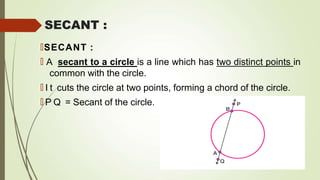
SECANT :
🠶SECANT :
🠶 A secant to a circle is a line which has two distinct points in
common with the circle.
🠶 I t cuts the circle at two points, forming a chord of the circle.
🠶 P Q = Secant of the circle.
TWO PARALLEL TANGENTS AT MOST FOR A GIVEN
SECANT :
🠶 For every given secant of a circle, there are exactly two tangents which
are parallel to it and touches the circle at two diametrically opposite
points.
IMPORTANT POINTS TO REMEMBER :
🠶 The number of tangents drawn from a given point.
🠶 i) If the point is in an interior region of the circle, any line
through that point will be a secant.
🠶 So, no tangent can be drawn to a circle which passes
through a point that lies inside it.
🠶 ii) When a point of tangency lies on the circle, there
is exactly one tangent to a circle that passes through it.
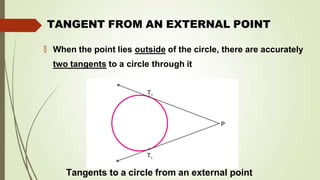
TANGENT FROM AN EXTERNAL POINT
🠶 When the point lies outside of the circle, there are accurately
two tangents to a circle through it
Tangents to a circle from an external point
LENGTH OF A TANGENT
🠶 The length of the tangent from the point (Say P) to the circle
is defined as the segment of the tangent from the external
point P to the point of tangency I with the circle.
🠶 In this case, PI is the tangent length.
CHORD, TANGENT AND SECANT
CIRCLE :
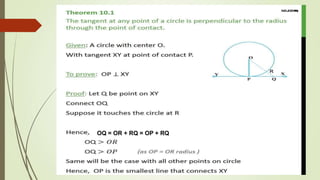
OQ = OR + RQ = OP + RQ
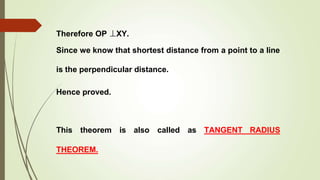
Therefore OP ⊥XY.
Since we know that shortest distance from a point to a line
is the perpendicular distance.
Hence proved.
This theorem is also called as TANGENT RADIUS
THEOREM.
R
H
S
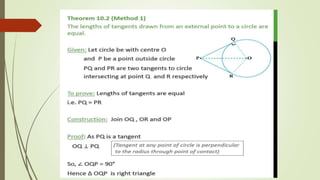
This theorem is also called as EQUAL TANGENT LENGTHS THEOREM
O
Q
P
O
R
P
IMPORTANT POINTS TO REMEMBER :
🠶 TANGENT RADIUS THEOREM :
The tangent at any point of a circle is perpendicular to
the radius through the point of contact.
POINT OF CONTACT : The common point of a tangent to a circle
and the circle is called point of contact.
🠶 A line drawn through the end point of the radius and perpendicular to
it is a tangent to the circle.
🠶 EQUAL TANGENT LENGTHS THEOREM :
The length of the tangents drawn from an external point are equal.
🠶 One and only one tangent can be drawn at any point of
a circle.
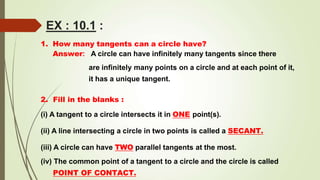
EX : 10.1 :
1. How many tangents can a circle have?
Answer: A circle can have infinitely many tangents since there
are infinitely many points on a circle and at each point of it,
it has a unique tangent.
2. Fill in the blanks :
(i) A tangent to a circle intersects it in ONE point(s).
(ii) A line intersecting a circle in two points is called a SECANT.
(iii) A circle can have TWO parallel tangents at the most.
(iv) The common point of a tangent to a circle and the circle is called
POINT OF CONTACT.
3. A tangent PQ at a point P of a circle of radius 5 cm meets a line
through the centre O at a point Q so that OQ = 12 cm. Length PQ is :
(A) 12 cm
(B) 13 cm
(C) 8.5 cm
(D) √119 cm
Answer :
Using the theorem, “The line drawn from the centre of the circle to the
tangent is perpendicular to the tangent”.
∴OP ⊥PQ .
By Pythagoras theorem in ΔOPQ,
OQ2 = OP2 + PQ2
⇒(12)2 = 52 + PQ2
⇒PQ2 = 144 – 25 = 119
⇒PQ = √119 cm
(D) is the correct option.
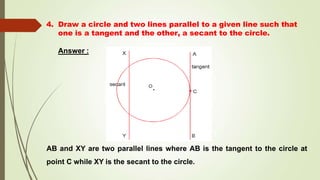
4. Draw a circle and two lines parallel to a given line such that
one is a tangent and the other, a secant to the circle.
Answer :
AB and XY are two parallel lines where AB is the tangent to the circle at
point C while XY is the secant to the circle.
EX : 10.2
1. From a point Q, the length of the tangent to a circle is 24 cm and the distance of Q from
the centre is 25 cm. The radius of the circle is
(A) 7 cm
(B) 12 cm
(C) 15 cm
(D) 24.5 cm
Answer:
First, draw a perpendicular from the center O of the triangle to a point P on the circle
which is touching the tangent. This line will be perpendicular to the tangent of the circle.
So, OP is perpendicular to PQ i.e. OP ⊥PQ
EX : 10.2
From the above figure, it is also seen that △OPQ is a right angled triangle.
It is given that
OQ = 25 cm and PQ = 24 cm
By using Pythagorean theorem in △OPQ,
OQ2 = OP2 + PQ2
⇒(25)2 = OP2 + (24)2
⇒OP2 = 625 – 576
⇒OP2 = 49
⇒OP = 7 cm
So, option A i.e. 7 cm is the radius of the given circle.
EX : 10.2
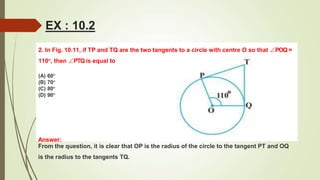
2. In Fig. 10.11, if TP and TQ are the two tangents to a circle with centre O so that ∠POQ =
110°, then ∠PTQ is equal to
(A) 60°
(B) 70°
(C) 80°
(D) 90°
Answer:
From the question, it is clear that OP is the radius of the circle to the tangent PT and OQ
is the radius to the tangents TQ.
So, OP ⊥PT and TQ ⊥OQ
∴∠OPT = ∠OQT = 90°
Now, in the quadrilateral POQT, we know that the sum of the interior angles is 360°
So, ∠PTQ + ∠POQ + ∠OPT + ∠OQT = 360°
Now, by putting the respective values we get,
⇒∠PTQ + 90° + 110° + 90° = 360°
⇒∠PTQ = 70°
So, ∠PTQ is 70° which is option B.
EX : 10.2
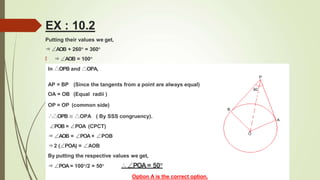
3. If tangents PA and PB from a point P to a circle with centre O are inclined to each other at
angle of 80°, then ∠POA is equal to
(A) 50°
(B) 60°
(C) 70°
(D) 80°
Answer:
GIVEN :
EX : 10.2
( Using Tangent Radius Theorem)
 OA is the radius to tangent PA
 OB is the radius to tangents PB.
 OA ⊥PA and OB ⊥PB
 So, ∠OBP = ∠OAP = 90°
 ∠ABP = 80°
TO FIND ∠POA.
In the quadrilateral AOBP,
∠AOB + ∠OAP + ∠OBP + ∠APB = 360° (Since the sum of all the interior angles will be 360°)
Putting their values we get,
⇒∠AOB + 260° = 360°
🠶 ⇒∠AOB = 100°
In △OPB and △OPA,
AP = BP (Since the tangents from a point are always equal)
OA = OB (Equal radii )
OP = OP (common side)
∴△OPB ≅ △OPA ( By SSS congruency).
∠POB = ∠POA (CPCT)
⇒∠AOB = ∠POA + ∠POB
⇒2 (∠POA) = ∠AOB
By putting the respective values we get,
⇒∠POA = 100°/2 = 50° ∴∠POA= 50°
Option A is the correct option.
EX : 10.2
4. Prove that the tangents drawn at the ends of a diameter of a circle are
parallel.
Answer:
Let AB be a diameter of the circle.
Two tangents PQ and RS are drawn at points A and B respectively.
Radii of the circle to the tangents will be perpendicular to it.
∴OB ⊥RS and OA ⊥PQ (By tangent radius theorem)
∠OBR = ∠OBS = ∠OAP = ∠OAQ = 90º
From the figure,
∠OBR = ∠OAQ (Alternate interior angles)
∠OBS = ∠OAP (Alternate interior angles)
Since alternate interior angles are equal, lines PQ and RS will be parallel.
Hence Proved that the tangents drawn at the ends of a diameter of a circle are parallel.
EX : 10.2
Q.5. Prove that the perpendicular at the point of contact to the tangent to a circle passes
through the centre.
Sol.
GIVEN : Let the centre of the circle is O and tangent AB touches the circle at P.
Let PX be perpendicular to AB at P.
PX passes through ‘O’
TOPROVE :
PROOF : If possible let PX not passing through O.
Join OP.
Since tangent at a point to a circle is perpendicular to
the radius through that point,
∴
AB ⊥OP i.e. ∠OPB= 90° ...(1)
∠XPB= 90° ...(2)
But by construction,
AB ⊥PX ⇒
From (1) and (2),
∠XPB= ∠OPB
which is possible only when O and X coincide.
Thus, the perpendicular at the point of contact to the tangent passes through the centre.
EX : 10.2
Q.6. The length of a tangent from a point A at distance 5 cm from the centre of the
circle is 4 cm. Find the radius of the circle.
Sol. ∵The tangent to a circle is perpendicular to the radius through the point of contact.
∠OTA= 90°
Now, in the right ΔOTA, we have:
OP
2
= OT
2
+ PT
2
⇒52
= OT2
+ 42
⇒OT2
= 52
– 42
⇒OT2
= (5 – 4) (5 + 4)
⇒OT2
= 1 × 9 = 9 = 32
⇒OT = 3
Thus, the radius of the circle is 3 cm.
EX : 10.2
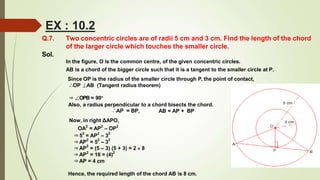
Q.7. Two concentric circles are of radii 5 cm and 3 cm. Find the length of the chord
of the larger circle which touches the smaller circle.
Sol.
In the figure, O is the common centre, of the given concentric circles.
AB is a chord of the bigger circle such that it is a tangent to the smaller circle at P.
Since OP is the radius of the smaller circle through P, the point of contact,
∴OP ⊥AB (Tangent radius theorem)
⇒∠OPB = 90°
Also, a radius perpendicular to a chord bisects the chord.
AB = AP + BP
∴AP = BP,
Now, in right ΔAPO,
OA2
= AP2
– OP2
⇒52
= AP2
– 32
⇒AP
2
= 52
– 32
⇒AP
2
= (5 – 3) (5 + 3) = 2 × 8
⇒AP
2
= 16 = (4)2
⇒AP = 4 cm
Hence, the required length of the chord AB is 8 cm.
EX : 10.2
Q.8. A quadrilateral ABCD is drawn to circumscribe a circle (see figure).
Prove that: AB + CD = AD + BC
Sol.
EX : 1
I0.2
Since the sides of quadrilateral ABCD, i.e., AB, BC, CD and DA touch the circle at P,
Q, R and S respectively, and the lengths of two tangents to a circle from an external
point are equal.
From the figure we observe that, (Using Equal tangent lengths theorem)
DR = DS (Tangents on the circle from point D) … (i)
AP = AS (Tangents on the circle from point A) … (ii)
BP = BQ (Tangents on the circle from point B) … (iii)
CR = CQ (Tangents on the circle from point C) … (iv)
Adding all these equations,
DR + AP + BP + CR = DS + AS + BQ + CQ
⇒(BP + AP) + (DR + CR) = (DS + AS) + (CQ + BQ)
⇒AB + CD = AD + BC
EX : 10.2
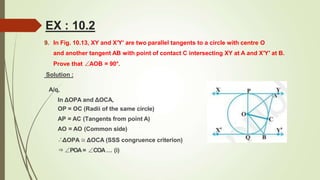
9. In Fig. 10.13, XY and X′Y′ are two parallel tangents to a circle with centre O
and another tangent AB with point of contact C intersecting XY at A and X′Y′ at B.
Prove that ∠AOB = 90°.
Solution :
A/q,
In ΔOPA and ΔOCA,
OP = OC (Radii of the same circle)
AP = AC (Tangents from point A)
AO = AO (Common side)
∴
ΔOPA ≅ ΔOCA (SSS congruence criterion)
⇒∠POA= ∠COA… (i)
Similarly,
ΔOQB ≅ ΔOCB
∠QOB= ∠COB … (ii)
Since POQ is a diameter of the circle,
it is a straight line.
∴∠POA+ ∠COA+ ∠COB + ∠QOB= 180 º
From equations (i) and (ii),
2∠COA+ 2∠COB = 180º
⇒∠COA+ ∠COB = 90º
⇒∠AOB = 90°
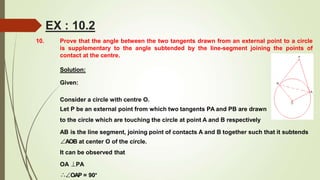
10. Prove that the angle between the two tangents drawn from an external point to a circle
is supplementary to the angle subtended by the line-segment joining the points of
contact at the centre.
Solution:
Given:
Consider a circle with centre O.
Let P be an external point from which two tangents PA and PB are drawn
to the circle which are touching the circle at point A and B respectively
AB is the line segment, joining point of contacts A and B together such that it subtends
∠AOB at center O of the circle.
It can be observed that
OA ⊥PA
∴∠OAP = 90°
EX : 10.2
Similarly, OB ⊥PB
∴∠OBP = 90°
In quadrilateral OAPB,
Sum of all interior angles = 360º
∠OAP +∠APB +∠PBO +∠BOA = 360º
⇒90º + ∠APB + 90º + ∠BOA= 360º
⇒∠APB + ∠BOA= 180º
∴The angle between the two tangents drawn from an
external point to a circle is supplementary to the
angle subtended by the line-segment joining the
points of contact at the centre.
11. Prove that the parallelogram circumscribing a circle is a rhombus.
Answer:
ABCD is a parallelogram,
∴
AB = CD ... (i) (opposite sides are equal)
∴BC = AD ... (ii)
From the figure, we observe that,
(Using Equal tangent lengths theorem)
DR = DS (Tangents to the circle at D)
CR = CQ (Tangents to the circle at C)
BP = BQ (Tangents to the circle at B)
AP = AS (Tangents to the circle at A)
EX : 10.2
Adding all these,
DR + CR + BP + AP = DS + CQ + BQ + AS
⇒(DR + CR) + (BP + AP) = (DS + AS) + (CQ + BQ)
⇒CD + AB = AD + BC ... (iii)
Putting the value of (i) and (ii) in equation (iii) we get,
⇒2AB = 2BC
⇒AB = BC ... (iv)
By Comparing equations (i), (ii), and (iv) we get,
AB = BC = CD = DA
∴
ABCD is a rhombus.
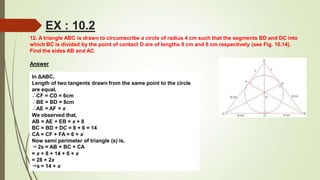
12. A triangle ABC is drawn to circumscribe a circle of radius 4 cm such that the segments BD and DC into
which BC is divided by the point of contact D are of lengths 8 cm and 6 cm respectively (see Fig. 10.14).
Find the sides AB and AC.
Answer
In ΔABC,
Length of two tangents drawn from the same point to the circle
are equal,
∴CF = CD = 6cm
∴BE = BD = 8cm
∴AE = AF = x
We observed that,
AB = AE + EB = x + 8
BC = BD + DC = 8 + 6 = 14
CA = CF + FA = 6 + x
Now semi perimeter of triangle (s) is,
⇒2s = AB + BC + CA
= x + 8 + 14 + 6 + x
= 28 + 2x
⇒s = 14 + x
EX : 10.2
Area of ΔABC = √s (s - a)(s - b)(s - c)
= √(14 + x) (14 + x - 14)(14 + x - x - 6)(14 + x - x - 8)
= √(14 + x) (x)(8)(6)
= √(14 + x) 48 x ... (i)
also, Area of ΔABC = 2×area of (ΔAOF + ΔCOD + ΔDOB)
= 2×[(1/2×OF×AF) + (1/2×CD×OD) + (1/2×DB×OD)]
= 2×1/2 (4x + 24 + 32) = 56 + 4x ... (ii)
⇒
Equating equation (i) and (ii) we get,
√(14 + x) 48 x = 56 + 4x
Squaring both sides,
48x (14 + x) = (56 + 4x)2
⇒48x = [4(14 + x)]2/(14 + x)
⇒48x = 16 (14 + x)
⇒48x = 224 + 16x
⇒32x = 224
⇒x = 7 cm
Hence, AB = x + 8 = 7 + 8 = 15 cm
CA = 6 + x = 6 + 7 = 13 cm
13. Prove that opposite sides of a quadrilateral circumscribing a circle subtend
supplementary angles at the centre of the circle.
Answer:
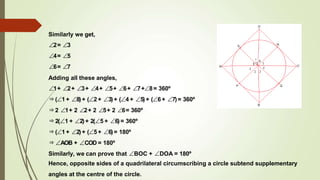
Let ABCD be a quadrilateral circumscribing a circle with O such that it touches the
circle at point P, Q, R, S. Join the vertices of the quadrilateral ABCD to the centre of the
circle.
In ΔOAP and ΔOAS,
AP = AS (Tangents from the same point)
OP = OS (Radii of the circle)
OA = OA (Common side)
ΔOAP ≅ ΔOAS (SSS congruence condition)
∴∠POA= ∠AOS
⇒∠1= ∠8
EX : 10.2
Similarly we get,
∠2= ∠3
∠4= ∠5
∠6= ∠7
Adding all these angles,
∠1+ ∠2+ ∠3+ ∠4+ ∠5+ ∠6+ ∠7+∠8= 360º
⇒(∠1+ ∠8)+ (∠2 + ∠3)+ (∠4 + ∠5)+ (∠6 + ∠7)= 360º
⇒2 ∠1+ 2 ∠2+ 2 ∠5+ 2 ∠6= 360º
⇒2(∠1 + ∠2)+ 2(∠5 + ∠6)= 360º
⇒(∠1+ ∠2)+ (∠5 + ∠6)= 180º
⇒∠AOB + ∠COD = 180º
Similarly, we can prove that ∠BOC + ∠DOA = 180º
Hence, opposite sides of a quadrilateral circumscribing a circle subtend supplementary
angles at the centre of the circle.

CIRCLE math 10 Second Quarter PowerPoint

  • 1.
  • 2.
    RECALL : 🠶 Whatis a circle? 🠶 A circle is a collection of all points in a plane which are at a constant distance called radius and from a certain fixed point called centre. 🠶 A circumference which is a set of all points at a fixed distance from the centre of the circle. 🠶 The distance from the centre of the circle to the circumference is called the radius of the circle. 🠶 You can draw a circle using a compass. Circumference
  • 3.
    APPLICATIONS OF CIRCLESIN DAY TO DAY LIFE :
  • 4.
    IMPORTANT TERMS RELATEDTO CIRCLE : 🠶 Chord of a circle is a line that joins two points on the circumference of a circle. 🠶 The diameter of a circle is its longest chord. 🠶 An arc of a circle is a continuous part of the circumference of the circle. 🠶 A sector of a circle is the area/region between an arc and the center of the circle. 🠶 A chord divides the area of a circle into two segments. The smaller area is called Minor segment and the bigger area is called Major segment.
  • 6.
    Introduction to Circles Circleand line in a plane 🠶 For a circle and a line on a plane, there can be three possibilities. 🠶 i) If the circle and line PQ have no point in common, then we say that PQ is a Non-intersecting line. 🠶 ii) If the circle and line PQ have only one point in common, then we say that PQ is a Tangent to the circle. 🠶 (iii) If the circle and line PQ have two distinct points A and B, then we say that PQ is a Secant of the circle. Also the line segment AB is called a chord of the circle.
  • 7.
    TANGENT : A tangentto a circle is a line which touches the circle at exactly one point. For every point on the circle, there is a unique tangent passing through it.  A = Point of contact PQ = Tangent.
  • 8.
    SECANT : 🠶SECANT : 🠶A secant to a circle is a line which has two distinct points in common with the circle. 🠶 I t cuts the circle at two points, forming a chord of the circle. 🠶 P Q = Secant of the circle.
  • 9.
    TWO PARALLEL TANGENTSAT MOST FOR A GIVEN SECANT : 🠶 For every given secant of a circle, there are exactly two tangents which are parallel to it and touches the circle at two diametrically opposite points.
  • 10.
    IMPORTANT POINTS TOREMEMBER : 🠶 The number of tangents drawn from a given point. 🠶 i) If the point is in an interior region of the circle, any line through that point will be a secant. 🠶 So, no tangent can be drawn to a circle which passes through a point that lies inside it. 🠶 ii) When a point of tangency lies on the circle, there is exactly one tangent to a circle that passes through it.
  • 11.
    TANGENT FROM ANEXTERNAL POINT 🠶 When the point lies outside of the circle, there are accurately two tangents to a circle through it Tangents to a circle from an external point
  • 12.
    LENGTH OF ATANGENT 🠶 The length of the tangent from the point (Say P) to the circle is defined as the segment of the tangent from the external point P to the point of tangency I with the circle. 🠶 In this case, PI is the tangent length.
  • 13.
  • 14.
  • 15.
    OQ = OR+ RQ = OP + RQ
  • 16.
    Therefore OP ⊥XY. Sincewe know that shortest distance from a point to a line is the perpendicular distance. Hence proved. This theorem is also called as TANGENT RADIUS THEOREM.
  • 18.
    R H S This theorem isalso called as EQUAL TANGENT LENGTHS THEOREM O Q P O R P
  • 19.
    IMPORTANT POINTS TOREMEMBER : 🠶 TANGENT RADIUS THEOREM : The tangent at any point of a circle is perpendicular to the radius through the point of contact. POINT OF CONTACT : The common point of a tangent to a circle and the circle is called point of contact. 🠶 A line drawn through the end point of the radius and perpendicular to it is a tangent to the circle. 🠶 EQUAL TANGENT LENGTHS THEOREM : The length of the tangents drawn from an external point are equal. 🠶 One and only one tangent can be drawn at any point of a circle.
  • 20.
    EX : 10.1: 1. How many tangents can a circle have? Answer: A circle can have infinitely many tangents since there are infinitely many points on a circle and at each point of it, it has a unique tangent. 2. Fill in the blanks : (i) A tangent to a circle intersects it in ONE point(s). (ii) A line intersecting a circle in two points is called a SECANT. (iii) A circle can have TWO parallel tangents at the most. (iv) The common point of a tangent to a circle and the circle is called POINT OF CONTACT.
  • 21.
    3. A tangentPQ at a point P of a circle of radius 5 cm meets a line through the centre O at a point Q so that OQ = 12 cm. Length PQ is : (A) 12 cm (B) 13 cm (C) 8.5 cm (D) √119 cm Answer : Using the theorem, “The line drawn from the centre of the circle to the tangent is perpendicular to the tangent”. ∴OP ⊥PQ . By Pythagoras theorem in ΔOPQ, OQ2 = OP2 + PQ2 ⇒(12)2 = 52 + PQ2 ⇒PQ2 = 144 – 25 = 119 ⇒PQ = √119 cm (D) is the correct option.
  • 22.
    4. Draw acircle and two lines parallel to a given line such that one is a tangent and the other, a secant to the circle. Answer : AB and XY are two parallel lines where AB is the tangent to the circle at point C while XY is the secant to the circle.
  • 23.
    EX : 10.2 1.From a point Q, the length of the tangent to a circle is 24 cm and the distance of Q from the centre is 25 cm. The radius of the circle is (A) 7 cm (B) 12 cm (C) 15 cm (D) 24.5 cm Answer: First, draw a perpendicular from the center O of the triangle to a point P on the circle which is touching the tangent. This line will be perpendicular to the tangent of the circle. So, OP is perpendicular to PQ i.e. OP ⊥PQ
  • 24.
    EX : 10.2 Fromthe above figure, it is also seen that △OPQ is a right angled triangle. It is given that OQ = 25 cm and PQ = 24 cm By using Pythagorean theorem in △OPQ, OQ2 = OP2 + PQ2 ⇒(25)2 = OP2 + (24)2 ⇒OP2 = 625 – 576 ⇒OP2 = 49 ⇒OP = 7 cm So, option A i.e. 7 cm is the radius of the given circle.
  • 25.
    EX : 10.2 2.In Fig. 10.11, if TP and TQ are the two tangents to a circle with centre O so that ∠POQ = 110°, then ∠PTQ is equal to (A) 60° (B) 70° (C) 80° (D) 90° Answer: From the question, it is clear that OP is the radius of the circle to the tangent PT and OQ is the radius to the tangents TQ.
  • 26.
    So, OP ⊥PTand TQ ⊥OQ ∴∠OPT = ∠OQT = 90° Now, in the quadrilateral POQT, we know that the sum of the interior angles is 360° So, ∠PTQ + ∠POQ + ∠OPT + ∠OQT = 360° Now, by putting the respective values we get, ⇒∠PTQ + 90° + 110° + 90° = 360° ⇒∠PTQ = 70° So, ∠PTQ is 70° which is option B. EX : 10.2
  • 27.
    3. If tangentsPA and PB from a point P to a circle with centre O are inclined to each other at angle of 80°, then ∠POA is equal to (A) 50° (B) 60° (C) 70° (D) 80° Answer: GIVEN : EX : 10.2 ( Using Tangent Radius Theorem)  OA is the radius to tangent PA  OB is the radius to tangents PB.  OA ⊥PA and OB ⊥PB  So, ∠OBP = ∠OAP = 90°  ∠ABP = 80° TO FIND ∠POA. In the quadrilateral AOBP, ∠AOB + ∠OAP + ∠OBP + ∠APB = 360° (Since the sum of all the interior angles will be 360°)
  • 28.
    Putting their valueswe get, ⇒∠AOB + 260° = 360° 🠶 ⇒∠AOB = 100° In △OPB and △OPA, AP = BP (Since the tangents from a point are always equal) OA = OB (Equal radii ) OP = OP (common side) ∴△OPB ≅ △OPA ( By SSS congruency). ∠POB = ∠POA (CPCT) ⇒∠AOB = ∠POA + ∠POB ⇒2 (∠POA) = ∠AOB By putting the respective values we get, ⇒∠POA = 100°/2 = 50° ∴∠POA= 50° Option A is the correct option. EX : 10.2
  • 29.
    4. Prove thatthe tangents drawn at the ends of a diameter of a circle are parallel. Answer: Let AB be a diameter of the circle. Two tangents PQ and RS are drawn at points A and B respectively. Radii of the circle to the tangents will be perpendicular to it. ∴OB ⊥RS and OA ⊥PQ (By tangent radius theorem) ∠OBR = ∠OBS = ∠OAP = ∠OAQ = 90º From the figure, ∠OBR = ∠OAQ (Alternate interior angles) ∠OBS = ∠OAP (Alternate interior angles) Since alternate interior angles are equal, lines PQ and RS will be parallel. Hence Proved that the tangents drawn at the ends of a diameter of a circle are parallel. EX : 10.2
  • 30.
    Q.5. Prove thatthe perpendicular at the point of contact to the tangent to a circle passes through the centre. Sol. GIVEN : Let the centre of the circle is O and tangent AB touches the circle at P. Let PX be perpendicular to AB at P. PX passes through ‘O’ TOPROVE : PROOF : If possible let PX not passing through O. Join OP. Since tangent at a point to a circle is perpendicular to the radius through that point, ∴ AB ⊥OP i.e. ∠OPB= 90° ...(1) ∠XPB= 90° ...(2) But by construction, AB ⊥PX ⇒ From (1) and (2), ∠XPB= ∠OPB which is possible only when O and X coincide. Thus, the perpendicular at the point of contact to the tangent passes through the centre. EX : 10.2
  • 31.
    Q.6. The lengthof a tangent from a point A at distance 5 cm from the centre of the circle is 4 cm. Find the radius of the circle. Sol. ∵The tangent to a circle is perpendicular to the radius through the point of contact. ∠OTA= 90° Now, in the right ΔOTA, we have: OP 2 = OT 2 + PT 2 ⇒52 = OT2 + 42 ⇒OT2 = 52 – 42 ⇒OT2 = (5 – 4) (5 + 4) ⇒OT2 = 1 × 9 = 9 = 32 ⇒OT = 3 Thus, the radius of the circle is 3 cm. EX : 10.2
  • 32.
    Q.7. Two concentriccircles are of radii 5 cm and 3 cm. Find the length of the chord of the larger circle which touches the smaller circle. Sol. In the figure, O is the common centre, of the given concentric circles. AB is a chord of the bigger circle such that it is a tangent to the smaller circle at P. Since OP is the radius of the smaller circle through P, the point of contact, ∴OP ⊥AB (Tangent radius theorem) ⇒∠OPB = 90° Also, a radius perpendicular to a chord bisects the chord. AB = AP + BP ∴AP = BP, Now, in right ΔAPO, OA2 = AP2 – OP2 ⇒52 = AP2 – 32 ⇒AP 2 = 52 – 32 ⇒AP 2 = (5 – 3) (5 + 3) = 2 × 8 ⇒AP 2 = 16 = (4)2 ⇒AP = 4 cm Hence, the required length of the chord AB is 8 cm. EX : 10.2
  • 33.
    Q.8. A quadrilateralABCD is drawn to circumscribe a circle (see figure). Prove that: AB + CD = AD + BC Sol. EX : 1 I0.2 Since the sides of quadrilateral ABCD, i.e., AB, BC, CD and DA touch the circle at P, Q, R and S respectively, and the lengths of two tangents to a circle from an external point are equal. From the figure we observe that, (Using Equal tangent lengths theorem) DR = DS (Tangents on the circle from point D) … (i) AP = AS (Tangents on the circle from point A) … (ii) BP = BQ (Tangents on the circle from point B) … (iii) CR = CQ (Tangents on the circle from point C) … (iv) Adding all these equations, DR + AP + BP + CR = DS + AS + BQ + CQ ⇒(BP + AP) + (DR + CR) = (DS + AS) + (CQ + BQ) ⇒AB + CD = AD + BC
  • 34.
    EX : 10.2 9.In Fig. 10.13, XY and X′Y′ are two parallel tangents to a circle with centre O and another tangent AB with point of contact C intersecting XY at A and X′Y′ at B. Prove that ∠AOB = 90°. Solution : A/q, In ΔOPA and ΔOCA, OP = OC (Radii of the same circle) AP = AC (Tangents from point A) AO = AO (Common side) ∴ ΔOPA ≅ ΔOCA (SSS congruence criterion) ⇒∠POA= ∠COA… (i)
  • 35.
    Similarly, ΔOQB ≅ ΔOCB ∠QOB=∠COB … (ii) Since POQ is a diameter of the circle, it is a straight line. ∴∠POA+ ∠COA+ ∠COB + ∠QOB= 180 º From equations (i) and (ii), 2∠COA+ 2∠COB = 180º ⇒∠COA+ ∠COB = 90º ⇒∠AOB = 90°
  • 36.
    10. Prove thatthe angle between the two tangents drawn from an external point to a circle is supplementary to the angle subtended by the line-segment joining the points of contact at the centre. Solution: Given: Consider a circle with centre O. Let P be an external point from which two tangents PA and PB are drawn to the circle which are touching the circle at point A and B respectively AB is the line segment, joining point of contacts A and B together such that it subtends ∠AOB at center O of the circle. It can be observed that OA ⊥PA ∴∠OAP = 90° EX : 10.2
  • 37.
    Similarly, OB ⊥PB ∴∠OBP= 90° In quadrilateral OAPB, Sum of all interior angles = 360º ∠OAP +∠APB +∠PBO +∠BOA = 360º ⇒90º + ∠APB + 90º + ∠BOA= 360º ⇒∠APB + ∠BOA= 180º ∴The angle between the two tangents drawn from an external point to a circle is supplementary to the angle subtended by the line-segment joining the points of contact at the centre.
  • 38.
    11. Prove thatthe parallelogram circumscribing a circle is a rhombus. Answer: ABCD is a parallelogram, ∴ AB = CD ... (i) (opposite sides are equal) ∴BC = AD ... (ii) From the figure, we observe that, (Using Equal tangent lengths theorem) DR = DS (Tangents to the circle at D) CR = CQ (Tangents to the circle at C) BP = BQ (Tangents to the circle at B) AP = AS (Tangents to the circle at A) EX : 10.2
  • 39.
    Adding all these, DR+ CR + BP + AP = DS + CQ + BQ + AS ⇒(DR + CR) + (BP + AP) = (DS + AS) + (CQ + BQ) ⇒CD + AB = AD + BC ... (iii) Putting the value of (i) and (ii) in equation (iii) we get, ⇒2AB = 2BC ⇒AB = BC ... (iv) By Comparing equations (i), (ii), and (iv) we get, AB = BC = CD = DA ∴ ABCD is a rhombus.
  • 40.
    12. A triangleABC is drawn to circumscribe a circle of radius 4 cm such that the segments BD and DC into which BC is divided by the point of contact D are of lengths 8 cm and 6 cm respectively (see Fig. 10.14). Find the sides AB and AC. Answer In ΔABC, Length of two tangents drawn from the same point to the circle are equal, ∴CF = CD = 6cm ∴BE = BD = 8cm ∴AE = AF = x We observed that, AB = AE + EB = x + 8 BC = BD + DC = 8 + 6 = 14 CA = CF + FA = 6 + x Now semi perimeter of triangle (s) is, ⇒2s = AB + BC + CA = x + 8 + 14 + 6 + x = 28 + 2x ⇒s = 14 + x EX : 10.2
  • 41.
    Area of ΔABC= √s (s - a)(s - b)(s - c) = √(14 + x) (14 + x - 14)(14 + x - x - 6)(14 + x - x - 8) = √(14 + x) (x)(8)(6) = √(14 + x) 48 x ... (i) also, Area of ΔABC = 2×area of (ΔAOF + ΔCOD + ΔDOB) = 2×[(1/2×OF×AF) + (1/2×CD×OD) + (1/2×DB×OD)] = 2×1/2 (4x + 24 + 32) = 56 + 4x ... (ii) ⇒ Equating equation (i) and (ii) we get, √(14 + x) 48 x = 56 + 4x Squaring both sides, 48x (14 + x) = (56 + 4x)2 ⇒48x = [4(14 + x)]2/(14 + x) ⇒48x = 16 (14 + x) ⇒48x = 224 + 16x ⇒32x = 224 ⇒x = 7 cm Hence, AB = x + 8 = 7 + 8 = 15 cm CA = 6 + x = 6 + 7 = 13 cm
  • 42.
    13. Prove thatopposite sides of a quadrilateral circumscribing a circle subtend supplementary angles at the centre of the circle. Answer: Let ABCD be a quadrilateral circumscribing a circle with O such that it touches the circle at point P, Q, R, S. Join the vertices of the quadrilateral ABCD to the centre of the circle. In ΔOAP and ΔOAS, AP = AS (Tangents from the same point) OP = OS (Radii of the circle) OA = OA (Common side) ΔOAP ≅ ΔOAS (SSS congruence condition) ∴∠POA= ∠AOS ⇒∠1= ∠8 EX : 10.2
  • 43.
    Similarly we get, ∠2=∠3 ∠4= ∠5 ∠6= ∠7 Adding all these angles, ∠1+ ∠2+ ∠3+ ∠4+ ∠5+ ∠6+ ∠7+∠8= 360º ⇒(∠1+ ∠8)+ (∠2 + ∠3)+ (∠4 + ∠5)+ (∠6 + ∠7)= 360º ⇒2 ∠1+ 2 ∠2+ 2 ∠5+ 2 ∠6= 360º ⇒2(∠1 + ∠2)+ 2(∠5 + ∠6)= 360º ⇒(∠1+ ∠2)+ (∠5 + ∠6)= 180º ⇒∠AOB + ∠COD = 180º Similarly, we can prove that ∠BOC + ∠DOA = 180º Hence, opposite sides of a quadrilateral circumscribing a circle subtend supplementary angles at the centre of the circle.