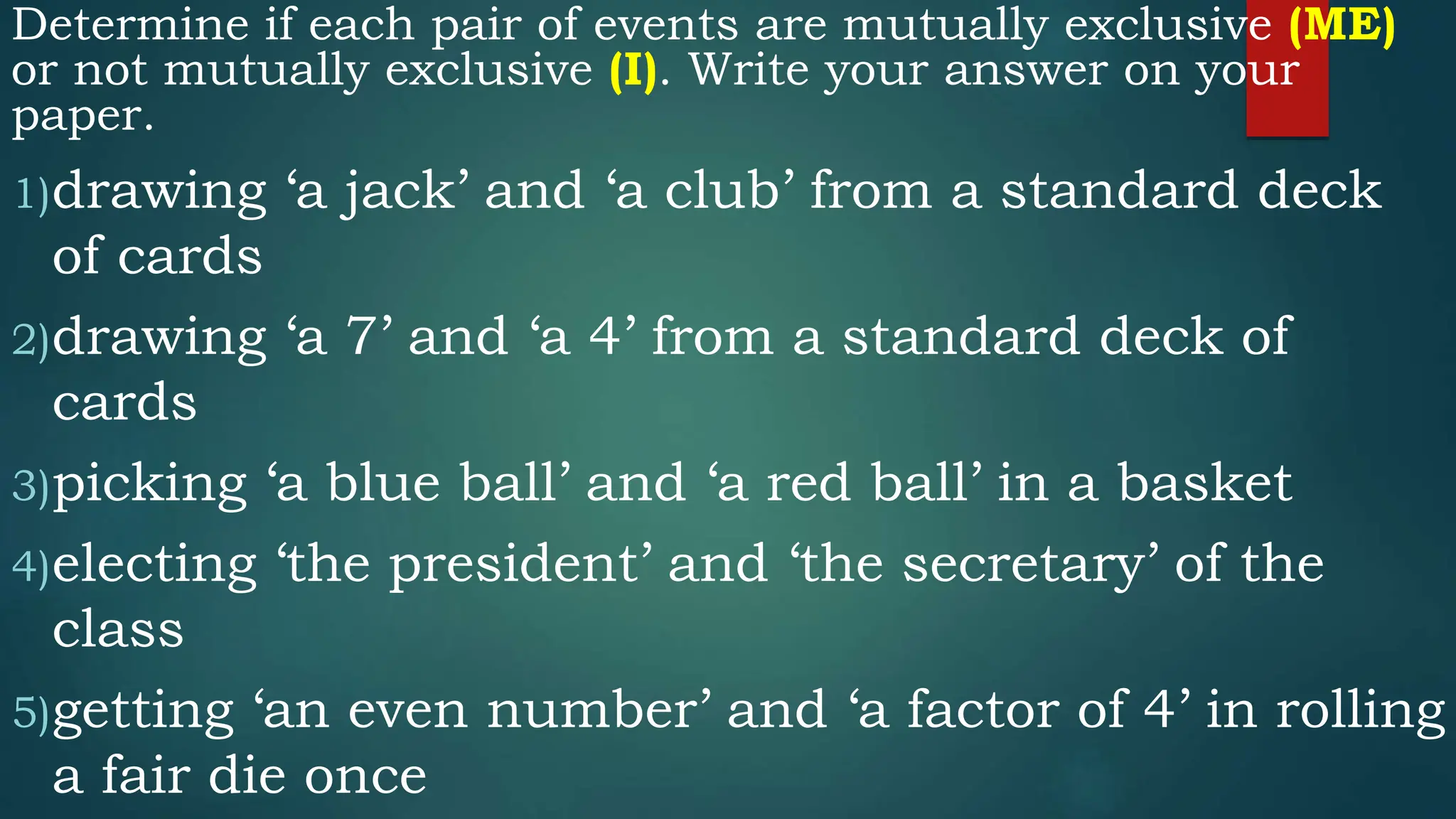
The document discusses mutually exclusive and not mutually exclusive events. It begins with examples of jumbled words related to probability that must be rearranged to form terms like union, intersection, event, etc. It then defines mutually exclusive events as events that cannot occur at the same time and provides examples like getting a head or tail in a coin toss. Not mutually exclusive events are defined as events that can occur at the same time, like getting an even number or a factor of 4 when rolling a die. Activities are included for students to identify whether event pairs are mutually exclusive or not.