Topic 5.
Counting
and
Probability
WEEK 5. AUG.2
Homework Review
Homework Review
Homework Review
Homework Review
Homework Review
How many positive integers less than 200 are divisible
by 2, 3 and 5?
● 6 positive integers
List the factors for 81
● 1, 3, 9, 27, 81
Definition of Sample Space
The sample space of an experiment or random trial
is the set of all possible outcomes or results of that
experiment.
For example, if you roll a dice, 6 things could
happen. You could roll a 1, 2, 3, 4, 5, or 6. Therefore,
1, 2, 3, 4, 5, and 6 would be the sample space for
this experiment.
Tree Diagram
As we all know, you can have two possible outcomes when flipping a
coin 1 time: heads or tails. But how would we find the possible outcomes
when we flip a coin 3 times?
We can find the
sample space
using a tree
diagram:
Listing the possibilities:
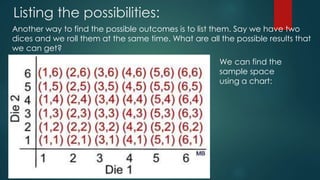
Another way to find the possible outcomes is to list them. Say we have two
dices and we roll them at the same time. What are all the possible results that
we can get?
We can find the
sample space
using a chart:
Practice Problem
Answer
Definition of Counting Principle
The Fundamental Counting Principle is a way to
figure out the number of outcomes in a probability
problem. Basically, you multiply the events together
to get the total number of outcomes
The Counting Principle
...
Question: How many different possible breakfast
combinations are there if you order one from each
group:
EGG GROUP ( Scrambled eggs, Fried Eggs,
Omelette )
MEAT GROUP ( Bacon, Sausage )
Answer:
...
Since there are 3
possible egg
choices and 2
possible meat
choices, we can
apply the
counting principle
and do 3 x 2 = 6
Practice Problem:
...
Answer:
...
Practice Problems (you don’t have to give
an exact answer, showing the equation is
enough):
...
Answer:
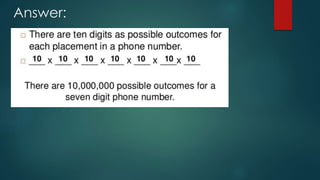
30 x 29 x 28 combinations possible
24 x 23 x 22 x 21 x 20 choices
Practice Problem
Answer
Definition of Probability
Probability is the extent to which something is
probable; the likelihood of something happening or
being the case.
Finding The Probability
Question: What is the probability of getting a head when
flipping a coin one time?
Practice Problems:
What is the probability of the following happening?
1. Randomly selecting the letter A in Cheatham?
1. Choosing a blue marble out of a bag filled with 3
blue marbles, 4 red marbles and 2 yellow
marbles?
1. Throwing a fair coin 2 times and getting 2 heads?
Answer:
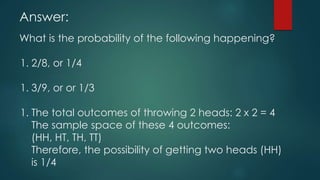
What is the probability of the following happening?
1. 2/8, or 1/4
1. 3/9, or or 1/3
1. The total outcomes of throwing 2 heads: 2 x 2 = 4
The sample space of these 4 outcomes:
(HH, HT, TH, TT)
Therefore, the possibility of getting two heads (HH)
is 1/4
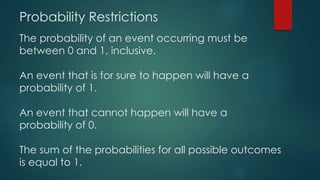
Probability Restrictions
The probability of an event occurring must be
between 0 and 1, inclusive.
An event that is for sure to happen will have a
probability of 1.
An event that cannot happen will have a
probability of 0.
The sum of the probabilities for all possible outcomes
is equal to 1.
Practice Problems:
What is the probability of the following happening?
1. Picking a candy that is not red out of a bag filled
with 5 blue candies, 6 purple candies and 4 red
candies?
2. Rolling a six-sided die and getting a number over
2?
3. Rolling two six-sided dice and getting a 3 and a
6?
Answer
What is the probability of the following happening?
1. 11/15
2. 2/3
3. 1/18
Review Problem:
Answer
Review Problem
To buy a computer system, a customer can choose
one of 4 monitors, one of 2 keyboards, one of 4
computers and one of 3 printers. Determine the
number of possible systems that a customer can
choose from.
Answer
A customer can choose one monitor, one keyboard, one
computer and one printer. The diagram below shows each
item with the number of choices the customer has.
Using the counting principle, the number of all possible
choices can be found by 4 × 2 × 4 × 3 = 96
Time for handouts!
Take the handouts that you printed out at home and using the
concepts that we learned today, start working on them. If you don’t
finish that’s okay, you can finish it at home.

Beginners counting and probability.pptx

  • 1.
  • 2.
  • 3.
  • 4.
  • 5.
  • 6.
    Homework Review How manypositive integers less than 200 are divisible by 2, 3 and 5? ● 6 positive integers List the factors for 81 ● 1, 3, 9, 27, 81
  • 7.
    Definition of SampleSpace The sample space of an experiment or random trial is the set of all possible outcomes or results of that experiment. For example, if you roll a dice, 6 things could happen. You could roll a 1, 2, 3, 4, 5, or 6. Therefore, 1, 2, 3, 4, 5, and 6 would be the sample space for this experiment.
  • 8.
    Tree Diagram As weall know, you can have two possible outcomes when flipping a coin 1 time: heads or tails. But how would we find the possible outcomes when we flip a coin 3 times? We can find the sample space using a tree diagram:
  • 9.
    Listing the possibilities: Anotherway to find the possible outcomes is to list them. Say we have two dices and we roll them at the same time. What are all the possible results that we can get? We can find the sample space using a chart:
  • 10.
  • 11.
  • 12.
    Definition of CountingPrinciple The Fundamental Counting Principle is a way to figure out the number of outcomes in a probability problem. Basically, you multiply the events together to get the total number of outcomes
  • 13.
    The Counting Principle ... Question:How many different possible breakfast combinations are there if you order one from each group: EGG GROUP ( Scrambled eggs, Fried Eggs, Omelette ) MEAT GROUP ( Bacon, Sausage )
  • 14.
    Answer: ... Since there are3 possible egg choices and 2 possible meat choices, we can apply the counting principle and do 3 x 2 = 6
  • 15.
  • 16.
  • 17.
    Practice Problems (youdon’t have to give an exact answer, showing the equation is enough): ...
  • 18.
    Answer: 30 x 29x 28 combinations possible 24 x 23 x 22 x 21 x 20 choices
  • 19.
  • 20.
  • 21.
    Definition of Probability Probabilityis the extent to which something is probable; the likelihood of something happening or being the case.
  • 22.
    Finding The Probability Question:What is the probability of getting a head when flipping a coin one time?
  • 23.
    Practice Problems: What isthe probability of the following happening? 1. Randomly selecting the letter A in Cheatham? 1. Choosing a blue marble out of a bag filled with 3 blue marbles, 4 red marbles and 2 yellow marbles? 1. Throwing a fair coin 2 times and getting 2 heads?
  • 24.
    Answer: What is theprobability of the following happening? 1. 2/8, or 1/4 1. 3/9, or or 1/3 1. The total outcomes of throwing 2 heads: 2 x 2 = 4 The sample space of these 4 outcomes: (HH, HT, TH, TT) Therefore, the possibility of getting two heads (HH) is 1/4
  • 25.
    Probability Restrictions The probabilityof an event occurring must be between 0 and 1, inclusive. An event that is for sure to happen will have a probability of 1. An event that cannot happen will have a probability of 0. The sum of the probabilities for all possible outcomes is equal to 1.
  • 26.
    Practice Problems: What isthe probability of the following happening? 1. Picking a candy that is not red out of a bag filled with 5 blue candies, 6 purple candies and 4 red candies? 2. Rolling a six-sided die and getting a number over 2? 3. Rolling two six-sided dice and getting a 3 and a 6?
  • 27.
    Answer What is theprobability of the following happening? 1. 11/15 2. 2/3 3. 1/18
  • 28.
  • 29.
  • 30.
    Review Problem To buya computer system, a customer can choose one of 4 monitors, one of 2 keyboards, one of 4 computers and one of 3 printers. Determine the number of possible systems that a customer can choose from.
  • 31.
    Answer A customer canchoose one monitor, one keyboard, one computer and one printer. The diagram below shows each item with the number of choices the customer has. Using the counting principle, the number of all possible choices can be found by 4 × 2 × 4 × 3 = 96
  • 32.
    Time for handouts! Takethe handouts that you printed out at home and using the concepts that we learned today, start working on them. If you don’t finish that’s okay, you can finish it at home.