Illustrating
Permutation of
Objects
LESSON 1 – ILLUSTRATING THE PERMUTATION OF DISTINCT OBJECTS
Four Techniques in Counting Events
 Making a table is a technique where values or different
possibilities are tabulated.
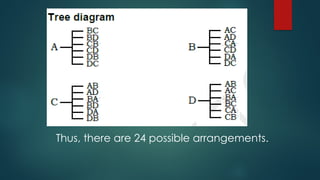
 Tree diagram is another technique which uses line segments
originating from an event to an outcome. This is a picture of all
possible outcomes when an event is unfolded.
 Systematic listing is a counting technique that involves a
complete list of all possible outcomes.
 Fundamental Principle of Counting is a counting technique in
which if two events are independent and one event occurs in a
ways, and the other event occurs in b ways, then, these events
occur in ab ways.
Try this!
There are 4 cyclists in a race. In how many ways
will they be ranked as first, second, and third
placers?
 Making a table
Thus, there are 24 possible arrangements.
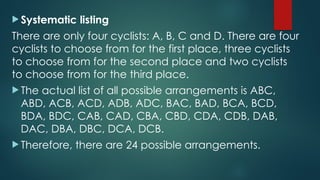
 Systematic listing
There are only four cyclists: A, B, C and D. There are four
cyclists to choose from for the first place, three cyclists
to choose from for the second place and two cyclists
to choose from for the third place.
 The actual list of all possible arrangements is ABC,
ABD, ACB, ACD, ADB, ADC, BAC, BAD, BCA, BCD,
BDA, BDC, CAB, CAD, CBA, CBD, CDA, CDB, DAB,
DAC, DBA, DBC, DCA, DCB.
 Therefore, there are 24 possible arrangements.
Fundamental Principle of Counting
Permutation
 A Permutation refers to the different arrangement of
objects in a definitive manner, in which the order of
the objects is important. There are two types of
permutations, permutations of objects in a line and
permutations of objects in a circle. Permutation of
distinct objects and permutation of non-distinct
objects are the two kinds of permutations of objects in
a line.
What is a permutation of distinct objects?
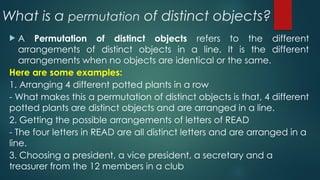
 A Permutation of distinct objects refers to the different
arrangements of distinct objects in a line. It is the different
arrangements when no objects are identical or the same.
Here are some examples:
1. Arranging 4 different potted plants in a row
- What makes this a permutation of distinct objects is that, 4 different
potted plants are distinct objects and are arranged in a line.
2. Getting the possible arrangements of letters of READ
- The four letters in READ are all distinct letters and are arranged in a
line.
3. Choosing a president, a vice president, a secretary and a
treasurer from the 12 members in a club
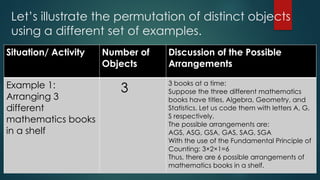
Let’s illustrate the permutation of distinct objects
using a different set of examples.
Situation/ Activity Number of
Objects
Discussion of the Possible
Arrangements
Example 1:
Arranging 3
different
mathematics books
in a shelf
3
3 books at a time:
Suppose the three different mathematics
books have titles, Algebra, Geometry, and
Statistics. Let us code them with letters A, G,
S respectively.
The possible arrangements are:
AGS, ASG, GSA, GAS, SAG, SGA
With the use of the Fundamental Principle of
Counting: 3×2×1=6
Thus, there are 6 possible arrangements of
mathematics books in a shelf.
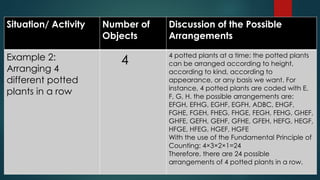
Situation/ Activity Number of
Objects
Discussion of the Possible
Arrangements
Example 2:
Arranging 4
different potted
plants in a row
4
4 potted plants at a time: the potted plants
can be arranged according to height,
according to kind, according to
appearance, or any basis we want. For
instance, 4 potted plants are coded with E,
F, G, H. the possible arrangements are:
EFGH, EFHG, EGHF, EGFH, ADBC, EHGF,
FGHE, FGEH, FHEG, FHGE, FEGH, FEHG, GHEF,
GHFE, GEFH, GEHF, GFHE, GFEH, HEFG, HEGF,
HFGE, HFEG, HGEF, HGFE
With the use of the Fundamental Principle of
Counting: 4×3×2×1=24
Therefore, there are 24 possible
arrangements of 4 potted plants in a row.
Situation/ Activity Number of
Objects
Discussion of the Possible
Arrangements
Example 3:
Electing a
Mathematics club
president, vice-
president and a
secretary from 10
members
10 (Note: It’s hard making a list of
all possible arrangements when
the list is long)
The number of possible
outcomes for the different
position is given below:
President- 10 possible choices
Vice President- 9 possible
choices
Secretary- 8 possible choices
Situation/ Activity Number of
Objects
Discussion of the Possible
Arrangements
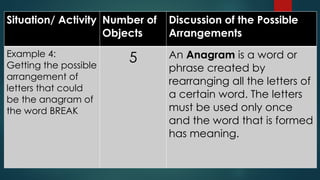
Example 4:
Getting the possible
arrangement of
letters that could
be the anagram of
the word BREAK
5 An Anagram is a word or
phrase created by
rearranging all the letters of
a certain word. The letters
must be used only once
and the word that is formed
has meaning.
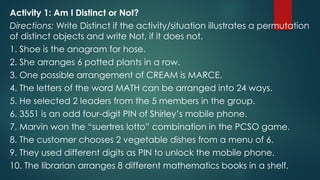
Activity 1: Am I Distinct or Not?
Directions: Write Distinct if the activity/situation illustrates a permutation
of distinct objects and write Not, if it does not.
1. Shoe is the anagram for hose.
2. She arranges 6 potted plants in a row.
3. One possible arrangement of CREAM is MARCE.
4. The letters of the word MATH can be arranged into 24 ways.
5. He selected 2 leaders from the 5 members in the group.
6. 3551 is an odd four-digit PIN of Shirley’s mobile phone.
7. Marvin won the “suertres lotto” combination in the PCSO game.
8. The customer chooses 2 vegetable dishes from a menu of 6.
9. They used different digits as PIN to unlock the mobile phone.
10. The librarian arranges 8 different mathematics books in a shelf.
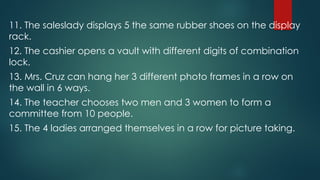
11. The saleslady displays 5 the same rubber shoes on the display
rack.
12. The cashier opens a vault with different digits of combination
lock.
13. Mrs. Cruz can hang her 3 different photo frames in a row on
the wall in 6 ways.
14. The teacher chooses two men and 3 women to form a
committee from 10 people.
15. The 4 ladies arranged themselves in a row for picture taking.
Activity 2: Fill Me In
Directions: Read each statement below and fill in the blank with the correct
answer. (Note: answers may be more than one word)
1. ______________ refers to the different arrangement of objects in a definitive
manner.
2. There are two types of permutations of objects in a line. These are
_____________________ and _______________________.
3. _____________________ refers to the number of arrangements of distinct objects.
4. In permutation of distinct objects, the objects are not _______________.
5. The four _________________ helps to illustrate permutation of objects. The counting
techniques such as ________________, _________________, __________________ and
__________________ help to describe and count the number of possible
arrangement of objects.
Activity 3: Find Ways!
Directions: Read, understand and answer the problem below.
Problem: Vice Ganda is a well-known artist. Suppose he is
planning to have a concert tour in the following four cities –
Davao, Cagayan de Oro, Malaybalay and Valencia, list and
count the number of ways he can arrange his possible tour
schedules.
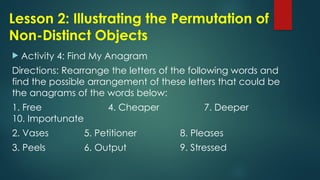
Lesson 2: Illustrating the Permutation of
Non-Distinct Objects
 Activity 4: Find My Anagram
Directions: Rearrange the letters of the following words and
find the possible arrangement of these letters that could be
the anagrams of the words below:
1. Free 4. Cheaper 7. Deeper
10. Importunate
2. Vases 5. Petitioner 8. Pleases
3. Peels 6. Output 9. Stressed
Permutation of Non-distinct Objects
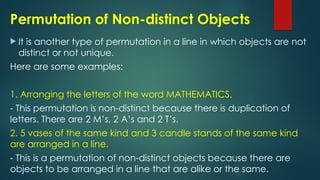
 It is another type of permutation in a line in which objects are not
distinct or not unique.
Here are some examples:
1. Arranging the letters of the word MATHEMATICS.
- This permutation is non-distinct because there is duplication of
letters. There are 2 M’s, 2 A’s and 2 T’s.
2. 5 vases of the same kind and 3 candle stands of the same kind
are arranged in a line.
- This is a permutation of non-distinct objects because there are
objects to be arranged in a line that are alike or the same.
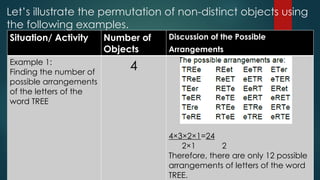
Let’s illustrate the permutation of non-distinct objects using
the following examples.
Situation/ Activity Number of
Objects
Discussion of the Possible
Arrangements
Example 1:
Finding the number of
possible arrangements
of the letters of the
word TREE
4
4×3×2×1=24
2×1 2
Therefore, there are only 12 possible
arrangements of letters of the word
TREE.
Example 2:
Displaying 5 flags in which 3 are red and 2 are
yellow
Example 3:
Assigning the same feed to 3 pigs and
another feed to 3 pigs
Activity 5: True or False
Directions: Write TRUE if the statement is true and write FALSE if it is
otherwise.
1. 10589 is the 5- non-distinct digit PIN of my phone.
2. DIVIDE is the anagram for DIVISION.
3. There are 7 ways to write in order, the word “ARRANGE.”
4. One possible arrangement of ADD is DAD.
5. WHEREVER is a permutation of non-distinct objects.
6. EVERYWHERE is not a permutation of non-distinct objects.
7. It takes 100 ways to arrange the letters of the word LETTER.
8. One possible arrangement of the letters of the word
MULTIPLICATION is MULTIPLY.
9. There are 12 possible arrangements of letters of the word ROOM.
10. 5 persons lining up, does not involve permutation of non-distinct
objects.
11. The objects to be arranged in permutation of non-distinct
objects are unique.
12. Getting the anagram of BUTTER is an example of permutation of
non-distinct objects.
13. Permutation of non-distinct objects is a different arrangement
where objects are not distinct.
14. You can form 180 different words with or without meaning if you
rearrange the letters of the word BETTER.
15. Putting 3 plates of the same design and 3 glasses of the same
size in a row on the table involves permutation of non-distinct
objects.
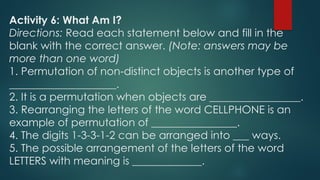
Activity 6: What Am I?
Directions: Read each statement below and fill in the
blank with the correct answer. (Note: answers may be
more than one word)
1. Permutation of non-distinct objects is another type of
____________________.
2. It is a permutation when objects are _________________.
3. Rearranging the letters of the word CELLPHONE is an
example of permutation of ________________.
4. The digits 1-3-3-1-2 can be arranged into ___ ways.
5. The possible arrangement of the letters of the word
LETTERS with meaning is _____________.
Activity 7: Line it up!
Directions: Read, understand and answer the problem
below.
Problem: The covered court of Kitaotao National High
School is to be lined up with flags. In how many ways that
the 10 flags can be arranged if there are 5 blue, 3 red
and 2 white flags?
Lesson 3: Illustrating the Circular
Permutation of Objects
Activity 8: Possible Arrangement
Directions: Read, understand and answer the
problem below.
Problem: Joelle has 3 guests, A, B and C. She needs
to arrange them around a circular table. What are
the possible arrangements?
A Circular permutation is a type of
permutation where the different objects are
arranged in a circular manner.
Here are some examples:
1. 3 people are seated around a circular table.
2. 5 different keys are arranged in a key ring.
3. 6 different beads on a bracelet
Let’s find out how to illustrate the circular permutation of
objects given another set of examples.
Situation/ Activity Number of
Objects
Discussion of the Possible
Arrangements
Example 1:
3 people are
seated sitting
around a circular
table
3
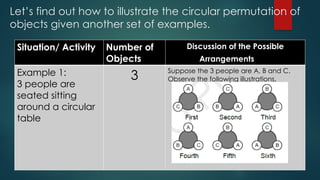
Suppose the 3 people are A, B and C.
Observe the following illustrations.
Situation/ Activity Number of
Objects
Discussion of the Possible
Arrangements
Example 2:
4 campers
sitting around a
campfire
4 Suppose the campers are A, B, C and D.
The possible arrangements of 4 campers
are:
Directions: Read each question carefully and choose the letter
that corresponds to the correct answer.
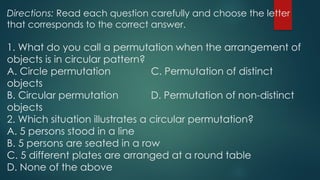
1. What do you call a permutation when the arrangement of
objects is in circular pattern?
A. Circle permutation C. Permutation of distinct
objects
B. Circular permutation D. Permutation of non-distinct
objects
2. Which situation illustrates a circular permutation?
A. 5 persons stood in a line
B. 5 persons are seated in a row
C. 5 different plates are arranged at a round table
D. None of the above
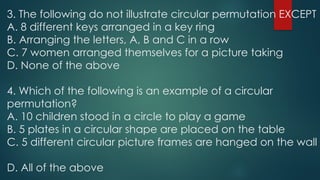
3. The following do not illustrate circular permutation EXCEPT
A. 8 different keys arranged in a key ring
B. Arranging the letters, A, B and C in a row
C. 7 women arranged themselves for a picture taking
D. None of the above
4. Which of the following is an example of a circular
permutation?
A. 10 children stood in a circle to play a game
B. 5 plates in a circular shape are placed on the table
C. 5 different circular picture frames are hanged on the wall
D. All of the above
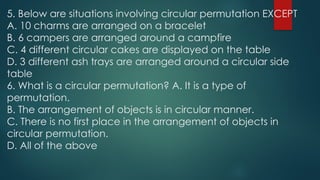
5. Below are situations involving circular permutation EXCEPT
A. 10 charms are arranged on a bracelet
B. 6 campers are arranged around a campfire
C. 4 different circular cakes are displayed on the table
D. 3 different ash trays are arranged around a circular side
table
6. What is a circular permutation? A. It is a type of
permutation.
B. The arrangement of objects is in circular manner.
C. There is no first place in the arrangement of objects in
circular permutation.
D. All of the above
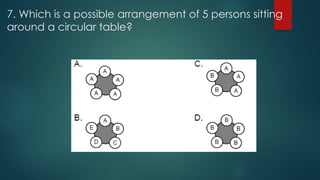
7. Which is a possible arrangement of 5 persons sitting
around a circular table?
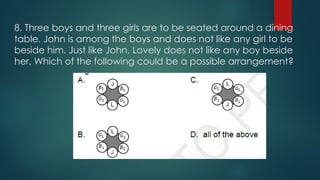
8. Three boys and three girls are to be seated around a dining
table. John is among the boys and does not like any girl to be
beside him. Just like John, Lovely does not like any boy beside
her. Which of the following could be a possible arrangement?
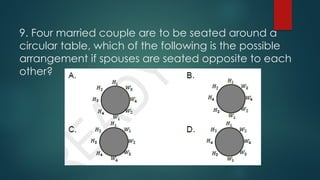
9. Four married couple are to be seated around a
circular table, which of the following is the possible
arrangement if spouses are seated opposite to each
other?
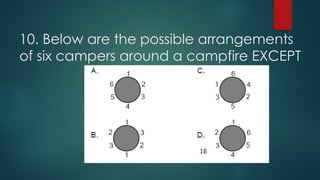
10. Below are the possible arrangements
of six campers around a campfire EXCEPT
Permutation Math 10 Quarter 3 Module 1.pptx

Permutation Math 10 Quarter 3 Module 1.pptx

  • 1.
    Illustrating Permutation of Objects LESSON 1– ILLUSTRATING THE PERMUTATION OF DISTINCT OBJECTS
  • 2.
    Four Techniques inCounting Events  Making a table is a technique where values or different possibilities are tabulated.  Tree diagram is another technique which uses line segments originating from an event to an outcome. This is a picture of all possible outcomes when an event is unfolded.  Systematic listing is a counting technique that involves a complete list of all possible outcomes.  Fundamental Principle of Counting is a counting technique in which if two events are independent and one event occurs in a ways, and the other event occurs in b ways, then, these events occur in ab ways.
  • 3.
    Try this! There are4 cyclists in a race. In how many ways will they be ranked as first, second, and third placers?  Making a table
  • 4.
    Thus, there are24 possible arrangements.
  • 5.
     Systematic listing Thereare only four cyclists: A, B, C and D. There are four cyclists to choose from for the first place, three cyclists to choose from for the second place and two cyclists to choose from for the third place.  The actual list of all possible arrangements is ABC, ABD, ACB, ACD, ADB, ADC, BAC, BAD, BCA, BCD, BDA, BDC, CAB, CAD, CBA, CBD, CDA, CDB, DAB, DAC, DBA, DBC, DCA, DCB.  Therefore, there are 24 possible arrangements.
  • 6.
  • 7.
    Permutation  A Permutationrefers to the different arrangement of objects in a definitive manner, in which the order of the objects is important. There are two types of permutations, permutations of objects in a line and permutations of objects in a circle. Permutation of distinct objects and permutation of non-distinct objects are the two kinds of permutations of objects in a line.
  • 8.
    What is apermutation of distinct objects?  A Permutation of distinct objects refers to the different arrangements of distinct objects in a line. It is the different arrangements when no objects are identical or the same. Here are some examples: 1. Arranging 4 different potted plants in a row - What makes this a permutation of distinct objects is that, 4 different potted plants are distinct objects and are arranged in a line. 2. Getting the possible arrangements of letters of READ - The four letters in READ are all distinct letters and are arranged in a line. 3. Choosing a president, a vice president, a secretary and a treasurer from the 12 members in a club
  • 9.
    Let’s illustrate thepermutation of distinct objects using a different set of examples. Situation/ Activity Number of Objects Discussion of the Possible Arrangements Example 1: Arranging 3 different mathematics books in a shelf 3 3 books at a time: Suppose the three different mathematics books have titles, Algebra, Geometry, and Statistics. Let us code them with letters A, G, S respectively. The possible arrangements are: AGS, ASG, GSA, GAS, SAG, SGA With the use of the Fundamental Principle of Counting: 3×2×1=6 Thus, there are 6 possible arrangements of mathematics books in a shelf.
  • 10.
    Situation/ Activity Numberof Objects Discussion of the Possible Arrangements Example 2: Arranging 4 different potted plants in a row 4 4 potted plants at a time: the potted plants can be arranged according to height, according to kind, according to appearance, or any basis we want. For instance, 4 potted plants are coded with E, F, G, H. the possible arrangements are: EFGH, EFHG, EGHF, EGFH, ADBC, EHGF, FGHE, FGEH, FHEG, FHGE, FEGH, FEHG, GHEF, GHFE, GEFH, GEHF, GFHE, GFEH, HEFG, HEGF, HFGE, HFEG, HGEF, HGFE With the use of the Fundamental Principle of Counting: 4×3×2×1=24 Therefore, there are 24 possible arrangements of 4 potted plants in a row.
  • 11.
    Situation/ Activity Numberof Objects Discussion of the Possible Arrangements Example 3: Electing a Mathematics club president, vice- president and a secretary from 10 members 10 (Note: It’s hard making a list of all possible arrangements when the list is long) The number of possible outcomes for the different position is given below: President- 10 possible choices Vice President- 9 possible choices Secretary- 8 possible choices
  • 12.
    Situation/ Activity Numberof Objects Discussion of the Possible Arrangements Example 4: Getting the possible arrangement of letters that could be the anagram of the word BREAK 5 An Anagram is a word or phrase created by rearranging all the letters of a certain word. The letters must be used only once and the word that is formed has meaning.
  • 13.
    Activity 1: AmI Distinct or Not? Directions: Write Distinct if the activity/situation illustrates a permutation of distinct objects and write Not, if it does not. 1. Shoe is the anagram for hose. 2. She arranges 6 potted plants in a row. 3. One possible arrangement of CREAM is MARCE. 4. The letters of the word MATH can be arranged into 24 ways. 5. He selected 2 leaders from the 5 members in the group. 6. 3551 is an odd four-digit PIN of Shirley’s mobile phone. 7. Marvin won the “suertres lotto” combination in the PCSO game. 8. The customer chooses 2 vegetable dishes from a menu of 6. 9. They used different digits as PIN to unlock the mobile phone. 10. The librarian arranges 8 different mathematics books in a shelf.
  • 14.
    11. The salesladydisplays 5 the same rubber shoes on the display rack. 12. The cashier opens a vault with different digits of combination lock. 13. Mrs. Cruz can hang her 3 different photo frames in a row on the wall in 6 ways. 14. The teacher chooses two men and 3 women to form a committee from 10 people. 15. The 4 ladies arranged themselves in a row for picture taking.
  • 15.
    Activity 2: FillMe In Directions: Read each statement below and fill in the blank with the correct answer. (Note: answers may be more than one word) 1. ______________ refers to the different arrangement of objects in a definitive manner. 2. There are two types of permutations of objects in a line. These are _____________________ and _______________________. 3. _____________________ refers to the number of arrangements of distinct objects. 4. In permutation of distinct objects, the objects are not _______________. 5. The four _________________ helps to illustrate permutation of objects. The counting techniques such as ________________, _________________, __________________ and __________________ help to describe and count the number of possible arrangement of objects.
  • 16.
    Activity 3: FindWays! Directions: Read, understand and answer the problem below. Problem: Vice Ganda is a well-known artist. Suppose he is planning to have a concert tour in the following four cities – Davao, Cagayan de Oro, Malaybalay and Valencia, list and count the number of ways he can arrange his possible tour schedules.
  • 17.
    Lesson 2: Illustratingthe Permutation of Non-Distinct Objects  Activity 4: Find My Anagram Directions: Rearrange the letters of the following words and find the possible arrangement of these letters that could be the anagrams of the words below: 1. Free 4. Cheaper 7. Deeper 10. Importunate 2. Vases 5. Petitioner 8. Pleases 3. Peels 6. Output 9. Stressed
  • 18.
    Permutation of Non-distinctObjects  It is another type of permutation in a line in which objects are not distinct or not unique. Here are some examples: 1. Arranging the letters of the word MATHEMATICS. - This permutation is non-distinct because there is duplication of letters. There are 2 M’s, 2 A’s and 2 T’s. 2. 5 vases of the same kind and 3 candle stands of the same kind are arranged in a line. - This is a permutation of non-distinct objects because there are objects to be arranged in a line that are alike or the same.
  • 19.
    Let’s illustrate thepermutation of non-distinct objects using the following examples. Situation/ Activity Number of Objects Discussion of the Possible Arrangements Example 1: Finding the number of possible arrangements of the letters of the word TREE 4 4×3×2×1=24 2×1 2 Therefore, there are only 12 possible arrangements of letters of the word TREE.
  • 20.
    Example 2: Displaying 5flags in which 3 are red and 2 are yellow Example 3: Assigning the same feed to 3 pigs and another feed to 3 pigs
  • 21.
    Activity 5: Trueor False Directions: Write TRUE if the statement is true and write FALSE if it is otherwise. 1. 10589 is the 5- non-distinct digit PIN of my phone. 2. DIVIDE is the anagram for DIVISION. 3. There are 7 ways to write in order, the word “ARRANGE.” 4. One possible arrangement of ADD is DAD. 5. WHEREVER is a permutation of non-distinct objects. 6. EVERYWHERE is not a permutation of non-distinct objects. 7. It takes 100 ways to arrange the letters of the word LETTER. 8. One possible arrangement of the letters of the word MULTIPLICATION is MULTIPLY. 9. There are 12 possible arrangements of letters of the word ROOM. 10. 5 persons lining up, does not involve permutation of non-distinct objects.
  • 22.
    11. The objectsto be arranged in permutation of non-distinct objects are unique. 12. Getting the anagram of BUTTER is an example of permutation of non-distinct objects. 13. Permutation of non-distinct objects is a different arrangement where objects are not distinct. 14. You can form 180 different words with or without meaning if you rearrange the letters of the word BETTER. 15. Putting 3 plates of the same design and 3 glasses of the same size in a row on the table involves permutation of non-distinct objects.
  • 23.
    Activity 6: WhatAm I? Directions: Read each statement below and fill in the blank with the correct answer. (Note: answers may be more than one word) 1. Permutation of non-distinct objects is another type of ____________________. 2. It is a permutation when objects are _________________. 3. Rearranging the letters of the word CELLPHONE is an example of permutation of ________________. 4. The digits 1-3-3-1-2 can be arranged into ___ ways. 5. The possible arrangement of the letters of the word LETTERS with meaning is _____________.
  • 24.
    Activity 7: Lineit up! Directions: Read, understand and answer the problem below. Problem: The covered court of Kitaotao National High School is to be lined up with flags. In how many ways that the 10 flags can be arranged if there are 5 blue, 3 red and 2 white flags?
  • 25.
    Lesson 3: Illustratingthe Circular Permutation of Objects Activity 8: Possible Arrangement Directions: Read, understand and answer the problem below. Problem: Joelle has 3 guests, A, B and C. She needs to arrange them around a circular table. What are the possible arrangements?
  • 26.
    A Circular permutationis a type of permutation where the different objects are arranged in a circular manner. Here are some examples: 1. 3 people are seated around a circular table. 2. 5 different keys are arranged in a key ring. 3. 6 different beads on a bracelet
  • 27.
    Let’s find outhow to illustrate the circular permutation of objects given another set of examples. Situation/ Activity Number of Objects Discussion of the Possible Arrangements Example 1: 3 people are seated sitting around a circular table 3 Suppose the 3 people are A, B and C. Observe the following illustrations.
  • 28.
    Situation/ Activity Numberof Objects Discussion of the Possible Arrangements Example 2: 4 campers sitting around a campfire 4 Suppose the campers are A, B, C and D. The possible arrangements of 4 campers are:
  • 29.
    Directions: Read eachquestion carefully and choose the letter that corresponds to the correct answer. 1. What do you call a permutation when the arrangement of objects is in circular pattern? A. Circle permutation C. Permutation of distinct objects B. Circular permutation D. Permutation of non-distinct objects 2. Which situation illustrates a circular permutation? A. 5 persons stood in a line B. 5 persons are seated in a row C. 5 different plates are arranged at a round table D. None of the above
  • 30.
    3. The followingdo not illustrate circular permutation EXCEPT A. 8 different keys arranged in a key ring B. Arranging the letters, A, B and C in a row C. 7 women arranged themselves for a picture taking D. None of the above 4. Which of the following is an example of a circular permutation? A. 10 children stood in a circle to play a game B. 5 plates in a circular shape are placed on the table C. 5 different circular picture frames are hanged on the wall D. All of the above
  • 31.
    5. Below aresituations involving circular permutation EXCEPT A. 10 charms are arranged on a bracelet B. 6 campers are arranged around a campfire C. 4 different circular cakes are displayed on the table D. 3 different ash trays are arranged around a circular side table 6. What is a circular permutation? A. It is a type of permutation. B. The arrangement of objects is in circular manner. C. There is no first place in the arrangement of objects in circular permutation. D. All of the above
  • 32.
    7. Which isa possible arrangement of 5 persons sitting around a circular table?
  • 33.
    8. Three boysand three girls are to be seated around a dining table. John is among the boys and does not like any girl to be beside him. Just like John, Lovely does not like any boy beside her. Which of the following could be a possible arrangement?
  • 34.
    9. Four marriedcouple are to be seated around a circular table, which of the following is the possible arrangement if spouses are seated opposite to each other?
  • 35.
    10. Below arethe possible arrangements of six campers around a campfire EXCEPT

Editor's Notes

  • #3 To answer this problem, we can use any of the four counting techniques mentioned above.
  • #6 Take a second look at the problem above and do the following. 1. Describe the arrangement of cyclists as first, second, and third placers. Is the order of arrangement important? 2. Is the list of possible arrangements of cyclists that are made, complete and actual? 3. What do you call each possible arrangement of cyclists?
  • #7 But in this lesson our focus is the permutation of distinct objects.
  • #8  - A president can’t be a vice president or a secretary or a treasurer at the same time. Hence, 4 different officers are to be chosen from the 12 members
  • #11 3 members at a time: Suppose the names of the 10 members: J. Gubaton A. Perez I. Macamay R. Cruz N. Torres F. Leon T. Fernandez H. Santos G. Sanchez B. Garcia One possible result is: President- J. Gubaton Vice-President- I. Macamay Secretary- F. Leon This is different from the other possible results, like: President- H. Santos Vice-President- R. Cruz Secretary- J. Gubaton With the use of the Fundamental Principle of Counting: 10×9×8=720 There are 720 possible ways of electing Mathematics club President, Vice President and Secretary.
  • #12 Since we are getting the possible arrangements of letters of BREAK that has meaning, then the possible words that could be formed are BRAKE and BAKER. Thus, there are only 2 possible arrangements.
  • #17 What have you observed with the letters of the words above? Is there duplication of the letters in the words?
  • #19 Since the two E’s are the same, we can’t make a distinction between the two. Thus, let us use upper case for one E and lower case for the other e. The possible arrangements are: Now, these two E’s are the same. Thus, TREe and TReE are also the same. Therefore, there are 12 possible arrangements of letters of the word TREE. We can also use the Fundamental Principle of Counting and since there are four letters in the word TREE and there are two E’s for each permutation like T-R-E-E, the duplication is eliminated by dividing
  • #20 Let R for the red flag and Y for the yellow flag. The possible arrangements of the 5 flags on display are: RRRYY, RRYYR, RRYRY, RYYRR, RYRYR, RYRRY, YYRRR, YRRRY, YRYRR, YRRYR. With the use of the fundamental counting principle: Since there are 5 flags in all and 3 red flags and 2 yellow flags, the duplication is eliminated by dividing 5×4×3×2×1/3×2×1×2×1=120/12 Therefore, there are 10 possible ways of displaying the 5 flags. Suppose these pigs are used in a study to compare 2 different feeds. Each of these feeds are to be used on 3 randomly selected pigs. Let’s assume that the 2 different feeds are A and B. The possible ways the feeds can be used on pigs are: AAABBB, AABBBA, AABBAB, AABABB, ABBBAA, ABBAAB, ABAABB, ABBABA, ABABAB, ABABBA, BBBAAA, BBAAAB, BBAABA, BBABAA, BAAABB, BAABBA, BABBAA, BAABAB, BABABA, BABAAB. With the use of the fundamental counting principle: Since there are 6 pigs in all and 3 pigs are used for the same feed and another 3 pigs for another the same feed, the duplication is eliminated by dividing 6×5×4×3×2×1/3×2×1×3×2×1=720/36 Hence, there are 20 possible ways the feeds can be used on pigs.
  • #25 The problem above involves circular permutation. What is a circular permutation?
  • #27 Notice that the first, second, and third arrangements are the same. Though the positions of the guests have been moved, but they are still in the same position in relation to one another. There is no first place in the arrangement of guests. When each guest moves his position by one place, may it be clockwise or counterclockwise, it does not change the relative positions. The same is true with fourth, fifth and sixth arrangements. These three arrangements as well are the same. Thus, the three guests can be arranged around a circular table in only 2 ways. Observe how the same letters A, B and C can be arranged in a line. ABC ACB CAB BAC BCA CBA Notice that the letters can be arranged in 6 ways in a line but the arrangements of them in circular manner is just 2 ways because the arrangements falling in each column are just the same since the 3 guests are supposed to be seated around a circular table. With the use of the Fundamental Principle of Counting, getting the number of possible arrangement of objects in a circular manner is by just dividing the possible arrangements of objects in a line by the number of objects involve in the circular permutation. Like: 3×2×1/3=6/3 Thus, there are 2 ways that the three guests can be arranged around a circular table.
  • #28 With the use of the Fundamental Principle of Counting: Since there are 4 objects involved, then, 4×3×2×1/4=24/4 Therefore, there are 6 possible arrangements of the 4 campers sitting around a campfire.