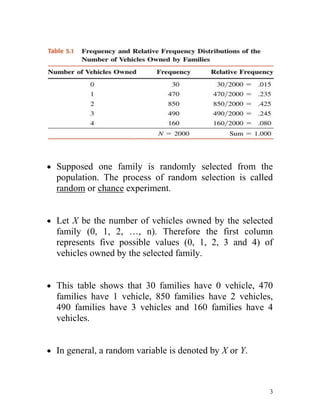
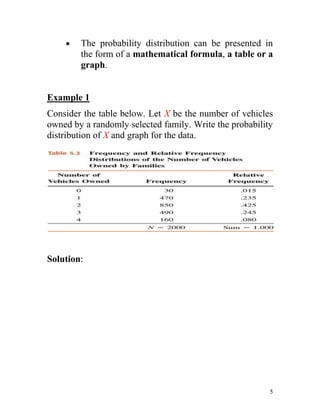
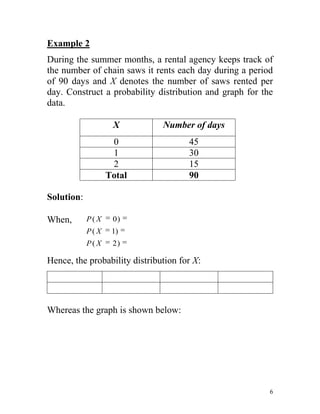
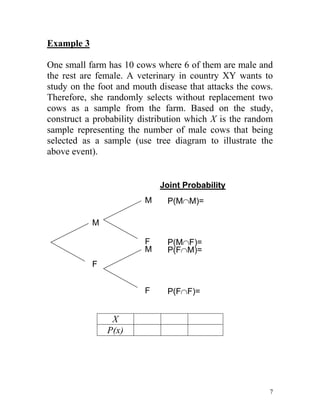
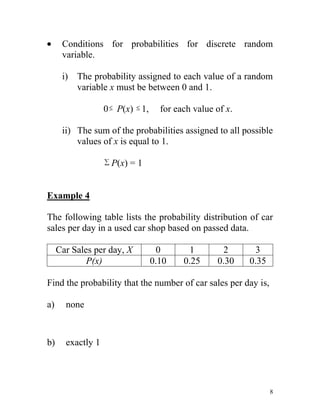
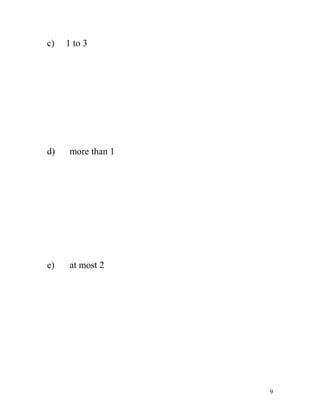
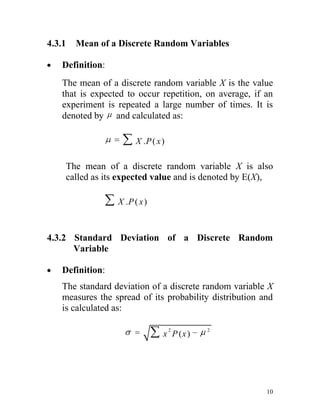
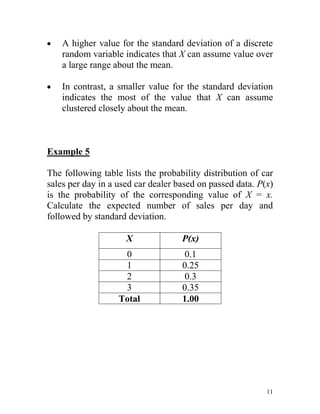
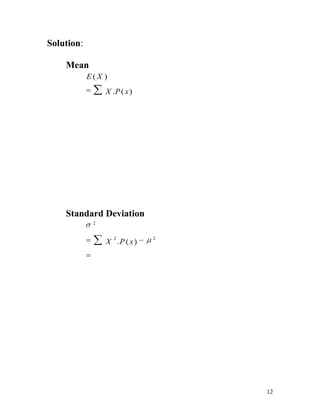
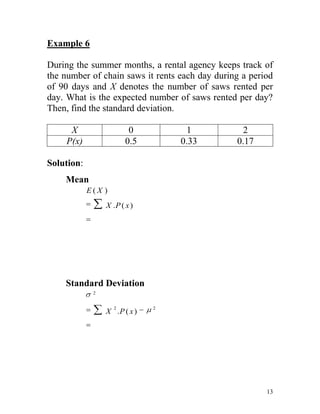
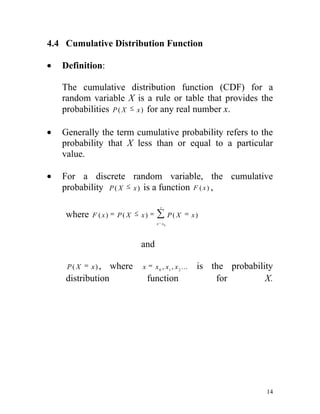
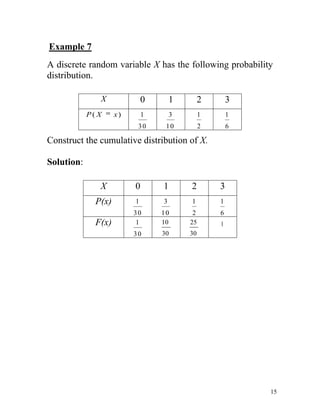
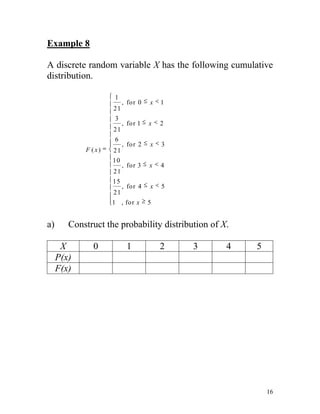
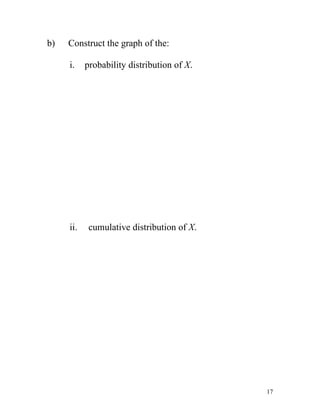
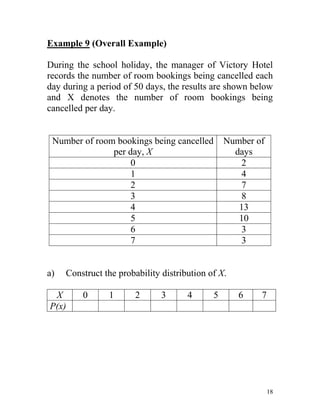
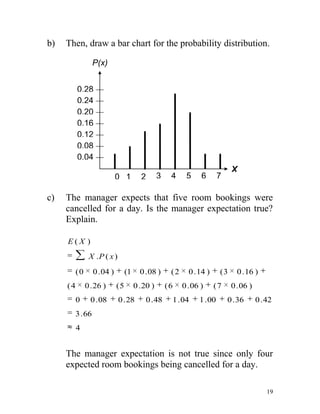
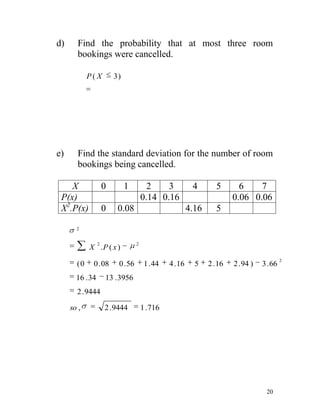
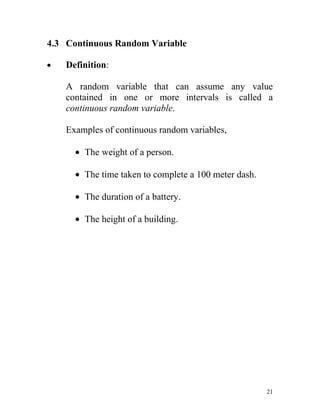
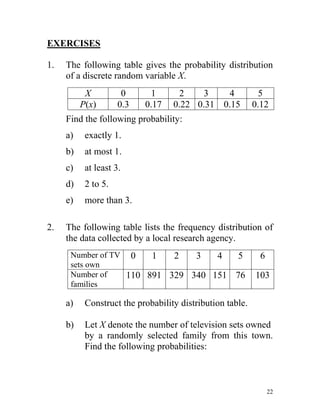
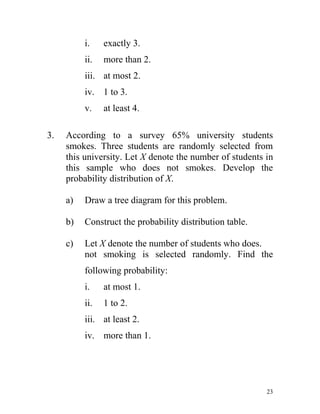
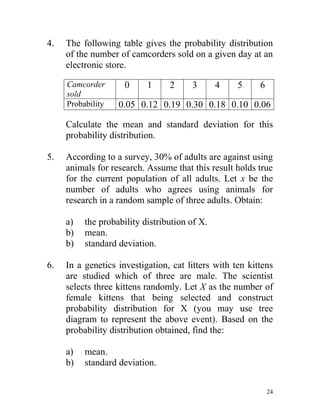
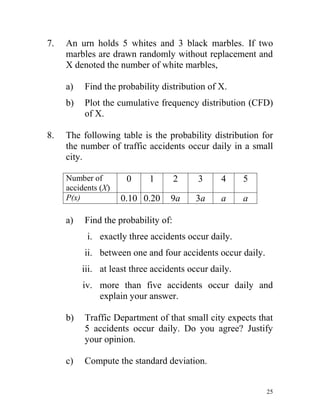
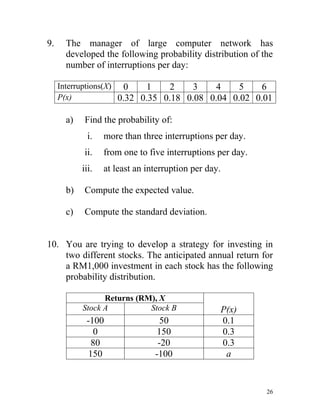
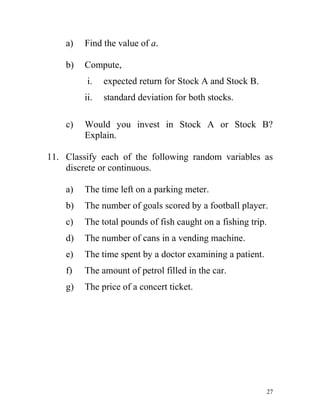
Chapter Outline4.1Random VariableDiscrete Random VariableProbability Distribution of a Discrete Random Variable4.3.1Mean of a Discrete Random Variable4.3.2Standard Deviation of a Discrete Random Variable4.4Cumulative Distribution Function for Discrete Random Variable4.5Continuous Random VariableObjectivesAfter completing this chapter, you should be able to:Interpret that a random variable is a numerical quantity whose value depends on the conditions and probabilities associated with an experiment.Differentiate between a discrete and a continuous random variable.Construct a discrete probability distribution based on an experiment or given function.Determine the similarities and differences between frequency distributions and probability distribution.Compute, describe and interpret the mean and standard deviation of a probability distribution.Random VariableDefinition:A random variable is a variable whose value is determined by the outcome of a random experiment.Supposed one family is randomly selected from the population. The process of random selection is called random or chance experiment.Let X be the number of vehicles owned by the selected family (0, 1, 2, …, n). Therefore the first column represents five possible values (0, 1, 2, 3 and 4) of vehicles owned by the selected family.This table shows that 30 families have 0 vehicle, 470 families have 1 vehicle, 850 families have 2 vehicles, 490 families have 3 vehicles and 160 families have 4 vehicles.In general, a random variable is denoted by X or Y.Discrete Random VariableDefinition:A random variable that assumes countable values is called discrete random variable.Examples of discrete random variables:Number of houses sold by a developer in a given month.Number of cars rented at a rental shop during a given month.Number of report received at the police station on a given day.Number of fish caught on a fishing trip.Probability Distribution of a Discrete Random          VariableDefinition:The probability distribution of a discrete random variable lists all the possible values that the random variable can assume and their corresponding probabilities.It is used to represent populations.The probability distribution can be presented in the form of a mathematical formula, a table or a graph. Example 1Consider the table below. Let X be the number of vehicles owned by a randomly selected family. Write the probability distribution of X and graph for the data.Solution:Example 2During the summer months, a rental agency keeps track of the number of chain saws it rents each day during a period of 90 days and X denotes the number of saws rented per day. Construct a probability distribution and graph for the data.XNumber of days045130215Total90Solution:When,  Hence, the probability distribution for X:Whereas the graph is shown below:Example 3One small farm has 10 cows where 6 of them are male and the rest are female. A veterinary in country XY wants to study on the foot and mouth disease that attacks the cows. Therefore, she randomly selects without replacement two cows as a sample from the farm. Based on the study, construct a probability distribution which X is the random sample representing the number of male cows that being selected as a sample (use tree diagram to illustrate the above event).MFMFMFJoint ProbabilityP(MM)=P(MF)=P(FM)=P(FF)=XP(x)Conditions for probabilities for discrete random variable.The probability assigned to each value of a random variable x must be between 0 and 1.0 P(x) 1,for each value of x.The sum of the probabilities assigned to all possible values of x is equal to 1.P(x) = 1Example 4The following table lists the probability distribution of car sales per day in a used car shop based on passed data.Car Sales per day, X0123P(x)0.100.250.300.35Find the probability that the number of car sales per day is,noneexactly 11 to 3more than 1at most 24.3.1 Mean of a Discrete Random VariablesDefinition:The mean of a discrete random variable X is the value that is expected to occur repetition, on average, if an experiment is repeated a large number of times. It is denoted by  and calculated as:       The mean of a discrete random variable X is also called as its expected value and is denoted by E(X),4.3.2 Standard Deviation of a Discrete Random VariableDefinition:The standard deviation of a discrete random variable X measures the spread of its probability distribution and is calculated as:                 A higher value for the standard deviation of a discrete random variable indicates that X can assume value over a large range about the mean. In contrast, a smaller value for the standard deviation indicates the most of the value that X can assume clustered closely about the mean.Example 5The following table lists the probability distribution of car sales per day in a used car dealer based on passed data. P(x) is the probability of the corresponding value of X = x. Calculate the expected number of sales per day and followed by standard deviation.XP(x)00.110.2520.330.35Total1.00Solution:MeanStandard DeviationExample 6 During the summer months, a rental agency keeps track of the number of chain saws it rents each day during a period of 90 days and X denotes the number of saws rented per day. What is the expected number of saws rented per day? Then, find the standard deviation.X012P(x)0.50.330.17Solution:Mean Standard DeviationCumulative Distribution FunctionDefinition:The cumulative distribution function (CDF) for a random variable X is a rule or table that provides the probabilities  for any real number x. Generally the term cumulative probability refers to the probability that X less than or equal to a particular value.For a discrete random variable, the cumulative probability   is a function , where and , where  is the probability distribution function for X.Example 7A discrete random variable X has the following probability distribution.X0123Construct the cumulative distribution of X.Solution:X0123P(x)F(x)Example 8 A discrete random variable X has the following cumulative distribution.a) Construct the probability distribution of X.X012345P(x)F(x)b) Construct the graph of the:i.probability distribution of X.cumulative distribution of X.Example 9 (Overall Example)During the school holiday, the manager of Victory Hotel records the number of room bookings being cancelled each day during a period of 50 days, the results are shown below and X denotes the number of room bookings being cancelled per day.Number of room bookings being cancelled per day, XNumber of days021427384135106373Construct the probability distribution of X. X01234567P(x)Then, draw a bar chart for the probability distribution.X0.040.080.120.200.16012P(x)30.24450.2867The manager expects that five room bookings were cancelled for a day. Is the manager expectation true? Explain.The manager expectation is not true since only four expected room bookings being cancelled for a day.Find the probability that at most three room bookings were cancelled.Find the standard deviation for the number of room bookings being cancelled.X01234567P(x)0.140.160.060.06X2.P(x)00.084.165Continuous Random VariableDefinition:A random variable that can assume any value contained in one or more intervals is called a continuous random variable.Examples of continuous random variables,The weight of a person.The time taken to complete a 100 meter dash.The duration of a battery.The height of a building.EXERCISES1.The following table gives the probability distribution of a discrete random variable X.X012345P(x)0.30.170.220.310.150.12Find the following probability:a)exactly 1.b)at most 1.c)at least 3.d)2 to 5.e)more than 3.2.The following table lists the frequency distribution of the data collected by a local research agency.Number of TV sets own0123456Number of families11089132934015176103a)Construct the probability distribution table.b)Let X denote the number of television sets owned by a randomly selected family from this town. Find the following probabilities:i.exactly 3.ii.more than 2.iii.at most 2.iv.1 to 3.v.at least 4.3.According to a survey 65% university students smokes. Three students are randomly selected from this university. Let X denote the number of students in this sample who does not smokes. Develop the probability distribution of X.a)Draw a tree diagram for this problem.b)Construct the probability distribution table.c)Let X denote the number of students who does. not smoking is selected randomly. Find the following probability:i.at most 1.ii.1 to 2.at least 2.more than 1.4.The following table gives the probability distribution of the number of camcorders sold on a given day at an electronic store.Camcorder sold0123456Probability0.050.120.190.300.180.100.06Calculate the mean and standard deviation for this probability distribution.5.According to a survey, 30% of adults are against using animals for research. Assume that this result holds true for the current population of all adults. Let x be the number of adults who agrees using animals for research in a random sample of three adults. Obtain: a)the probability distribution of X.b)mean.standard deviation.In a genetics investigation, cat litters with ten kittens are studied which of three are male. The scientist selects three kittens randomly. Let X as the number of female kittens that being selected and construct probability distribution for X (you may use tree diagram to represent the above event). Based on the probability distribution obtained, find the:mean.standard deviation.An urn holds 5 whites and 3 black marbles. If two marbles are drawn randomly without replacement and X denoted the number of white marbles,Find the probability distribution of X.Plot the cumulative frequency distribution (CFD) of X.The following table is the probability distribution for the number of traffic accidents occur daily in a small city. Number of accidents (X)012345P(x)0.100.209a3aaaFind the probability of:exactly three accidents occur daily.between one and four accidents occur daily.at least three accidents occur daily.more than five accidents occur daily and explain your answer.Traffic Department of that small city expects that 5 accidents occur daily. Do you agree? Justify your opinion.Compute the standard deviation.The manager of large computer network has developed the following probability distribution of the number of interruptions per day:Interruptions(X)0123456P(x)0.320.350.180.080.040.020.01Find the probability of:more than three interruptions per day.from one to five interruptions per day.at least an interruption per day.Compute the expected value.Compute the standard deviation.You are trying to develop a strategy for investing in two different stocks. The anticipated annual return for a RM1,000 investment in each stock has the following probability distribution.Returns (RM), XP(x)Stock AStock B-100500.101500.380-200.3150-100aFind the value of a.Compute,expected return for Stock A and Stock B.standard deviation for both stocks.Would you invest in Stock A or Stock B? Explain.11.Classify each of the following random variables as discrete or continuous.The time left on a parking meter.The number of goals scored by a football player.The total pounds of fish caught on a fishing trip.The number of cans in a vending machine.The time spent by a doctor examining a patient.The amount of petrol filled in the car.The price of a concert ticket.
Statistik Chapter 4
Statistik Chapter 4
Statistik Chapter 4
Statistik Chapter 4
Statistik Chapter 4
Statistik Chapter 4
Statistik Chapter 4
Statistik Chapter 4
Statistik Chapter 4
Statistik Chapter 4
Statistik Chapter 4
Statistik Chapter 4
Statistik Chapter 4
Statistik Chapter 4
Statistik Chapter 4
Statistik Chapter 4
Statistik Chapter 4
Statistik Chapter 4
Statistik Chapter 4
Statistik Chapter 4
Statistik Chapter 4
Statistik Chapter 4
Statistik Chapter 4
Statistik Chapter 4
Statistik Chapter 4
Statistik Chapter 4

Statistik Chapter 4

  • 1.
    Chapter Outline4.1Random VariableDiscreteRandom VariableProbability Distribution of a Discrete Random Variable4.3.1Mean of a Discrete Random Variable4.3.2Standard Deviation of a Discrete Random Variable4.4Cumulative Distribution Function for Discrete Random Variable4.5Continuous Random VariableObjectivesAfter completing this chapter, you should be able to:Interpret that a random variable is a numerical quantity whose value depends on the conditions and probabilities associated with an experiment.Differentiate between a discrete and a continuous random variable.Construct a discrete probability distribution based on an experiment or given function.Determine the similarities and differences between frequency distributions and probability distribution.Compute, describe and interpret the mean and standard deviation of a probability distribution.Random VariableDefinition:A random variable is a variable whose value is determined by the outcome of a random experiment.Supposed one family is randomly selected from the population. The process of random selection is called random or chance experiment.Let X be the number of vehicles owned by the selected family (0, 1, 2, …, n). Therefore the first column represents five possible values (0, 1, 2, 3 and 4) of vehicles owned by the selected family.This table shows that 30 families have 0 vehicle, 470 families have 1 vehicle, 850 families have 2 vehicles, 490 families have 3 vehicles and 160 families have 4 vehicles.In general, a random variable is denoted by X or Y.Discrete Random VariableDefinition:A random variable that assumes countable values is called discrete random variable.Examples of discrete random variables:Number of houses sold by a developer in a given month.Number of cars rented at a rental shop during a given month.Number of report received at the police station on a given day.Number of fish caught on a fishing trip.Probability Distribution of a Discrete Random VariableDefinition:The probability distribution of a discrete random variable lists all the possible values that the random variable can assume and their corresponding probabilities.It is used to represent populations.The probability distribution can be presented in the form of a mathematical formula, a table or a graph. Example 1Consider the table below. Let X be the number of vehicles owned by a randomly selected family. Write the probability distribution of X and graph for the data.Solution:Example 2During the summer months, a rental agency keeps track of the number of chain saws it rents each day during a period of 90 days and X denotes the number of saws rented per day. Construct a probability distribution and graph for the data.XNumber of days045130215Total90Solution:When, Hence, the probability distribution for X:Whereas the graph is shown below:Example 3One small farm has 10 cows where 6 of them are male and the rest are female. A veterinary in country XY wants to study on the foot and mouth disease that attacks the cows. Therefore, she randomly selects without replacement two cows as a sample from the farm. Based on the study, construct a probability distribution which X is the random sample representing the number of male cows that being selected as a sample (use tree diagram to illustrate the above event).MFMFMFJoint ProbabilityP(MM)=P(MF)=P(FM)=P(FF)=XP(x)Conditions for probabilities for discrete random variable.The probability assigned to each value of a random variable x must be between 0 and 1.0 P(x) 1,for each value of x.The sum of the probabilities assigned to all possible values of x is equal to 1.P(x) = 1Example 4The following table lists the probability distribution of car sales per day in a used car shop based on passed data.Car Sales per day, X0123P(x)0.100.250.300.35Find the probability that the number of car sales per day is,noneexactly 11 to 3more than 1at most 24.3.1 Mean of a Discrete Random VariablesDefinition:The mean of a discrete random variable X is the value that is expected to occur repetition, on average, if an experiment is repeated a large number of times. It is denoted by and calculated as: The mean of a discrete random variable X is also called as its expected value and is denoted by E(X),4.3.2 Standard Deviation of a Discrete Random VariableDefinition:The standard deviation of a discrete random variable X measures the spread of its probability distribution and is calculated as: A higher value for the standard deviation of a discrete random variable indicates that X can assume value over a large range about the mean. In contrast, a smaller value for the standard deviation indicates the most of the value that X can assume clustered closely about the mean.Example 5The following table lists the probability distribution of car sales per day in a used car dealer based on passed data. P(x) is the probability of the corresponding value of X = x. Calculate the expected number of sales per day and followed by standard deviation.XP(x)00.110.2520.330.35Total1.00Solution:MeanStandard DeviationExample 6 During the summer months, a rental agency keeps track of the number of chain saws it rents each day during a period of 90 days and X denotes the number of saws rented per day. What is the expected number of saws rented per day? Then, find the standard deviation.X012P(x)0.50.330.17Solution:Mean Standard DeviationCumulative Distribution FunctionDefinition:The cumulative distribution function (CDF) for a random variable X is a rule or table that provides the probabilities for any real number x. Generally the term cumulative probability refers to the probability that X less than or equal to a particular value.For a discrete random variable, the cumulative probability is a function , where and , where is the probability distribution function for X.Example 7A discrete random variable X has the following probability distribution.X0123Construct the cumulative distribution of X.Solution:X0123P(x)F(x)Example 8 A discrete random variable X has the following cumulative distribution.a) Construct the probability distribution of X.X012345P(x)F(x)b) Construct the graph of the:i.probability distribution of X.cumulative distribution of X.Example 9 (Overall Example)During the school holiday, the manager of Victory Hotel records the number of room bookings being cancelled each day during a period of 50 days, the results are shown below and X denotes the number of room bookings being cancelled per day.Number of room bookings being cancelled per day, XNumber of days021427384135106373Construct the probability distribution of X. X01234567P(x)Then, draw a bar chart for the probability distribution.X0.040.080.120.200.16012P(x)30.24450.2867The manager expects that five room bookings were cancelled for a day. Is the manager expectation true? Explain.The manager expectation is not true since only four expected room bookings being cancelled for a day.Find the probability that at most three room bookings were cancelled.Find the standard deviation for the number of room bookings being cancelled.X01234567P(x)0.140.160.060.06X2.P(x)00.084.165Continuous Random VariableDefinition:A random variable that can assume any value contained in one or more intervals is called a continuous random variable.Examples of continuous random variables,The weight of a person.The time taken to complete a 100 meter dash.The duration of a battery.The height of a building.EXERCISES1.The following table gives the probability distribution of a discrete random variable X.X012345P(x)0.30.170.220.310.150.12Find the following probability:a)exactly 1.b)at most 1.c)at least 3.d)2 to 5.e)more than 3.2.The following table lists the frequency distribution of the data collected by a local research agency.Number of TV sets own0123456Number of families11089132934015176103a)Construct the probability distribution table.b)Let X denote the number of television sets owned by a randomly selected family from this town. Find the following probabilities:i.exactly 3.ii.more than 2.iii.at most 2.iv.1 to 3.v.at least 4.3.According to a survey 65% university students smokes. Three students are randomly selected from this university. Let X denote the number of students in this sample who does not smokes. Develop the probability distribution of X.a)Draw a tree diagram for this problem.b)Construct the probability distribution table.c)Let X denote the number of students who does. not smoking is selected randomly. Find the following probability:i.at most 1.ii.1 to 2.at least 2.more than 1.4.The following table gives the probability distribution of the number of camcorders sold on a given day at an electronic store.Camcorder sold0123456Probability0.050.120.190.300.180.100.06Calculate the mean and standard deviation for this probability distribution.5.According to a survey, 30% of adults are against using animals for research. Assume that this result holds true for the current population of all adults. Let x be the number of adults who agrees using animals for research in a random sample of three adults. Obtain: a)the probability distribution of X.b)mean.standard deviation.In a genetics investigation, cat litters with ten kittens are studied which of three are male. The scientist selects three kittens randomly. Let X as the number of female kittens that being selected and construct probability distribution for X (you may use tree diagram to represent the above event). Based on the probability distribution obtained, find the:mean.standard deviation.An urn holds 5 whites and 3 black marbles. If two marbles are drawn randomly without replacement and X denoted the number of white marbles,Find the probability distribution of X.Plot the cumulative frequency distribution (CFD) of X.The following table is the probability distribution for the number of traffic accidents occur daily in a small city. Number of accidents (X)012345P(x)0.100.209a3aaaFind the probability of:exactly three accidents occur daily.between one and four accidents occur daily.at least three accidents occur daily.more than five accidents occur daily and explain your answer.Traffic Department of that small city expects that 5 accidents occur daily. Do you agree? Justify your opinion.Compute the standard deviation.The manager of large computer network has developed the following probability distribution of the number of interruptions per day:Interruptions(X)0123456P(x)0.320.350.180.080.040.020.01Find the probability of:more than three interruptions per day.from one to five interruptions per day.at least an interruption per day.Compute the expected value.Compute the standard deviation.You are trying to develop a strategy for investing in two different stocks. The anticipated annual return for a RM1,000 investment in each stock has the following probability distribution.Returns (RM), XP(x)Stock AStock B-100500.101500.380-200.3150-100aFind the value of a.Compute,expected return for Stock A and Stock B.standard deviation for both stocks.Would you invest in Stock A or Stock B? Explain.11.Classify each of the following random variables as discrete or continuous.The time left on a parking meter.The number of goals scored by a football player.The total pounds of fish caught on a fishing trip.The number of cans in a vending machine.The time spent by a doctor examining a patient.The amount of petrol filled in the car.The price of a concert ticket.