GENERAL MATHEMATICS
for SENIOR HIGH SCHOOL
Preliminary Activities
1. Opening Prayer
Opening Prayer
Heavenly Father and Your Beloved Son Jesus Christ,
Thank you for another day of being able to go to school and
learn new set of things we will experience in our classes today.
As we go through our class at this moment, give us wisdom to
understand the lessons that we will be discussing this afternoon.
Help us to be obedient, honest, and kind to one another. Bless
our teachers, our school and my fellow students.
In Jesus’ name we pray. Amen.
2. Checking of Attendance
3. Preliminary Activities
Math Puzzle
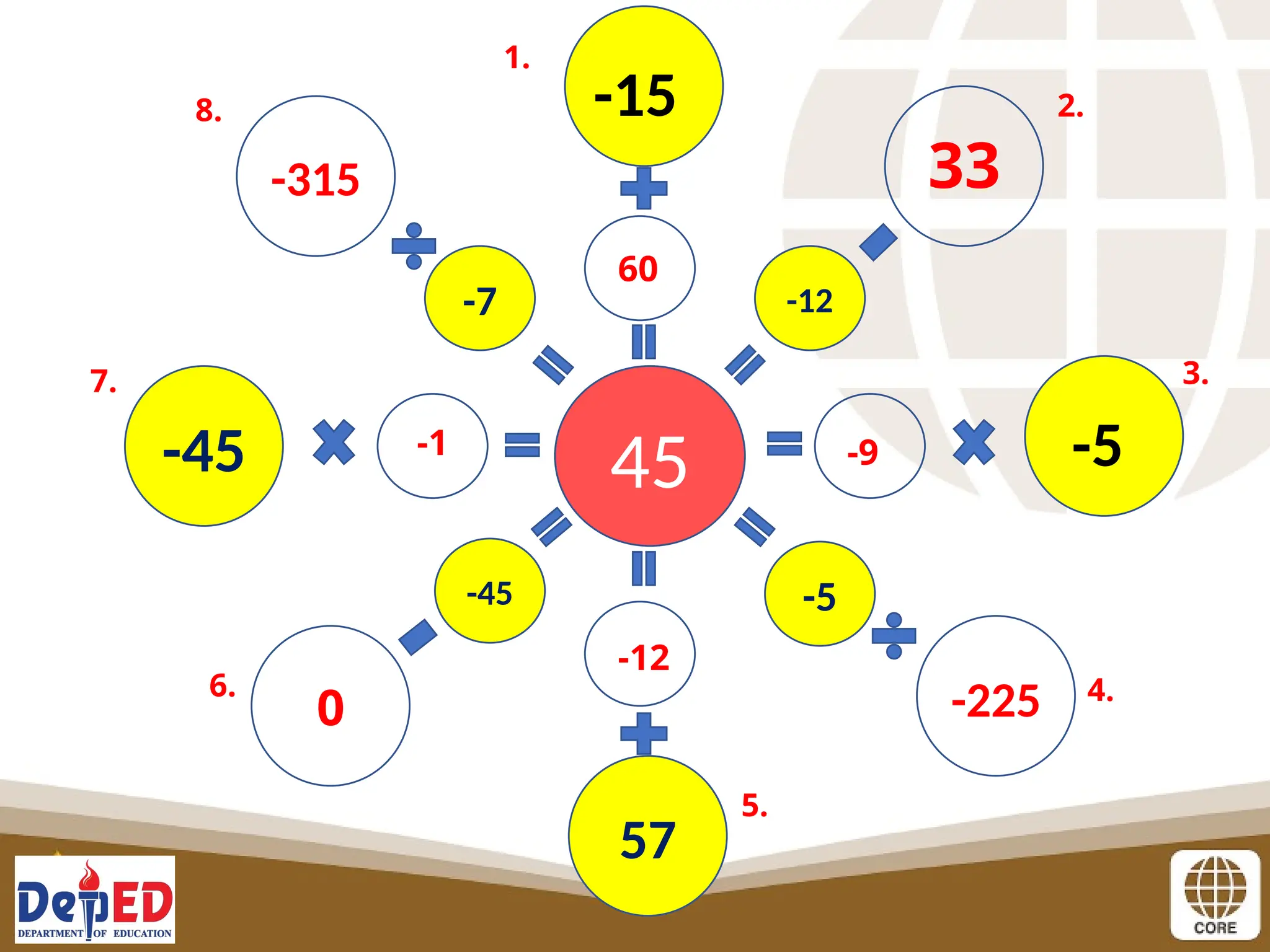
45
-12
-7
-45 -5
57
-45
-15
-5
1.
2.
3.
4.
5.
6.
7.
8.
60
33
-9
-225
-12
0
-1
-315
LESSON OBJECTIVES:
At the end of the period, the students with 80%
accuracy,
are expected to:
• Know what is a probability distribution for a discrete
random variable and its properties;
• compute probabilities corresponding to a given random
variable; and
• construct the probability mass function of a discrete
random variable
REVIEW:
DISCRETE
VARIABLES
CONTINUOUS
VARIABLES
VS
REVIEW:
DISCRETE
VARIABLES
CONTINUOUS
VARIABLES
VS
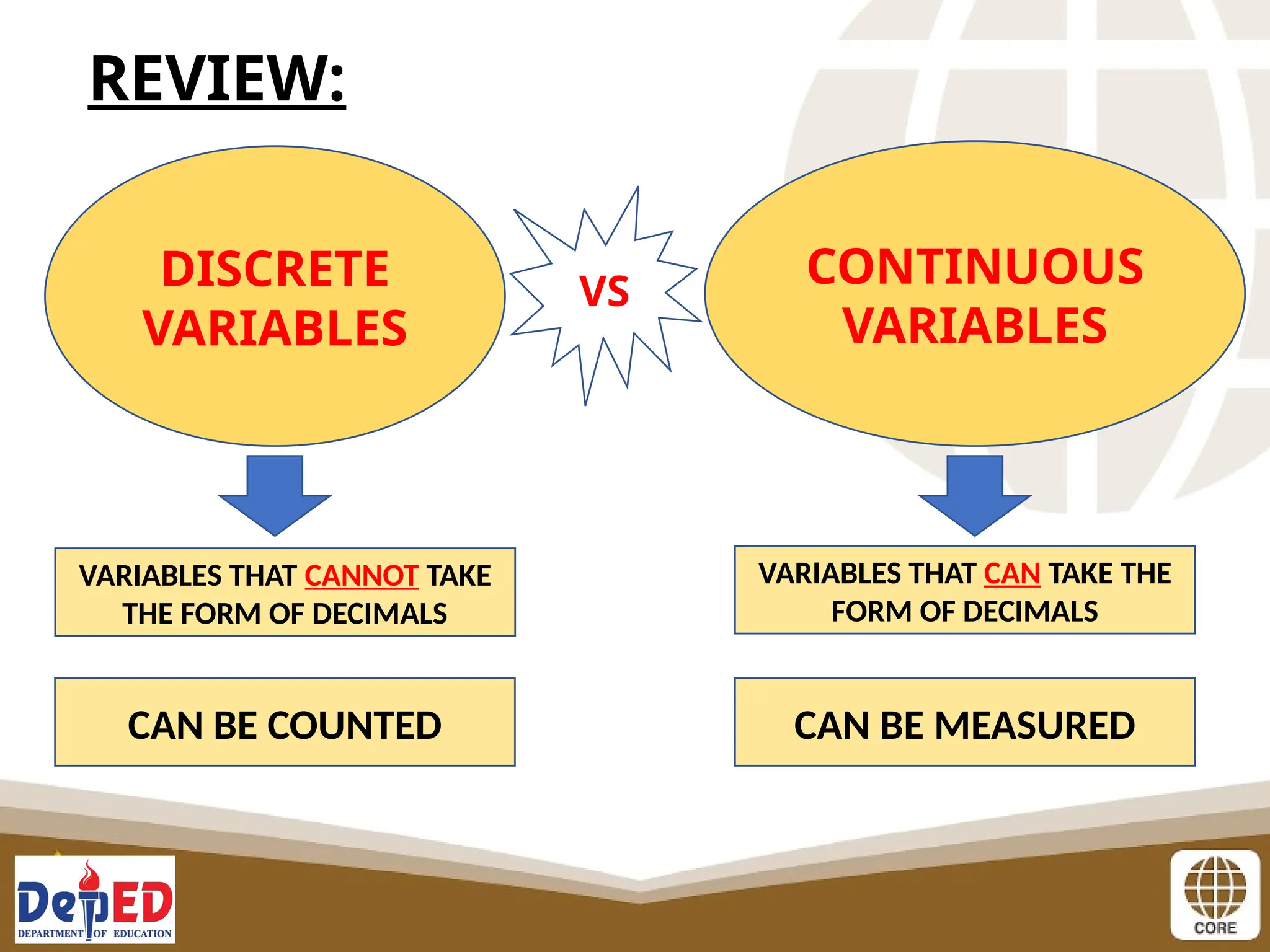
VARIABLES THAT CANNOT TAKE
THE FORM OF DECIMALS
CAN BE COUNTED
VARIABLES THAT CAN TAKE THE
FORM OF DECIMALS
CAN BE MEASURED
REVIEW:
DISCRETE
VARIABLES
CONTINUOUS
VARIABLES
VS
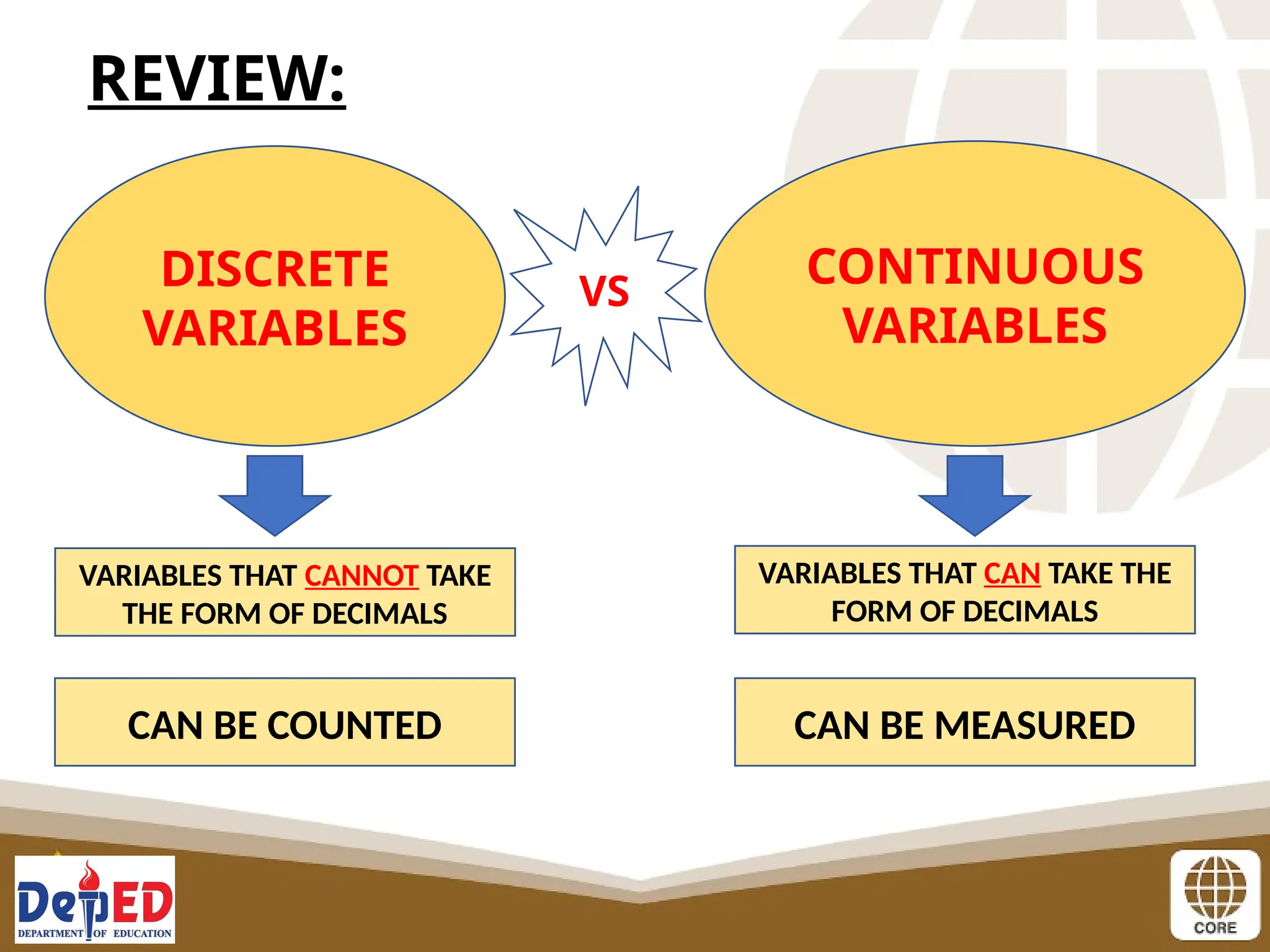
VARIABLES THAT CANNOT TAKE
THE FORM OF DECIMALS
CAN BE COUNTED
VARIABLES THAT CAN TAKE THE
FORM OF DECIMALS
CAN BE MEASURED
REVIEW:
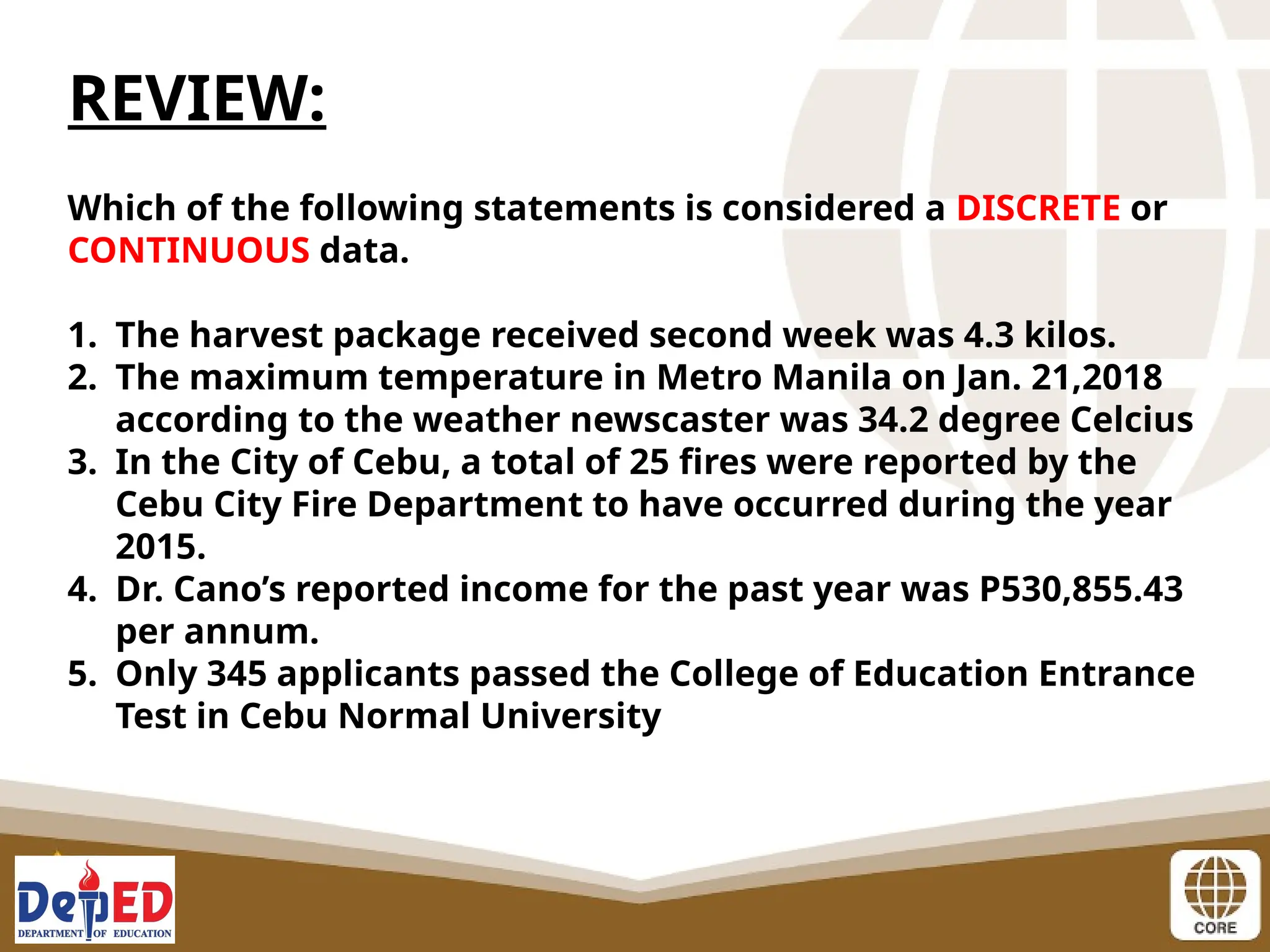
Which of the following statements is considered a DISCRETE or
CONTINUOUS data.
1. The harvest package received second week was 4.3 kilos.
2. The maximum temperature in Metro Manila on Jan. 21,2018
according to the weather newscaster was 34.2 degree Celcius
3. In the City of Cebu, a total of 25 fires were reported by the
Cebu City Fire Department to have occurred during the year
2015.
4. Dr. Cano’s reported income for the past year was P530,855.43
per annum.
5. Only 345 applicants passed the College of Education Entrance
Test in Cebu Normal University
REVIEW:
FINDING POSSIBLE VALUES OF RANDOM VARIABLES:
STEPS:
1. To determine the sample space/number
possible outcome, use where n is refers to
number of an object.
2. Make a table.
3. Identify the possible values of the random
variable.
Decision-making is an important aspect in business, education,
insurance, and other real-life situations. Many decisions are
made by assigning probabilities to all possible outcomes
pertaining to the situation and then evaluating the results.
For instance, an insurance company might be able to assign
probabilities to the number of vehicles a family owns. This
information will help the company in making decisions
regarding future financial situations. This situation requires the
use of random variables and probability distribution.
Ask: How does probability distribution relates to real-life
situation?
Lesson Introduction:
DISCUSSION ON
DISCRETE PROBABILITY
DISTRIBUTION
DISCRETE PROBABILITY
DISTRIBUTION
Also known as probability mass
function consists of the values of
random variable can assume
and the corresponding probabilities
of the values.
DISCRETE PROBABILITY
DISTRIBUTION
Properties:
1. The probability of each value of the random
variable must be between or equal to 0 and 1.
2. The sum of the probability of all values of the
random variable must be equal to 1
Illustrative Example:
Finding the probability corresponding to a given random variable
Experiment #1: Drawing balls from a basket
Two balls are drawn in succession without
replacements from a basket, contains 4 yellow
balls and 4 blue balls. Let X be the random
variable representing the number of blue balls,
Find the values of the random variable X.
• Step 1: Determine the sample space
• Step 2: List the possible outcome
• Step 3: Count the number of the variable asked
in the experiment in each outcome in the sample
space and assign this number to this outcome
Finally,
• Given the values of the possible outcomes,
solve/compute the probability P of each value of
the random variable.
Discussion Points:
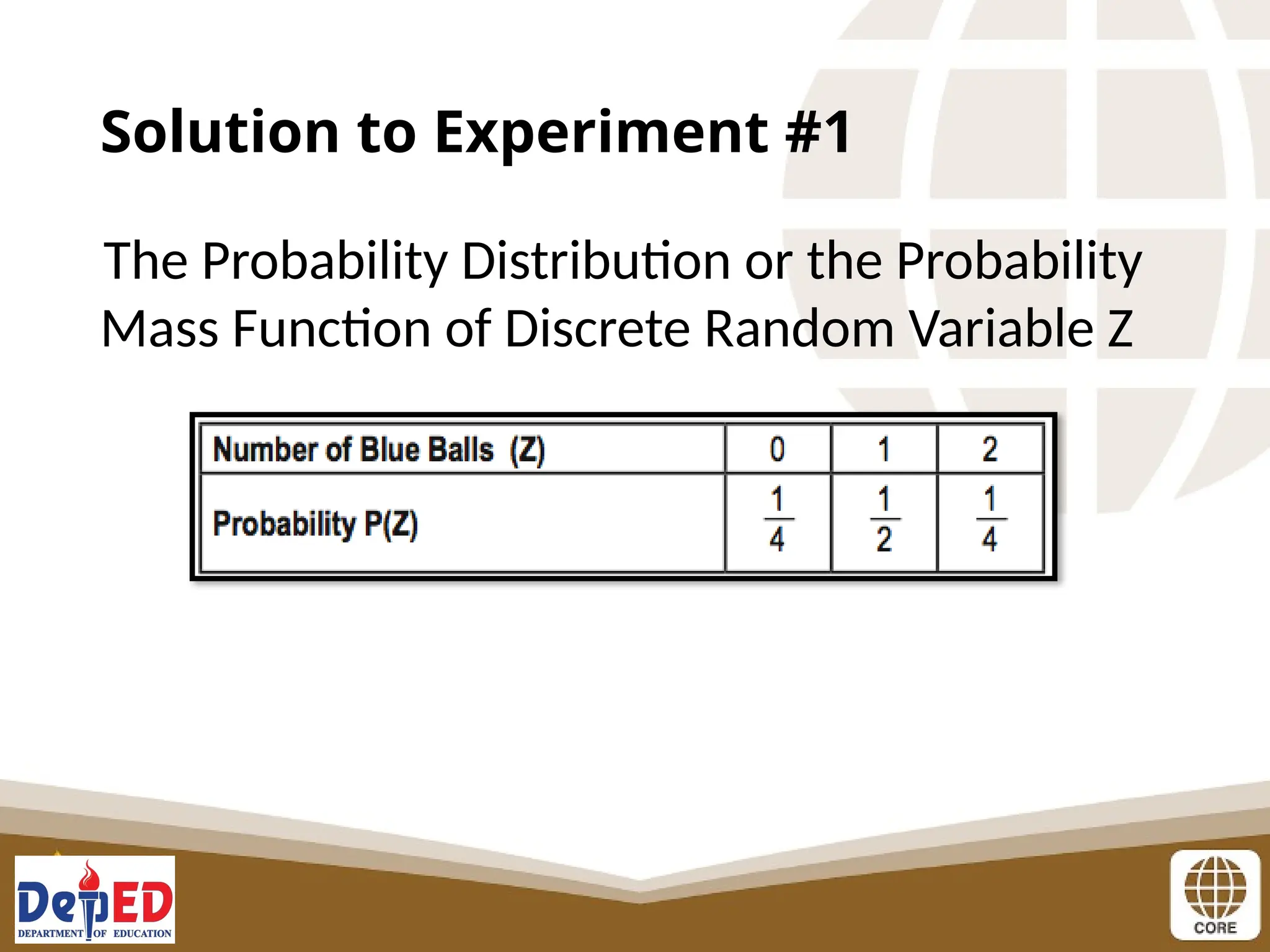
The Probability Distribution or the Probability
Mass Function of Discrete Random Variable Z
Solution to Experiment #1
Group Activity
Finding the probability corresponding to a given random variable
Experiment # 2: Tossing Three Coins
Suppose three coins are tossed. Let Y be the
random variable representing the number of
tails that occur. Find the probability of each of
the values of the random variable Y.
Group Activity
Finding the probability corresponding to a given random variable
Experiment # 3: Defective Cellphones
Suppose three cell phones are tested at random. We
want to find out the number of defective cell phones
that occur. Let D represent the defective cellphone
and N represent the non-defective cellphone. Let X
be the random variable representing the number of
defective cellphones. Construct the probability
distribution of the random variable X.
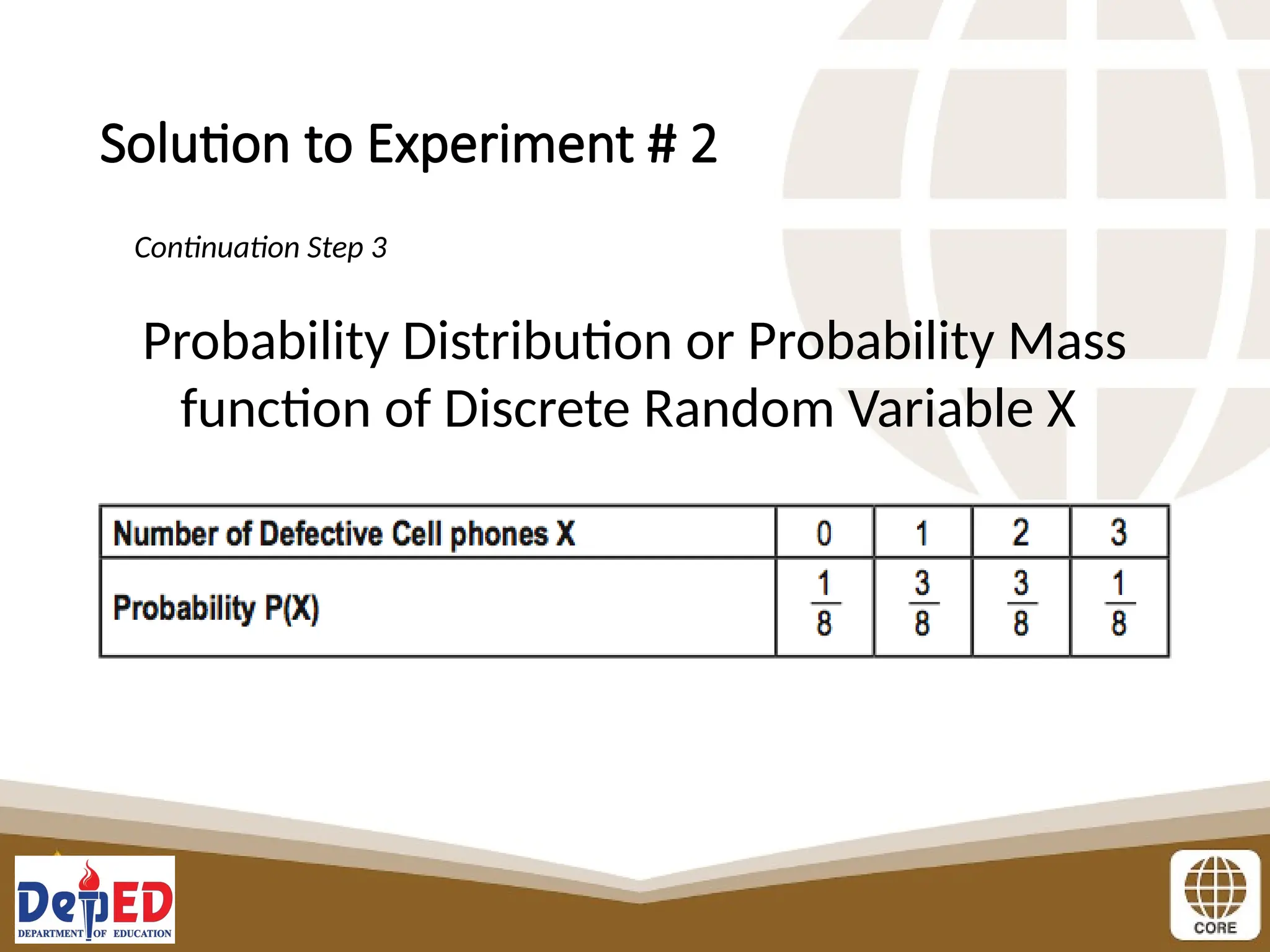
Solution to Experiment # 2
Probability Distribution or Probability Mass
function of Discrete Random Variable X
Continuation Step 3
A discrete probability distribution or a
probability mass function consists of the
values a random variable can assume and the
corresponding probabilities of the values.
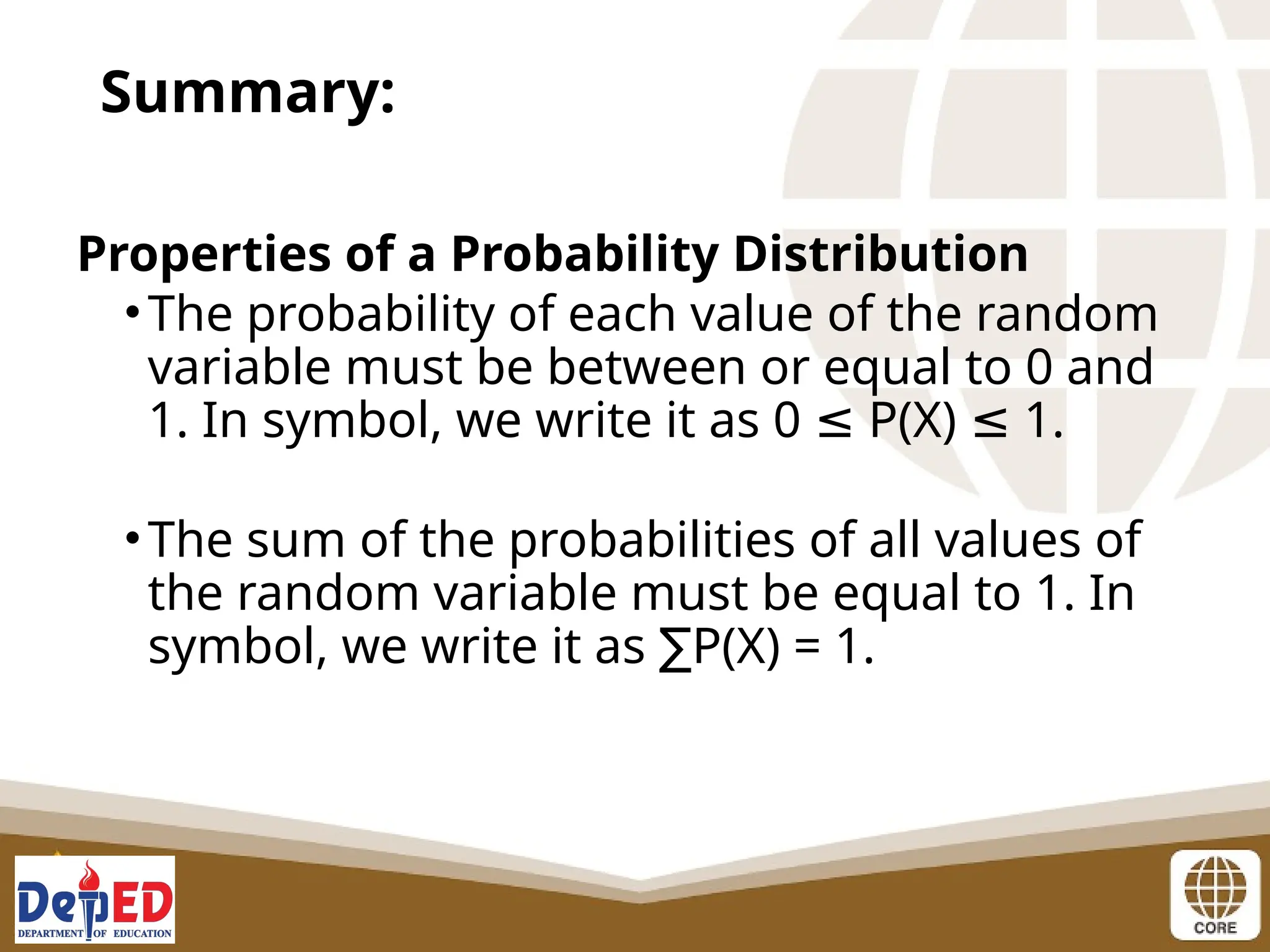
Summary:
Properties of a Probability Distribution
•The probability of each value of the random
variable must be between or equal to 0 and
1. In symbol, we write it as 0 P(X) 1.
≤ ≤
•The sum of the probabilities of all values of
the random variable must be equal to 1. In
symbol, we write it as P(X) = 1.
∑
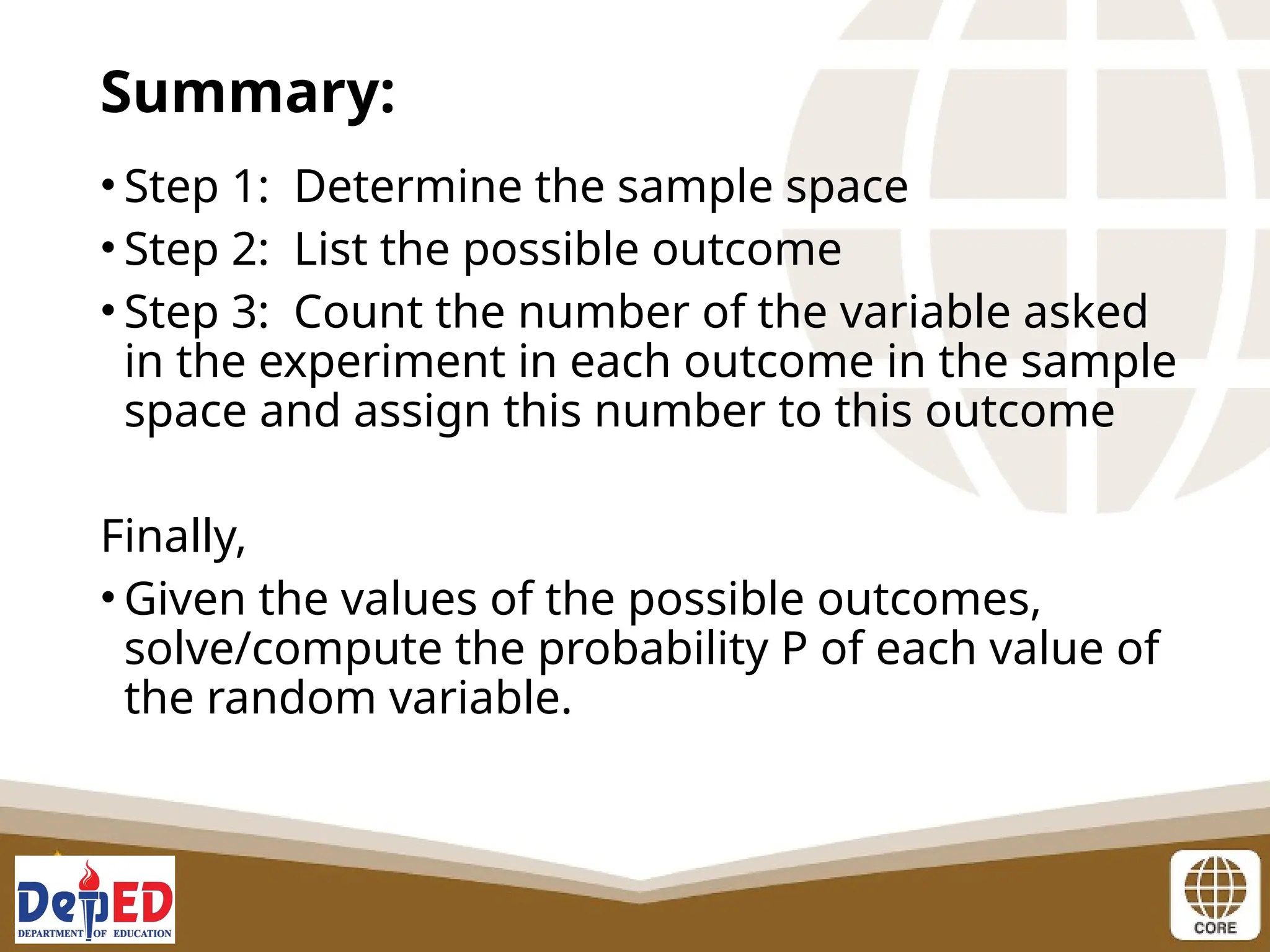
Summary:
• Step 1: Determine the sample space
• Step 2: List the possible outcome
• Step 3: Count the number of the variable asked
in the experiment in each outcome in the sample
space and assign this number to this outcome
Finally,
• Given the values of the possible outcomes,
solve/compute the probability P of each value of
the random variable.
Summary:
Assessment
•The students will answer Worksheet 3.4
•Checking of answers will follow.
•Feedbacking of results and difficulties
Assignment
•The students will answer Activity 3.2 and
Activity 3.3 pages 14 and 15 in their
Module.
•To be submitted next meeting
THOUGHTS TO PONDER:
End Activity
Closing Prayer

Discrete random variable Statistics and Probability.pptx

  • 1.
  • 2.
  • 3.
    Opening Prayer Heavenly Fatherand Your Beloved Son Jesus Christ, Thank you for another day of being able to go to school and learn new set of things we will experience in our classes today. As we go through our class at this moment, give us wisdom to understand the lessons that we will be discussing this afternoon. Help us to be obedient, honest, and kind to one another. Bless our teachers, our school and my fellow students. In Jesus’ name we pray. Amen.
  • 4.
    2. Checking ofAttendance
  • 5.
  • 6.
  • 8.
    LESSON OBJECTIVES: At theend of the period, the students with 80% accuracy, are expected to: • Know what is a probability distribution for a discrete random variable and its properties; • compute probabilities corresponding to a given random variable; and • construct the probability mass function of a discrete random variable
  • 9.
  • 10.
    REVIEW: DISCRETE VARIABLES CONTINUOUS VARIABLES VS VARIABLES THAT CANNOTTAKE THE FORM OF DECIMALS CAN BE COUNTED VARIABLES THAT CAN TAKE THE FORM OF DECIMALS CAN BE MEASURED
  • 11.
    REVIEW: DISCRETE VARIABLES CONTINUOUS VARIABLES VS VARIABLES THAT CANNOTTAKE THE FORM OF DECIMALS CAN BE COUNTED VARIABLES THAT CAN TAKE THE FORM OF DECIMALS CAN BE MEASURED
  • 12.
    REVIEW: Which of thefollowing statements is considered a DISCRETE or CONTINUOUS data. 1. The harvest package received second week was 4.3 kilos. 2. The maximum temperature in Metro Manila on Jan. 21,2018 according to the weather newscaster was 34.2 degree Celcius 3. In the City of Cebu, a total of 25 fires were reported by the Cebu City Fire Department to have occurred during the year 2015. 4. Dr. Cano’s reported income for the past year was P530,855.43 per annum. 5. Only 345 applicants passed the College of Education Entrance Test in Cebu Normal University
  • 13.
    REVIEW: FINDING POSSIBLE VALUESOF RANDOM VARIABLES: STEPS: 1. To determine the sample space/number possible outcome, use where n is refers to number of an object. 2. Make a table. 3. Identify the possible values of the random variable.
  • 14.
    Decision-making is animportant aspect in business, education, insurance, and other real-life situations. Many decisions are made by assigning probabilities to all possible outcomes pertaining to the situation and then evaluating the results. For instance, an insurance company might be able to assign probabilities to the number of vehicles a family owns. This information will help the company in making decisions regarding future financial situations. This situation requires the use of random variables and probability distribution. Ask: How does probability distribution relates to real-life situation? Lesson Introduction:
  • 15.
  • 16.
    DISCRETE PROBABILITY DISTRIBUTION Also knownas probability mass function consists of the values of random variable can assume and the corresponding probabilities of the values.
  • 17.
    DISCRETE PROBABILITY DISTRIBUTION Properties: 1. Theprobability of each value of the random variable must be between or equal to 0 and 1. 2. The sum of the probability of all values of the random variable must be equal to 1
  • 18.
    Illustrative Example: Finding theprobability corresponding to a given random variable Experiment #1: Drawing balls from a basket Two balls are drawn in succession without replacements from a basket, contains 4 yellow balls and 4 blue balls. Let X be the random variable representing the number of blue balls, Find the values of the random variable X.
  • 19.
    • Step 1:Determine the sample space • Step 2: List the possible outcome • Step 3: Count the number of the variable asked in the experiment in each outcome in the sample space and assign this number to this outcome Finally, • Given the values of the possible outcomes, solve/compute the probability P of each value of the random variable. Discussion Points:
  • 20.
    The Probability Distributionor the Probability Mass Function of Discrete Random Variable Z Solution to Experiment #1
  • 21.
    Group Activity Finding theprobability corresponding to a given random variable Experiment # 2: Tossing Three Coins Suppose three coins are tossed. Let Y be the random variable representing the number of tails that occur. Find the probability of each of the values of the random variable Y.
  • 22.
    Group Activity Finding theprobability corresponding to a given random variable Experiment # 3: Defective Cellphones Suppose three cell phones are tested at random. We want to find out the number of defective cell phones that occur. Let D represent the defective cellphone and N represent the non-defective cellphone. Let X be the random variable representing the number of defective cellphones. Construct the probability distribution of the random variable X.
  • 23.
    Solution to Experiment# 2 Probability Distribution or Probability Mass function of Discrete Random Variable X Continuation Step 3
  • 24.
    A discrete probabilitydistribution or a probability mass function consists of the values a random variable can assume and the corresponding probabilities of the values. Summary:
  • 25.
    Properties of aProbability Distribution •The probability of each value of the random variable must be between or equal to 0 and 1. In symbol, we write it as 0 P(X) 1. ≤ ≤ •The sum of the probabilities of all values of the random variable must be equal to 1. In symbol, we write it as P(X) = 1. ∑ Summary:
  • 26.
    • Step 1:Determine the sample space • Step 2: List the possible outcome • Step 3: Count the number of the variable asked in the experiment in each outcome in the sample space and assign this number to this outcome Finally, • Given the values of the possible outcomes, solve/compute the probability P of each value of the random variable. Summary:
  • 27.
    Assessment •The students willanswer Worksheet 3.4 •Checking of answers will follow. •Feedbacking of results and difficulties
  • 28.
    Assignment •The students willanswer Activity 3.2 and Activity 3.3 pages 14 and 15 in their Module. •To be submitted next meeting
  • 29.
  • 30.

Editor's Notes

  • #19 Suppose three cell phones are tested at random. We want to find out the number of defective cell phones that occur. Thus, to each outcome in the sample space we shall assign a value. These are 0, 1, 2, or 3. If there is no defective cell phone, we assign the number 0; if there is 1 defective cell phone, we assign the number 1; if there are two defective cell phones, we assign the number 2; and 3, if there are three defective cell phones. The number of defective cell phones is a random variable. The possible values of this random variable are 0, 1, 2, and 3.
  • #26 Suppose three cell phones are tested at random. We want to find out the number of defective cell phones that occur. Thus, to each outcome in the sample space we shall assign a value. These are 0, 1, 2, or 3. If there is no defective cell phone, we assign the number 0; if there is 1 defective cell phone, we assign the number 1; if there are two defective cell phones, we assign the number 2; and 3, if there are three defective cell phones. The number of defective cell phones is a random variable. The possible values of this random variable are 0, 1, 2, and 3.