Privilege Levels
Computer system security measures prevent Users from interfering with one another Users from examining secure data Program bugs from damaging other programs Program bugs from damaging data Malicious attempts to compromise system integrity Accidental damage to data
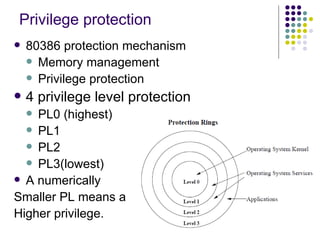
Privilege protection 80386 protection mechanism Memory management Privilege protection 4 privilege level protection PL0 (highest) PL1 PL2 PL3(lowest) A numerically  Smaller PL means a Higher privilege.
When running in protected mode, the 80386 continually checks that the application is privileged enough to Execute certain instructions. Reference data other than its own. Transfer control to code other than its own.
Executing privileged instructions Privilege instructions Modify interrupt flag Alter segmentation Affect protection mechanism They are allowed only if the program is running at  PL0
References to other data Shared data Programs are not allowed to read or write data items that have a higher privilege level.
Transferring control to other code Programs are not allowed to  CALL  or  JMP  to code that does not have exactly the same privilege level that they do.
Defining privilege levels Privileges are assigned by segment. Everything contained in a segment have same privilege. The privilege level is defined in the segment descriptors. The privilege level of the code segment determines the current privilege level(CPL).
Privileged instructions 19 instructions Privilege instructions are those That affect the segmentation  and protection mechanism  CPL=0  Alter interrupt flag Perform peripheral I/O  CPL <IOPL numerically A numerically smaller PL means a higher privilege level
Privileged instructions HLT  (Halts the processor) CLTS   (Clear task switch flag) LGDT,LIDT,LLDT(Loads GDT,IDT,LDT register) LTR  (Load task register) LMSW  (Load machine status word) Mov CRn,….  (moves to control register) Mov DRn,..  (moved to debug registers) Mov TRn,….  (moves to test registers)
IOPL sensitive instructions CLI Disables interrupts STI Enables interrupts IN Inputs data from I/O port Out Outputs data to output port
Privildged Data References Second type of privilege checking DPL of code segment descriptor must have smaller value (higher privilege)than DPL of data segment  descriptor.
After u have placed each descriptor in a descriptor table, you need to inform the processor U can place theses tables anywhere in the processor’s address space and u need not keep them together.  To allow processor to locate the GDT, IDT and current LDT, u load three special purpose registers, GDTR, IDTR,LDTR resply.
GDTR,IDTR,LDTR contains Base address of table Limit
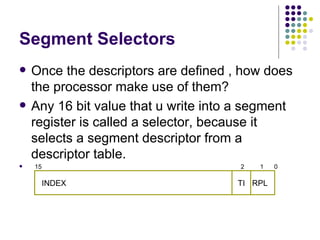
Segment Selectors Once the descriptors are defined , how does the processor make use of them? Any 16 bit value that u write into a segment register is called a selector, because it selects a segment descriptor from a descriptor table. 15  2  1  0  INDEX  RPL TI
80386 segment registers 80386 has 6 segment registers One for current code segment(CS) One for current stack segment (SS) Four for general data segments (DS, ES,FS,GS) Segment registers select segment descriptors: Thirteen bits select descriptors One bit selects descriptor table Two bits privilege checking
Loading Segment Selectors Any given selector value selects one and only one descriptor When loading segment selector ,the 80386 check that The selector index is within the descriptor table limit The selector references the correct descriptor table The descriptor is of correct type The selector uses  the correct privilege level
GDT GDT 0 GDT 1 GDT 2 GDTR Offset Index 2  1  0 TI RPL
SEGMENTATION Addressing  GDT Prog GDT Main Memory Index 2  1  0 TI RPL GD 0 GD 1 GD 2 GDTR Offset
Addressing  GDT GD 0 GD 1 GD 2 Main Memory Base Address Seg Limit Attrib Index 3  2  1  0 TI RPL GDTR Offset
GD 0 GD 1 GD 2 GDTR Index 2  1  0 TI RPL GDT Base Address Seg Limit Attrib + Offset
Local Descriptor Tables(LDT’s) LDT’s act like extension to GDT Are assigned to individual tasks when task switching is done. While running, any program can assess descriptors from GDT and LDT The way in which the processor locates LDT’s is much different, however.
Descriptor LDT Descriptor Descriptor Descriptor Data Descriptor Descriptor GDT LDT GDTR LDTR 1 DS ESI
Local Descriptor table Hold segment descriptors May be used in addition to the global descriptor table Are defined by special “system descriptor” in GDT. May be larger or smaller than GDT. May not be define other LDTs

Privilege levels 80386

  • 1.
  • 2.
    Computer system securitymeasures prevent Users from interfering with one another Users from examining secure data Program bugs from damaging other programs Program bugs from damaging data Malicious attempts to compromise system integrity Accidental damage to data
  • 3.
    Privilege protection 80386protection mechanism Memory management Privilege protection 4 privilege level protection PL0 (highest) PL1 PL2 PL3(lowest) A numerically Smaller PL means a Higher privilege.
  • 4.
    When running inprotected mode, the 80386 continually checks that the application is privileged enough to Execute certain instructions. Reference data other than its own. Transfer control to code other than its own.
  • 5.
    Executing privileged instructionsPrivilege instructions Modify interrupt flag Alter segmentation Affect protection mechanism They are allowed only if the program is running at PL0
  • 6.
    References to otherdata Shared data Programs are not allowed to read or write data items that have a higher privilege level.
  • 7.
    Transferring control toother code Programs are not allowed to CALL or JMP to code that does not have exactly the same privilege level that they do.
  • 8.
    Defining privilege levelsPrivileges are assigned by segment. Everything contained in a segment have same privilege. The privilege level is defined in the segment descriptors. The privilege level of the code segment determines the current privilege level(CPL).
  • 9.
    Privileged instructions 19instructions Privilege instructions are those That affect the segmentation and protection mechanism CPL=0 Alter interrupt flag Perform peripheral I/O CPL <IOPL numerically A numerically smaller PL means a higher privilege level
  • 10.
    Privileged instructions HLT (Halts the processor) CLTS (Clear task switch flag) LGDT,LIDT,LLDT(Loads GDT,IDT,LDT register) LTR (Load task register) LMSW (Load machine status word) Mov CRn,…. (moves to control register) Mov DRn,.. (moved to debug registers) Mov TRn,…. (moves to test registers)
  • 11.
    IOPL sensitive instructionsCLI Disables interrupts STI Enables interrupts IN Inputs data from I/O port Out Outputs data to output port
  • 12.
    Privildged Data ReferencesSecond type of privilege checking DPL of code segment descriptor must have smaller value (higher privilege)than DPL of data segment descriptor.
  • 13.
    After u haveplaced each descriptor in a descriptor table, you need to inform the processor U can place theses tables anywhere in the processor’s address space and u need not keep them together. To allow processor to locate the GDT, IDT and current LDT, u load three special purpose registers, GDTR, IDTR,LDTR resply.
  • 14.
    GDTR,IDTR,LDTR contains Baseaddress of table Limit
  • 15.
    Segment Selectors Oncethe descriptors are defined , how does the processor make use of them? Any 16 bit value that u write into a segment register is called a selector, because it selects a segment descriptor from a descriptor table. 15 2 1 0 INDEX RPL TI
  • 16.
    80386 segment registers80386 has 6 segment registers One for current code segment(CS) One for current stack segment (SS) Four for general data segments (DS, ES,FS,GS) Segment registers select segment descriptors: Thirteen bits select descriptors One bit selects descriptor table Two bits privilege checking
  • 17.
    Loading Segment SelectorsAny given selector value selects one and only one descriptor When loading segment selector ,the 80386 check that The selector index is within the descriptor table limit The selector references the correct descriptor table The descriptor is of correct type The selector uses the correct privilege level
  • 18.
    GDT GDT 0GDT 1 GDT 2 GDTR Offset Index 2 1 0 TI RPL
  • 19.
    SEGMENTATION Addressing GDT Prog GDT Main Memory Index 2 1 0 TI RPL GD 0 GD 1 GD 2 GDTR Offset
  • 20.
    Addressing GDTGD 0 GD 1 GD 2 Main Memory Base Address Seg Limit Attrib Index 3 2 1 0 TI RPL GDTR Offset
  • 21.
    GD 0 GD1 GD 2 GDTR Index 2 1 0 TI RPL GDT Base Address Seg Limit Attrib + Offset
  • 22.
    Local Descriptor Tables(LDT’s)LDT’s act like extension to GDT Are assigned to individual tasks when task switching is done. While running, any program can assess descriptors from GDT and LDT The way in which the processor locates LDT’s is much different, however.
  • 23.
    Descriptor LDT DescriptorDescriptor Descriptor Data Descriptor Descriptor GDT LDT GDTR LDTR 1 DS ESI
  • 24.
    Local Descriptor tableHold segment descriptors May be used in addition to the global descriptor table Are defined by special “system descriptor” in GDT. May be larger or smaller than GDT. May not be define other LDTs