CLASS- S.E.(G)
Data Communication
Friday11.25 to 12.25
DEFINITION


       What is a Topology ?

 The physical topology of a network
refers to the configuration of cables,
 computers and other peripherals.
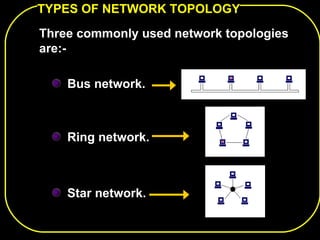
TYPES OF NETWORK TOPOLOGY
Three commonly used network topologies
are:-

    Bus network.


    Ring network.


    Star network.
BUS TOPOLOGY

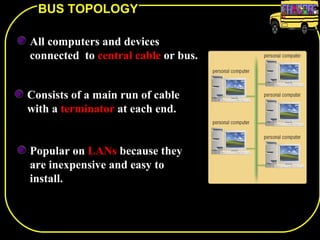
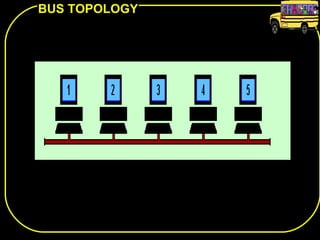
All computers and devices
connected to central cable or bus.


Consists of a main run of cable
with a terminator at each end.


Popular on LANs because they
are inexpensive and easy to
install.
BUS TOPOLOGY
BUS TOPOLOGY
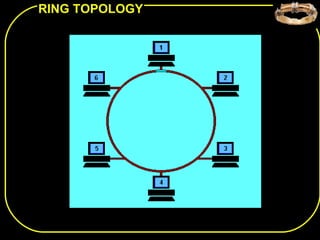
RING TOPOLOGY

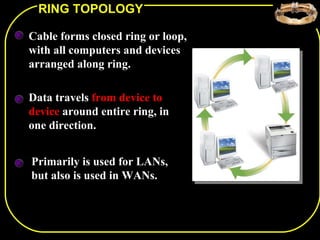
Cable forms closed ring or loop,
with all computers and devices
arranged along ring.

Data travels from device to
device around entire ring, in
one direction.


Primarily is used for LANs,
but also is used in WANs.
RING TOPOLOGY
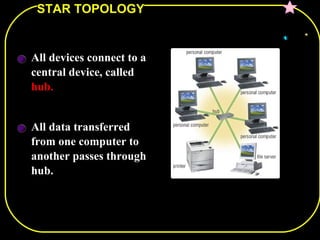
STAR TOPOLOGY


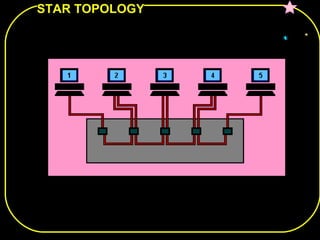
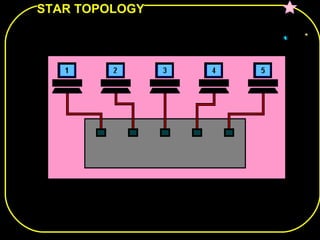
All devices connect to a
central device, called
hub.


All data transferred
from one computer to
another passes through
hub.
STAR TOPOLOGY
STAR TOPOLOGY
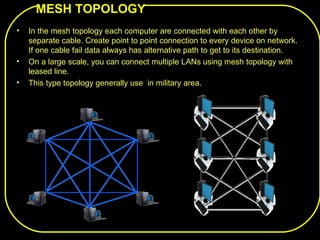
MESH TOPOLOGY
•   In the mesh topology each computer are connected with each other by
    separate cable. Create point to point connection to every device on network.
    If one cable fail data always has alternative path to get to its destination.
•   On a large scale, you can connect multiple LANs using mesh topology with
    leased line.
•   This type topology generally use in military area.
DIFFERENTIATION BETWEEN THE THREE
    TYPES OF NETWORK TOPOLOGY


 WHAT ARE THE ADVANTAGES AND
  DISADVANTAGES OF THE THREE
    OF NETWORK TOPOLOGY?
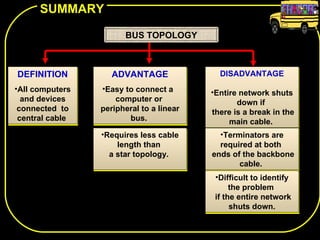
SUMMARY

                       BUS TOPOLOGY


DEFINITION          ADVANTAGE               DISADVANTAGE
•All computers   •Easy to connect a       •Entire network shuts
  and devices        computer or                 down if
 connected to    peripheral to a linear   there is a break in the
 central cable          bus.                   main cable.
                 •Requires less cable       •Terminators are
                     length than            required at both
                   a star topology.       ends of the backbone
                                                 cable.
                                           •Difficult to identify
                                                the problem
                                           if the entire network
                                                shuts down.
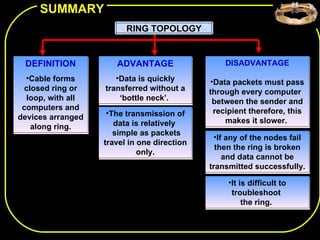
SUMMARY
                         RING TOPOLOGY


 DEFINITION           ADVANTAGE                  DISADVANTAGE
  •Cable forms        •Data is quickly        •Data packets must pass
 closed ring or    transferred without a     through every computer
  loop, with all       ‘bottle neck’.         between the sender and
 computers and                                 recipient therefore, this
devices arranged    •The transmission of
                      data is relatively          makes it slower.
   along ring.
                      simple as packets
                                               •If any of the nodes fail
                   travel in one direction
                                               then the ring is broken
                             only.
                                                  and data cannot be
                                             transmitted successfully.

                                                  •It is difficult to
                                                   troubleshoot
                                                       the ring.
SUMMARY
                         STAR TOPOLOGY


DEFINITION           ADVANTAGE                DISADVANTAGE
                                            •Requires more cable
 •All devices      •Easy to install and             length
 connect to a             wire.            than a linear topology.
central device,
  called hub.       •Security can be           If the hub or
                      implemented           concentrator fails,
                   in the hub/switch.      nodes attached are
                                                 disabled.
                  •Easy to detect faults
                         and to             More expensive than
                     remove parts          linear bus topologies
                                           because of the cost of
                                             the concentrators.
SUMMARY
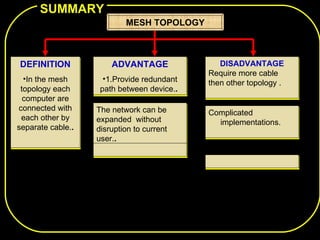
                             MESH TOPOLOGY


DEFINITION               ADVANTAGE                DISADVANTAGE
                                               Require more cable
  •In the mesh          •1.Provide redundant   then other topology .
 topology each         path between device..
  computer are
connected with        The network can be       Complicated
 each other by
 1.Provide redundant path between device.
                      expanded without           implementations.
separate cable..      disruption to current
                      user..
тнє єη∂
нσρє yσυ ℓιкє∂ ιт

1.network topology

  • 1.
  • 2.
    DEFINITION What is a Topology ? The physical topology of a network refers to the configuration of cables, computers and other peripherals.
  • 3.
    TYPES OF NETWORKTOPOLOGY Three commonly used network topologies are:- Bus network. Ring network. Star network.
  • 4.
    BUS TOPOLOGY All computersand devices connected to central cable or bus. Consists of a main run of cable with a terminator at each end. Popular on LANs because they are inexpensive and easy to install.
  • 5.
  • 6.
  • 7.
    RING TOPOLOGY Cable formsclosed ring or loop, with all computers and devices arranged along ring. Data travels from device to device around entire ring, in one direction. Primarily is used for LANs, but also is used in WANs.
  • 8.
  • 9.
    STAR TOPOLOGY All devicesconnect to a central device, called hub. All data transferred from one computer to another passes through hub.
  • 10.
  • 11.
  • 12.
    MESH TOPOLOGY • In the mesh topology each computer are connected with each other by separate cable. Create point to point connection to every device on network. If one cable fail data always has alternative path to get to its destination. • On a large scale, you can connect multiple LANs using mesh topology with leased line. • This type topology generally use in military area.
  • 13.
    DIFFERENTIATION BETWEEN THETHREE TYPES OF NETWORK TOPOLOGY WHAT ARE THE ADVANTAGES AND DISADVANTAGES OF THE THREE OF NETWORK TOPOLOGY?
  • 14.
    SUMMARY BUS TOPOLOGY DEFINITION ADVANTAGE DISADVANTAGE •All computers •Easy to connect a •Entire network shuts and devices computer or down if connected to peripheral to a linear there is a break in the central cable bus. main cable. •Requires less cable •Terminators are length than required at both a star topology. ends of the backbone cable. •Difficult to identify the problem if the entire network shuts down.
  • 15.
    SUMMARY RING TOPOLOGY DEFINITION ADVANTAGE DISADVANTAGE •Cable forms •Data is quickly •Data packets must pass closed ring or transferred without a through every computer loop, with all ‘bottle neck’. between the sender and computers and recipient therefore, this devices arranged •The transmission of data is relatively makes it slower. along ring. simple as packets •If any of the nodes fail travel in one direction then the ring is broken only. and data cannot be transmitted successfully. •It is difficult to troubleshoot the ring.
  • 16.
    SUMMARY STAR TOPOLOGY DEFINITION ADVANTAGE DISADVANTAGE •Requires more cable •All devices •Easy to install and length connect to a wire. than a linear topology. central device, called hub. •Security can be If the hub or implemented concentrator fails, in the hub/switch. nodes attached are disabled. •Easy to detect faults and to More expensive than remove parts linear bus topologies because of the cost of the concentrators.
  • 17.
    SUMMARY MESH TOPOLOGY DEFINITION ADVANTAGE DISADVANTAGE Require more cable •In the mesh •1.Provide redundant then other topology . topology each path between device.. computer are connected with The network can be Complicated each other by 1.Provide redundant path between device. expanded without implementations. separate cable.. disruption to current user..
  • 18.

Editor's Notes