Assembly Language Programming of 8085 Unit-2
Topics Introduction Programming model of  8085 Instruction set of  8085 Example Programs Addressing modes of  8085 Instruction & Data Formats of  8085
1.  Introduction A  microprocessor  executes instructions given by the user  Instructions should be in a language known to the  microprocessor Microprocessor  understands the language of 0’s and 1’s only This language is called  Machine Language
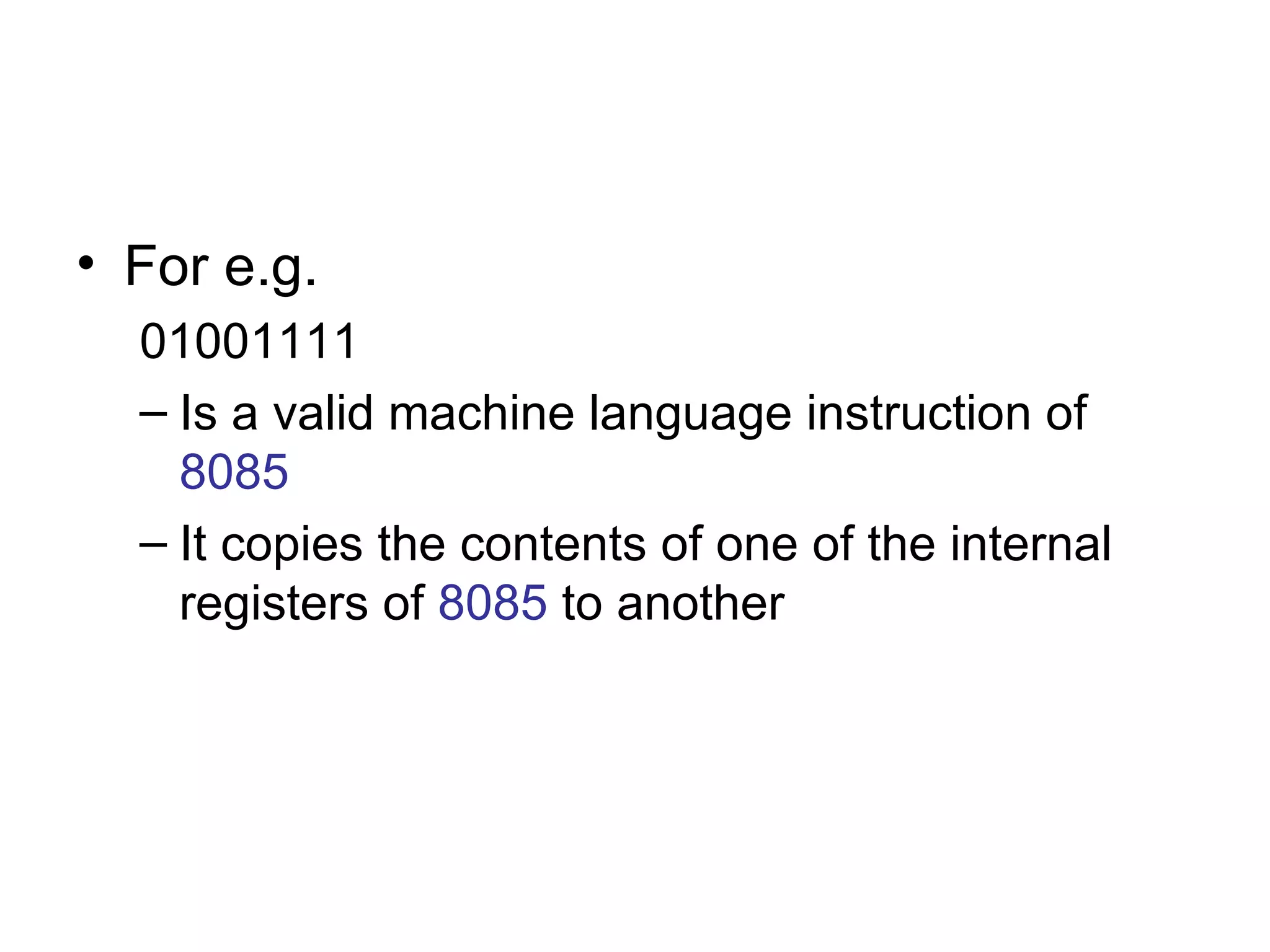
For e.g. 01001111 Is a valid machine language instruction of  8085 It copies the contents of one of the internal registers of  8085  to another
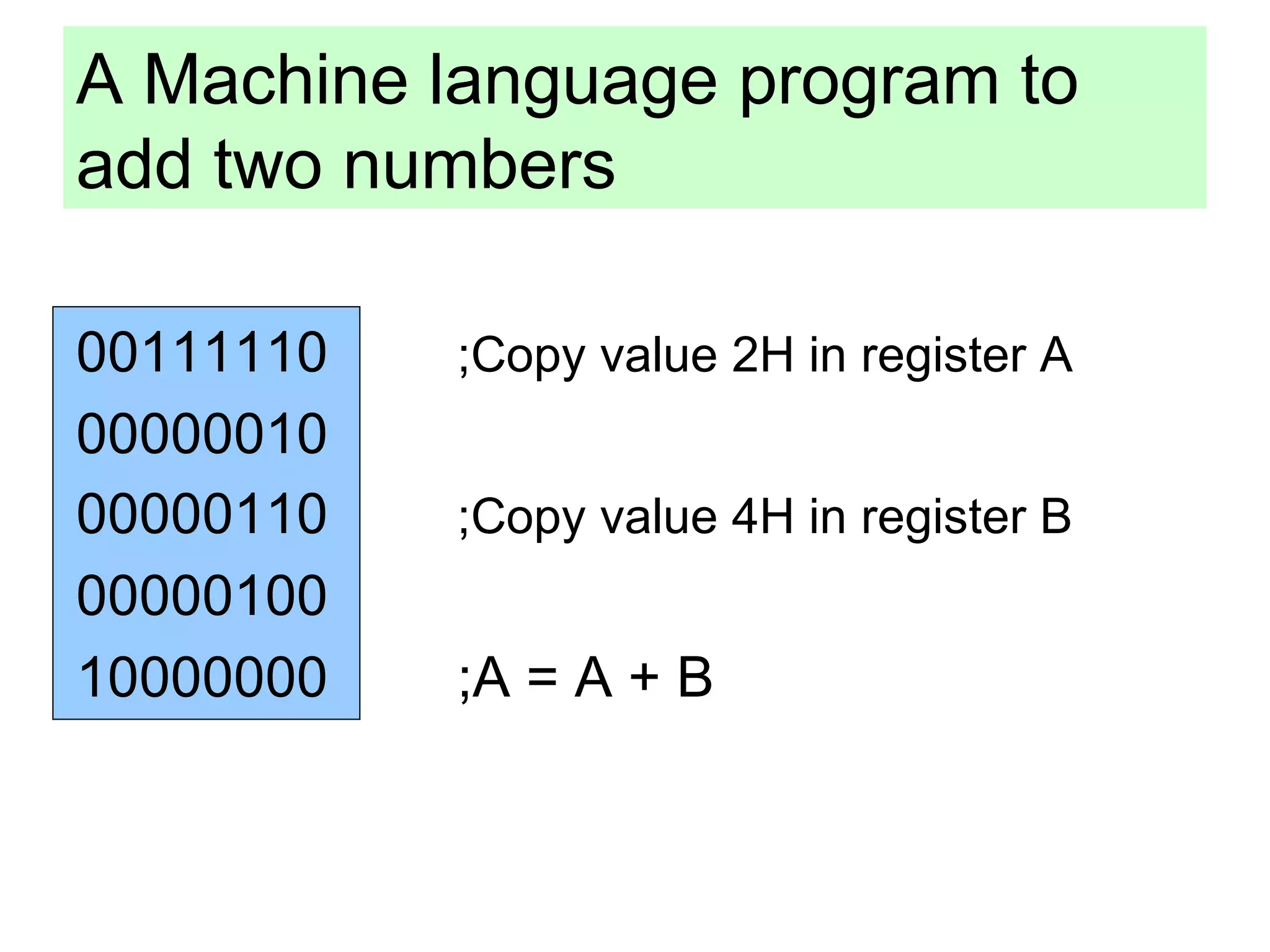
A Machine language program to add two numbers  00111110 ;Copy value 2H in register A 00000010 00000110 ;Copy value 4H in register B 00000100 10000000 ;A = A + B
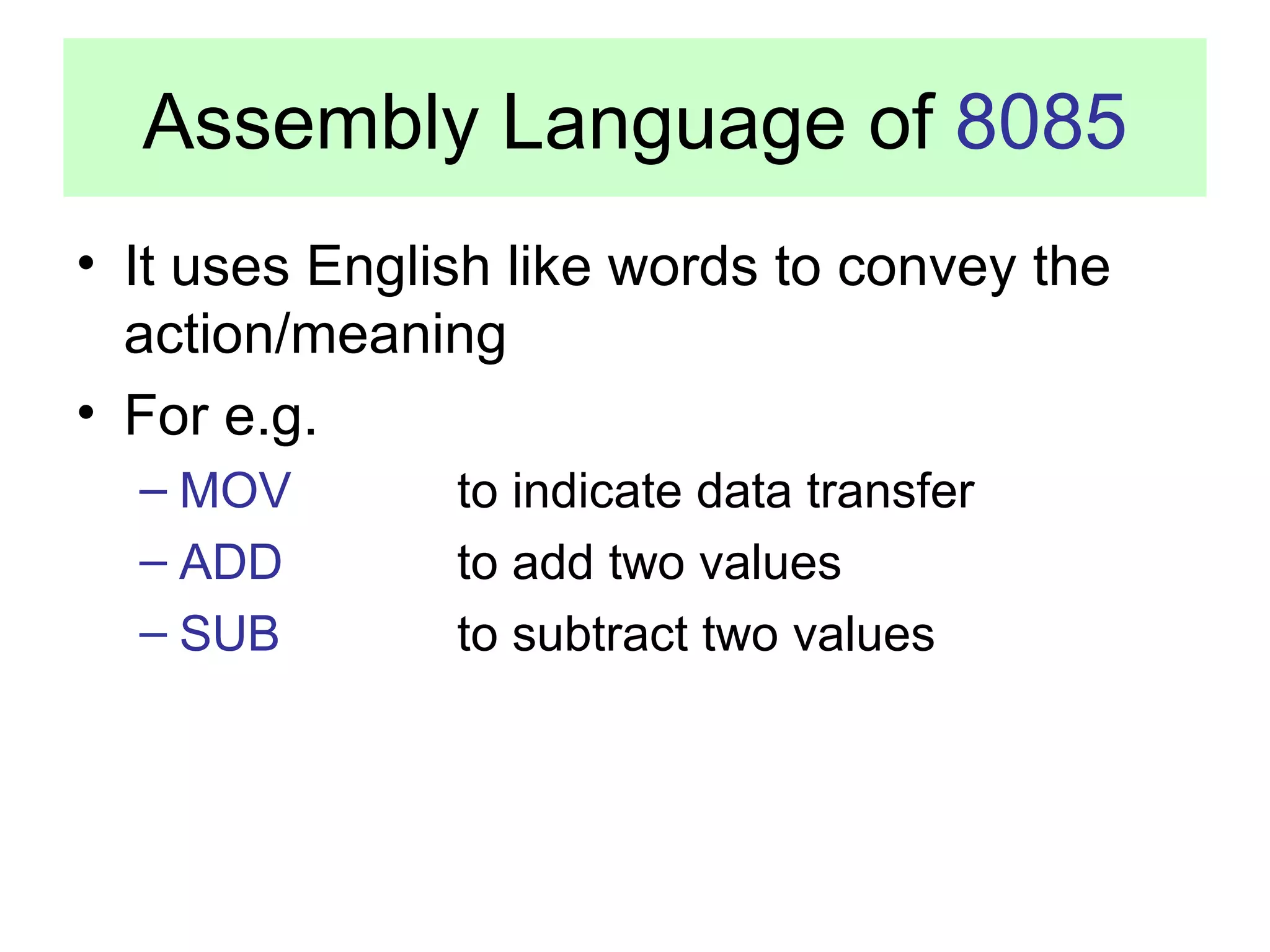
Assembly Language of  8085 It uses English like words to convey the action/meaning For e.g. MOV   to indicate data transfer ADD   to add two values SUB   to subtract two values
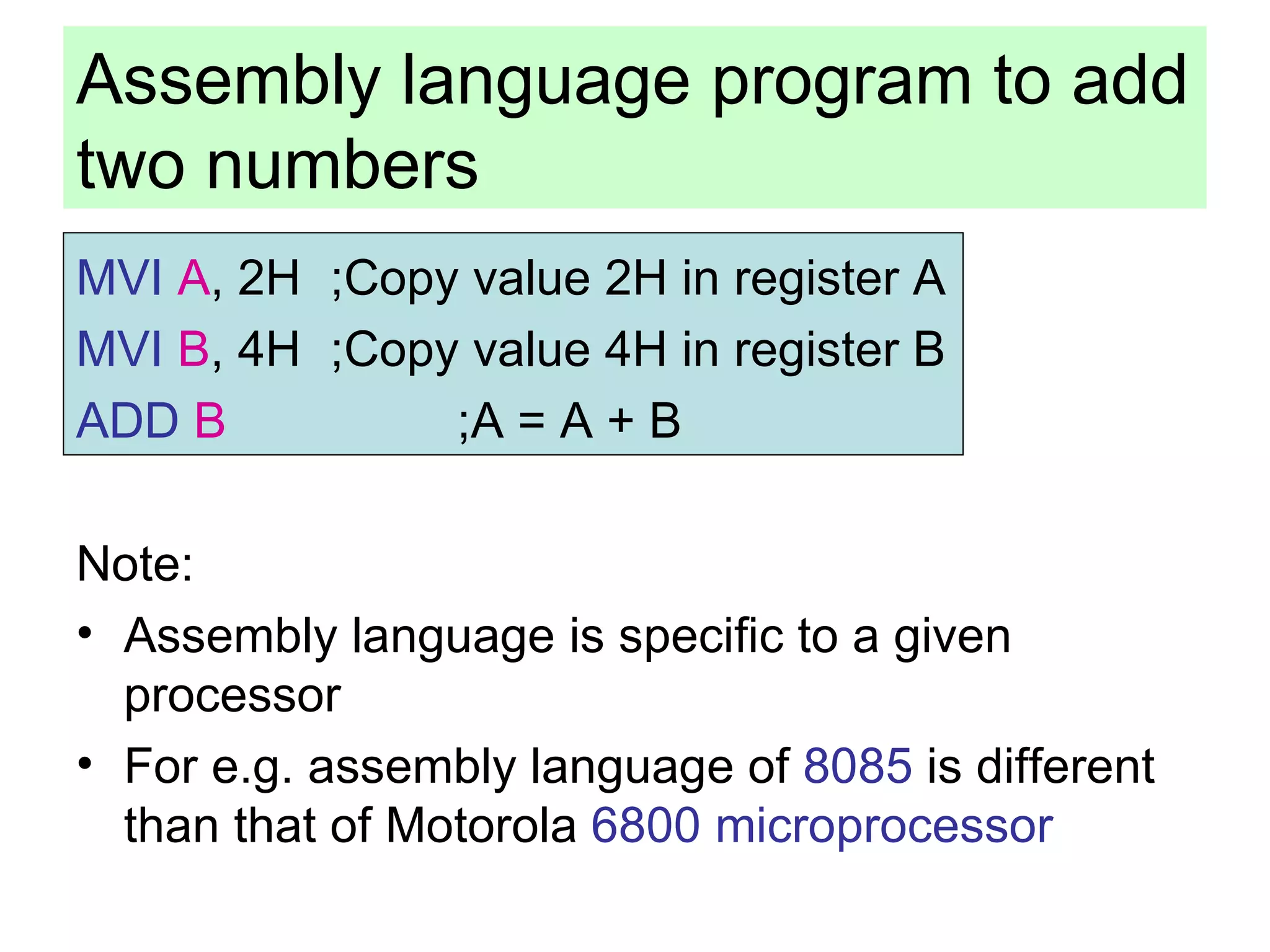
Assembly language program to add two numbers MVI   A , 2H ;Copy value 2H in register A MVI   B , 4H ;Copy value 4H in register B ADD   B ;A = A + B Note: Assembly language is specific to a given processor For e.g. assembly language of  8085  is different than that of Motorola  6800 microprocessor
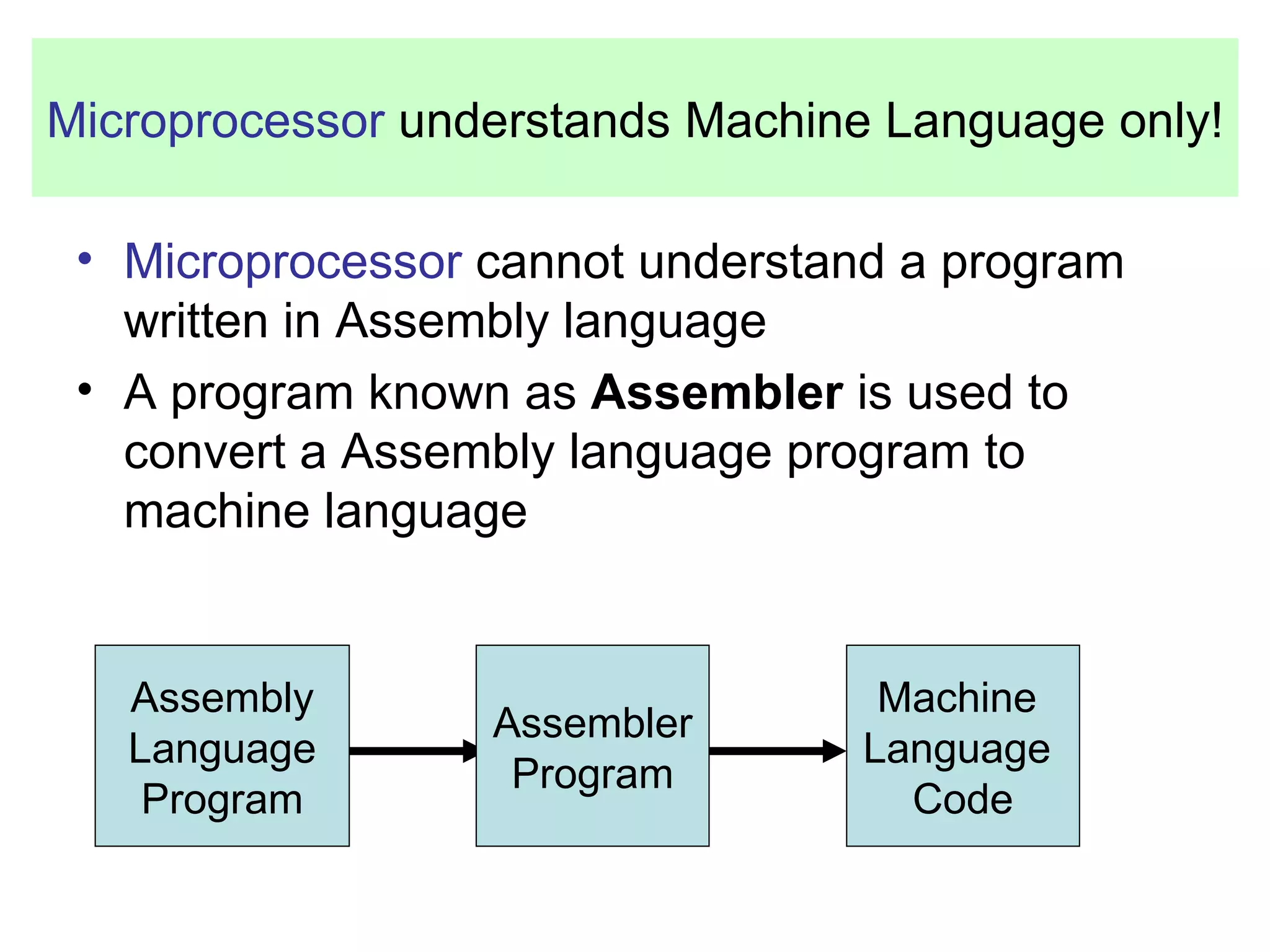
Microprocessor  understands Machine Language only! Microprocessor  cannot understand a program written in Assembly language A program known as  Assembler  is used to convert a Assembly language program to machine language Assembly Language Program Assembler Program Machine  Language  Code
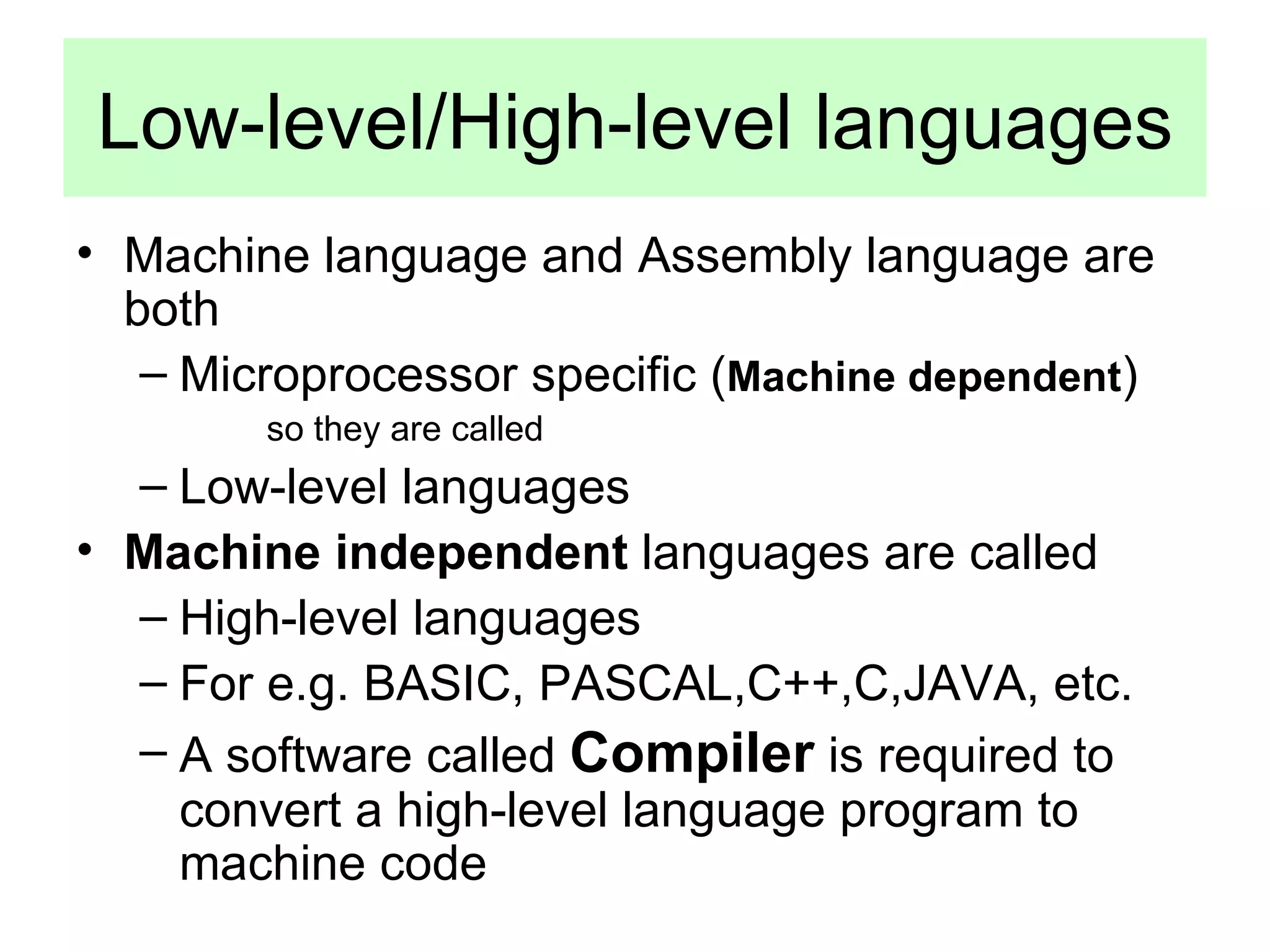
Low-level/High-level languages Machine language and Assembly language are both  Microprocessor specific ( Machine dependent ) so they are called Low-level languages Machine independent  languages are called High-level languages For e.g. BASIC, PASCAL,C++,C,JAVA, etc. A software called  Compiler  is required to convert a high-level language program to machine code
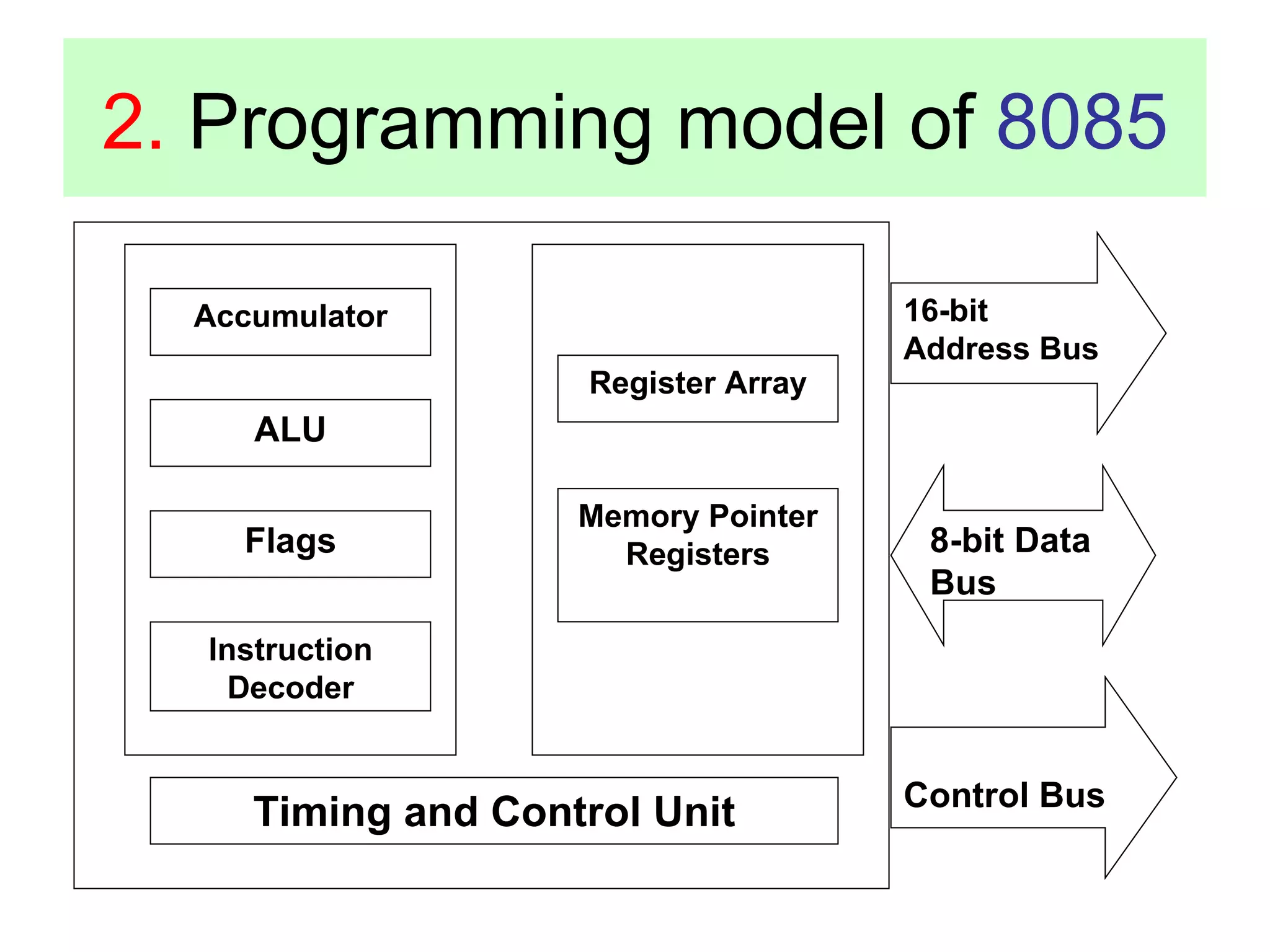
2.  Programming model of  8085 16-bit Address Bus 8-bit Data Bus Control Bus Accumulator ALU Flags Instruction Decoder Register Array Memory Pointer Registers Timing and Control Unit
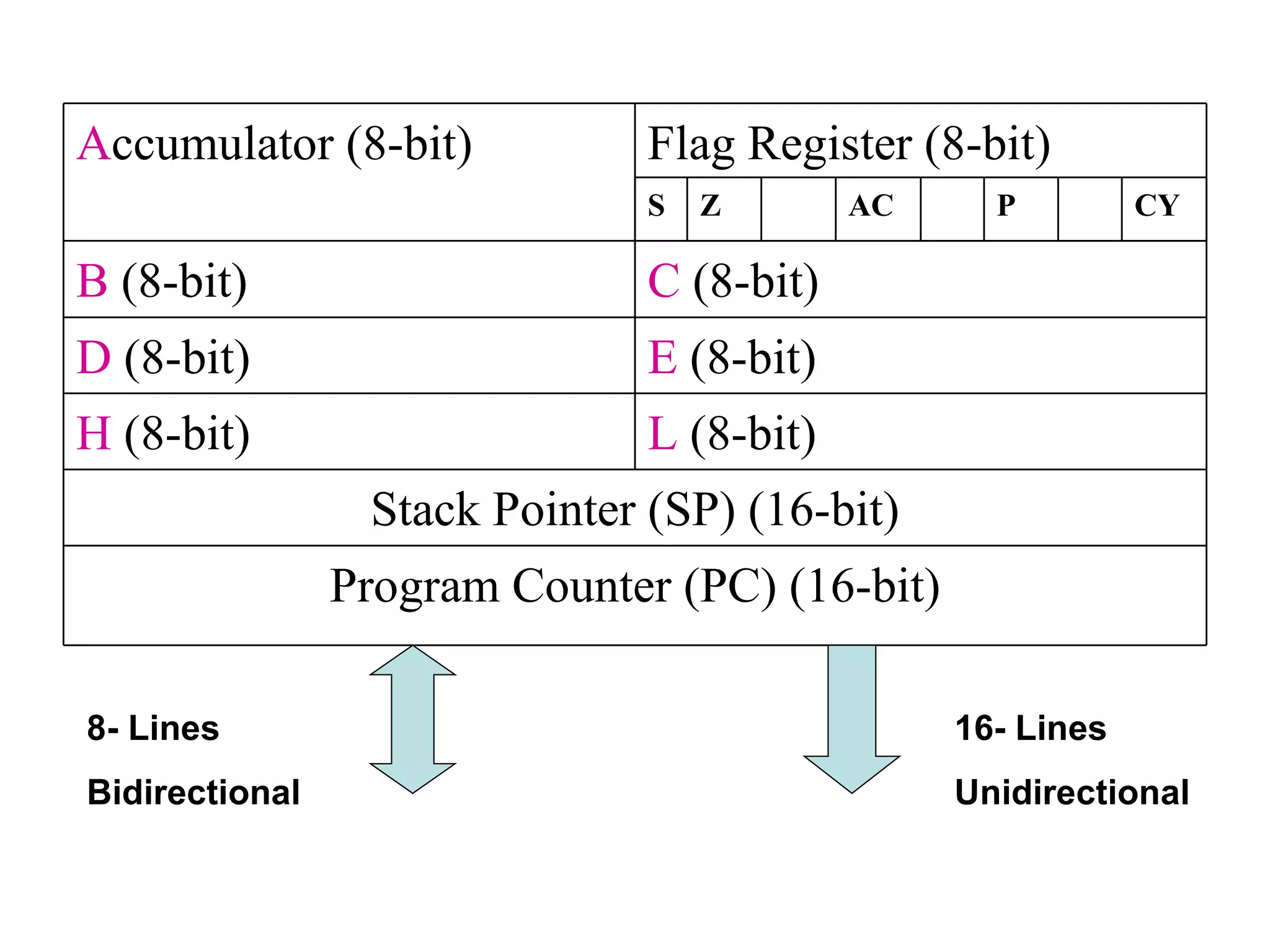
16- Lines Unidirectional 8- Lines Bidirectional Program Counter (PC) (16-bit) Stack Pointer (SP) (16-bit) L  (8-bit) H  (8-bit) E  (8-bit) D  (8-bit) C  (8-bit) B  (8-bit) Flag Register (8-bit) A ccumulator (8-bit) CY P AC Z S
Overview:  8085  Programming model   Six general-purpose Registers Accumulator Register Flag Register Program Counter Register Stack Pointer Register
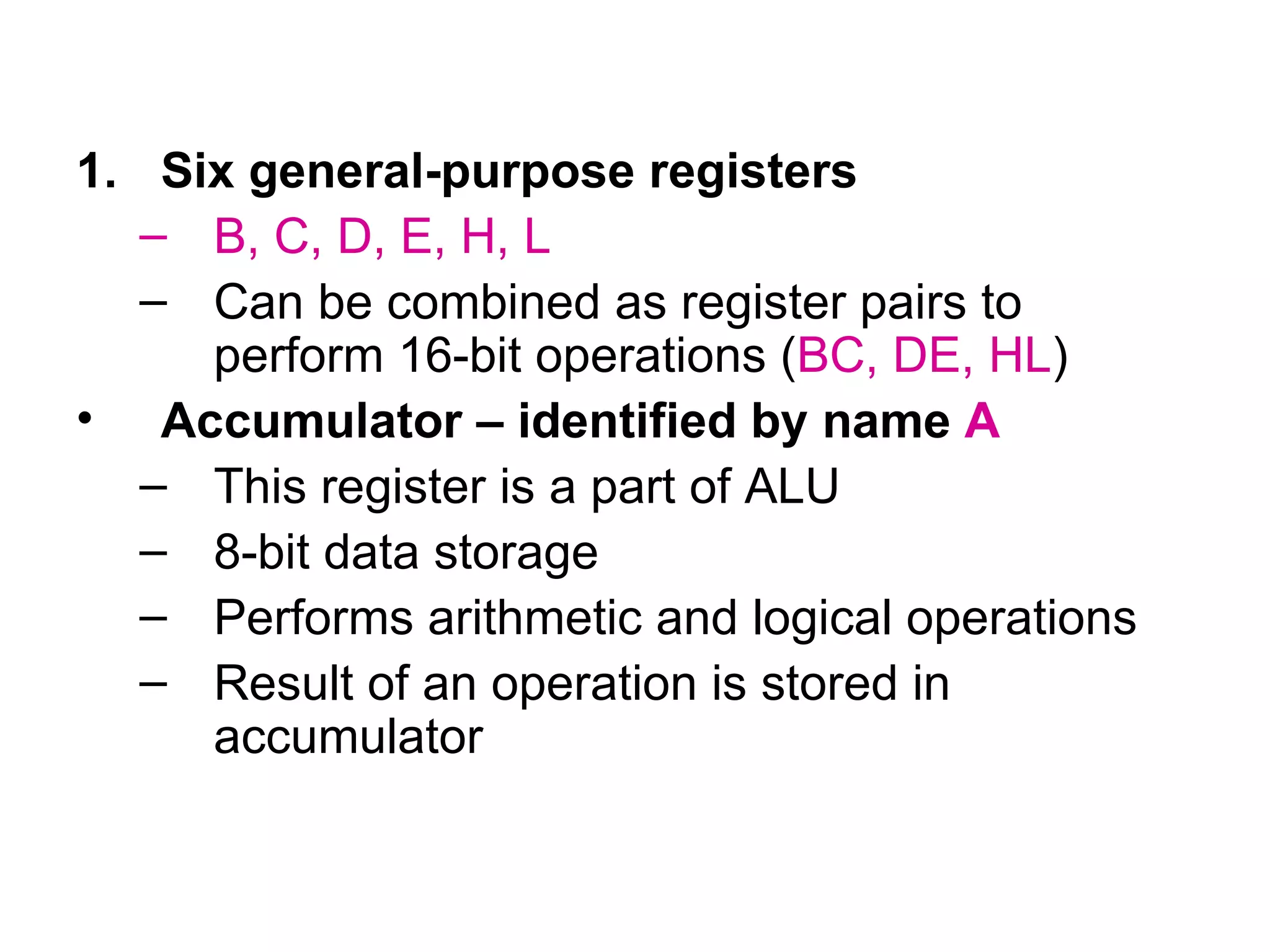
Six general-purpose registers B, C, D, E, H, L Can be combined as register pairs to perform 16-bit operations ( BC, DE, HL ) Accumulator – identified by name  A This register is a part of ALU 8-bit data storage Performs arithmetic and logical operations Result of an operation is stored in accumulator
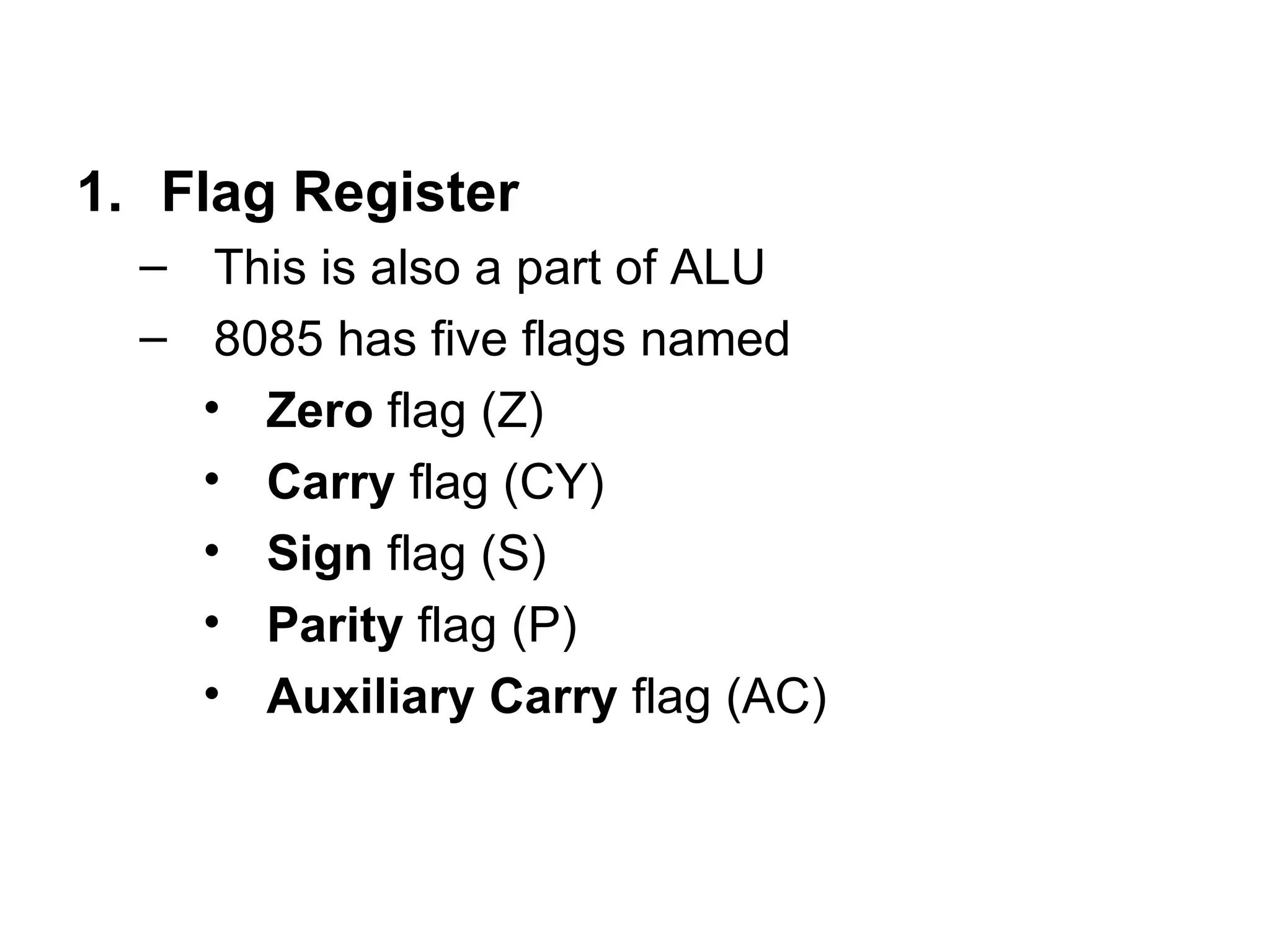
Flag Register This is also a part of ALU 8085 has five flags named Zero  flag (Z) Carry  flag (CY) Sign  flag (S) Parity  flag (P) Auxiliary Carry  flag (AC)
These flags are five flip-flops in flag register Execution of an arithmetic/logic operation can  set  or  reset  these flags Condition of flags (set or reset) can be tested through software instructions 8085  uses these flags in decision-making process
Program Counter (PC) A 16-bit memory pointer register Used to sequence execution of program instructions Stores address of a memory location where next instruction byte is to be fetched by the  8085 when  8085  gets busy to fetch current instruction from memory PC is incremented by one PC is now pointing to the address of next instruction
Stack Pointer Register a 16-bit memory pointer register Points to a location in  Stack  memory Beginning of the stack is defined by loading a 16-bit address in stack pointer register
3. Instruction Set of 8085 Consists of 74 operation codes, e.g.  MOV 246 Instructions, e.g.  MOV   A , B 8085  instructions can be classified as Data Transfer (Copy)  Arithmetic Logical and Bit manipulation Branch Machine Control
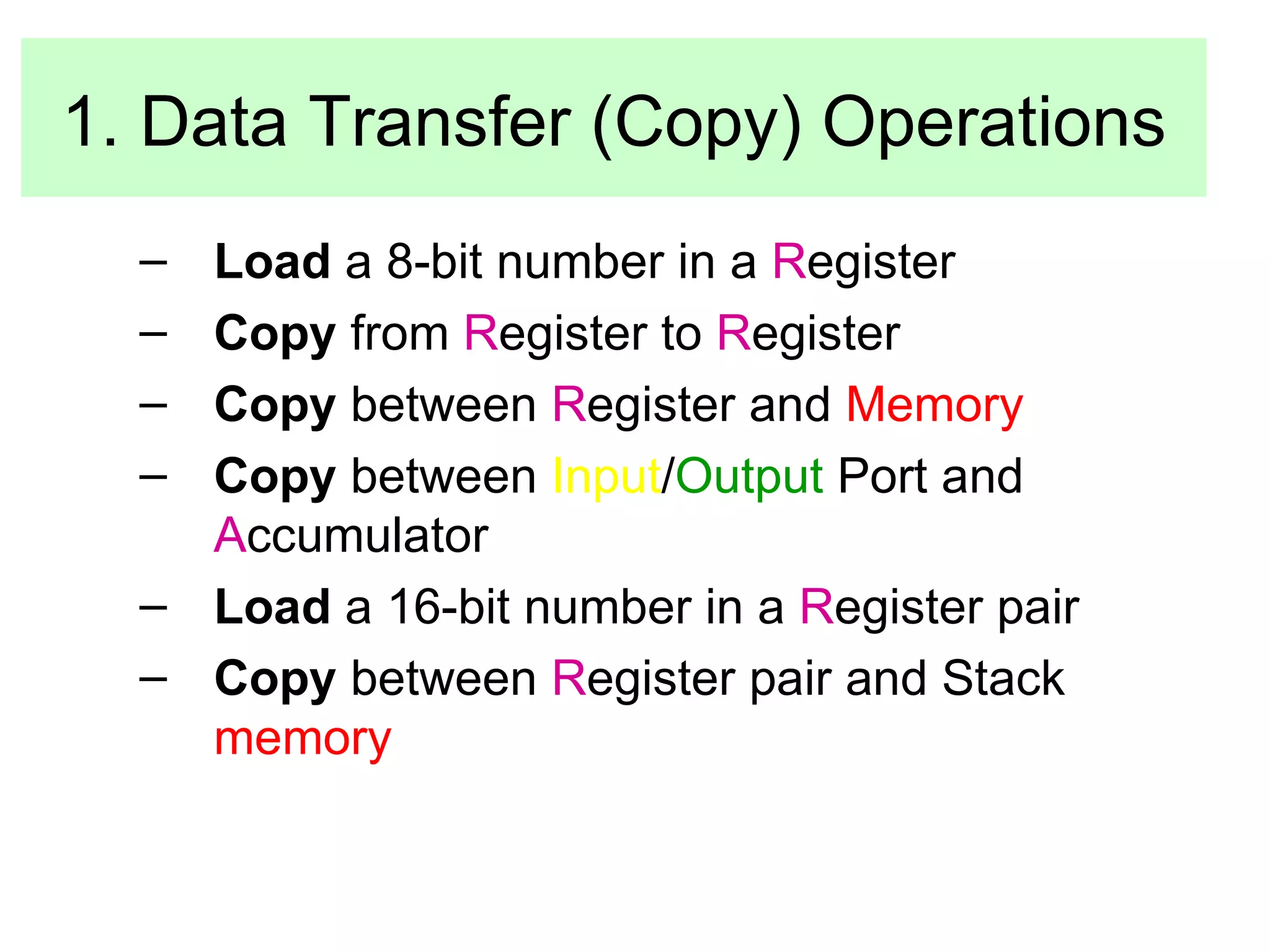
1.  Data Transfer (Copy) Operations Load  a 8-bit number in a  R egister Copy  from  R egister to  R egister Copy  between  R egister and  Memory Copy  between  Input / Output  Port and  A ccumulator Load  a 16-bit number in a  R egister pair Copy  between  R egister pair and Stack  memory
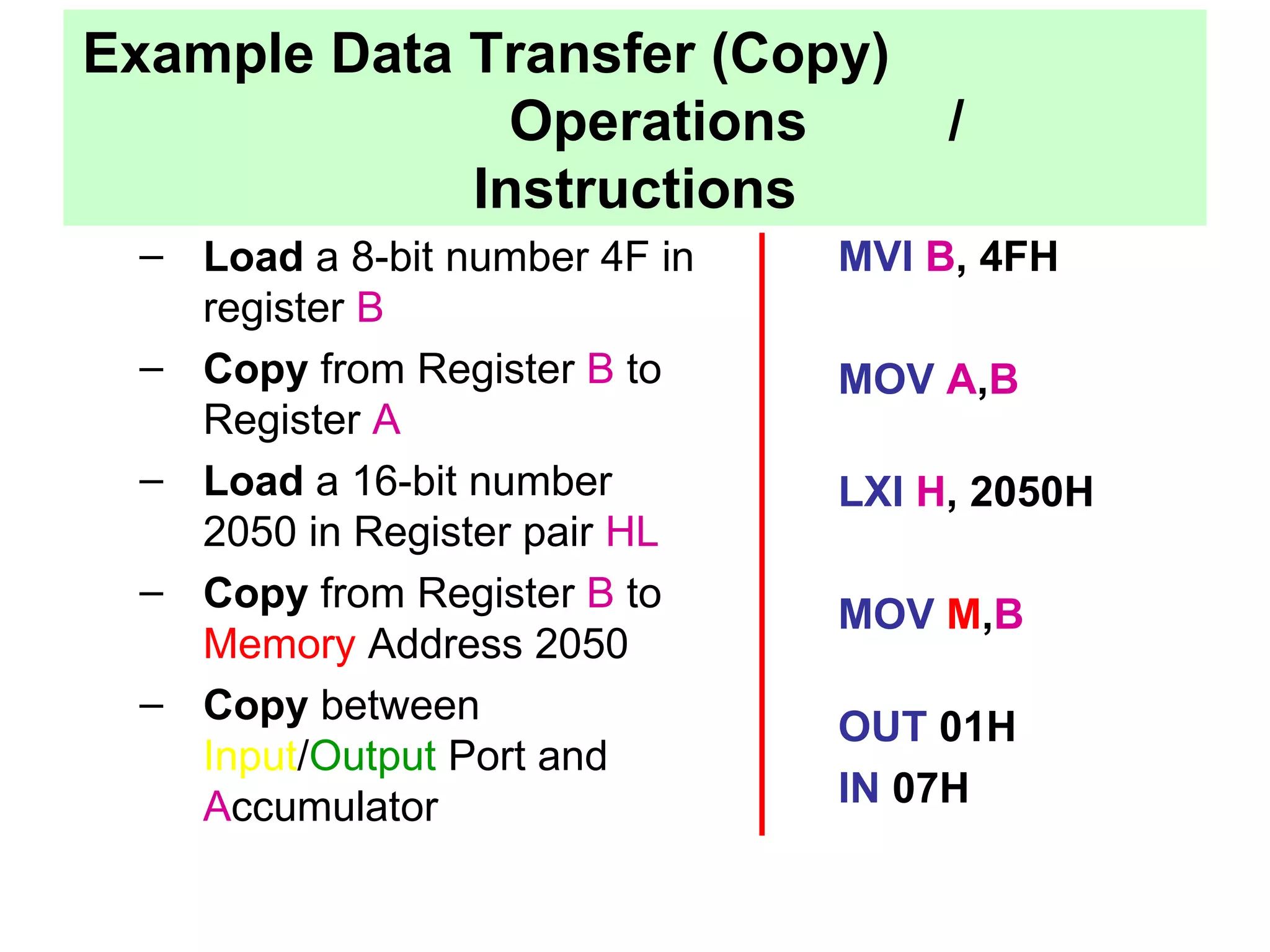
Example Data Transfer (Copy)  Operations  /  Instructions Load  a 8-bit number 4F in register  B Copy  from Register  B  to Register  A Load  a 16-bit number 2050 in Register pair  HL Copy  from Register  B  to  Memory  Address 2050 Copy  between  Input / Output  Port and  A ccumulator MVI   B , 4FH MOV   A , B LXI   H , 2050H MOV   M , B OUT  01H IN  07H
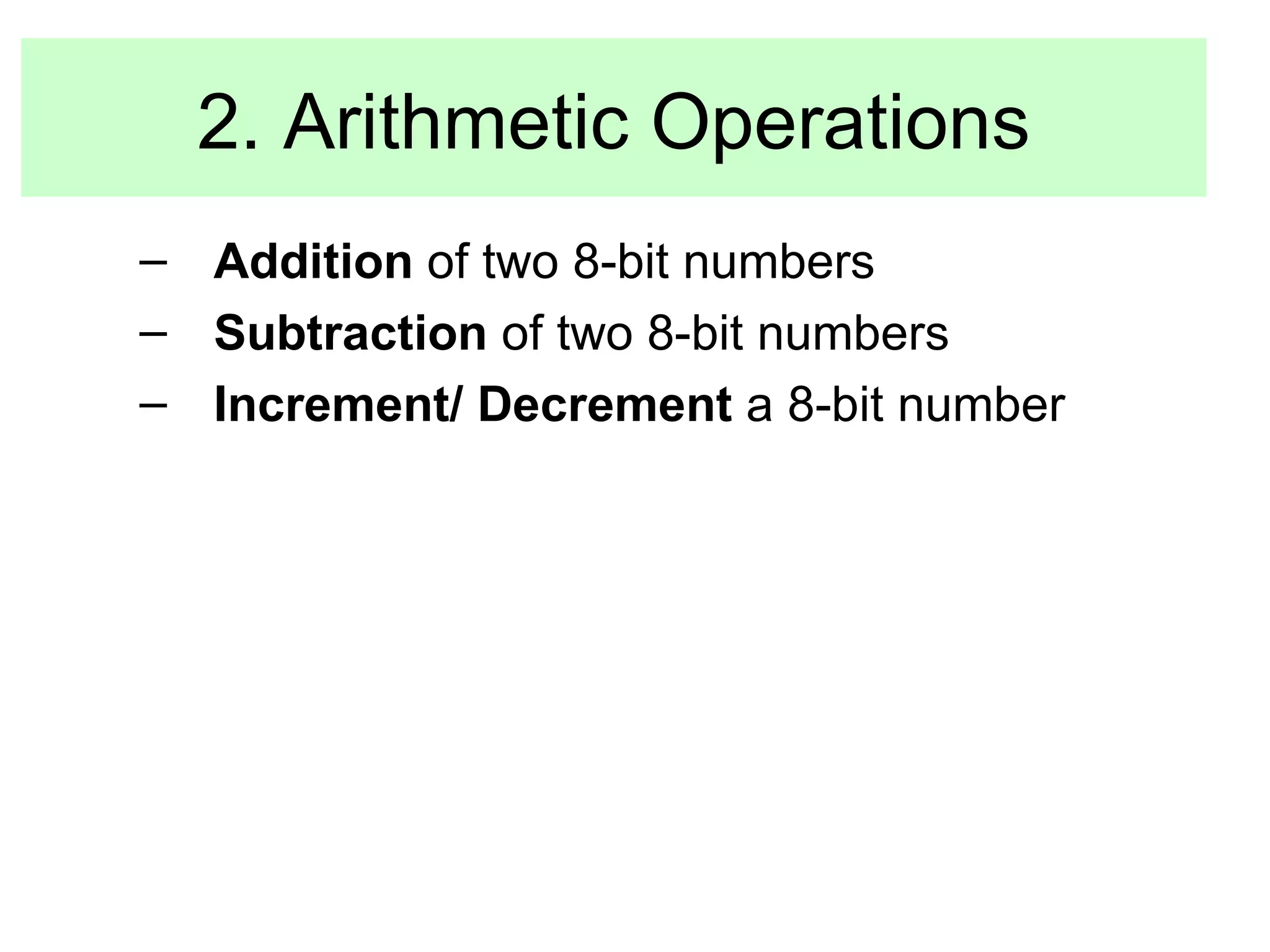
2.  Arithmetic Operations Addition  of two 8-bit numbers Subtraction  of two 8-bit numbers Increment/ Decrement  a 8-bit number
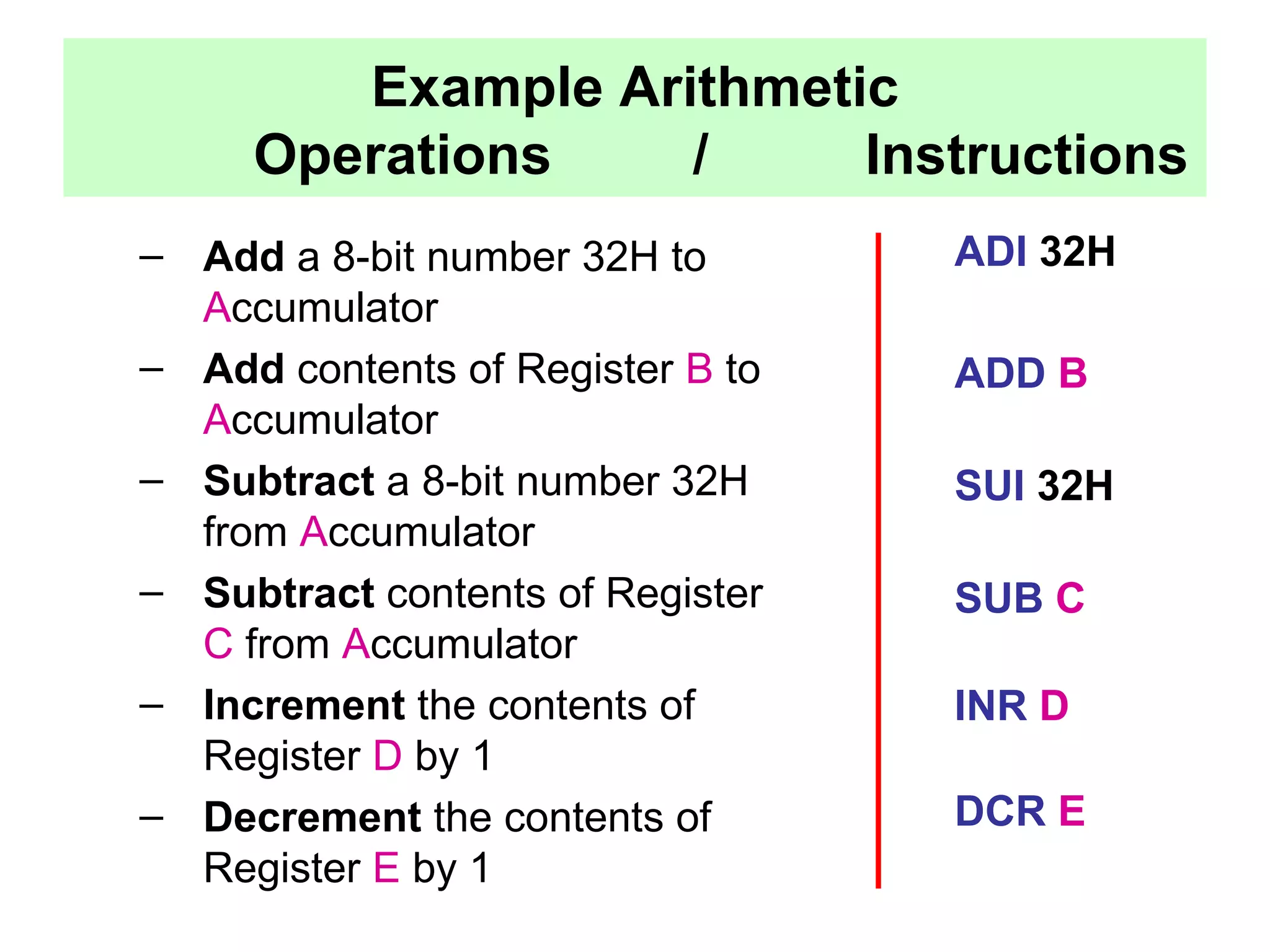
Example Arithmetic   Operations  /  Instructions Add  a 8-bit number 32H to  A ccumulator Add  contents of Register  B  to  A ccumulator Subtract  a 8-bit number 32H from  A ccumulator Subtract  contents of Register  C  from  A ccumulator Increment  the contents of Register  D  by 1 Decrement  the contents of Register  E  by 1 ADI  32H ADD   B SUI  32H SUB  C   INR  D DCR  E
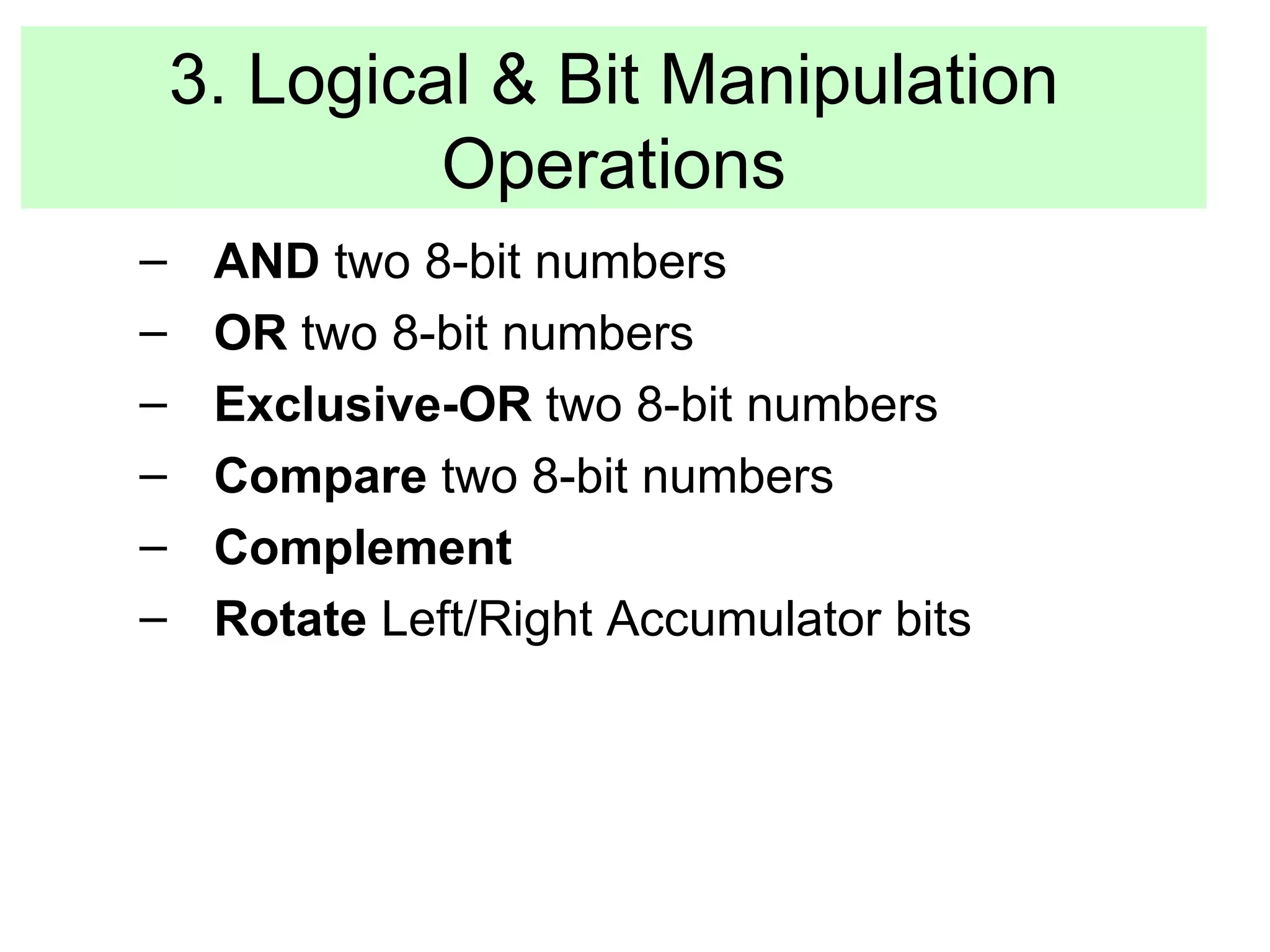
3.  Logical & Bit Manipulation Operations AND  two 8-bit numbers OR  two 8-bit numbers Exclusive-OR  two 8-bit numbers Compare  two 8-bit numbers Complement   Rotate  Left/Right Accumulator bits
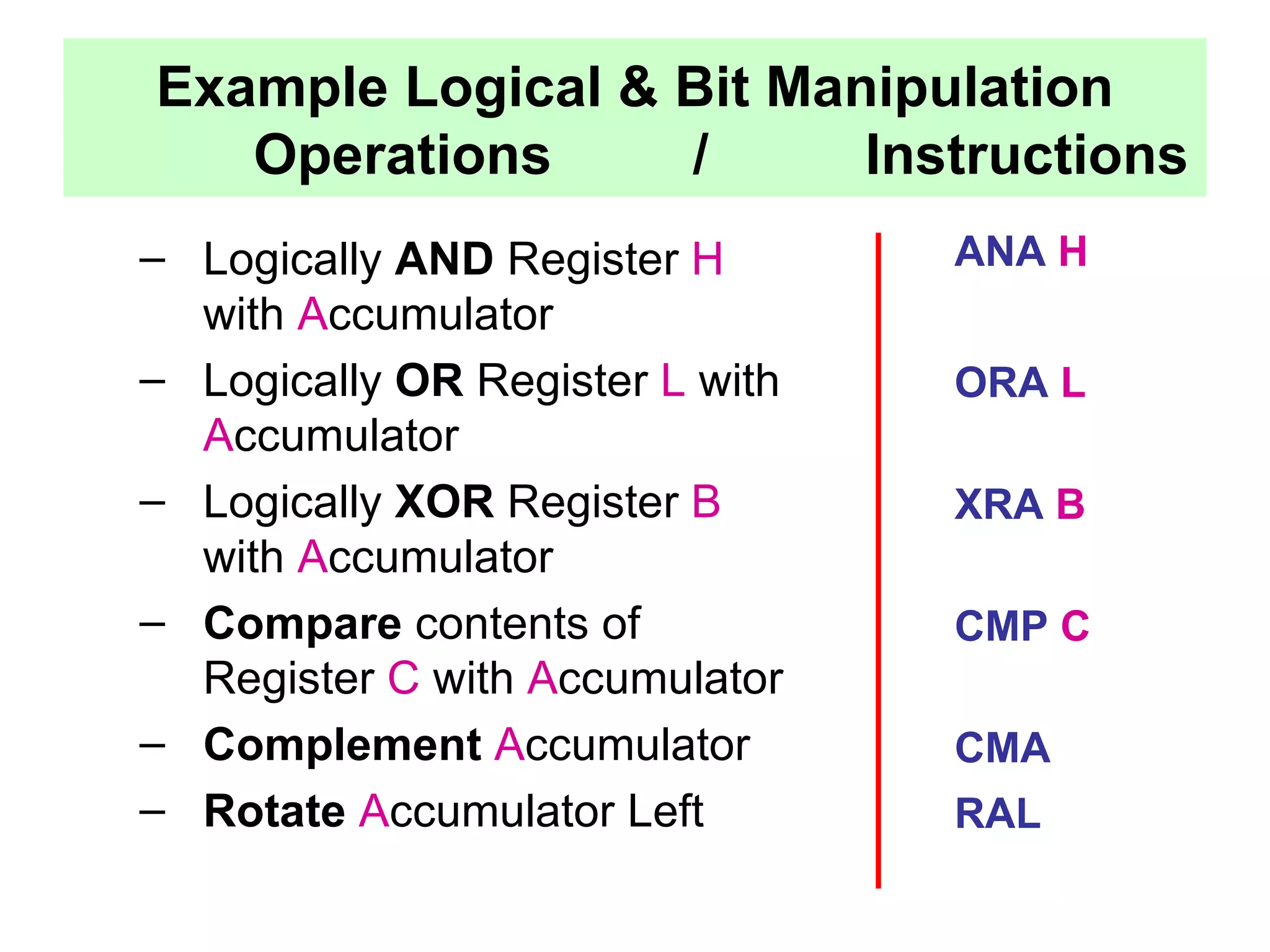
Example Logical & Bit Manipulation   Operations  /  Instructions Logically  AND  Register  H  with  A ccumulator Logically  OR  Register  L  with  A ccumulator Logically  XOR  Register  B  with  A ccumulator Compare  contents of Register  C  with  A ccumulator Complement   A ccumulator Rotate   A ccumulator Left ANA   H ORA   L XRA  B CMP  C   CMA RAL
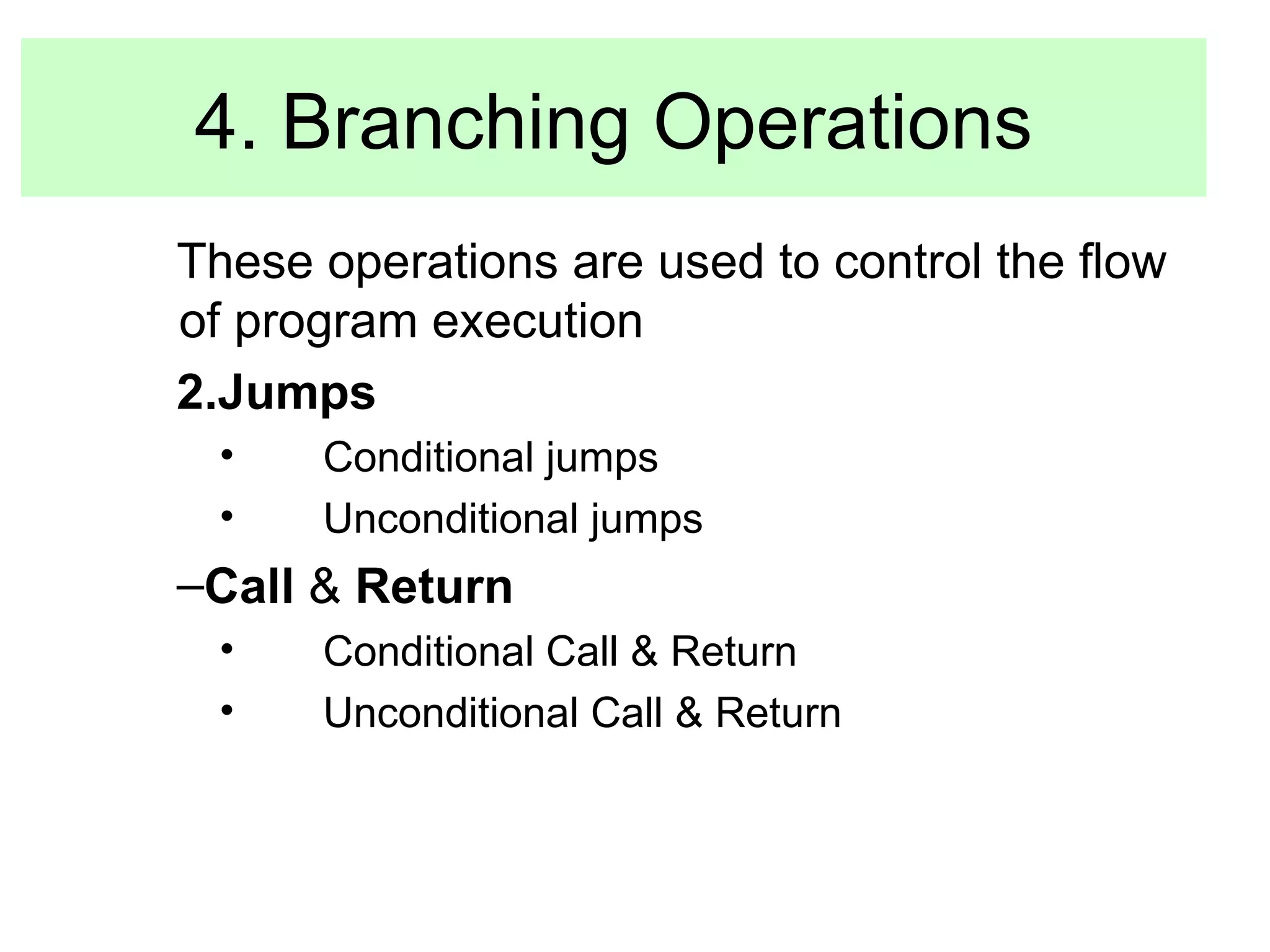
4.  Branching Operations These operations are used to control the flow of program execution Jumps Conditional jumps Unconditional jumps Call  &  Return Conditional Call & Return Unconditional Call & Return
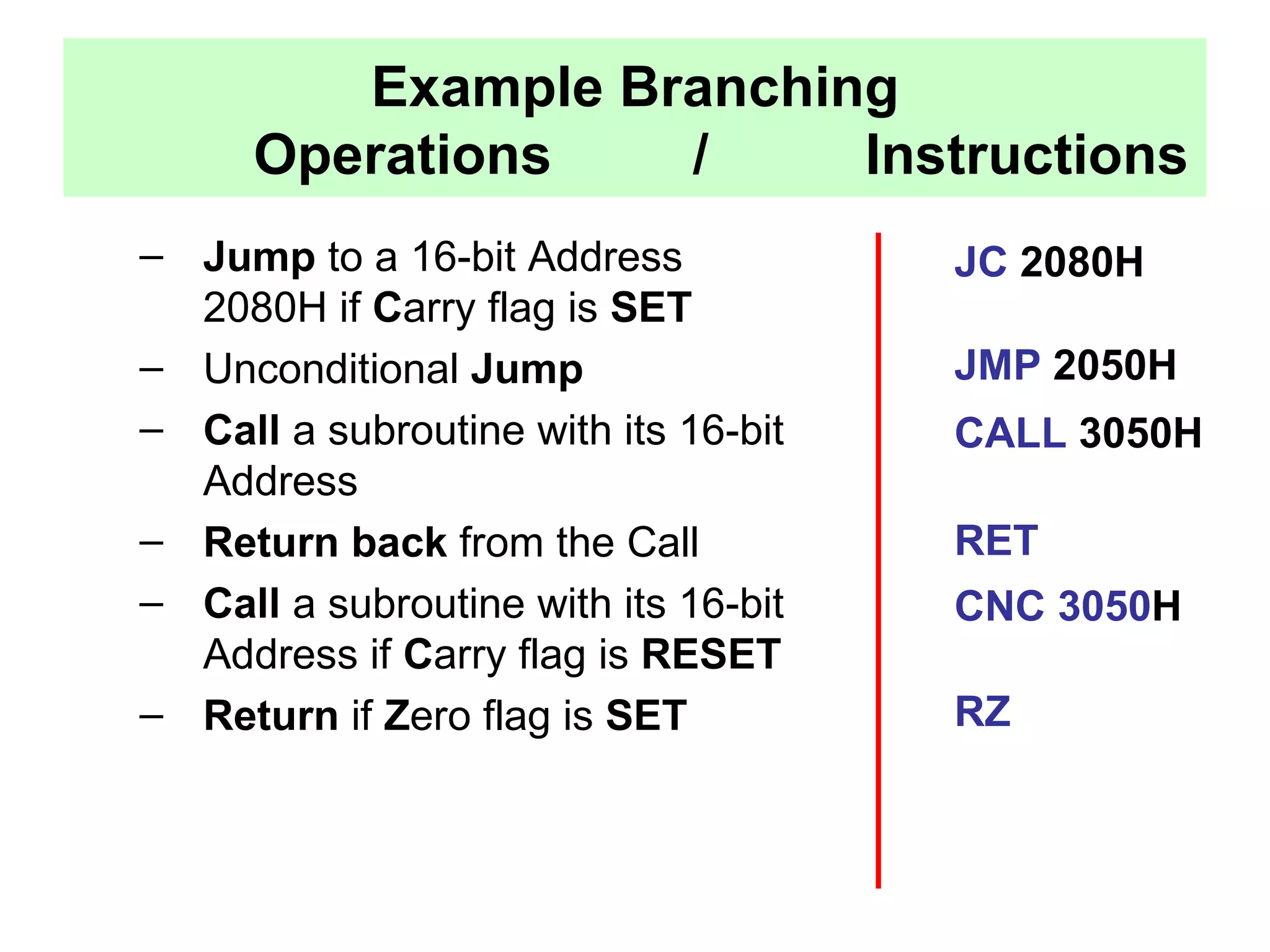
Example Branching   Operations  /  Instructions Jump  to a 16-bit Address 2080H if  C arry flag is  SET Unconditional  Jump Call  a subroutine with its 16-bit Address  Return back  from the Call Call  a subroutine with its 16-bit Address if  C arry flag is  RESET Return  if  Z ero flag is  SET JC  2080H JMP  2050H CALL  3050H  RET CNC 3050 H RZ
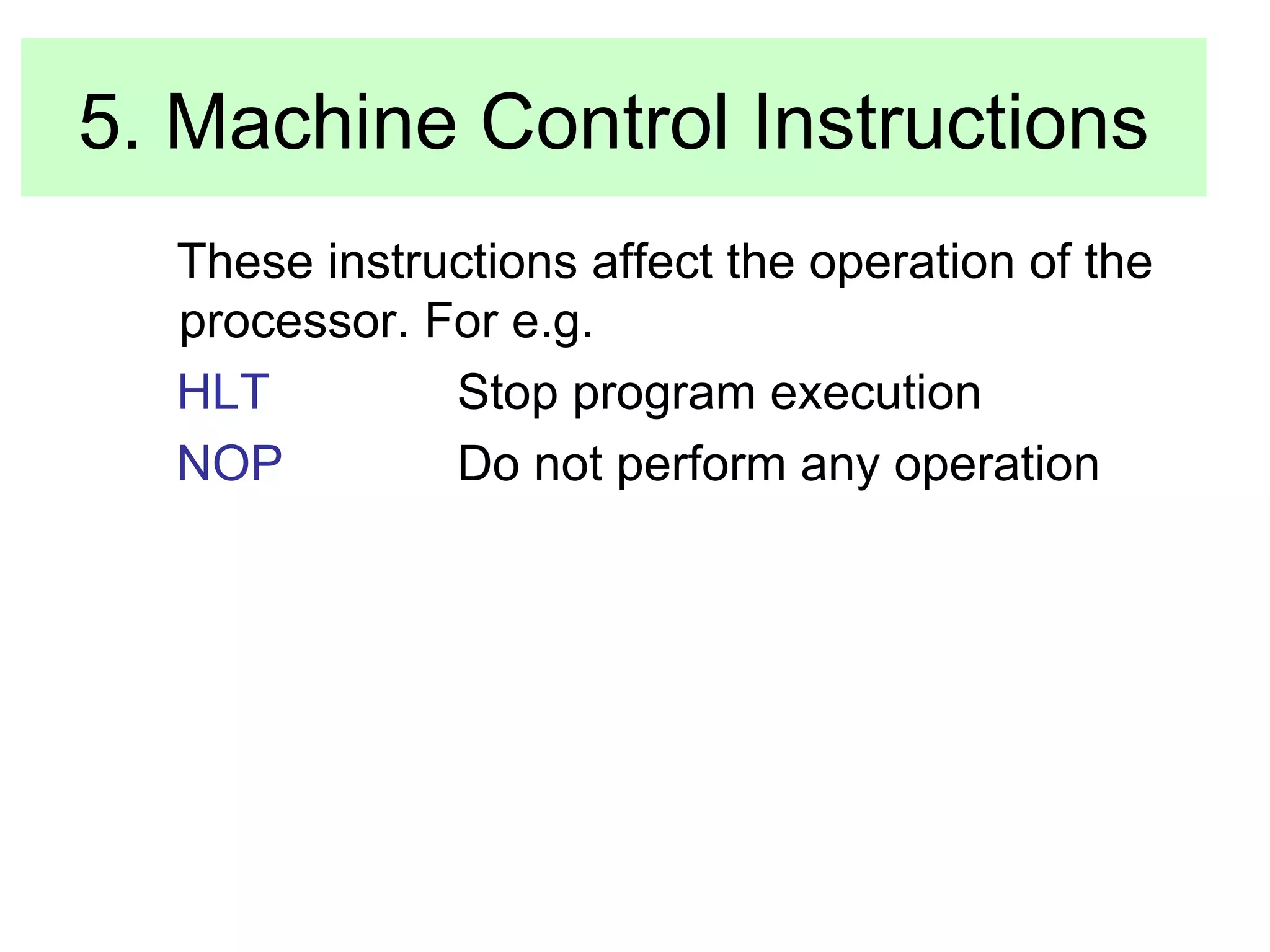
5.  Machine Control Instructions These instructions affect the operation of the processor. For e.g. HLT Stop program execution NOP Do not perform any operation
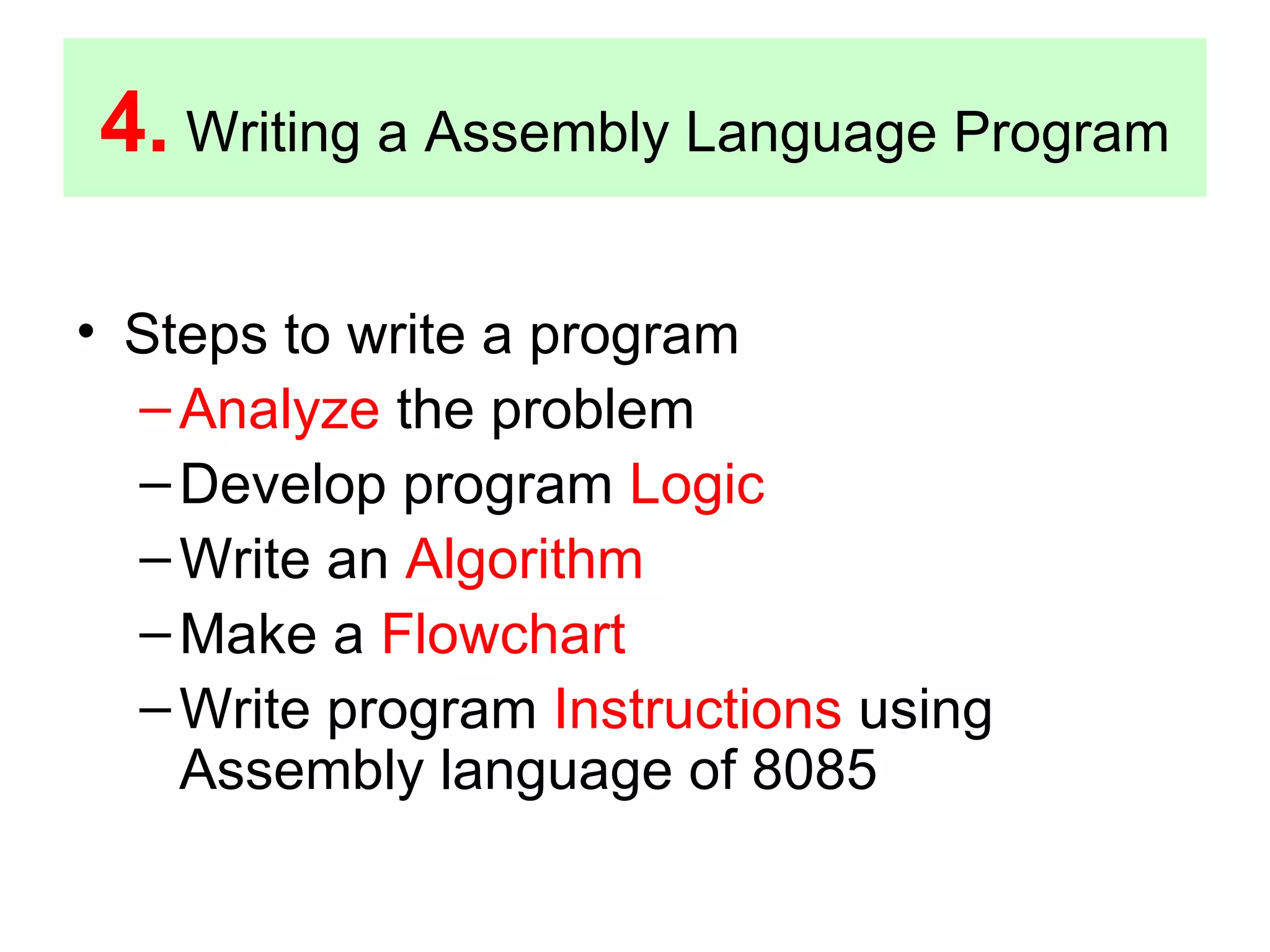
4.  Writing a Assembly Language Program Steps to write a program Analyze  the problem Develop program  Logic Write an  Algorithm Make a  Flowchart Write program  Instructions  using Assembly language of 8085
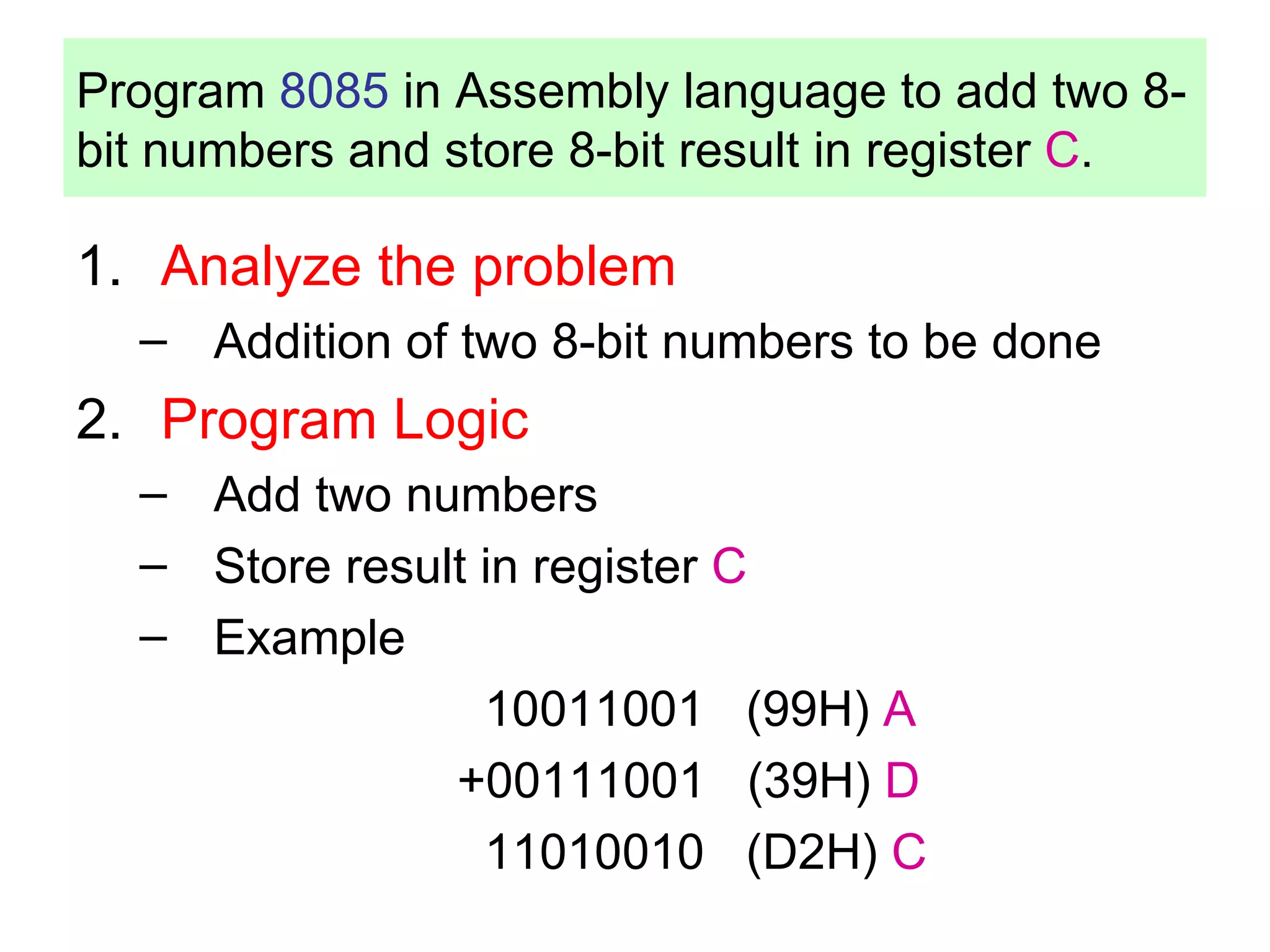
Program  8085  in Assembly language to add two 8-bit numbers and store 8-bit result in register  C . Analyze the problem Addition of two 8-bit numbers to be done Program Logic Add two numbers Store result in register  C Example   10011001  (99H)  A +00111001  (39H)  D   11010010  (D2H)  C
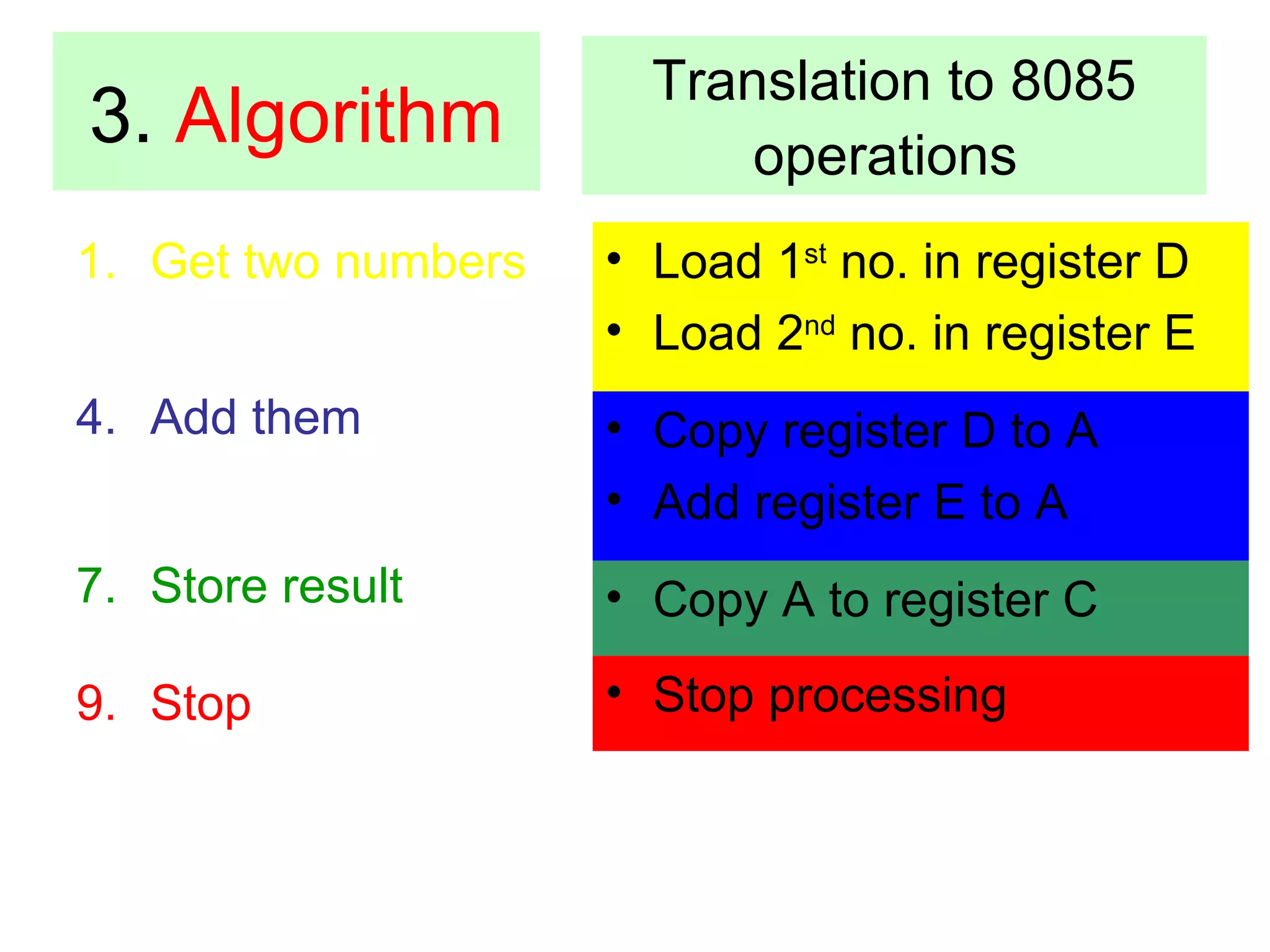
Get two numbers  Add them Store result Stop Load 1 st  no. in register D Load 2 nd  no. in register E 3.  Algorithm Translation to 8085 operations   Copy register D to A Add register E to A Copy A to register C Stop processing
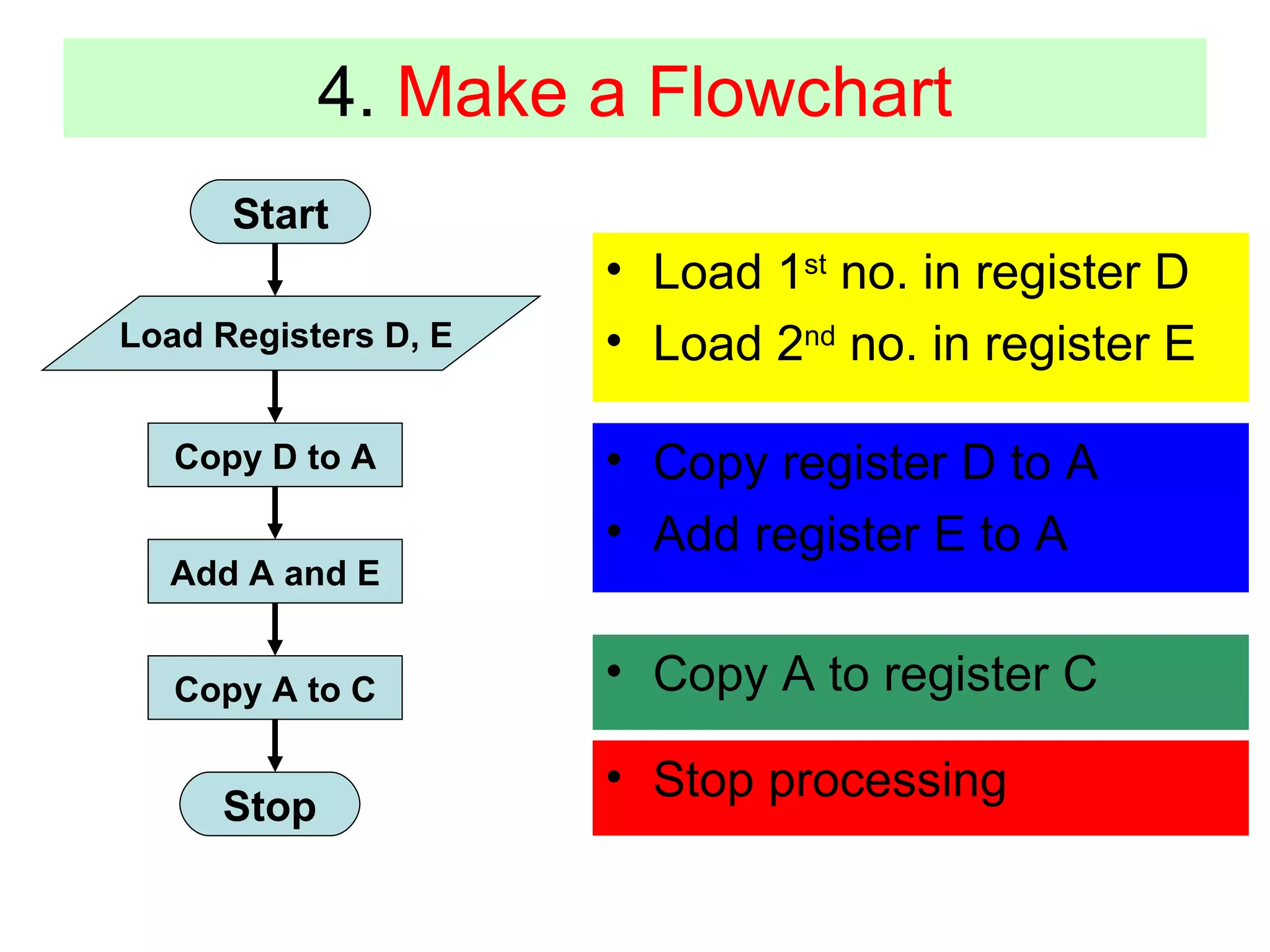
4.  Make a Flowchart Start Load Registers D, E  Copy D to A Add A and E Copy A to C Stop Load 1 st  no. in register D Load 2 nd  no. in register E Copy register D to A Add register E to A Copy A to register C Stop processing
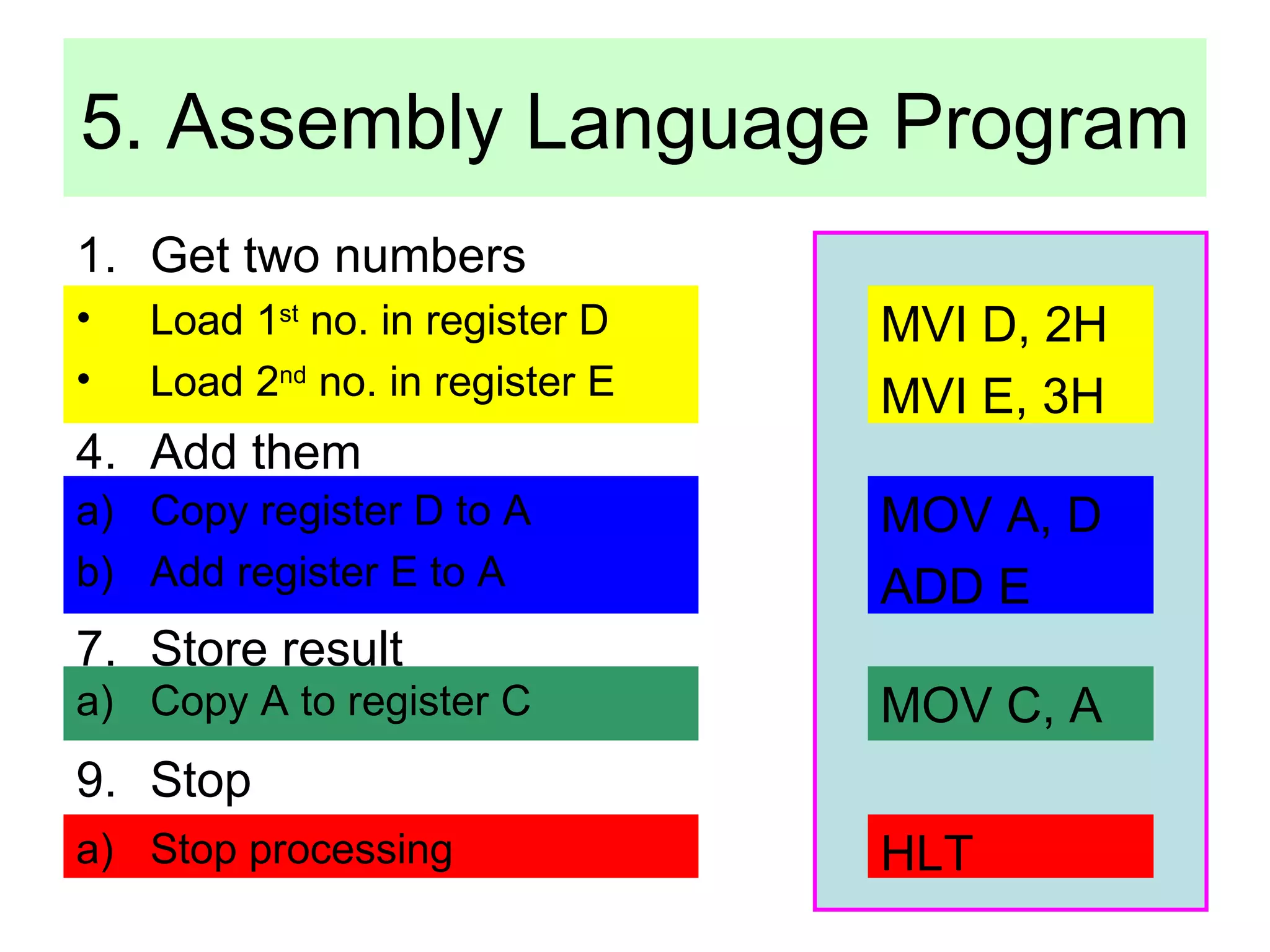
5. Assembly Language Program Get two numbers Add them Store result Stop Load 1 st  no. in register D Load 2 nd  no. in register E Copy register D to A Add register E to A Copy A to register C Stop processing MVI D, 2H MVI E, 3H MOV A, D ADD E MOV C, A HLT
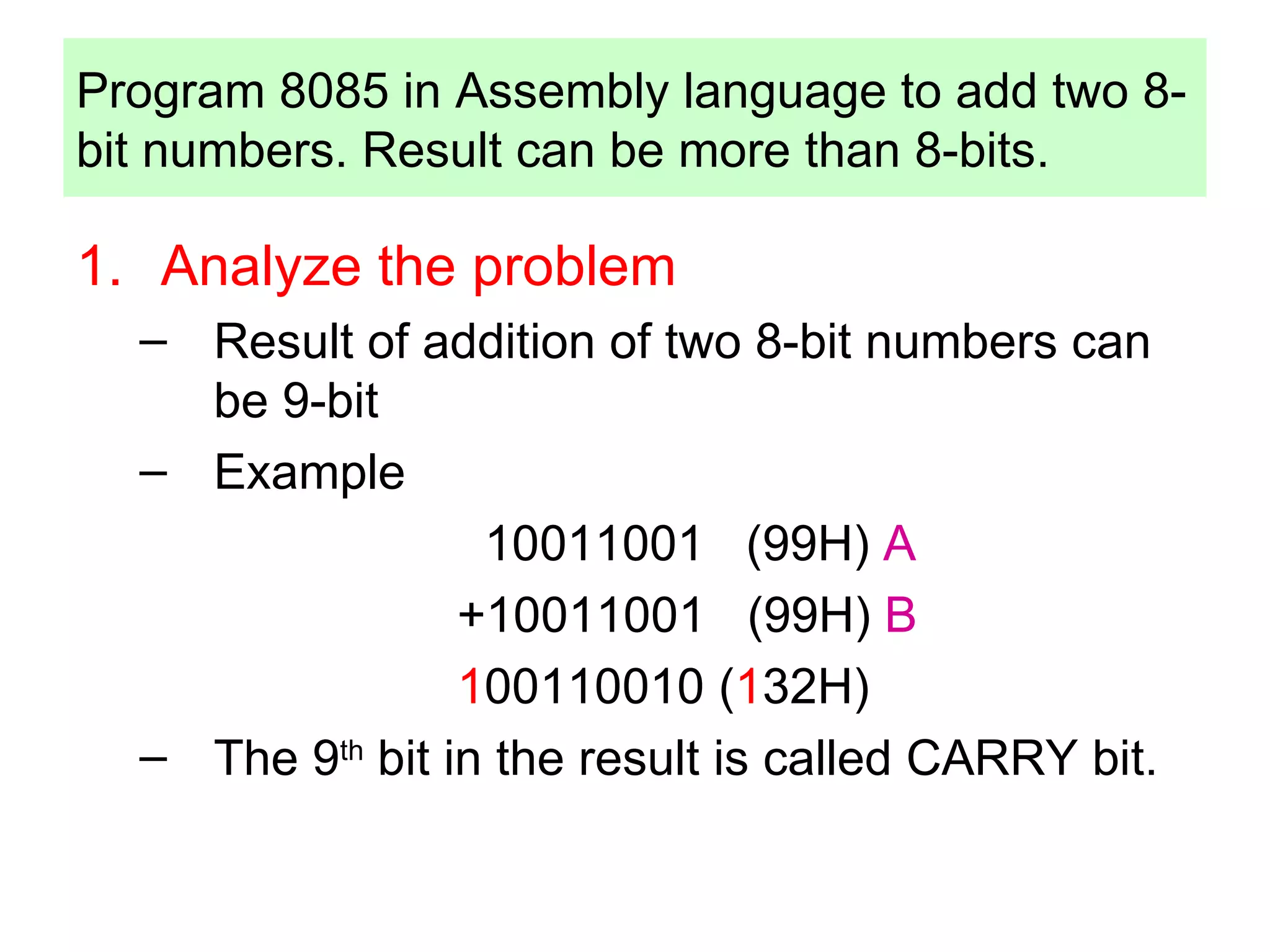
Program 8085 in Assembly language to add two 8-bit numbers. Result can be more than 8-bits. Analyze the problem Result of addition of two 8-bit numbers can be 9-bit Example   10011001  (99H)  A +10011001  (99H)  B 1 00110010 ( 1 32H) The 9 th  bit in the result is called CARRY bit.
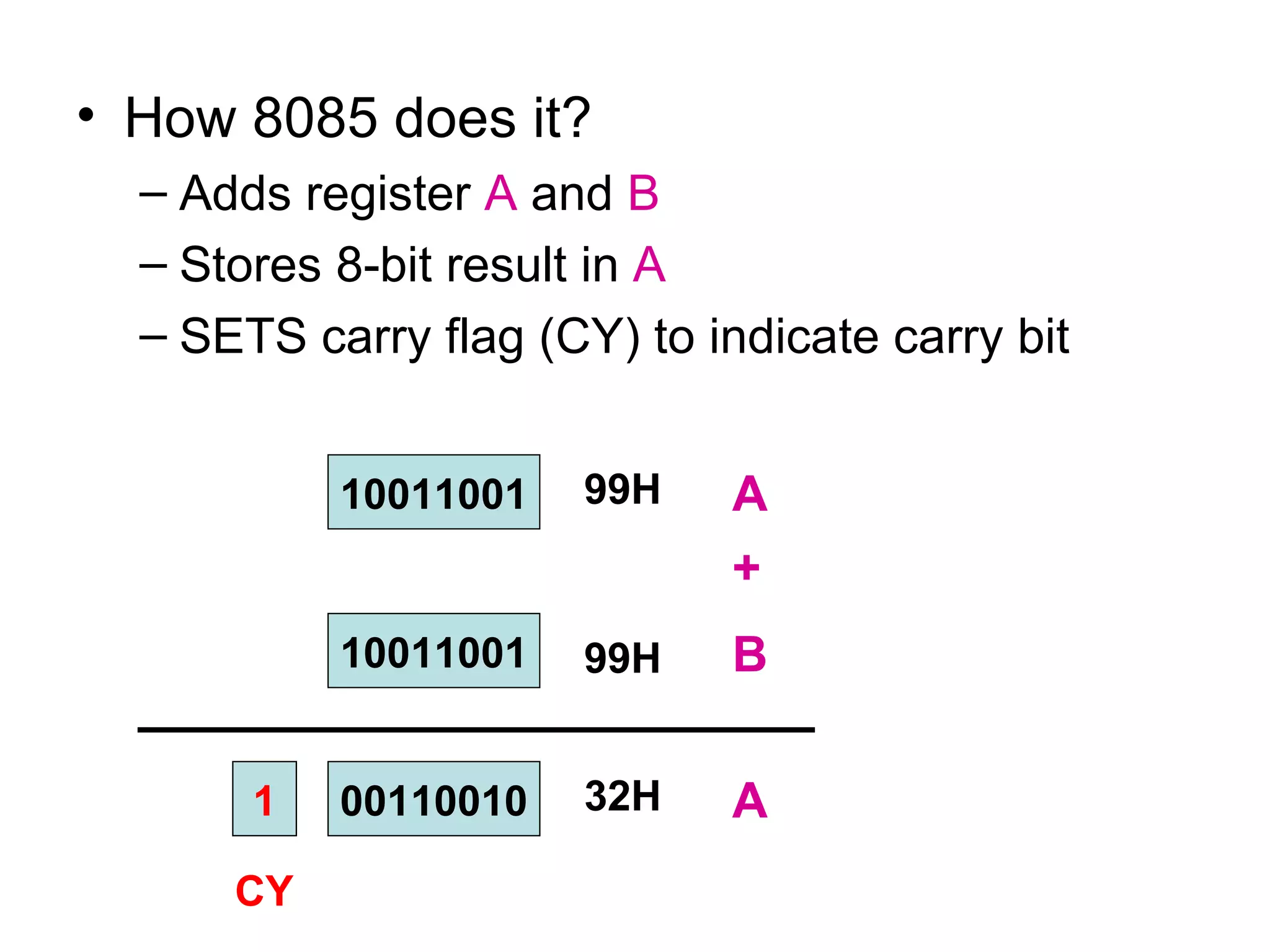
How 8085 does it? Adds register  A  and  B Stores 8-bit result in  A SETS carry flag (CY) to indicate carry bit 0 10011001 10011001 A B + 99H 99H 10011001 A 1 CY 00110010 99H 32H
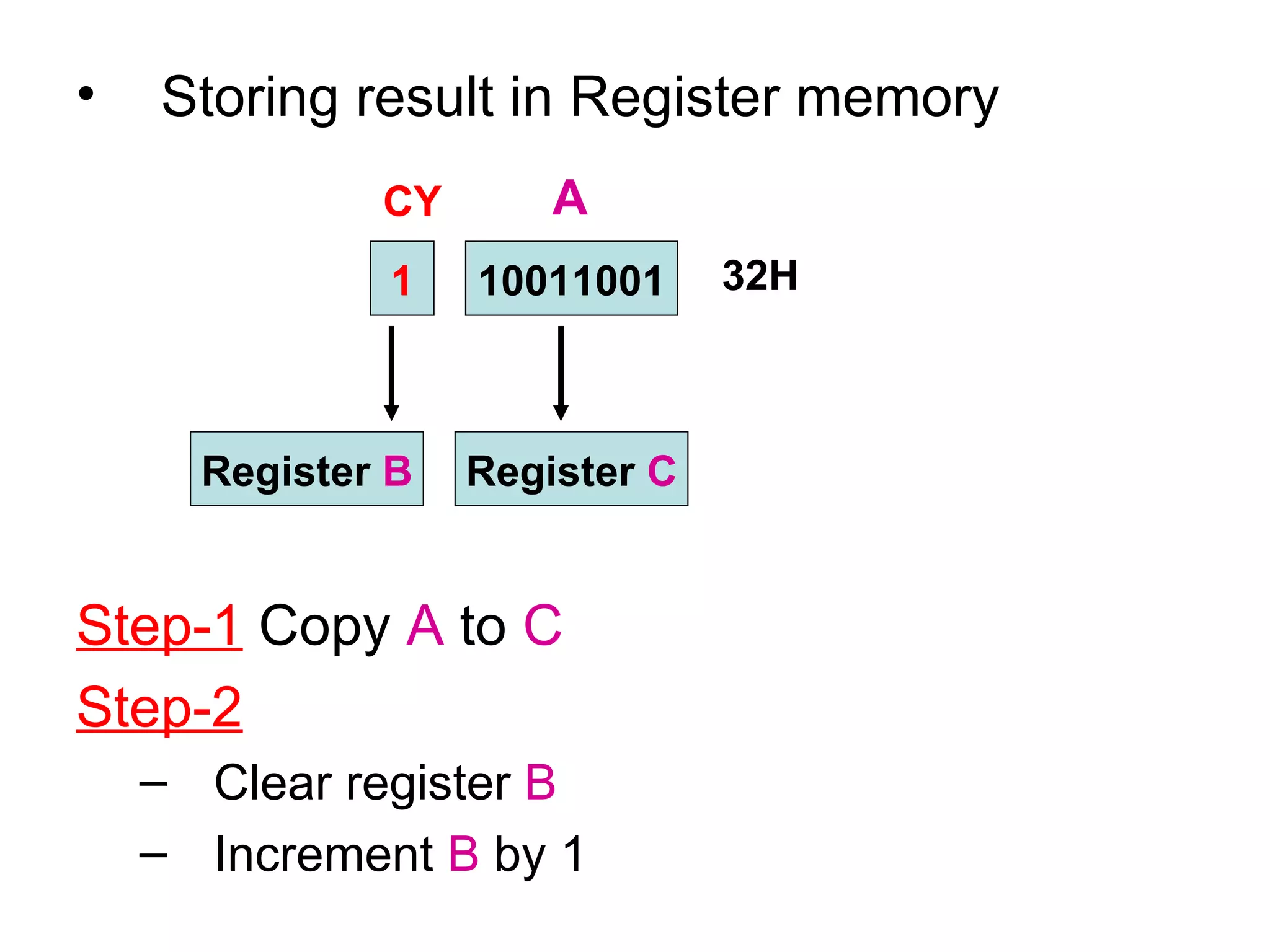
Storing result in Register memory 10011001 A 32H 1 CY Register  C Register  B Step-1  Copy  A  to  C Step-2   Clear register  B Increment  B  by 1
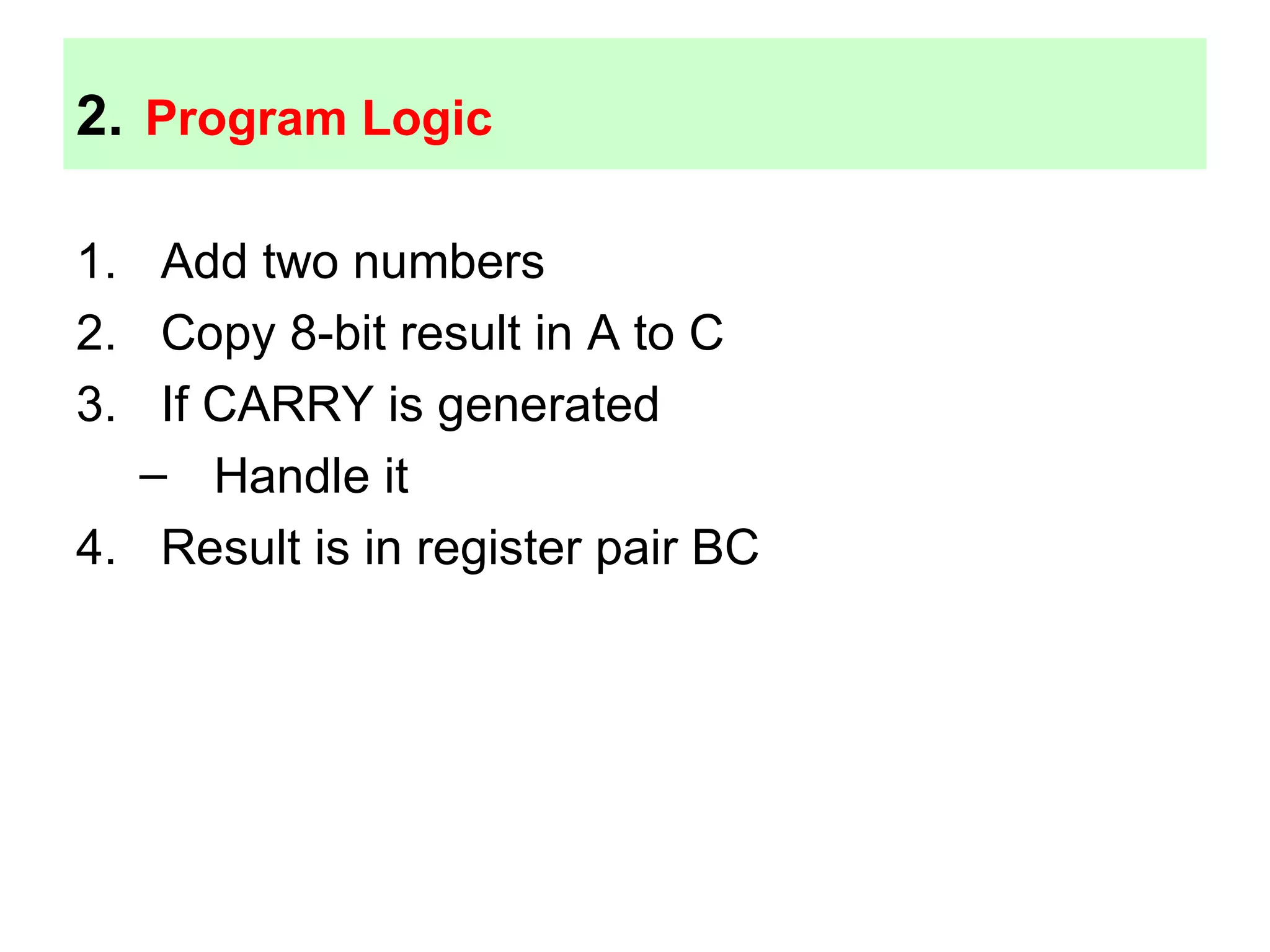
2.   Program Logic Add two numbers Copy 8-bit result in A to C If CARRY is generated Handle it Result is in register pair BC
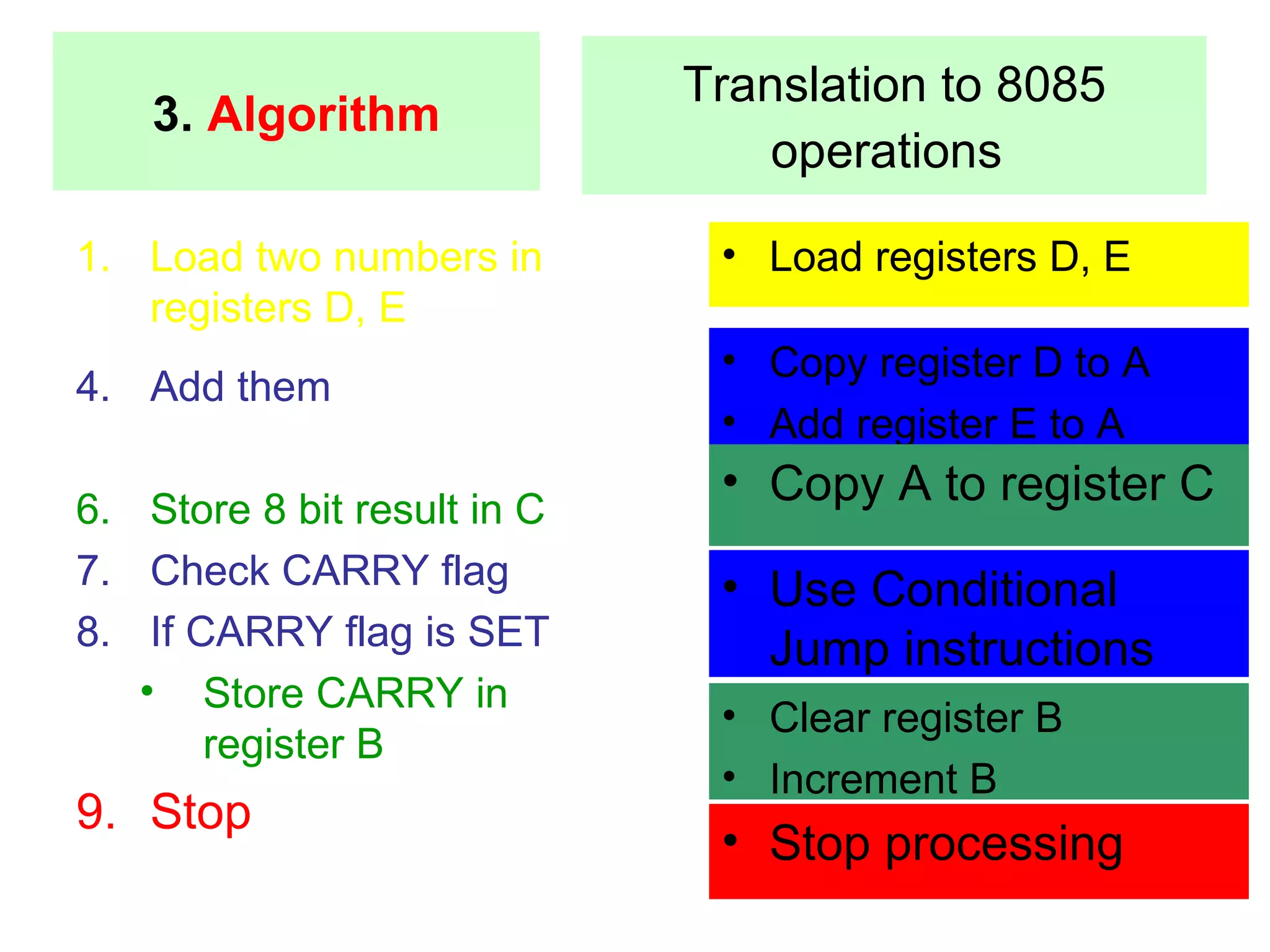
Load two numbers in registers D, E Add them Store 8 bit result in C Check CARRY flag If CARRY flag is SET Store CARRY in register B Stop Load registers D, E 3.  Algorithm Translation to 8085 operations   Copy register D to A Add register E to A Copy A to register C Stop processing Use Conditional Jump instructions Clear register B Increment B Copy A to register C
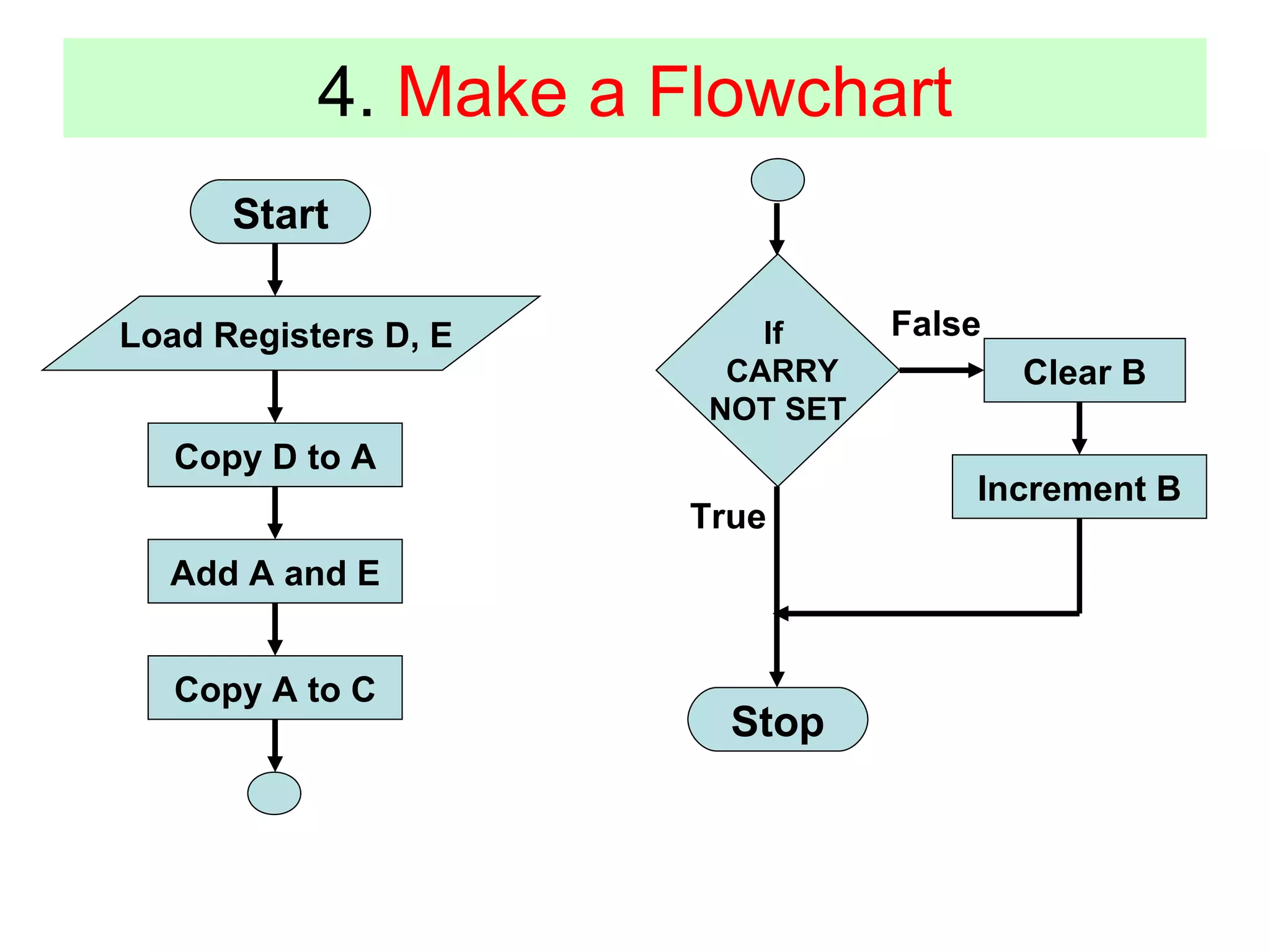
4.  Make a Flowchart Start Load Registers D, E  Copy D to A Add A and E Copy A to C Stop If  CARRY NOT SET Clear B Increment B False True
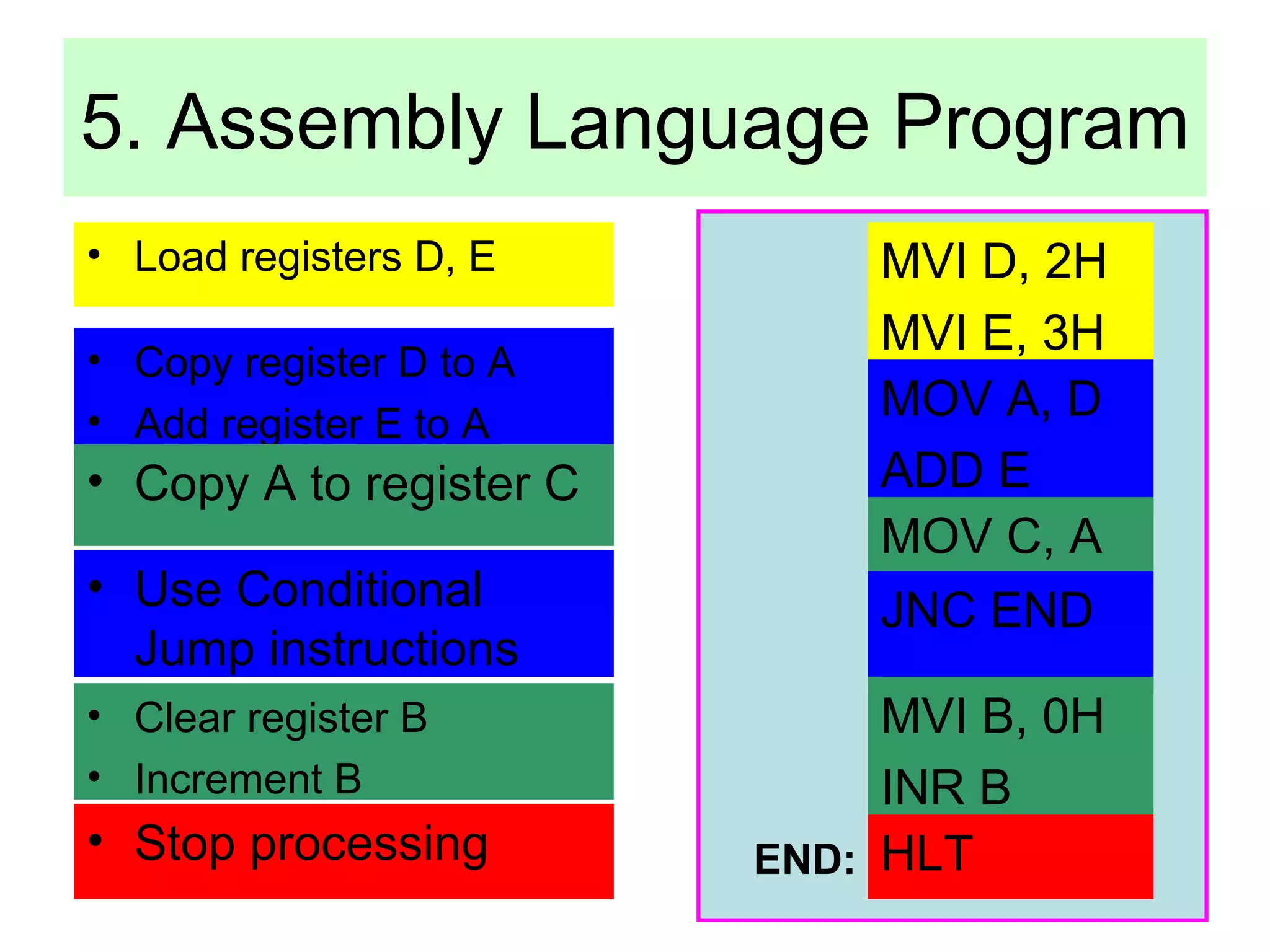
5. Assembly Language Program MVI D, 2H MVI E, 3H MOV A, D ADD E MOV C, A HLT Load registers D, E Copy register D to A Add register E to A Copy A to register C Stop processing Use Conditional Jump instructions Clear register B Increment B Copy A to register C JNC END MVI B, 0H INR B END:
4.  Addressing Modes of 8085 Format of a typical Assembly language instruction is given below- [ Label: ]  Mnemonic  [ Operands ] [ ;comments ]   HLT   MVI  A ,   20H     MOV   M ,   A   ;Copy A to memory location whose    address is stored in register pair HL LOAD:   LDA   2050H  ;Load A with contents of memory    location with address 2050H READ:   IN   07H   ;Read data from Input port with    address 07H
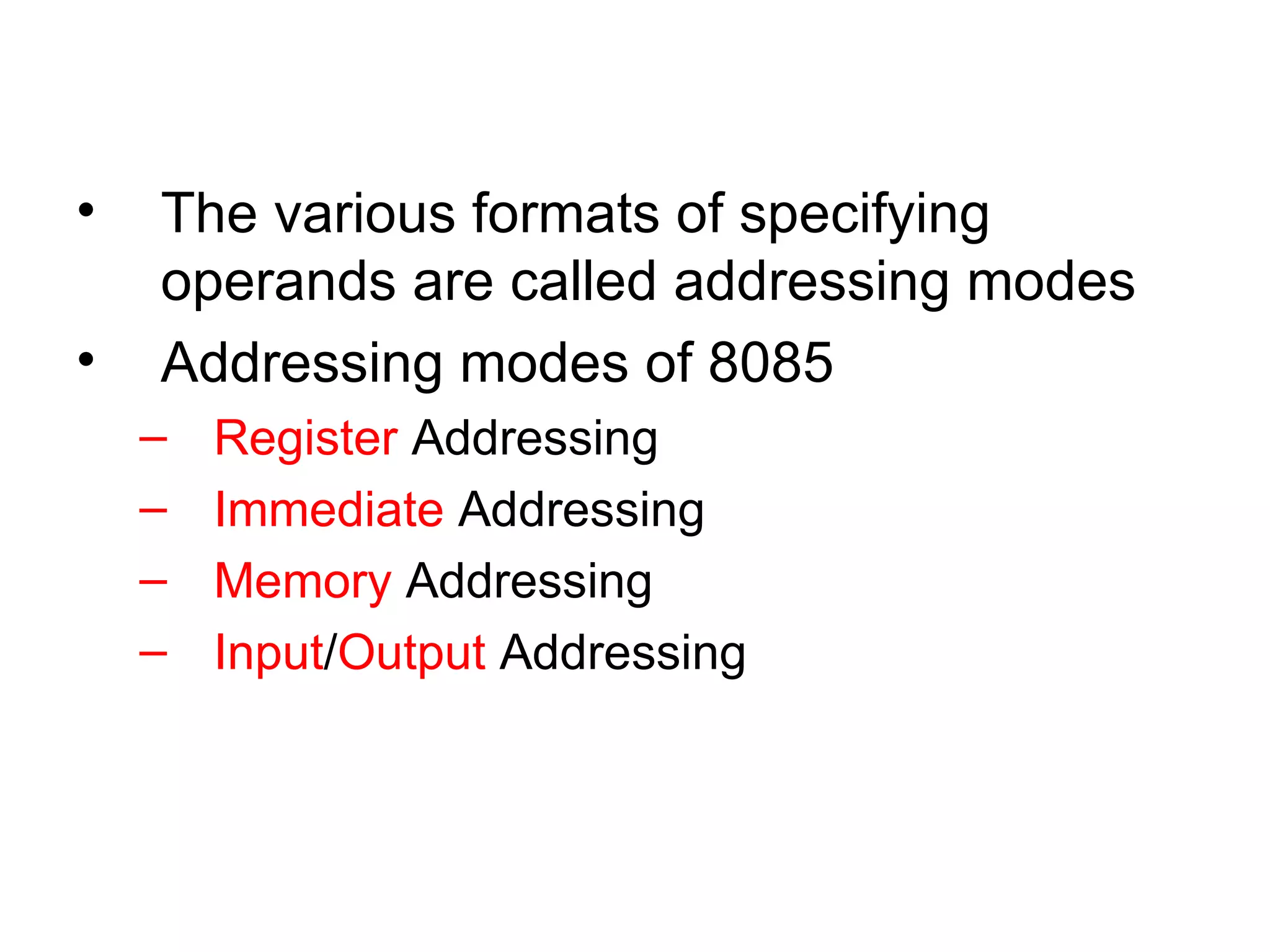
The various formats of specifying operands are called addressing modes Addressing modes of 8085 Register  Addressing Immediate  Addressing Memory  Addressing Input / Output  Addressing
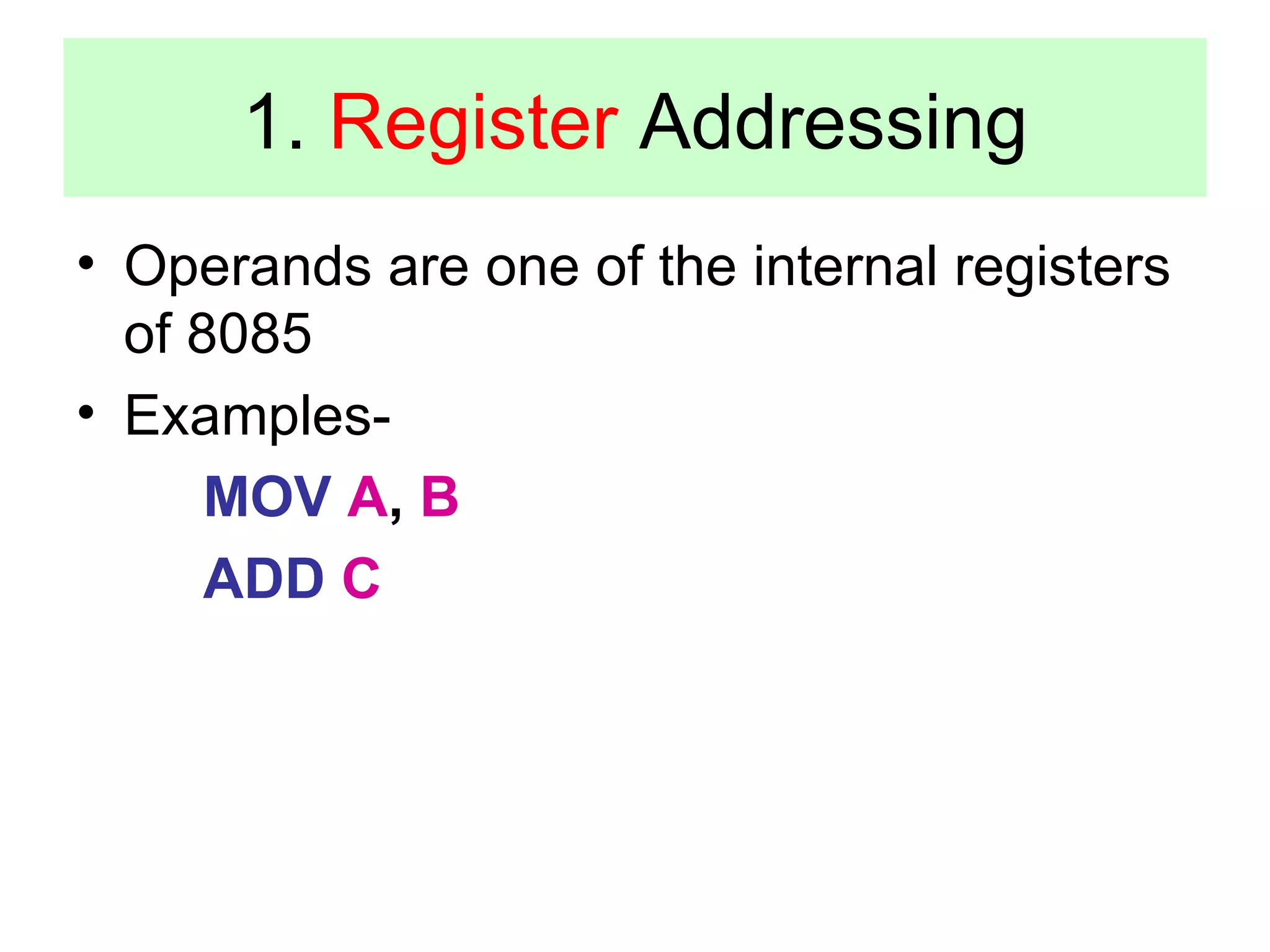
1.  Register  Addressing Operands are one of the internal registers of 8085 Examples- MOV   A ,  B ADD   C
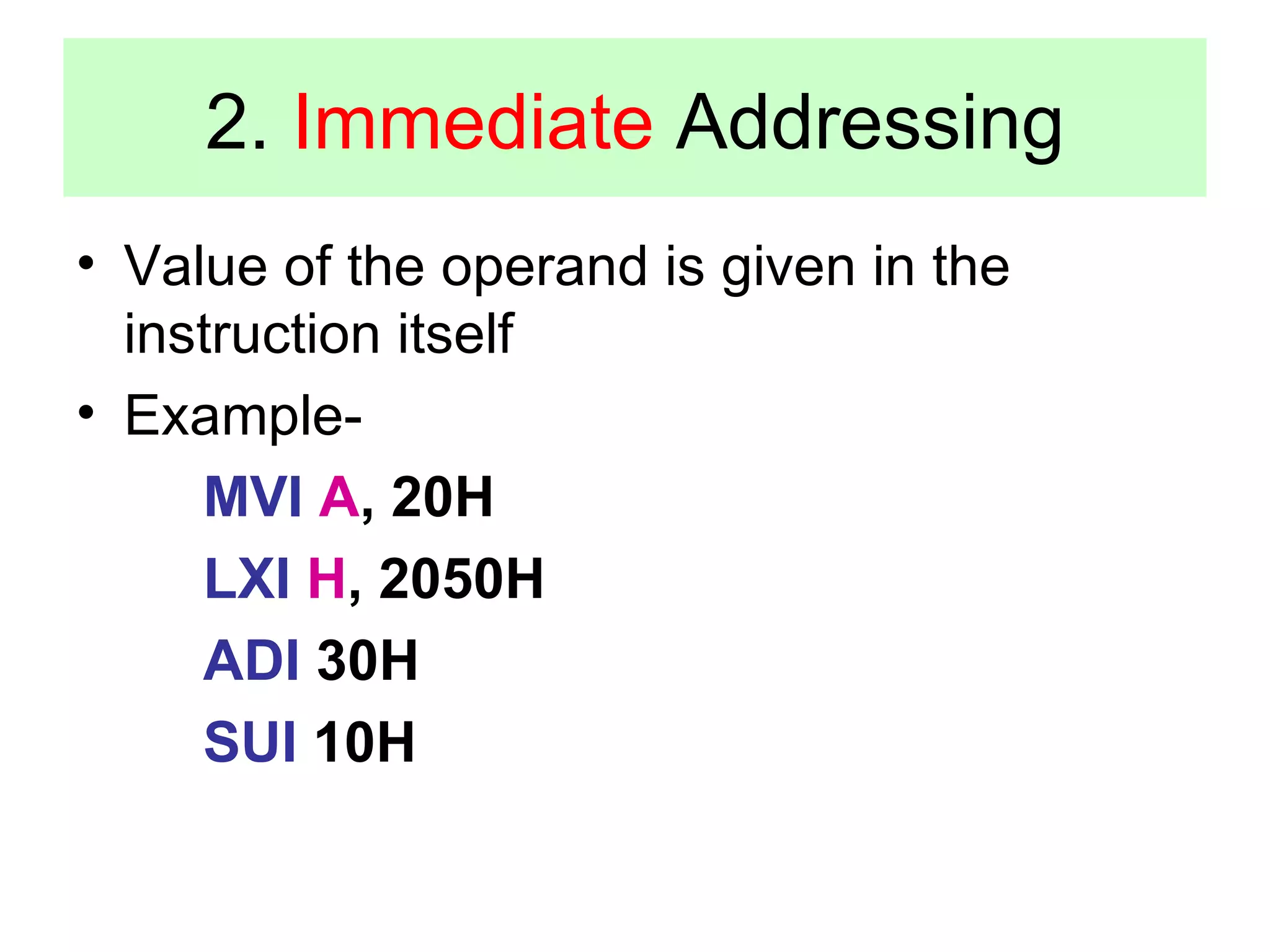
2.  Immediate  Addressing Value of the operand is given in the instruction itself Example- MVI   A , 20H LXI   H , 2050H ADI  30H SUI  10H
3.  Memory  Addressing One of the operands is a memory location Depending on how address of memory location is specified,  memory  addressing is of two types Direct  addressing Indirect  addressing
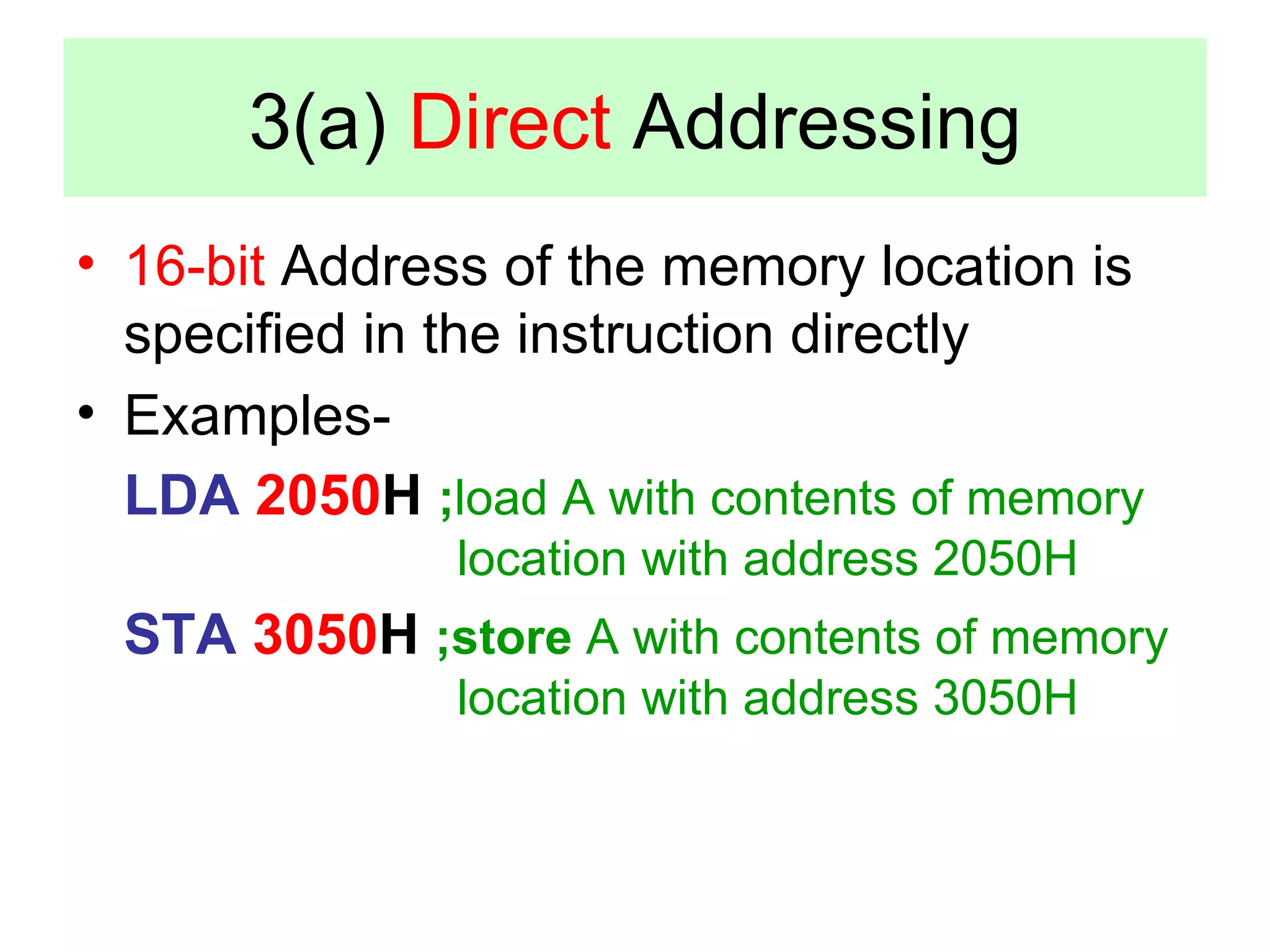
3(a)  Direct  Addressing 16-bit  Address of the memory location is specified in the instruction directly Examples- LDA   2050 H  ; load A with contents of memory  location with address 2050H STA   3050 H  ;store  A with contents of memory  location with address 3050H
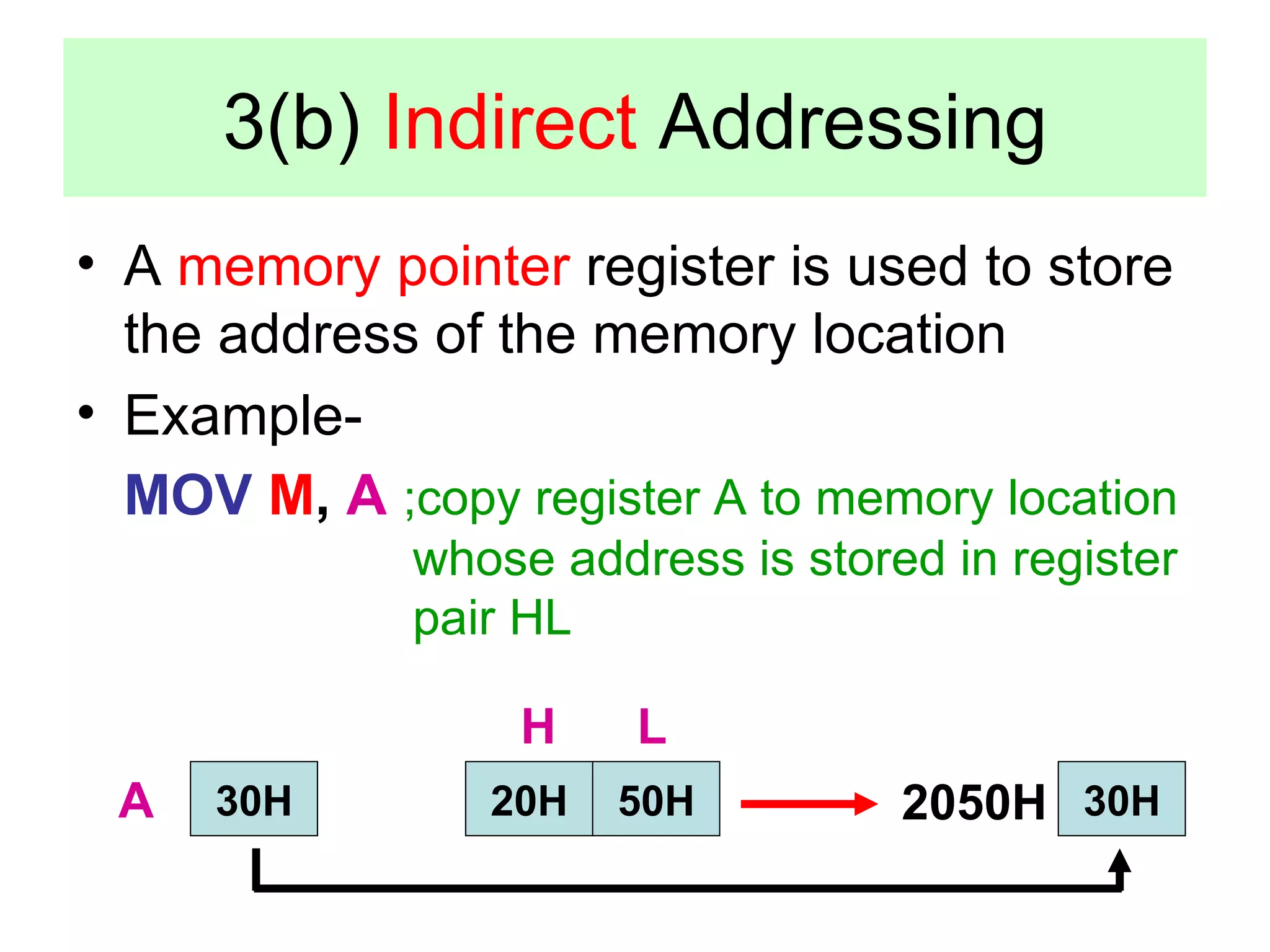
3(b)  Indirect  Addressing A  memory pointer  register is used to store the address of the memory location Example- MOV   M ,  A   ;copy register A to memory location    whose address is stored in register    pair HL 30H A 20H H 50H L 30H 2050H
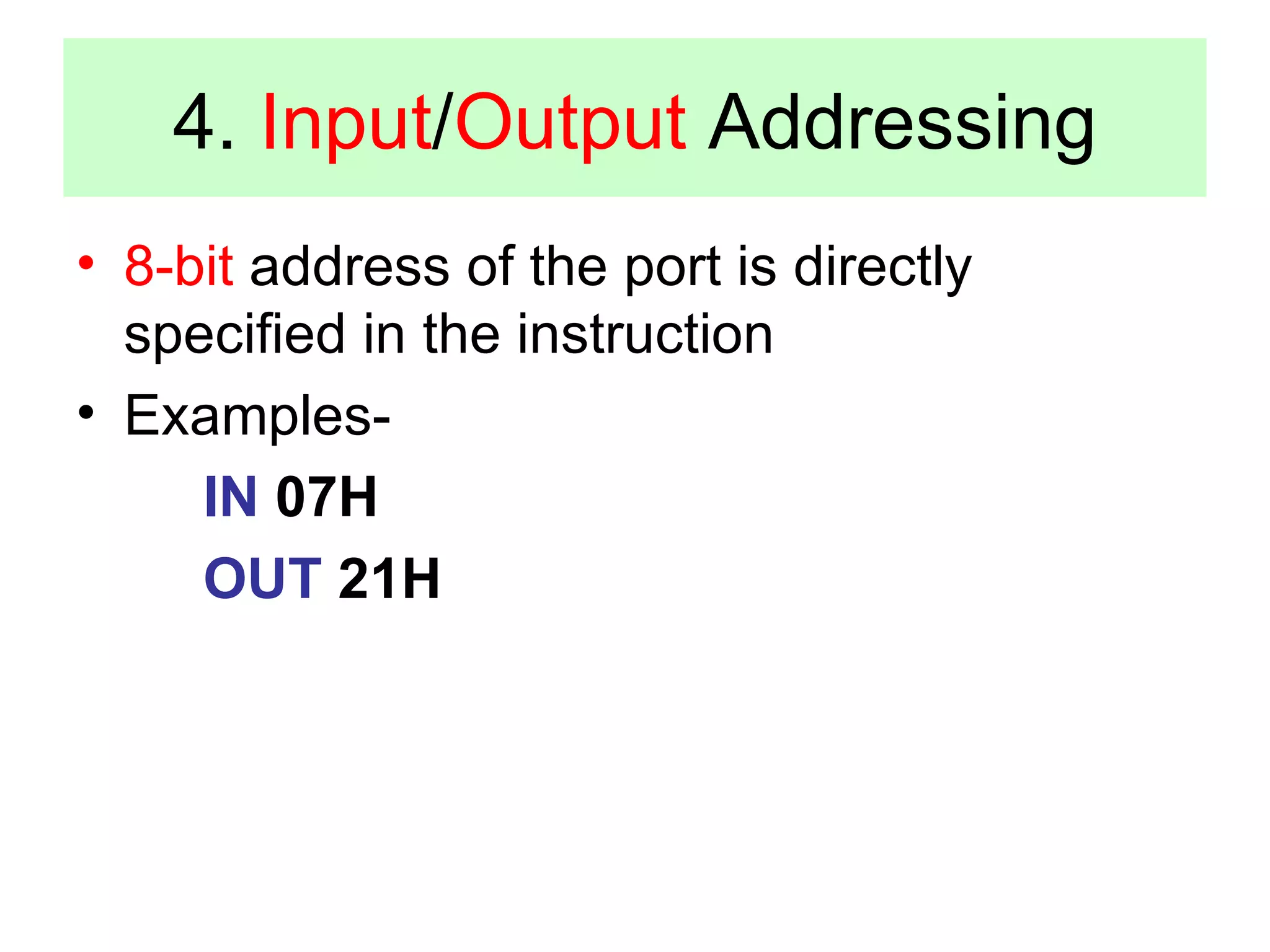
4.  Input / Output  Addressing 8-bit  address of the port is directly specified in the instruction Examples- IN  07H OUT  21H
5.  Instruction & Data Formats 8085 Instruction set can be classified according to size (in bytes) as 1-byte Instructions 2-byte Instructions 3-byte Instructions
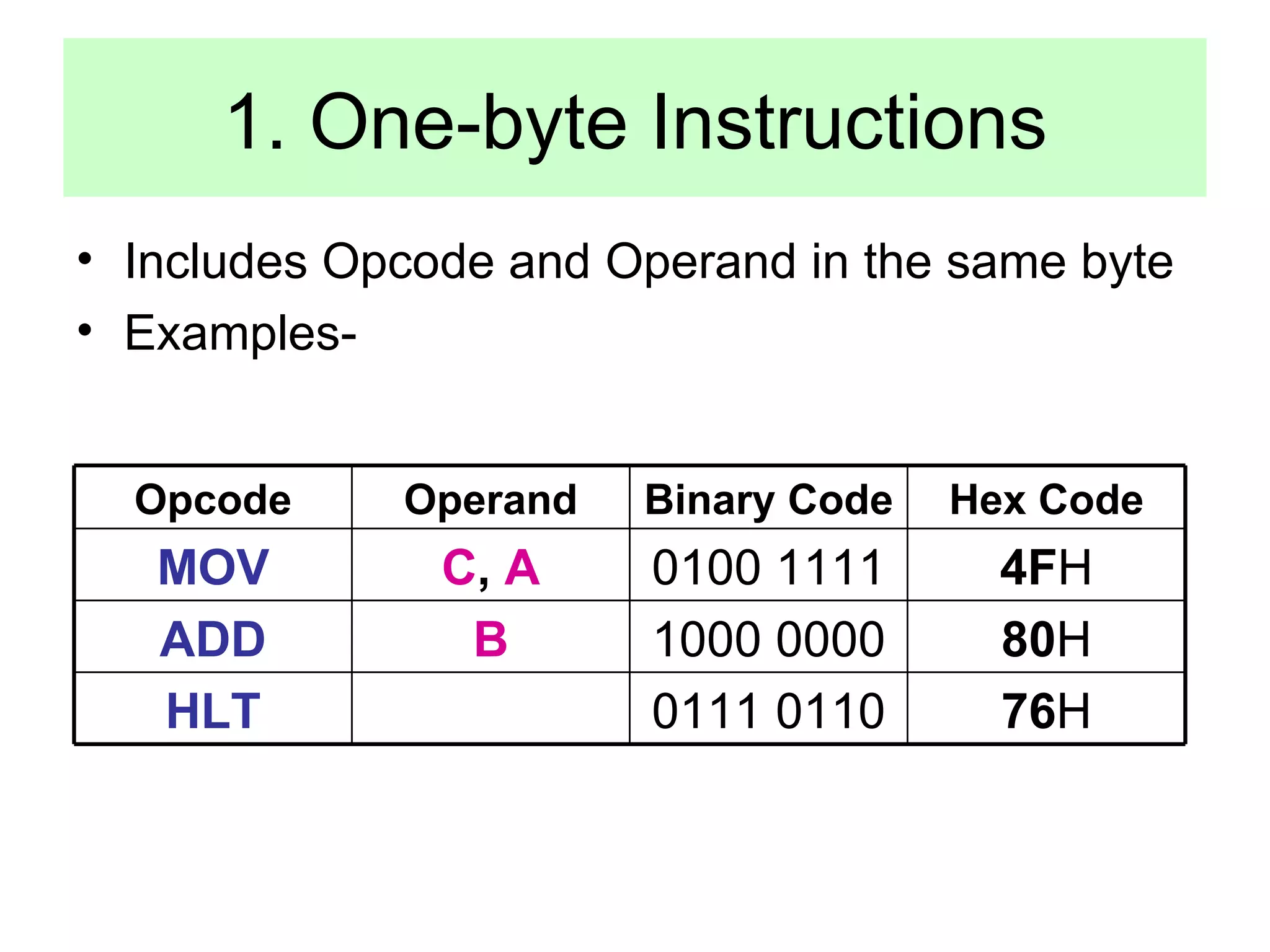
1. One-byte Instructions Includes Opcode and Operand in the same byte Examples- 76 H 0111 0110 HLT 80 H 1000 0000 B ADD 4F H 0100 1111 C ,  A MOV Hex Code Binary Code Operand Opcode
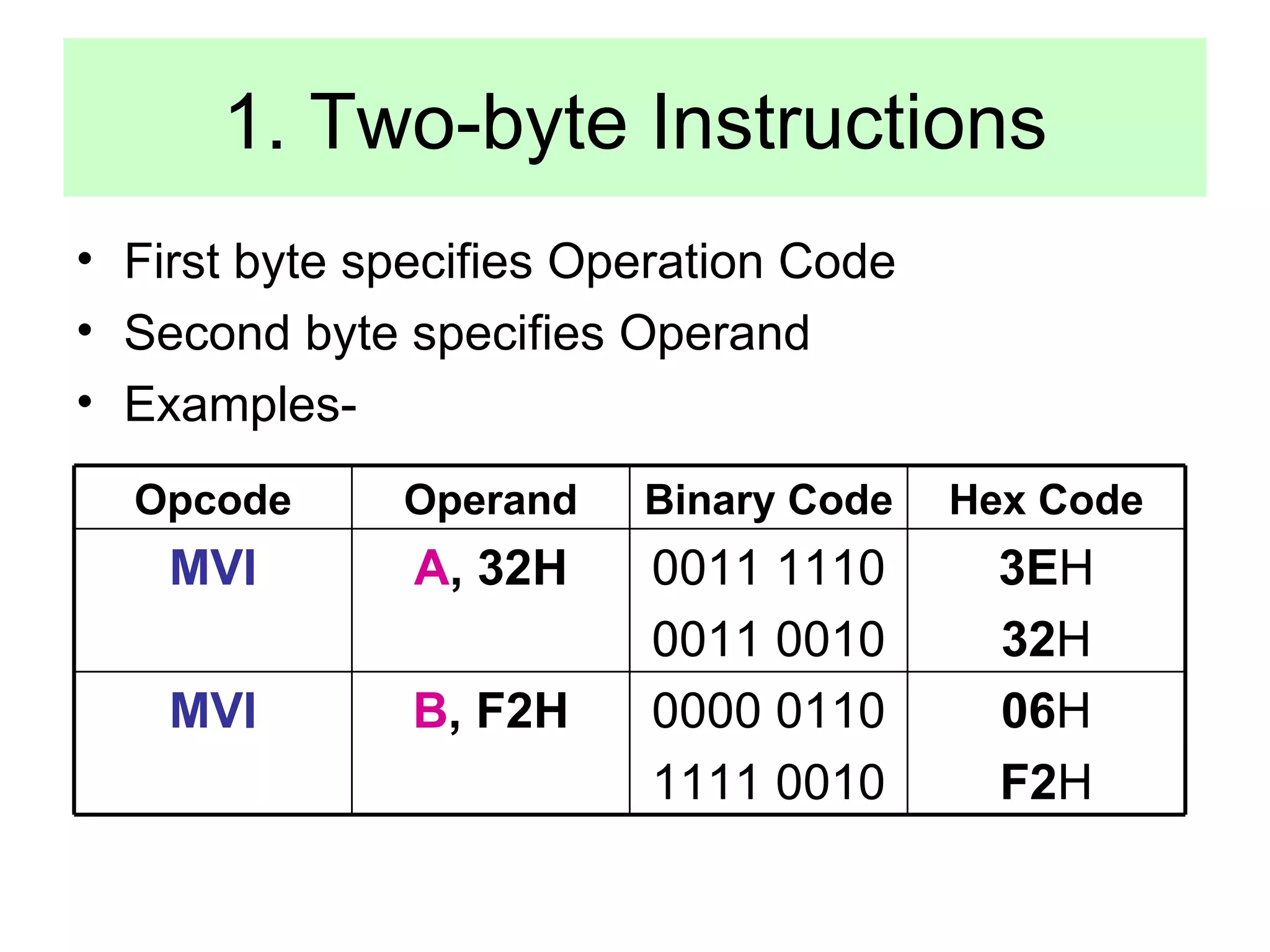
1. Two-byte Instructions First byte specifies Operation Code Second byte specifies Operand Examples- 06 H F2 H 0000 0110 1111 0010 B , F2H MVI 3E H 32 H 0011 1110 0011 0010 A ,   32H MVI Hex Code Binary Code Operand Opcode
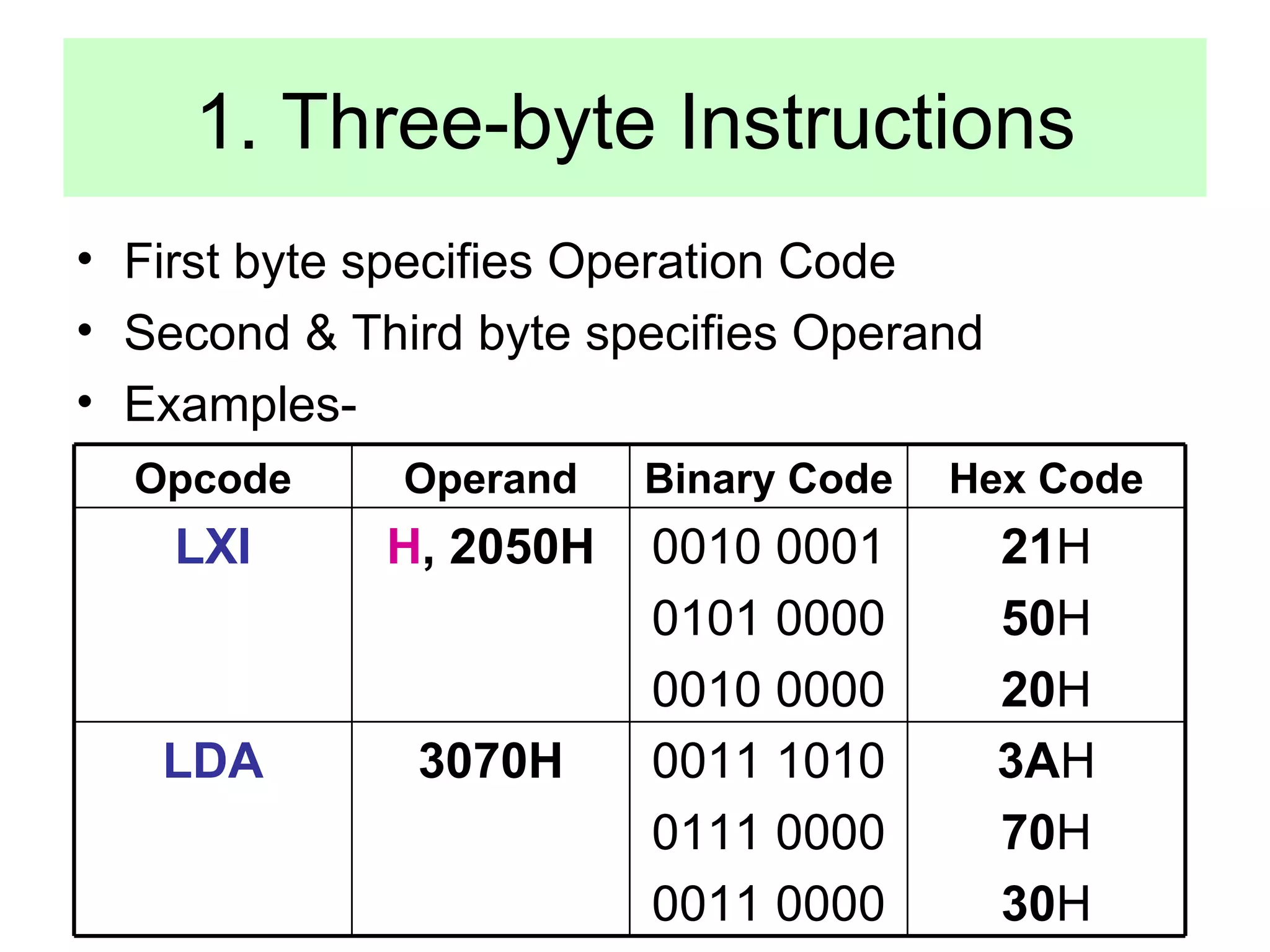
1. Three-byte Instructions First byte specifies Operation Code Second & Third byte specifies Operand Examples- 3A H 70 H 30 H 0011 1010 0111 0000 0011 0000 3070H LDA 21 H 50 H 20 H 0010 0001 0101 0000 0010 0000 H ,   2050H LXI Hex Code Binary Code Operand Opcode
2. Two-byte Instructions

Assembly Language Programming Of 8085

  • 1.
  • 2.
    Topics Introduction Programmingmodel of 8085 Instruction set of 8085 Example Programs Addressing modes of 8085 Instruction & Data Formats of 8085
  • 3.
    1. IntroductionA microprocessor executes instructions given by the user Instructions should be in a language known to the microprocessor Microprocessor understands the language of 0’s and 1’s only This language is called Machine Language
  • 4.
    For e.g. 01001111Is a valid machine language instruction of 8085 It copies the contents of one of the internal registers of 8085 to another
  • 5.
    A Machine languageprogram to add two numbers 00111110 ;Copy value 2H in register A 00000010 00000110 ;Copy value 4H in register B 00000100 10000000 ;A = A + B
  • 6.
    Assembly Language of 8085 It uses English like words to convey the action/meaning For e.g. MOV to indicate data transfer ADD to add two values SUB to subtract two values
  • 7.
    Assembly language programto add two numbers MVI A , 2H ;Copy value 2H in register A MVI B , 4H ;Copy value 4H in register B ADD B ;A = A + B Note: Assembly language is specific to a given processor For e.g. assembly language of 8085 is different than that of Motorola 6800 microprocessor
  • 8.
    Microprocessor understandsMachine Language only! Microprocessor cannot understand a program written in Assembly language A program known as Assembler is used to convert a Assembly language program to machine language Assembly Language Program Assembler Program Machine Language Code
  • 9.
    Low-level/High-level languages Machinelanguage and Assembly language are both Microprocessor specific ( Machine dependent ) so they are called Low-level languages Machine independent languages are called High-level languages For e.g. BASIC, PASCAL,C++,C,JAVA, etc. A software called Compiler is required to convert a high-level language program to machine code
  • 10.
    2. Programmingmodel of 8085 16-bit Address Bus 8-bit Data Bus Control Bus Accumulator ALU Flags Instruction Decoder Register Array Memory Pointer Registers Timing and Control Unit
  • 11.
    16- Lines Unidirectional8- Lines Bidirectional Program Counter (PC) (16-bit) Stack Pointer (SP) (16-bit) L (8-bit) H (8-bit) E (8-bit) D (8-bit) C (8-bit) B (8-bit) Flag Register (8-bit) A ccumulator (8-bit) CY P AC Z S
  • 12.
    Overview: 8085 Programming model Six general-purpose Registers Accumulator Register Flag Register Program Counter Register Stack Pointer Register
  • 13.
    Six general-purpose registersB, C, D, E, H, L Can be combined as register pairs to perform 16-bit operations ( BC, DE, HL ) Accumulator – identified by name A This register is a part of ALU 8-bit data storage Performs arithmetic and logical operations Result of an operation is stored in accumulator
  • 14.
    Flag Register Thisis also a part of ALU 8085 has five flags named Zero flag (Z) Carry flag (CY) Sign flag (S) Parity flag (P) Auxiliary Carry flag (AC)
  • 15.
    These flags arefive flip-flops in flag register Execution of an arithmetic/logic operation can set or reset these flags Condition of flags (set or reset) can be tested through software instructions 8085 uses these flags in decision-making process
  • 16.
    Program Counter (PC)A 16-bit memory pointer register Used to sequence execution of program instructions Stores address of a memory location where next instruction byte is to be fetched by the 8085 when 8085 gets busy to fetch current instruction from memory PC is incremented by one PC is now pointing to the address of next instruction
  • 17.
    Stack Pointer Registera 16-bit memory pointer register Points to a location in Stack memory Beginning of the stack is defined by loading a 16-bit address in stack pointer register
  • 18.
    3. Instruction Setof 8085 Consists of 74 operation codes, e.g. MOV 246 Instructions, e.g. MOV A , B 8085 instructions can be classified as Data Transfer (Copy) Arithmetic Logical and Bit manipulation Branch Machine Control
  • 19.
    1. DataTransfer (Copy) Operations Load a 8-bit number in a R egister Copy from R egister to R egister Copy between R egister and Memory Copy between Input / Output Port and A ccumulator Load a 16-bit number in a R egister pair Copy between R egister pair and Stack memory
  • 20.
    Example Data Transfer(Copy) Operations / Instructions Load a 8-bit number 4F in register B Copy from Register B to Register A Load a 16-bit number 2050 in Register pair HL Copy from Register B to Memory Address 2050 Copy between Input / Output Port and A ccumulator MVI B , 4FH MOV A , B LXI H , 2050H MOV M , B OUT 01H IN 07H
  • 21.
    2. ArithmeticOperations Addition of two 8-bit numbers Subtraction of two 8-bit numbers Increment/ Decrement a 8-bit number
  • 22.
    Example Arithmetic Operations / Instructions Add a 8-bit number 32H to A ccumulator Add contents of Register B to A ccumulator Subtract a 8-bit number 32H from A ccumulator Subtract contents of Register C from A ccumulator Increment the contents of Register D by 1 Decrement the contents of Register E by 1 ADI 32H ADD B SUI 32H SUB C INR D DCR E
  • 23.
    3. Logical& Bit Manipulation Operations AND two 8-bit numbers OR two 8-bit numbers Exclusive-OR two 8-bit numbers Compare two 8-bit numbers Complement Rotate Left/Right Accumulator bits
  • 24.
    Example Logical &Bit Manipulation Operations / Instructions Logically AND Register H with A ccumulator Logically OR Register L with A ccumulator Logically XOR Register B with A ccumulator Compare contents of Register C with A ccumulator Complement A ccumulator Rotate A ccumulator Left ANA H ORA L XRA B CMP C CMA RAL
  • 25.
    4. BranchingOperations These operations are used to control the flow of program execution Jumps Conditional jumps Unconditional jumps Call & Return Conditional Call & Return Unconditional Call & Return
  • 26.
    Example Branching Operations / Instructions Jump to a 16-bit Address 2080H if C arry flag is SET Unconditional Jump Call a subroutine with its 16-bit Address Return back from the Call Call a subroutine with its 16-bit Address if C arry flag is RESET Return if Z ero flag is SET JC 2080H JMP 2050H CALL 3050H RET CNC 3050 H RZ
  • 27.
    5. MachineControl Instructions These instructions affect the operation of the processor. For e.g. HLT Stop program execution NOP Do not perform any operation
  • 28.
    4. Writinga Assembly Language Program Steps to write a program Analyze the problem Develop program Logic Write an Algorithm Make a Flowchart Write program Instructions using Assembly language of 8085
  • 29.
    Program 8085 in Assembly language to add two 8-bit numbers and store 8-bit result in register C . Analyze the problem Addition of two 8-bit numbers to be done Program Logic Add two numbers Store result in register C Example 10011001 (99H) A +00111001 (39H) D 11010010 (D2H) C
  • 30.
    Get two numbers Add them Store result Stop Load 1 st no. in register D Load 2 nd no. in register E 3. Algorithm Translation to 8085 operations Copy register D to A Add register E to A Copy A to register C Stop processing
  • 31.
    4. Makea Flowchart Start Load Registers D, E Copy D to A Add A and E Copy A to C Stop Load 1 st no. in register D Load 2 nd no. in register E Copy register D to A Add register E to A Copy A to register C Stop processing
  • 32.
    5. Assembly LanguageProgram Get two numbers Add them Store result Stop Load 1 st no. in register D Load 2 nd no. in register E Copy register D to A Add register E to A Copy A to register C Stop processing MVI D, 2H MVI E, 3H MOV A, D ADD E MOV C, A HLT
  • 33.
    Program 8085 inAssembly language to add two 8-bit numbers. Result can be more than 8-bits. Analyze the problem Result of addition of two 8-bit numbers can be 9-bit Example 10011001 (99H) A +10011001 (99H) B 1 00110010 ( 1 32H) The 9 th bit in the result is called CARRY bit.
  • 34.
    How 8085 doesit? Adds register A and B Stores 8-bit result in A SETS carry flag (CY) to indicate carry bit 0 10011001 10011001 A B + 99H 99H 10011001 A 1 CY 00110010 99H 32H
  • 35.
    Storing result inRegister memory 10011001 A 32H 1 CY Register C Register B Step-1 Copy A to C Step-2 Clear register B Increment B by 1
  • 36.
    2. Program Logic Add two numbers Copy 8-bit result in A to C If CARRY is generated Handle it Result is in register pair BC
  • 37.
    Load two numbersin registers D, E Add them Store 8 bit result in C Check CARRY flag If CARRY flag is SET Store CARRY in register B Stop Load registers D, E 3. Algorithm Translation to 8085 operations Copy register D to A Add register E to A Copy A to register C Stop processing Use Conditional Jump instructions Clear register B Increment B Copy A to register C
  • 38.
    4. Makea Flowchart Start Load Registers D, E Copy D to A Add A and E Copy A to C Stop If CARRY NOT SET Clear B Increment B False True
  • 39.
    5. Assembly LanguageProgram MVI D, 2H MVI E, 3H MOV A, D ADD E MOV C, A HLT Load registers D, E Copy register D to A Add register E to A Copy A to register C Stop processing Use Conditional Jump instructions Clear register B Increment B Copy A to register C JNC END MVI B, 0H INR B END:
  • 40.
    4. AddressingModes of 8085 Format of a typical Assembly language instruction is given below- [ Label: ] Mnemonic [ Operands ] [ ;comments ] HLT MVI A , 20H MOV M , A ;Copy A to memory location whose address is stored in register pair HL LOAD: LDA 2050H ;Load A with contents of memory location with address 2050H READ: IN 07H ;Read data from Input port with address 07H
  • 41.
    The various formatsof specifying operands are called addressing modes Addressing modes of 8085 Register Addressing Immediate Addressing Memory Addressing Input / Output Addressing
  • 42.
    1. Register Addressing Operands are one of the internal registers of 8085 Examples- MOV A , B ADD C
  • 43.
    2. Immediate Addressing Value of the operand is given in the instruction itself Example- MVI A , 20H LXI H , 2050H ADI 30H SUI 10H
  • 44.
    3. Memory Addressing One of the operands is a memory location Depending on how address of memory location is specified, memory addressing is of two types Direct addressing Indirect addressing
  • 45.
    3(a) Direct Addressing 16-bit Address of the memory location is specified in the instruction directly Examples- LDA 2050 H ; load A with contents of memory location with address 2050H STA 3050 H ;store A with contents of memory location with address 3050H
  • 46.
    3(b) Indirect Addressing A memory pointer register is used to store the address of the memory location Example- MOV M , A ;copy register A to memory location whose address is stored in register pair HL 30H A 20H H 50H L 30H 2050H
  • 47.
    4. Input/ Output Addressing 8-bit address of the port is directly specified in the instruction Examples- IN 07H OUT 21H
  • 48.
    5. Instruction& Data Formats 8085 Instruction set can be classified according to size (in bytes) as 1-byte Instructions 2-byte Instructions 3-byte Instructions
  • 49.
    1. One-byte InstructionsIncludes Opcode and Operand in the same byte Examples- 76 H 0111 0110 HLT 80 H 1000 0000 B ADD 4F H 0100 1111 C , A MOV Hex Code Binary Code Operand Opcode
  • 50.
    1. Two-byte InstructionsFirst byte specifies Operation Code Second byte specifies Operand Examples- 06 H F2 H 0000 0110 1111 0010 B , F2H MVI 3E H 32 H 0011 1110 0011 0010 A , 32H MVI Hex Code Binary Code Operand Opcode
  • 51.
    1. Three-byte InstructionsFirst byte specifies Operation Code Second & Third byte specifies Operand Examples- 3A H 70 H 30 H 0011 1010 0111 0000 0011 0000 3070H LDA 21 H 50 H 20 H 0010 0001 0101 0000 0010 0000 H , 2050H LXI Hex Code Binary Code Operand Opcode
  • 52.