Presented By,
Palash A. Mehar
M.Sc.(Forensic Science) Part-I
Govt. Institute Of Forensic Science, Nagpur.
Privacy Enhanced Mail (PEM)
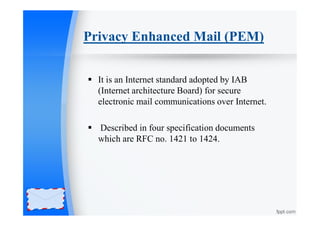
 It is an Internet standard adopted by IAB
(Internet architecture Board) for secure
electronic mail communications over Internet.
 Described in four specification documents
which are RFC no. 1421 to 1424.
Privacy Enhanced Mail (PEM)
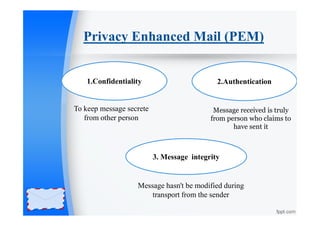
1.Confidentiality 2.Authentication
To keep message secrete Message received is truly
3. Message integrity
from other person
Message received is truly
from person who claims to
have sent it
Message hasn't be modified during
transport from the sender
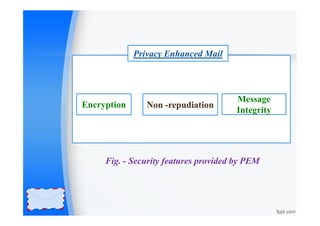
Privacy Enhanced Mail
Encryption Non -repudiation
Message
IntegrityIntegrity
Fig. - Security features provided by PEM
Working of PEM:-
Broad steps in PEM are –
1. Canonical conversion
2. Digital signature
3. Encryption3. Encryption
4. Base - 64 - encoding
1) CANONICAL CONVERSION
Transfer each email message in an abstract,
Canonical representation
 Regardless regardless of architecture and OS of
sending and receiving computers, email messagesending and receiving computers, email message
travel in uniform, independent format.
 Ensure uniform presentation syntax among a
heterogeneous collection of computer system
2. DIGITAL SIGNATURE
 Creates the message using MD 5 or MD 2.
 Then it is encrypted with the sender's private key
to form the sender's digital signature.
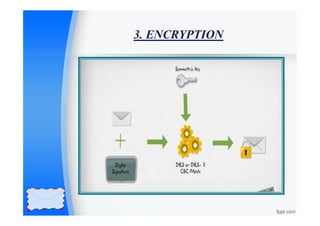
3. ENCRYPTION
4. BASE 64 ENCODING
 Also called as radix 64 encoding or ASCII armour.
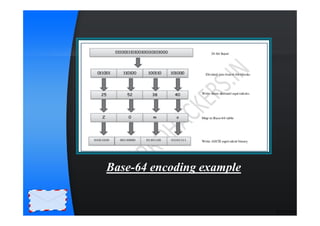
 Binary input is processed in the block of 3 octates or
24 bits.
 These 24 bits are considered to be made up of 4 sets,
each of 6 bits.
 Each such set of 6 bits is mapped into an 8 bit output
character
Base-64 encoding example
Privacy Enhanced Mail (PEM)

Privacy Enhanced Mail (PEM)

  • 1.
    Presented By, Palash A.Mehar M.Sc.(Forensic Science) Part-I Govt. Institute Of Forensic Science, Nagpur.
  • 2.
    Privacy Enhanced Mail(PEM)  It is an Internet standard adopted by IAB (Internet architecture Board) for secure electronic mail communications over Internet.  Described in four specification documents which are RFC no. 1421 to 1424.
  • 3.
    Privacy Enhanced Mail(PEM) 1.Confidentiality 2.Authentication To keep message secrete Message received is truly 3. Message integrity from other person Message received is truly from person who claims to have sent it Message hasn't be modified during transport from the sender
  • 4.
    Privacy Enhanced Mail EncryptionNon -repudiation Message IntegrityIntegrity Fig. - Security features provided by PEM
  • 5.
    Working of PEM:- Broadsteps in PEM are – 1. Canonical conversion 2. Digital signature 3. Encryption3. Encryption 4. Base - 64 - encoding
  • 6.
    1) CANONICAL CONVERSION Transfereach email message in an abstract, Canonical representation  Regardless regardless of architecture and OS of sending and receiving computers, email messagesending and receiving computers, email message travel in uniform, independent format.  Ensure uniform presentation syntax among a heterogeneous collection of computer system
  • 7.
    2. DIGITAL SIGNATURE Creates the message using MD 5 or MD 2.  Then it is encrypted with the sender's private key to form the sender's digital signature.
  • 8.
  • 9.
    4. BASE 64ENCODING  Also called as radix 64 encoding or ASCII armour.  Binary input is processed in the block of 3 octates or 24 bits.  These 24 bits are considered to be made up of 4 sets, each of 6 bits.  Each such set of 6 bits is mapped into an 8 bit output character
  • 10.