Case Study
Case Title: - The Colin Pitchfork case
Introduction:-
On November 21, 1983 and July 31, 1986 Colin Pitchfork raped and murdered two girls in Narborough,
Leicestershire. Lynda Mann, who was 15 years old left her home one evening to visit her friend’s house
and did not return. The next morning she was found on a deserted footpath known locally as the black pad
raped and murdered. Taken from the crime scene, semen found was later tested which shown the person
had type A blood.
On July 31, 1986 Dawn Ashworth, 15 years old took a shortcut instead of taking her normal route home,
two days later was found in a wooded area near a footpath called ten pound lane raped and murdered. In
the same position as Lynda Mann, a semen sample was taken from Dawn and tested. The modus operandi
matched that of the first attack, and semen samples revealed the same blood type.
 The first criminal caught using DNA fingerprinting (England), using the DNA profiling method
published in 1985 by Sir Alec Jeffrey’s.
 Richard Buckland became the first person in the world to be exonerated of murder through
the use of DNA profiling.
Key players:-
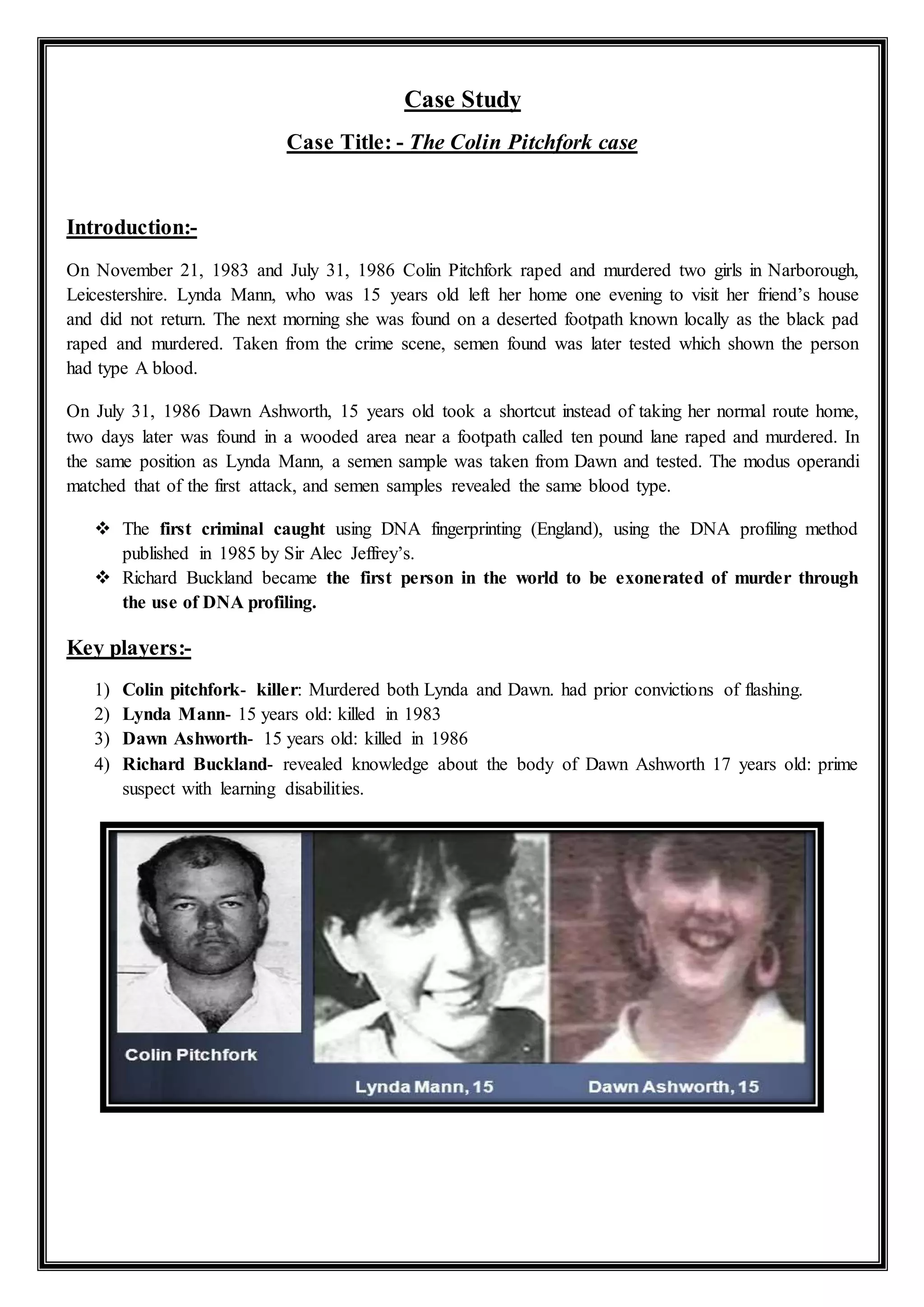
1) Colin pitchfork- killer: Murdered both Lynda and Dawn. had prior convictions of flashing.
2) Lynda Mann- 15 years old: killed in 1983
3) Dawn Ashworth- 15 years old: killed in 1986
4) Richard Buckland- revealed knowledge about the body of Dawn Ashworth 17 years old: prime
suspect with learning disabilities.
Background Of Suspects:-
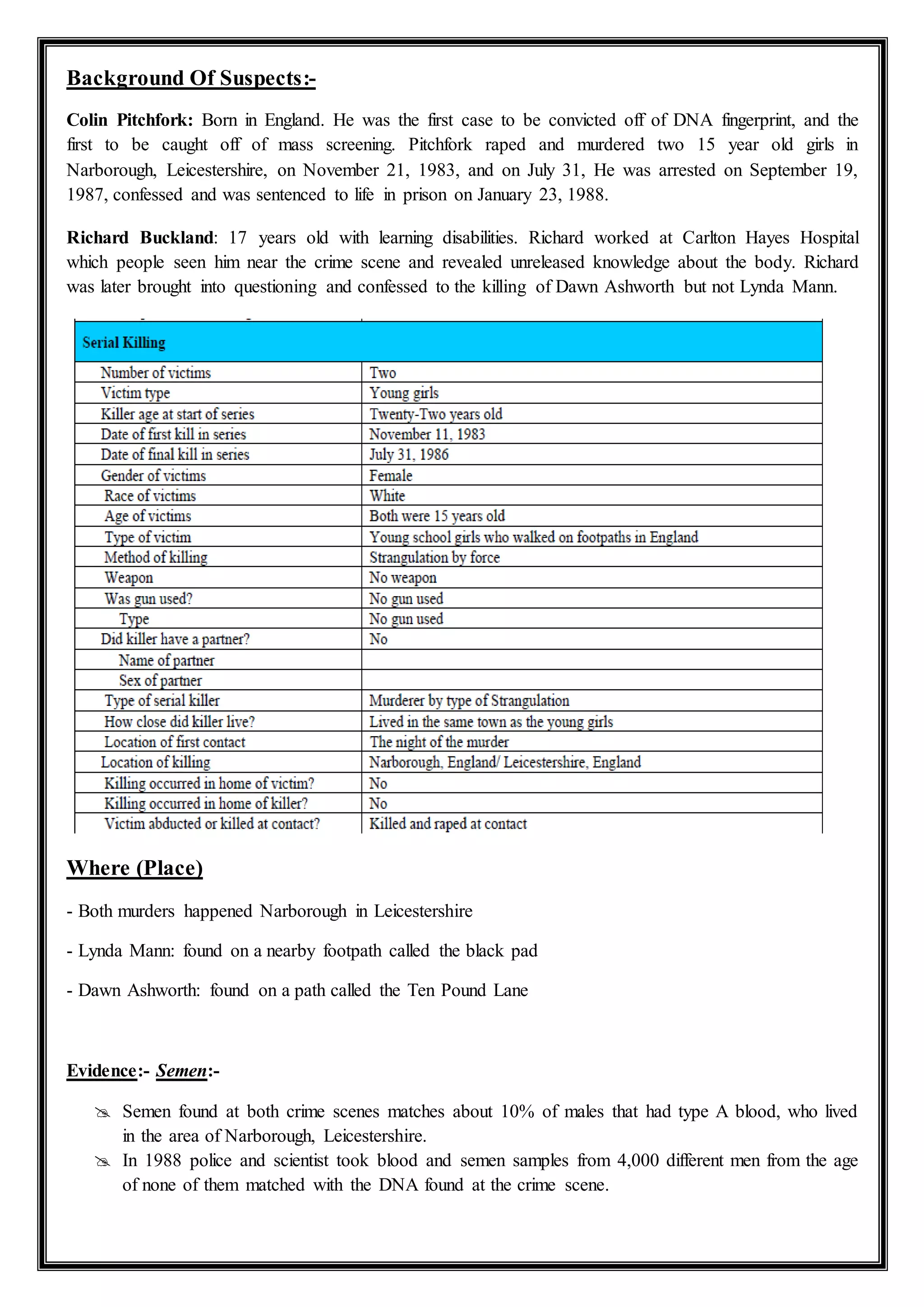
Colin Pitchfork: Born in England. He was the first case to be convicted off of DNA fingerprint, and the
first to be caught off of mass screening. Pitchfork raped and murdered two 15 year old girls in
Narborough, Leicestershire, on November 21, 1983, and on July 31, He was arrested on September 19,
1987, confessed and was sentenced to life in prison on January 23, 1988.
Richard Buckland: 17 years old with learning disabilities. Richard worked at Carlton Hayes Hospital
which people seen him near the crime scene and revealed unreleased knowledge about the body. Richard
was later brought into questioning and confessed to the killing of Dawn Ashworth but not Lynda Mann.
Where (Place)
- Both murders happened Narborough in Leicestershire
- Lynda Mann: found on a nearby footpath called the black pad
- Dawn Ashworth: found on a path called the Ten Pound Lane
Evidence:- Semen:-
 Semen found at both crime scenes matches about 10% of males that had type A blood, who lived
in the area of Narborough, Leicestershire.
 In 1988 police and scientist took blood and semen samples from 4,000 different men from the age
of none of them matched with the DNA found at the crime scene.
Case Lead:
- Ian Kelly, called in telling police about what he overheard one of his co-workers talking about. He said
he heard him say that he got paid for posing as his friend who was later found to be Colin Pitchfork.
Techniques used against suspect:-
-Dr. Jeffrey's used DNA profiling: DNA can be taken by using human skin cells found at the crime scene.
(Semen from both victims)
-Semen found at the crime scene was taken from both victims Lynda and Dawn to determine further lead
in the investigation.
- After being compared to Richard Buckland’s DNA, test shown it wasn't a match
- With having no lead in the case forensic science service teamed up to conduct a project in which 5,000
men were asked to give blood or saliva sample in for testing no match.
DNA profiling:-
In 1985, Alec Jeffrey’s, a genetics researcher at the University of Leicester, first developed DNA
profiling along with Peter Gill and Dave Werrett of the Forensic Science Service (FSS).
Gill commented:
“I was responsible for developing all of the DNA extraction techniques and demonstrating that it was
possible after all to obtain DNA profiles from old stains. The biggest achievement was developing the
preferential extraction method to separate sperm from vaginal cells – without this method; it would have
been difficult to use DNA in rape cases.”
Using this technique, Jeffrey’s compared semen samples from both murder victims against a blood
sample from Buckland and conclusively proved that both girls were killed by the same man and not
Buckland. Buckland became the first person to have his innocence established by DNA fingerprinting.
Jeffrey’s later said:
“I have no doubt whatsoever that he [Buckland] would have been found guilty had it not been for DNA
evidence. That was a remarkable occurrence.”
Leicestershire police then decided to undertake the world's first DNA mass intelligence screen. All adult
males in three villages, a total of 5,000 men, were asked to volunteer and provide blood or saliva samples.
Blood grouping was performed and DNA profiling carried out on the 10 per cent of men who had the
same blood type as the killer.
All of the mass screening work was carried out by the FSS, a painstaking task that took six months to
complete. When they discovered that no profiles matched the profile of the killer, it seemed that all
possibilities had been exhausted. However, the investigation took a strange twist when a year later a
woman overheard her colleague, Ian Kelly, bragging that he had given his sample whilst masquerading as
his friend, Colin Pitchfork. Pitchfork, a local baker, had apparently persuaded Kelly to take the test for
him. Pitchfork was subsequently arrested and his DNA profile was found to match with the semen from
both murders. He was eventually sentenced to life imprisonment for the two murders in 1988.
Arrest & Conviction:-
On 1 August 1987, one of Pitchfork's colleagues at the bakery, Ian Kelly, revealed to fellow workers in a
Leicester pub (The Clarendon) that he had taken the blood test while masquerading as Pitchfork.
Pitchfork told Kelly that he could not give blood under his own name because he had already given blood
while pretending to be a friend of his who had wanted to avoid being harassed by police because of a
youthful conviction for burglary. A woman who overheard the conversation reported it to police.
On 19 September 1987, Pitchfork was arrested. During subsequent questioning, Pitchfork admitted to
exposing himself to more than 1,000 women, a compulsion that he had started in his early teens. He later
progressed to sexual assault and then to strangling his victims in order to protect his identity. He pleaded
guilty to the two rape/murders in addition to another incident of sexual assault, and was sentenced to life
imprisonment. The Lord Chief Justice at the time of his sentencing said: "From the point of view of the
safety of the public I doubt if he should ever be released." The Secretary of State set a minimum term of
30 years; in 2009, Pitchfork's sentence was reduced on appeal to 28 years.
Parole review:-
On 22 April 2016, the Parole Board for England and Wales heard Pitchfork's case for early release on
parole. Pitchfork's advocates presented evidence of his improved character, noting that Pitchfork had
furthered his education to degree level and had become expert at the transcription of printed music into
Braille, for the benefit of the blind. The families of victims Lynda Mann and Dawn Ashworth opposed his
release on parole.
On 29 April 2016, the Parole Board announced that Pitchfork's petition for parole had been denied, but
they then issued a recommendation that Pitchfork be moved to an open prison. In June 2016, Michael
Gove, then serving as Justice Secretary, agreed with the board's recommendation, and at some point prior
to 8 January 2017, Pitchfork was moved to an undisclosed open prison. The Parole Board denied parole
again in 2018. He may be eligible for parole again in 2020. (https://www.bbc.co.uk/news/uk-england-
leicestershire-43993232)
In November 2018, Colin Pitchfork was spotted walking around Bristol, so it has been assumed that he
was moved to HM Prison Leyhill.
2018 Parole Review
On the 3rd of May 2018, Pitchfork was denied parole. The Parole Board said Pitchfork will be eligible for
a further review within two years. Lynda's mother said the Parole Board had "listened to us before the
murderer". Last year, it emerged Pitchfork would be released from open prison on unsupervised days out.
It had been widely expected that Pitchfork could be approaching final release from prison on parole.
References:-
 EOCL Lecture 20, 21 : Some famous casesinvolving DNA Evidence (version 29
March 2008).
 Colin Pitchfork | Murderpedia, the encyclopedia of murderers
 http://en.wikipedia.org/wiki/Colin Pitchfork :Colin Pitchfork

Forensic Biology Case Study :- The Colin Pitchfork Case

  • 1.
    Case Study Case Title:- The Colin Pitchfork case Introduction:- On November 21, 1983 and July 31, 1986 Colin Pitchfork raped and murdered two girls in Narborough, Leicestershire. Lynda Mann, who was 15 years old left her home one evening to visit her friend’s house and did not return. The next morning she was found on a deserted footpath known locally as the black pad raped and murdered. Taken from the crime scene, semen found was later tested which shown the person had type A blood. On July 31, 1986 Dawn Ashworth, 15 years old took a shortcut instead of taking her normal route home, two days later was found in a wooded area near a footpath called ten pound lane raped and murdered. In the same position as Lynda Mann, a semen sample was taken from Dawn and tested. The modus operandi matched that of the first attack, and semen samples revealed the same blood type.  The first criminal caught using DNA fingerprinting (England), using the DNA profiling method published in 1985 by Sir Alec Jeffrey’s.  Richard Buckland became the first person in the world to be exonerated of murder through the use of DNA profiling. Key players:- 1) Colin pitchfork- killer: Murdered both Lynda and Dawn. had prior convictions of flashing. 2) Lynda Mann- 15 years old: killed in 1983 3) Dawn Ashworth- 15 years old: killed in 1986 4) Richard Buckland- revealed knowledge about the body of Dawn Ashworth 17 years old: prime suspect with learning disabilities.
  • 2.
    Background Of Suspects:- ColinPitchfork: Born in England. He was the first case to be convicted off of DNA fingerprint, and the first to be caught off of mass screening. Pitchfork raped and murdered two 15 year old girls in Narborough, Leicestershire, on November 21, 1983, and on July 31, He was arrested on September 19, 1987, confessed and was sentenced to life in prison on January 23, 1988. Richard Buckland: 17 years old with learning disabilities. Richard worked at Carlton Hayes Hospital which people seen him near the crime scene and revealed unreleased knowledge about the body. Richard was later brought into questioning and confessed to the killing of Dawn Ashworth but not Lynda Mann. Where (Place) - Both murders happened Narborough in Leicestershire - Lynda Mann: found on a nearby footpath called the black pad - Dawn Ashworth: found on a path called the Ten Pound Lane Evidence:- Semen:-  Semen found at both crime scenes matches about 10% of males that had type A blood, who lived in the area of Narborough, Leicestershire.  In 1988 police and scientist took blood and semen samples from 4,000 different men from the age of none of them matched with the DNA found at the crime scene.
  • 3.
    Case Lead: - IanKelly, called in telling police about what he overheard one of his co-workers talking about. He said he heard him say that he got paid for posing as his friend who was later found to be Colin Pitchfork. Techniques used against suspect:- -Dr. Jeffrey's used DNA profiling: DNA can be taken by using human skin cells found at the crime scene. (Semen from both victims) -Semen found at the crime scene was taken from both victims Lynda and Dawn to determine further lead in the investigation. - After being compared to Richard Buckland’s DNA, test shown it wasn't a match - With having no lead in the case forensic science service teamed up to conduct a project in which 5,000 men were asked to give blood or saliva sample in for testing no match. DNA profiling:- In 1985, Alec Jeffrey’s, a genetics researcher at the University of Leicester, first developed DNA profiling along with Peter Gill and Dave Werrett of the Forensic Science Service (FSS). Gill commented: “I was responsible for developing all of the DNA extraction techniques and demonstrating that it was possible after all to obtain DNA profiles from old stains. The biggest achievement was developing the preferential extraction method to separate sperm from vaginal cells – without this method; it would have been difficult to use DNA in rape cases.” Using this technique, Jeffrey’s compared semen samples from both murder victims against a blood sample from Buckland and conclusively proved that both girls were killed by the same man and not Buckland. Buckland became the first person to have his innocence established by DNA fingerprinting. Jeffrey’s later said: “I have no doubt whatsoever that he [Buckland] would have been found guilty had it not been for DNA evidence. That was a remarkable occurrence.” Leicestershire police then decided to undertake the world's first DNA mass intelligence screen. All adult males in three villages, a total of 5,000 men, were asked to volunteer and provide blood or saliva samples. Blood grouping was performed and DNA profiling carried out on the 10 per cent of men who had the same blood type as the killer. All of the mass screening work was carried out by the FSS, a painstaking task that took six months to complete. When they discovered that no profiles matched the profile of the killer, it seemed that all possibilities had been exhausted. However, the investigation took a strange twist when a year later a woman overheard her colleague, Ian Kelly, bragging that he had given his sample whilst masquerading as his friend, Colin Pitchfork. Pitchfork, a local baker, had apparently persuaded Kelly to take the test for him. Pitchfork was subsequently arrested and his DNA profile was found to match with the semen from both murders. He was eventually sentenced to life imprisonment for the two murders in 1988.
  • 4.
    Arrest & Conviction:- On1 August 1987, one of Pitchfork's colleagues at the bakery, Ian Kelly, revealed to fellow workers in a Leicester pub (The Clarendon) that he had taken the blood test while masquerading as Pitchfork. Pitchfork told Kelly that he could not give blood under his own name because he had already given blood while pretending to be a friend of his who had wanted to avoid being harassed by police because of a youthful conviction for burglary. A woman who overheard the conversation reported it to police. On 19 September 1987, Pitchfork was arrested. During subsequent questioning, Pitchfork admitted to exposing himself to more than 1,000 women, a compulsion that he had started in his early teens. He later progressed to sexual assault and then to strangling his victims in order to protect his identity. He pleaded guilty to the two rape/murders in addition to another incident of sexual assault, and was sentenced to life imprisonment. The Lord Chief Justice at the time of his sentencing said: "From the point of view of the safety of the public I doubt if he should ever be released." The Secretary of State set a minimum term of 30 years; in 2009, Pitchfork's sentence was reduced on appeal to 28 years. Parole review:- On 22 April 2016, the Parole Board for England and Wales heard Pitchfork's case for early release on parole. Pitchfork's advocates presented evidence of his improved character, noting that Pitchfork had furthered his education to degree level and had become expert at the transcription of printed music into Braille, for the benefit of the blind. The families of victims Lynda Mann and Dawn Ashworth opposed his release on parole. On 29 April 2016, the Parole Board announced that Pitchfork's petition for parole had been denied, but they then issued a recommendation that Pitchfork be moved to an open prison. In June 2016, Michael Gove, then serving as Justice Secretary, agreed with the board's recommendation, and at some point prior to 8 January 2017, Pitchfork was moved to an undisclosed open prison. The Parole Board denied parole again in 2018. He may be eligible for parole again in 2020. (https://www.bbc.co.uk/news/uk-england- leicestershire-43993232) In November 2018, Colin Pitchfork was spotted walking around Bristol, so it has been assumed that he was moved to HM Prison Leyhill. 2018 Parole Review On the 3rd of May 2018, Pitchfork was denied parole. The Parole Board said Pitchfork will be eligible for a further review within two years. Lynda's mother said the Parole Board had "listened to us before the murderer". Last year, it emerged Pitchfork would be released from open prison on unsupervised days out. It had been widely expected that Pitchfork could be approaching final release from prison on parole. References:-  EOCL Lecture 20, 21 : Some famous casesinvolving DNA Evidence (version 29 March 2008).  Colin Pitchfork | Murderpedia, the encyclopedia of murderers  http://en.wikipedia.org/wiki/Colin Pitchfork :Colin Pitchfork