Cellular Wireless Network
Security
Prepared by:-
Gowri Sajith
IT-A
Roll no-47
INTRODUCTION
Cellular Communication has become an important part of our daily life. Besides using cell phones
for voice communication, we are now able to access the Internet, conduct monetary transactions,
send text messages etc. using our cell phones, and new services continue to be added.
Thus it is of utmost importance to provide a safe and secure channel to user for communication.
Security in wireless cellular networks determines the system to manage, protect and distribute
sensitive information in a secure way.
To combat the risks involved in cellular networks certain security models have been proposed,
implemented and deployed continuously.
About different security threats and mechanism to solve it
Security Issues In Cellular Networks
There are several security issues that have to be taken into consideration when deploying a cellular
infrastructure. The importance of which has increased with the advent of advanced networks like
3G.Authentication: Cellular networks have a large number of subscribers, and each has to be authenticated to
ensure the right people are using the network. Since the purpose of 3G is to enable people to communicate from
anywhere in the world, the issue of cross region and cross provider authentication becomes an issue.
Integrity: With services such as SMS, chat and file transfer it is important that the data arrives without any
modifications.
Confidentiality: With the increased use of cellular phones in sensitive communication, there is a need for a
secure channel in order to transmit information.
Access Control: The Cellular device may have files that need to have restricted access to them. The device
might access a database where some sort of role based access control is necessary .
Location Detection: The actual location of a cellular device needs to be kept hidden for reasons of
privacy of the user. With the move to IP based networks, the issue arises that a user may be associated
with an access point and therefore their location might be compromised.
Viruses And Malware: With increased functionality provided in cellular systems, problems prevalent in
larger systems such as viruses and malware arise. The first virus that appeared on cellular devices was
Liberty: An affected device can also be used to attack the cellular network infrastructure by becoming
part of a large scale denial of service attack.
Downloaded Contents: Spyware or Adware might be downloaded causing security issues. Another
problem is that of digital rights management. Users might download unauthorized copies of music,
videos, wallpapers and games.
Device Security: If a device is lost or stolen, it needs to be protected from unauthorized use so that
potential sensitive information such as emails, documents, phone numbers etc. cannot be accessed.
Operating Systems In Mobile Devices: Cellular Phones have evolved from low processing power, ad-hoc supervisors
to high power processors and full fledged operating systems. Some phones may use a Java Based system, others use
Microsoft Windows CE and have the same capabilities as a desktop computer. Issues may arise in the OS which might
open security holes that can be exploited.
Web Services: A Web Service is a component that provides functionality accessible through the web using the standard
HTTP Protocol. This opens the cellular device to variety of security issues such as viruses, buffer overflows, denial of
service attacks etc.
Types of Attacks
Due to the massive architecture of a cellular network, there are a variety of attacks that the infrastructure is open
to
• Denial Of Service (DOS): This is probably the most potent attack that can bring down the entire network
infrastructure. This is caused by sending excessive data to the network, more than the network can handle,
resulting in users being unable to access network resources.
• Distributed Denial Of Service (DDOS): It might be difficult to launch a large scale DOS attack from a
single host. A number of hosts can be used to launch an attack.
• Channel Jamming: Channel jamming is a technique used by attackers to jam the wireless channel and
therefore deny access to any legitimate users in the network.
• Unauthorized Access: If a proper method of authentication is not deployed then an attacker can gain free
access to a network and then can use it for services that he might not be authorized for.
Eavesdropping: If the traffic on the wireless link is not encrypted then an attacker can eavesdrop and intercept
sensitive communication such as confidential calls, sensitive documents etc.
Message Forgery: If the communication channel is not secure, then an attacker can intercept messages in both
directions and change the content without the users ever knowing.
Message Replay: Even if communication channel is secure, an attacker can intercept an encrypted message and then
replay it back at a later time and the user might not know that the packet received is not the right one.
Man In The Middle Attack: An attacker can sit in between a cell phone and an access station and intercept messages
in between them and change them.
Session Hijacking: A malicious user can highjack an already established session, and can act as a legitimate base
station.
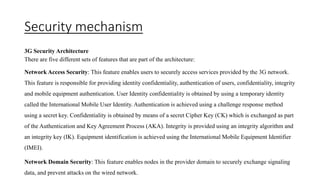
Security mechanism
3G Security Architecture
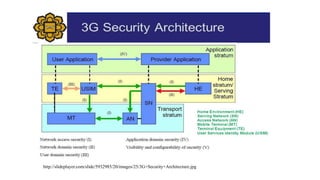
There are five different sets of features that are part of the architecture:
Network Access Security: This feature enables users to securely access services provided by the 3G network.
This feature is responsible for providing identity confidentiality, authentication of users, confidentiality, integrity
and mobile equipment authentication. User Identity confidentiality is obtained by using a temporary identity
called the International Mobile User Identity. Authentication is achieved using a challenge response method
using a secret key. Confidentiality is obtained by means of a secret Cipher Key (CK) which is exchanged as part
of the Authentication and Key Agreement Process (AKA). Integrity is provided using an integrity algorithm and
an integrity key (IK). Equipment identification is achieved using the International Mobile Equipment Identifier
(IMEI).
Network Domain Security: This feature enables nodes in the provider domain to securely exchange signaling
data, and prevent attacks on the wired network.
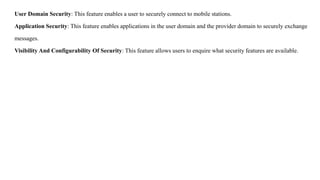
User Domain Security: This feature enables a user to securely connect to mobile stations.
Application Security: This feature enables applications in the user domain and the provider domain to securely exchange
messages.
Visibility And Configurability Of Security: This feature allows users to enquire what security features are available.
http://slideplayer.com/slide/5932985/20/images/25/3G+Security+Architecture.jpg
3G Defensive Measure
• Network Access Security
• Utilizes secret keys and secret key ciphers to maintain confidentiality
• Uses a temporary International Mobile User Identity to protect the user’s
identity.
• Challenge Response System
• Used when Authenticating
• Occurs when user first connects to network, when the network receives a
service request, when a location update is sent, on attach/detatch request,
etc.
Security in 4G
Future 4G mobile communication networks are expected to provide all Ipbased services for heterogeneous
wireless access technologies assisted by mobile IP to provide seamless Internet access for mobile users. 4G
support for interactive multi-media services like video teleconferencing etc , scalability of mobile
networks and higher bandwidth up-to 100Mbps .Two major challenges in developing such heterogeneous
network infrastructure are QoS provisioning and security services for mobile user communication flow.
The Primary weakness in 4G security is that its use of cryptography does not provide endto-end security. It
only encrypts the traffic between the phone and the base station but there is no encryption while the data is
communicated over wired network. It means there is no security against malicious or compromised carrier.
Conclusion
Cellular Networks are open to attacks such as DOS, channel jamming, message forgery etc. Therefore, it is
necessary that security features are provided that prevent such attacks. The 3G security architecture provides
features such as authentication, confidentiality, integrity etc. Also, the WAP protocol makes use of network
security layers such as TLS/WTLS/SSL to provide a secure path for HTTP communication. Although 3G
provides good security features, there are always new security issues that come up and researchers are actively
pursuing new and improved solutions for these issues. People have also started looking ahead at how new
features of the 4G network infrastructure will affect security and what measures can be taken to add new
security features and also improve upon those that have been employed in 3G.
References
[1]”Security in Wireless Cellular Networks” IJAIEM, Volume 4,Issue 4,April 2015
http://www.ijaiem.org/Volume4Issue4/IJAIEM-2015-04-29-72.pdf
[2]”Wireless Cellular Security Mechanism” IJESI, Volume 3,Issue 5,May 2015
http://www.ijesi.org/papers/Vol(3)5/Version-1/A035101011.pdf
[3]”A Survey of Wireless Network Security” IJCSMC, Vol. 3, Issue. 1, January 2014
http://d.researchbib.com/f/7nnJcwp21wYzAioF9xo2AmY3OupTIlpl9XLJ51LKW5ZwNkAP9JZ0xkZwNkAQR
jYaOxMt.pdf
[4]”Wireless Networking and Communication” International Journal of Advanced Research in Computer and
Communication Engineering Vol. 2, Issue 8, August 2013

Cellular wireless network security

  • 1.
    Cellular Wireless Network Security Preparedby:- Gowri Sajith IT-A Roll no-47
  • 2.
    INTRODUCTION Cellular Communication hasbecome an important part of our daily life. Besides using cell phones for voice communication, we are now able to access the Internet, conduct monetary transactions, send text messages etc. using our cell phones, and new services continue to be added. Thus it is of utmost importance to provide a safe and secure channel to user for communication. Security in wireless cellular networks determines the system to manage, protect and distribute sensitive information in a secure way. To combat the risks involved in cellular networks certain security models have been proposed, implemented and deployed continuously. About different security threats and mechanism to solve it
  • 3.
    Security Issues InCellular Networks There are several security issues that have to be taken into consideration when deploying a cellular infrastructure. The importance of which has increased with the advent of advanced networks like 3G.Authentication: Cellular networks have a large number of subscribers, and each has to be authenticated to ensure the right people are using the network. Since the purpose of 3G is to enable people to communicate from anywhere in the world, the issue of cross region and cross provider authentication becomes an issue. Integrity: With services such as SMS, chat and file transfer it is important that the data arrives without any modifications. Confidentiality: With the increased use of cellular phones in sensitive communication, there is a need for a secure channel in order to transmit information. Access Control: The Cellular device may have files that need to have restricted access to them. The device might access a database where some sort of role based access control is necessary .
  • 4.
    Location Detection: Theactual location of a cellular device needs to be kept hidden for reasons of privacy of the user. With the move to IP based networks, the issue arises that a user may be associated with an access point and therefore their location might be compromised. Viruses And Malware: With increased functionality provided in cellular systems, problems prevalent in larger systems such as viruses and malware arise. The first virus that appeared on cellular devices was Liberty: An affected device can also be used to attack the cellular network infrastructure by becoming part of a large scale denial of service attack. Downloaded Contents: Spyware or Adware might be downloaded causing security issues. Another problem is that of digital rights management. Users might download unauthorized copies of music, videos, wallpapers and games. Device Security: If a device is lost or stolen, it needs to be protected from unauthorized use so that potential sensitive information such as emails, documents, phone numbers etc. cannot be accessed.
  • 5.
    Operating Systems InMobile Devices: Cellular Phones have evolved from low processing power, ad-hoc supervisors to high power processors and full fledged operating systems. Some phones may use a Java Based system, others use Microsoft Windows CE and have the same capabilities as a desktop computer. Issues may arise in the OS which might open security holes that can be exploited. Web Services: A Web Service is a component that provides functionality accessible through the web using the standard HTTP Protocol. This opens the cellular device to variety of security issues such as viruses, buffer overflows, denial of service attacks etc.
  • 6.
    Types of Attacks Dueto the massive architecture of a cellular network, there are a variety of attacks that the infrastructure is open to • Denial Of Service (DOS): This is probably the most potent attack that can bring down the entire network infrastructure. This is caused by sending excessive data to the network, more than the network can handle, resulting in users being unable to access network resources. • Distributed Denial Of Service (DDOS): It might be difficult to launch a large scale DOS attack from a single host. A number of hosts can be used to launch an attack. • Channel Jamming: Channel jamming is a technique used by attackers to jam the wireless channel and therefore deny access to any legitimate users in the network. • Unauthorized Access: If a proper method of authentication is not deployed then an attacker can gain free access to a network and then can use it for services that he might not be authorized for.
  • 7.
    Eavesdropping: If thetraffic on the wireless link is not encrypted then an attacker can eavesdrop and intercept sensitive communication such as confidential calls, sensitive documents etc. Message Forgery: If the communication channel is not secure, then an attacker can intercept messages in both directions and change the content without the users ever knowing. Message Replay: Even if communication channel is secure, an attacker can intercept an encrypted message and then replay it back at a later time and the user might not know that the packet received is not the right one. Man In The Middle Attack: An attacker can sit in between a cell phone and an access station and intercept messages in between them and change them. Session Hijacking: A malicious user can highjack an already established session, and can act as a legitimate base station.
  • 8.
    Security mechanism 3G SecurityArchitecture There are five different sets of features that are part of the architecture: Network Access Security: This feature enables users to securely access services provided by the 3G network. This feature is responsible for providing identity confidentiality, authentication of users, confidentiality, integrity and mobile equipment authentication. User Identity confidentiality is obtained by using a temporary identity called the International Mobile User Identity. Authentication is achieved using a challenge response method using a secret key. Confidentiality is obtained by means of a secret Cipher Key (CK) which is exchanged as part of the Authentication and Key Agreement Process (AKA). Integrity is provided using an integrity algorithm and an integrity key (IK). Equipment identification is achieved using the International Mobile Equipment Identifier (IMEI). Network Domain Security: This feature enables nodes in the provider domain to securely exchange signaling data, and prevent attacks on the wired network.
  • 9.
    User Domain Security:This feature enables a user to securely connect to mobile stations. Application Security: This feature enables applications in the user domain and the provider domain to securely exchange messages. Visibility And Configurability Of Security: This feature allows users to enquire what security features are available.
  • 10.
  • 11.
    3G Defensive Measure •Network Access Security • Utilizes secret keys and secret key ciphers to maintain confidentiality • Uses a temporary International Mobile User Identity to protect the user’s identity. • Challenge Response System • Used when Authenticating • Occurs when user first connects to network, when the network receives a service request, when a location update is sent, on attach/detatch request, etc.
  • 12.
    Security in 4G Future4G mobile communication networks are expected to provide all Ipbased services for heterogeneous wireless access technologies assisted by mobile IP to provide seamless Internet access for mobile users. 4G support for interactive multi-media services like video teleconferencing etc , scalability of mobile networks and higher bandwidth up-to 100Mbps .Two major challenges in developing such heterogeneous network infrastructure are QoS provisioning and security services for mobile user communication flow. The Primary weakness in 4G security is that its use of cryptography does not provide endto-end security. It only encrypts the traffic between the phone and the base station but there is no encryption while the data is communicated over wired network. It means there is no security against malicious or compromised carrier.
  • 13.
    Conclusion Cellular Networks areopen to attacks such as DOS, channel jamming, message forgery etc. Therefore, it is necessary that security features are provided that prevent such attacks. The 3G security architecture provides features such as authentication, confidentiality, integrity etc. Also, the WAP protocol makes use of network security layers such as TLS/WTLS/SSL to provide a secure path for HTTP communication. Although 3G provides good security features, there are always new security issues that come up and researchers are actively pursuing new and improved solutions for these issues. People have also started looking ahead at how new features of the 4G network infrastructure will affect security and what measures can be taken to add new security features and also improve upon those that have been employed in 3G.
  • 14.
    References [1]”Security in WirelessCellular Networks” IJAIEM, Volume 4,Issue 4,April 2015 http://www.ijaiem.org/Volume4Issue4/IJAIEM-2015-04-29-72.pdf [2]”Wireless Cellular Security Mechanism” IJESI, Volume 3,Issue 5,May 2015 http://www.ijesi.org/papers/Vol(3)5/Version-1/A035101011.pdf [3]”A Survey of Wireless Network Security” IJCSMC, Vol. 3, Issue. 1, January 2014 http://d.researchbib.com/f/7nnJcwp21wYzAioF9xo2AmY3OupTIlpl9XLJ51LKW5ZwNkAP9JZ0xkZwNkAQR jYaOxMt.pdf [4]”Wireless Networking and Communication” International Journal of Advanced Research in Computer and Communication Engineering Vol. 2, Issue 8, August 2013