Presented To: Mr. Balwant Rai
Presented By: Preeti Sood
DEFINITIONS:
 Booklet, leaflet and pamphlets are printed
materials, small in size, covered or bound containing
information on a subject or specific topic and
providing opportunity for reading, learning and/or
referring.
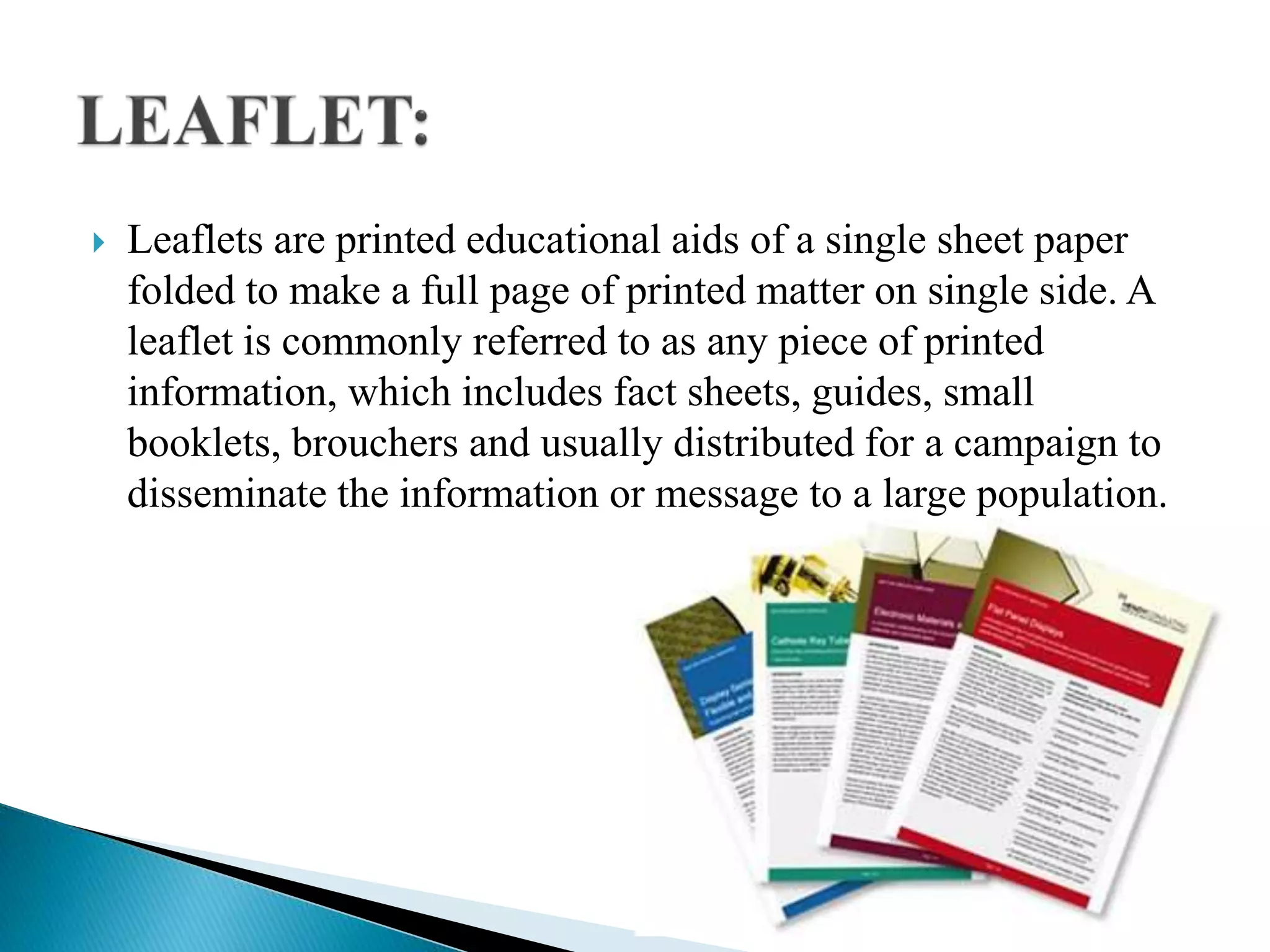
 Leaflets are printed educational aids of a single sheet paper
folded to make a full page of printed matter on single side. A
leaflet is commonly referred to as any piece of printed
information, which includes fact sheets, guides, small
booklets, brouchers and usually distributed for a campaign to
disseminate the information or message to a large population.
 Heading: Leaflet heading is the part which is most
prominently responsible for catching the attention of
people and is therefore considered as the most
important part the leaflet. The heading must be precise,
focused on the main theme and written in eye catching
words and colours.
 Subheadings: Leaflet subheading are essential when
the main heading is not successful in covering the
theme of the main text or if stress required on a specific
point.
 Text: The text in leaflets must be as possible and
should begin with impressive and interesting sentences
to capture the attention of readers.
 Pictures: To make the leaflet more eye catching, the
pictures are mixed in the text so that it becomes more
easily understandable, interesting and meaningful.
 Good colour combinations and background must be
used in organizing the leaflet so that leaflet could be
more attractive and amazing.
 The size of leaflet is customized so that it is easy to
carry and read.
 The written word must be large enough so that
everyone including the elderly people with diminished
eyesight may read the content.
 Leaflets must be good mixture of text, illustrations and
pictures so that they become more interesting for the
readers.
 Leaflets are a good combination of written words,
illustrations and pictures so they are more widely
accepted.
 They should have facts to enjoy a high level of
credibility and prestige in readers.
 They are considered a permanent source of message
which cannot be alerted until and unless the leaflet is
tampered with.
 A wide range of people may be targeted to spread the
message through leaflets.
 Illiterate people can’t be targeted through
leaflets to spread message.
 Planning, printing, and designing the leaflets
requires a lot of time, effort, men and money.
 Expert, skilled professional manpower is
required for planning the designing leaflets.
 Distribution of leaflet is not an easy task, it
requires a strong coordination, efforts, time
and money.
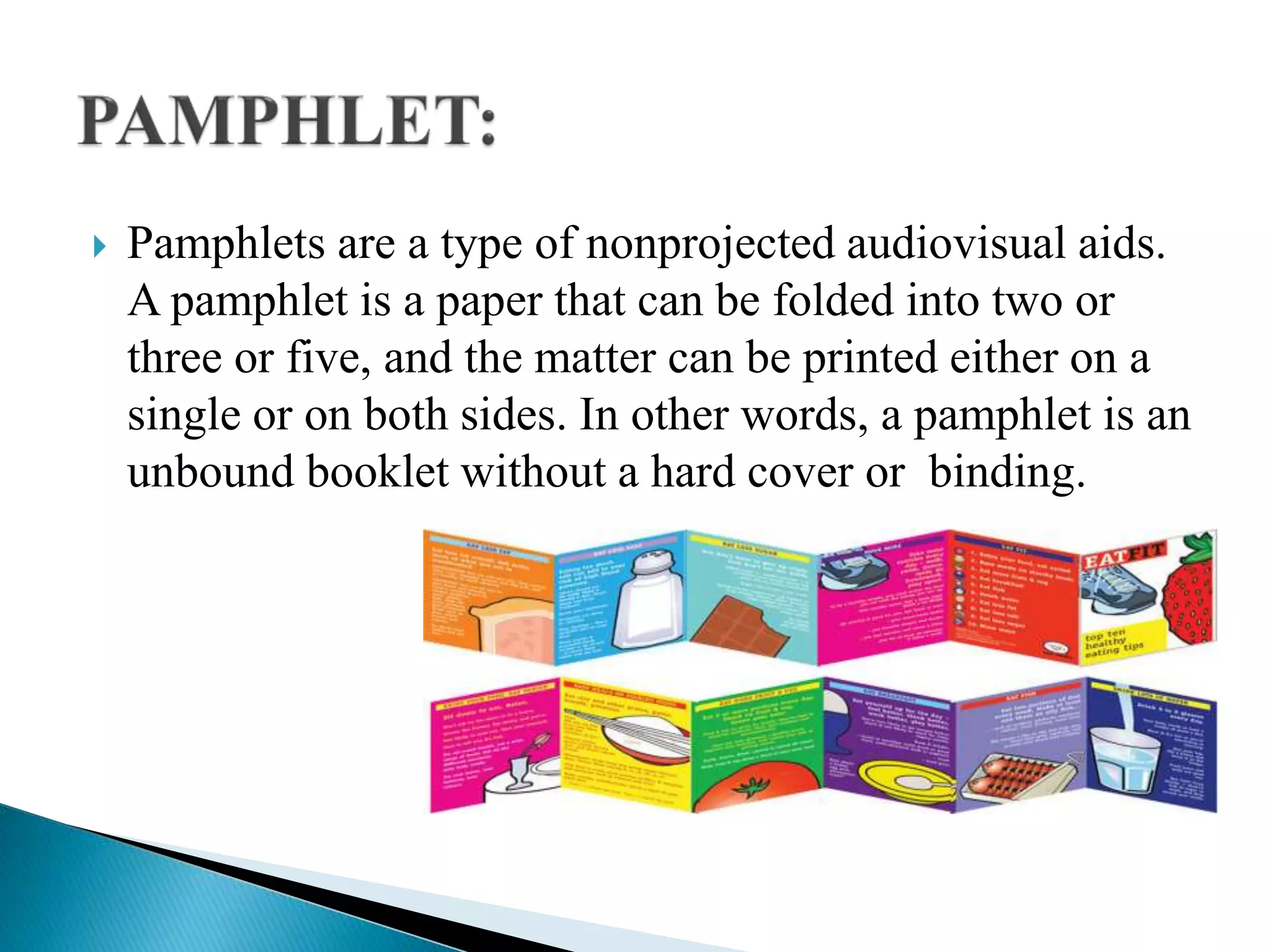
 Pamphlets are a type of nonprojected audiovisual aids.
A pamphlet is a paper that can be folded into two or
three or five, and the matter can be printed either on a
single or on both sides. In other words, a pamphlet is an
unbound booklet without a hard cover or binding.
 To mobilize people to support a cause.
 To advertise a meeting or a specific event.
 To popularize a slogan or a message.
 Explain an issue to the community.
 Inform people of their rights.
 Win support for a campaign.
 Discuss the purpose, the message, the target people and
content.
 Discuss the quantity and quality of pamphlet.
 Each side should also carry the organization’s logo or
name.
 Keep the language simple by avoiding long and
complicated sentences.
 The best pamphlets are short and simple.
 All facts should be correct.
 Tutorial Style: This is the first and the most basic style
of pamphlets. It gives information on a particular
subject or explains how something is done.
 Frequently Asked Question Style: This is a very
effective technique to get an answer to any question
fast.
 Testimonial style: This is a story telling mode. A story
is narrated about the pamphlet issue. The concepts are
introduced one by one historically. This makes the
learning process easier for most learners.
 They are best method for dissemination of information
or a message to larger group of people.
 They save time and resources in dissemination of
information to a large group of people.
 The main disadvantage of pamphlets is that they can
waste a lot of money and time if printed pamphlets are
not distributed properly.
 Only literate and educated people can be benefited with
this educational aid.
 They do not ensure that the target group has surely paid
attention and time to read the pamphlet.
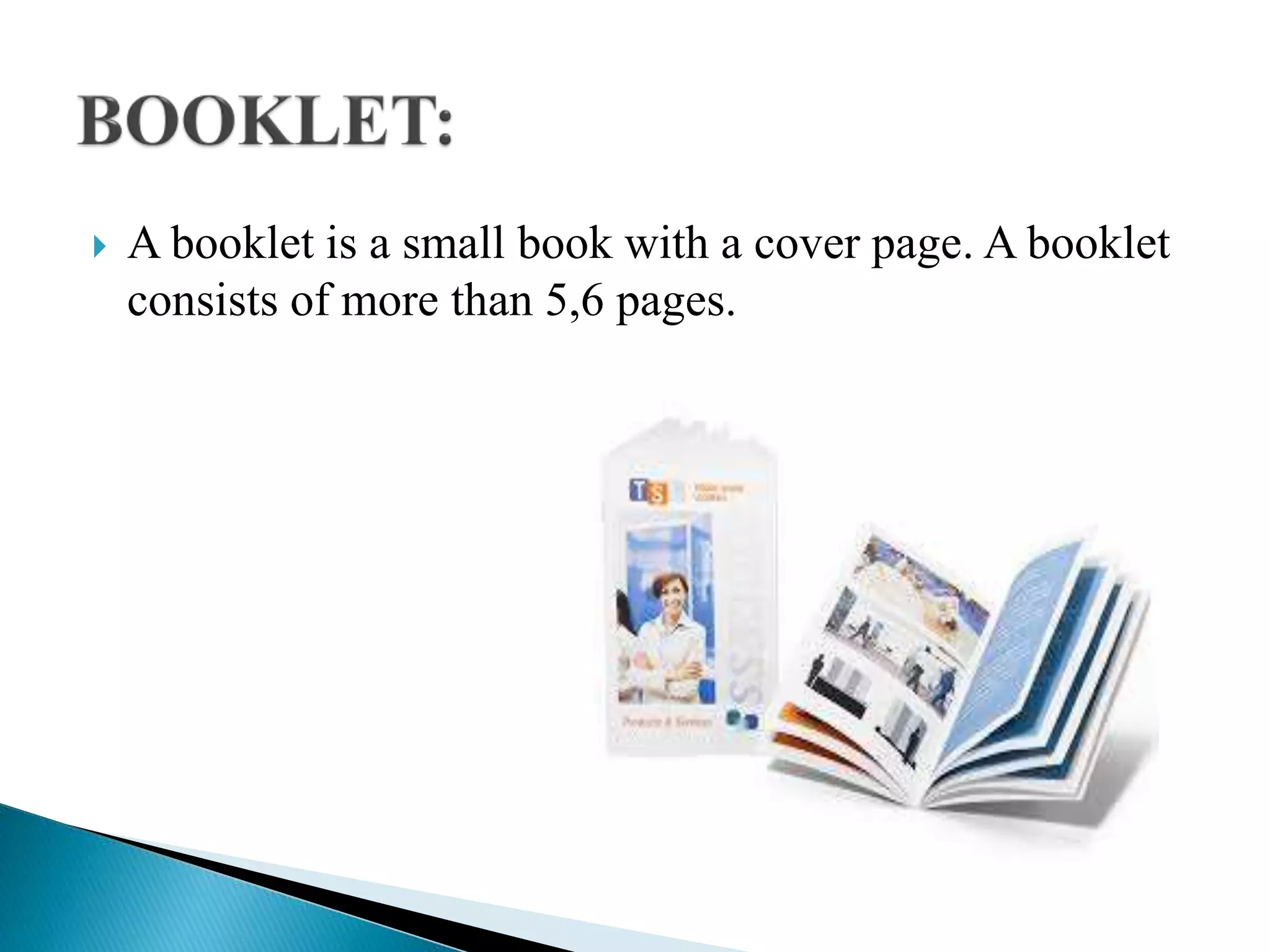
 A booklet is a small book with a cover page. A booklet
consists of more than 5,6 pages.
 Provides basic information related to the subject/topic.
 Provides additional knowledge.
 Reinforces learning.
 Contributes to increased retention of contents.
 Used as an effective mass media for health education of
the people.
 Acts as a teaching-learning aid and can be used at any
age.
 It should center on a single concept.
 There should be a logical sequence.
 The writing should be based on the readability level.
 Objectives should be framed according to the need of
the population it serves.
 Should create interest.
Cont..
 Should be attractive.
 Procedure preparation should include the feelings that
patient have and offer advice and ways for the patient
to practice coping with feelings
 Spoken language should be taken into account while it
is being prepared.
 Illustration with pictures will enhance the
comprehension in the learner.
 Should be formulated with care and often without strict
time limit.
 Pictures can be added sometimes. On certain occasions
pictures may not be necessary.
 Color catches attention and helps to make the
sectioning of material into topics that follow a train of
thought.
 • Heading
 • Sub-heading
 • Text
 • Pictures
 Used in health workers program to hand out to people
as an aid.
 Used as mass media for health education.
 Used as a teaching-learning material in classroom
teaching.
Popular applications for booklets include:
 Product and service catalogs.
 Reference materials.
 Manuals.
 Any application where detailed descriptions
and durability are desired.
 Individualized learning.
 Makes mass education possible with high efficiency.
 Easy to transport.
 Commonly and constantly available.
 Allow self-pacing. Certain people who read-skim
rapidly, using trigger word to read selectively and non-
sequentially. Such processing cannot be used with
audiotapes.
 Can be reproduction in logical languages. Needs very
little maintenance when compared with sophisticated
aids.
 Can be used at an age.
 More efficient than oral languages.
 Saves times that can be spent on more complex
activities such as IPR.
 Relatively cheap to produce. Lasts well when given
reasonable care.
 Very flexible as a teaching aid since it can be used in
whole or in part.
 Stimulates interest of the learner.
 Some may throw it out.
 Storing is found to be difficult.
 Demands good typing.
 No group dynamics is encouraged.
 Can’t be used for those who have not learned to
read.
 If the learning objective primarily requires skills
in dealing with persons, this may not be
effective.
 Printed teaching material can be described as a
frozen language that is selective in its description
of reality.
Leaflet, pamphlet and booklet

Leaflet, pamphlet and booklet

  • 1.
    Presented To: Mr.Balwant Rai Presented By: Preeti Sood
  • 2.
    DEFINITIONS:  Booklet, leafletand pamphlets are printed materials, small in size, covered or bound containing information on a subject or specific topic and providing opportunity for reading, learning and/or referring.
  • 3.
     Leaflets areprinted educational aids of a single sheet paper folded to make a full page of printed matter on single side. A leaflet is commonly referred to as any piece of printed information, which includes fact sheets, guides, small booklets, brouchers and usually distributed for a campaign to disseminate the information or message to a large population.
  • 4.
     Heading: Leafletheading is the part which is most prominently responsible for catching the attention of people and is therefore considered as the most important part the leaflet. The heading must be precise, focused on the main theme and written in eye catching words and colours.  Subheadings: Leaflet subheading are essential when the main heading is not successful in covering the theme of the main text or if stress required on a specific point.
  • 5.
     Text: Thetext in leaflets must be as possible and should begin with impressive and interesting sentences to capture the attention of readers.  Pictures: To make the leaflet more eye catching, the pictures are mixed in the text so that it becomes more easily understandable, interesting and meaningful.  Good colour combinations and background must be used in organizing the leaflet so that leaflet could be more attractive and amazing.
  • 6.
     The sizeof leaflet is customized so that it is easy to carry and read.  The written word must be large enough so that everyone including the elderly people with diminished eyesight may read the content.  Leaflets must be good mixture of text, illustrations and pictures so that they become more interesting for the readers.
  • 7.
     Leaflets area good combination of written words, illustrations and pictures so they are more widely accepted.  They should have facts to enjoy a high level of credibility and prestige in readers.  They are considered a permanent source of message which cannot be alerted until and unless the leaflet is tampered with.  A wide range of people may be targeted to spread the message through leaflets.
  • 8.
     Illiterate peoplecan’t be targeted through leaflets to spread message.  Planning, printing, and designing the leaflets requires a lot of time, effort, men and money.  Expert, skilled professional manpower is required for planning the designing leaflets.  Distribution of leaflet is not an easy task, it requires a strong coordination, efforts, time and money.
  • 9.
     Pamphlets area type of nonprojected audiovisual aids. A pamphlet is a paper that can be folded into two or three or five, and the matter can be printed either on a single or on both sides. In other words, a pamphlet is an unbound booklet without a hard cover or binding.
  • 10.
     To mobilizepeople to support a cause.  To advertise a meeting or a specific event.  To popularize a slogan or a message.  Explain an issue to the community.  Inform people of their rights.  Win support for a campaign.
  • 11.
     Discuss thepurpose, the message, the target people and content.  Discuss the quantity and quality of pamphlet.  Each side should also carry the organization’s logo or name.  Keep the language simple by avoiding long and complicated sentences.  The best pamphlets are short and simple.  All facts should be correct.
  • 12.
     Tutorial Style:This is the first and the most basic style of pamphlets. It gives information on a particular subject or explains how something is done.  Frequently Asked Question Style: This is a very effective technique to get an answer to any question fast.  Testimonial style: This is a story telling mode. A story is narrated about the pamphlet issue. The concepts are introduced one by one historically. This makes the learning process easier for most learners.
  • 13.
     They arebest method for dissemination of information or a message to larger group of people.  They save time and resources in dissemination of information to a large group of people.
  • 14.
     The maindisadvantage of pamphlets is that they can waste a lot of money and time if printed pamphlets are not distributed properly.  Only literate and educated people can be benefited with this educational aid.  They do not ensure that the target group has surely paid attention and time to read the pamphlet.
  • 15.
     A bookletis a small book with a cover page. A booklet consists of more than 5,6 pages.
  • 16.
     Provides basicinformation related to the subject/topic.  Provides additional knowledge.  Reinforces learning.  Contributes to increased retention of contents.  Used as an effective mass media for health education of the people.  Acts as a teaching-learning aid and can be used at any age.
  • 17.
     It shouldcenter on a single concept.  There should be a logical sequence.  The writing should be based on the readability level.  Objectives should be framed according to the need of the population it serves.  Should create interest.
  • 18.
    Cont..  Should beattractive.  Procedure preparation should include the feelings that patient have and offer advice and ways for the patient to practice coping with feelings
  • 19.
     Spoken languageshould be taken into account while it is being prepared.  Illustration with pictures will enhance the comprehension in the learner.  Should be formulated with care and often without strict time limit.  Pictures can be added sometimes. On certain occasions pictures may not be necessary.  Color catches attention and helps to make the sectioning of material into topics that follow a train of thought.
  • 20.
     • Heading • Sub-heading  • Text  • Pictures
  • 21.
     Used inhealth workers program to hand out to people as an aid.  Used as mass media for health education.  Used as a teaching-learning material in classroom teaching.
  • 22.
    Popular applications forbooklets include:  Product and service catalogs.  Reference materials.  Manuals.  Any application where detailed descriptions and durability are desired.
  • 23.
     Individualized learning. Makes mass education possible with high efficiency.  Easy to transport.  Commonly and constantly available.  Allow self-pacing. Certain people who read-skim rapidly, using trigger word to read selectively and non- sequentially. Such processing cannot be used with audiotapes.  Can be reproduction in logical languages. Needs very little maintenance when compared with sophisticated aids.
  • 24.
     Can beused at an age.  More efficient than oral languages.  Saves times that can be spent on more complex activities such as IPR.  Relatively cheap to produce. Lasts well when given reasonable care.  Very flexible as a teaching aid since it can be used in whole or in part.  Stimulates interest of the learner.
  • 25.
     Some maythrow it out.  Storing is found to be difficult.  Demands good typing.  No group dynamics is encouraged.  Can’t be used for those who have not learned to read.  If the learning objective primarily requires skills in dealing with persons, this may not be effective.  Printed teaching material can be described as a frozen language that is selective in its description of reality.