DIALYSIS
MACHINE
By
DARSHAN S
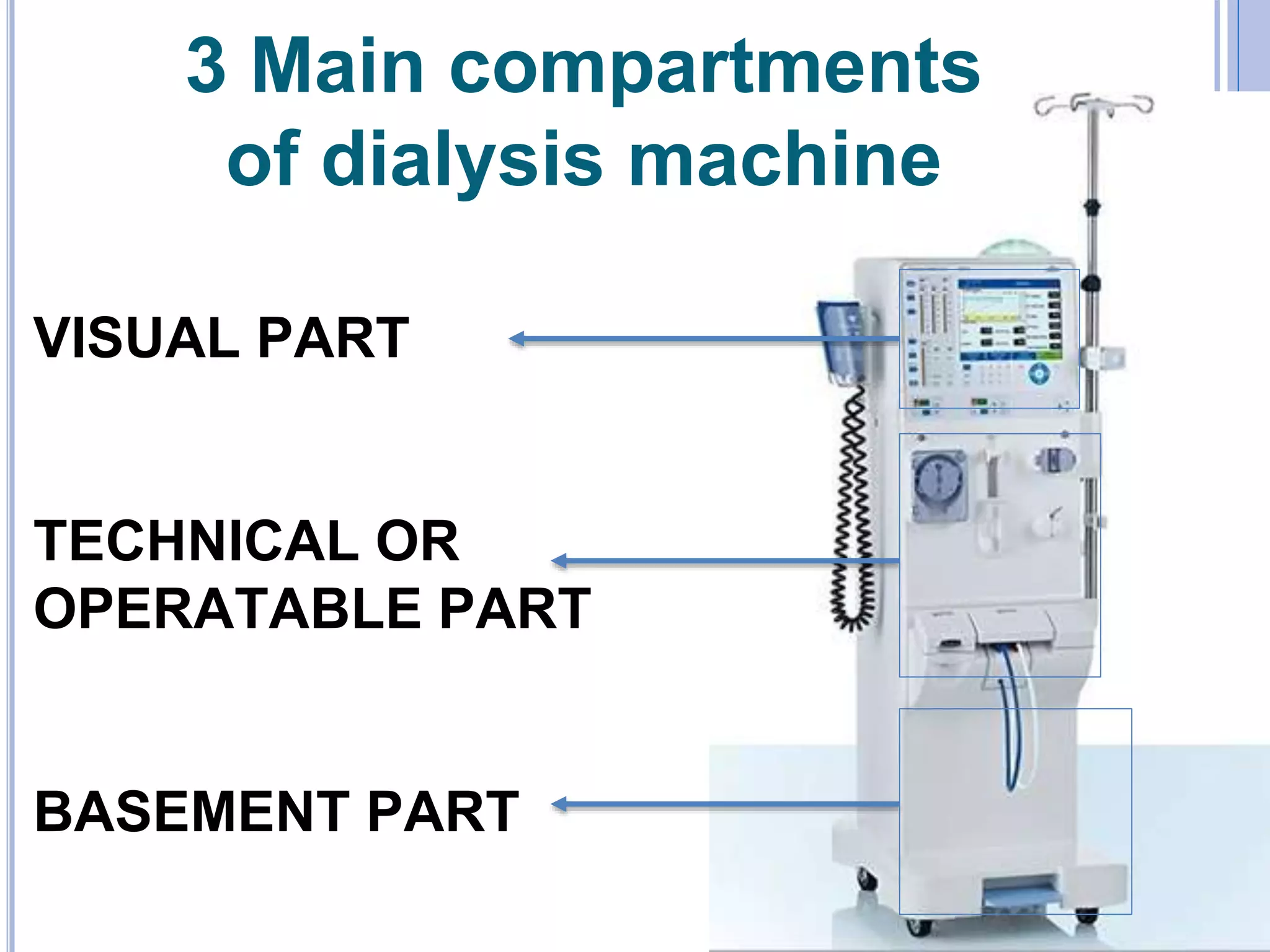
3 Main compartments
of dialysis machine
VISUAL PART
TECHNICAL OR
OPERATABLE PART
BASEMENT PART
DIALYSIS MACHINES
KEY FEATURES
1) Blood pump
2) Dialysate delivery system
3) Safety monitors
4) Options
5) System disinfection
BLOOD PUMP
 Circulate the blood through the dialyzer back to
the patient.
 Peristaltic roller pumps which works by
progressive compressing special segments of
the blood tubing are used.
 Pump occlusion: occlusion means that the
roller compress the tubing segments against
the semicircular housing sufficiently to close
the lumen completely at that point.
 Overocclusion may crack tubing and rupture
 Occlusion incomplete – back flow
DIALYSATE DELIVERY
SYSTEM
 Appropriate blending of concentrate and water
for preparation of final dialysate.
 To monitor dialysate for temperature,
composition and blood leak.
 To control dialysate pressure or ultrafiltration rate.
 To regulate the dialysate flow rate through the
dialyzer.
 Deareation of water
 Provide protective mechanisms to isolate the
blood circuit and the patient from unsafe dialysis.
 System for disinfection and cleaning.
SAFETY MONITORS
Arterial pressure monitor:
 Proximal to the blood pump
 Reads the arterial pressure at the segment
between the pt needle site and proximal to the
blood pump which represent the negative
pressure created by roller pump.
 How much suction is being placed on the
arterial wall and guard against excessive
suction on the vascular access.
VENOUS PRESSURE
MONITOR
 Just distal to the dialyzer usually attached to
the top of the venous air trap.
 Reads the venous pressure at the segment
b/w the point after the dialyzer and before the
blood return to the pts body.
 Represent resistance of the blood returning to
the patient via the venous needle.
 It may indicate venous stenosis proximal to
the needle site.
VENOUS AIR TRAP
AND AIR DETECTOR
Just distal to venous pressure monitor.
Often second air trap on the arterial line
is also used.
To prevent air entry into pt
 Mechanism: air bubble enter- sensor
reacted through ultrasonic transducer
or light beam by stopping blood
pump, clamping the venous line and
activation audiovisual alarms.
MONITORS FOR DIALYSIS
SOLUTION CIRCUIT
Conductivity:
 Before dialysate reaches to dialyzer
 To guard against excessive diluted or concentrated dialysis
solution.
 Conductivity meter detects high or low conductivity the
machine automatically sounds an alarm and puts the
dialysate into bypass mode so that no dialysate flow to
the dialyzer.
 Exposure of the blood to hyperosmolar dialysate can
lead to hypernatremia and other electrolyte
disturbances.
 Exposure of the blood to hypo osmolar dialysate can lead
result in hyponatremia and rapid hemolysis.
Temperature:
 Before the dialyzer
 To avoid high temperature
 Mechanism: through a temperature sensor, high
temperature activate an audiovisual alarm simultaneously
with bypass mechanism.
Dialysate pressure or Transmembranous
monitor:
 To monitor the ultrafiltration with an upper limits avoids
excessive level (the usual preset range 0-500 mmHg).
Excessive TMP may lead to rupture of the dialyzer and
secondary deareation ( cause air accumulation).
 Mechanism: the monitor may have automatic or
manually set limits so that extrusion outside the limits
trigger an audiovisual alarm.
Blood leak detector:
 In the effluent dialysate line
 It guards against undetected blood loss during
dialysis.
 A beam of light is directed through a column of
dialysate onto a photoelectric cell. A change in
translucence and light scatter in dialysate reduces
the light received by the photocell, stopping blood
pump and activating audiovisual alarms.
Bypass valve mechanism:
 If the conductivity or temperature found to be out
of limits a bypass valve is activated to divert
dialysate around the dialyzer directly to the drain.
OPTION IN HEMODIALYSIS
MACHINE
Heparin pump
Bicarbonate
Variable sodium
Controlled ultrafiltration
Programable ultrafiltration
Dialysate urea sensor (online kt/v
monitor)
Single blood pathway
SYSTEM DISINFECTION
 All dialysis unit must have written policies the deal with
the dialysis fluid pathway and dialysis machine.
 Disinfection procedure should be done on regular base
according to manufacturer's instruction.
Target:
 To control bacterial contamination. HIV, HCV and HBV
viruses are known to be inactivated by common
household bleach.
Methods:
 Heat disinfection requires temperature greater than 85-
90 C.
 Chemical disinfection such as formaldehyde, sodium
hydrochloride and acetic acid.
DIALYSIS MACHINE:
PATIENT MONITOR
B.p:
 Some machine monitor arterial pressure automatically.
ECG:
 Can be monitored by the machine
Blood volume monitors:
 Hct or protein conc. In the arterial blood line by optical
or ultrasonic sensors as surrogate for blood volume (as
water is removed from the blood, blood volume falls,
and red blood cell and protein conc. increase) they can
measure relative blood volume reliably and reproducibly
and allow automatic feedback.
ALARMS DURING
HEMODIALYSIS
When an alarm is activated during
dialysis do the following
1. Identify which alarm has been activated
2. Identify the cause
3. Correct the cause
4. Resume dialysis if safe to do so
Power:
 Turn the system off and on: if still no power check the
power cord and make sure power is available.
 Check the fuse.
Arterial and Venous Pressure:
 Check to see that blood pump is running and connected
properly
 Check to see if blood flow rate has changed
 Determine if patient has coughed or moved
 Check to see if the monitor line is leaking
 Check the blood line for kinks or leaks
 Ensure the monitoring lines are connected to proper
drip chambers
High venous pressure:
 Manipulate the needle or the line. If access is small a
tourniquet must be used, being certain the blood
pump is off, recannulation with new needle if needed.
 Adjust the blood flow rate, proper heparnization,
treat access problem and proper needle and
needling.
 Extreme care must be given when dialyzing a patient
with high venous pressure
 This increase the baseline TMP
 Single needle device is occasionally impossible to use,
because with high venous pressure, venous return
will be impaired and blood recirculation will be high.
High negative pressure:
 Manipulation of the arterial needle is similar to that of
venous needle. In most cases the needle may have to be
replaced with the same precaution as with venous
needle.
 Treat the cause
 Proper needling
 Asses the access
High positive dialysate pressure alarm:
 Check to see if drain is occluded or kinked
 Check to see if dialysate hoses are leaking
Low negative dialysate pressure alarm:
 Check to see if dialysate hoses are kinked
Air Detector alarm:
 Check for air leaks around tubing joints
 Check for air bubbles accumulation in the chamber
Management of air embolism if present.
 Clamp the venous line and stop the blood pump.
 Place the patient in trendelenberg position on the left
side with the chest and head tilted downward to trap the
air at the apex of right ventricle away from the outflow
tract.
 Cardiorespiratory support oxygen 100%.
 Occasionally percutaneous aspiration of the air foam
from the heart may be necessary.
High temperature alarm:
 Determine temperature of dialysate in the line
actually high
 Check to ensure incoming water temperature is
below 90 F.
Low Temperature alarm:
 Determine temperature of dialysate to dialyzer in
the line is actually low.
 Turn the mode selector switch to dialyzer
 Allow adequate time for the system to stabilize and
come to proper temperature range.
 Check to ensure incoming water temperature is
above 40 F.
High Conductivity alarm:
1. Check to see if water is flowing too slowly or turn
off.
2. Check for kink in the concentrate out line.
3. Make sure that the system has had time to
stabilize
4. Analyze the dialysate to confirm high conductivity
at the to dialyzer line connection:
5. If normal there is malfunction in the machine
itself (change it)
6. If high again concentrate before resuming
dialysis.
7. Be certain that the dialysate flow rate is proper.
Low conductivity alarm:
 Turn the mode selector switch to dialyze.
 Connect the concentrate line to the system
 Drop the concentrate line into the concentrate
container
 Check for kinks in the concentrate in line
 Make sure the filter on the concentratein is clean
 Allow adequate time for the system to stabilize
 Change the concentrate container if it is dry
 If the concentrate container has not run dry, a
sample of dialysate should sent to the laboratory
for sodium and chloride.
Blood leak alarm:
 make sure the blood leak detector is clean
 Check the effluent for traces of blood
 Air bubbles in dialysate, Dirty sensor
 If leak confirmed and you can not manage the cause
 Reduce dialysate compartment pressure to -50 mmHg
to avoid bacterial entry to the blood
 Analyze the dialysate to conform low conductivity at drain
 If low conductivity is conformed change the concentrate
bottle.
 If the conductivity still low after changing the concentrate a
different machine should be tried.
 Be certain that the dialysate flow rate is proper.
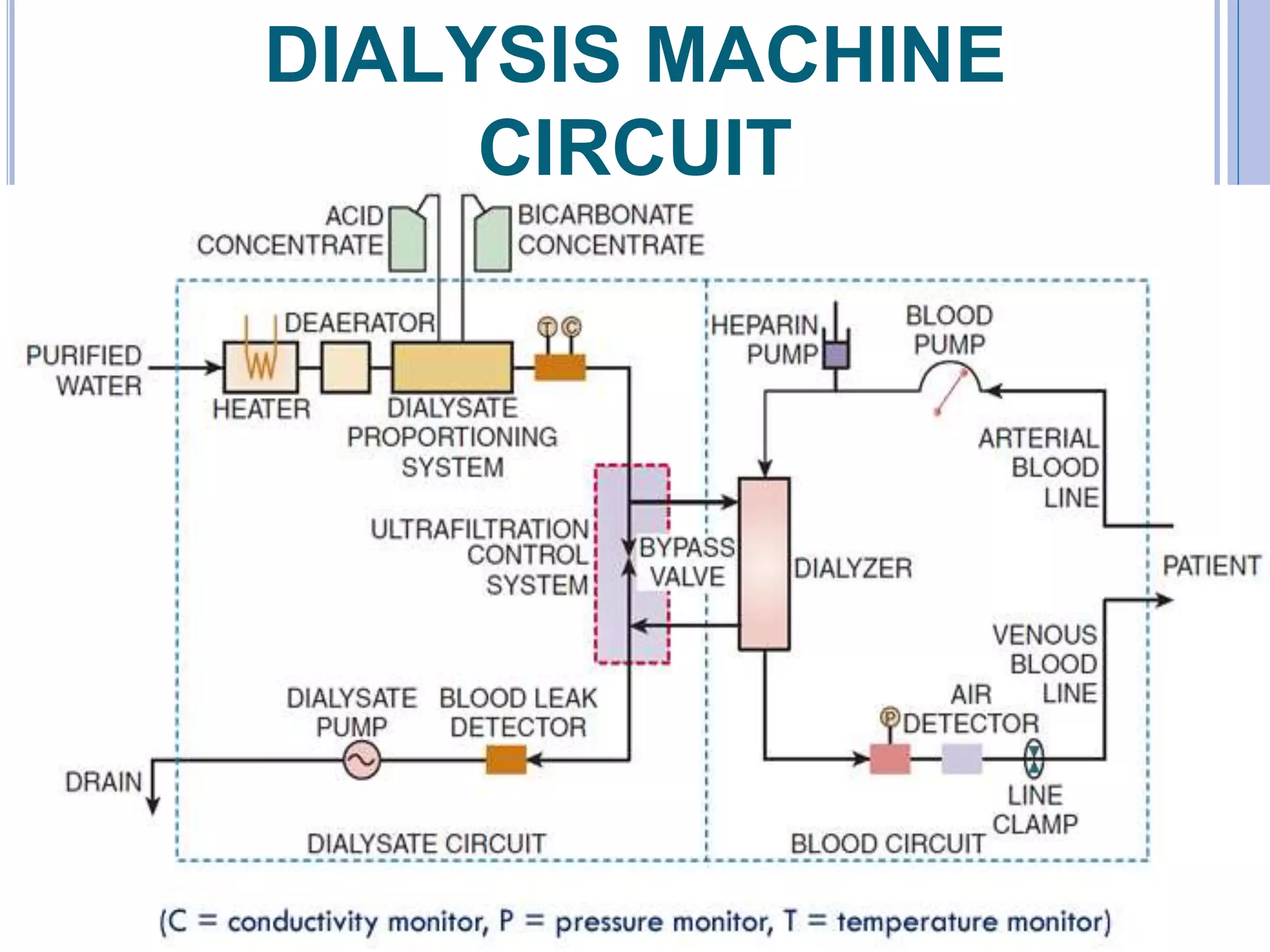
DIALYSIS MACHINE
CIRCUIT
Thank
You

Dialysis machines.pptx

  • 1.
  • 2.
    3 Main compartments ofdialysis machine VISUAL PART TECHNICAL OR OPERATABLE PART BASEMENT PART
  • 3.
    DIALYSIS MACHINES KEY FEATURES 1)Blood pump 2) Dialysate delivery system 3) Safety monitors 4) Options 5) System disinfection
  • 4.
    BLOOD PUMP  Circulatethe blood through the dialyzer back to the patient.  Peristaltic roller pumps which works by progressive compressing special segments of the blood tubing are used.  Pump occlusion: occlusion means that the roller compress the tubing segments against the semicircular housing sufficiently to close the lumen completely at that point.  Overocclusion may crack tubing and rupture  Occlusion incomplete – back flow
  • 5.
    DIALYSATE DELIVERY SYSTEM  Appropriateblending of concentrate and water for preparation of final dialysate.  To monitor dialysate for temperature, composition and blood leak.  To control dialysate pressure or ultrafiltration rate.  To regulate the dialysate flow rate through the dialyzer.  Deareation of water  Provide protective mechanisms to isolate the blood circuit and the patient from unsafe dialysis.  System for disinfection and cleaning.
  • 6.
    SAFETY MONITORS Arterial pressuremonitor:  Proximal to the blood pump  Reads the arterial pressure at the segment between the pt needle site and proximal to the blood pump which represent the negative pressure created by roller pump.  How much suction is being placed on the arterial wall and guard against excessive suction on the vascular access.
  • 7.
    VENOUS PRESSURE MONITOR  Justdistal to the dialyzer usually attached to the top of the venous air trap.  Reads the venous pressure at the segment b/w the point after the dialyzer and before the blood return to the pts body.  Represent resistance of the blood returning to the patient via the venous needle.  It may indicate venous stenosis proximal to the needle site.
  • 8.
    VENOUS AIR TRAP ANDAIR DETECTOR Just distal to venous pressure monitor. Often second air trap on the arterial line is also used. To prevent air entry into pt  Mechanism: air bubble enter- sensor reacted through ultrasonic transducer or light beam by stopping blood pump, clamping the venous line and activation audiovisual alarms.
  • 9.
    MONITORS FOR DIALYSIS SOLUTIONCIRCUIT Conductivity:  Before dialysate reaches to dialyzer  To guard against excessive diluted or concentrated dialysis solution.  Conductivity meter detects high or low conductivity the machine automatically sounds an alarm and puts the dialysate into bypass mode so that no dialysate flow to the dialyzer.  Exposure of the blood to hyperosmolar dialysate can lead to hypernatremia and other electrolyte disturbances.  Exposure of the blood to hypo osmolar dialysate can lead result in hyponatremia and rapid hemolysis.
  • 10.
    Temperature:  Before thedialyzer  To avoid high temperature  Mechanism: through a temperature sensor, high temperature activate an audiovisual alarm simultaneously with bypass mechanism. Dialysate pressure or Transmembranous monitor:  To monitor the ultrafiltration with an upper limits avoids excessive level (the usual preset range 0-500 mmHg). Excessive TMP may lead to rupture of the dialyzer and secondary deareation ( cause air accumulation).  Mechanism: the monitor may have automatic or manually set limits so that extrusion outside the limits trigger an audiovisual alarm.
  • 11.
    Blood leak detector: In the effluent dialysate line  It guards against undetected blood loss during dialysis.  A beam of light is directed through a column of dialysate onto a photoelectric cell. A change in translucence and light scatter in dialysate reduces the light received by the photocell, stopping blood pump and activating audiovisual alarms. Bypass valve mechanism:  If the conductivity or temperature found to be out of limits a bypass valve is activated to divert dialysate around the dialyzer directly to the drain.
  • 12.
    OPTION IN HEMODIALYSIS MACHINE Heparinpump Bicarbonate Variable sodium Controlled ultrafiltration Programable ultrafiltration Dialysate urea sensor (online kt/v monitor) Single blood pathway
  • 13.
    SYSTEM DISINFECTION  Alldialysis unit must have written policies the deal with the dialysis fluid pathway and dialysis machine.  Disinfection procedure should be done on regular base according to manufacturer's instruction. Target:  To control bacterial contamination. HIV, HCV and HBV viruses are known to be inactivated by common household bleach. Methods:  Heat disinfection requires temperature greater than 85- 90 C.  Chemical disinfection such as formaldehyde, sodium hydrochloride and acetic acid.
  • 14.
    DIALYSIS MACHINE: PATIENT MONITOR B.p: Some machine monitor arterial pressure automatically. ECG:  Can be monitored by the machine Blood volume monitors:  Hct or protein conc. In the arterial blood line by optical or ultrasonic sensors as surrogate for blood volume (as water is removed from the blood, blood volume falls, and red blood cell and protein conc. increase) they can measure relative blood volume reliably and reproducibly and allow automatic feedback.
  • 15.
    ALARMS DURING HEMODIALYSIS When analarm is activated during dialysis do the following 1. Identify which alarm has been activated 2. Identify the cause 3. Correct the cause 4. Resume dialysis if safe to do so
  • 16.
    Power:  Turn thesystem off and on: if still no power check the power cord and make sure power is available.  Check the fuse. Arterial and Venous Pressure:  Check to see that blood pump is running and connected properly  Check to see if blood flow rate has changed  Determine if patient has coughed or moved  Check to see if the monitor line is leaking  Check the blood line for kinks or leaks  Ensure the monitoring lines are connected to proper drip chambers
  • 17.
    High venous pressure: Manipulate the needle or the line. If access is small a tourniquet must be used, being certain the blood pump is off, recannulation with new needle if needed.  Adjust the blood flow rate, proper heparnization, treat access problem and proper needle and needling.  Extreme care must be given when dialyzing a patient with high venous pressure  This increase the baseline TMP  Single needle device is occasionally impossible to use, because with high venous pressure, venous return will be impaired and blood recirculation will be high.
  • 18.
    High negative pressure: Manipulation of the arterial needle is similar to that of venous needle. In most cases the needle may have to be replaced with the same precaution as with venous needle.  Treat the cause  Proper needling  Asses the access High positive dialysate pressure alarm:  Check to see if drain is occluded or kinked  Check to see if dialysate hoses are leaking Low negative dialysate pressure alarm:  Check to see if dialysate hoses are kinked
  • 19.
    Air Detector alarm: Check for air leaks around tubing joints  Check for air bubbles accumulation in the chamber Management of air embolism if present.  Clamp the venous line and stop the blood pump.  Place the patient in trendelenberg position on the left side with the chest and head tilted downward to trap the air at the apex of right ventricle away from the outflow tract.  Cardiorespiratory support oxygen 100%.  Occasionally percutaneous aspiration of the air foam from the heart may be necessary.
  • 20.
    High temperature alarm: Determine temperature of dialysate in the line actually high  Check to ensure incoming water temperature is below 90 F. Low Temperature alarm:  Determine temperature of dialysate to dialyzer in the line is actually low.  Turn the mode selector switch to dialyzer  Allow adequate time for the system to stabilize and come to proper temperature range.  Check to ensure incoming water temperature is above 40 F.
  • 21.
    High Conductivity alarm: 1.Check to see if water is flowing too slowly or turn off. 2. Check for kink in the concentrate out line. 3. Make sure that the system has had time to stabilize 4. Analyze the dialysate to confirm high conductivity at the to dialyzer line connection: 5. If normal there is malfunction in the machine itself (change it) 6. If high again concentrate before resuming dialysis. 7. Be certain that the dialysate flow rate is proper.
  • 22.
    Low conductivity alarm: Turn the mode selector switch to dialyze.  Connect the concentrate line to the system  Drop the concentrate line into the concentrate container  Check for kinks in the concentrate in line  Make sure the filter on the concentratein is clean  Allow adequate time for the system to stabilize  Change the concentrate container if it is dry  If the concentrate container has not run dry, a sample of dialysate should sent to the laboratory for sodium and chloride.
  • 23.
    Blood leak alarm: make sure the blood leak detector is clean  Check the effluent for traces of blood  Air bubbles in dialysate, Dirty sensor  If leak confirmed and you can not manage the cause  Reduce dialysate compartment pressure to -50 mmHg to avoid bacterial entry to the blood  Analyze the dialysate to conform low conductivity at drain  If low conductivity is conformed change the concentrate bottle.  If the conductivity still low after changing the concentrate a different machine should be tried.  Be certain that the dialysate flow rate is proper.
  • 24.
  • 27.