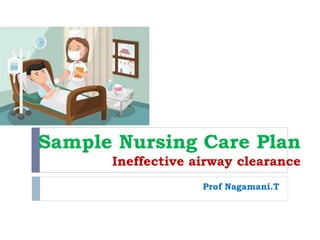
Sample Nursing Care Plan
Ineffective airway clearance
Prof Nagamani.T
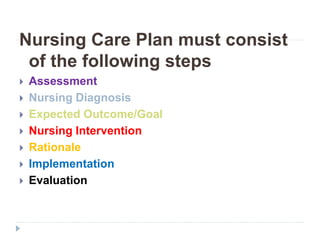
Nursing Care Plan must consist
of the following steps
 Assessment
 Nursing Diagnosis
 Expected Outcome/Goal
 Nursing Intervention
 Rationale
 Implementation
 Evaluation
Assessme
nt
Nursing
Diagnosis
Goal Interventio
n/
Implement
ation
Rationale Evaluatio
n
Subjective
data
Patient
complains
of severe
cough
during
nights,
unable to
remove
secretions,
fatigue, lack
of sleep
Objective
Data
Presence of
cough,
Secretions,
26
breaths/mt,
In effective
airway
clearance
related to
cough and
inability to
remove
airway
secretions
Patient will
maintain
clear, open
airways as
evidence by
normal
breath
sounds,
normal rate
and depth
of
respirations,
and ability
to
effectively
cough up
secretions
after
treatments
and deep
•Assess
airway for
patency.
•Auscultate
lungs for
presence of
normal or
adventitious
breath
sounds
•Maintaining
patent airway
is always the
first priority to
understand
patient
condition
•Abnormal
breath sounds
can be heard
as fluid and
mucus
accumulate.
This may
indicate
ineffective
airway
clearance.
Assessme
nt
Nursing
Diagnos
is
Goal Intervention Rationale Evaluati
on
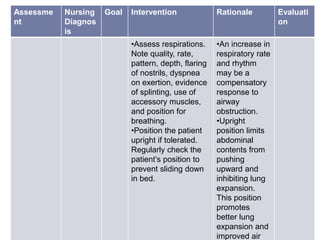
•Assess respirations.
Note quality, rate,
pattern, depth, flaring
of nostrils, dyspnea
on exertion, evidence
of splinting, use of
accessory muscles,
and position for
breathing.
•Position the patient
upright if tolerated.
Regularly check the
patient’s position to
prevent sliding down
in bed.
•An increase in
respiratory rate
and rhythm
may be a
compensatory
response to
airway
obstruction.
•Upright
position limits
abdominal
contents from
pushing
upward and
inhibiting lung
expansion.
This position
promotes
better lung
expansion and
improved air
Assessme
nt
Nursing
Diagnos
is
Goal Intervention Rationale Evaluati
on
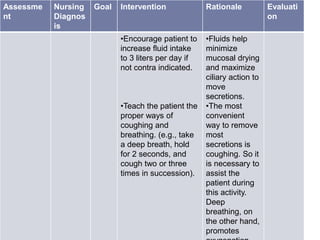
•Encourage patient to
increase fluid intake
to 3 liters per day if
not contra indicated.
•Teach the patient the
proper ways of
coughing and
breathing. (e.g., take
a deep breath, hold
for 2 seconds, and
cough two or three
times in succession).
•Fluids help
minimize
mucosal drying
and maximize
ciliary action to
move
secretions.
•The most
convenient
way to remove
most
secretions is
coughing. So it
is necessary to
assist the
patient during
this activity.
Deep
breathing, on
the other hand,
promotes
Assessme
nt
Nursing
Diagnos
is
Goal Intervention Rationale Evaluati
on
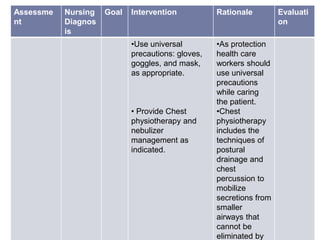
•Use universal
precautions: gloves,
goggles, and mask,
as appropriate.
• Provide Chest
physiotherapy and
nebulizer
management as
indicated.
•As protection
health care
workers should
use universal
precautions
while caring
the patient.
•Chest
physiotherapy
includes the
techniques of
postural
drainage and
chest
percussion to
mobilize
secretions from
smaller
airways that
cannot be
eliminated by
Assessme
nt
Nursing
Diagnos
is
Goal Intervention Rationale Evaluati
on
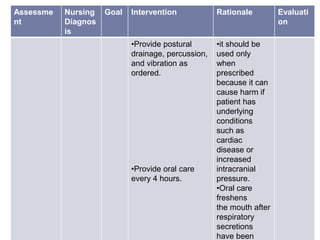
•Provide postural
drainage, percussion,
and vibration as
ordered.
•Provide oral care
every 4 hours.
•it should be
used only
when
prescribed
because it can
cause harm if
patient has
underlying
conditions
such as
cardiac
disease or
increased
intracranial
pressure.
•Oral care
freshens
the mouth after
respiratory
secretions
have been
Assessme
nt
Nursing
Diagnos
is
Goal Intervention Rationale Evaluati
on
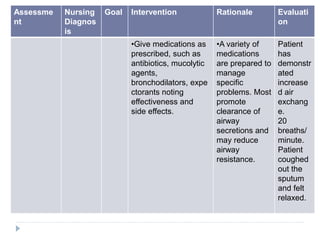
•Give medications as
prescribed, such as
antibiotics, mucolytic
agents,
bronchodilators, expe
ctorants noting
effectiveness and
side effects.
•A variety of
medications
are prepared to
manage
specific
problems. Most
promote
clearance of
airway
secretions and
may reduce
airway
resistance.
Patient
has
demonstr
ated
increase
d air
exchang
e.
20
breaths/
minute.
Patient
coughed
out the
sputum
and felt
relaxed.
Keep Watching………..

Nsg Process Ineffective airway.pptx

  • 1.
    Sample Nursing CarePlan Ineffective airway clearance Prof Nagamani.T
  • 2.
    Nursing Care Planmust consist of the following steps  Assessment  Nursing Diagnosis  Expected Outcome/Goal  Nursing Intervention  Rationale  Implementation  Evaluation
  • 3.
    Assessme nt Nursing Diagnosis Goal Interventio n/ Implement ation Rationale Evaluatio n Subjective data Patient complains ofsevere cough during nights, unable to remove secretions, fatigue, lack of sleep Objective Data Presence of cough, Secretions, 26 breaths/mt, In effective airway clearance related to cough and inability to remove airway secretions Patient will maintain clear, open airways as evidence by normal breath sounds, normal rate and depth of respirations, and ability to effectively cough up secretions after treatments and deep •Assess airway for patency. •Auscultate lungs for presence of normal or adventitious breath sounds •Maintaining patent airway is always the first priority to understand patient condition •Abnormal breath sounds can be heard as fluid and mucus accumulate. This may indicate ineffective airway clearance.
  • 4.
    Assessme nt Nursing Diagnos is Goal Intervention RationaleEvaluati on •Assess respirations. Note quality, rate, pattern, depth, flaring of nostrils, dyspnea on exertion, evidence of splinting, use of accessory muscles, and position for breathing. •Position the patient upright if tolerated. Regularly check the patient’s position to prevent sliding down in bed. •An increase in respiratory rate and rhythm may be a compensatory response to airway obstruction. •Upright position limits abdominal contents from pushing upward and inhibiting lung expansion. This position promotes better lung expansion and improved air
  • 5.
    Assessme nt Nursing Diagnos is Goal Intervention RationaleEvaluati on •Encourage patient to increase fluid intake to 3 liters per day if not contra indicated. •Teach the patient the proper ways of coughing and breathing. (e.g., take a deep breath, hold for 2 seconds, and cough two or three times in succession). •Fluids help minimize mucosal drying and maximize ciliary action to move secretions. •The most convenient way to remove most secretions is coughing. So it is necessary to assist the patient during this activity. Deep breathing, on the other hand, promotes
  • 6.
    Assessme nt Nursing Diagnos is Goal Intervention RationaleEvaluati on •Use universal precautions: gloves, goggles, and mask, as appropriate. • Provide Chest physiotherapy and nebulizer management as indicated. •As protection health care workers should use universal precautions while caring the patient. •Chest physiotherapy includes the techniques of postural drainage and chest percussion to mobilize secretions from smaller airways that cannot be eliminated by
  • 7.
    Assessme nt Nursing Diagnos is Goal Intervention RationaleEvaluati on •Provide postural drainage, percussion, and vibration as ordered. •Provide oral care every 4 hours. •it should be used only when prescribed because it can cause harm if patient has underlying conditions such as cardiac disease or increased intracranial pressure. •Oral care freshens the mouth after respiratory secretions have been
  • 8.
    Assessme nt Nursing Diagnos is Goal Intervention RationaleEvaluati on •Give medications as prescribed, such as antibiotics, mucolytic agents, bronchodilators, expe ctorants noting effectiveness and side effects. •A variety of medications are prepared to manage specific problems. Most promote clearance of airway secretions and may reduce airway resistance. Patient has demonstr ated increase d air exchang e. 20 breaths/ minute. Patient coughed out the sputum and felt relaxed.
  • 9.