Prof Nagamani.T
 Evaluation is the last phase of the nursing process. It
follows implementation of the plan of care. It’s the
judgment of the effectiveness of nursing care to meet
patient goals based on the patient’s behavioral
responses.
 Evaluation is continuous.
 Evaluation is defined as the judgment of the
effectiveness of nursing care to meet client goals; in
this phase nurse compare the client behavioral
responses with pre determined client goals and
outcome criteria.
 Evaluation is a planned, ongoing, purposeful activity in
which patients and health care professionals determine
the patient’s progress toward achievement of
goals/outcomes and the effectiveness of the nursing care
plan.
 1. The primary purpose of an evaluation is to
determine the patient’s progress toward achieving
established goals and outcomes.
2. Through evaluation, it is possible to determine a
healthcare agency’s ability to provide safe and effective
healthcare services.
3. Evaluation provides a mechanism to help nurses
define, explain, and measure the results of nursing
interventions.
1. To determine if nursing interventions are helping
clients achieve expected outcomes.
2. To verify the quality of nursing care provided.
3. To promote accountability among nurses.
4. To analyze current data.
5. To promote continuity of care
Nursing evaluation includes
(1) collecting data,
(2) comparing collected data with desired outcomes,
(3) analyzing client’s response relating to nursing
activities,
(4) identifying factors that contributed to the success or
failure of the care plan,
(5) continuing, modifying, or terminating the nursing
care plan, and
(6) planning for future nursing care.
1. Collecting Data
 The nurse recollects data so that conclusions can be
drawn about whether goals have been fulfilled. It is
usually vital to collect both objective and subjective
data. Data must be documented concisely and
accurately to facilitate the next part of the evaluating
process.
2. Comparing Data with Desired Outcomes
 The documented goals and objectives of the nursing
care plan become the standards or criteria by which to
measure the client’s progress whether the desired
outcome has been met, partially met, or not met.
 The goal was met, when the client response is the
same as the desired outcome.
 The goal was partially met, when either a short-term
outcome was achieved but the long-term goal was not,
or the desired goal was incompletely attained.
 The goal was not met.
3. Analyzing Client’s Response Relating to Nursing
Activities
 It is also very important to determine whether the
nursing activities had any relation to the outcomes
whether it was successfully accomplished or not.
4. Identifying Factors Contributing to Success or
Failure
 It is required to collect more data to confirm if the plan
was successful or a failure. Different factors may
contribute to the achievement of goals. For example,
the client’s family may or may not be supportive, or the
client may be uncooperative to perform such
activities.
5. Continuing, Modifying, or Terminating the
Nursing Care Plan
 The nursing process is dynamic and cyclical. If goals
were not sufficed, the nursing process begins again
from the first step. Reassessment and modification
may continually be needed to keep them current and
relevant depending upon general patient condition.
The plan of care may be adjusted based on new
assessment data.
6. planning for future nursing care(Discharge
Planning)
 Discharge planning is the process of transitioning a
patient from one level of care to the next. Discharge
plans are individualized instructions provided as the
client is prepared for continued care outside the
healthcare facility or for independent living at home.
The main purpose of a discharge plan is to improve the
client’s quality of life by ensuring continuity of care
together with the client’s family or other healthcare
workers providing continuing care.
 Nurse must know the hospital policies, procedure and
protocols of interventions and recording.
 Nurse must have up to date knowledge and
information of many subjects
 Nurse must have intellectual and technical skill to
monitor the effectiveness of Nursing interventions.
 Nurse must have knowledge and skill of collecting
subjective data and objective data.
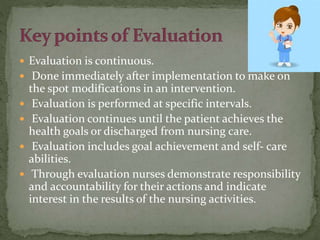
 Evaluation is continuous.
 Done immediately after implementation to make on
the spot modifications in an intervention.
 Evaluation is performed at specific intervals.
 Evaluation continues until the patient achieves the
health goals or discharged from nursing care.
 Evaluation includes goal achievement and self- care
abilities.
 Through evaluation nurses demonstrate responsibility
and accountability for their actions and indicate
interest in the results of the nursing activities.
Keep watching ……

Evaluation.pptx

  • 1.
  • 2.
     Evaluation isthe last phase of the nursing process. It follows implementation of the plan of care. It’s the judgment of the effectiveness of nursing care to meet patient goals based on the patient’s behavioral responses.  Evaluation is continuous.
  • 3.
     Evaluation isdefined as the judgment of the effectiveness of nursing care to meet client goals; in this phase nurse compare the client behavioral responses with pre determined client goals and outcome criteria.  Evaluation is a planned, ongoing, purposeful activity in which patients and health care professionals determine the patient’s progress toward achievement of goals/outcomes and the effectiveness of the nursing care plan.
  • 4.
     1. Theprimary purpose of an evaluation is to determine the patient’s progress toward achieving established goals and outcomes. 2. Through evaluation, it is possible to determine a healthcare agency’s ability to provide safe and effective healthcare services. 3. Evaluation provides a mechanism to help nurses define, explain, and measure the results of nursing interventions.
  • 5.
    1. To determineif nursing interventions are helping clients achieve expected outcomes. 2. To verify the quality of nursing care provided. 3. To promote accountability among nurses. 4. To analyze current data. 5. To promote continuity of care
  • 6.
    Nursing evaluation includes (1)collecting data, (2) comparing collected data with desired outcomes, (3) analyzing client’s response relating to nursing activities, (4) identifying factors that contributed to the success or failure of the care plan, (5) continuing, modifying, or terminating the nursing care plan, and (6) planning for future nursing care.
  • 7.
    1. Collecting Data The nurse recollects data so that conclusions can be drawn about whether goals have been fulfilled. It is usually vital to collect both objective and subjective data. Data must be documented concisely and accurately to facilitate the next part of the evaluating process.
  • 8.
    2. Comparing Datawith Desired Outcomes  The documented goals and objectives of the nursing care plan become the standards or criteria by which to measure the client’s progress whether the desired outcome has been met, partially met, or not met.  The goal was met, when the client response is the same as the desired outcome.  The goal was partially met, when either a short-term outcome was achieved but the long-term goal was not, or the desired goal was incompletely attained.  The goal was not met.
  • 9.
    3. Analyzing Client’sResponse Relating to Nursing Activities  It is also very important to determine whether the nursing activities had any relation to the outcomes whether it was successfully accomplished or not.
  • 10.
    4. Identifying FactorsContributing to Success or Failure  It is required to collect more data to confirm if the plan was successful or a failure. Different factors may contribute to the achievement of goals. For example, the client’s family may or may not be supportive, or the client may be uncooperative to perform such activities.
  • 11.
    5. Continuing, Modifying,or Terminating the Nursing Care Plan  The nursing process is dynamic and cyclical. If goals were not sufficed, the nursing process begins again from the first step. Reassessment and modification may continually be needed to keep them current and relevant depending upon general patient condition. The plan of care may be adjusted based on new assessment data.
  • 12.
    6. planning forfuture nursing care(Discharge Planning)  Discharge planning is the process of transitioning a patient from one level of care to the next. Discharge plans are individualized instructions provided as the client is prepared for continued care outside the healthcare facility or for independent living at home. The main purpose of a discharge plan is to improve the client’s quality of life by ensuring continuity of care together with the client’s family or other healthcare workers providing continuing care.
  • 13.
     Nurse mustknow the hospital policies, procedure and protocols of interventions and recording.  Nurse must have up to date knowledge and information of many subjects  Nurse must have intellectual and technical skill to monitor the effectiveness of Nursing interventions.  Nurse must have knowledge and skill of collecting subjective data and objective data.
  • 14.
     Evaluation iscontinuous.  Done immediately after implementation to make on the spot modifications in an intervention.  Evaluation is performed at specific intervals.  Evaluation continues until the patient achieves the health goals or discharged from nursing care.  Evaluation includes goal achievement and self- care abilities.  Through evaluation nurses demonstrate responsibility and accountability for their actions and indicate interest in the results of the nursing activities.
  • 15.