Primer on reverberation
R.Narasimha Swamy
Senior consultant
narasimhaswamy@yahoo.com
Reverberation
• This is due to multiple reflections of the sound waves in enclosed
spaces.
• Wallace Sabine introduced the reverberation time (RT60) as a
measure of acoustic characteristics of a enclosed spaces almost a
century before.
• RT60 provides a rough thumb rule figure of the acoustic
characteristics of the enclosed space.
• In past 20 years, several other parameters have been added to
accurately characterize and compare the relative performance of
the enclosed spaces.
• All acoustic parameters are derived from sound decay
characteristics - signature of the enclosed spaces.
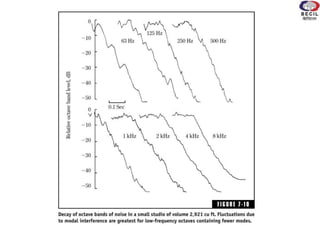
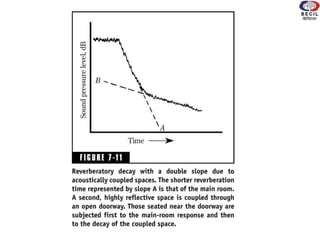
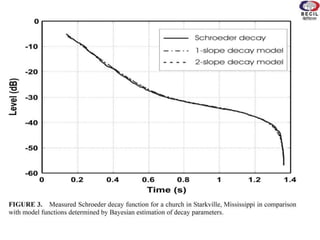
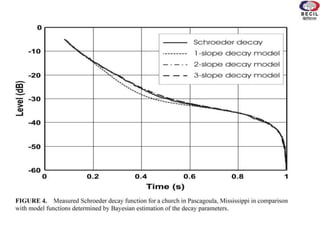
Decay characteristics – Signature of the enclosed spaces
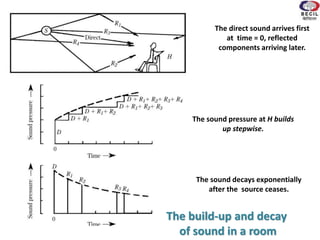
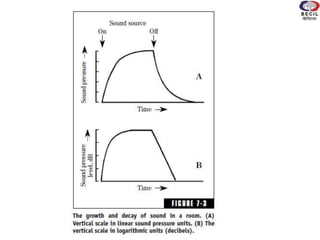
The sound decays exponentially
after the source ceases.
The build-up and decay
of sound in a room
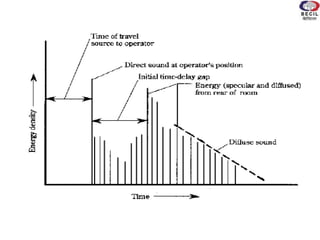
The direct sound arrives first
at time = 0, reflected
components arriving later.
The sound pressure at H builds
up stepwise.
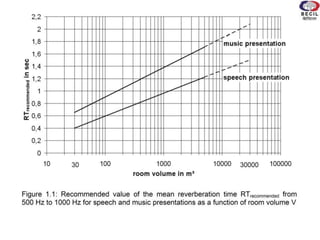
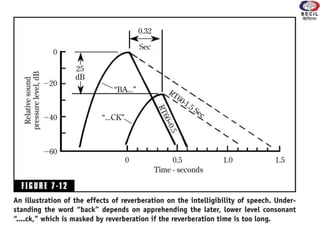
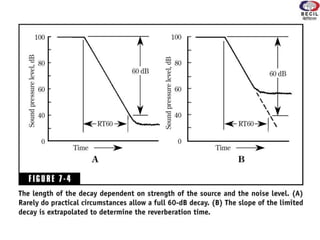
Reverberation RT60
• Reverberation time RT60 is defined as that time taken
for the sound in a room to decay to 60 dB below the
source level, after the source is muted.
• In very rough human terms, it is the time required for
a sound that is very loud to decay to inaudibility.
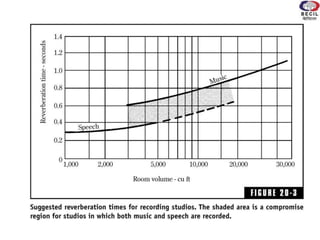
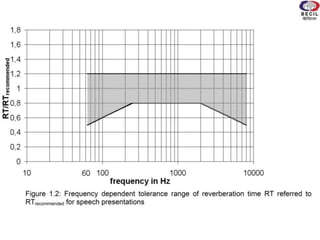
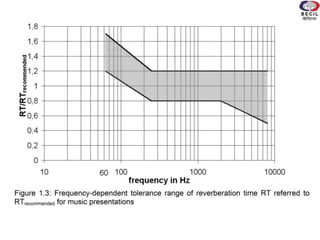
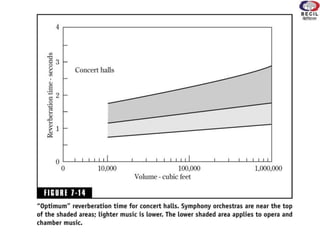
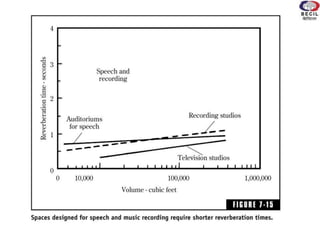
• Reverberation is a desirable effect for music, whereas
they are highly undesirable for speech, as it adversely
affects intelligibility of the spoken words.
Determining the RT60
• Can be computed from the dimension and the
absorption characteristics of the material used
for the inner surfaces of the enclosed spaces
by using classical Sabine’s formula. Used for
preliminary design.
• Can be measured using instrumentation.
Sabine’s formula
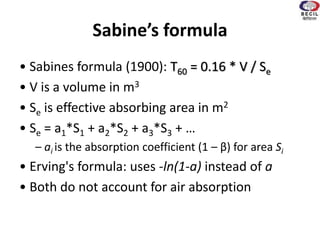
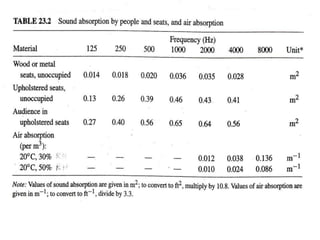
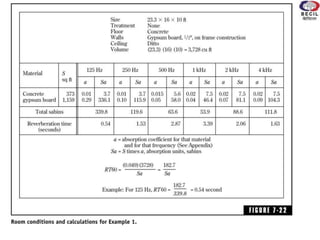
• Sabines formula (1900): T60 = 0.16 * V / Se
• V is a volume in m3
• Se is effective absorbing area in m2
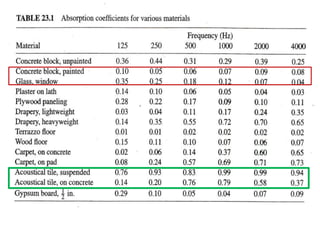
• Se = a1*S1 + a2*S2 + a3*S3 + …
– ai is the absorption coefficient (1 – β) for area Si
• Erving's formula: uses -ln(1-a) instead of a
• Both do not account for air absorption
Measurement of RT60
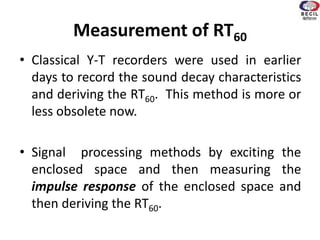
• Classical Y-T recorders were used in earlier
days to record the sound decay characteristics
and deriving the RT60. This method is more or
less obsolete now.
• Signal processing methods by exciting the
enclosed space and then measuring the
impulse response of the enclosed space and
then deriving the RT60.
Impulse response
• In signal processing, the IR of a dynamic
system is its output when its input is
presented with an impulse signal.
• The impulse response describes the response
of the system as a function of time that
characterizes the dynamic behaviour of the
system.
Impulse sound
• Physical stimuli like bursting of balloons, gun
shots etc.
• Exciting the room with the help of electronically
generated signals like Maximum length sequence
[MLS], swept tone etc and recording the
response of the room and analyzing it with the
help of signal processing to obtain the complete
acoustic characteristics of the enclosed spaces.
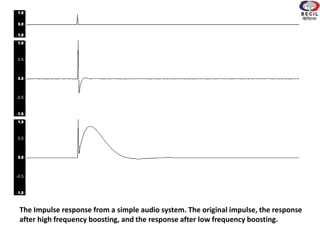
The Impulse response from a simple audio system. The original impulse, the response
after high frequency boosting, and the response after low frequency boosting.
Room impulse response [RIR]
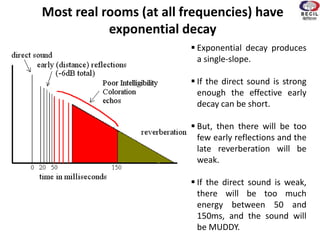
Most real rooms (at all frequencies) have
exponential decay
 Exponential decay produces
a single-slope.
 If the direct sound is strong
enough the effective early
decay can be short.
 But, then there will be too
few early reflections and the
late reverberation will be
weak.
 If the direct sound is weak,
there will be too much
energy between 50 and
150ms, and the sound will
be MUDDY.
Early and late reflections
• Early reflections:
– Strong and distinct
– Provide spatial information
– Should be modelled accurately
• Late reverberation:
– Low intensity and high density of reflections
– Provide room information
– No longer depends on source position
– Can be modelled statistically
Early reflections
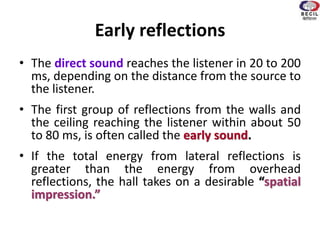
• The direct sound reaches the listener in 20 to 200
ms, depending on the distance from the source to
the listener.
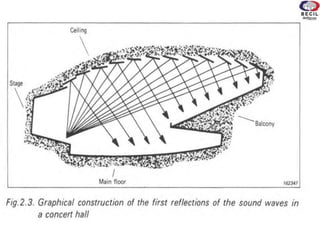
• The first group of reflections from the walls and
the ceiling reaching the listener within about 50
to 80 ms, is often called the early sound.
• If the total energy from lateral reflections is
greater than the energy from overhead
reflections, the hall takes on a desirable “spatial
impression.”
Precedence effect
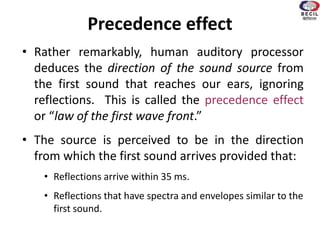
• Rather remarkably, human auditory processor
deduces the direction of the sound source from
the first sound that reaches our ears, ignoring
reflections. This is called the precedence effect
or “law of the first wave front.”
• The source is perceived to be in the direction
from which the first sound arrives provided that:
• Reflections arrive within 35 ms.
• Reflections that have spectra and envelopes similar to the
first sound.
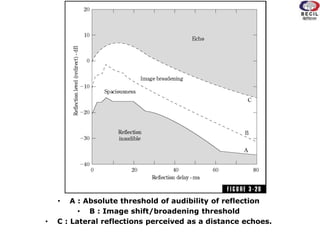
• A : Absolute threshold of audibility of reflection
• B : Image shift/broadening threshold
• C : Lateral reflections perceived as a distance echoes.
Reverberant chambers
T60 > 1000 ms.
Large, specially designed concert halls.
Acoustically pleasant (for each seat!).
Even decay of the reverberant response to
mask disturbing artefacts.
Good for Western classical symphony orchestra
Most unsuitable for speech.
• Intelligibility is impaired by late reflections.
• Try to talk in a large gym or in a pool…
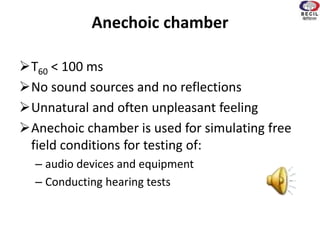
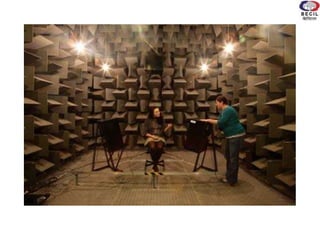
Anechoic chamber
T60 < 100 ms
No sound sources and no reflections
Unnatural and often unpleasant feeling
Anechoic chamber is used for simulating free
field conditions for testing of:
– audio devices and equipment
– Conducting hearing tests
Choice
 For a particular enclosed space, the choice is
always between clarity or reverberation.
 Reverberation currently has the upper hand
because it provides a pleasant aural experience.
 Emphasis on reverberation is often misguided.
 However, whenever an opportunity is provided to
increase the clarity, the improvement is noticed
immediately and appreciated by everyone.
Thank you

Primer on reverberation

  • 1.
    Primer on reverberation R.NarasimhaSwamy Senior consultant narasimhaswamy@yahoo.com
  • 2.
    Reverberation • This isdue to multiple reflections of the sound waves in enclosed spaces. • Wallace Sabine introduced the reverberation time (RT60) as a measure of acoustic characteristics of a enclosed spaces almost a century before. • RT60 provides a rough thumb rule figure of the acoustic characteristics of the enclosed space. • In past 20 years, several other parameters have been added to accurately characterize and compare the relative performance of the enclosed spaces. • All acoustic parameters are derived from sound decay characteristics - signature of the enclosed spaces.
  • 3.
    Decay characteristics –Signature of the enclosed spaces
  • 4.
    The sound decaysexponentially after the source ceases. The build-up and decay of sound in a room The direct sound arrives first at time = 0, reflected components arriving later. The sound pressure at H builds up stepwise.
  • 12.
    Reverberation RT60 • Reverberationtime RT60 is defined as that time taken for the sound in a room to decay to 60 dB below the source level, after the source is muted. • In very rough human terms, it is the time required for a sound that is very loud to decay to inaudibility. • Reverberation is a desirable effect for music, whereas they are highly undesirable for speech, as it adversely affects intelligibility of the spoken words.
  • 13.
    Determining the RT60 •Can be computed from the dimension and the absorption characteristics of the material used for the inner surfaces of the enclosed spaces by using classical Sabine’s formula. Used for preliminary design. • Can be measured using instrumentation.
  • 14.
    Sabine’s formula • Sabinesformula (1900): T60 = 0.16 * V / Se • V is a volume in m3 • Se is effective absorbing area in m2 • Se = a1*S1 + a2*S2 + a3*S3 + … – ai is the absorption coefficient (1 – β) for area Si • Erving's formula: uses -ln(1-a) instead of a • Both do not account for air absorption
  • 21.
    Measurement of RT60 •Classical Y-T recorders were used in earlier days to record the sound decay characteristics and deriving the RT60. This method is more or less obsolete now. • Signal processing methods by exciting the enclosed space and then measuring the impulse response of the enclosed space and then deriving the RT60.
  • 22.
    Impulse response • Insignal processing, the IR of a dynamic system is its output when its input is presented with an impulse signal. • The impulse response describes the response of the system as a function of time that characterizes the dynamic behaviour of the system.
  • 23.
    Impulse sound • Physicalstimuli like bursting of balloons, gun shots etc. • Exciting the room with the help of electronically generated signals like Maximum length sequence [MLS], swept tone etc and recording the response of the room and analyzing it with the help of signal processing to obtain the complete acoustic characteristics of the enclosed spaces.
  • 24.
    The Impulse responsefrom a simple audio system. The original impulse, the response after high frequency boosting, and the response after low frequency boosting.
  • 26.
  • 27.
    Most real rooms(at all frequencies) have exponential decay  Exponential decay produces a single-slope.  If the direct sound is strong enough the effective early decay can be short.  But, then there will be too few early reflections and the late reverberation will be weak.  If the direct sound is weak, there will be too much energy between 50 and 150ms, and the sound will be MUDDY.
  • 28.
    Early and latereflections • Early reflections: – Strong and distinct – Provide spatial information – Should be modelled accurately • Late reverberation: – Low intensity and high density of reflections – Provide room information – No longer depends on source position – Can be modelled statistically
  • 29.
    Early reflections • Thedirect sound reaches the listener in 20 to 200 ms, depending on the distance from the source to the listener. • The first group of reflections from the walls and the ceiling reaching the listener within about 50 to 80 ms, is often called the early sound. • If the total energy from lateral reflections is greater than the energy from overhead reflections, the hall takes on a desirable “spatial impression.”
  • 30.
    Precedence effect • Ratherremarkably, human auditory processor deduces the direction of the sound source from the first sound that reaches our ears, ignoring reflections. This is called the precedence effect or “law of the first wave front.” • The source is perceived to be in the direction from which the first sound arrives provided that: • Reflections arrive within 35 ms. • Reflections that have spectra and envelopes similar to the first sound.
  • 32.
    • A :Absolute threshold of audibility of reflection • B : Image shift/broadening threshold • C : Lateral reflections perceived as a distance echoes.
  • 33.
    Reverberant chambers T60 >1000 ms. Large, specially designed concert halls. Acoustically pleasant (for each seat!). Even decay of the reverberant response to mask disturbing artefacts. Good for Western classical symphony orchestra Most unsuitable for speech. • Intelligibility is impaired by late reflections. • Try to talk in a large gym or in a pool…
  • 34.
    Anechoic chamber T60 <100 ms No sound sources and no reflections Unnatural and often unpleasant feeling Anechoic chamber is used for simulating free field conditions for testing of: – audio devices and equipment – Conducting hearing tests
  • 41.
    Choice  For aparticular enclosed space, the choice is always between clarity or reverberation.  Reverberation currently has the upper hand because it provides a pleasant aural experience.  Emphasis on reverberation is often misguided.  However, whenever an opportunity is provided to increase the clarity, the improvement is noticed immediately and appreciated by everyone.
  • 42.