6TH UNIT:
FUNDAMENTALS OF ACOUSTICS
Minakshi Atre
PVGCOET, PUNE.
WHAT IS TO BE COVERED
 Studio Acoustics
 Reverberation
 P.A. System for Auditorium
 Acoustic Chambers
 Cordless microphone system
 Special types of speakers
 Special types of microphones
 Digital Radio receiver
 Satellite Radio Reception
REFERENCES
 Audio and Video Systems by R.G.Gupta
 www.AcousticGeometry.com
 http://www.acoustics.salford.ac.uk/facilities/?con
tent=anechoic
 https://www.youtube.com/watch?v=I3q5kQjMAb
c ( Auralex acoustics products )
STUDIO ACOUSTICS
FOR STUDIOS, SILENCE IS GOLDEN AND SO, IT’S
PRETTY EXPENSIVE
COMMERCIAL RECORDING STUDIOS COST HUNDREDS OF
THOUSANDS OF DOLLARS TO BUILD BECAUSE THEY MUST
ALLOW ABSOLUTELY NO SOUND TO ENTER FROM A
USUALLY NOISY URBAN ENVIRONMENT.
WHAT IS DONE FOR SOUNDPROOFING?
1.Double and triple walls,
2.Isolated concrete slabs,
3.Custom steel doors
are all standard but high priced items used in their
construction.
A studio's sound is its number one asset and most
owners will go to any lengths to get it right.
SOUNDPROOFING : AGAINST WHAT?
 Wall couplings
 Resonant frequencies
 Bass frequencies
 Early reflections
 Standing waves
UNFORTUNATELY, ALL WALLS ARE SOMEWHAT FLEXIBLE.
ANY MOTION CAUSED BY SOUND STRIKING ONE SIDE OF
THE WALL WILL RESULT IN SOUND RADIATED BY THE
OTHER SIDE, AN EFFECT CALLED COUPLING
IF THE SOUND HITS A RESONANT FREQUENCY, THE WALL
WILL BOOM LIKE A DRUM.
MOST ISOLATION TECHNIQUES ARE REALLY WAYS TO
REDUCE COUPLING AND PREVENT RESONANCES.
HOW TO CALCULATE THE RESONANCE FREQUENCY
OF A ROOM?
 1130/2*10=56.5 Hz ….the first resonance
frequency..this is also called the ROOM MODE
 At 56.5 Hz, the music note played will sound
louder than any other note and will decay slow
which will affect the later performance
 Room modes are the collection of resonances that
exist in a room when the room is excited by an
acoustic source such as a loudspeaker.
 Most rooms have their fundamental resonances in
the region of 20 Hz to 200 Hz, each frequency being
related to one or more of the room's dimension's or
a divisor thereof.
LOWERING THE WALL RESONANCE
 A typical residential wall is made of a frame of 2x4
wood studs covered with 5/8" thick gypsum board.
 Properly built (no holes!) this will provide about 35
dB of isolation.
 Fiberglas filler, will increase this by 5 to 8 dB and
decrease wall resonance.
 Doubling the thickness of gypsum gives another 3
to 6 dB of overall isolation, but its most important
effect is lowering the resonant frequency, hopefully
below the audio range.
THE SAME PRINCIPLE CAN BE APPLIED TO FLOORS AND
CEILINGS. A HEAVY FALSE CEILING HUNG ON SPRINGS
CAN MATCH THE PERFORMANCE OF A DOUBLE WALL-- IF
THERE IS A ROOM BELOW THE STUDIO, IT SHOULD GET A
DOUBLE CEILING TOO.
EARLY REFLECTIONS
IF THE WALL IS FLAT AND HARD, THE SOUND WILL
BE REFLECTED.
A SINGLE STRONG REFLECTION CAN SOMETIMES
BE HEARD AS AN ECHO, BUT IN MOST ROOMS A LOT
OF REFLECTIONS (INCLUDING REFLECTIONS OF
REFLECTIONS) COMBINE INTO THE
REVERBERATION.
WHAT TO DO @ REFLECTIONS?
 Use absorption tiles to
minimize those
reflections
 Use mirror trick to find
the 1st Reflection Point
 Break the continuity
of the flat surfaces of
wall by these tiles
STANDING WAVES
 Standing waves are created when you have two
parallel facing walls.
 There will be a particular set of frequencies that are
reinforced by the distance between the walls (the
sound makes exactly one round trip on each cycle
of the speaker and the pressure fronts pile up)
 This phenomenon can be prevented by designing
the room with nonparallel walls.
 It can be cured in existing rooms by making one of
the walls absorptive or by breaking up the flat
surfaces.
 When sound is reflected off a rounded or complex
surface, it is diffused.
 Diffusion spreads the reverberant sound evenly
throughout a room, which not only prevents
standing waves but also eliminates "dead spots"--
places where components of the sound are missing.
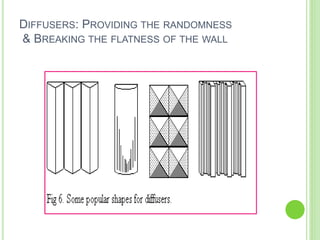
DIFFUSERS: PROVIDING THE RANDOMNESS
& BREAKING THE FLATNESS OF THE WALL
AVOID CONCAVE CURVES, WHICH FOCUS SOUND
INSTEAD OF DISPERSING IT, BUT OTHERWISE PYRAMIDS,
LATTICES, OR COMPUTER DESIGNED RANDOM SURFACES
ALL WORK WELL.
THE DEPTH OF A DIFFUSER DETERMINES THE LOWEST
FREQUENCY THAT WILL BE AFFECTED.
A DIFFUSER ONE FOOT DEEP WILL SCATTER SOUND
DOWN TO 160 HZ
SKYLINE DIFFUSERS
PHASE INTERFERENCE
 You may be familiar with phase interference from
recording work with multiple microphones.
 If a sound arrives at a single point via two paths at
slightly different times, certain frequencies will be
reinforced and others will be weakened.
 You can easily hear this by putting your ear close to
a wall: the quality of sound will change because the
reflections off the wall interfere with the direct
sound.
 The effect is at its worst when the distance the
reflected sound travels is only slightly longer than
the direct distance
SUMMARY
 Kill early reflections by placing acoustic panels at your
first reflection points ( sweet spot, RFZ (reflection free
zone))
 Bass traps and low frequency absorption (room modes)
 Broadband absorption (sound dampening material)
taken to the extreme (even frequency response)
 Making your ceiling disappear using absorption (for
RFZ near listening position)
 Making your room disappear (not anechoic chamber
but should sound like earphones plugged into ears)
 Adding a sense of space with diffusion (diffusion
to add life to the music)
 The balance: absorption, diffusion and
“reverberation” time (RT60) (mounting bass
absorbers, carpets or at least a rug under listening
position)
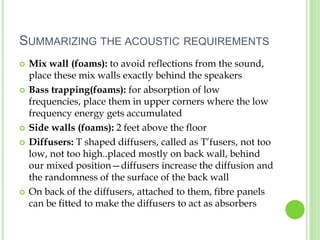
SUMMARIZING THE ACOUSTIC REQUIREMENTS
 Mix wall (foams): to avoid reflections from the sound,
place these mix walls exactly behind the speakers
 Bass trapping(foams): for absorption of low
frequencies, place them in upper corners where the low
frequency energy gets accumulated
 Side walls (foams): 2 feet above the floor
 Diffusers: T shaped diffusers, called as T’fusers, not too
low, not too high..placed mostly on back wall, behind
our mixed position—diffusers increase the diffusion and
the randomness of the surface of the back wall
 On back of the diffusers, attached to them, fibre panels
can be fitted to make the diffusers to act as absorbers
ACOUSTICALLY READY ROOM
ACOUSTIC ROOM: READY?
YES, WITH ADDED ABSORPTION SHEETS!
Absorptive ceiling cloud above listener to create RFZ around
the listening position
ONE OF THE BIGGEST RECORDING STUDIOS IN
EUROPE, LA CHAPELLE (BELGIUM) STUDIO’S
RECORDING FACILITIES DATE BACK TO 1979.
REVERBERATION: GOOD OR BAD?
REVERBERATION :
1.REVERBERATION IS MULTIPLE, RANDOM, BLENDED
REPETITIONS OF A SOUND.
2.GRADUAL FADING OF CONTINUING ECHO IS CALLED
REVERBERATION.
REVERBERATION TIME (RT 60)
THIS IS THE AMOUNT OF TIME IT TAKES A LOUD SHORT
SOUND TO DIE AWAY.
"DYING AWAY" CAN BE DEFINED MORE SCIENTIFICALLY
AS A DROP IN LOUDNESS OF 60 DB, SO ACOUSTICIANS
CALL REVERBERATION TIME RT60
HOW MUCH SHOULD BE THE REVERBERATION
TIME
 The amount of reverberation desired in a room
depends on the activity going on.
 Musicians like fairly long reverberation times;
between one and two seconds.
 This allows them to hear themselves play and
enhances the harmonic effects of the music. (In
larger rooms even more reverb is desirable because
it helps fill the hall with sound.)
 For listening to speech or music played through
loudspeakers this amount of reverb is too much--
values around a second are more comfortable, and
 for critical listening to speakers the RT60 should be
close to a half second.
 Reverberation time is determined by the volume of the
room.
 It can be reduced by replacing some of the hard,
reflective parts of the walls with soft, absorptive sections.
 Every material has some absorptive qualities.
 This is described by its coefficient of absorption, a
number between 0 and 1, with
 0 being totally reflective and 1 being an open window.
TYPICAL REVERBERATION PERIODS (FOR
WAVELENGTH OF 70CM(500 HZ FREQUENCY)
FACTORS AFFECTING RT60
 Volume of the room
 Surface area
 Absorption coefficient of surface area
 Velocity of sound (and hence wavelength)
W. C. SABINE, THE HARVARD PIONEER IN
ACOUSTICS INTRODUCED THE CONCEPT OF
RT60.
GROWTH AND DECAY OF SOUND IN AN
ENCLOSURE
SABINE’S EQUATION
SABINE’S EQUATION
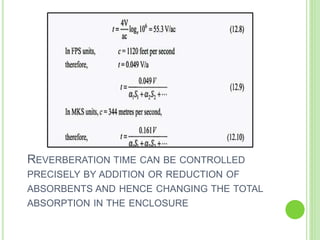
REVERBERATION TIME CAN BE CONTROLLED
PRECISELY BY ADDITION OR REDUCTION OF
ABSORBENTS AND HENCE CHANGING THE TOTAL
ABSORPTION IN THE ENCLOSURE
SUMMARIZING REVERBERATION AND SABINE’S
EQUATION
 Absorption: in acoustics, the conversion of sound
energy to heat.
 Absorption Coefficient: the fraction of sound
energy that is absorbed at any surface. It has a
value between 0 and 1 and varies with the
frequency and angle of incidence of the sound.
 Multiplying the surface area (in sq. ft.) by the
absorption coefficient results in absorption units
(sabins).
P A SYSTEM
NEED
 sound decays with distance
 so to address a large gathering, sound needs to be
amplified so that people from distance may receive
good intensity of sound for comfortable listening
 System fulfilling this function is called as Public
Address System
BLOCK DIAGRAM OF P A SYSTEM
REQUIREMENTS OF P A SYSTEM
 Acoustic feedback
 Distribution of sound energy
 Reverberation
 Orientation of Loudspeakers
 Ambient Noise
 Dynamic Range Limitation
 Selection of microphones
 Sense of direction of source of sound
 Phase delay
 Matching of loudspeaker’s impedance with impedance
of output amplifiers
 Grounding
 Amplifier Power
 Choice of loudspeakers
ACOUSTIC CHAMBERS
Prof. Minakshi Atre
ANECHOIC CHAMBER AT IWK, VIENNA
ANECHOIC/ ACOUSTIC CHAMBER
 In an anechoic chamber no reflections from the
walls, floor or ceiling are allowed
 99.5% of the radiated sound energy must be
absorbed.
 Anechoic chambers are commonly used for
experiments requiring acoustic 'free field'
conditions.
 Therefore no standing waves can establish.
 And to remove any sound reflections, or echoes,
the chamber is lined from floor to ceiling with
soft foam wedges which absorb any vibrations in
the air.
ACOUSTIC CHAMBERS
BUILDING THE ACOUSTIC CHAMBER
WHAT IS IT FOR?
 This is a room which is acoustically like being high
above the ground in the open air because there are
no reflections from the walls, floor or ceiling.
 This means it is ideal for testing the response of
loudspeakers or microphones because the room
doesn’t affect the measurements.
 It is also the best place for virtual acoustics -
generating auralisations of concert halls, city streets
and other spaces.
 The anechoic chamber is immensely quiet which
makes it ideal for testing very quiet products or
people hearing very quiet sounds.
EXAMPLE APPLICATION
 Patrick Froment at IWK, Vienna, wanted to
simulate the sound of rain on roofs.
 He needed to measure the sound of a single
raindrop landing on a roof section without the
effect of a room, so he used the anechoic chamber.
 He also needed a very quiet acoustic to measure the
sound.
EXAMPLE APPLICATION
 The protection that ear muffs and earplugs provide
varies from person to person, so they need to be tested
on real people.
 To do this four loudspeakers are placed at the corners of
a tetrahedron and a person sits so his head is at the
centre.
 The loudspeakers then produce sounds that are used to
test the person’s hearing threshold – the method is very
similar to how your doctor might test your hearing.
 The threshold is tested with and without the hearing
protectors, and the difference gives the product’s
performance.
 If you buy some ear plugs from a DIY store, the chances
are that the performance was tested in our chamber.
HOW IS IT MADE?
 We need to prevent sound getting into the room,
and this can pass through the walls, or through the
foundations of the building.
 The background noise level in the chamber is
immensely low; this is probably the quietest place
you’ll ever experience.
 An anechoic chamber is actually a room, within a
room, within the Newton building.
 The walls, floor and ceiling of the inner chamber
are made of heavy Accrington brick and concrete to
prevent sound getting into the room.
 Two heavy acoustic doors with rubber seals are
used to minimize airborne sound.
 Careful design is needed to deal with structure-
borne sound, for example, vibrations through the
foundations.
 The whole inner chamber is mounted on a set of
springs - neoprene rubber mounts - to reduce
vibration, as is done for major concert halls, but this
chamber is very much quieter than even the
grandest auditorium.
 The design is very exacting, for instance the bridge
leading into the chamber is attached to the outer
but not to the inner wall, to prevent the vibration
isolation being bypassed.
REMOVING REFLECTIONS FROM THE
CHAMBER
 To remove reflections from the walls of the
chamber, every surface is covered in absorbing
materials.
 The inside of the chamber is lined with foam
wedges to absorb sound; this includes the floor.
 The floor you walk on is a wire trampoline
stretched between the walls with an acoustically
transparent catch net below.
 The wire floor is safe, but you shouldn’t enter if
you are wearing high heels!
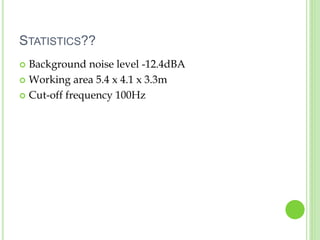
STATISTICS??
 Background noise level -12.4dBA
 Working area 5.4 x 4.1 x 3.3m
 Cut-off frequency 100Hz
DIGITAL SATELLITE RADIO
WHAT IS SATELLITE RADIO?
 Satellite Radio is digital radio that receives signals
from a broadcast communication satellite.
 Functions any place… there is a line of sight
between the antenna and the satellite
 Requires access to a commercial satellite for signal
propagation
 Satellites transmit radio frequency (RF) signals at
approximately 2.3 gigahertz (GHz)
SDARS
 Satellite digital audio radio service (SDARS) is a
satellite-based direct-broadcast radio service
 In SDARS, digitally encoded audio entertainment
material, is broadcast to earth-based receivers either
directly from an orbiting satellite, or in cases in
which the receiver is in a shielded location from the
satellite, to the receiver via a repeater station
 Satellite radio is available, in a digital audio format,
for subscription through two services in the US -
XM Radio and Sirius Satellite Radio.
 Bandwidth : 12.5 MHz for XM and Sirius Radio
Services
SDARS FREQUENCY BANDS
WHAT IS WCS
 WCS: wireless communication service
 The Wireless Communications Service (WCS) is in
the 2305-2320 and 2345-2360 MHz spectrum range.
 The most common use of WCS spectrum is :
 mobile voice and data services, including cell
phone, text messaging, and Internet.
CURRENT PROVIDERS
SIRIUS SATELLITE RADIO
 Operated in the United States and Canada
 Provides 69 channels of music
 65 channels of news, sports and entertainment
 Broadcast 24 hours a day commercial free from
three satellites
 Three satellites in an inclined elliptical orbit
 Each satellite spends about 16 hours over the US,
with two satellites always above the equator
 The satellites are inclined at 60 degrees
 The satellites are of lower power than XM Radio’s
 105 high power repeaters serving 46 markets
XM SATELLITE RADIO
 United States and Canada
 73 music, 39 news, sports and entertainment, 29
regional traffic and weather, 23 play-by-play sports
 Two geostationary satellites with a 45 degree
angle of elevation
 Each satellite emits about 10MW of signal energy
 Approximately 1500 low power repeater stations
serving 70 markets
WORLDSPACE
 Based in Silver Spring,MD
 First stated by wanting to improve literacy in Africa
 Covers Asia, Europe, and Africa
 Licensed to serve Central and South America
 AfriStar (serves Africa) and AsiaStar (serves Asia
and Europe)
 3 transmission beams; 50 channels each
IN THE UK AND OTHER COUNTRIES, THE
CONTEMPORARY EVOLUTION OF RADIO SERVICES IS
FOCUSED ON DIGITAL AUDIO BROADCASTING (DAB)
SERVICES OR HD RADIO, RATHER THAN SATELLITE
RADIO. SATELLITE RADIO, PARTICULARLY IN THE UNITED
STATES, HAS BECOME A MAJOR PROVIDER OF
BACKGROUND MUSIC TO BUSINESSES SUCH AS HOTELS,
RETAIL CHAINS, AND RESTAURANTS.
THANK YOU

Fundamentals of acoustics

  • 1.
    6TH UNIT: FUNDAMENTALS OFACOUSTICS Minakshi Atre PVGCOET, PUNE.
  • 2.
    WHAT IS TOBE COVERED  Studio Acoustics  Reverberation  P.A. System for Auditorium  Acoustic Chambers  Cordless microphone system  Special types of speakers  Special types of microphones  Digital Radio receiver  Satellite Radio Reception
  • 3.
    REFERENCES  Audio andVideo Systems by R.G.Gupta  www.AcousticGeometry.com  http://www.acoustics.salford.ac.uk/facilities/?con tent=anechoic  https://www.youtube.com/watch?v=I3q5kQjMAb c ( Auralex acoustics products )
  • 4.
  • 5.
    FOR STUDIOS, SILENCEIS GOLDEN AND SO, IT’S PRETTY EXPENSIVE
  • 6.
    COMMERCIAL RECORDING STUDIOSCOST HUNDREDS OF THOUSANDS OF DOLLARS TO BUILD BECAUSE THEY MUST ALLOW ABSOLUTELY NO SOUND TO ENTER FROM A USUALLY NOISY URBAN ENVIRONMENT.
  • 7.
    WHAT IS DONEFOR SOUNDPROOFING? 1.Double and triple walls, 2.Isolated concrete slabs, 3.Custom steel doors are all standard but high priced items used in their construction. A studio's sound is its number one asset and most owners will go to any lengths to get it right.
  • 8.
    SOUNDPROOFING : AGAINSTWHAT?  Wall couplings  Resonant frequencies  Bass frequencies  Early reflections  Standing waves
  • 9.
    UNFORTUNATELY, ALL WALLSARE SOMEWHAT FLEXIBLE. ANY MOTION CAUSED BY SOUND STRIKING ONE SIDE OF THE WALL WILL RESULT IN SOUND RADIATED BY THE OTHER SIDE, AN EFFECT CALLED COUPLING
  • 10.
    IF THE SOUNDHITS A RESONANT FREQUENCY, THE WALL WILL BOOM LIKE A DRUM. MOST ISOLATION TECHNIQUES ARE REALLY WAYS TO REDUCE COUPLING AND PREVENT RESONANCES.
  • 11.
    HOW TO CALCULATETHE RESONANCE FREQUENCY OF A ROOM?  1130/2*10=56.5 Hz ….the first resonance frequency..this is also called the ROOM MODE  At 56.5 Hz, the music note played will sound louder than any other note and will decay slow which will affect the later performance  Room modes are the collection of resonances that exist in a room when the room is excited by an acoustic source such as a loudspeaker.  Most rooms have their fundamental resonances in the region of 20 Hz to 200 Hz, each frequency being related to one or more of the room's dimension's or a divisor thereof.
  • 12.
    LOWERING THE WALLRESONANCE  A typical residential wall is made of a frame of 2x4 wood studs covered with 5/8" thick gypsum board.  Properly built (no holes!) this will provide about 35 dB of isolation.  Fiberglas filler, will increase this by 5 to 8 dB and decrease wall resonance.  Doubling the thickness of gypsum gives another 3 to 6 dB of overall isolation, but its most important effect is lowering the resonant frequency, hopefully below the audio range.
  • 14.
    THE SAME PRINCIPLECAN BE APPLIED TO FLOORS AND CEILINGS. A HEAVY FALSE CEILING HUNG ON SPRINGS CAN MATCH THE PERFORMANCE OF A DOUBLE WALL-- IF THERE IS A ROOM BELOW THE STUDIO, IT SHOULD GET A DOUBLE CEILING TOO.
  • 15.
  • 16.
    IF THE WALLIS FLAT AND HARD, THE SOUND WILL BE REFLECTED. A SINGLE STRONG REFLECTION CAN SOMETIMES BE HEARD AS AN ECHO, BUT IN MOST ROOMS A LOT OF REFLECTIONS (INCLUDING REFLECTIONS OF REFLECTIONS) COMBINE INTO THE REVERBERATION.
  • 17.
    WHAT TO DO@ REFLECTIONS?  Use absorption tiles to minimize those reflections  Use mirror trick to find the 1st Reflection Point  Break the continuity of the flat surfaces of wall by these tiles
  • 18.
    STANDING WAVES  Standingwaves are created when you have two parallel facing walls.  There will be a particular set of frequencies that are reinforced by the distance between the walls (the sound makes exactly one round trip on each cycle of the speaker and the pressure fronts pile up)
  • 19.
     This phenomenoncan be prevented by designing the room with nonparallel walls.  It can be cured in existing rooms by making one of the walls absorptive or by breaking up the flat surfaces.  When sound is reflected off a rounded or complex surface, it is diffused.  Diffusion spreads the reverberant sound evenly throughout a room, which not only prevents standing waves but also eliminates "dead spots"-- places where components of the sound are missing.
  • 20.
    DIFFUSERS: PROVIDING THERANDOMNESS & BREAKING THE FLATNESS OF THE WALL
  • 21.
    AVOID CONCAVE CURVES,WHICH FOCUS SOUND INSTEAD OF DISPERSING IT, BUT OTHERWISE PYRAMIDS, LATTICES, OR COMPUTER DESIGNED RANDOM SURFACES ALL WORK WELL. THE DEPTH OF A DIFFUSER DETERMINES THE LOWEST FREQUENCY THAT WILL BE AFFECTED. A DIFFUSER ONE FOOT DEEP WILL SCATTER SOUND DOWN TO 160 HZ
  • 22.
  • 23.
    PHASE INTERFERENCE  Youmay be familiar with phase interference from recording work with multiple microphones.  If a sound arrives at a single point via two paths at slightly different times, certain frequencies will be reinforced and others will be weakened.  You can easily hear this by putting your ear close to a wall: the quality of sound will change because the reflections off the wall interfere with the direct sound.  The effect is at its worst when the distance the reflected sound travels is only slightly longer than the direct distance
  • 24.
    SUMMARY  Kill earlyreflections by placing acoustic panels at your first reflection points ( sweet spot, RFZ (reflection free zone))  Bass traps and low frequency absorption (room modes)  Broadband absorption (sound dampening material) taken to the extreme (even frequency response)  Making your ceiling disappear using absorption (for RFZ near listening position)  Making your room disappear (not anechoic chamber but should sound like earphones plugged into ears)
  • 25.
     Adding asense of space with diffusion (diffusion to add life to the music)  The balance: absorption, diffusion and “reverberation” time (RT60) (mounting bass absorbers, carpets or at least a rug under listening position)
  • 26.
    SUMMARIZING THE ACOUSTICREQUIREMENTS  Mix wall (foams): to avoid reflections from the sound, place these mix walls exactly behind the speakers  Bass trapping(foams): for absorption of low frequencies, place them in upper corners where the low frequency energy gets accumulated  Side walls (foams): 2 feet above the floor  Diffusers: T shaped diffusers, called as T’fusers, not too low, not too high..placed mostly on back wall, behind our mixed position—diffusers increase the diffusion and the randomness of the surface of the back wall  On back of the diffusers, attached to them, fibre panels can be fitted to make the diffusers to act as absorbers
  • 27.
  • 28.
  • 29.
    YES, WITH ADDEDABSORPTION SHEETS! Absorptive ceiling cloud above listener to create RFZ around the listening position
  • 30.
    ONE OF THEBIGGEST RECORDING STUDIOS IN EUROPE, LA CHAPELLE (BELGIUM) STUDIO’S RECORDING FACILITIES DATE BACK TO 1979.
  • 31.
  • 32.
    REVERBERATION : 1.REVERBERATION ISMULTIPLE, RANDOM, BLENDED REPETITIONS OF A SOUND. 2.GRADUAL FADING OF CONTINUING ECHO IS CALLED REVERBERATION. REVERBERATION TIME (RT 60) THIS IS THE AMOUNT OF TIME IT TAKES A LOUD SHORT SOUND TO DIE AWAY. "DYING AWAY" CAN BE DEFINED MORE SCIENTIFICALLY AS A DROP IN LOUDNESS OF 60 DB, SO ACOUSTICIANS CALL REVERBERATION TIME RT60
  • 33.
    HOW MUCH SHOULDBE THE REVERBERATION TIME  The amount of reverberation desired in a room depends on the activity going on.  Musicians like fairly long reverberation times; between one and two seconds.  This allows them to hear themselves play and enhances the harmonic effects of the music. (In larger rooms even more reverb is desirable because it helps fill the hall with sound.)
  • 34.
     For listeningto speech or music played through loudspeakers this amount of reverb is too much-- values around a second are more comfortable, and  for critical listening to speakers the RT60 should be close to a half second.
  • 35.
     Reverberation timeis determined by the volume of the room.  It can be reduced by replacing some of the hard, reflective parts of the walls with soft, absorptive sections.  Every material has some absorptive qualities.  This is described by its coefficient of absorption, a number between 0 and 1, with  0 being totally reflective and 1 being an open window.
  • 36.
    TYPICAL REVERBERATION PERIODS(FOR WAVELENGTH OF 70CM(500 HZ FREQUENCY)
  • 37.
    FACTORS AFFECTING RT60 Volume of the room  Surface area  Absorption coefficient of surface area  Velocity of sound (and hence wavelength)
  • 38.
    W. C. SABINE,THE HARVARD PIONEER IN ACOUSTICS INTRODUCED THE CONCEPT OF RT60.
  • 39.
    GROWTH AND DECAYOF SOUND IN AN ENCLOSURE
  • 40.
  • 41.
  • 42.
    REVERBERATION TIME CANBE CONTROLLED PRECISELY BY ADDITION OR REDUCTION OF ABSORBENTS AND HENCE CHANGING THE TOTAL ABSORPTION IN THE ENCLOSURE
  • 43.
    SUMMARIZING REVERBERATION ANDSABINE’S EQUATION  Absorption: in acoustics, the conversion of sound energy to heat.  Absorption Coefficient: the fraction of sound energy that is absorbed at any surface. It has a value between 0 and 1 and varies with the frequency and angle of incidence of the sound.  Multiplying the surface area (in sq. ft.) by the absorption coefficient results in absorption units (sabins).
  • 44.
  • 45.
    NEED  sound decayswith distance  so to address a large gathering, sound needs to be amplified so that people from distance may receive good intensity of sound for comfortable listening  System fulfilling this function is called as Public Address System
  • 46.
    BLOCK DIAGRAM OFP A SYSTEM
  • 47.
    REQUIREMENTS OF PA SYSTEM  Acoustic feedback  Distribution of sound energy  Reverberation  Orientation of Loudspeakers  Ambient Noise  Dynamic Range Limitation  Selection of microphones  Sense of direction of source of sound  Phase delay  Matching of loudspeaker’s impedance with impedance of output amplifiers  Grounding  Amplifier Power  Choice of loudspeakers
  • 48.
  • 49.
  • 50.
    ANECHOIC/ ACOUSTIC CHAMBER In an anechoic chamber no reflections from the walls, floor or ceiling are allowed  99.5% of the radiated sound energy must be absorbed.  Anechoic chambers are commonly used for experiments requiring acoustic 'free field' conditions.  Therefore no standing waves can establish.  And to remove any sound reflections, or echoes, the chamber is lined from floor to ceiling with soft foam wedges which absorb any vibrations in the air.
  • 51.
  • 52.
  • 53.
    WHAT IS ITFOR?  This is a room which is acoustically like being high above the ground in the open air because there are no reflections from the walls, floor or ceiling.  This means it is ideal for testing the response of loudspeakers or microphones because the room doesn’t affect the measurements.  It is also the best place for virtual acoustics - generating auralisations of concert halls, city streets and other spaces.  The anechoic chamber is immensely quiet which makes it ideal for testing very quiet products or people hearing very quiet sounds.
  • 54.
    EXAMPLE APPLICATION  PatrickFroment at IWK, Vienna, wanted to simulate the sound of rain on roofs.  He needed to measure the sound of a single raindrop landing on a roof section without the effect of a room, so he used the anechoic chamber.  He also needed a very quiet acoustic to measure the sound.
  • 55.
    EXAMPLE APPLICATION  Theprotection that ear muffs and earplugs provide varies from person to person, so they need to be tested on real people.  To do this four loudspeakers are placed at the corners of a tetrahedron and a person sits so his head is at the centre.  The loudspeakers then produce sounds that are used to test the person’s hearing threshold – the method is very similar to how your doctor might test your hearing.  The threshold is tested with and without the hearing protectors, and the difference gives the product’s performance.  If you buy some ear plugs from a DIY store, the chances are that the performance was tested in our chamber.
  • 56.
    HOW IS ITMADE?  We need to prevent sound getting into the room, and this can pass through the walls, or through the foundations of the building.  The background noise level in the chamber is immensely low; this is probably the quietest place you’ll ever experience.  An anechoic chamber is actually a room, within a room, within the Newton building.  The walls, floor and ceiling of the inner chamber are made of heavy Accrington brick and concrete to prevent sound getting into the room.  Two heavy acoustic doors with rubber seals are used to minimize airborne sound.
  • 57.
     Careful designis needed to deal with structure- borne sound, for example, vibrations through the foundations.  The whole inner chamber is mounted on a set of springs - neoprene rubber mounts - to reduce vibration, as is done for major concert halls, but this chamber is very much quieter than even the grandest auditorium.  The design is very exacting, for instance the bridge leading into the chamber is attached to the outer but not to the inner wall, to prevent the vibration isolation being bypassed.
  • 58.
    REMOVING REFLECTIONS FROMTHE CHAMBER  To remove reflections from the walls of the chamber, every surface is covered in absorbing materials.  The inside of the chamber is lined with foam wedges to absorb sound; this includes the floor.  The floor you walk on is a wire trampoline stretched between the walls with an acoustically transparent catch net below.  The wire floor is safe, but you shouldn’t enter if you are wearing high heels!
  • 59.
    STATISTICS??  Background noiselevel -12.4dBA  Working area 5.4 x 4.1 x 3.3m  Cut-off frequency 100Hz
  • 60.
  • 61.
    WHAT IS SATELLITERADIO?  Satellite Radio is digital radio that receives signals from a broadcast communication satellite.  Functions any place… there is a line of sight between the antenna and the satellite  Requires access to a commercial satellite for signal propagation  Satellites transmit radio frequency (RF) signals at approximately 2.3 gigahertz (GHz)
  • 62.
    SDARS  Satellite digitalaudio radio service (SDARS) is a satellite-based direct-broadcast radio service  In SDARS, digitally encoded audio entertainment material, is broadcast to earth-based receivers either directly from an orbiting satellite, or in cases in which the receiver is in a shielded location from the satellite, to the receiver via a repeater station  Satellite radio is available, in a digital audio format, for subscription through two services in the US - XM Radio and Sirius Satellite Radio.  Bandwidth : 12.5 MHz for XM and Sirius Radio Services
  • 63.
  • 64.
    WHAT IS WCS WCS: wireless communication service  The Wireless Communications Service (WCS) is in the 2305-2320 and 2345-2360 MHz spectrum range.  The most common use of WCS spectrum is :  mobile voice and data services, including cell phone, text messaging, and Internet.
  • 65.
  • 66.
    SIRIUS SATELLITE RADIO Operated in the United States and Canada  Provides 69 channels of music  65 channels of news, sports and entertainment  Broadcast 24 hours a day commercial free from three satellites  Three satellites in an inclined elliptical orbit  Each satellite spends about 16 hours over the US, with two satellites always above the equator  The satellites are inclined at 60 degrees  The satellites are of lower power than XM Radio’s  105 high power repeaters serving 46 markets
  • 67.
    XM SATELLITE RADIO United States and Canada  73 music, 39 news, sports and entertainment, 29 regional traffic and weather, 23 play-by-play sports  Two geostationary satellites with a 45 degree angle of elevation  Each satellite emits about 10MW of signal energy  Approximately 1500 low power repeater stations serving 70 markets
  • 68.
    WORLDSPACE  Based inSilver Spring,MD  First stated by wanting to improve literacy in Africa  Covers Asia, Europe, and Africa  Licensed to serve Central and South America  AfriStar (serves Africa) and AsiaStar (serves Asia and Europe)  3 transmission beams; 50 channels each
  • 69.
    IN THE UKAND OTHER COUNTRIES, THE CONTEMPORARY EVOLUTION OF RADIO SERVICES IS FOCUSED ON DIGITAL AUDIO BROADCASTING (DAB) SERVICES OR HD RADIO, RATHER THAN SATELLITE RADIO. SATELLITE RADIO, PARTICULARLY IN THE UNITED STATES, HAS BECOME A MAJOR PROVIDER OF BACKGROUND MUSIC TO BUSINESSES SUCH AS HOTELS, RETAIL CHAINS, AND RESTAURANTS.
  • 70.

Editor's Notes

  • #25 Sound engineers also refer to the "sweet spot" of any noise-producing body that may be captured with a microphone. Every individual instrument has its own sweet spot, the perfect location to place the microphone or microphones, in order to obtain the best sound.
  • #26 Dead rooms are anechoic chambers..for audio books’ recording the anechoic chambers can be used. In a normal classroom setting the teacher's voice is some 20-30 dB above the background noise level
  • #27 For example, a teacher's voice level was measured at 50-60 dB in a classroom with a bacground noise level measured at 33 dB.
  • #28 If you can, add broadband bass traps to the ceiling, or turn your entire ceiling into a giant bass absorber
  • #30 In the example room setups you can see the outline of an absorptive ceiling cloud above the listener. This is the minimum ceiling treatment required — just enough to create a reflection free zone around your listening position.
  • #32 The low-frequency effects (LFE) channel is the name of an audio track specifically intended for deep, low-pitched sounds ranging from 3-120 Hz. This track is normally sent to a speaker that is specially designed for low-pitched sounds called the subwoofer.
  • #33 Woofers: upto 500 Hz, squawkers: 500-5kHz, tweeters: 5 KHz onwards
  • #53 The measured threshold of hearing curve shows that the sound intensity required to be heard is quite different for different frequencies. The standard threshold of hearing at 1000 Hz is nominally taken to be 0 dB, but the actual curves show the measured threshold at 1000 Hz to be about 4 dB.