Acoustics
Pankaj Kumar
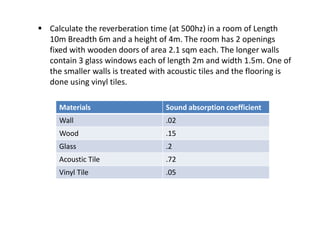
 Calculate the reverberation time (at 500hz) in a room of Length
10m Breadth 6m and a height of 4m. The room has 2 openings
fixed with wooden doors of area 2.1 sqm each. The longer walls
contain 3 glass windows each of length 2m and width 1.5m. One of
the smaller walls is treated with acoustic tiles and the flooring is
done using vinyl tiles.
Materials Sound absorption coefficient
Wall .02
Wood .15
Glass .2
Acoustic Tile .72
Vinyl Tile .05
 An Auditorium with a volume of 5000 cum has an optimal Reverberation
time of 0.8 sec.
1) The sound absorption power in m2-sabins is
2) During a convocation program the sound absorption power is
further increased by 200 m2-sabins. Calculate the new RT.
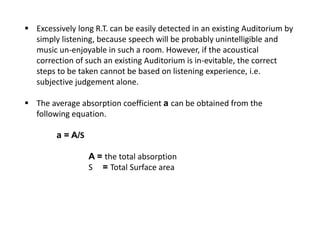
 Excessively long R.T. can be easily detected in an existing Auditorium by
simply listening, because speech will be probably unintelligible and
music un-enjoyable in such a room. However, if the acoustical
correction of such an existing Auditorium is in-evitable, the correct
steps to be taken cannot be based on listening experience, i.e.
subjective judgement alone.
 The average absorption coefficient a can be obtained from the
following equation.
a = A/S
A = the total absorption
S = Total Surface area
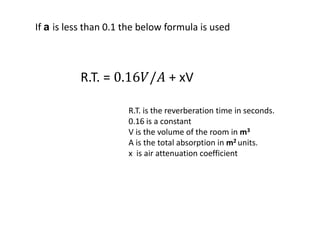
R.T. = 0.16𝑉/𝐴 + xV
If a is less than 0.1 the below formula is used
R.T. is the reverberation time in seconds.
0.16 is a constant
V is the volume of the room in m3
A is the total absorption in m2 units.
x is air attenuation coefficient
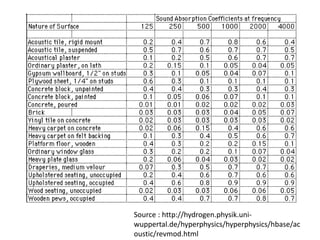
Source : http://hydrogen.physik.uni-
wuppertal.de/hyperphysics/hyperphysics/hbase/ac
oustic/revmod.html
Sound Absorbing Materials
1) Porous materials
2) Non-perforated panel or Membrane absorbers
3) Cavity (or Helmholtz) resonators
• Basic acoustical characteristic of all porous materials is a cellular
network of minute interlocking pores.
• They convert the incident sound energy into heat energy by the
frictional and viscous resistance within these pores and by vibration of
their small fibres.
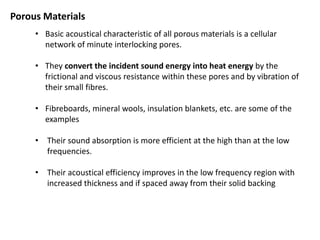
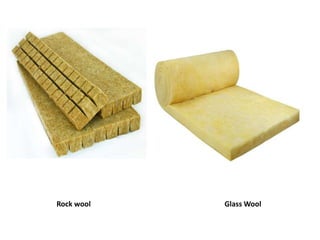
• Fibreboards, mineral wools, insulation blankets, etc. are some of the
examples
• Their sound absorption is more efficient at the high than at the low
frequencies.
• Their acoustical efficiency improves in the low frequency region with
increased thickness and if spaced away from their solid backing
Porous Materials
Rock wool Glass Wool
Non-perforated panel or Membrane absorbers
• Any impervious material, installed on a solid backing but separated from it
by an air space, will be set to vibration when struck by sound waves.
• The flexural vibration of the panel absorber will then absorb a certain
amount of the incident sound energy by converting it into heat energy.
• The theory of absorption provided by a vibrating panel is rather
complicated but it is a fair approximation to assume that maximum
absorption will occur in the region of the resonance frequency of the panel.
• The resonance frequency is normally at the lower end of the audio-
frequency range, therefore panel absorbers are efficient as low frequency
absorbers.
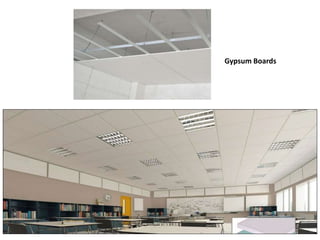
• Wood and hardboard panelling, gypsum boards, suspended plaster
ceilings, furred out plasters, rigid plastic boards, windows, glazing, doors,
wood floors and plat-forms, etc.
Gypsum Boards
Cavity (or Helmholtz) resonators
• They consist of an enclosed body of air confined within rigid walls and
connected by a narrow opening(called the neck) with the surrounding
space in which the sound waves travel.
• A cavity resonator of this type will absorb maximum sound energy in the
region of its resonance frequency.
• An empty jar or bottle, also acts as a cavity resonator; however, its
maximum absorption is confined to a very narrow frequency band.
Cavity resonators can be applied
1. As individual units
2. As perforated panel resonators
3. As slit resonator panels.
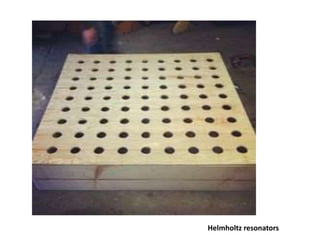
Helmholtz resonators
 Individual cavity resonators were used a very long time ago in
Scandinavian Churches. These resonators were made of empty clay
vessels, indifferent sizes, so that their effective absorption (at
resonance frequencies) was spread between100 and400 cps (low
frequencies).
 In contemporary room acoustical practice their application is
restricted to particular cases when individual low frequency peaks
within an exceptionally long R.T. of a room have to be reduced
drastically, without affecting the R.T. at medium and high frequencies.
 Perforated panels, spaced away from a solid backing, provide a widely
used practical application of the cavity resonator principle.
 They contain a large number of necks , constituting the perforation of
the panel, thus functioning as an array of cavity resonators.
 The perforations are usually circular, seldom slotted.
 The air space behind the perforation forms the undivided body of the
resonator, separated into bays by horizontal and vertical elements of
the framing system.

Room acoustics and sound absorption materials

  • 1.
  • 2.
     Calculate thereverberation time (at 500hz) in a room of Length 10m Breadth 6m and a height of 4m. The room has 2 openings fixed with wooden doors of area 2.1 sqm each. The longer walls contain 3 glass windows each of length 2m and width 1.5m. One of the smaller walls is treated with acoustic tiles and the flooring is done using vinyl tiles. Materials Sound absorption coefficient Wall .02 Wood .15 Glass .2 Acoustic Tile .72 Vinyl Tile .05
  • 3.
     An Auditoriumwith a volume of 5000 cum has an optimal Reverberation time of 0.8 sec. 1) The sound absorption power in m2-sabins is 2) During a convocation program the sound absorption power is further increased by 200 m2-sabins. Calculate the new RT.
  • 4.
     Excessively longR.T. can be easily detected in an existing Auditorium by simply listening, because speech will be probably unintelligible and music un-enjoyable in such a room. However, if the acoustical correction of such an existing Auditorium is in-evitable, the correct steps to be taken cannot be based on listening experience, i.e. subjective judgement alone.  The average absorption coefficient a can be obtained from the following equation. a = A/S A = the total absorption S = Total Surface area
  • 5.
    R.T. = 0.16𝑉/𝐴+ xV If a is less than 0.1 the below formula is used R.T. is the reverberation time in seconds. 0.16 is a constant V is the volume of the room in m3 A is the total absorption in m2 units. x is air attenuation coefficient
  • 6.
  • 7.
    Sound Absorbing Materials 1)Porous materials 2) Non-perforated panel or Membrane absorbers 3) Cavity (or Helmholtz) resonators
  • 8.
    • Basic acousticalcharacteristic of all porous materials is a cellular network of minute interlocking pores. • They convert the incident sound energy into heat energy by the frictional and viscous resistance within these pores and by vibration of their small fibres. • Fibreboards, mineral wools, insulation blankets, etc. are some of the examples • Their sound absorption is more efficient at the high than at the low frequencies. • Their acoustical efficiency improves in the low frequency region with increased thickness and if spaced away from their solid backing Porous Materials
  • 9.
  • 10.
    Non-perforated panel orMembrane absorbers • Any impervious material, installed on a solid backing but separated from it by an air space, will be set to vibration when struck by sound waves. • The flexural vibration of the panel absorber will then absorb a certain amount of the incident sound energy by converting it into heat energy. • The theory of absorption provided by a vibrating panel is rather complicated but it is a fair approximation to assume that maximum absorption will occur in the region of the resonance frequency of the panel. • The resonance frequency is normally at the lower end of the audio- frequency range, therefore panel absorbers are efficient as low frequency absorbers. • Wood and hardboard panelling, gypsum boards, suspended plaster ceilings, furred out plasters, rigid plastic boards, windows, glazing, doors, wood floors and plat-forms, etc.
  • 11.
  • 12.
    Cavity (or Helmholtz)resonators • They consist of an enclosed body of air confined within rigid walls and connected by a narrow opening(called the neck) with the surrounding space in which the sound waves travel. • A cavity resonator of this type will absorb maximum sound energy in the region of its resonance frequency. • An empty jar or bottle, also acts as a cavity resonator; however, its maximum absorption is confined to a very narrow frequency band. Cavity resonators can be applied 1. As individual units 2. As perforated panel resonators 3. As slit resonator panels. Helmholtz resonators
  • 13.
  • 14.
     Individual cavityresonators were used a very long time ago in Scandinavian Churches. These resonators were made of empty clay vessels, indifferent sizes, so that their effective absorption (at resonance frequencies) was spread between100 and400 cps (low frequencies).  In contemporary room acoustical practice their application is restricted to particular cases when individual low frequency peaks within an exceptionally long R.T. of a room have to be reduced drastically, without affecting the R.T. at medium and high frequencies.  Perforated panels, spaced away from a solid backing, provide a widely used practical application of the cavity resonator principle.  They contain a large number of necks , constituting the perforation of the panel, thus functioning as an array of cavity resonators.  The perforations are usually circular, seldom slotted.  The air space behind the perforation forms the undivided body of the resonator, separated into bays by horizontal and vertical elements of the framing system.