S U B M I TTE D B Y –
G AR I M A S I N G H
C L AS S - B . AR C H
S U B J E C T- B U I L D I N G
S E RV I C E S
MATERIAL USED TO
MINIMIZE REVERBERATION
REVERBERATION
Definition-This prolongation of sound in a hall even though
the source of sound is cut off is called reverberation.
Reverberation is dependent only on the volume of a space
and the acoustically absorptive quality of the room’s
finishes.
REDUCING REVERBERATION
 Excessive reverberation can cause echoes that interfere
with speech intelligibility.
 Smaller classrooms generally have shorter reverberation
times than large classrooms.
 However , sound waves may be reflected more frequently
and can create a masking effect.
MATERIALS AND SURFACE
 Increase the amount of soft, rough, or porous surfaces (e.g.,
acoustical paneling, bulletin boards, carpeting, bookcases)
and decrease the amount of smooth, hard surfaces (e.g.,
exposed concrete walls, glass) to reduce room reverberation
times and overall noise levels.
MATERIALS AND SURFACE
 Avoid placing sound-absorbing material directly above or in front of the
teacher’s lecture position.
 Install acoustical tiling with an absorption coefficient of atleast 0.65 to
cover hard, sound reflective ceilings Install sound-absorbing wall
panels or sound-absorbing concrete masonry units to lower
reverberation times in especially problematic rooms (e.g., high ceilings,
many windows).
 Position large reflective surfaces (e.g., blackboards, glazing)at non-
parallel angles to the walls to reduce echoes.
POROUS ABSORPTIVE MATERIALS
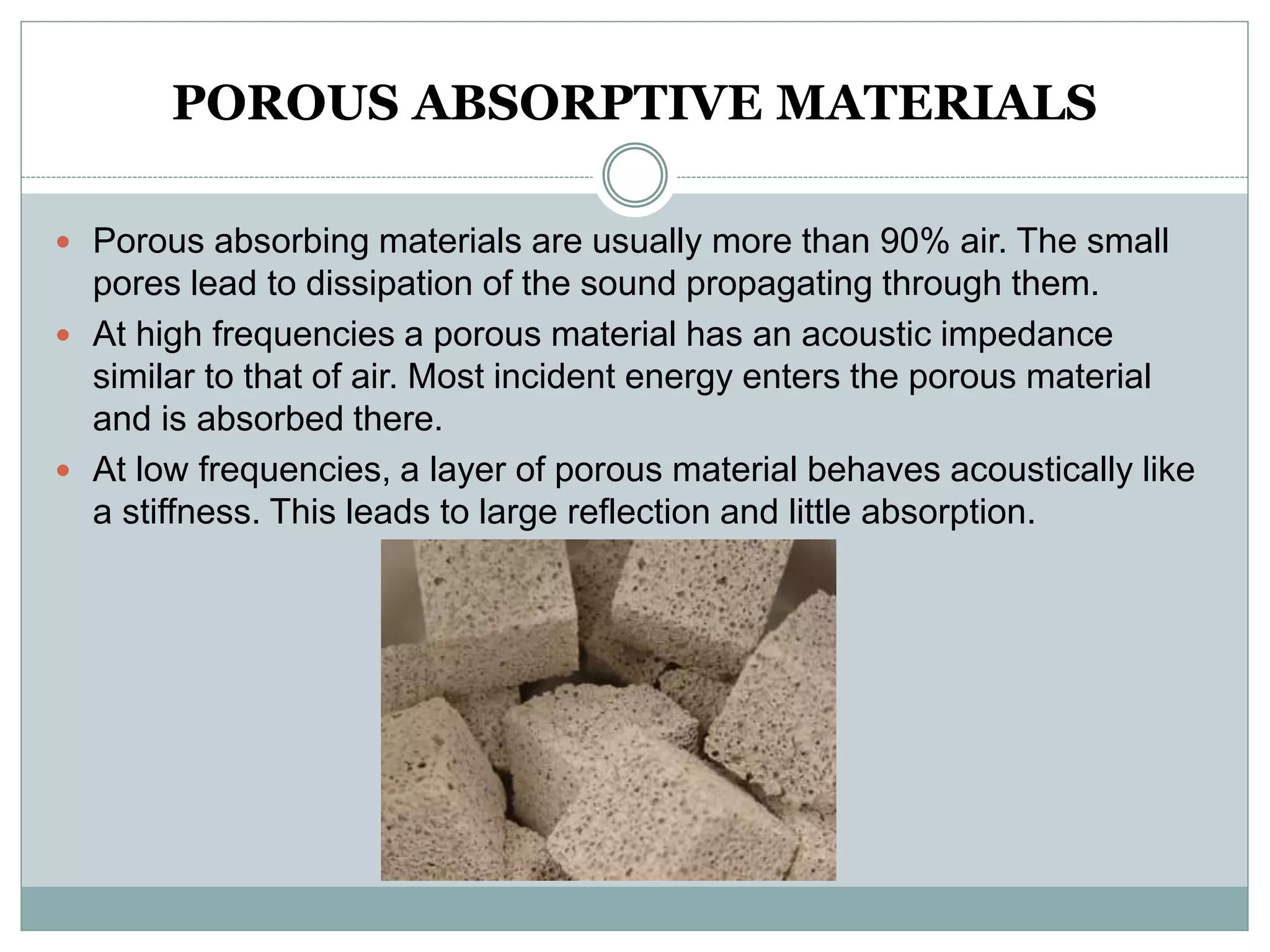
 Porous absorbing materials are usually more than 90% air. The small
pores lead to dissipation of the sound propagating through them.
 At high frequencies a porous material has an acoustic impedance
similar to that of air. Most incident energy enters the porous material
and is absorbed there.
 At low frequencies, a layer of porous material behaves acoustically like
a stiffness. This leads to large reflection and little absorption.
GYMNASIUMS
 Hang sound-absorbing baffles or
banners from the ceiling to
 reduce reverberation times.
 Include sound-absorbing panels
above perforated metal and fiber
glass roof decking on ceilings to
reduce reverberation times.
 Install acoustical panels or
bleachers on at least one of two
parallel walls to reduce flutter,
echoes.
 Leave ceilings above bleachers
non-absorptive to support livelier
cheering.
CONCERT HALL
 Materials play a huge part in
concert hall acoustics.
 The same materials used in
a space with good acoustics
could be made to sound
worse if they were arranged
in a different way.
 In general, however, hard,
reflective materials are ideal
for concert hall acoustics.
 This is because the
orchestra needs all the
reflection and reverberation
that it can get to make the
sound richer.
CINEMA HALL
 A simple hand clap at the front
of the cinema will reveal the
slap echoes across the walls
floor and ceiling which evolve
into reverberation, and will be
clearly heard.
 As a general rule the first early
reflections within 30 milli-
seconds are heard as being
part of the direct sound.
 Whereas after 30 milli-seconds
the later slap echoes and
reverberation are heard as
being from the room.
CINEMA HALL
 The majority of modern cinemas
are concrete constructed which
limits sound escaping from the
room.
 The curtain material on walls
absorbs high frequencies but has
little effect on absorbing low
frequencies as in the pic below.
 If pleated curtain material absorbs
50% (-3dB) of sound energy at
500Hz the sound would have to
strike the curtain 20 times to be
reduced to 0.0001% (-60dB). -
3dB is only heard as a slight
reduction.
AUDITORIUM
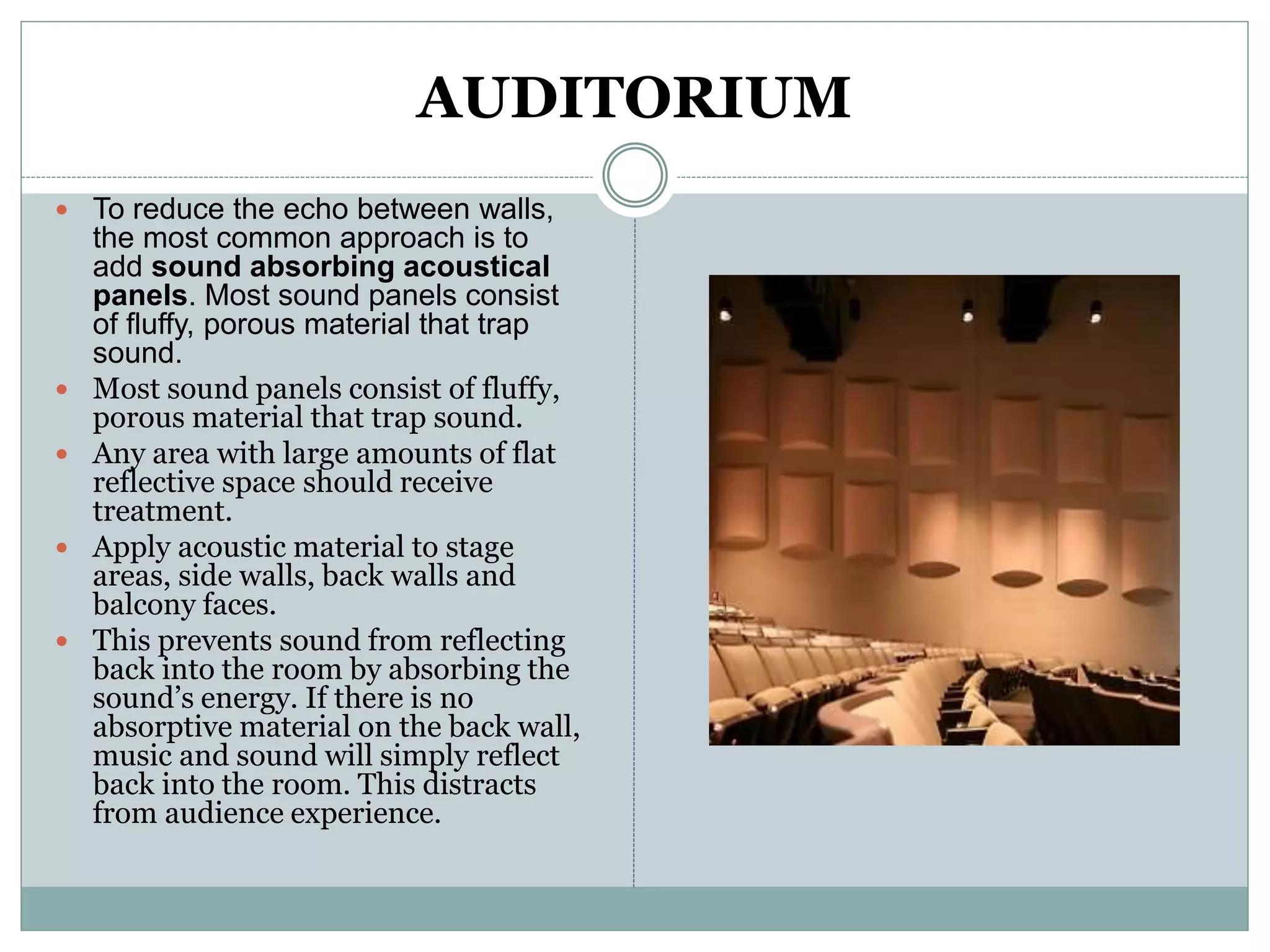
 To reduce the echo between walls,
the most common approach is to
add sound absorbing acoustical
panels. Most sound panels consist
of fluffy, porous material that trap
sound.
 Most sound panels consist of fluffy,
porous material that trap sound.
 Any area with large amounts of flat
reflective space should receive
treatment.
 Apply acoustic material to stage
areas, side walls, back walls and
balcony faces.
 This prevents sound from reflecting
back into the room by absorbing the
sound’s energy. If there is no
absorptive material on the back wall,
music and sound will simply reflect
back into the room. This distracts
from audience experience.
REFERENCE
Reverberation

Reverberation

  • 1.
    S U BM I TTE D B Y – G AR I M A S I N G H C L AS S - B . AR C H S U B J E C T- B U I L D I N G S E RV I C E S MATERIAL USED TO MINIMIZE REVERBERATION
  • 2.
    REVERBERATION Definition-This prolongation ofsound in a hall even though the source of sound is cut off is called reverberation. Reverberation is dependent only on the volume of a space and the acoustically absorptive quality of the room’s finishes.
  • 3.
    REDUCING REVERBERATION  Excessivereverberation can cause echoes that interfere with speech intelligibility.  Smaller classrooms generally have shorter reverberation times than large classrooms.  However , sound waves may be reflected more frequently and can create a masking effect.
  • 4.
    MATERIALS AND SURFACE Increase the amount of soft, rough, or porous surfaces (e.g., acoustical paneling, bulletin boards, carpeting, bookcases) and decrease the amount of smooth, hard surfaces (e.g., exposed concrete walls, glass) to reduce room reverberation times and overall noise levels.
  • 5.
    MATERIALS AND SURFACE Avoid placing sound-absorbing material directly above or in front of the teacher’s lecture position.  Install acoustical tiling with an absorption coefficient of atleast 0.65 to cover hard, sound reflective ceilings Install sound-absorbing wall panels or sound-absorbing concrete masonry units to lower reverberation times in especially problematic rooms (e.g., high ceilings, many windows).  Position large reflective surfaces (e.g., blackboards, glazing)at non- parallel angles to the walls to reduce echoes.
  • 6.
    POROUS ABSORPTIVE MATERIALS Porous absorbing materials are usually more than 90% air. The small pores lead to dissipation of the sound propagating through them.  At high frequencies a porous material has an acoustic impedance similar to that of air. Most incident energy enters the porous material and is absorbed there.  At low frequencies, a layer of porous material behaves acoustically like a stiffness. This leads to large reflection and little absorption.
  • 7.
    GYMNASIUMS  Hang sound-absorbingbaffles or banners from the ceiling to  reduce reverberation times.  Include sound-absorbing panels above perforated metal and fiber glass roof decking on ceilings to reduce reverberation times.  Install acoustical panels or bleachers on at least one of two parallel walls to reduce flutter, echoes.  Leave ceilings above bleachers non-absorptive to support livelier cheering.
  • 8.
    CONCERT HALL  Materialsplay a huge part in concert hall acoustics.  The same materials used in a space with good acoustics could be made to sound worse if they were arranged in a different way.  In general, however, hard, reflective materials are ideal for concert hall acoustics.  This is because the orchestra needs all the reflection and reverberation that it can get to make the sound richer.
  • 9.
    CINEMA HALL  Asimple hand clap at the front of the cinema will reveal the slap echoes across the walls floor and ceiling which evolve into reverberation, and will be clearly heard.  As a general rule the first early reflections within 30 milli- seconds are heard as being part of the direct sound.  Whereas after 30 milli-seconds the later slap echoes and reverberation are heard as being from the room.
  • 10.
    CINEMA HALL  Themajority of modern cinemas are concrete constructed which limits sound escaping from the room.  The curtain material on walls absorbs high frequencies but has little effect on absorbing low frequencies as in the pic below.  If pleated curtain material absorbs 50% (-3dB) of sound energy at 500Hz the sound would have to strike the curtain 20 times to be reduced to 0.0001% (-60dB). - 3dB is only heard as a slight reduction.
  • 11.
    AUDITORIUM  To reducethe echo between walls, the most common approach is to add sound absorbing acoustical panels. Most sound panels consist of fluffy, porous material that trap sound.  Most sound panels consist of fluffy, porous material that trap sound.  Any area with large amounts of flat reflective space should receive treatment.  Apply acoustic material to stage areas, side walls, back walls and balcony faces.  This prevents sound from reflecting back into the room by absorbing the sound’s energy. If there is no absorptive material on the back wall, music and sound will simply reflect back into the room. This distracts from audience experience.
  • 12.

Editor's Notes

  • #3 Sources-
  • #4 Sources-
  • #10 http://education.lenardaudio.com/en/17_cinema_6.html
  • #11 http://education.lenardaudio.com/en/17_cinema_6.html
  • #12 https://acousticalsolutions.com/soundproofing-an-auditorium/