AUDIOGRAPHY
UNIT – 4 – Acoustics
PREPARED BY
SANKARANARAYANAN K. B
ASST. PROFESSOR
DEPARTMENT OF VISUAL COMMUNICATION
NEHRU ARTS AND SCIENCE COLLEGE(Autonomous)
COIMBATORE
Expected outcomes
 Students will be able to remember the various
concept of acoustics.
 Students will be able to understand about the
various properties about sound reflection.
 Students will be able to apply various
equations and formulas regarding to acoustics.
SYLLABUS – Unit 4
 Basic acoustics-SPL and Sound power, Reflection Refraction,
Diffusion, diffraction, absorption, standing waves.
Reverberation, RT, Room modes-Axial, Tangential oblique
modes. Necessity of Reverberation, control and monitoring
rooms, concert halls and theatres, inverse square law,
Absorption coefficients of Materials. Sabine Equation, Growth
and Decay of sound in an Enclosure. Acoustical features and
design of Auditoriums and Theaters. Delay, Echo, Filters,
Effects. Reverberant Fields .Binaural hearing, stereo/ Mono
Introduction
 Acoustics is the branch of physics that deals
with the study of all mechanical waves in gases,
liquids, and solids including topics such as
vibration, sound, ultrasound and infrasound.
 A scientist who works in the field of acoustics is
an acoustician while someone working in the
field of acoustics technology may be called an
acoustical engineer.
 The application of acoustics is present in almost
all aspects of modern society with the most
obvious being the audio and noise control
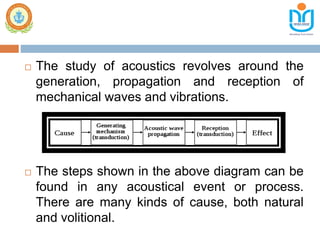
 The study of acoustics revolves around the
generation, propagation and reception of
mechanical waves and vibrations.
 The steps shown in the above diagram can be
found in any acoustical event or process.
There are many kinds of cause, both natural
and volitional.
 There is one fundamental equation that describes sound wave
propagation, the acoustic wave equation, but the phenomena that
emerge from it are varied and often complex.
 The wave carries energy throughout the propagating medium.
 The final effect may be purely physical or it may reach far into the
biological or volitional domains.
 The five basic steps are found equally well whether we are talking
about an earthquake, a submarine using sonar to locate its foe, or a
band playing in a rock concert.
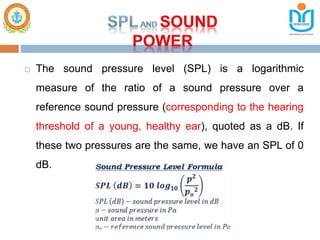
 The sound pressure level (SPL) is a logarithmic
measure of the ratio of a sound pressure over a
reference sound pressure (corresponding to the hearing
threshold of a young, healthy ear), quoted as a dB. If
these two pressures are the same, we have an SPL of 0
dB.
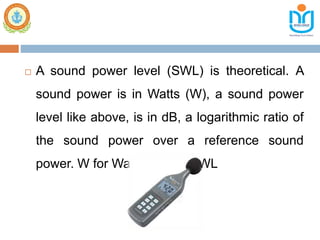
 A sound power level (SWL) is theoretical. A
sound power is in Watts (W), a sound power
level like above, is in dB, a logarithmic ratio of
the sound power over a reference sound
power. W for Watts, hence SWL
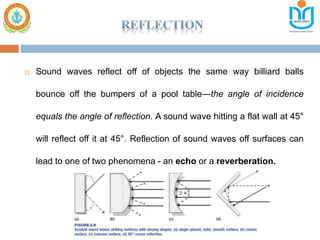
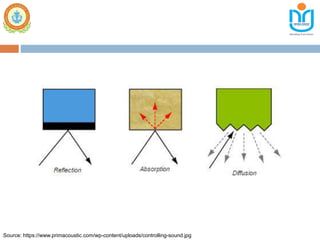
 Sound waves reflect off of objects the same way billiard balls
bounce off the bumpers of a pool table—the angle of incidence
equals the angle of reflection. A sound wave hitting a flat wall at 45°
will reflect off it at 45°. Reflection of sound waves off surfaces can
lead to one of two phenomena - an echo or a reverberation.
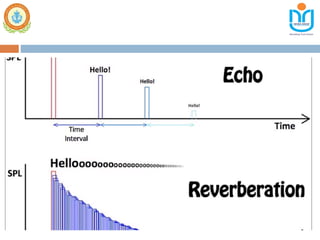
 An echo is a single reflection of a sound wave from a certain
distance over particular intervals of time.
 Reverberation is the reflection of sound waves formed by the
continuous reflection of sound over a period of time.
 An echo can only be heard by humans when the distance between
the source of the sound and the reflecting body is more than 45-50
ft.
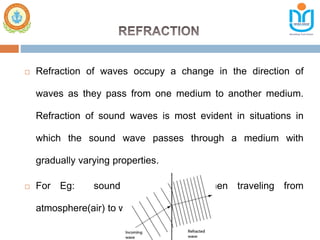
 Refraction of waves occupy a change in the direction of
waves as they pass from one medium to another medium.
Refraction of sound waves is most evident in situations in
which the sound wave passes through a medium with
gradually varying properties.
 For Eg: sound waves refract when traveling from
atmosphere(air) to water.
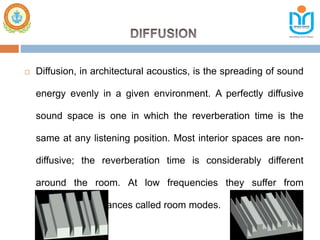
 Diffusion, in architectural acoustics, is the spreading of sound
energy evenly in a given environment. A perfectly diffusive
sound space is one in which the reverberation time is the
same at any listening position. Most interior spaces are non-
diffusive; the reverberation time is considerably different
around the room. At low frequencies they suffer from
prominent resonances called room modes.
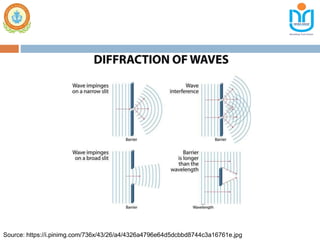
 Diffraction, the spreading of waves around
obstacles. Diffraction takes place with sound; with
electromagnetic radiation, such as light, X-rays, and
gamma rays. Diffraction: the bending of waves
around small obstacles and the spreading out of
waves beyond small openings.
Source: https://i.pinimg.com/736x/43/26/a4/4326a4796e64d5dcbbd8744c3a16761e.jpg
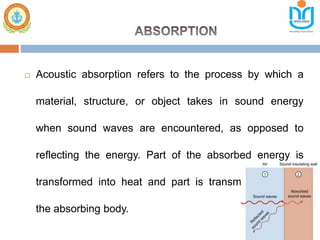
 Acoustic absorption refers to the process by which a
material, structure, or object takes in sound energy
when sound waves are encountered, as opposed to
reflecting the energy. Part of the absorbed energy is
transformed into heat and part is transmitted through
the absorbing body.
Source: https://www.primacoustic.com/wp-content/uploads/controlling-sound.jpg
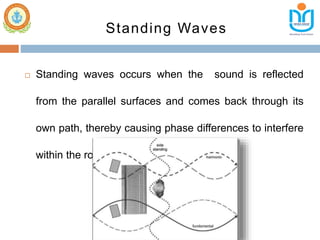
 Standing waves occurs when the sound is reflected
from the parallel surfaces and comes back through its
own path, thereby causing phase differences to interfere
within the room.
Standing Waves
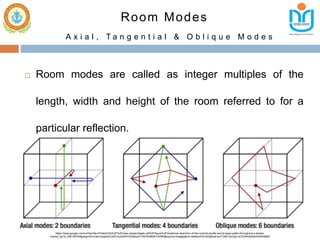
 Room modes are called as integer multiples of the
length, width and height of the room referred to for a
particular reflection.
Room Modes
A x i a l , T a n g e n t i a l & O b l i q u e M o d e s
https://www.google.com/url?sa=i&url=https%3A%2F%2Fwww.researchgate.net%2Ffigure%2FGraphical-depiction-of-the-cyclical-modal-sound-wave-paths-throughout-a-simple-
cuboid_fig19_336128702&psig=AOvVaw1ezajQQCoRCUuh0nNYS3dl&ust=1597929606140000&source=images&cd=vfe&ved=0CAIQjRxqFwoTCMCYpOytp-sCFQAAAAAdAAAAABAN
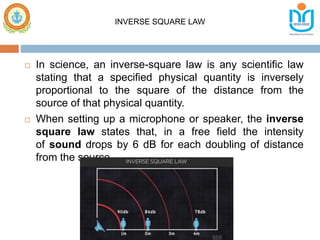
 In science, an inverse-square law is any scientific law
stating that a specified physical quantity is inversely
proportional to the square of the distance from the
source of that physical quantity.
 When setting up a microphone or speaker, the inverse
square law states that, in a free field the intensity
of sound drops by 6 dB for each doubling of distance
from the source.
INVERSE SQUARE LAW
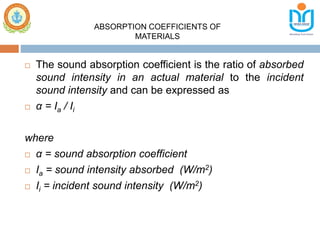
 The sound absorption coefficient is the ratio of absorbed
sound intensity in an actual material to the incident
sound intensity and can be expressed as
 α = Ia / Ii
where
 α = sound absorption coefficient
 Ia = sound intensity absorbed (W/m2)
 Ii = incident sound intensity (W/m2)
ABSORPTION COEFFICIENTS OF
MATERIALS
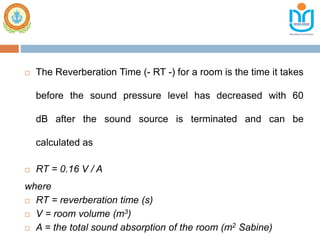
 The Reverberation Time (- RT -) for a room is the time it takes
before the sound pressure level has decreased with 60
dB after the sound source is terminated and can be
calculated as
 RT = 0.16 V / A
where
 RT = reverberation time (s)
 V = room volume (m3)
 A = the total sound absorption of the room (m2 Sabine)
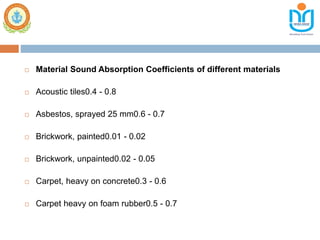
 Material Sound Absorption Coefficients of different materials
 Acoustic tiles0.4 - 0.8
 Asbestos, sprayed 25 mm0.6 - 0.7
 Brickwork, painted0.01 - 0.02
 Brickwork, unpainted0.02 - 0.05
 Carpet, heavy on concrete0.3 - 0.6
 Carpet heavy on foam rubber0.5 - 0.7
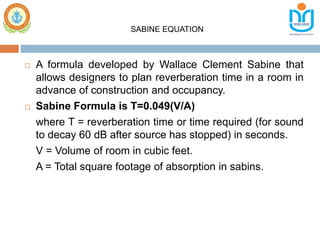
 A formula developed by Wallace Clement Sabine that
allows designers to plan reverberation time in a room in
advance of construction and occupancy.
 Sabine Formula is T=0.049(V/A)
where T = reverberation time or time required (for sound
to decay 60 dB after source has stopped) in seconds.
V = Volume of room in cubic feet.
A = Total square footage of absorption in sabins.
SABINE EQUATION
 Acoustical sound absorbing materials like foams, fabrics, metals,
etc are used to quiet the workplaces, homes, inside automobiles,
and so as to increase the comfort and safety by reducing the noise
generated both inside and outside of those spaces. Acoustical
materials are used in two major ways: as soundproofing, by which
noise generated from outside a given space is blocked from
entering the space; and, as sound absorbing, where noise
generated within a space is reduced inside the space itself.
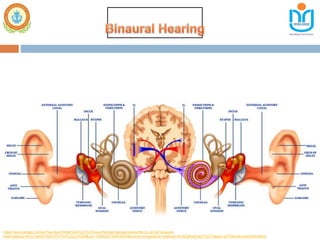
https://www.google.com/url?sa=i&url=https%3A%2F%2Fwww.thehearingaidadvicecentre.co.uk%2Fbinaural-
hearing&psig=AOvVaw05YXdOVFrrT04VJOLyVG59&ust=1599032193044000&source=images&cd=vfe&ved=0CAIQjRxqFwoTCIDTw6a5x-sCFQAAAAAdAAAAABAq
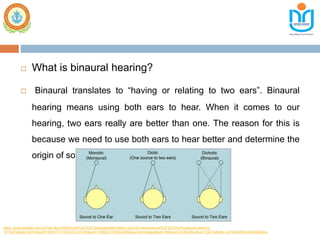
 What is binaural hearing?
 Binaural translates to “having or relating to two ears”. Binaural
hearing means using both ears to hear. When it comes to our
hearing, two ears really are better than one. The reason for this is
because we need to use both ears to hear better and determine the
origin of sounds.
https://www.google.com/url?sa=i&url=https%3A%2F%2Fhearinghealthmatters.org%2Fwaynesworld%2F2015%2Fbinaural-hearing-
101%2F&psig=AOvVaw05YXdOVFrrT04VJOLyVG59&ust=1599032193044000&source=images&cd=vfe&ved=0CAIQjRxqFwoTCIDTw6a5x-sCFQAAAAAdAAAAABAu
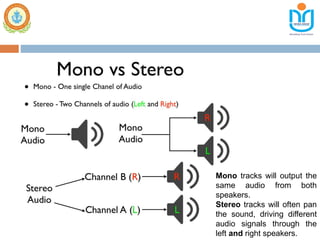
Mono tracks will output the
same audio from both
speakers.
Stereo tracks will often pan
the sound, driving different
audio signals through the
left and right speakers.
MCQs / Assessment
 Multiple Choice Questions Link will be shared
in Quizziz.com/Google Forms
Model Question :
 What is Mono?
a) L only b) L+L
c) R+R d) L+R
Summary
 Acoustics is the science that deals with the controlling of
sound in an particular environment.
 Reverberation and RT plays a vital role in the behaviour of
sound in a room/auditorium.
 Binaural hearing is important to distinguish the space, depth
and direction of a sound.
Points to Remember
 Basic acoustics-SPL and Sound power.
 Reflection Refraction, Diffusion, diffraction, absorption,
standing waves.
 Reverberation, RT.
 Room modes-Axial, Tangential oblique modes.
 inverse square law, Absorption coefficients of Materials.
Sabine Equation.
 Binaural hearing, stereo/ Mono.
Source for Reference
 https://www.youtube.com/watch?v=-S6FPeJW60s
 https://www.youtube.com/watch?v=dof2W38_eQ8
 https://www.youtube.com/watch?v=1d9WmjTJniI
 https://youtu.be/JPYt10zrclQ
 https://www.youtube.com/watch?v=umTSWJ3POOk&feature=youtu.b
e
 https://www.thomasnet.com/articles/plant-facility-equipment/overview-
of-acoustical-materials/
 Pictures and Illustrations from Modern Recording Techniques,7th Edition, David
Miles Huber Robert E. Runstein
Thank You
SANKARANARAYANAN K. B
ASST. PROFESSOR
DEPARTMENT OF VISUAL COMMUNICATION
NEHRU ARTS AND SCIENCE
COLLEGE(Autonomous)
COIMBATORE
Mail Id:
nascsankaranarayanan@nehrucolleges.com

Acoustics_Unit IV_Viscom_NASC

  • 1.
    AUDIOGRAPHY UNIT – 4– Acoustics PREPARED BY SANKARANARAYANAN K. B ASST. PROFESSOR DEPARTMENT OF VISUAL COMMUNICATION NEHRU ARTS AND SCIENCE COLLEGE(Autonomous) COIMBATORE
  • 2.
    Expected outcomes  Studentswill be able to remember the various concept of acoustics.  Students will be able to understand about the various properties about sound reflection.  Students will be able to apply various equations and formulas regarding to acoustics.
  • 3.
    SYLLABUS – Unit4  Basic acoustics-SPL and Sound power, Reflection Refraction, Diffusion, diffraction, absorption, standing waves. Reverberation, RT, Room modes-Axial, Tangential oblique modes. Necessity of Reverberation, control and monitoring rooms, concert halls and theatres, inverse square law, Absorption coefficients of Materials. Sabine Equation, Growth and Decay of sound in an Enclosure. Acoustical features and design of Auditoriums and Theaters. Delay, Echo, Filters, Effects. Reverberant Fields .Binaural hearing, stereo/ Mono
  • 4.
    Introduction  Acoustics isthe branch of physics that deals with the study of all mechanical waves in gases, liquids, and solids including topics such as vibration, sound, ultrasound and infrasound.  A scientist who works in the field of acoustics is an acoustician while someone working in the field of acoustics technology may be called an acoustical engineer.  The application of acoustics is present in almost all aspects of modern society with the most obvious being the audio and noise control
  • 5.
     The studyof acoustics revolves around the generation, propagation and reception of mechanical waves and vibrations.  The steps shown in the above diagram can be found in any acoustical event or process. There are many kinds of cause, both natural and volitional.
  • 6.
     There isone fundamental equation that describes sound wave propagation, the acoustic wave equation, but the phenomena that emerge from it are varied and often complex.  The wave carries energy throughout the propagating medium.  The final effect may be purely physical or it may reach far into the biological or volitional domains.  The five basic steps are found equally well whether we are talking about an earthquake, a submarine using sonar to locate its foe, or a band playing in a rock concert.
  • 7.
     The soundpressure level (SPL) is a logarithmic measure of the ratio of a sound pressure over a reference sound pressure (corresponding to the hearing threshold of a young, healthy ear), quoted as a dB. If these two pressures are the same, we have an SPL of 0 dB.
  • 8.
     A soundpower level (SWL) is theoretical. A sound power is in Watts (W), a sound power level like above, is in dB, a logarithmic ratio of the sound power over a reference sound power. W for Watts, hence SWL
  • 10.
     Sound wavesreflect off of objects the same way billiard balls bounce off the bumpers of a pool table—the angle of incidence equals the angle of reflection. A sound wave hitting a flat wall at 45° will reflect off it at 45°. Reflection of sound waves off surfaces can lead to one of two phenomena - an echo or a reverberation.
  • 12.
     An echois a single reflection of a sound wave from a certain distance over particular intervals of time.  Reverberation is the reflection of sound waves formed by the continuous reflection of sound over a period of time.  An echo can only be heard by humans when the distance between the source of the sound and the reflecting body is more than 45-50 ft.
  • 13.
     Refraction ofwaves occupy a change in the direction of waves as they pass from one medium to another medium. Refraction of sound waves is most evident in situations in which the sound wave passes through a medium with gradually varying properties.  For Eg: sound waves refract when traveling from atmosphere(air) to water.
  • 14.
     Diffusion, inarchitectural acoustics, is the spreading of sound energy evenly in a given environment. A perfectly diffusive sound space is one in which the reverberation time is the same at any listening position. Most interior spaces are non- diffusive; the reverberation time is considerably different around the room. At low frequencies they suffer from prominent resonances called room modes.
  • 15.
     Diffraction, thespreading of waves around obstacles. Diffraction takes place with sound; with electromagnetic radiation, such as light, X-rays, and gamma rays. Diffraction: the bending of waves around small obstacles and the spreading out of waves beyond small openings.
  • 16.
  • 17.
     Acoustic absorptionrefers to the process by which a material, structure, or object takes in sound energy when sound waves are encountered, as opposed to reflecting the energy. Part of the absorbed energy is transformed into heat and part is transmitted through the absorbing body.
  • 18.
  • 19.
     Standing wavesoccurs when the sound is reflected from the parallel surfaces and comes back through its own path, thereby causing phase differences to interfere within the room. Standing Waves
  • 20.
     Room modesare called as integer multiples of the length, width and height of the room referred to for a particular reflection. Room Modes A x i a l , T a n g e n t i a l & O b l i q u e M o d e s https://www.google.com/url?sa=i&url=https%3A%2F%2Fwww.researchgate.net%2Ffigure%2FGraphical-depiction-of-the-cyclical-modal-sound-wave-paths-throughout-a-simple- cuboid_fig19_336128702&psig=AOvVaw1ezajQQCoRCUuh0nNYS3dl&ust=1597929606140000&source=images&cd=vfe&ved=0CAIQjRxqFwoTCMCYpOytp-sCFQAAAAAdAAAAABAN
  • 21.
     In science,an inverse-square law is any scientific law stating that a specified physical quantity is inversely proportional to the square of the distance from the source of that physical quantity.  When setting up a microphone or speaker, the inverse square law states that, in a free field the intensity of sound drops by 6 dB for each doubling of distance from the source. INVERSE SQUARE LAW
  • 22.
     The soundabsorption coefficient is the ratio of absorbed sound intensity in an actual material to the incident sound intensity and can be expressed as  α = Ia / Ii where  α = sound absorption coefficient  Ia = sound intensity absorbed (W/m2)  Ii = incident sound intensity (W/m2) ABSORPTION COEFFICIENTS OF MATERIALS
  • 23.
     The ReverberationTime (- RT -) for a room is the time it takes before the sound pressure level has decreased with 60 dB after the sound source is terminated and can be calculated as  RT = 0.16 V / A where  RT = reverberation time (s)  V = room volume (m3)  A = the total sound absorption of the room (m2 Sabine)
  • 24.
     Material SoundAbsorption Coefficients of different materials  Acoustic tiles0.4 - 0.8  Asbestos, sprayed 25 mm0.6 - 0.7  Brickwork, painted0.01 - 0.02  Brickwork, unpainted0.02 - 0.05  Carpet, heavy on concrete0.3 - 0.6  Carpet heavy on foam rubber0.5 - 0.7
  • 26.
     A formuladeveloped by Wallace Clement Sabine that allows designers to plan reverberation time in a room in advance of construction and occupancy.  Sabine Formula is T=0.049(V/A) where T = reverberation time or time required (for sound to decay 60 dB after source has stopped) in seconds. V = Volume of room in cubic feet. A = Total square footage of absorption in sabins. SABINE EQUATION
  • 27.
     Acoustical soundabsorbing materials like foams, fabrics, metals, etc are used to quiet the workplaces, homes, inside automobiles, and so as to increase the comfort and safety by reducing the noise generated both inside and outside of those spaces. Acoustical materials are used in two major ways: as soundproofing, by which noise generated from outside a given space is blocked from entering the space; and, as sound absorbing, where noise generated within a space is reduced inside the space itself.
  • 28.
  • 29.
     What isbinaural hearing?  Binaural translates to “having or relating to two ears”. Binaural hearing means using both ears to hear. When it comes to our hearing, two ears really are better than one. The reason for this is because we need to use both ears to hear better and determine the origin of sounds. https://www.google.com/url?sa=i&url=https%3A%2F%2Fhearinghealthmatters.org%2Fwaynesworld%2F2015%2Fbinaural-hearing- 101%2F&psig=AOvVaw05YXdOVFrrT04VJOLyVG59&ust=1599032193044000&source=images&cd=vfe&ved=0CAIQjRxqFwoTCIDTw6a5x-sCFQAAAAAdAAAAABAu
  • 30.
    Mono tracks willoutput the same audio from both speakers. Stereo tracks will often pan the sound, driving different audio signals through the left and right speakers.
  • 31.
    MCQs / Assessment Multiple Choice Questions Link will be shared in Quizziz.com/Google Forms Model Question :  What is Mono? a) L only b) L+L c) R+R d) L+R
  • 32.
    Summary  Acoustics isthe science that deals with the controlling of sound in an particular environment.  Reverberation and RT plays a vital role in the behaviour of sound in a room/auditorium.  Binaural hearing is important to distinguish the space, depth and direction of a sound.
  • 33.
    Points to Remember Basic acoustics-SPL and Sound power.  Reflection Refraction, Diffusion, diffraction, absorption, standing waves.  Reverberation, RT.  Room modes-Axial, Tangential oblique modes.  inverse square law, Absorption coefficients of Materials. Sabine Equation.  Binaural hearing, stereo/ Mono.
  • 34.
    Source for Reference https://www.youtube.com/watch?v=-S6FPeJW60s  https://www.youtube.com/watch?v=dof2W38_eQ8  https://www.youtube.com/watch?v=1d9WmjTJniI  https://youtu.be/JPYt10zrclQ  https://www.youtube.com/watch?v=umTSWJ3POOk&feature=youtu.b e  https://www.thomasnet.com/articles/plant-facility-equipment/overview- of-acoustical-materials/  Pictures and Illustrations from Modern Recording Techniques,7th Edition, David Miles Huber Robert E. Runstein
  • 35.
    Thank You SANKARANARAYANAN K.B ASST. PROFESSOR DEPARTMENT OF VISUAL COMMUNICATION NEHRU ARTS AND SCIENCE COLLEGE(Autonomous) COIMBATORE Mail Id: nascsankaranarayanan@nehrucolleges.com