Noise control measures
R.Narasimha Swamy
Senior consultant
narasimhaswamy@yahoo.com
Contents
• Effect of noise on human beings
• Basic measures of noise control
• Case study of a HVAC system
Effect of noise on humans
• Affects peace of mind, social behaviour and
concentration.
• Causes discomfort, irritation and
annoyance.
• May cause hearing impairment.
• Affects other physiological functioning of
the body.
• In totality, disturbs the life style and affects
the productivity.
Effect of noise and vibration on humans
Four noise control mistakes to avoid
1. Thinking that there is no noise problem! NL greater than
85dB in factory environment and level as low as a 55dB in a class
room/Studios should be considered as a problem. In general, if
conversation is difficult, treat it as a serious noise issue.
2. Not considering noise control during the design stage:
Although all source of noise can be treated after installation, it’s
generally twice as expensive and half as effective compared with
designing proper noise control into the system before the noise
source is installed.
3. Not sealing the air leaks: Sound always takes the easiest path
around or through a barrier. Construction gaps or air leaks are the
easiest way for sound to pass from one space to another.
4. Not using a systems approach to noise control: A common mistake
in noise control effort is the failure to consider all possible noise
paths. All airborne and structure borne noise paths must be studied
and treated accordingly.
Basic measures of noise control
• Absorption
• Damping
• Decoupling
• Mass
• Flow control
• Absorption by installing appropriate sound absorbing solutions
in the form of wall panels, false ceiling, carpeting. This is
necessary for any serious soundproofing project.
• Decoupling to isolate walls from the studs, thereby breaking
the direct path of sound, by using resilient channel and sound
clips. This decoupling technique adds resilience to the walls.
• Damping is the process of sound insulation by installing the non
vibrating dead panels as barriers. Damping is improved by
applying suitable compounds in between two constrained layers.
• Mass simply means creating a heavier wall by using more
(another layer) and/or thicker material.
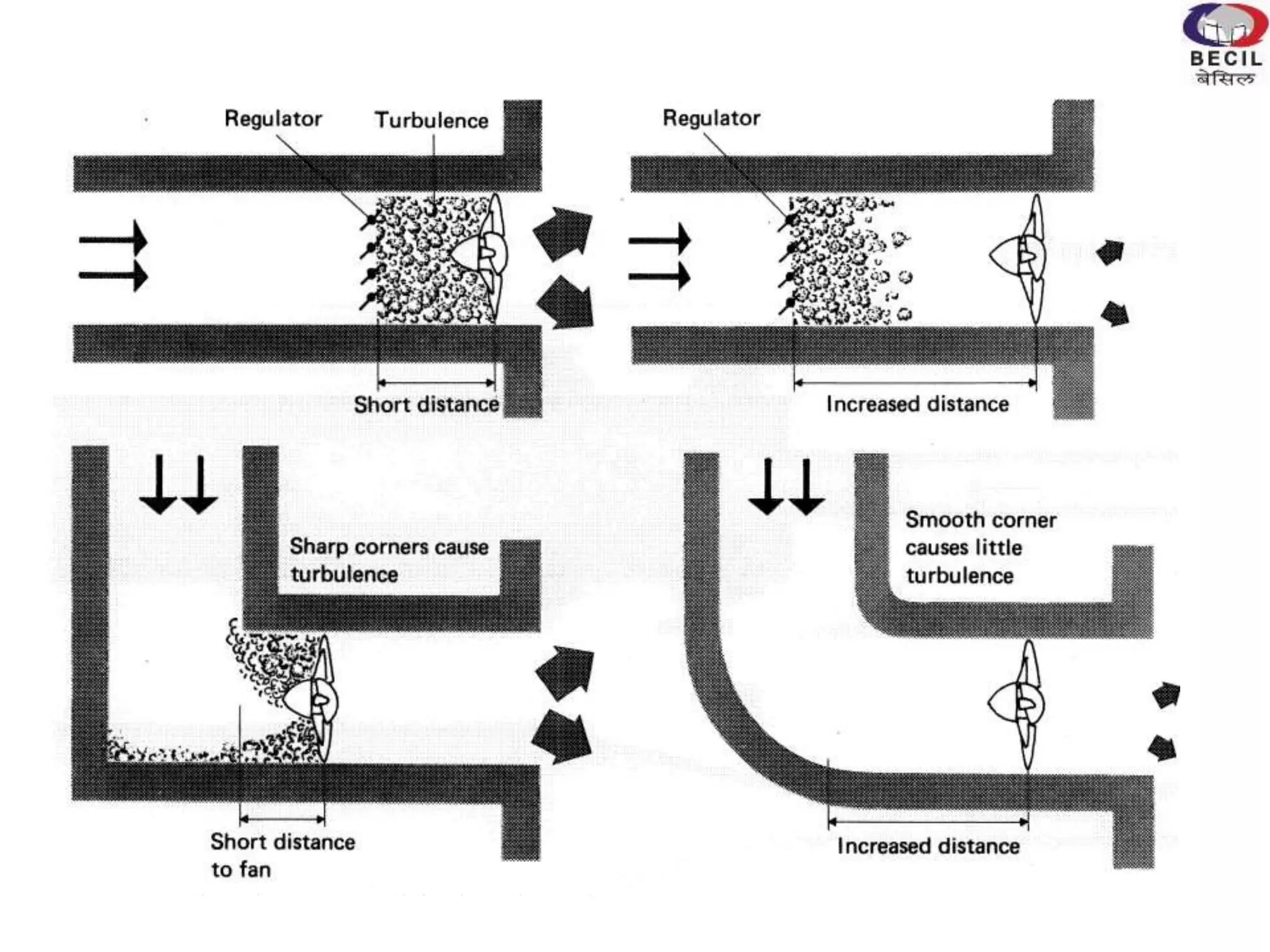
• Flow control measures to avoid turbulence and resulting noise
and vibration in free flow of fluids in pipe lines, ducts etc.
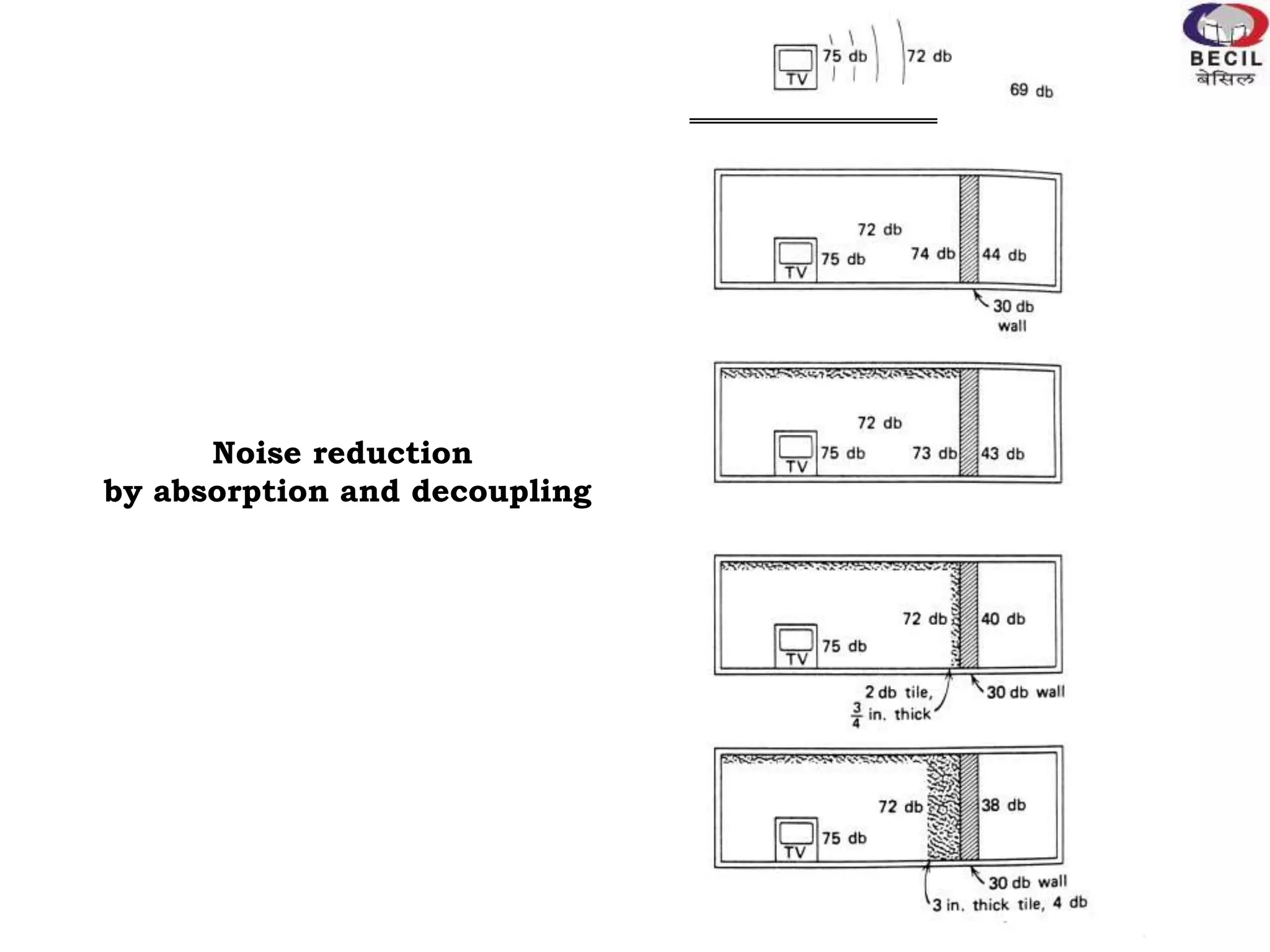
Noise Reduction by Absorption
Increased absorption reduces ambient noise
Noise reduction
by absorption and decoupling
Ceiling tiles
Fabric-wrapped glass wool panels absorb sound
Noise Reduction
• Combined effect of TL and absorption
• NR = TL - 10 log (S/AR)
 NR: noise reduction (db)
 TL: transmission loss (db)
 S: area of barrier wall (ft2)
 AR: total absorption of receiving room (Sabins, ft2)
Decoupling measures
Directivity index
Pressure increases at walls
Resilient Channel
Resilient Clip
Resilient Duct Hangers
Elastomeric Hanger
From Kirkegaard Associates
Resilient Duct Hangers
Spring-and-Neoprene-in Series
Isolator (Hanger)
From Kirkegaard Associates
Pre-compressed Spring-and-
Neoprene-in-Series Isolator (Hanger)
Dampers
Isolator Types
Elastomeric Pads
Isolator Types
Elastomeric Pads
Isolator Types
Neoprene-In-Shear Floor Mount
Isolator Types
Open Spring Floor Mount
Isolator Types
Restrained Open Spring Floor Mount
Flow control measures
Plenum chamber
Wind generated tones can be avoided
by profile changes or spoilers
Smooth ducts and pipes create less
turbulence noise
LF exhaust noise transformed
to HF is easier to attenuate
Flow noise in pipes is formed by
sudden pressure changes
Case study of noise control in HVAC system
48
Typical Sound Paths
Airborne
Sound that travels through supply
ductwork, return ductwork, or an open
plenum
Can travel with or against the direction of
airflow
Breakout
Sound that breaks out through the walls of
the supply or return ductwork
Transmission
Sound that travels through walls, floors, or
ceilings
Main HVAC Noise Sources
• Fans (for air circulation)
– Axial
– Centrifugal
– Propeller
• Compressors (that convert
gas to liquid)
– Piston
– Rotary
– Scroll
– Centrifugal
– Screw
• Pumps (to circulate
liquids)
• Diffusers and
Ductwork (to distribute
air)
– Turbulent aerodynamic
noise
– “Break-out” noise
50
Noise Control Approaches in HVAC
• Location
• Sealing penetrations
• Resilient mounting & connected services
• Flexible connections to equipment to lower
fluid velocities
• Internal duct lining and attenuators
• Routing of ductwork and piping
• Enclosing ductwork and piping
Fan Coil Units
• Opportunity for
significant noise
issues:
– Fan and coil in close
proximity: high
turbulence
– Applications: typically
close to “listeners” (hotel
rooms, etc.)
– Water flow noise
Typical Air-Handler Design
Equipment Location: Rooftop
Equipment Location:
Mechanical Equipment Room
• Noise inside the
MER
• Noise outside the
MER
• Duct Breakout
• Active Noise Control
Fan Noise Components
• 1 duct length
• 3 duct length
• 5 duct length
• Aerodynamic noise
• Blade-passage noise
 fB = (RPM/60) ·N
 N = number of blades
Fan Noise
Fan noise depends on the fan
operation point on the fan curve
Fan Noise
Fan noise depends on the fan
operation point on the fan curve
Fan and Compressor Noise
Diffuser Noise
• Flow sets the
noise level at a
given static
pressure level
forcing the flow
• Good
aerodynamics are
important to
lower the noise
from air
terminals
From Paul Henderson, Acoustics for Mechanical Engineers, ASHRAE Expo 2005 (Long Fig. 13.23, p. 474)
How Ductwork Radiates Noise (Break Out)
Duct Shape and Noise Control
From Paul Henderson, Acoustics for Mechanical Engineers, ASHRAE Expo 2005
• Stiffness of round
ductwork reduces break-
out noise since motion of
the duct walls is restricted
• However, this means that
more noise energy stays
within the duct and may
produce higher noise levels
at the outlet
Duct Liner
MJR Figure 9.5 and 9.7, pp. 193 and 194
Duct Lagging
Make the ducts stiff using lagging, typically fire-rated drywall.
Duct Lagging
MJR Figure 9.14, p. 200
Duct Lagging
From Kirkegaard Associates
Duct Lagging
Resilient Hangers
From Kirkegaard Associates
Resilient Hangers
From Kirkegaard Associates
Flexible Duct Connections
From Kirkegaard Associates
Application of Duct Liner in Underfloor Plenum
From Kirkegaard Associates
Lined Plenum
(For under-floor air supply)
Silencer Location
From Paul Henderson, Acoustics for Mechanical Engineers, ASHRAE Expo 2005
Duct Sound Attenuators
From Kirkegaard Associates
Air Plenums, Passive and Active Silencers
• Plenum used near
equipment outlet;
promotes laminar
airflow and provides
acoustical insertion
loss (< 12 dB)
• Passive silencers used
when large insertion
loss is required; must
account for pressure
drop
• Active silencer has no
pressure drop.
From Paul Henderson, Acoustics for Mechanical Engineers, ASHRAE Expo 2005
Improvements in Design for Noise Performance
Poor Design
Better Design
Duct Liner Data
Airflow: Turbulent Noise in Ductwork
Long, p. 486
Frequency
(Hz)
63 125 250 500 1000 2000 4000
Loss (dB/ft)
Circular
0.03 0.03 0.03 0.05 0.07 0.07 0.07
Loss (dB/ft)
Square
0.36 0.20 0.11 0.06 0.06 0.06 0.06
• Data for circular duct from Long, Table 14.1
• Data for square duct from previous equations with P/S = 4
Duct Shape and Noise Control
A Sample Interior Noise Prediction
Active Noise Control in Ducts
MJR Figure 9.19, p. 205
Using data from the input microphone, the controller generates a signal
to be played by the loudspeaker which is out of phase (180⁰) with the
duct-borne noise at the loudspeaker position. Feedback from the error
microphone (which ideally senses no noise) helps fine tune the process.
Active silencer
• Good LF attenuation.
• HF attenuation remains a challenge.
• Normally combine active/passive for full
range attenuation.
• Lower pressure loss.
• Smaller size and weight than passive for
similar LF performance.
• Higher initial cost?
Conclusion
• All measures discussed viz Absorption,
damping, decoupling, adding mass and flow
control needs to be carefully considered
while designing the potential noise emitting
equipment.
• Active silencer is attractive measure but,
not an alternative for the classical
measures, but, can supplement these
efforts.
Thank you
Air-Borne Sound
Transmission Loss (TL): sound energy lost through a construction assembly

Noise control

  • 1.
    Noise control measures R.NarasimhaSwamy Senior consultant narasimhaswamy@yahoo.com
  • 2.
    Contents • Effect ofnoise on human beings • Basic measures of noise control • Case study of a HVAC system
  • 3.
    Effect of noiseon humans
  • 4.
    • Affects peaceof mind, social behaviour and concentration. • Causes discomfort, irritation and annoyance. • May cause hearing impairment. • Affects other physiological functioning of the body. • In totality, disturbs the life style and affects the productivity. Effect of noise and vibration on humans
  • 6.
    Four noise controlmistakes to avoid 1. Thinking that there is no noise problem! NL greater than 85dB in factory environment and level as low as a 55dB in a class room/Studios should be considered as a problem. In general, if conversation is difficult, treat it as a serious noise issue. 2. Not considering noise control during the design stage: Although all source of noise can be treated after installation, it’s generally twice as expensive and half as effective compared with designing proper noise control into the system before the noise source is installed. 3. Not sealing the air leaks: Sound always takes the easiest path around or through a barrier. Construction gaps or air leaks are the easiest way for sound to pass from one space to another. 4. Not using a systems approach to noise control: A common mistake in noise control effort is the failure to consider all possible noise paths. All airborne and structure borne noise paths must be studied and treated accordingly.
  • 7.
    Basic measures ofnoise control • Absorption • Damping • Decoupling • Mass • Flow control
  • 8.
    • Absorption byinstalling appropriate sound absorbing solutions in the form of wall panels, false ceiling, carpeting. This is necessary for any serious soundproofing project. • Decoupling to isolate walls from the studs, thereby breaking the direct path of sound, by using resilient channel and sound clips. This decoupling technique adds resilience to the walls. • Damping is the process of sound insulation by installing the non vibrating dead panels as barriers. Damping is improved by applying suitable compounds in between two constrained layers. • Mass simply means creating a heavier wall by using more (another layer) and/or thicker material. • Flow control measures to avoid turbulence and resulting noise and vibration in free flow of fluids in pipe lines, ducts etc.
  • 9.
    Noise Reduction byAbsorption Increased absorption reduces ambient noise
  • 10.
  • 11.
  • 12.
    Fabric-wrapped glass woolpanels absorb sound
  • 13.
    Noise Reduction • Combinedeffect of TL and absorption • NR = TL - 10 log (S/AR)  NR: noise reduction (db)  TL: transmission loss (db)  S: area of barrier wall (ft2)  AR: total absorption of receiving room (Sabins, ft2)
  • 14.
  • 15.
  • 17.
  • 20.
  • 21.
  • 22.
    Resilient Duct Hangers ElastomericHanger From Kirkegaard Associates
  • 23.
    Resilient Duct Hangers Spring-and-Neoprene-inSeries Isolator (Hanger) From Kirkegaard Associates Pre-compressed Spring-and- Neoprene-in-Series Isolator (Hanger)
  • 26.
  • 28.
  • 29.
  • 30.
  • 31.
  • 32.
  • 33.
  • 35.
  • 36.
    Wind generated tonescan be avoided by profile changes or spoilers
  • 37.
    Smooth ducts andpipes create less turbulence noise
  • 38.
    LF exhaust noisetransformed to HF is easier to attenuate
  • 40.
    Flow noise inpipes is formed by sudden pressure changes
  • 47.
    Case study ofnoise control in HVAC system
  • 48.
    48 Typical Sound Paths Airborne Soundthat travels through supply ductwork, return ductwork, or an open plenum Can travel with or against the direction of airflow Breakout Sound that breaks out through the walls of the supply or return ductwork Transmission Sound that travels through walls, floors, or ceilings
  • 49.
    Main HVAC NoiseSources • Fans (for air circulation) – Axial – Centrifugal – Propeller • Compressors (that convert gas to liquid) – Piston – Rotary – Scroll – Centrifugal – Screw • Pumps (to circulate liquids) • Diffusers and Ductwork (to distribute air) – Turbulent aerodynamic noise – “Break-out” noise
  • 50.
  • 51.
    Noise Control Approachesin HVAC • Location • Sealing penetrations • Resilient mounting & connected services • Flexible connections to equipment to lower fluid velocities • Internal duct lining and attenuators • Routing of ductwork and piping • Enclosing ductwork and piping
  • 52.
    Fan Coil Units •Opportunity for significant noise issues: – Fan and coil in close proximity: high turbulence – Applications: typically close to “listeners” (hotel rooms, etc.) – Water flow noise
  • 53.
  • 54.
  • 55.
    Equipment Location: Mechanical EquipmentRoom • Noise inside the MER • Noise outside the MER • Duct Breakout • Active Noise Control
  • 56.
    Fan Noise Components •1 duct length • 3 duct length • 5 duct length • Aerodynamic noise • Blade-passage noise  fB = (RPM/60) ·N  N = number of blades
  • 57.
    Fan Noise Fan noisedepends on the fan operation point on the fan curve
  • 58.
    Fan Noise Fan noisedepends on the fan operation point on the fan curve
  • 59.
  • 60.
    Diffuser Noise • Flowsets the noise level at a given static pressure level forcing the flow • Good aerodynamics are important to lower the noise from air terminals From Paul Henderson, Acoustics for Mechanical Engineers, ASHRAE Expo 2005 (Long Fig. 13.23, p. 474)
  • 61.
    How Ductwork RadiatesNoise (Break Out)
  • 62.
    Duct Shape andNoise Control From Paul Henderson, Acoustics for Mechanical Engineers, ASHRAE Expo 2005 • Stiffness of round ductwork reduces break- out noise since motion of the duct walls is restricted • However, this means that more noise energy stays within the duct and may produce higher noise levels at the outlet
  • 63.
    Duct Liner MJR Figure9.5 and 9.7, pp. 193 and 194
  • 64.
    Duct Lagging Make theducts stiff using lagging, typically fire-rated drywall.
  • 65.
  • 66.
  • 67.
  • 69.
  • 70.
  • 71.
    Flexible Duct Connections FromKirkegaard Associates
  • 72.
    Application of DuctLiner in Underfloor Plenum From Kirkegaard Associates Lined Plenum (For under-floor air supply)
  • 73.
    Silencer Location From PaulHenderson, Acoustics for Mechanical Engineers, ASHRAE Expo 2005
  • 74.
    Duct Sound Attenuators FromKirkegaard Associates
  • 75.
    Air Plenums, Passiveand Active Silencers • Plenum used near equipment outlet; promotes laminar airflow and provides acoustical insertion loss (< 12 dB) • Passive silencers used when large insertion loss is required; must account for pressure drop • Active silencer has no pressure drop. From Paul Henderson, Acoustics for Mechanical Engineers, ASHRAE Expo 2005
  • 76.
    Improvements in Designfor Noise Performance Poor Design Better Design
  • 77.
  • 78.
  • 79.
    Long, p. 486 Frequency (Hz) 63125 250 500 1000 2000 4000 Loss (dB/ft) Circular 0.03 0.03 0.03 0.05 0.07 0.07 0.07 Loss (dB/ft) Square 0.36 0.20 0.11 0.06 0.06 0.06 0.06 • Data for circular duct from Long, Table 14.1 • Data for square duct from previous equations with P/S = 4 Duct Shape and Noise Control
  • 80.
    A Sample InteriorNoise Prediction
  • 81.
    Active Noise Controlin Ducts MJR Figure 9.19, p. 205 Using data from the input microphone, the controller generates a signal to be played by the loudspeaker which is out of phase (180⁰) with the duct-borne noise at the loudspeaker position. Feedback from the error microphone (which ideally senses no noise) helps fine tune the process.
  • 86.
    Active silencer • GoodLF attenuation. • HF attenuation remains a challenge. • Normally combine active/passive for full range attenuation. • Lower pressure loss. • Smaller size and weight than passive for similar LF performance. • Higher initial cost?
  • 87.
    Conclusion • All measuresdiscussed viz Absorption, damping, decoupling, adding mass and flow control needs to be carefully considered while designing the potential noise emitting equipment. • Active silencer is attractive measure but, not an alternative for the classical measures, but, can supplement these efforts.
  • 88.
  • 89.
    Air-Borne Sound Transmission Loss(TL): sound energy lost through a construction assembly