Characterization of sound – a review
R.Narasimha Swamy
Senior consultant
narasimhaswamy@yahoo.com
What is sound?
 Sound can be defined in two ways. [Physical or psychophysical]
 Sound can be defined as a wave motion in air or other elastic
media.
 Or as excitation of the hearing mechanism that results in the
perception of sound [sensation].
Transmission of Sound
• Requires a medium with elasticity and
inertia (air, water, steel, etc.)
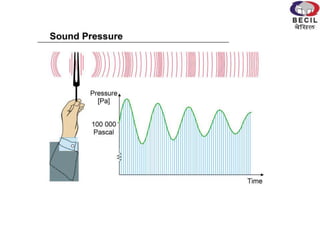
• Movements of air molecules result in the
variation of sound pressure causing the
propagation of a sound wave
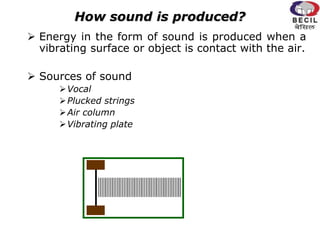
How sound is produced?
 Energy in the form of sound is produced when a
vibrating surface or object is contact with the air.
 Sources of sound
Vocal
Plucked strings
Air column
Vibrating plate
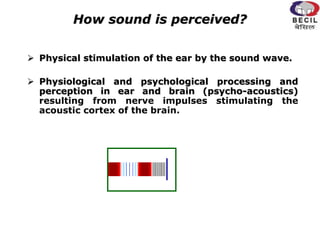
How sound is perceived?
 Physical stimulation of the ear by the sound wave.
 Physiological and psychological processing and
perception in ear and brain (psycho-acoustics)
resulting from nerve impulses stimulating the
acoustic cortex of the brain.
Attributes of the sound
• Loudness, pitch, timbre and duration are
subjective qualities used to describe a particular
sound stimuli.
• Each of these attributes depends on one or more
physical parameters viz Sound pressure,
frequency, spectrum, duration and envelope that
can be physically described and measured.
Amplitude
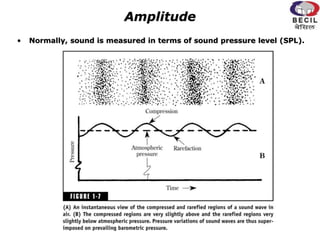
• Normally, sound is measured in terms of sound pressure level (SPL).
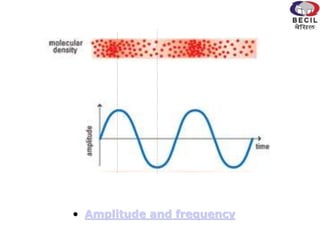
• Amplitude and frequency
Relation between power, intensity and pressure
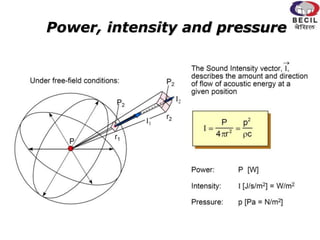
Power, intensity and pressure
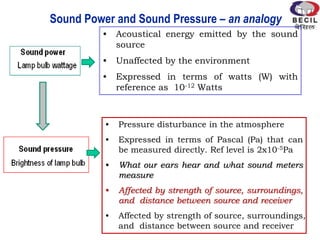
• Acoustical energy emitted by the sound
source
• Unaffected by the environment
• Expressed in terms of watts (W) with
reference as 10-12 Watts
Sound Power and Sound Pressure – an analogy
• Pressure disturbance in the atmosphere
• Expressed in terms of Pascal (Pa) that can
be measured directly. Ref level is 2x10⁻⁵Pa
• What our ears hear and what sound meters
measure
• Affected by strength of source, surroundings,
and distance between source and receiver
• Affected by strength of source, surroundings,
and distance between source and receiver
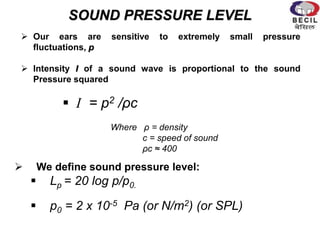
SOUND PRESSURE LEVEL
 Our ears are sensitive to extremely small pressure
fluctuations, p
 Intensity I of a sound wave is proportional to the sound
Pressure squared
 I = p2 /ρc
Where ρ = density
c = speed of sound
ρc ≈ 400
 We define sound pressure level:
 Lp = 20 log p/p0.
 p0 = 2 x 10⁻⁵ Pa (or N/m2) (or SPL)
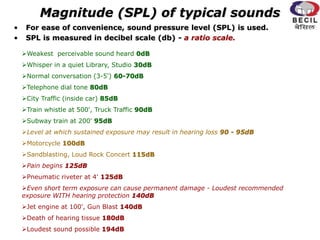
Magnitude (SPL) of typical sounds
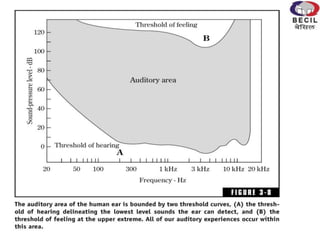
Weakest perceivable sound heard 0dB
Whisper in a quiet Library, Studio 30dB
Normal conversation (3-5') 60-70dB
Telephone dial tone 80dB
City Traffic (inside car) 85dB
Train whistle at 500', Truck Traffic 90dB
Subway train at 200' 95dB
Level at which sustained exposure may result in hearing loss 90 - 95dB
Motorcycle 100dB
Sandblasting, Loud Rock Concert 115dB
Pain begins 125dB
Pneumatic riveter at 4' 125dB
Even short term exposure can cause permanent damage - Loudest recommended
exposure WITH hearing protection 140dB
Jet engine at 100', Gun Blast 140dB
Death of hearing tissue 180dB
Loudest sound possible 194dB
• For ease of convenience, sound pressure level (SPL) is used.
• SPL is measured in decibel scale (db) - a ratio scale.
Loudness
• Perceived loudness is the intensity attribute of the
sound.
• Loudness relates to the dynamics of the music.
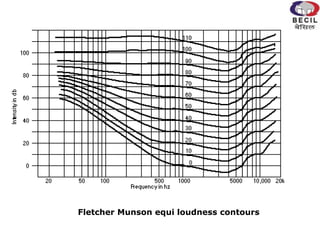
• Loudness does not have simple one to one relation
with the magnitude/SPL.
• Loudness is also the function of frequency, duration
etc.
• At 1 kHz, at low levels, a 3 dB change is the least
detectable by the ear, but at high levels, the ear can
detect 0.25 dB change.
Fletcher Munson equi loudness contours
Frequency
• Human beings (adult, healthy) can hear frequencies in the
range of 20 Hz to 20,000 Hz.
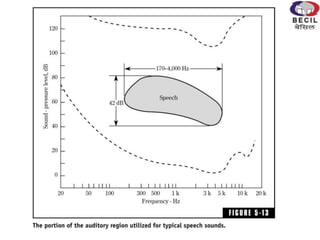
• Spoken words have frequency band of 170 Hz to 4000 Hz.
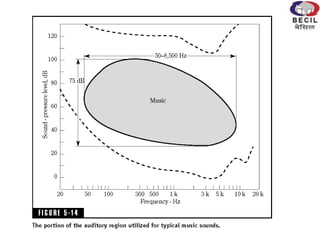
• Natural musical instruments have frequency band of 50 Hz
to 8500 Hz.
• Though pitch and frequency are not same, they are
correlated.
Pitch
• Pitch: A subjective term for the perceived frequency
attribute of a tone.
• One key distinction between these terms is that, pitch is
relative (a matter of common agreement among
musicians), while frequency is absolute (a precise,
unambiguous measurement).
• Frequency describes a physical phenomenon, while
pitch describes a perceptual phenomenon.
Attributes Pitched Non pitched
Example Musical note Noise
Waveform
[Time
domain]
Periodic Non-periodic
Spectrum
[Frequency
domain]
Lines Continuous
Pitch
Dependence of loudness on SPL and frequency
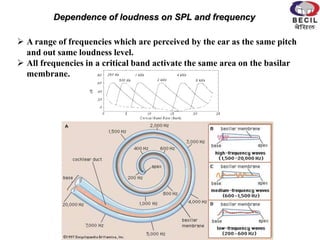
 A range of frequencies which are perceived by the ear as the same pitch
and out same loudness level.
 All frequencies in a critical band activate the same area on the basilar
membrane.
Duration
• The duration (time length) of a particular note is defined
by how long it lasts compared to a whole note.
• Duration is a property of tone that becomes one of the
bases for rhythm.
Timbre, the color of the music
• Timbre describes all of the aspects of a musical sound that do
not have anything to do with the sound's pitch, loudness or
length.
• In other words, if a flute plays a note, and then a violin plays
the same note, for the same length of time, at the same
loudness, we can still easily distinguish between the two
sounds.
• This difference is in the timbre of the sounds. This is due to
the variation in the spectral characteristics of the sound.
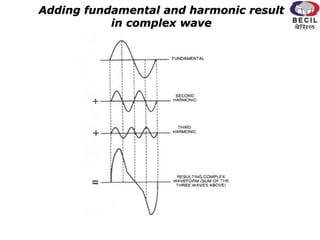
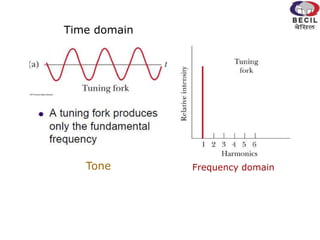
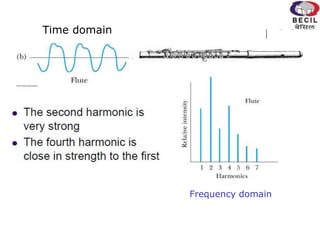
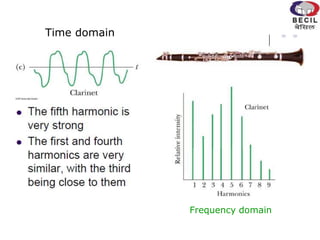
Analyzing non sinusioidal wave
• If the wave pattern is periodic i.e repetitive, it can
be represented as combination of different
sinusoidal waves.
• This is based on a mathematical technique known
as Fourier series.
Adding fundamental and harmonic result
in complex wave
Tone
Time domain
Frequency domain
Time domain
Frequency domain
Time domain
Frequency domain
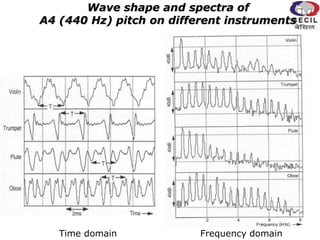
Wave shape and spectra of
A4 (440 Hz) pitch on different instruments
Time domain Frequency domain
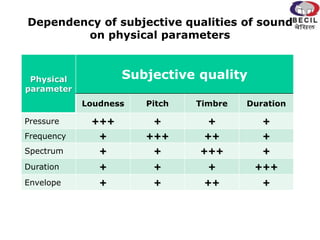
Dependency of subjective qualities of sound
on physical parameters
Physical
parameter
Subjective quality
Loudness Pitch Timbre Duration
Pressure +++ + + +
Frequency + +++ ++ +
Spectrum + + +++ +
Duration + + + +++
Envelope + + ++ +
Summary
 There is a strong mathematical correlation between the
physical and perceived sound. It needs to be properly
studied, interpreted and understood.
 This knowledge is essential for interpreting the
measurement in planning and maintaining facilities for
sound recording and broadcasting.
Bibliography
1. Master hand book of acoustics by F.Alton Everest.
2. Animations by D.Russell.
3. Reading material from B&K
4. Indian Classical Music: Tuning and Ragas by Catherine
Schmidt-Jones
Questions?
Thank you
Musical note (swara)
• Note is a periodic sound wave of either single frequency
(tone) or of a particular shape.
• Discreatization of musical phenomena that, facilitate
performance, comprehension and analysis.
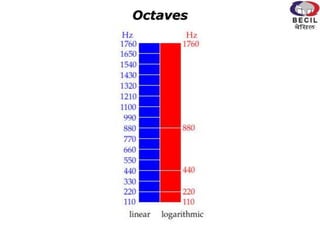
Octaves
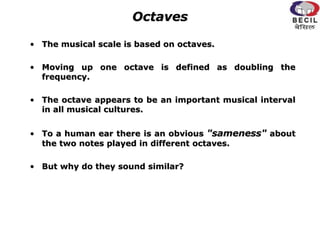
Octaves
• The musical scale is based on octaves.
• Moving up one octave is defined as doubling the
frequency.
• The octave appears to be an important musical interval
in all musical cultures.
• To a human ear there is an obvious "sameness" about
the two notes played in different octaves.
• But why do they sound similar?
Consonance and dissonance
• Notes that sound good and melodious when
played together are called consonant.
• If it does not sound pleasing, it is called as
dissonance.
• The "simple frequency ratio" theory of
consonance is one of the oldest hypotheses in
musical thought.
• This phenomenon is due to the way ear processes
the sound by critical bands.

Characterization of sound

  • 1.
    Characterization of sound– a review R.Narasimha Swamy Senior consultant narasimhaswamy@yahoo.com
  • 2.
    What is sound? Sound can be defined in two ways. [Physical or psychophysical]  Sound can be defined as a wave motion in air or other elastic media.  Or as excitation of the hearing mechanism that results in the perception of sound [sensation].
  • 3.
    Transmission of Sound •Requires a medium with elasticity and inertia (air, water, steel, etc.) • Movements of air molecules result in the variation of sound pressure causing the propagation of a sound wave
  • 4.
    How sound isproduced?  Energy in the form of sound is produced when a vibrating surface or object is contact with the air.  Sources of sound Vocal Plucked strings Air column Vibrating plate
  • 5.
    How sound isperceived?  Physical stimulation of the ear by the sound wave.  Physiological and psychological processing and perception in ear and brain (psycho-acoustics) resulting from nerve impulses stimulating the acoustic cortex of the brain.
  • 6.
    Attributes of thesound • Loudness, pitch, timbre and duration are subjective qualities used to describe a particular sound stimuli. • Each of these attributes depends on one or more physical parameters viz Sound pressure, frequency, spectrum, duration and envelope that can be physically described and measured.
  • 7.
    Amplitude • Normally, soundis measured in terms of sound pressure level (SPL).
  • 8.
  • 9.
    Relation between power,intensity and pressure
  • 10.
  • 11.
    • Acoustical energyemitted by the sound source • Unaffected by the environment • Expressed in terms of watts (W) with reference as 10-12 Watts Sound Power and Sound Pressure – an analogy • Pressure disturbance in the atmosphere • Expressed in terms of Pascal (Pa) that can be measured directly. Ref level is 2x10⁻⁵Pa • What our ears hear and what sound meters measure • Affected by strength of source, surroundings, and distance between source and receiver • Affected by strength of source, surroundings, and distance between source and receiver
  • 12.
    SOUND PRESSURE LEVEL Our ears are sensitive to extremely small pressure fluctuations, p  Intensity I of a sound wave is proportional to the sound Pressure squared  I = p2 /ρc Where ρ = density c = speed of sound ρc ≈ 400  We define sound pressure level:  Lp = 20 log p/p0.  p0 = 2 x 10⁻⁵ Pa (or N/m2) (or SPL)
  • 14.
    Magnitude (SPL) oftypical sounds Weakest perceivable sound heard 0dB Whisper in a quiet Library, Studio 30dB Normal conversation (3-5') 60-70dB Telephone dial tone 80dB City Traffic (inside car) 85dB Train whistle at 500', Truck Traffic 90dB Subway train at 200' 95dB Level at which sustained exposure may result in hearing loss 90 - 95dB Motorcycle 100dB Sandblasting, Loud Rock Concert 115dB Pain begins 125dB Pneumatic riveter at 4' 125dB Even short term exposure can cause permanent damage - Loudest recommended exposure WITH hearing protection 140dB Jet engine at 100', Gun Blast 140dB Death of hearing tissue 180dB Loudest sound possible 194dB • For ease of convenience, sound pressure level (SPL) is used. • SPL is measured in decibel scale (db) - a ratio scale.
  • 15.
    Loudness • Perceived loudnessis the intensity attribute of the sound. • Loudness relates to the dynamics of the music. • Loudness does not have simple one to one relation with the magnitude/SPL. • Loudness is also the function of frequency, duration etc. • At 1 kHz, at low levels, a 3 dB change is the least detectable by the ear, but at high levels, the ear can detect 0.25 dB change.
  • 16.
    Fletcher Munson equiloudness contours
  • 17.
    Frequency • Human beings(adult, healthy) can hear frequencies in the range of 20 Hz to 20,000 Hz. • Spoken words have frequency band of 170 Hz to 4000 Hz. • Natural musical instruments have frequency band of 50 Hz to 8500 Hz. • Though pitch and frequency are not same, they are correlated.
  • 21.
    Pitch • Pitch: Asubjective term for the perceived frequency attribute of a tone. • One key distinction between these terms is that, pitch is relative (a matter of common agreement among musicians), while frequency is absolute (a precise, unambiguous measurement). • Frequency describes a physical phenomenon, while pitch describes a perceptual phenomenon.
  • 22.
    Attributes Pitched Nonpitched Example Musical note Noise Waveform [Time domain] Periodic Non-periodic Spectrum [Frequency domain] Lines Continuous Pitch
  • 23.
    Dependence of loudnesson SPL and frequency  A range of frequencies which are perceived by the ear as the same pitch and out same loudness level.  All frequencies in a critical band activate the same area on the basilar membrane.
  • 24.
    Duration • The duration(time length) of a particular note is defined by how long it lasts compared to a whole note. • Duration is a property of tone that becomes one of the bases for rhythm.
  • 25.
    Timbre, the colorof the music • Timbre describes all of the aspects of a musical sound that do not have anything to do with the sound's pitch, loudness or length. • In other words, if a flute plays a note, and then a violin plays the same note, for the same length of time, at the same loudness, we can still easily distinguish between the two sounds. • This difference is in the timbre of the sounds. This is due to the variation in the spectral characteristics of the sound.
  • 26.
    Analyzing non sinusioidalwave • If the wave pattern is periodic i.e repetitive, it can be represented as combination of different sinusoidal waves. • This is based on a mathematical technique known as Fourier series.
  • 27.
    Adding fundamental andharmonic result in complex wave
  • 28.
  • 29.
  • 30.
  • 31.
    Wave shape andspectra of A4 (440 Hz) pitch on different instruments Time domain Frequency domain
  • 32.
    Dependency of subjectivequalities of sound on physical parameters Physical parameter Subjective quality Loudness Pitch Timbre Duration Pressure +++ + + + Frequency + +++ ++ + Spectrum + + +++ + Duration + + + +++ Envelope + + ++ +
  • 33.
    Summary  There isa strong mathematical correlation between the physical and perceived sound. It needs to be properly studied, interpreted and understood.  This knowledge is essential for interpreting the measurement in planning and maintaining facilities for sound recording and broadcasting.
  • 34.
    Bibliography 1. Master handbook of acoustics by F.Alton Everest. 2. Animations by D.Russell. 3. Reading material from B&K 4. Indian Classical Music: Tuning and Ragas by Catherine Schmidt-Jones
  • 35.
  • 36.
  • 38.
    Musical note (swara) •Note is a periodic sound wave of either single frequency (tone) or of a particular shape. • Discreatization of musical phenomena that, facilitate performance, comprehension and analysis.
  • 39.
  • 40.
    Octaves • The musicalscale is based on octaves. • Moving up one octave is defined as doubling the frequency. • The octave appears to be an important musical interval in all musical cultures. • To a human ear there is an obvious "sameness" about the two notes played in different octaves. • But why do they sound similar?
  • 41.
    Consonance and dissonance •Notes that sound good and melodious when played together are called consonant. • If it does not sound pleasing, it is called as dissonance. • The "simple frequency ratio" theory of consonance is one of the oldest hypotheses in musical thought. • This phenomenon is due to the way ear processes the sound by critical bands.