Financial Institution
    and Markets
GROUP MEMBERS
 Chhitiz Shrestha
 Digaj Amatya

 Dikshya Acharya

 Leeza Shrestha
INTRODUCTION TO CAPITAL STRUCTURE

 Represents long term investment
 Includes funds raised through:
       Ordinary and Preference shares
       Bonds
       Debentures
       Term loans from financial institutions
       Earned revenue
       Capital surpluses
       And so on..
INTRODUCTION TO CAPITAL STRUCTURE
 Represents the proportionate relationship between
  debt and equity
 Types:

o Primary market

o Secondary market
PRIMARY MARKET
 Also known as “New Issue Market”
 Success of the capital market depends on primary market

 Is the market for new issuers

 Can be directly bought from the shareholders

 Small and medium scale business, enter the primary
  market to raise money from the public
 Accelerates the process of capital formation in a country's
  economy
PRIMARY MARKET
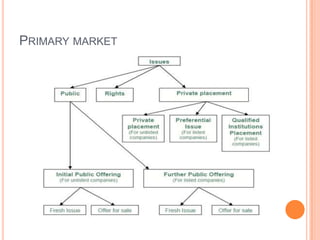
   Three methods to issue primary market
o   Rights Issue,
o   Initial Public Offer (IPO),
o   Preferential Issue.
PRIMARY MARKET
FEATURES OF PRIMARY MARKET

 This is the market for new long term equity capital.
 The primary market is the market where the securities are
  sold for the first time.
 In a primary issue, the securities are issued by the company
  directly to investors.
 The company receives the money and issues new security
  certificates to the investors.
 Primary issues are used by companies for the purpose of
  setting up new business or for expanding or modernizing the
  existing business.
FEATURES OF PRIMARY MARKET

 The new issue market does not include certain other
  sources of new long term external finance
 Borrowers in the new issue market may be raising capital
  for converting private capital into public capital; this is
  known as "going public."
THE NEED FOR PRIMARY MARKET
 To raise funds for certain purpose.
 To create market for new issues of securities.

 To establish the magnitude of the market.

 To mobilize Resource the economy.

 For overall development of companies.
FUNCTIONS OF PRIMARY MARKET
 Household Savings
 Global Investments

 Sale of Government Securities

 Primary Market Participants

 Marker Risk
IMPORTANCE
 It studies needs, wants and expectations of the
  customers.
 It finds out reactions of customers to products of the
  company.
 It evaluates company's sales promotion measures for
  suitable adjustment and improvements.
 It studies current marketing problems and opportunities
  for suitable follow up.
 It suggest introduction of new products, modification of
  existing products.
 It studies marketing competition, channel of distribution
  and pricing for suitable changes if necessary.
 It find methods for making the product popular and
  raising its goodwill and marketing reputation.
HISTORICAL PERSPECTIVES OF NEPALESE
SECURITIES MARKET
 The history of capital market in Nepal dates back to
  1936.
 First issue of government bonds made in the year
  1964.
 carried 6 percent rate of interest and had the
  maturity period of five years.
 In 1974, industrial policy was announced.
HISTORICAL PERSPECTIVES OF NEPALESE
SECURITIES MARKET
 In 1976 Securities exchange center was
  established .
 The interim government (1990/91) initiated financial
  reform program and two indirect investment
  vehicles-Citizen's Investment Fund and NIDC
  Capital Markets Ltd.
 Nepal (SEBO/N) and Nepal Stock Exchange Ltd.
  (NEPSE) at the policy level in 1993.
 Since then they are operating as the main
  constituents of securities market in Nepal.
DISCLOSURE IN PRIMARY MARKET

    The directors need to submit a copy of prospectus to the
     concerned authorities
    After that the prospectus is approved for initial public offering.
    Possible financial risks involved in running the business,
     financial arrangements made, detail list of the names and
     particulars of all those involved in companies and other
     important matters to be clearly stated in prospectus.
DISCLOSURE IN PRIMARY MARKET

    The issuance of shares worth Rs 7.77 billion in fiscal year
     2010-11.
    Nepal Rastra Bank (NRB) has stopped giving license to new
     financial institutions lessening the pressure of new share
     issues.
    Every public company must publish its prospectus before
     issuing securities.
DISCLOSURE IN PRIMARY MARKET

    Last fiscal year shows17 companies got approval to float their
     primary shares
    31 listed companies were allowed to issue right shares.
    Yet the depreciating value of securities has reduced the
     market capitalization of the secondary market.
    The capital market regulator shave witnessed the registration
     of bonus shares worth Rs 4.41 billion of 62 companies and
     promoters shares worth Rs 1.8 billion of 18 companies in the
     last fiscal year.
PROCESS OF ISSUING PRIMARY IN NEPAL
 Originating the Securities
 Underwriting the Securities

 Formation of Syndicate

 Risk Diversification

 Distribution of Securities

 Stabilization of the Market
ISSUE PROCEDURE IN NEPAL
 In Nepal, the company should follow the company
  act.
 This is a legal document containing the various
  financial, corporate and business information,
  which will help investors make rational investment
  decisions
 the various guidelines developed by SEBON have
  to be followed and issue managers have to obtain
  Due Diligence Certificate in dealing in the primary
  market issues.
ISSUE PROCEDURE IN NEPAL

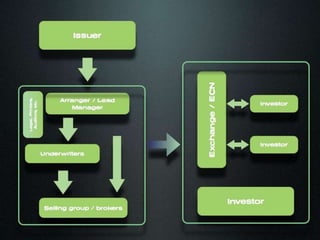
 Companies take the help of the investment bankers
  to provide guarantee of funds
 Investment bankers may act either as agents or as
  principals in any given transactions
 The investor banker in this principal transaction is
  often called an underwriter
ROLES OF AN ISSUE MANAGER

 Easy floatation
 Financial consultant

 Underwriting

 Market makers

 Due diligence

 Coordination

 Liaison with SEBI
ROLES OF UNDERWRITER

   Primarily responsible for subscription of the unsold
    portion o f the securities .

   And also to make        payment   for   the related
    security.
FUNCTIONING OF UNDERWRITER
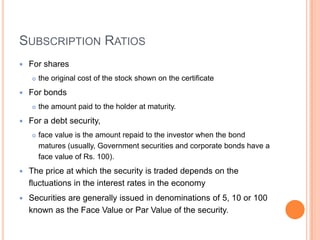
SUBSCRIPTION RATIOS
   For shares
       the original cost of the stock shown on the certificate
   For bonds
       the amount paid to the holder at maturity.
   For a debt security,
       face value is the amount repaid to the investor when the bond
        matures (usually, Government securities and corporate bonds have a
        face value of Rs. 100).
   The price at which the security is traded depends on the
    fluctuations in the interest rates in the economy
   Securities are generally issued in denominations of 5, 10 or 100
    known as the Face Value or Par Value of the security.
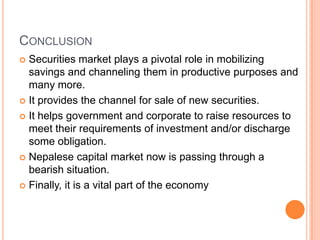
CONCLUSION
 Securities market plays a pivotal role in mobilizing
  savings and channeling them in productive purposes and
  many more.
 It provides the channel for sale of new securities.

 It helps government and corporate to raise resources to
  meet their requirements of investment and/or discharge
  some obligation.
 Nepalese capital market now is passing through a
  bearish situation.
 Finally, it is a vital part of the economy
Primary market

Primary market

  • 1.
  • 2.
    GROUP MEMBERS  ChhitizShrestha  Digaj Amatya  Dikshya Acharya  Leeza Shrestha
  • 3.
    INTRODUCTION TO CAPITALSTRUCTURE  Represents long term investment  Includes funds raised through:  Ordinary and Preference shares  Bonds  Debentures  Term loans from financial institutions  Earned revenue  Capital surpluses  And so on..
  • 4.
    INTRODUCTION TO CAPITALSTRUCTURE  Represents the proportionate relationship between debt and equity  Types: o Primary market o Secondary market
  • 5.
    PRIMARY MARKET  Alsoknown as “New Issue Market”  Success of the capital market depends on primary market  Is the market for new issuers  Can be directly bought from the shareholders  Small and medium scale business, enter the primary market to raise money from the public  Accelerates the process of capital formation in a country's economy
  • 6.
    PRIMARY MARKET  Three methods to issue primary market o Rights Issue, o Initial Public Offer (IPO), o Preferential Issue.
  • 7.
  • 8.
    FEATURES OF PRIMARYMARKET  This is the market for new long term equity capital.  The primary market is the market where the securities are sold for the first time.  In a primary issue, the securities are issued by the company directly to investors.  The company receives the money and issues new security certificates to the investors.  Primary issues are used by companies for the purpose of setting up new business or for expanding or modernizing the existing business.
  • 9.
    FEATURES OF PRIMARYMARKET  The new issue market does not include certain other sources of new long term external finance  Borrowers in the new issue market may be raising capital for converting private capital into public capital; this is known as "going public."
  • 10.
    THE NEED FORPRIMARY MARKET  To raise funds for certain purpose.  To create market for new issues of securities.  To establish the magnitude of the market.  To mobilize Resource the economy.  For overall development of companies.
  • 11.
    FUNCTIONS OF PRIMARYMARKET  Household Savings  Global Investments  Sale of Government Securities  Primary Market Participants  Marker Risk
  • 12.
    IMPORTANCE  It studiesneeds, wants and expectations of the customers.  It finds out reactions of customers to products of the company.  It evaluates company's sales promotion measures for suitable adjustment and improvements.  It studies current marketing problems and opportunities for suitable follow up.
  • 13.
     It suggestintroduction of new products, modification of existing products.  It studies marketing competition, channel of distribution and pricing for suitable changes if necessary.  It find methods for making the product popular and raising its goodwill and marketing reputation.
  • 14.
    HISTORICAL PERSPECTIVES OFNEPALESE SECURITIES MARKET  The history of capital market in Nepal dates back to 1936.  First issue of government bonds made in the year 1964.  carried 6 percent rate of interest and had the maturity period of five years.  In 1974, industrial policy was announced.
  • 15.
    HISTORICAL PERSPECTIVES OFNEPALESE SECURITIES MARKET  In 1976 Securities exchange center was established .  The interim government (1990/91) initiated financial reform program and two indirect investment vehicles-Citizen's Investment Fund and NIDC Capital Markets Ltd.  Nepal (SEBO/N) and Nepal Stock Exchange Ltd. (NEPSE) at the policy level in 1993.  Since then they are operating as the main constituents of securities market in Nepal.
  • 16.
    DISCLOSURE IN PRIMARYMARKET  The directors need to submit a copy of prospectus to the concerned authorities  After that the prospectus is approved for initial public offering.  Possible financial risks involved in running the business, financial arrangements made, detail list of the names and particulars of all those involved in companies and other important matters to be clearly stated in prospectus.
  • 17.
    DISCLOSURE IN PRIMARYMARKET  The issuance of shares worth Rs 7.77 billion in fiscal year 2010-11.  Nepal Rastra Bank (NRB) has stopped giving license to new financial institutions lessening the pressure of new share issues.  Every public company must publish its prospectus before issuing securities.
  • 18.
    DISCLOSURE IN PRIMARYMARKET  Last fiscal year shows17 companies got approval to float their primary shares  31 listed companies were allowed to issue right shares.  Yet the depreciating value of securities has reduced the market capitalization of the secondary market.  The capital market regulator shave witnessed the registration of bonus shares worth Rs 4.41 billion of 62 companies and promoters shares worth Rs 1.8 billion of 18 companies in the last fiscal year.
  • 20.
    PROCESS OF ISSUINGPRIMARY IN NEPAL  Originating the Securities  Underwriting the Securities  Formation of Syndicate  Risk Diversification  Distribution of Securities  Stabilization of the Market
  • 21.
    ISSUE PROCEDURE INNEPAL  In Nepal, the company should follow the company act.  This is a legal document containing the various financial, corporate and business information, which will help investors make rational investment decisions  the various guidelines developed by SEBON have to be followed and issue managers have to obtain Due Diligence Certificate in dealing in the primary market issues.
  • 22.
    ISSUE PROCEDURE INNEPAL  Companies take the help of the investment bankers to provide guarantee of funds  Investment bankers may act either as agents or as principals in any given transactions  The investor banker in this principal transaction is often called an underwriter
  • 23.
    ROLES OF ANISSUE MANAGER  Easy floatation  Financial consultant  Underwriting  Market makers  Due diligence  Coordination  Liaison with SEBI
  • 24.
    ROLES OF UNDERWRITER  Primarily responsible for subscription of the unsold portion o f the securities .  And also to make payment for the related security.
  • 25.
  • 26.
    SUBSCRIPTION RATIOS  For shares  the original cost of the stock shown on the certificate  For bonds  the amount paid to the holder at maturity.  For a debt security,  face value is the amount repaid to the investor when the bond matures (usually, Government securities and corporate bonds have a face value of Rs. 100).  The price at which the security is traded depends on the fluctuations in the interest rates in the economy  Securities are generally issued in denominations of 5, 10 or 100 known as the Face Value or Par Value of the security.
  • 27.
    CONCLUSION  Securities marketplays a pivotal role in mobilizing savings and channeling them in productive purposes and many more.  It provides the channel for sale of new securities.  It helps government and corporate to raise resources to meet their requirements of investment and/or discharge some obligation.  Nepalese capital market now is passing through a bearish situation.  Finally, it is a vital part of the economy