Presented By:
•Adesh Thangden
•Anmol Pasa Shrestha
•Asish Tandukar
•Chhitiz Shrestha
•Dikshya Acharya
Nepal
 Developing economy: transferring from rural to urban
 and traditional to modern market oriented
 Predominantly agricultural country, about 80 percent
 populations deriving their livelihood from this sector
 and the main source of gross domestic production
 (about 40%)
 Literacy rate: 68.2% ( According to the UNDP report
 2011)
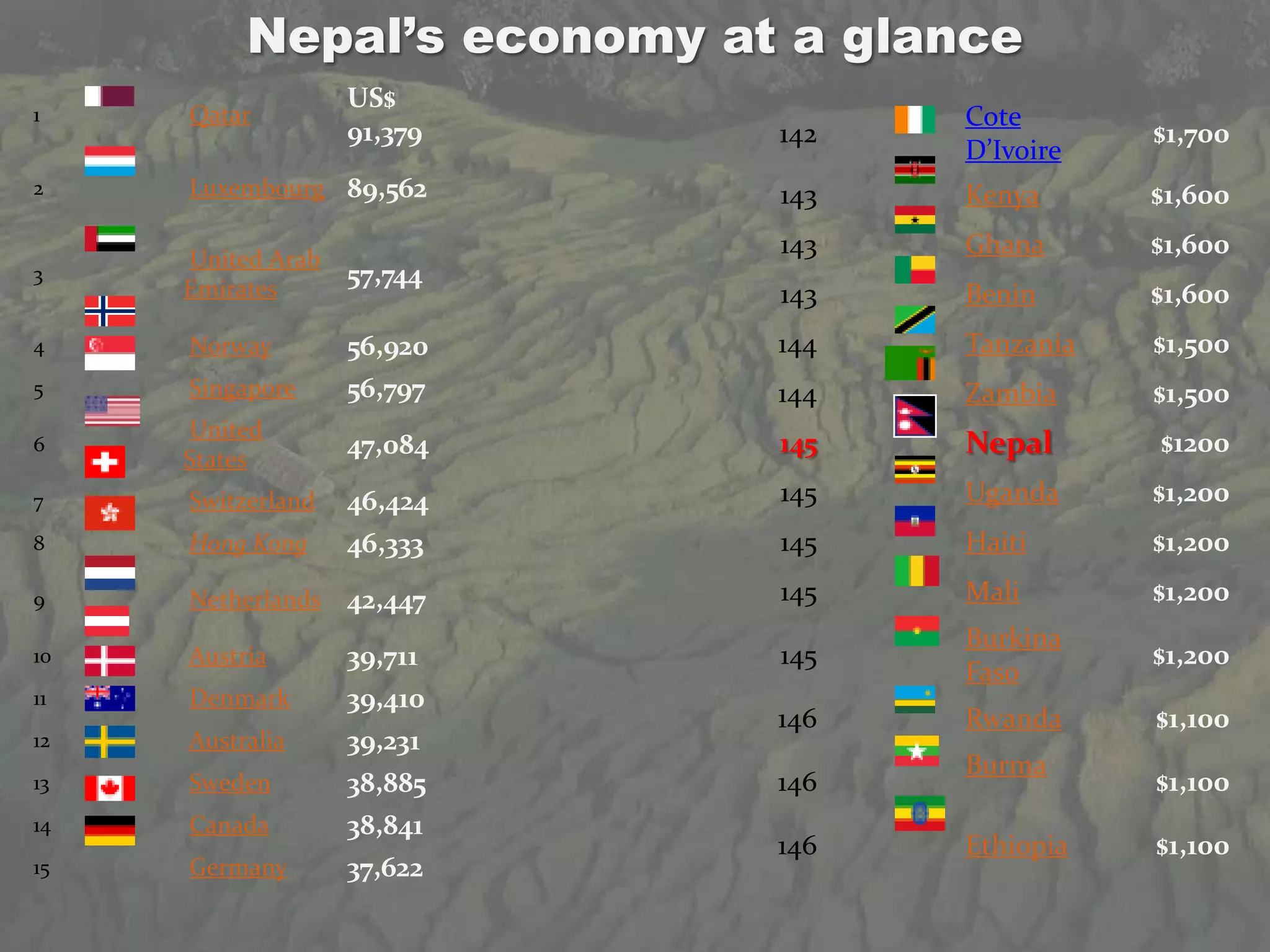
Nepal’s economy at a glance
                   US$
1    Qatar                        Cote
                   91,379   142              $1,700
                                  D’Ivoire
2    Luxembourg 89,562      143   Kenya      $1,600

     United Arab
                            143   Ghana      $1,600
3
     Emirates
                   57,744
                            143   Benin      $1,600
4    Norway        56,920   144   Tanzania   $1,500
5    Singapore     56,797   144   Zambia     $1,500
     United
6
     States
                   47,084   145   Nepal      $1200
7    Switzerland   46,424   145   Uganda     $1,200
8    Hong Kong     46,333   145   Haiti      $1,200
9    Netherlands   42,447   145   Mali       $1,200
                                  Burkina
10   Austria       39,711   145              $1,200
                                  Faso
11   Denmark       39,410
                            146   Rwanda     $1,100
12   Australia     39,231
                                  Burma
13   Sweden        38,885   146              $1,100
14   Canada        38,841
                            146   Ethiopia   $1,100
15   Germany       37,622
Introduction
 Technology includes all aspects of applied science
  for achieving a practical purpose.
 Technology is viewed as a means of combining four
  factors of production( land, labor, capital and
  knowledge) which increases the ability to create new
  product from combining these factors.
Definitions
 According to G. Jones And C. Hill : “Technology is
  the combination of skills and equipments that
  managers use in the design, production and
  distribution of goods and services.”
 According to R.W. Griffin (2007) :- “Technology is
  the set of processes and systems used by
  organizations to convert resources in to products or
  services”.
Business and Technology
 Business and technology are inseparable, and
  complementary to each other.
 Technology advancement increases the production,
  effective use of resources, and brings opportunity for
  upgrading business firms.
 Technological change leads to improved production
  of goods and services
Business and Technology
 Technology which are related to business are:-
    Reduced running costs
    Improved productivity
    Improved competitiveness
    Lower costs per unit of product
    Improved quality of service (e.g. speed of service)
    Reduced wastage
Technology and Human Factor
 There are 3 areas which make the effective use of
  technology and they are:
   Production,
   Investment, &
   Innovation
 The capability of technology revolves around its
  people.
 Managers should be skillful for full utilization of
  technology.
Technology and Human Factor
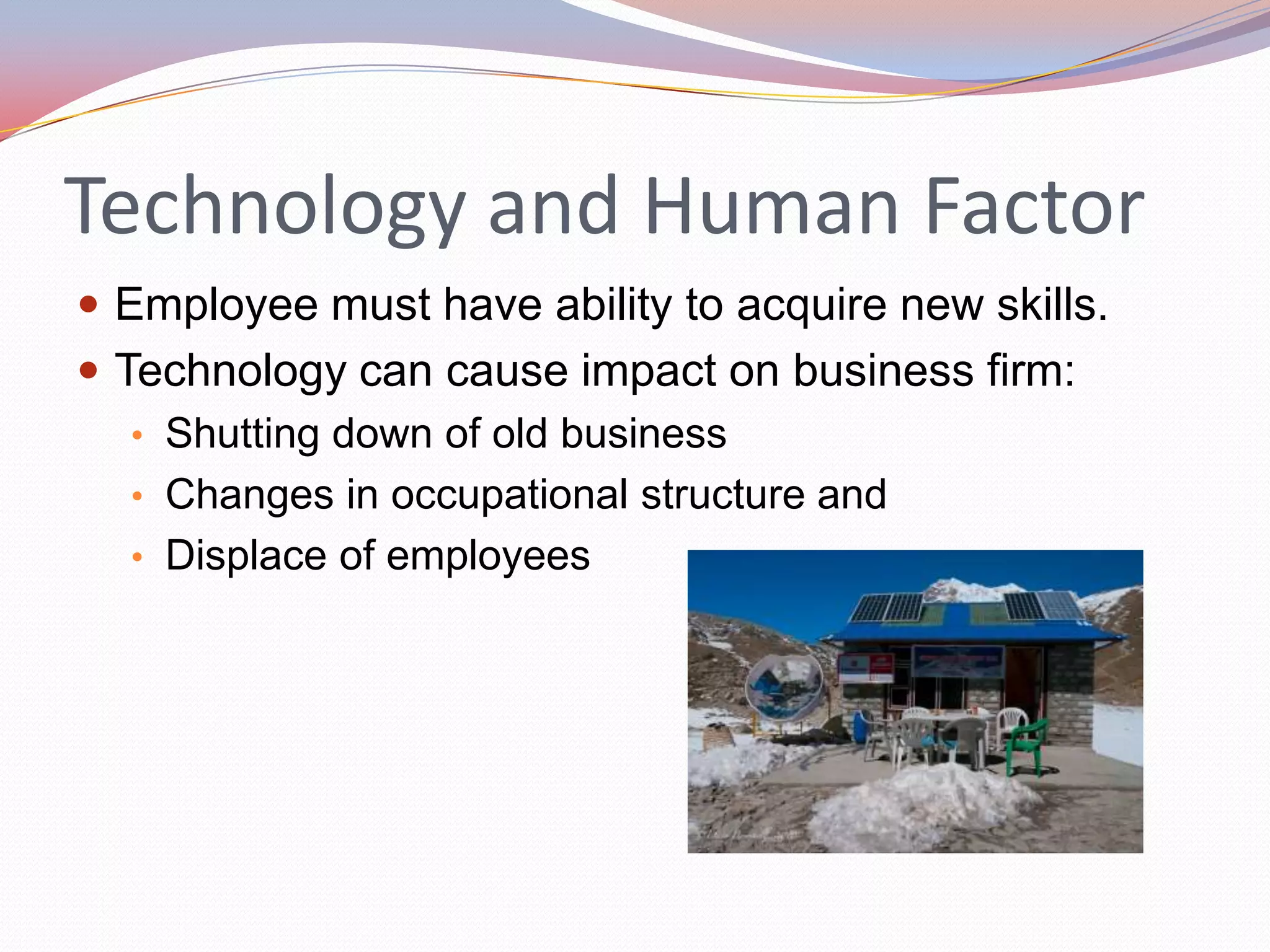
 Employee must have ability to acquire new skills.
 Technology can cause impact on business firm:
   • Shutting down of old business
   • Changes in occupational structure and
   • Displace of employees
Status of Technology in Nepalese
Industrial Sector
 Research and Development
 Exports as Indicators of Technology
 Skill base for Technology
 Technology transfer
Research and Development
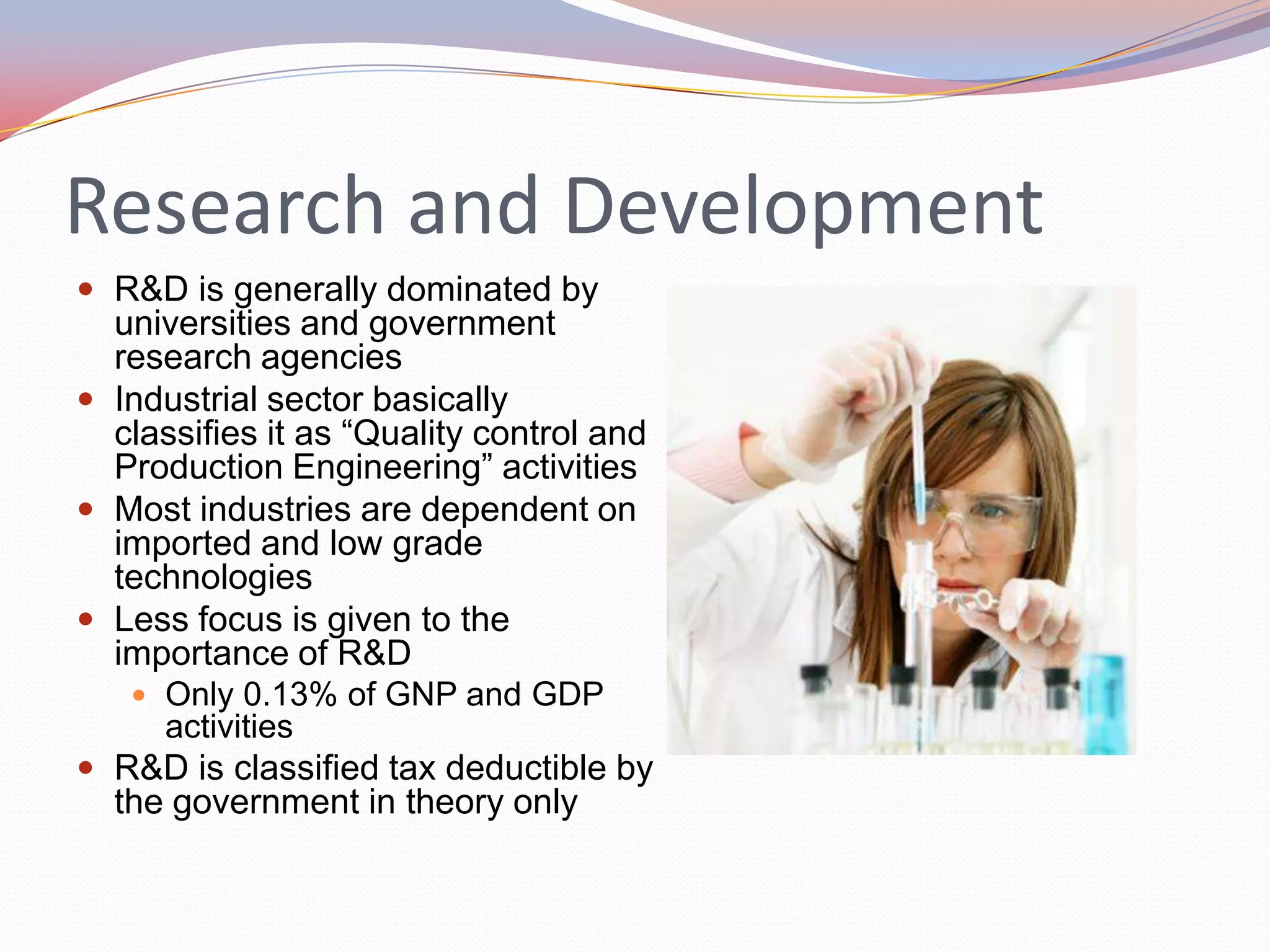
 R&D is generally dominated by
  universities and government
  research agencies
 Industrial sector basically
  classifies it as “Quality control and
  Production Engineering” activities
 Most industries are dependent on
  imported and low grade
  technologies
 Less focus is given to the
  importance of R&D
    Only 0.13% of GNP and GDP
      activities
 R&D is classified tax deductible by
  the government in theory only
Exports as Indicators of Technology
 Technological status of a nation can be measured by
  its export status
 Nepalese exports are mainly focused on raw or
  semi-processed materials
 Major exports in the form of finished goods include:
   Carpets
   Garments
   Leather Products
 This deficiency is primarily caused due to lack of
 efficiency and competitiveness
Skill base for Technology
 Skill base for technology can be gauged by education
  enrollment statistics
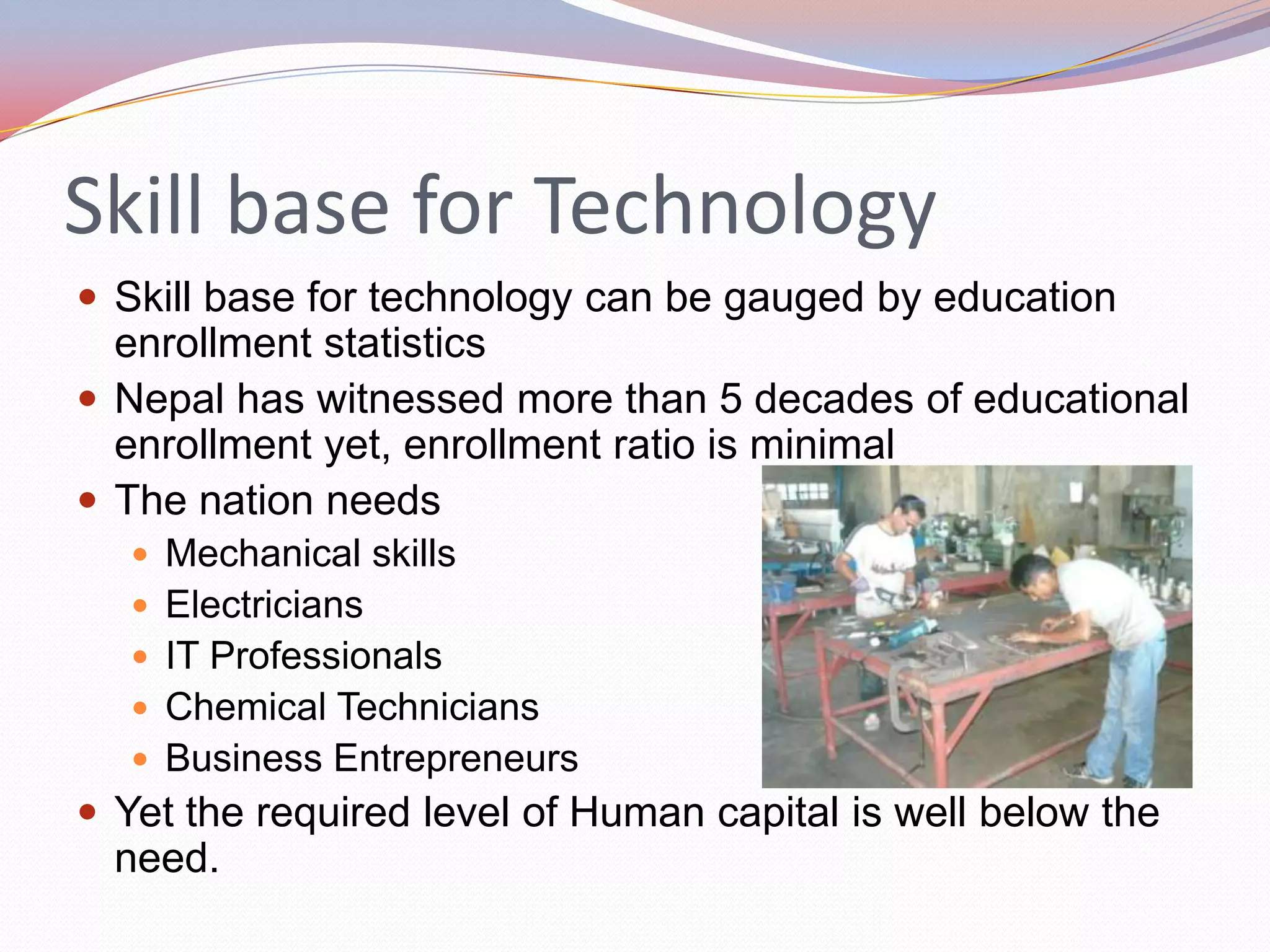
 Nepal has witnessed more than 5 decades of educational
  enrollment yet, enrollment ratio is minimal
 The nation needs
   Mechanical skills
   Electricians
   IT Professionals
   Chemical Technicians
   Business Entrepreneurs
 Yet the required level of Human capital is well below the
  need.
Technology Transfer
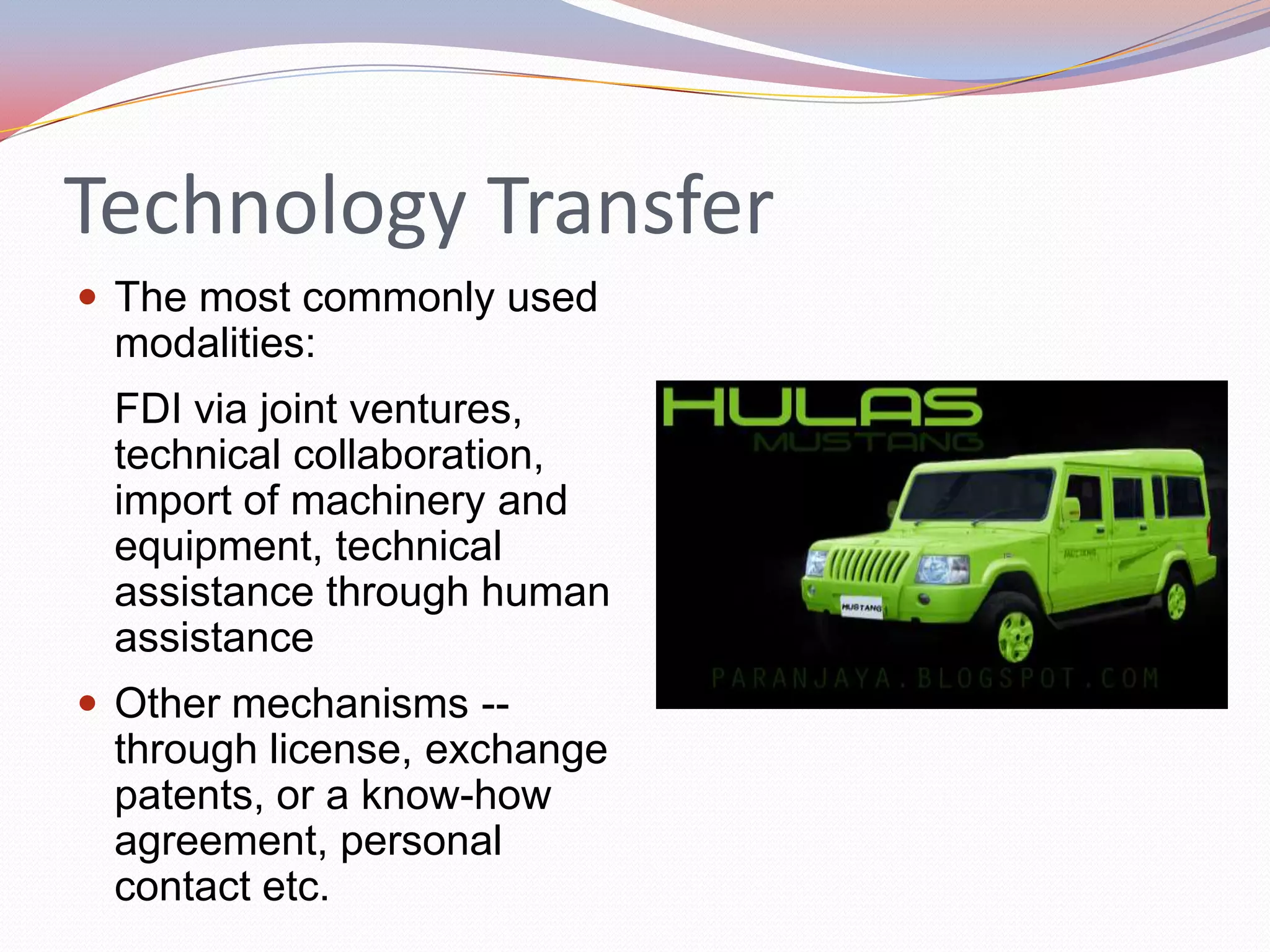
 The most commonly used
 modalities:
 FDI via joint ventures,
 technical collaboration,
 import of machinery and
 equipment, technical
 assistance through human
 assistance
 Other mechanisms --
 through license, exchange
 patents, or a know-how
 agreement, personal
 contact etc.
Technology Transfer in Nepal
Foreign Investment and Technology Transfer Act, 1992
 The Act defines technology transfer as any transfer of
 technology to be made under an agreement between an
 industry and a foreign investor on the following matters:
   Use of any technological right, specialization, formula,
    process, patent or technical know-how of foreign
    origin;
   Use of any trademark of foreign ownership;
   Acquiring any foreign technical, consultancy,
    management and marketing service
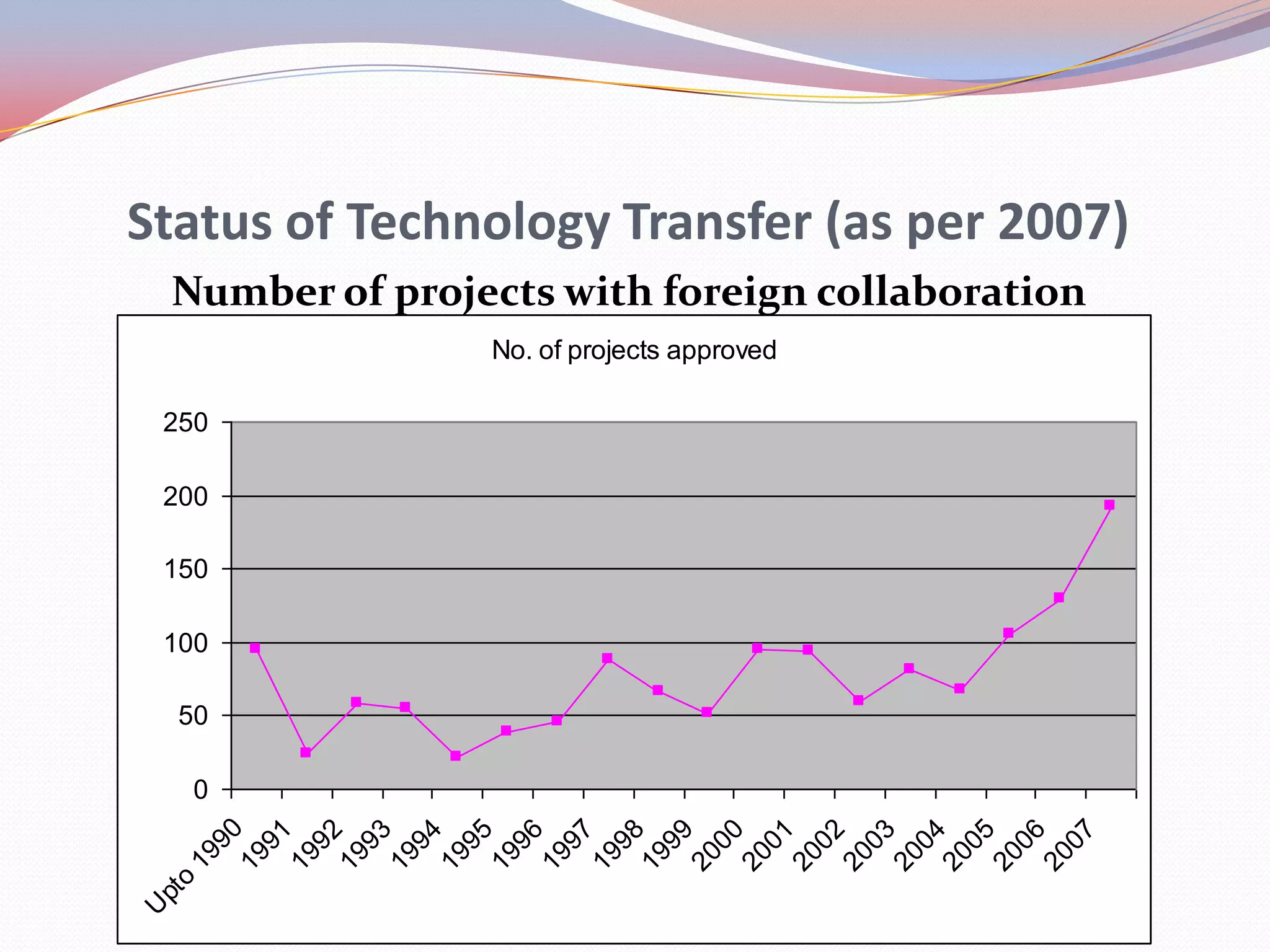
Status of Technology Transfer (as per 2007)
    Number of projects with foreign collaboration
                                      No. of projects approved

    250

    200

    150

    100

     50

        0
        90
             91
                  92
                       93
                            94
                                 95
                                       96
                                            97
                                                 98
                                                      99
                                                           00
                                                                01
                                                                     02
                                                                          03
                                                                               04
                                                                                    05
                                                                                         06
                                                                                              07
     19
            19
                 19
                      19
                           19
                                19
                                     19
                                          19
                                               19
                                                    19
                                                         20
                                                              20
                                                                   20
                                                                        20
                                                                             20
                                                                                  20
                                                                                       20
                                                                                            20
    o
 pt
U
Status…
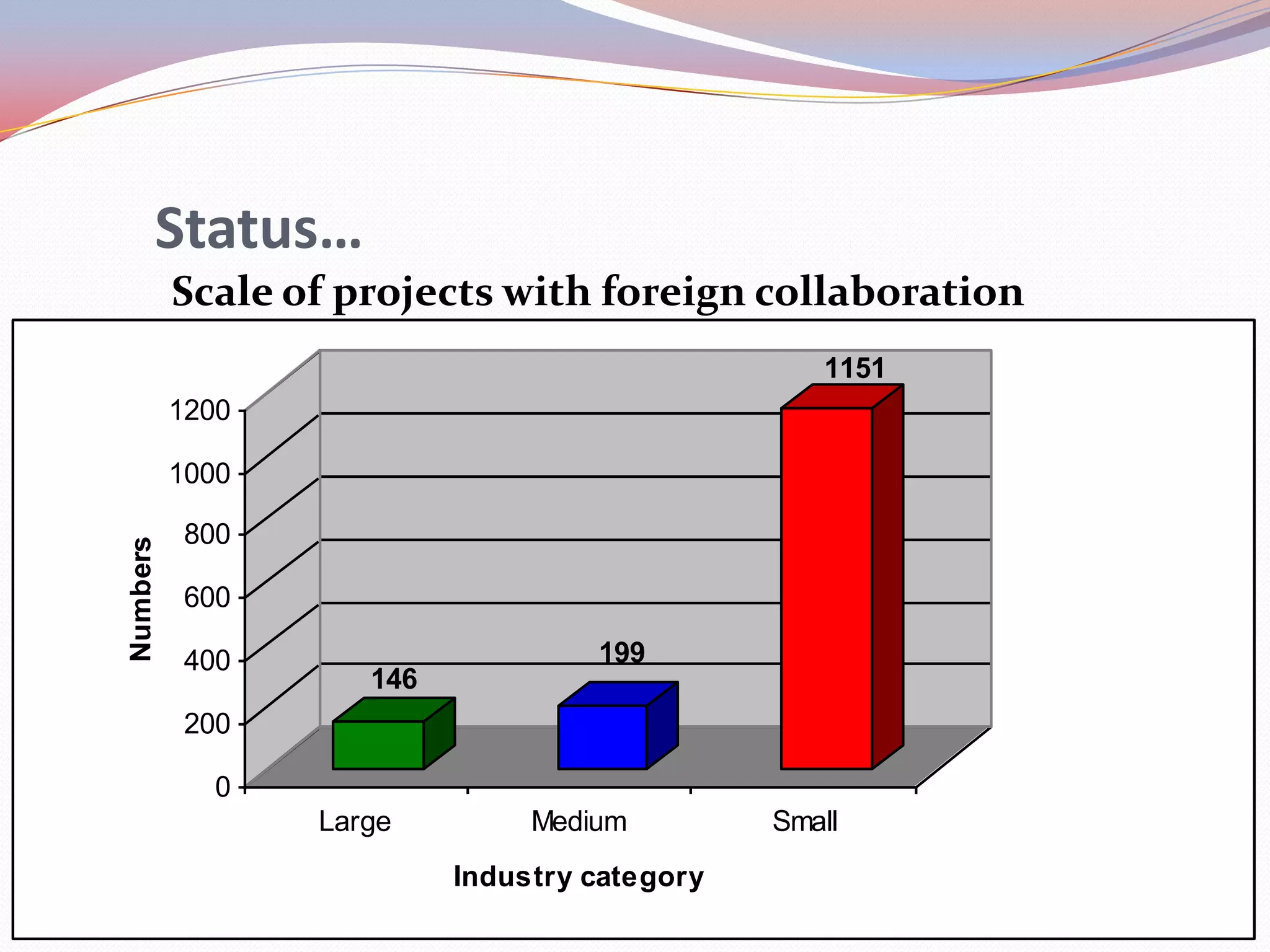
          Scale of projects with foreign collaboration
                                                 1151
          1200

          1000

          800
Numbers


          600

          400                      199
                    146
          200

            0
                 Large         Medium         Small
                          Industry category
Status…
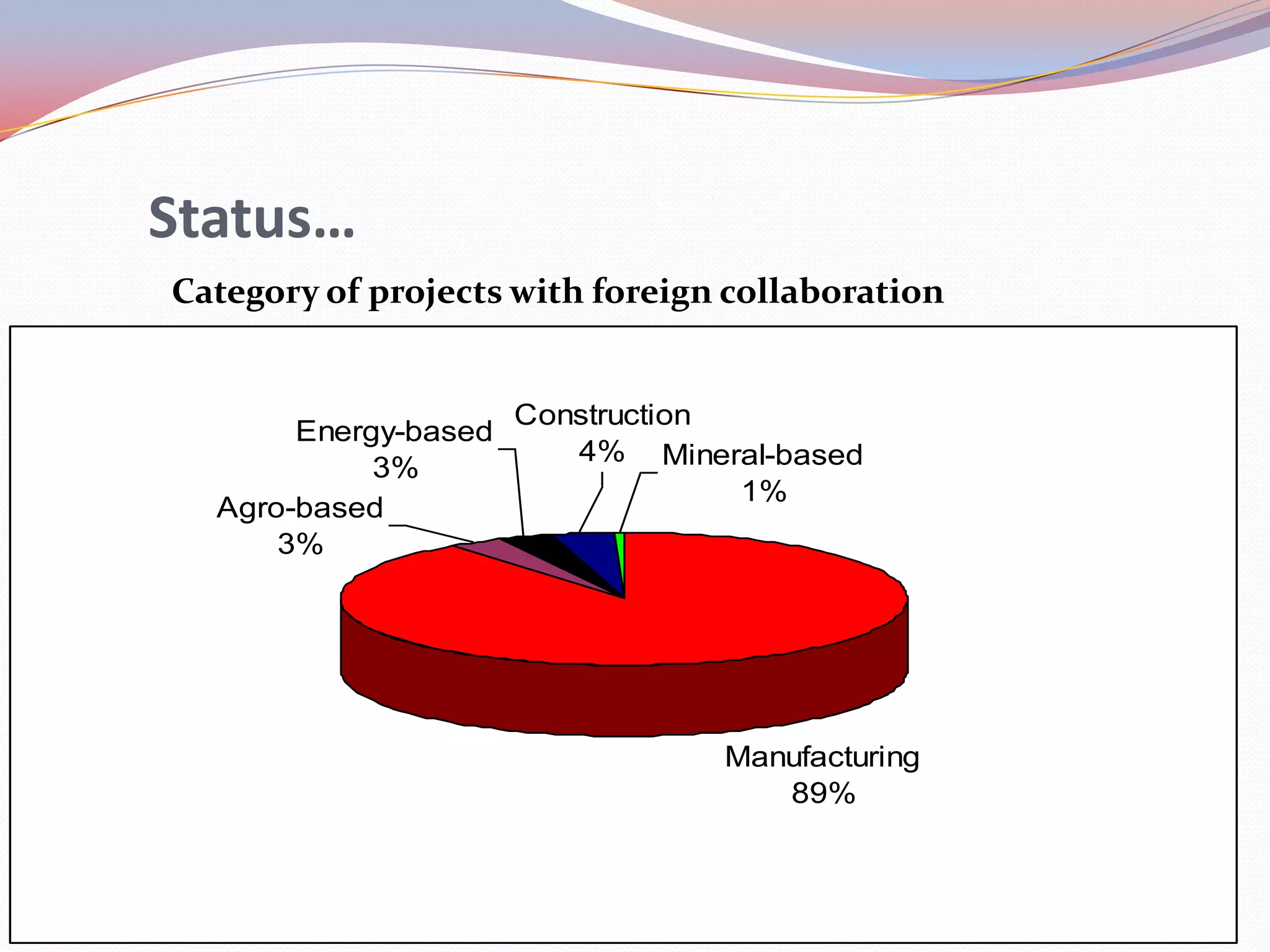
Category of projects with foreign collaboration


                      Construction
       Energy-based
                         4% Mineral-based
            3%
                                   1%
  Agro-based
      3%


                                 Manufacturing
                                    89%
Status…
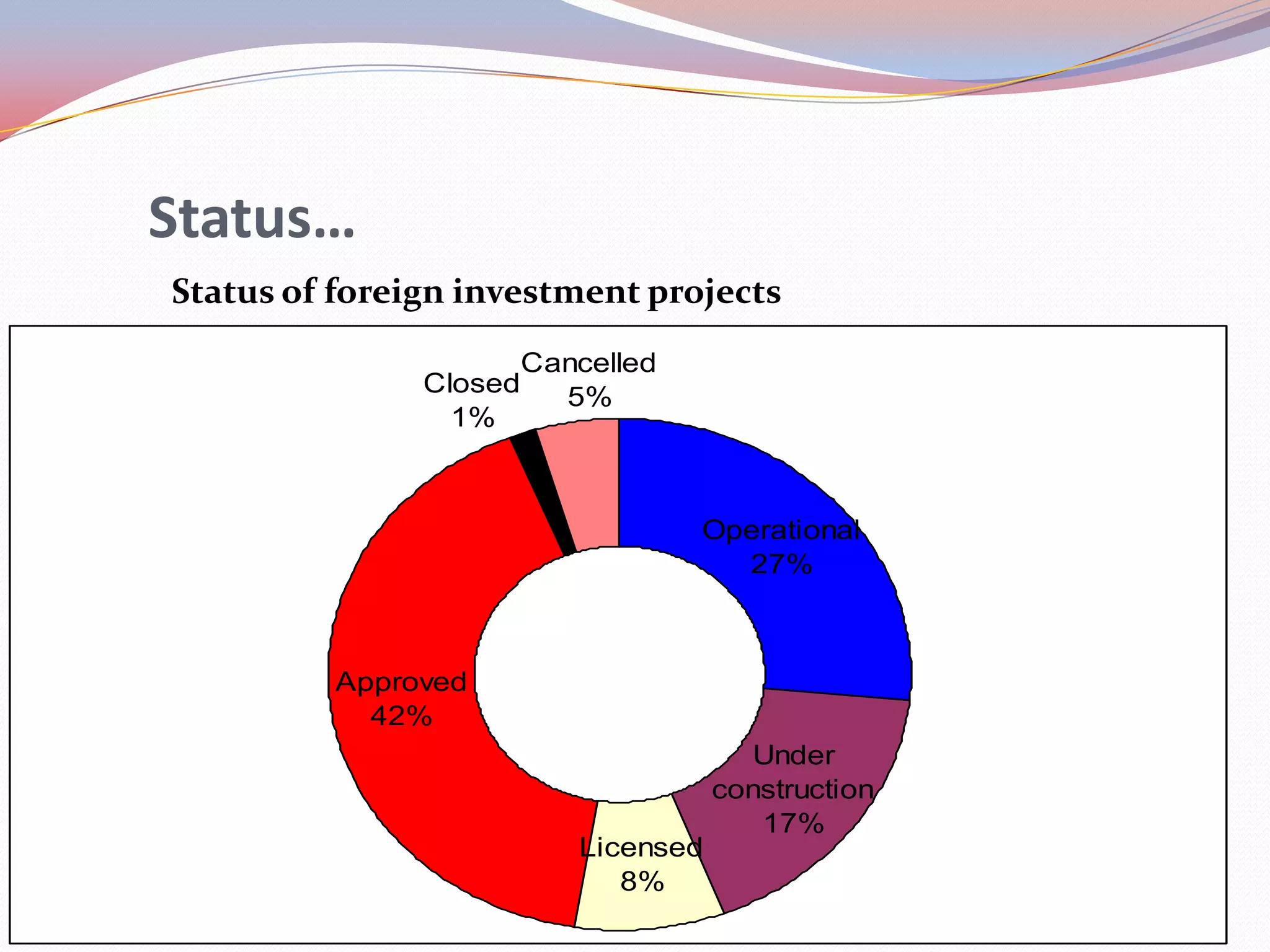
Status of foreign investment projects
                        Cancelled
               Closed     5%
                 1%


                                    Operational
                                      27%


         Approved
           42%
                                         Under
                                      construction
                                         17%
                           Licensed
                              8%
Science and Technology policy
 Nepal adopted the science and technology policy in
  1989.
 Objective was to improve country’s S&T for the over
  all development and scientific creativity.
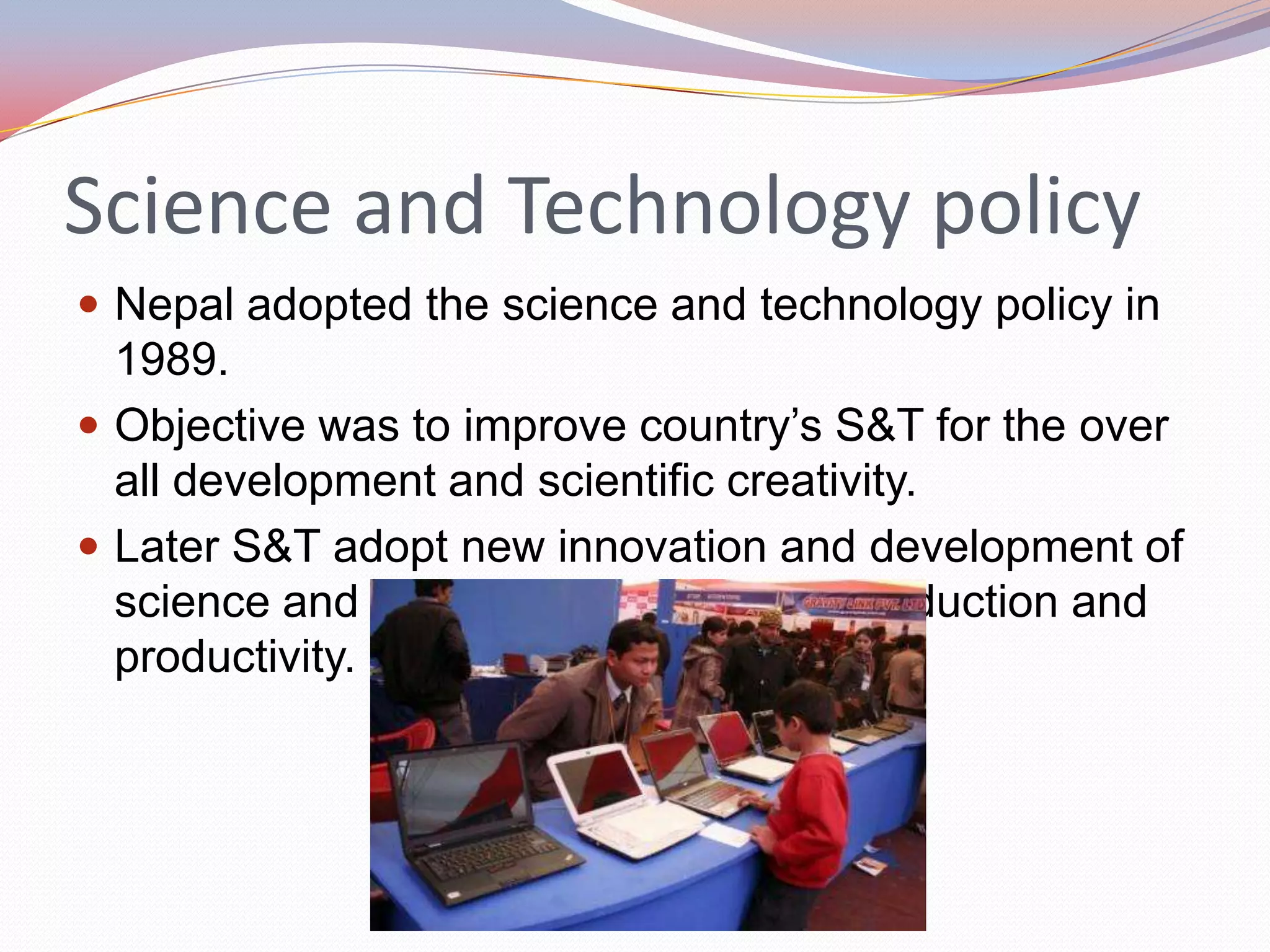
 Later S&T adopt new innovation and development of
  science and technology to increase production and
  productivity.
Science and Technology policy
 The following strategies were adopted for the
 sector:-
  • Development of technologies and services for priority
    areas of socio-economic development.
  • Fulfillment of people’s basic needs.
  • Qualitative development of human resources
 Three Year plan (2010/2013) focused on
   • Ensuring maximum utilization of the resources.
   • Developing and adopting appropriate technology
     through mobilization of private sector.
   • Developing a mechanism to conduct research and
     development activities.
Science and Technology policy
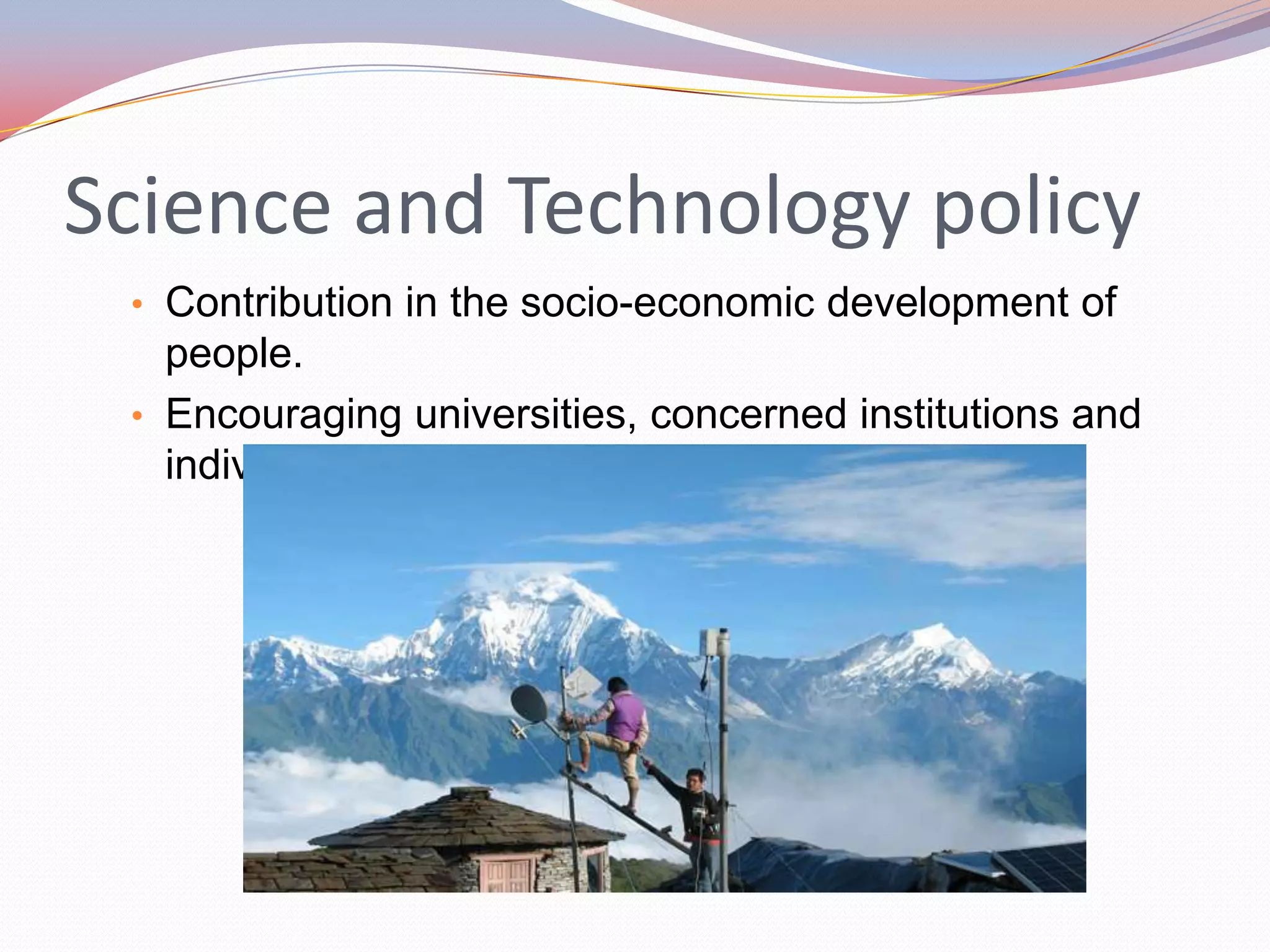
 • Contribution in the socio-economic development of
   people.
 • Encouraging universities, concerned institutions and
   individuals in scientific researches.
Information Technology
 Information technology (IT) is a branch of knowledge
  concerned with the development, management, and
  use of computer-based information systems.
 The term "information technology", or IT, commonly
  refers to computers and computer networks but is
  also used to encompass other information
  distribution technologies such as television and
  telephones etc.
IT policy
 Government adopted Information technology policy
  in 2000.
 The main objectives were:
   To increase employment through reaching IT among
    the general public
   To create knowledge based society
   To established knowledge based industry
IT in Nepal
 In Nepal, Mercantile Office System introduced e-mail
    services in 1993.
   Mercantile Office Systems, the first Internet Service
    Provider (ISP) in Nepal started its services since July
    1995
   Today there are about 30 ISPs in Nepal
   IT mostly limited to urban areas
   Yet due to low costs of computers nowadays, it is
    spreading nation wide gradually
IT in Nepal
 In recent years, the use of Internet has increased in
  the country
 The most web-effected areas of information in Nepal
  are
   Education,
   Travel,
   Tourism, and
   Media
 The past few years have seen an impressive growth
 in Internet use and web-based information dispersal
 in the country
IT in Nepal
 Today, there are about 300,000 users of Internet in
  the country
 However, the majority of the internet users are in the
  Kathmandu valley.
 Yet, it has much scope Nation wide
Technological Environment

Technological Environment

  • 1.
    Presented By: •Adesh Thangden •AnmolPasa Shrestha •Asish Tandukar •Chhitiz Shrestha •Dikshya Acharya
  • 2.
    Nepal  Developing economy:transferring from rural to urban and traditional to modern market oriented  Predominantly agricultural country, about 80 percent populations deriving their livelihood from this sector and the main source of gross domestic production (about 40%)  Literacy rate: 68.2% ( According to the UNDP report 2011)
  • 4.
    Nepal’s economy ata glance US$ 1 Qatar Cote 91,379 142 $1,700 D’Ivoire 2 Luxembourg 89,562 143 Kenya $1,600 United Arab 143 Ghana $1,600 3 Emirates 57,744 143 Benin $1,600 4 Norway 56,920 144 Tanzania $1,500 5 Singapore 56,797 144 Zambia $1,500 United 6 States 47,084 145 Nepal $1200 7 Switzerland 46,424 145 Uganda $1,200 8 Hong Kong 46,333 145 Haiti $1,200 9 Netherlands 42,447 145 Mali $1,200 Burkina 10 Austria 39,711 145 $1,200 Faso 11 Denmark 39,410 146 Rwanda $1,100 12 Australia 39,231 Burma 13 Sweden 38,885 146 $1,100 14 Canada 38,841 146 Ethiopia $1,100 15 Germany 37,622
  • 5.
    Introduction  Technology includesall aspects of applied science for achieving a practical purpose.  Technology is viewed as a means of combining four factors of production( land, labor, capital and knowledge) which increases the ability to create new product from combining these factors.
  • 6.
    Definitions  According toG. Jones And C. Hill : “Technology is the combination of skills and equipments that managers use in the design, production and distribution of goods and services.”  According to R.W. Griffin (2007) :- “Technology is the set of processes and systems used by organizations to convert resources in to products or services”.
  • 7.
    Business and Technology Business and technology are inseparable, and complementary to each other.  Technology advancement increases the production, effective use of resources, and brings opportunity for upgrading business firms.  Technological change leads to improved production of goods and services
  • 8.
    Business and Technology Technology which are related to business are:-  Reduced running costs  Improved productivity  Improved competitiveness  Lower costs per unit of product  Improved quality of service (e.g. speed of service)  Reduced wastage
  • 9.
    Technology and HumanFactor  There are 3 areas which make the effective use of technology and they are:  Production,  Investment, &  Innovation  The capability of technology revolves around its people.  Managers should be skillful for full utilization of technology.
  • 10.
    Technology and HumanFactor  Employee must have ability to acquire new skills.  Technology can cause impact on business firm: • Shutting down of old business • Changes in occupational structure and • Displace of employees
  • 11.
    Status of Technologyin Nepalese Industrial Sector  Research and Development  Exports as Indicators of Technology  Skill base for Technology  Technology transfer
  • 12.
    Research and Development R&D is generally dominated by universities and government research agencies  Industrial sector basically classifies it as “Quality control and Production Engineering” activities  Most industries are dependent on imported and low grade technologies  Less focus is given to the importance of R&D  Only 0.13% of GNP and GDP activities  R&D is classified tax deductible by the government in theory only
  • 13.
    Exports as Indicatorsof Technology  Technological status of a nation can be measured by its export status  Nepalese exports are mainly focused on raw or semi-processed materials  Major exports in the form of finished goods include:  Carpets  Garments  Leather Products  This deficiency is primarily caused due to lack of efficiency and competitiveness
  • 14.
    Skill base forTechnology  Skill base for technology can be gauged by education enrollment statistics  Nepal has witnessed more than 5 decades of educational enrollment yet, enrollment ratio is minimal  The nation needs  Mechanical skills  Electricians  IT Professionals  Chemical Technicians  Business Entrepreneurs  Yet the required level of Human capital is well below the need.
  • 15.
    Technology Transfer  Themost commonly used modalities: FDI via joint ventures, technical collaboration, import of machinery and equipment, technical assistance through human assistance  Other mechanisms -- through license, exchange patents, or a know-how agreement, personal contact etc.
  • 16.
    Technology Transfer inNepal Foreign Investment and Technology Transfer Act, 1992 The Act defines technology transfer as any transfer of technology to be made under an agreement between an industry and a foreign investor on the following matters:  Use of any technological right, specialization, formula, process, patent or technical know-how of foreign origin;  Use of any trademark of foreign ownership;  Acquiring any foreign technical, consultancy, management and marketing service
  • 18.
    Status of TechnologyTransfer (as per 2007) Number of projects with foreign collaboration No. of projects approved 250 200 150 100 50 0 90 91 92 93 94 95 96 97 98 99 00 01 02 03 04 05 06 07 19 19 19 19 19 19 19 19 19 19 20 20 20 20 20 20 20 20 o pt U
  • 19.
    Status… Scale of projects with foreign collaboration 1151 1200 1000 800 Numbers 600 400 199 146 200 0 Large Medium Small Industry category
  • 20.
    Status… Category of projectswith foreign collaboration Construction Energy-based 4% Mineral-based 3% 1% Agro-based 3% Manufacturing 89%
  • 21.
    Status… Status of foreigninvestment projects Cancelled Closed 5% 1% Operational 27% Approved 42% Under construction 17% Licensed 8%
  • 22.
    Science and Technologypolicy  Nepal adopted the science and technology policy in 1989.  Objective was to improve country’s S&T for the over all development and scientific creativity.  Later S&T adopt new innovation and development of science and technology to increase production and productivity.
  • 23.
    Science and Technologypolicy  The following strategies were adopted for the sector:- • Development of technologies and services for priority areas of socio-economic development. • Fulfillment of people’s basic needs. • Qualitative development of human resources  Three Year plan (2010/2013) focused on • Ensuring maximum utilization of the resources. • Developing and adopting appropriate technology through mobilization of private sector. • Developing a mechanism to conduct research and development activities.
  • 24.
    Science and Technologypolicy • Contribution in the socio-economic development of people. • Encouraging universities, concerned institutions and individuals in scientific researches.
  • 25.
    Information Technology  Informationtechnology (IT) is a branch of knowledge concerned with the development, management, and use of computer-based information systems.  The term "information technology", or IT, commonly refers to computers and computer networks but is also used to encompass other information distribution technologies such as television and telephones etc.
  • 26.
    IT policy  Governmentadopted Information technology policy in 2000.  The main objectives were:  To increase employment through reaching IT among the general public  To create knowledge based society  To established knowledge based industry
  • 27.
    IT in Nepal In Nepal, Mercantile Office System introduced e-mail services in 1993.  Mercantile Office Systems, the first Internet Service Provider (ISP) in Nepal started its services since July 1995  Today there are about 30 ISPs in Nepal  IT mostly limited to urban areas  Yet due to low costs of computers nowadays, it is spreading nation wide gradually
  • 28.
    IT in Nepal In recent years, the use of Internet has increased in the country  The most web-effected areas of information in Nepal are  Education,  Travel,  Tourism, and  Media  The past few years have seen an impressive growth in Internet use and web-based information dispersal in the country
  • 29.
    IT in Nepal Today, there are about 300,000 users of Internet in the country  However, the majority of the internet users are in the Kathmandu valley.  Yet, it has much scope Nation wide