Secondary Market
www.kanishgeorge.blogspot.in
SECONDARY MARKET
• Market in which securities already issued by
companies are subsequently traded among
investors.
• Continuous trading.
• The secondary market is that market in which the
buying and selling of the previously issued
securities is done.
• The transactions of the secondary market are
generally done through the medium of stock
exchange.
• The chief purpose of the secondary market is to
create liquidity in securities.
www.kanishgeorge.blogspot.in
• Under Securities Contract Regulation Act
1956, securities trading is regulated by
Central Government;
• Takes place only in stock exchanges
recognized.
• SEBI, Company Law Board and stock
exchanges regulate secondary market.
www.kanishgeorge.blogspot.in
Primary Vs Secondary Market
• Organisation
• Period
• Capital Contribution
• Ownership
• Liquidity
• Seller
www.kanishgeorge.blogspot.in
STOCK EXCHANGE
• Market where securities of joint stock
companies and govt, or semi-govt bodies are
dealt in.
• Securities Contracts (Regulation) Act 1956
• Any body of individuals, whether
incorporated or not constituted for the
purpose of assisting, regulating or controlling
the business of buying, selling or dealing in
securities.
www.kanishgeorge.blogspot.in
STOCK EXCHANGE
• First stock exchange in India- The Native Stock
and Share Brokers Association (Bombay 1875)
• Ahmedabad 1894.
• SCRA 1956.
• G.S Patel Committee 1985
• L C Gupta Committee 1991
• Pherwani Committee 1991
• G S Patel committee 1995
• Varma Committee 1997
• Self regulatory role of Stock exchanges
www.kanishgeorge.blogspot.in
THE ROLE OF STOCK EXCHANGES
• Raising capital for business.
• Mobilizing savings for investment.
• Facilitating companies growth.
• Profit sharing.
• Creating investment opportunities for small
investors.
• Government capital- raising for development
projects.
• Barometer of the economy.www.kanishgeorge.blogspot.in
Functions
• Liquidity and Marketability
• Helps in capital Formation
• Fixation of Prices
• Safety of Funds
• Supply of Long Term Funds
• Motivation for improved performance
• Motivation for investment
• Reflects the general state of economy
www.kanishgeorge.blogspot.in
Listing of Securities
• Enrolment of name in the official trading list
maintained in the stock exchange.
• SCRA rules, SEBI guidelines and rules and
regulations of exchange prescribe the statutory
requirements to be fulfilled by company for
getting its shares listed.
• Sec 73(1) of Companies Act: should make an
application to one or more recognised stock
exchange for listing its securities within the
prescribed time.
• After scrutiny of listing application, a listing
agreement would be executed.
www.kanishgeorge.blogspot.in
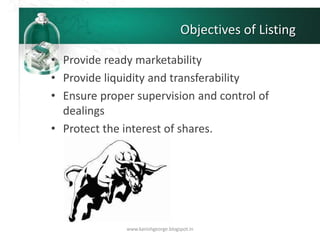
Objectives of Listing
• Provide ready marketability
• Provide liquidity and transferability
• Ensure proper supervision and control of
dealings
• Protect the interest of shares.
www.kanishgeorge.blogspot.in
Listing Obligations
• Annual Listing Fee
– Prescribed initial listing fee and annual listing fee on or
before April 30 each year.
• Regulations of Stock Exchange
– Agrees to comply with rules, byelaws and regulations now
and hereafter.
• Notice of Board Meetings
– Prior intimation at least seven days in advance.
• Book closure notice
– 42 days advance notice, specifying the purpose.
www.kanishgeorge.blogspot.in
• Submission of reports
– Annual reports, B/S, P&L, and all periodical and special
reports
– All notices, resolutions, and circulars relating to new issue
– Notices and call letters of all meetings.
– Proceedings of annual/general body meeting.
– Copies of all notices, circulars etc issued or advertised in
the press.
• Publication of periodical interim statements
– In a form approved by exchange.
• Issue of shares
– Offer shares, securities, rights, benefits to subscribe pro rat
a basis to equity share holders, unless approved in General
meeting, 4 weeks time.
www.kanishgeorge.blogspot.in
• Effecting changes in securities
– 21 days prior notice necessary to
make changes and make
application to stock exchange
• Circulation of Annual results
– Supply a copy of B/S, P&L and
directors report to each share
holder and up on application to any
member of the exchange
• Information of events
– Inform about strikes, lockouts both
at occurrence and cessation
www.kanishgeorge.blogspot.in
• Take over conditions
– Take over regulations of SEBI should be fulfilled.
• Unaudited financial results
– Will be published within one month from the end
of a quarter to the stock exchange
• Corporate governance
– Include separate section on corporate governance
in annual reports
www.kanishgeorge.blogspot.in
Advantages of Listing
• Provides liquidity to the securities of the
company.
• Help investors to evaluate the company through
periodic reports.
• Ensures free transferability of shares.
• Exceptions and concessions available to a widely
held companies are available to listed companies.
• Transactions appear in news papers, provide
information regarding market value of
investments.
www.kanishgeorge.blogspot.in
• Prices determined by demand and supply,
ensures fair prices.
• By compulsory disclosure, the investing public
get valuable information.
• Improves public image and reputation.
• Facilitates to mobilize more funds from
public.
• Listed securities are treated as collateral
securities for loans and advances.
www.kanishgeorge.blogspot.in
Disadvantages of Listing
• Regulatory measures of the stock exchanges
and SEBI.
• Sending notices of annual meeting, annual
reports to a large number of shareholders will
raise cost to the company.
• Submitted periodical reports and vital
information might be used by competitors.
• Public offer itself is expensive.
• Listing does not guarantee price quotations.
www.kanishgeorge.blogspot.in
Minimum Requirements/ Qualifications for Listing
• Minimum Issued capital
– Ministry of finance & Department of
economic affairs: Minimum issued capital 3
crores and minimum public issue 75 Lakhs.
BSE 10 crore
• Payment of excess application money
– Allotment should be done within 30 days of
closure of public issue. 15% p.a interest rate
applicable for further period.
• Listing on multiple exchanges
– Paid up capital of the company above R 5
crores.
www.kanishgeorge.blogspot.in
• The number of shareholders
– For every 1 lakh of fresh capital- at least 10
shareholders
– For sale of existing capital; 20 shareholders.
• Appointment of a market maker
– Paid up capital between ₹ 3 cr and ₹5 cr, to
provide two way quotations for a minimum
period of 18 months.
• Articles of Association
– If veto power to director to overrule majority
decision, not qualified.
www.kanishgeorge.blogspot.in
• Advertisement
– Issue over subscribed/ Thanks to the investing
public for their overwhelming response
• Minimum Subscription
– Rs 5000 (500xRs.10) SEBI; reduced to Rs.2000.
Should be given in Prospectus.
• Applying Mode
– Single name or joint name of not more than
three. Can be made by Limited companies,
corporations, or institutions not by trust or
partnership.
www.kanishgeorge.blogspot.in
• Cost of Public Issue
– Ceiling in the expenditure prescribed by
SEBI
• Public Offer Size
– Size and value should be stated in
prospectus. Whether at premium,
preferential allotment etc should also be
stated.
www.kanishgeorge.blogspot.in
Listing Procedure
• Preliminary discussion
• Articles of association Approval
• Draft prospectus Approval
www.kanishgeorge.blogspot.in
Delisting
• Voluntary delisting
– Listing fee is prohibitive.
– Business sick/ Suspended/ closed.
– Capital base is small.
– Mergers, amalgamations and takeovers.
• Conditions to be fulfilled:
– Company must have incurred losses in the
preceding three years, with net worth less
than the paid up capital.
– Securities have been infrequently traded.
– Securities remain listed at least on the
regional stock exchange.
www.kanishgeorge.blogspot.in
• Compulsory Delisting
– Failed to comply with requirements of
listing agreement.
– Fails to redress the grievances of investors.
– Unfair trade practices of promoters or
managers and malpractices such as issuing
of fake shares by management.
– Thin / negligible shareholding base.
– Trading in securities of the company has
been suspended for more than six months.
www.kanishgeorge.blogspot.in
Trading System
• Floor Trading
– Trading took place through an open outcry
system on the trading floor or ring of the
exchange during official trading hours.
– Buyers and sellers transact business with
broker.
– Brokers transact on behalf of investors.
www.kanishgeorge.blogspot.in
• Screen based Trading
– Fully automated computer mode of
trading.
– Distant participants can trade with each
other.
– Greater transparency
– Quick trading
– Proper matching of orders to buy and sell
– Easy and paperless trading through demat
accounts
www.kanishgeorge.blogspot.in
Quote driven system
• Market maker inputs two way quotes into the
system
– Bid price
– Offer price
• Participants place orders based on bid-offer
quotes.
• These are automatically matched by the
system according to certain rules.
www.kanishgeorge.blogspot.in
Order driven system
• Clients place their buy and sell orders with
the brokers.
• Orders feed in to the system.
• The buy and sell orders are automatically
matched by the system according to
predetermined rules.
www.kanishgeorge.blogspot.in
Types of Orders
• Market Orders
– Broker is instructed by investor to buy or
sell a stated number of shares immediately
at the best prevailing price in the market.
– Buy order- lowest price obtainable
– Sell order- highest price obtainable
– Investor will be certain about execution;
uncertain about price.
www.kanishgeorge.blogspot.in
• Limit Orders
– Investor specifies the limit price.
– Limit buy order- maximum price that he
will pay for the share; order executed at
limit price or lower price.
– Limit sell order- minimum price he will
accept for shares; order executed at
limited price or higher price.
– Limit prices are away from the market
price
www.kanishgeorge.blogspot.in
• Stop orders (Stop loss order)
– To protect a profit or limit a loss.
– In sell order, stop price will be below the
market price.
– Buy order, stop price will be above the
market price.
– It is a conditional market order, it becomes
a market order when the market price
reaches or passes the stop price.
www.kanishgeorge.blogspot.in
• Stop limit orders (Conditional limit order)
– The investor specifies two prices, a stop
price and a limit price.
– When the market price reaches the stop
price, the order becomes the limit order to
be executed within the limit price.
www.kanishgeorge.blogspot.in
• Day order
• Week order
• Month order
• Open orders ( GTC)
• Fill or Kill Orders (FoK)
www.kanishgeorge.blogspot.in
Settlement
• Execution of orders
– Buy orders are matched with sell orders.
• Settlement of trade
– Delivery of security and payment of cash.
– Functioned by clearing house.
• Clearing house acts as counter party.
• “Account Period Settlement”
• “Compulsory Rolling Settlement”
www.kanishgeorge.blogspot.in
• Trades executed on a particular day are
settled after a specified number of business
days.
• T + 5, T + 3, now T + 2.
• On the first business day (T+1) exchange
generates delivery and receive orders for
transactions done by member brokers along
with a money statement.
• Can be downloaded by member brokers.
www.kanishgeorge.blogspot.in

Secondary Market

  • 1.
  • 2.
    SECONDARY MARKET • Marketin which securities already issued by companies are subsequently traded among investors. • Continuous trading. • The secondary market is that market in which the buying and selling of the previously issued securities is done. • The transactions of the secondary market are generally done through the medium of stock exchange. • The chief purpose of the secondary market is to create liquidity in securities. www.kanishgeorge.blogspot.in
  • 3.
    • Under SecuritiesContract Regulation Act 1956, securities trading is regulated by Central Government; • Takes place only in stock exchanges recognized. • SEBI, Company Law Board and stock exchanges regulate secondary market. www.kanishgeorge.blogspot.in
  • 4.
    Primary Vs SecondaryMarket • Organisation • Period • Capital Contribution • Ownership • Liquidity • Seller www.kanishgeorge.blogspot.in
  • 5.
    STOCK EXCHANGE • Marketwhere securities of joint stock companies and govt, or semi-govt bodies are dealt in. • Securities Contracts (Regulation) Act 1956 • Any body of individuals, whether incorporated or not constituted for the purpose of assisting, regulating or controlling the business of buying, selling or dealing in securities. www.kanishgeorge.blogspot.in
  • 6.
    STOCK EXCHANGE • Firststock exchange in India- The Native Stock and Share Brokers Association (Bombay 1875) • Ahmedabad 1894. • SCRA 1956. • G.S Patel Committee 1985 • L C Gupta Committee 1991 • Pherwani Committee 1991 • G S Patel committee 1995 • Varma Committee 1997 • Self regulatory role of Stock exchanges www.kanishgeorge.blogspot.in
  • 7.
    THE ROLE OFSTOCK EXCHANGES • Raising capital for business. • Mobilizing savings for investment. • Facilitating companies growth. • Profit sharing. • Creating investment opportunities for small investors. • Government capital- raising for development projects. • Barometer of the economy.www.kanishgeorge.blogspot.in
  • 8.
    Functions • Liquidity andMarketability • Helps in capital Formation • Fixation of Prices • Safety of Funds • Supply of Long Term Funds • Motivation for improved performance • Motivation for investment • Reflects the general state of economy www.kanishgeorge.blogspot.in
  • 9.
    Listing of Securities •Enrolment of name in the official trading list maintained in the stock exchange. • SCRA rules, SEBI guidelines and rules and regulations of exchange prescribe the statutory requirements to be fulfilled by company for getting its shares listed. • Sec 73(1) of Companies Act: should make an application to one or more recognised stock exchange for listing its securities within the prescribed time. • After scrutiny of listing application, a listing agreement would be executed. www.kanishgeorge.blogspot.in
  • 10.
    Objectives of Listing •Provide ready marketability • Provide liquidity and transferability • Ensure proper supervision and control of dealings • Protect the interest of shares. www.kanishgeorge.blogspot.in
  • 11.
    Listing Obligations • AnnualListing Fee – Prescribed initial listing fee and annual listing fee on or before April 30 each year. • Regulations of Stock Exchange – Agrees to comply with rules, byelaws and regulations now and hereafter. • Notice of Board Meetings – Prior intimation at least seven days in advance. • Book closure notice – 42 days advance notice, specifying the purpose. www.kanishgeorge.blogspot.in
  • 12.
    • Submission ofreports – Annual reports, B/S, P&L, and all periodical and special reports – All notices, resolutions, and circulars relating to new issue – Notices and call letters of all meetings. – Proceedings of annual/general body meeting. – Copies of all notices, circulars etc issued or advertised in the press. • Publication of periodical interim statements – In a form approved by exchange. • Issue of shares – Offer shares, securities, rights, benefits to subscribe pro rat a basis to equity share holders, unless approved in General meeting, 4 weeks time. www.kanishgeorge.blogspot.in
  • 13.
    • Effecting changesin securities – 21 days prior notice necessary to make changes and make application to stock exchange • Circulation of Annual results – Supply a copy of B/S, P&L and directors report to each share holder and up on application to any member of the exchange • Information of events – Inform about strikes, lockouts both at occurrence and cessation www.kanishgeorge.blogspot.in
  • 14.
    • Take overconditions – Take over regulations of SEBI should be fulfilled. • Unaudited financial results – Will be published within one month from the end of a quarter to the stock exchange • Corporate governance – Include separate section on corporate governance in annual reports www.kanishgeorge.blogspot.in
  • 15.
    Advantages of Listing •Provides liquidity to the securities of the company. • Help investors to evaluate the company through periodic reports. • Ensures free transferability of shares. • Exceptions and concessions available to a widely held companies are available to listed companies. • Transactions appear in news papers, provide information regarding market value of investments. www.kanishgeorge.blogspot.in
  • 16.
    • Prices determinedby demand and supply, ensures fair prices. • By compulsory disclosure, the investing public get valuable information. • Improves public image and reputation. • Facilitates to mobilize more funds from public. • Listed securities are treated as collateral securities for loans and advances. www.kanishgeorge.blogspot.in
  • 17.
    Disadvantages of Listing •Regulatory measures of the stock exchanges and SEBI. • Sending notices of annual meeting, annual reports to a large number of shareholders will raise cost to the company. • Submitted periodical reports and vital information might be used by competitors. • Public offer itself is expensive. • Listing does not guarantee price quotations. www.kanishgeorge.blogspot.in
  • 18.
    Minimum Requirements/ Qualificationsfor Listing • Minimum Issued capital – Ministry of finance & Department of economic affairs: Minimum issued capital 3 crores and minimum public issue 75 Lakhs. BSE 10 crore • Payment of excess application money – Allotment should be done within 30 days of closure of public issue. 15% p.a interest rate applicable for further period. • Listing on multiple exchanges – Paid up capital of the company above R 5 crores. www.kanishgeorge.blogspot.in
  • 19.
    • The numberof shareholders – For every 1 lakh of fresh capital- at least 10 shareholders – For sale of existing capital; 20 shareholders. • Appointment of a market maker – Paid up capital between ₹ 3 cr and ₹5 cr, to provide two way quotations for a minimum period of 18 months. • Articles of Association – If veto power to director to overrule majority decision, not qualified. www.kanishgeorge.blogspot.in
  • 20.
    • Advertisement – Issueover subscribed/ Thanks to the investing public for their overwhelming response • Minimum Subscription – Rs 5000 (500xRs.10) SEBI; reduced to Rs.2000. Should be given in Prospectus. • Applying Mode – Single name or joint name of not more than three. Can be made by Limited companies, corporations, or institutions not by trust or partnership. www.kanishgeorge.blogspot.in
  • 21.
    • Cost ofPublic Issue – Ceiling in the expenditure prescribed by SEBI • Public Offer Size – Size and value should be stated in prospectus. Whether at premium, preferential allotment etc should also be stated. www.kanishgeorge.blogspot.in
  • 22.
    Listing Procedure • Preliminarydiscussion • Articles of association Approval • Draft prospectus Approval www.kanishgeorge.blogspot.in
  • 23.
    Delisting • Voluntary delisting –Listing fee is prohibitive. – Business sick/ Suspended/ closed. – Capital base is small. – Mergers, amalgamations and takeovers. • Conditions to be fulfilled: – Company must have incurred losses in the preceding three years, with net worth less than the paid up capital. – Securities have been infrequently traded. – Securities remain listed at least on the regional stock exchange. www.kanishgeorge.blogspot.in
  • 24.
    • Compulsory Delisting –Failed to comply with requirements of listing agreement. – Fails to redress the grievances of investors. – Unfair trade practices of promoters or managers and malpractices such as issuing of fake shares by management. – Thin / negligible shareholding base. – Trading in securities of the company has been suspended for more than six months. www.kanishgeorge.blogspot.in
  • 25.
    Trading System • FloorTrading – Trading took place through an open outcry system on the trading floor or ring of the exchange during official trading hours. – Buyers and sellers transact business with broker. – Brokers transact on behalf of investors. www.kanishgeorge.blogspot.in
  • 26.
    • Screen basedTrading – Fully automated computer mode of trading. – Distant participants can trade with each other. – Greater transparency – Quick trading – Proper matching of orders to buy and sell – Easy and paperless trading through demat accounts www.kanishgeorge.blogspot.in
  • 27.
    Quote driven system •Market maker inputs two way quotes into the system – Bid price – Offer price • Participants place orders based on bid-offer quotes. • These are automatically matched by the system according to certain rules. www.kanishgeorge.blogspot.in
  • 28.
    Order driven system •Clients place their buy and sell orders with the brokers. • Orders feed in to the system. • The buy and sell orders are automatically matched by the system according to predetermined rules. www.kanishgeorge.blogspot.in
  • 29.
    Types of Orders •Market Orders – Broker is instructed by investor to buy or sell a stated number of shares immediately at the best prevailing price in the market. – Buy order- lowest price obtainable – Sell order- highest price obtainable – Investor will be certain about execution; uncertain about price. www.kanishgeorge.blogspot.in
  • 30.
    • Limit Orders –Investor specifies the limit price. – Limit buy order- maximum price that he will pay for the share; order executed at limit price or lower price. – Limit sell order- minimum price he will accept for shares; order executed at limited price or higher price. – Limit prices are away from the market price www.kanishgeorge.blogspot.in
  • 31.
    • Stop orders(Stop loss order) – To protect a profit or limit a loss. – In sell order, stop price will be below the market price. – Buy order, stop price will be above the market price. – It is a conditional market order, it becomes a market order when the market price reaches or passes the stop price. www.kanishgeorge.blogspot.in
  • 32.
    • Stop limitorders (Conditional limit order) – The investor specifies two prices, a stop price and a limit price. – When the market price reaches the stop price, the order becomes the limit order to be executed within the limit price. www.kanishgeorge.blogspot.in
  • 33.
    • Day order •Week order • Month order • Open orders ( GTC) • Fill or Kill Orders (FoK) www.kanishgeorge.blogspot.in
  • 34.
    Settlement • Execution oforders – Buy orders are matched with sell orders. • Settlement of trade – Delivery of security and payment of cash. – Functioned by clearing house. • Clearing house acts as counter party. • “Account Period Settlement” • “Compulsory Rolling Settlement” www.kanishgeorge.blogspot.in
  • 35.
    • Trades executedon a particular day are settled after a specified number of business days. • T + 5, T + 3, now T + 2. • On the first business day (T+1) exchange generates delivery and receive orders for transactions done by member brokers along with a money statement. • Can be downloaded by member brokers. www.kanishgeorge.blogspot.in

Editor's Notes

  • #9 Transparent, rules and byelaws.
  • #12 Fulfil following obligations Basis of capital of the company on march 31st. On or bfor 30 april. Prior notice on board meeting declaration of dividend, byback of shares etc. 7 days in advance.
  • #20 Prevent undue concentration of large holdings BSE 10 and 5.
  • #27 Two types: Quote driven system Order driven system
  • #31 Buy: limit price below the market price Sell: above market price Floor price and ceiling price
  • #34 All orders are day orders unless stated. Good till cancelled
  • #36 Settlement of transaction done on Trade day has to be done on the second business day after the trade. Bank accounts authorised by clearing houses on day 2.