Primary Eye Care and
Community Participation
Dr. Saman Wimalasundera MBBS, DO, PhD
Senior lecturer in community medicine
& community ophthalmologist
Community Ophthalmology center
Department of community medicine
P.O.Box 70,
Galle
Sri Lanka
Primary eye care and
community participation
Delivery of primary eye care has its specific
roles and targets in the community and good
community participation is an essential
component in the successful prevention of
blindness program.
Primary eye care is the primary health
care approach to the prevention of
blindness.
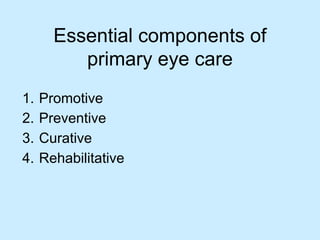
Essential components of
primary eye care
1. Promotive
2. Preventive
3. Curative
4. Rehabilitative
(1) Promotive eye care
1.Creating and awareness of the
blinding diseases existing in the
community and the ways of preventing
or curing it.
2.How to use the available recourses to
overcome the problems.
(2) Preventive eye care
1.Motivation of individuals and their
communities to participate in blindness
prevention activities.
2.Social and community development that
promotes health
3.Change of behavior and environment
Examples
❖ Provision of adequate safe water.
construction of latrines &refuse pits
❖ maintenance of environmental
hygiene.
❖ Consumption of food rich in vitamin A.
❖ Care for individuals at risk.
❖ Prevention of measles, malnutrition and
diarrhea in children
❖ Protection of eyes against injuries.
❖ Immunization (E.g. Measles)
❖ Screening of antenatal mothers for sexually
transmitted diseases.
❖ Family planning
(3) Curative activities
1. To carry out treatment procedures for simple
common diseases that lead to blindness or
impaired vision if not treated
e.g. corneal ulcers, refractive errors etc.
2. First aid treatment for eye injuries.
3.Timely referral to secondary level.
4.Identification of potentially blinding disease
conditions for proper management
5.Identification of curable blinding diseases
e.g.cataract and referral for treatment
(4) Rehabilitative activities
Target group: Incurably blind people
What can the primary eye care workers
do to them ?
They should be assured that they are
not
completely useless
Some carefully selected appropriate
training should be given to them to
acquire some skills
Make them functional and do not allow
to depend on the others totally.
Development of primary eye
care program
A good primary Eye care Program will depend
on :
(1) existing health care services and availability
of trained health care workers (Manpower)
(2) Political and professional motivation
(3) Resources for training, to conduct programs
and to monitor it.
(4) Supplies for primary eye care workers.
(5) Funding for capital and recurrent expenditure.
(6) Close liaison with secondary and tertiary
centers
(7) Careful Planning and evaluation
Basic equipment essential for
PEC program
• Snellens chart and pinhole
• Hand magnifying lens
• Good source of light (Torch with
batteries)
• Eye dressings
• Teaching materials
Different Types of Primary Eye care
Programs that can be used in the
community
• Depend on the need of the local community
and available resources
1. Need assessment Programs
2. Screening for blinding diseases
3. Comprehensive care Eye camps
4. Out reach Surgical Camps
5. Health Education Programs
Sustainability of the PEC
programs
Depend on the following areas
1. Technical sustainability :- Training
of technical staff
2. Financial sustainability :-
Continuous allocation of funds necessary
3. Operational sustainability :-
Monitoring of the activities regularly.
Community Participation
Ottawa charter and health
promotion
In 1986 an international conference
called Ottawa charter adopts five principal
elements that improve health promotion.
The Five principals are
1. Healthy public policy
2. Personnel skills development
3. Community participation
4. Healthy and supportive environment
5. Re-organization of health services
Community participation is a major
emphasis in eye health promotion.
The promotion of eye health and to
reduce the risk of blindness though
community ophthalmology needs good
community participation
Community participation is
influenced by
1. Community beliefs and perceptions
2. Motivation of people in the community
3. Awareness of the problems related to
blindness
Community participation can
be improved by
1. Encouraging the people with early
symptoms by their families to attend to
available health services
2. By creating and awareness through
health education programs
- Mass media programs
- Through volunteers or community
health workers by small group
discussions
- Through community leaders
- Self help groups
- Improving education of children
through schools
Community participation
enhances eye health
1. By attending to the community health
programs for early detection
2. By following treatment procedures until
full recovery
3. By adopting changes in life style that
encourages eye health
4. By improving the living environment in
the communities to reduce the risk of
transmission of eye diseases
5. By creating a community demand by
the people of the community to develop
infra structure facilities by policy makers
that improves eye care services.
There is a high demand for a
community based approach in the
prevention of blindness. That needs
proper community participation.

COMMUNITY EYE CARE, Community optometry.

  • 1.
    Primary Eye Careand Community Participation Dr. Saman Wimalasundera MBBS, DO, PhD Senior lecturer in community medicine & community ophthalmologist Community Ophthalmology center Department of community medicine P.O.Box 70, Galle Sri Lanka
  • 2.
    Primary eye careand community participation Delivery of primary eye care has its specific roles and targets in the community and good community participation is an essential component in the successful prevention of blindness program.
  • 3.
    Primary eye careis the primary health care approach to the prevention of blindness.
  • 4.
    Essential components of primaryeye care 1. Promotive 2. Preventive 3. Curative 4. Rehabilitative
  • 5.
    (1) Promotive eyecare 1.Creating and awareness of the blinding diseases existing in the community and the ways of preventing or curing it. 2.How to use the available recourses to overcome the problems.
  • 6.
    (2) Preventive eyecare 1.Motivation of individuals and their communities to participate in blindness prevention activities. 2.Social and community development that promotes health 3.Change of behavior and environment
  • 7.
    Examples ❖ Provision ofadequate safe water. construction of latrines &refuse pits ❖ maintenance of environmental hygiene. ❖ Consumption of food rich in vitamin A. ❖ Care for individuals at risk.
  • 8.
    ❖ Prevention ofmeasles, malnutrition and diarrhea in children ❖ Protection of eyes against injuries. ❖ Immunization (E.g. Measles) ❖ Screening of antenatal mothers for sexually transmitted diseases. ❖ Family planning
  • 9.
    (3) Curative activities 1.To carry out treatment procedures for simple common diseases that lead to blindness or impaired vision if not treated e.g. corneal ulcers, refractive errors etc. 2. First aid treatment for eye injuries. 3.Timely referral to secondary level. 4.Identification of potentially blinding disease conditions for proper management 5.Identification of curable blinding diseases e.g.cataract and referral for treatment
  • 10.
    (4) Rehabilitative activities Targetgroup: Incurably blind people What can the primary eye care workers do to them ? They should be assured that they are not completely useless
  • 11.
    Some carefully selectedappropriate training should be given to them to acquire some skills Make them functional and do not allow to depend on the others totally.
  • 12.
    Development of primaryeye care program A good primary Eye care Program will depend on : (1) existing health care services and availability of trained health care workers (Manpower) (2) Political and professional motivation
  • 13.
    (3) Resources fortraining, to conduct programs and to monitor it. (4) Supplies for primary eye care workers. (5) Funding for capital and recurrent expenditure. (6) Close liaison with secondary and tertiary centers (7) Careful Planning and evaluation
  • 14.
    Basic equipment essentialfor PEC program • Snellens chart and pinhole • Hand magnifying lens • Good source of light (Torch with batteries) • Eye dressings • Teaching materials
  • 15.
    Different Types ofPrimary Eye care Programs that can be used in the community • Depend on the need of the local community and available resources 1. Need assessment Programs 2. Screening for blinding diseases 3. Comprehensive care Eye camps 4. Out reach Surgical Camps 5. Health Education Programs
  • 16.
    Sustainability of thePEC programs Depend on the following areas 1. Technical sustainability :- Training of technical staff 2. Financial sustainability :- Continuous allocation of funds necessary 3. Operational sustainability :- Monitoring of the activities regularly.
  • 17.
  • 18.
    Ottawa charter andhealth promotion In 1986 an international conference called Ottawa charter adopts five principal elements that improve health promotion.
  • 19.
    The Five principalsare 1. Healthy public policy 2. Personnel skills development 3. Community participation 4. Healthy and supportive environment 5. Re-organization of health services Community participation is a major emphasis in eye health promotion.
  • 20.
    The promotion ofeye health and to reduce the risk of blindness though community ophthalmology needs good community participation
  • 21.
    Community participation is influencedby 1. Community beliefs and perceptions 2. Motivation of people in the community 3. Awareness of the problems related to blindness
  • 22.
    Community participation can beimproved by 1. Encouraging the people with early symptoms by their families to attend to available health services
  • 23.
    2. By creatingand awareness through health education programs - Mass media programs - Through volunteers or community health workers by small group discussions - Through community leaders - Self help groups - Improving education of children through schools
  • 24.
    Community participation enhances eyehealth 1. By attending to the community health programs for early detection 2. By following treatment procedures until full recovery
  • 25.
    3. By adoptingchanges in life style that encourages eye health 4. By improving the living environment in the communities to reduce the risk of transmission of eye diseases 5. By creating a community demand by the people of the community to develop infra structure facilities by policy makers that improves eye care services.
  • 26.
    There is ahigh demand for a community based approach in the prevention of blindness. That needs proper community participation.