JBCHimalaya Eye Hospital, Pokhara JBC
Disorder of Lids and Red Eye
J.B.Chand DCEHJ.B.Chand DCEH
Himalaya Eye HospitalHimalaya Eye Hospital
Pokhara, NepalPokhara, Nepal
June 28, 2014 Disorder of Lids and Red Eye 2
JBCHimalaya Eye Hospital, Pokhara JBC
Blepharitis
• Chronic inflammation of eye lid margins usually caused by
staphylococcus
• Aetiology: Dryness of mucus membrane (Sicca) and
overactivity of the sebaceous glands, resulting in an excessive
amount of sebum (Seborrhae)
• Clinical features: Itching in eye lids, gritty and foreign body
sensation, dandruff, scalps in eye lid margin in squamos type and
pus point with sore in ulcerative type
• Complication: Thickened eye lid and loss of eye lashes
• Treatment: Control scalp dandruff when present, clean lashes
routinely, apply antibiotic ointment to lashes
• Lid hygiene and artificial tear
June 28, 2014 Disorder of Lids and Red Eye 3
JBCHimalaya Eye Hospital, Pokhara JBC
Blepharitis
June 28, 2014 Disorder of Lids and Red Eye 4
JBCHimalaya Eye Hospital, Pokhara JBC
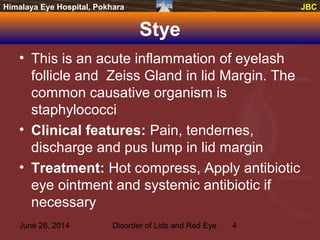
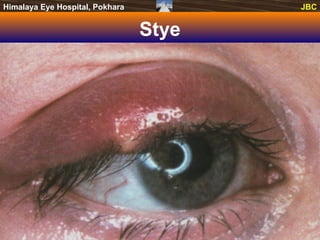
Stye
• This is an acute inflammation of eyelash
follicle and Zeiss Gland in lid Margin. The
common causative organism is
staphylococci
• Clinical features: Pain, tendernes,
discharge and pus lump in lid margin
• Treatment: Hot compress, Apply antibiotic
eye ointment and systemic antibiotic if
necessary
June 28, 2014 Disorder of Lids and Red Eye 5
JBCHimalaya Eye Hospital, Pokhara JBC
Stye
June 28, 2014 Disorder of Lids and Red Eye 6
JBCHimalaya Eye Hospital, Pokhara JBC
Chalazion
• Non inflammatory granuloma of
mebomian gland
• Appears as painless lump or cyst in
mebomian gland
• Sometime disappears it self after hot
compress.
• Refer to eye hospital for I & C.
June 28, 2014 Disorder of Lids and Red Eye 7
JBCHimalaya Eye Hospital, Pokhara JBC
Chalazion
June 28, 2014 Disorder of Lids and Red Eye 8
JBCHimalaya Eye Hospital, Pokhara JBC
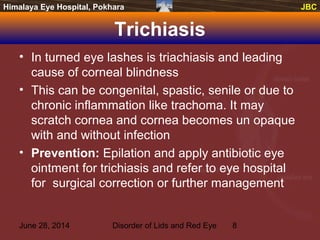
Trichiasis
• In turned eye lashes is triachiasis and leading
cause of corneal blindness
• This can be congenital, spastic, senile or due to
chronic inflammation like trachoma. It may
scratch cornea and cornea becomes un opaque
with and without infection
• Prevention: Epilation and apply antibiotic eye
ointment for trichiasis and refer to eye hospital
for surgical correction or further management
June 28, 2014 Disorder of Lids and Red Eye 9
JBCHimalaya Eye Hospital, Pokhara JBC
Entropion
• In turned lid is entropion
• This can be congenital, spastic, senile or due to
chronic inflammation like trachoma. It may
scratch cornea and cornea becomes un opaque
with and without infection
• Prevention: Apply antibiotic eye ointment and
refer to eye hospital for surgical correction or
further management
June 28, 2014 Disorder of Lids and Red Eye 10
JBCHimalaya Eye Hospital, Pokhara JBC
Triachisis / Entropion
June 28, 2014 Disorder of Lids and Red Eye 11
JBCHimalaya Eye Hospital, Pokhara JBC
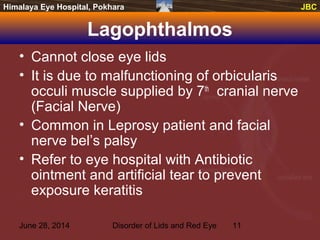
Lagophthalmos
• Cannot close eye lids
• It is due to malfunctioning of orbicularis
occuli muscle supplied by 7th
cranial nerve
(Facial Nerve)
• Common in Leprosy patient and facial
nerve bel’s palsy
• Refer to eye hospital with Antibiotic
ointment and artificial tear to prevent
exposure keratitis
June 28, 2014 Disorder of Lids and Red Eye 12
JBCHimalaya Eye Hospital, Pokhara JBC
Lagophthalmos
June 28, 2014 Disorder of Lids and Red Eye 13
JBCHimalaya Eye Hospital, Pokhara JBC
Ptosis
• Drooping of eye lids (Can not open the
eye lids) This is usually due to congenital
defect or due to trauma in 3rd
cranial nerve
(Oculomoter) or aponeurosis supplying
levator muscle of eyelid.
• Complication: Loss of vision and
amblyopia.
• Treatment: Refer to eye hospital for
surgical correction
June 28, 2014 Disorder of Lids and Red Eye 14
JBCHimalaya Eye Hospital, Pokhara JBC
Ptosis
June 28, 2014 Disorder of Lids and Red Eye 15
JBCHimalaya Eye Hospital, Pokhara JBC
Dacryocystitis
• Infection of lacrimal sac secondary to obstruction
of lacrimal passage.
• Clinical features: Sudden onset of pain,
tenderness and epiphora
• Treatment: Systemic topical Antibiotic and
analgesic resolves the immediate problem.
Refer to Primary Eye Care Center/Eye Hospital
if condition does not improves.
June 28, 2014 Disorder of Lids and Red Eye 16
JBCHimalaya Eye Hospital, Pokhara JBC
Acute Dacryocystits
June 28, 2014 Disorder of Lids and Red Eye 17
JBCHimalaya Eye Hospital, Pokhara JBC
Orbital Cellulitis
• Bacterial infection of soft tissue behind
orbital septum:
• Clinical Features: Fever, chemosis
(conjunctival edema), proptosis, diplopia
(extraocular muscle involved), and lid
edema.
• Treatment: Refer immediately with
broad spectrum systemic Antibiotics. Be
aware: Could spread to cavernous
sinus.
June 28, 2014 Disorder of Lids and Red Eye 18
JBCHimalaya Eye Hospital, Pokhara JBC
Orbital Cellulitis
June 28, 2014 Disorder of Lids and Red Eye 19
JBCHimalaya Eye Hospital, Pokhara JBC
Red Eye
June 28, 2014 Disorder of Lids and Red Eye 20
JBCHimalaya Eye Hospital, Pokhara JBC
Ophthalmia Neonatorum
• The eye infection of infant age below 4 weeks. This is usually due
to the infection spread in to eye from mother’s infected vaginal
track while birth
• Can cause blind
• The common causative organisms are Chalamydia and Nisseria
Gonococi
• Type: Infective and chemical
• Clinical feature: Swelling of eye lid, watering, and purulent
discharge from eye
• Complication: Corneal involvement are frequent in Gonococi
type, which leads to corneal ulcer
• Frequent installation of broad spectrum antibiotic eye drop,
Tetracycline eye ointment and or Gentamycine/Tobramycine eye
drop.
• Refer parents for VDRL Check-ups
June 28, 2014 Disorder of Lids and Red Eye 21
JBCHimalaya Eye Hospital, Pokhara JBC
Ophthalmia Neonatorum
June 28, 2014 Disorder of Lids and Red Eye 22
JBCHimalaya Eye Hospital, Pokhara JBC
Conjunctivitis - Infective
• Inflammation of conjunctiva
• Usually communicable and easily transmits to other person from
contamination of ocular discharge
• Common causative organism, Bacteria, virus and Chalmydia
• It is important to prevent transmission. Do not share towel,
handkerchief and pillow of the infected patients. Wash hand properly
after cleaning and after contacting infected eyes
• Redness, Muco/purulent discharge, sticky eye, grittiness
• Frequent cleaning of eye and antibiotic usually Chloramphenicol 2
hrly for 5 days resolves the condition. In some types cornea may
involved
• Refer immediately to nearest eye hospital/center if patient have
photophobia, pain and loss of vision
June 28, 2014 Disorder of Lids and Red Eye 23
JBCHimalaya Eye Hospital, Pokhara JBC
Conjunctivitis - Infective
June 28, 2014 Disorder of Lids and Red Eye 24
JBCHimalaya Eye Hospital, Pokhara JBC
Haemorrhagic Conjunctivitis
June 28, 2014 Disorder of Lids and Red Eye 25
JBCHimalaya Eye Hospital, Pokhara JBC
Conjunctivitis - Allergic
• This is usually appears in grown-up children and
is seasonal. Most of the time it disappears after
running season
• Clinical features: Itching redness and ropy
discharge are common feature
• Treatment: Cold compress and anti-allergy/anti-
histamine eye drop will be helpful to resolve the
symptoms
• Refer to eye hospital in the condition of
photophobia and not improving with treatment
June 28, 2014 Disorder of Lids and Red Eye 26
JBCHimalaya Eye Hospital, Pokhara JBC
Phlyctenular conjunctivitis
Vernal conjunctivitis
Palpebral
Bulbar
Allergic Conjunctivitis
June 28, 2014 Disorder of Lids and Red Eye 27
JBCHimalaya Eye Hospital, Pokhara JBC
Follicles-papillae
Papillary hypertrophyPapillary hypertrophy
Follicles-lower fornixFollicles-lower fornix
Follicles-upper tarsalFollicles-upper tarsal
conjunctivaconjunctiva
June 28, 2014 Disorder of Lids and Red Eye 28
JBCHimalaya Eye Hospital, Pokhara JBC
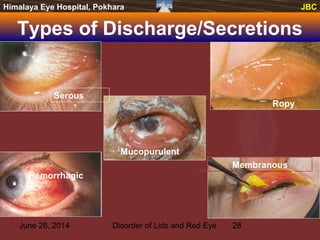
Types of Discharge/Secretions
Serous
Mucopurulent
Hemorrhagic
Ropy
Membranous
June 28, 2014 Disorder of Lids and Red Eye 29
JBCHimalaya Eye Hospital, Pokhara JBC
Fornicial Congestion
June 28, 2014 Disorder of Lids and Red Eye 30
JBCHimalaya Eye Hospital, Pokhara JBC
Phlyctenular - Conjunctivitis
• Triangular whitish nodule in limbal area.
Common in children. This is usually due to
endogenous reaction to tubercular protein or
exogenous organism bacterial infection mainly
staphylococcus
• Clinical features : Pain, tenderness, localised
red and whitish nodules in the limbal area
• Treatment : Treat with antibiotic (Tetracycline)
eye ointment
• Refer to nearest eye hospital if not resolves
within five days and pain associated with
photophobia and loss of vision.
June 28, 2014 Disorder of Lids and Red Eye 31
JBCHimalaya Eye Hospital, Pokhara JBC
Phlycten
June 28, 2014 Disorder of Lids and Red Eye 32
JBCHimalaya Eye Hospital, Pokhara JBC
Pterygium
• This is fibrovascular growth of sub conjunctival
tissue towards the cornea.
• More common with the people living in dry, dusty
and hot climate
• Chronic dryness of eye id another cause
• Treatment: Surgical excision should be
performed if 2/3 of cornea is involved
• Chances of recurrence
• Surgery should be performed once it becomes
vision threatening
June 28, 2014 Disorder of Lids and Red Eye 33
JBCHimalaya Eye Hospital, Pokhara JBC
Pterygium
June 28, 2014 Disorder of Lids and Red Eye 34
JBCHimalaya Eye Hospital, Pokhara JBC
Corneal ulcer
• Discontinuation of corneal epithelium, cellular
infiltration and tissue necrosis
• The common causative organism can be
bacteria, virus and fungus
• Investigation: Fluorscein stain and refer to
eye hospital
• Grams/geimsa stain, culture and sensitivity test
June 28, 2014 Disorder of Lids and Red Eye 35
JBCHimalaya Eye Hospital, Pokhara JBC
Corneal ulcer
• Clinical features: Grayish infiltration appears in
cornea Circum corneal congestion associated
with pain tenderness, photophobia and loss of
vision
– Bacterial ulcer are more virulent type with
mucopurulent discharge
– Viral are more chronic with geographical and branch
lesions with serous discharge
– Fungal are more chronic and less virulent
• Treatment: Topical broad-spectrum antibiotic
eye drop/ointment hourly. Immediate Refer to
eye hopital/center
June 28, 2014 Disorder of Lids and Red Eye 36
JBCHimalaya Eye Hospital, Pokhara JBC
Corneal Ulcer
June 28, 2014 Disorder of Lids and Red Eye 37
JBCHimalaya Eye Hospital, Pokhara JBC
Episcleritis/Scleritis
• Inflammation of Epiclera/Sclera.
• Clinical features: Localized swelling , pain and
tenderness in episcleritis and more diffuse
swelling and inflammation in scleritis
• Treatment: NSAID locally and systemically will
resolve the immediate problem.
• Recurrences are frequent
• Refer if it does not improve
June 28, 2014 Disorder of Lids and Red Eye 38
JBCHimalaya Eye Hospital, Pokhara JBC
Episcleritis/Scleritis
June 28, 2014 Disorder of Lids and Red Eye 39
JBCHimalaya Eye Hospital, Pokhara JBC
Anterior Uveitis
• This is inflammation of anterior vascular layer
(Iris and ciliary body) of the eye
• Classification:
– Anatomical
• Anterior,
• Intermediate,
• Posterior
– Clinical:
• Acute,
• Chronic
– Aetiological
• Exogenous,
• Endogenous (Sarcoidosis, Tuberculosis, Herpes Zoster)
June 28, 2014 Disorder of Lids and Red Eye 40
JBCHimalaya Eye Hospital, Pokhara JBC
Anterior Uveitis
Posterior Synechia
KPsPosterior Synechia
Occulsio Pupilae
June 28, 2014 Disorder of Lids and Red Eye 41
JBCHimalaya Eye Hospital, Pokhara JBC
Uveitis
• Symptoms :
– Pain, Tenderness, Loss of vision, Photophobia
• Signs:
– Circum ciliary congestion, Irregular and constriction
pupil, Flares and cells in AC, Posterior synechia and
Nodules in iris
– Usually unilateral
• Treatment : Requires thorough investigation
• Refer to eye hospital/centrs
June 28, 2014 Disorder of Lids and Red Eye 42
JBCHimalaya Eye Hospital, Pokhara JBC
Acute Angle Glaucoma
• Glaucoma is a condition in which optic
nerve fibres are damaged due to raised
intra-ocular pressure
• Clinical features: Pain, watering,
photophobia, halos, loss of vision, nausea,
vomiting, circum ciliary congestion, hazy
cornea, fix and dilated pupil, raised IOP
and shallow anterior chamber
• Refer immediately to eye hospital
June 28, 2014 Disorder of Lids and Red Eye 43
JBCHimalaya Eye Hospital, Pokhara JBC
Acute Angle Glaucoma
June 28, 2014 Disorder of Lids and Red Eye 44
JBCHimalaya Eye Hospital, Pokhara JBC
Thank You
With Raute Girls in DailekhWith Raute Girls in Dailekh

Ocular disorder

  • 1.
    JBCHimalaya Eye Hospital,Pokhara JBC Disorder of Lids and Red Eye J.B.Chand DCEHJ.B.Chand DCEH Himalaya Eye HospitalHimalaya Eye Hospital Pokhara, NepalPokhara, Nepal
  • 2.
    June 28, 2014Disorder of Lids and Red Eye 2 JBCHimalaya Eye Hospital, Pokhara JBC Blepharitis • Chronic inflammation of eye lid margins usually caused by staphylococcus • Aetiology: Dryness of mucus membrane (Sicca) and overactivity of the sebaceous glands, resulting in an excessive amount of sebum (Seborrhae) • Clinical features: Itching in eye lids, gritty and foreign body sensation, dandruff, scalps in eye lid margin in squamos type and pus point with sore in ulcerative type • Complication: Thickened eye lid and loss of eye lashes • Treatment: Control scalp dandruff when present, clean lashes routinely, apply antibiotic ointment to lashes • Lid hygiene and artificial tear
  • 3.
    June 28, 2014Disorder of Lids and Red Eye 3 JBCHimalaya Eye Hospital, Pokhara JBC Blepharitis
  • 4.
    June 28, 2014Disorder of Lids and Red Eye 4 JBCHimalaya Eye Hospital, Pokhara JBC Stye • This is an acute inflammation of eyelash follicle and Zeiss Gland in lid Margin. The common causative organism is staphylococci • Clinical features: Pain, tendernes, discharge and pus lump in lid margin • Treatment: Hot compress, Apply antibiotic eye ointment and systemic antibiotic if necessary
  • 5.
    June 28, 2014Disorder of Lids and Red Eye 5 JBCHimalaya Eye Hospital, Pokhara JBC Stye
  • 6.
    June 28, 2014Disorder of Lids and Red Eye 6 JBCHimalaya Eye Hospital, Pokhara JBC Chalazion • Non inflammatory granuloma of mebomian gland • Appears as painless lump or cyst in mebomian gland • Sometime disappears it self after hot compress. • Refer to eye hospital for I & C.
  • 7.
    June 28, 2014Disorder of Lids and Red Eye 7 JBCHimalaya Eye Hospital, Pokhara JBC Chalazion
  • 8.
    June 28, 2014Disorder of Lids and Red Eye 8 JBCHimalaya Eye Hospital, Pokhara JBC Trichiasis • In turned eye lashes is triachiasis and leading cause of corneal blindness • This can be congenital, spastic, senile or due to chronic inflammation like trachoma. It may scratch cornea and cornea becomes un opaque with and without infection • Prevention: Epilation and apply antibiotic eye ointment for trichiasis and refer to eye hospital for surgical correction or further management
  • 9.
    June 28, 2014Disorder of Lids and Red Eye 9 JBCHimalaya Eye Hospital, Pokhara JBC Entropion • In turned lid is entropion • This can be congenital, spastic, senile or due to chronic inflammation like trachoma. It may scratch cornea and cornea becomes un opaque with and without infection • Prevention: Apply antibiotic eye ointment and refer to eye hospital for surgical correction or further management
  • 10.
    June 28, 2014Disorder of Lids and Red Eye 10 JBCHimalaya Eye Hospital, Pokhara JBC Triachisis / Entropion
  • 11.
    June 28, 2014Disorder of Lids and Red Eye 11 JBCHimalaya Eye Hospital, Pokhara JBC Lagophthalmos • Cannot close eye lids • It is due to malfunctioning of orbicularis occuli muscle supplied by 7th cranial nerve (Facial Nerve) • Common in Leprosy patient and facial nerve bel’s palsy • Refer to eye hospital with Antibiotic ointment and artificial tear to prevent exposure keratitis
  • 12.
    June 28, 2014Disorder of Lids and Red Eye 12 JBCHimalaya Eye Hospital, Pokhara JBC Lagophthalmos
  • 13.
    June 28, 2014Disorder of Lids and Red Eye 13 JBCHimalaya Eye Hospital, Pokhara JBC Ptosis • Drooping of eye lids (Can not open the eye lids) This is usually due to congenital defect or due to trauma in 3rd cranial nerve (Oculomoter) or aponeurosis supplying levator muscle of eyelid. • Complication: Loss of vision and amblyopia. • Treatment: Refer to eye hospital for surgical correction
  • 14.
    June 28, 2014Disorder of Lids and Red Eye 14 JBCHimalaya Eye Hospital, Pokhara JBC Ptosis
  • 15.
    June 28, 2014Disorder of Lids and Red Eye 15 JBCHimalaya Eye Hospital, Pokhara JBC Dacryocystitis • Infection of lacrimal sac secondary to obstruction of lacrimal passage. • Clinical features: Sudden onset of pain, tenderness and epiphora • Treatment: Systemic topical Antibiotic and analgesic resolves the immediate problem. Refer to Primary Eye Care Center/Eye Hospital if condition does not improves.
  • 16.
    June 28, 2014Disorder of Lids and Red Eye 16 JBCHimalaya Eye Hospital, Pokhara JBC Acute Dacryocystits
  • 17.
    June 28, 2014Disorder of Lids and Red Eye 17 JBCHimalaya Eye Hospital, Pokhara JBC Orbital Cellulitis • Bacterial infection of soft tissue behind orbital septum: • Clinical Features: Fever, chemosis (conjunctival edema), proptosis, diplopia (extraocular muscle involved), and lid edema. • Treatment: Refer immediately with broad spectrum systemic Antibiotics. Be aware: Could spread to cavernous sinus.
  • 18.
    June 28, 2014Disorder of Lids and Red Eye 18 JBCHimalaya Eye Hospital, Pokhara JBC Orbital Cellulitis
  • 19.
    June 28, 2014Disorder of Lids and Red Eye 19 JBCHimalaya Eye Hospital, Pokhara JBC Red Eye
  • 20.
    June 28, 2014Disorder of Lids and Red Eye 20 JBCHimalaya Eye Hospital, Pokhara JBC Ophthalmia Neonatorum • The eye infection of infant age below 4 weeks. This is usually due to the infection spread in to eye from mother’s infected vaginal track while birth • Can cause blind • The common causative organisms are Chalamydia and Nisseria Gonococi • Type: Infective and chemical • Clinical feature: Swelling of eye lid, watering, and purulent discharge from eye • Complication: Corneal involvement are frequent in Gonococi type, which leads to corneal ulcer • Frequent installation of broad spectrum antibiotic eye drop, Tetracycline eye ointment and or Gentamycine/Tobramycine eye drop. • Refer parents for VDRL Check-ups
  • 21.
    June 28, 2014Disorder of Lids and Red Eye 21 JBCHimalaya Eye Hospital, Pokhara JBC Ophthalmia Neonatorum
  • 22.
    June 28, 2014Disorder of Lids and Red Eye 22 JBCHimalaya Eye Hospital, Pokhara JBC Conjunctivitis - Infective • Inflammation of conjunctiva • Usually communicable and easily transmits to other person from contamination of ocular discharge • Common causative organism, Bacteria, virus and Chalmydia • It is important to prevent transmission. Do not share towel, handkerchief and pillow of the infected patients. Wash hand properly after cleaning and after contacting infected eyes • Redness, Muco/purulent discharge, sticky eye, grittiness • Frequent cleaning of eye and antibiotic usually Chloramphenicol 2 hrly for 5 days resolves the condition. In some types cornea may involved • Refer immediately to nearest eye hospital/center if patient have photophobia, pain and loss of vision
  • 23.
    June 28, 2014Disorder of Lids and Red Eye 23 JBCHimalaya Eye Hospital, Pokhara JBC Conjunctivitis - Infective
  • 24.
    June 28, 2014Disorder of Lids and Red Eye 24 JBCHimalaya Eye Hospital, Pokhara JBC Haemorrhagic Conjunctivitis
  • 25.
    June 28, 2014Disorder of Lids and Red Eye 25 JBCHimalaya Eye Hospital, Pokhara JBC Conjunctivitis - Allergic • This is usually appears in grown-up children and is seasonal. Most of the time it disappears after running season • Clinical features: Itching redness and ropy discharge are common feature • Treatment: Cold compress and anti-allergy/anti- histamine eye drop will be helpful to resolve the symptoms • Refer to eye hospital in the condition of photophobia and not improving with treatment
  • 26.
    June 28, 2014Disorder of Lids and Red Eye 26 JBCHimalaya Eye Hospital, Pokhara JBC Phlyctenular conjunctivitis Vernal conjunctivitis Palpebral Bulbar Allergic Conjunctivitis
  • 27.
    June 28, 2014Disorder of Lids and Red Eye 27 JBCHimalaya Eye Hospital, Pokhara JBC Follicles-papillae Papillary hypertrophyPapillary hypertrophy Follicles-lower fornixFollicles-lower fornix Follicles-upper tarsalFollicles-upper tarsal conjunctivaconjunctiva
  • 28.
    June 28, 2014Disorder of Lids and Red Eye 28 JBCHimalaya Eye Hospital, Pokhara JBC Types of Discharge/Secretions Serous Mucopurulent Hemorrhagic Ropy Membranous
  • 29.
    June 28, 2014Disorder of Lids and Red Eye 29 JBCHimalaya Eye Hospital, Pokhara JBC Fornicial Congestion
  • 30.
    June 28, 2014Disorder of Lids and Red Eye 30 JBCHimalaya Eye Hospital, Pokhara JBC Phlyctenular - Conjunctivitis • Triangular whitish nodule in limbal area. Common in children. This is usually due to endogenous reaction to tubercular protein or exogenous organism bacterial infection mainly staphylococcus • Clinical features : Pain, tenderness, localised red and whitish nodules in the limbal area • Treatment : Treat with antibiotic (Tetracycline) eye ointment • Refer to nearest eye hospital if not resolves within five days and pain associated with photophobia and loss of vision.
  • 31.
    June 28, 2014Disorder of Lids and Red Eye 31 JBCHimalaya Eye Hospital, Pokhara JBC Phlycten
  • 32.
    June 28, 2014Disorder of Lids and Red Eye 32 JBCHimalaya Eye Hospital, Pokhara JBC Pterygium • This is fibrovascular growth of sub conjunctival tissue towards the cornea. • More common with the people living in dry, dusty and hot climate • Chronic dryness of eye id another cause • Treatment: Surgical excision should be performed if 2/3 of cornea is involved • Chances of recurrence • Surgery should be performed once it becomes vision threatening
  • 33.
    June 28, 2014Disorder of Lids and Red Eye 33 JBCHimalaya Eye Hospital, Pokhara JBC Pterygium
  • 34.
    June 28, 2014Disorder of Lids and Red Eye 34 JBCHimalaya Eye Hospital, Pokhara JBC Corneal ulcer • Discontinuation of corneal epithelium, cellular infiltration and tissue necrosis • The common causative organism can be bacteria, virus and fungus • Investigation: Fluorscein stain and refer to eye hospital • Grams/geimsa stain, culture and sensitivity test
  • 35.
    June 28, 2014Disorder of Lids and Red Eye 35 JBCHimalaya Eye Hospital, Pokhara JBC Corneal ulcer • Clinical features: Grayish infiltration appears in cornea Circum corneal congestion associated with pain tenderness, photophobia and loss of vision – Bacterial ulcer are more virulent type with mucopurulent discharge – Viral are more chronic with geographical and branch lesions with serous discharge – Fungal are more chronic and less virulent • Treatment: Topical broad-spectrum antibiotic eye drop/ointment hourly. Immediate Refer to eye hopital/center
  • 36.
    June 28, 2014Disorder of Lids and Red Eye 36 JBCHimalaya Eye Hospital, Pokhara JBC Corneal Ulcer
  • 37.
    June 28, 2014Disorder of Lids and Red Eye 37 JBCHimalaya Eye Hospital, Pokhara JBC Episcleritis/Scleritis • Inflammation of Epiclera/Sclera. • Clinical features: Localized swelling , pain and tenderness in episcleritis and more diffuse swelling and inflammation in scleritis • Treatment: NSAID locally and systemically will resolve the immediate problem. • Recurrences are frequent • Refer if it does not improve
  • 38.
    June 28, 2014Disorder of Lids and Red Eye 38 JBCHimalaya Eye Hospital, Pokhara JBC Episcleritis/Scleritis
  • 39.
    June 28, 2014Disorder of Lids and Red Eye 39 JBCHimalaya Eye Hospital, Pokhara JBC Anterior Uveitis • This is inflammation of anterior vascular layer (Iris and ciliary body) of the eye • Classification: – Anatomical • Anterior, • Intermediate, • Posterior – Clinical: • Acute, • Chronic – Aetiological • Exogenous, • Endogenous (Sarcoidosis, Tuberculosis, Herpes Zoster)
  • 40.
    June 28, 2014Disorder of Lids and Red Eye 40 JBCHimalaya Eye Hospital, Pokhara JBC Anterior Uveitis Posterior Synechia KPsPosterior Synechia Occulsio Pupilae
  • 41.
    June 28, 2014Disorder of Lids and Red Eye 41 JBCHimalaya Eye Hospital, Pokhara JBC Uveitis • Symptoms : – Pain, Tenderness, Loss of vision, Photophobia • Signs: – Circum ciliary congestion, Irregular and constriction pupil, Flares and cells in AC, Posterior synechia and Nodules in iris – Usually unilateral • Treatment : Requires thorough investigation • Refer to eye hospital/centrs
  • 42.
    June 28, 2014Disorder of Lids and Red Eye 42 JBCHimalaya Eye Hospital, Pokhara JBC Acute Angle Glaucoma • Glaucoma is a condition in which optic nerve fibres are damaged due to raised intra-ocular pressure • Clinical features: Pain, watering, photophobia, halos, loss of vision, nausea, vomiting, circum ciliary congestion, hazy cornea, fix and dilated pupil, raised IOP and shallow anterior chamber • Refer immediately to eye hospital
  • 43.
    June 28, 2014Disorder of Lids and Red Eye 43 JBCHimalaya Eye Hospital, Pokhara JBC Acute Angle Glaucoma
  • 44.
    June 28, 2014Disorder of Lids and Red Eye 44 JBCHimalaya Eye Hospital, Pokhara JBC Thank You With Raute Girls in DailekhWith Raute Girls in Dailekh