Primary Secondary and
Tertiary Eye Care
Nayab Farhana B.optom
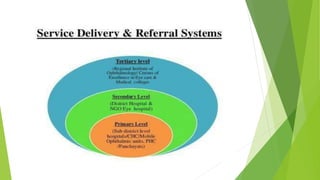
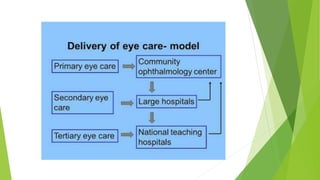
Primary Eye care
 Primary eye care (PEC) is an integral part of comprehensive eye care. It is
targeted not only towards preventing blindness and visual impairment, but also
towards providing services to redress ocular morbidity. PEC is a frontline
activity, providing care and identifying disease before it becomes a serious
medical condition. Primary eye care is delivered in many different ways.
However, it all aims at making eye care services available within reach of the
community. In the long run this allows each better penetration of services and
reduced cost for the patient.
Components of primary eye care
 Eye health education
 Symptom identification
 Visual acuity measurement
 Basic eye examination
 Diagnosis
 Timely referral
Secondary Eye care
 Secondary care includes acute care: necessary treatment
for a short period of time for a brief but serious illness,
injury or other eye health condition. Such as management
of diseases like cataract, glaucoma, trachoma etc at
secondary level i.e hostipals.
Tertiary Eye Care
 Tertiary care is specialized consultative health care,
usually for in patients and on referral from a primary or
secondary health professional, in a facility that has
personnel and facilities for advanced medical investigation
and treatment, such as a tertiary referral hospitals.
 Centralized at a major health care complex.
 A medical teaching hospitals, eye hospitals or eye centres.
Concept of Primary health Care
 The concept of primary health care (PHC) was introduced
in 1978 in Alma-Ata. It was envisaged as a solution to reach
the unreached in poor rural populations of many developing
countries. It was said that it would be made universally
accessible to individuals and families in the community
through their full participation.
• PHC is:
Essential health care based on practical, scientifically
sound and socially acceptable methods and technology
made universally accessible to individuals and families in
the community through their full participation and at a cost
that community and the country can afford … (Alma-Ata,
1978)
Principles for PHC
• PHC based on the following principles :
– Social equity
– Nation-wide coverage
– Self-reliance
– Inter-sectoral coordination
– People’s involvement in the planning and
implementation of health programs
Principles of PHC
The 1978 Declaration of Alma-Ata proposed a set of
PRINCIPLES for primary health care. PHC should:
1. “Reflect and evolve from the economic conditions and
socio-cultural and political characteristics of the country
and its communities, and be based on the application of
the relevant results of social, biomedical and health
services research and public health experience”
2. “Address the main health problems in the community,
providing promotive, preventive, curative and
rehabilitative services accordingly”
3. “Involve, in addition to the health sector, all related sectors
and aspects of national and community development, in
particular agriculture, animal husbandry, food, industry,
education, housing, public works,
4. “Promote maximum community and individual self-reliance
and participation in the planning, organization, operation
and control of primary health care, making fullest use of
local, national and other available resources; and to this
end develop through appropriate education the ability of
communities to participate”
5. “Be sustained by integrated, functional and mutually-supportive
referral systems, leading to the progressive improvement of
comprehensive health care for all, and giving priority to those
most in need”
6. “Rely, at local and referral levels, on health workers, including
physicians, nurses, midwives, auxiliaries and community
workers as applicable, as well as traditional practitioners as
needed, suitably trained socially and technically to work as a
health team and to respond to the expressed health needs of the
community.”
Core activities of PHC
 Primary eye care (PEC) is a broad concept,
encompassing the prevention of potentially blinding eye
diseases through primary health care (PHC). PEC
includes the identification, with treatment or referral, of
individuals with treatable causes of blindness; and the
diagnosis and treatment of common eye diseases,
particularly those causing an acute red eye.
 The principles of PHC should all apply in primary eye
care. If many of the eight essential elements of PHC are
applied, this would contribute significantly to the
prevention of eye diseases and blindness.
The eight essential elements of PHC are as
follows:
• Education concerning main health problems
• Promotion of food supply and good nutrition
• Adequate supply of safe water and basic
sanitation
• Maternal and child health, and family planning
• Immunisation against major infectious diseases
• Prevention and control of local endemic
diseases
• Appropriate treatment of common diseases
and injuries
• Provision of essential drugs.
WHO Guidelines for Primary Eye Care
1.Conditions to be recognised and treated by a trained primary health care
worker
 Conjunctivitis and lid infections
 Acute conjunctivitis
 Ophthalmia neonatorum
 Trachoma
 Allergic and irritative conjunctivitis
 Lid lesions, e.g., stye and chalazion
 Trauma
 Subconjunctival haemorrhages
 Superficial foreign body
 Blunt trauma
 Blinding malnutrition
2. Conditions to be recognised and referred after treatment has been
initiated
•Corneal ulcers
•Lacerating or perforating injuries of the eyeball
•Lid lacerations
•Entropion/trichiasis
•Burns: chemical, thermal
3. Conditions that should be recognised and referred for treatment
Painful red eye with visual loss
Cataract
Pterygium
Visual loss; <6/18 in either eye
Importance of PHC
Why exactly is primary care important?
 Through routine check-ups, primary care can head potentially serious
problems off at the pass.
 primary care is important because it lowers costs, too. People who have a
primary care provider save 33% on healthcare over their peers who only see
specialists. Access to primary care helps keep people out of emergency
rooms, where care costs at least four times as much other outpatient care
 A study in a North Carolina ER found that nearly 60% of the patients’
problems could have been addressed in a primary care clinic for a savings of
a whopping 320-720% – that’s a value of three to seven times less.
 Catching and treating problems early, which happens during annual check-
ups, is also cheaper than treating severe or advanced illness, which often
bring patients to specialists
Conclusion
Primary care is an approach that:
 Focuses on the person not the disease, considers all
determinants of health
 Integrates care when there is more than one problem
 Uses resources to narrow differences.
 Forms the basis for other levels of health systems
 Addresses most important problems in the community by
providing preventive, curative, and rehabilitative services
 Organizes deployment of resources aiming at promoting
and maintaining health.
Reference
 Integrated model of primary and secondary eye care for underserved rural
areas: The L V Prasad Eye Institute experience - www.ijo.in
 Essentials components of primary health care - www.nih.in
 Primary care: an increasingly important contributor to effectiveness, equity, and
efficiency of health services. SESPAS report 2012 – www.sciencedirect.com
 Importance and value: why primary care important –
www.primarycareprogress.org.
 Primary healthcare – wikipedia.org
 Community health - slideshare
Thank you

Primary secindary and tertiary eye care

  • 1.
    Primary Secondary and TertiaryEye Care Nayab Farhana B.optom
  • 2.
    Primary Eye care Primary eye care (PEC) is an integral part of comprehensive eye care. It is targeted not only towards preventing blindness and visual impairment, but also towards providing services to redress ocular morbidity. PEC is a frontline activity, providing care and identifying disease before it becomes a serious medical condition. Primary eye care is delivered in many different ways. However, it all aims at making eye care services available within reach of the community. In the long run this allows each better penetration of services and reduced cost for the patient. Components of primary eye care  Eye health education  Symptom identification  Visual acuity measurement  Basic eye examination  Diagnosis  Timely referral
  • 3.
    Secondary Eye care Secondary care includes acute care: necessary treatment for a short period of time for a brief but serious illness, injury or other eye health condition. Such as management of diseases like cataract, glaucoma, trachoma etc at secondary level i.e hostipals.
  • 4.
    Tertiary Eye Care Tertiary care is specialized consultative health care, usually for in patients and on referral from a primary or secondary health professional, in a facility that has personnel and facilities for advanced medical investigation and treatment, such as a tertiary referral hospitals.  Centralized at a major health care complex.  A medical teaching hospitals, eye hospitals or eye centres.
  • 7.
    Concept of Primaryhealth Care  The concept of primary health care (PHC) was introduced in 1978 in Alma-Ata. It was envisaged as a solution to reach the unreached in poor rural populations of many developing countries. It was said that it would be made universally accessible to individuals and families in the community through their full participation. • PHC is: Essential health care based on practical, scientifically sound and socially acceptable methods and technology made universally accessible to individuals and families in the community through their full participation and at a cost that community and the country can afford … (Alma-Ata, 1978)
  • 8.
    Principles for PHC •PHC based on the following principles : – Social equity – Nation-wide coverage – Self-reliance – Inter-sectoral coordination – People’s involvement in the planning and implementation of health programs
  • 9.
    Principles of PHC The1978 Declaration of Alma-Ata proposed a set of PRINCIPLES for primary health care. PHC should: 1. “Reflect and evolve from the economic conditions and socio-cultural and political characteristics of the country and its communities, and be based on the application of the relevant results of social, biomedical and health services research and public health experience” 2. “Address the main health problems in the community, providing promotive, preventive, curative and rehabilitative services accordingly”
  • 10.
    3. “Involve, inaddition to the health sector, all related sectors and aspects of national and community development, in particular agriculture, animal husbandry, food, industry, education, housing, public works, 4. “Promote maximum community and individual self-reliance and participation in the planning, organization, operation and control of primary health care, making fullest use of local, national and other available resources; and to this end develop through appropriate education the ability of communities to participate”
  • 11.
    5. “Be sustainedby integrated, functional and mutually-supportive referral systems, leading to the progressive improvement of comprehensive health care for all, and giving priority to those most in need” 6. “Rely, at local and referral levels, on health workers, including physicians, nurses, midwives, auxiliaries and community workers as applicable, as well as traditional practitioners as needed, suitably trained socially and technically to work as a health team and to respond to the expressed health needs of the community.”
  • 12.
    Core activities ofPHC  Primary eye care (PEC) is a broad concept, encompassing the prevention of potentially blinding eye diseases through primary health care (PHC). PEC includes the identification, with treatment or referral, of individuals with treatable causes of blindness; and the diagnosis and treatment of common eye diseases, particularly those causing an acute red eye.  The principles of PHC should all apply in primary eye care. If many of the eight essential elements of PHC are applied, this would contribute significantly to the prevention of eye diseases and blindness.
  • 13.
    The eight essentialelements of PHC are as follows: • Education concerning main health problems • Promotion of food supply and good nutrition • Adequate supply of safe water and basic sanitation • Maternal and child health, and family planning • Immunisation against major infectious diseases • Prevention and control of local endemic diseases • Appropriate treatment of common diseases and injuries • Provision of essential drugs.
  • 15.
    WHO Guidelines forPrimary Eye Care 1.Conditions to be recognised and treated by a trained primary health care worker  Conjunctivitis and lid infections  Acute conjunctivitis  Ophthalmia neonatorum  Trachoma  Allergic and irritative conjunctivitis  Lid lesions, e.g., stye and chalazion  Trauma  Subconjunctival haemorrhages  Superficial foreign body  Blunt trauma  Blinding malnutrition
  • 16.
    2. Conditions tobe recognised and referred after treatment has been initiated •Corneal ulcers •Lacerating or perforating injuries of the eyeball •Lid lacerations •Entropion/trichiasis •Burns: chemical, thermal 3. Conditions that should be recognised and referred for treatment Painful red eye with visual loss Cataract Pterygium Visual loss; <6/18 in either eye
  • 17.
    Importance of PHC Whyexactly is primary care important?  Through routine check-ups, primary care can head potentially serious problems off at the pass.  primary care is important because it lowers costs, too. People who have a primary care provider save 33% on healthcare over their peers who only see specialists. Access to primary care helps keep people out of emergency rooms, where care costs at least four times as much other outpatient care  A study in a North Carolina ER found that nearly 60% of the patients’ problems could have been addressed in a primary care clinic for a savings of a whopping 320-720% – that’s a value of three to seven times less.  Catching and treating problems early, which happens during annual check- ups, is also cheaper than treating severe or advanced illness, which often bring patients to specialists
  • 18.
    Conclusion Primary care isan approach that:  Focuses on the person not the disease, considers all determinants of health  Integrates care when there is more than one problem  Uses resources to narrow differences.  Forms the basis for other levels of health systems  Addresses most important problems in the community by providing preventive, curative, and rehabilitative services  Organizes deployment of resources aiming at promoting and maintaining health.
  • 19.
    Reference  Integrated modelof primary and secondary eye care for underserved rural areas: The L V Prasad Eye Institute experience - www.ijo.in  Essentials components of primary health care - www.nih.in  Primary care: an increasingly important contributor to effectiveness, equity, and efficiency of health services. SESPAS report 2012 – www.sciencedirect.com  Importance and value: why primary care important – www.primarycareprogress.org.  Primary healthcare – wikipedia.org  Community health - slideshare
  • 20.