Prepared by
Mussab jaffar
Farhad Rafique
Muhammad
yousaf
farooq bashir
Khalid nawaz









1) What are prills and Prillings
2)Why we are studying prillings
3) Prilling Tower…?
4)what are grains and granulation
5)why we study granulation
6) Granulator…?
7) And their Industrial applications
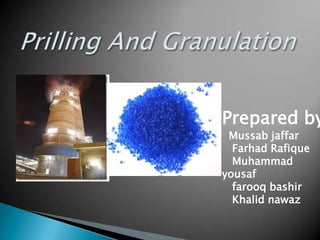
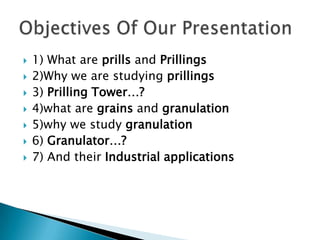
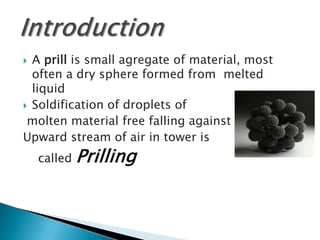
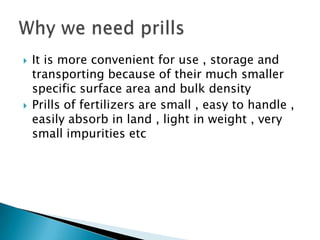
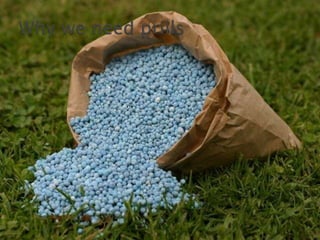
A prill is small agregate of material, most
often a dry sphere formed from melted
liquid
 Soldification of droplets of
molten material free falling against
Upward stream of air in tower is


called

Prilling




It is more convenient for use , storage and
transporting because of their much smaller
specific surface area and bulk density
Prills of fertilizers are small , easy to handle ,
easily absorb in land , light in weight , very
small impurities etc




The melt must be sprayed into droplets
uniform size as required
The sprayed droplets must be fully solidified
and cooled in order to avoid bonding of
particles with each other and caking on wall




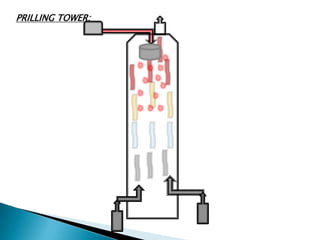
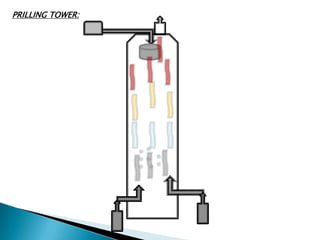
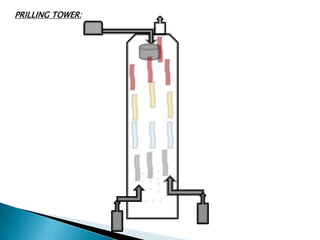
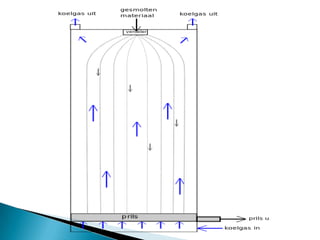
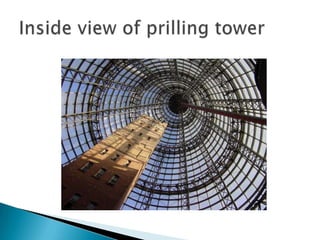
It is cylindrical vertical tower with average
hight 75 m , in which urea prilling take place
with huge diameter it has two prill sections

One is at top from where molten fertilizer
comes and other one at bottom from where
prills are collected






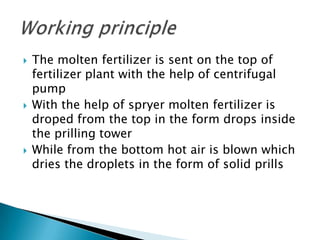
The molten fertilizer is sent on the top of
fertilizer plant with the help of centrifugal
pump
With the help of spryer molten fertilizer is
droped from the top in the form drops inside
the prilling tower
While from the bottom hot air is blown which
dries the droplets in the form of solid prills
PRILLING TOWER:
PRILLING TOWER:
PRILLING TOWER:






This process is widely used in manufacturing
of ammonium nitrate, calcium nitrate and
fertilizers of N,K and P
Prilling also used in explosives industry to
produce porous prills of amonium nitrate
which will absorb oil
Typical prilling tower produce 200 ton/day of
fertilizer






In order to produce large size fertilizer prills
the hight of prilling should be high and vice
versa
Higher the hight of prilling tower more will be
the strength of prills
50 m high fertilizer prilling tower produce
2mm size prills while , for explosive particles
size of prilling tower is about 10 m to
produce small prills




The prill tower is a major source of emission
in urea plants. The large volumes of
discharged untreated cooling air contain
particulate urea dust (1-2kg.t-1) as well as
NH3 (0.7-1.0kg.t-1).
Increasing the load on a prilling tower can
have negative consequences for the prill
quality. Higher moisture contents and higher
temperatures cause more dust formation and
an increased likelihood of caking problems
Competition from granules
 The quality of prills is significant less than that
of granules, the main difference being the lower
strength and smaller size of prills.
 Research has shown that once a farmer has
used granules, he will not choose prills again,
unless the price is lower.
 Most new urea plants are large scale
granulation plants and are located in low
feedstock areas; these plants are export driven
and compete – or will compete – with your
prills.






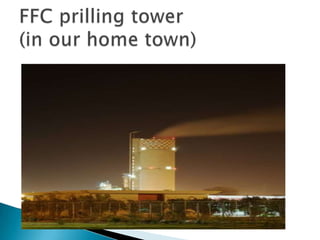
Prilling tower is backbone of fertilizer or any
other chemical industry where the final
product is in the form of solid prills
We can’t imagine a fertilizer industry without
a prilling tower
The process in prilling tower is continuous ,
prills moves downward due to gravitational
force










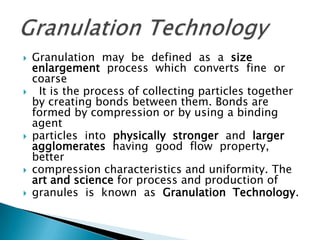
Granulation may be defined as a size
enlargement process which converts fine or
coarse
It is the process of collecting particles together
by creating bonds between them. Bonds are
formed by compression or by using a binding
agent
particles into physically stronger and larger
agglomerates having good flow property,
better
compression characteristics and uniformity. The
art and science for process and production of
granules is known as Granulation Technology.
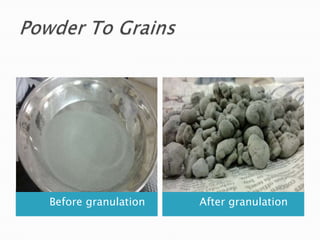
Before granulation

After granulation
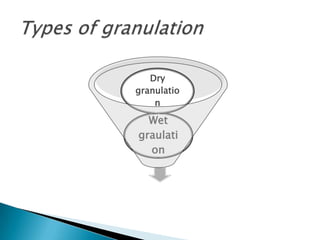
Dry
granulatio
n

Wet
graulati
on






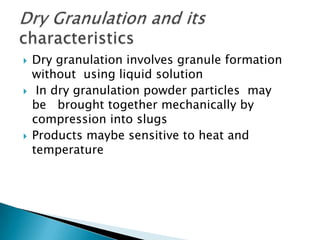
Dry granulation involves granule formation
without using liquid solution
In dry granulation powder particles may
be brought together mechanically by
compression into slugs
Products maybe sensitive to heat and
temperature




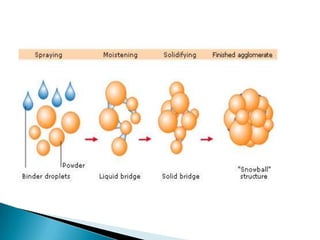
The process in which powder form particles
combine to form bigger and solid particle by
the process of agglorimation with the help of
binding agent like water

It is mainly used in pharmacutical industry ,
in the formation of tablets








The instrument where the process of
granulation take place is called granulator
Granulators are classified on the base of
shear
Shear is mechanical force applied by
instrument
Granulators may be high shear , low shear or
intermediate shear


There are four major techniques which are
used for wet granulation process



1)high shear mixing granulation



2)fluid bed granulation



3)rotating disk method



4)spray drying








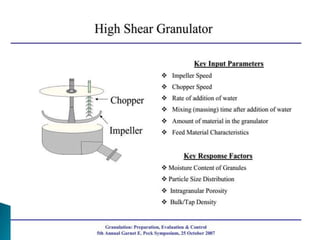
In this type of equipment, the particles
are set into movement by an impeller
rotating at a high speed (Approx 50100 rpm). Equipment also contains a
chopper which
rotates at around 1500 – 4000 rpm [10]. The
primary function of chopper is to cut large
lumps
into smaller fragments thus increases the
binder distribution into the blend.




Impeller speed : higher the impeller speed
generally denser and smaller granules , lower
the speed generally more porous and large
particles
Chopper speed : there is no effect of chopper
speed on granules size but in the case when
chopper is large size it act as secondary
impeller




Surface tension: lower surface tension binder
will be use in large amount to form granules
of same size as compared to binder with high
surface tension

Viscosity: a binder with higher viscosity will
produce smaller and stronger granules






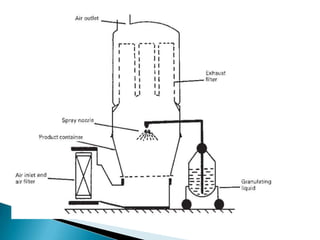
Fluid bed granulator is low shear type
granulator
Fluid bed means suspended different
particles in air
The term fluidization used which means
mixing of solids




The powder particles are fluidized in a steam
of air , but in addition of granulation fluid
sprayed from nozzle on bed of powder

Heated and filtered air is blown in order to
mix powder


Granulation fluid is pumped from a reservior
through a spry nozzle positioned over bed of
particle the fluid cause the particles to adhere
when droplets and particle collide escape of
material from chamber is prevented by exaust
filter sufficient liquid is sprayed to produce
require size particles
> Spray dryer is the process has been used to
produce microcapsules , food ingredients ,
flavors and various biotechnological
ingredients
>This process differ from others as it isa
continues process










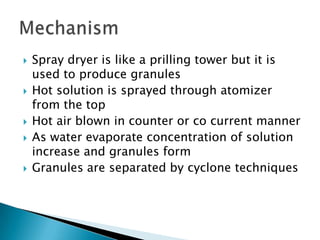
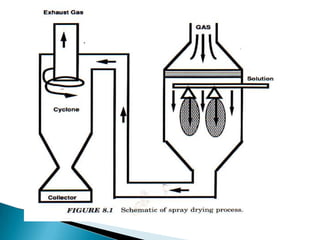
Spray dryer is like a prilling tower but it is
used to produce granules
Hot solution is sprayed through atomizer
from the top
Hot air blown in counter or co current manner
As water evaporate concentration of solution
increase and granules form
Granules are separated by cyclone techniques


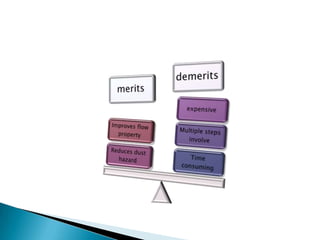
Rapid and continues process



Reduce overall cost



No dust formation



Suitable for heat and moisture








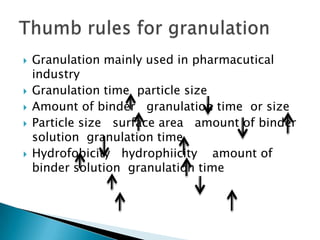
Granulation mainly used in pharmacutical
industry
Granulation time particle size
Amount of binder granulation time or size
Particle size surface area amount of binder
solution granulation time
Hydrofobicity hydrophiicity amount of
binder solution granulation time









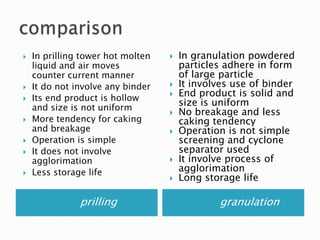
In prilling tower hot molten
liquid and air moves
counter current manner
It do not involve any binder
Its end product is hollow
and size is not uniform
More tendency for caking
and breakage
Operation is simple
It does not involve
agglorimation
Less storage life

prilling











In granulation powdered
particles adhere in form
of large particle
It involves use of binder
End product is solid and
size is uniform
No breakage and less
caking tendency
Operation is not simple
screening and cyclone
separator used
It involve process of
agglorimation
Long storage life

granulation
prilling tower and granulation

prilling tower and granulation

  • 2.
    Prepared by Mussab jaffar FarhadRafique Muhammad yousaf farooq bashir Khalid nawaz
  • 3.
           1) What areprills and Prillings 2)Why we are studying prillings 3) Prilling Tower…? 4)what are grains and granulation 5)why we study granulation 6) Granulator…? 7) And their Industrial applications
  • 4.
    A prill issmall agregate of material, most often a dry sphere formed from melted liquid  Soldification of droplets of molten material free falling against Upward stream of air in tower is  called Prilling
  • 5.
      It is moreconvenient for use , storage and transporting because of their much smaller specific surface area and bulk density Prills of fertilizers are small , easy to handle , easily absorb in land , light in weight , very small impurities etc
  • 7.
      The melt mustbe sprayed into droplets uniform size as required The sprayed droplets must be fully solidified and cooled in order to avoid bonding of particles with each other and caking on wall
  • 8.
      It is cylindricalvertical tower with average hight 75 m , in which urea prilling take place with huge diameter it has two prill sections One is at top from where molten fertilizer comes and other one at bottom from where prills are collected
  • 10.
       The molten fertilizeris sent on the top of fertilizer plant with the help of centrifugal pump With the help of spryer molten fertilizer is droped from the top in the form drops inside the prilling tower While from the bottom hot air is blown which dries the droplets in the form of solid prills
  • 11.
  • 12.
  • 13.
  • 14.
       This process iswidely used in manufacturing of ammonium nitrate, calcium nitrate and fertilizers of N,K and P Prilling also used in explosives industry to produce porous prills of amonium nitrate which will absorb oil Typical prilling tower produce 200 ton/day of fertilizer
  • 16.
       In order toproduce large size fertilizer prills the hight of prilling should be high and vice versa Higher the hight of prilling tower more will be the strength of prills 50 m high fertilizer prilling tower produce 2mm size prills while , for explosive particles size of prilling tower is about 10 m to produce small prills
  • 18.
      The prill toweris a major source of emission in urea plants. The large volumes of discharged untreated cooling air contain particulate urea dust (1-2kg.t-1) as well as NH3 (0.7-1.0kg.t-1). Increasing the load on a prilling tower can have negative consequences for the prill quality. Higher moisture contents and higher temperatures cause more dust formation and an increased likelihood of caking problems
  • 19.
    Competition from granules The quality of prills is significant less than that of granules, the main difference being the lower strength and smaller size of prills.  Research has shown that once a farmer has used granules, he will not choose prills again, unless the price is lower.  Most new urea plants are large scale granulation plants and are located in low feedstock areas; these plants are export driven and compete – or will compete – with your prills.
  • 25.
       Prilling tower isbackbone of fertilizer or any other chemical industry where the final product is in the form of solid prills We can’t imagine a fertilizer industry without a prilling tower The process in prilling tower is continuous , prills moves downward due to gravitational force
  • 26.
         Granulation may bedefined as a size enlargement process which converts fine or coarse It is the process of collecting particles together by creating bonds between them. Bonds are formed by compression or by using a binding agent particles into physically stronger and larger agglomerates having good flow property, better compression characteristics and uniformity. The art and science for process and production of granules is known as Granulation Technology.
  • 27.
  • 28.
  • 29.
       Dry granulation involvesgranule formation without using liquid solution In dry granulation powder particles may be brought together mechanically by compression into slugs Products maybe sensitive to heat and temperature
  • 30.
      The process inwhich powder form particles combine to form bigger and solid particle by the process of agglorimation with the help of binding agent like water It is mainly used in pharmacutical industry , in the formation of tablets
  • 33.
        The instrument wherethe process of granulation take place is called granulator Granulators are classified on the base of shear Shear is mechanical force applied by instrument Granulators may be high shear , low shear or intermediate shear
  • 34.
     There are fourmajor techniques which are used for wet granulation process  1)high shear mixing granulation  2)fluid bed granulation  3)rotating disk method  4)spray drying
  • 35.
        In this typeof equipment, the particles are set into movement by an impeller rotating at a high speed (Approx 50100 rpm). Equipment also contains a chopper which rotates at around 1500 – 4000 rpm [10]. The primary function of chopper is to cut large lumps into smaller fragments thus increases the binder distribution into the blend.
  • 37.
      Impeller speed :higher the impeller speed generally denser and smaller granules , lower the speed generally more porous and large particles Chopper speed : there is no effect of chopper speed on granules size but in the case when chopper is large size it act as secondary impeller
  • 38.
      Surface tension: lowersurface tension binder will be use in large amount to form granules of same size as compared to binder with high surface tension Viscosity: a binder with higher viscosity will produce smaller and stronger granules
  • 39.
       Fluid bed granulatoris low shear type granulator Fluid bed means suspended different particles in air The term fluidization used which means mixing of solids
  • 40.
      The powder particlesare fluidized in a steam of air , but in addition of granulation fluid sprayed from nozzle on bed of powder Heated and filtered air is blown in order to mix powder
  • 41.
     Granulation fluid ispumped from a reservior through a spry nozzle positioned over bed of particle the fluid cause the particles to adhere when droplets and particle collide escape of material from chamber is prevented by exaust filter sufficient liquid is sprayed to produce require size particles
  • 43.
    > Spray dryeris the process has been used to produce microcapsules , food ingredients , flavors and various biotechnological ingredients >This process differ from others as it isa continues process
  • 44.
         Spray dryer islike a prilling tower but it is used to produce granules Hot solution is sprayed through atomizer from the top Hot air blown in counter or co current manner As water evaporate concentration of solution increase and granules form Granules are separated by cyclone techniques
  • 46.
     Rapid and continuesprocess  Reduce overall cost  No dust formation  Suitable for heat and moisture
  • 47.
         Granulation mainly usedin pharmacutical industry Granulation time particle size Amount of binder granulation time or size Particle size surface area amount of binder solution granulation time Hydrofobicity hydrophiicity amount of binder solution granulation time
  • 48.
           In prilling towerhot molten liquid and air moves counter current manner It do not involve any binder Its end product is hollow and size is not uniform More tendency for caking and breakage Operation is simple It does not involve agglorimation Less storage life prilling        In granulation powdered particles adhere in form of large particle It involves use of binder End product is solid and size is uniform No breakage and less caking tendency Operation is not simple screening and cyclone separator used It involve process of agglorimation Long storage life granulation