Agglomeration:
Pelletizing or
Compaction?
Experts in process design and material
processing for over 60 years.
The choice of whether to use
compaction granulation or pelletization
to process material fines is one
commonly seen throughout a variety
of industries.
The two processes are very different, with
each offering different advantages and
disadvantages. And while the material will
sometimes dictate which process must be
used, often times, both methods must be
explored to determine which method will best
suit the material and process requirements.
Compaction
Granulation
Compaction granulation is a type of pressure
agglomeration that produces dense, jagged
granules.
Compaction granulation is a type of pressure
agglomeration that produces dense, jagged
granules.
This is a dry process, and relies on the
principle that some materials will naturally
adhere to themselves under extreme
pressure. Not all materials will behave this
way, so compaction granulation is not
always an option.
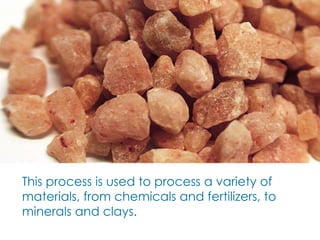
This process is used to process a variety of
materials, from chemicals and fertilizers, to
minerals and clays.
How it Works
Compaction granulation is carried out in a
compactor, or double roll press.
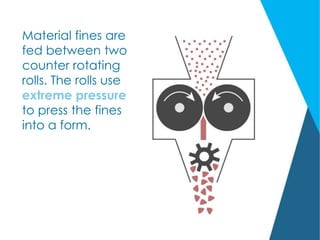
Material fines are
fed between two
counter rotating
rolls. The rolls use
extreme pressure
to press the fines
into a form.
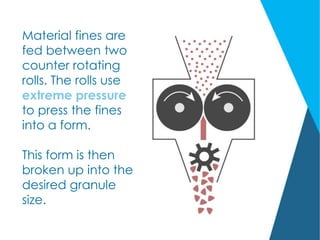
Material fines are
fed between two
counter rotating
rolls. The rolls use
extreme pressure
to press the fines
into a form.
This form is then
broken up into the
desired granule
size.
Since this process utilizes pressure, typically no
binder is needed.
Subsequently, this processing method also
does not require a drying stage in most
applications.
Granules are sometimes conditioned after
compaction, in order to help reduce the
opportunity for attrition.
This can be carried out in paddle mixer, or a
coating/conditioning drum.
This can be carried out in paddle mixer, or a
coating/conditioning drum.
This step can also be used to include
desirable additives, such as anti-caking
additives and the like.
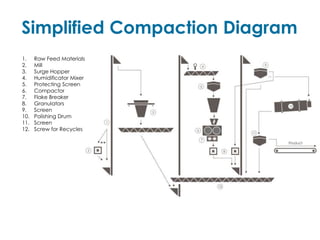
Simplified Compaction Diagram
1. Raw Feed Materials
2. Mill
3. Surge Hopper
4. Humidificator Mixer
5. Protecting Screen
6. Compactor
7. Flake Breaker
8. Granulators
9. Screen
10. Polishing Drum
11. Screen
12. Screw for Recycles
Advantages
Lower Operating Costs
The main advantage to compaction
granulation is that it offers lower operating
costs than pelletizing. This is because a binder
is usually not needed, so there are no binder
costs, and subsequently, no drying step is
needed, so there are no costs in terms of
drying energy.
Disadvantages
Larger Capital Investment
Compaction granulation does require
a higher initial capital investment.
Attrition
Attrition is commonly seen with
granules produced via the
compaction process, because of the
rough, jagged edges. There are
methods to help combat attrition, but
these can increase operating costs.
Pelletizing
Pelletizing is a non-pressure (tumble growth)
agglomeration method used throughout a
variety of industries to process all sorts of
materials into uniform, round pellets.
How it Works
The pelletizing process is most often
comprised of three main steps: pre-
conditioning, pelletizing, and drying. In
many applications, the pre-conditioning
stage is optional, but offers many benefits.
Pelletizing is a wet process, requiring the use
of a binding agent to foster particle size
enlargement.
In a typical pelletizing process,
material fines are first conditioned in a
pin mixer.
In a typical pelletizing process,
material fines are first conditioned in a
pin mixer.
The material is then fed onto a disc
pelletizer, where the pellets are
“grown.” This is achieved by tumbling
the fines against themselves in the
presence of a binder, a process similar
to rolling a snowball.
Once pellets have reached the
desired size, they exit the pelletizer,
and are carried via a conveyor to a
dryer – most often a rotary dryer.
Once pellets have reached the
desired size, they exit the pelletizer,
and are carried via a conveyor to a
dryer – most often a rotary dryer.
Here, pellets are dried into their final
form, allowing them to withstand
further handling and transportation,
but still break down as needed.
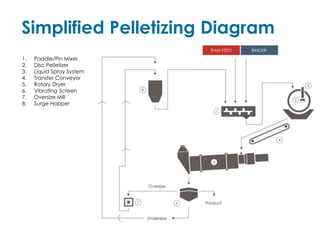
Simplified Pelletizing Diagram
1. Paddle/Pin Mixer
2. Disc Pelletizer
3. Liquid Spray System
4. Transfer Conveyor
5. Rotary Dryer
6. Vibrating Screen
7. Oversize Mill
8. Surge Hopper
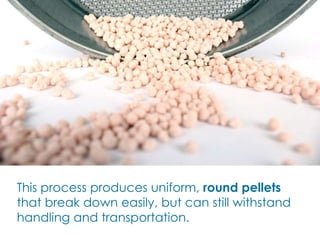
This process produces uniform, round pellets
that break down easily, but can still withstand
handling and transportation.
Advantages
Faster Nutrient Delivery
Because pellets are not created
through the use of pressure, they are less
dense than granules created in the
compaction process. Pellets are
capable of withstanding handling and
transport, but can still break down
quickly upon application.
Faster Nutrient Delivery
Because pellets are not created
through the use of pressure, they are less
dense than granules created in the
compaction process. Pellets are
capable of withstanding handling and
transport, but can still break down
quickly upon application.
This is particularly beneficial in
agricultural settings, such as with soil
amendments and fertilizers, as well as
other products that benefit from faster
product breakdown.
Less Dust & Fines
Round pellets produce significantly less
dust and fines than jagged granules.
This is because there are no rough
edges to break off, creating dust.
Binders as a Benefit
Though required in the pelletizing
process, binders can actually serve as
beneficial additives. This allows for tight
control of product formulation, and
can help to create a pellet product
enhanced with desirable additives.
Lower Capital Costs
Pelletizing operations require a lower
capital investment than compaction
granulation.
Disadvantages
Higher Processing Costs
The use of a binder, and subsequently
the required drying step, results in
higher processing costs compared to
compaction granulation.
Conclusion
The choice between compaction
granulation and pelletizing is one that
requires careful consideration.
Conclusion
The choice between compaction
granulation and pelletizing is one that
requires careful consideration.
End product use, capital costs, operating
costs, and other factors must all be
considered.
Sometimes, the choice between the two
methods is clear, while other times, it is not.
When it’s not clear which method will best suit
your processing needs, testing your material in
a feasibility lab can also help to determine
which method will produce the desired results.
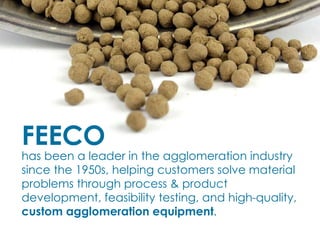
has been a leader in the agglomeration industry
since the 1950s, helping customers solve material
problems through process & product
development, feasibility testing, and high-quality,
custom agglomeration equipment.
FEECO
Want to learn more?
Download our
Agglomeration Handbook
Intro to Agglomeration
Processing Techniques
Considerations in Agglomeration
And more…
Download Now

Agglomeration: Pelletizing or Compaction?

  • 1.
    Agglomeration: Pelletizing or Compaction? Experts inprocess design and material processing for over 60 years.
  • 2.
    The choice ofwhether to use compaction granulation or pelletization to process material fines is one commonly seen throughout a variety of industries.
  • 3.
    The two processesare very different, with each offering different advantages and disadvantages. And while the material will sometimes dictate which process must be used, often times, both methods must be explored to determine which method will best suit the material and process requirements.
  • 4.
  • 5.
    Compaction granulation isa type of pressure agglomeration that produces dense, jagged granules.
  • 6.
    Compaction granulation isa type of pressure agglomeration that produces dense, jagged granules. This is a dry process, and relies on the principle that some materials will naturally adhere to themselves under extreme pressure. Not all materials will behave this way, so compaction granulation is not always an option.
  • 7.
    This process isused to process a variety of materials, from chemicals and fertilizers, to minerals and clays.
  • 8.
  • 9.
    Compaction granulation iscarried out in a compactor, or double roll press.
  • 10.
    Material fines are fedbetween two counter rotating rolls. The rolls use extreme pressure to press the fines into a form.
  • 11.
    Material fines are fedbetween two counter rotating rolls. The rolls use extreme pressure to press the fines into a form. This form is then broken up into the desired granule size.
  • 12.
    Since this processutilizes pressure, typically no binder is needed. Subsequently, this processing method also does not require a drying stage in most applications.
  • 13.
    Granules are sometimesconditioned after compaction, in order to help reduce the opportunity for attrition.
  • 14.
    This can becarried out in paddle mixer, or a coating/conditioning drum.
  • 15.
    This can becarried out in paddle mixer, or a coating/conditioning drum. This step can also be used to include desirable additives, such as anti-caking additives and the like.
  • 16.
    Simplified Compaction Diagram 1.Raw Feed Materials 2. Mill 3. Surge Hopper 4. Humidificator Mixer 5. Protecting Screen 6. Compactor 7. Flake Breaker 8. Granulators 9. Screen 10. Polishing Drum 11. Screen 12. Screw for Recycles
  • 17.
  • 18.
    Lower Operating Costs Themain advantage to compaction granulation is that it offers lower operating costs than pelletizing. This is because a binder is usually not needed, so there are no binder costs, and subsequently, no drying step is needed, so there are no costs in terms of drying energy.
  • 19.
  • 20.
    Larger Capital Investment Compactiongranulation does require a higher initial capital investment.
  • 21.
    Attrition Attrition is commonlyseen with granules produced via the compaction process, because of the rough, jagged edges. There are methods to help combat attrition, but these can increase operating costs.
  • 22.
  • 23.
    Pelletizing is anon-pressure (tumble growth) agglomeration method used throughout a variety of industries to process all sorts of materials into uniform, round pellets.
  • 24.
  • 25.
    The pelletizing processis most often comprised of three main steps: pre- conditioning, pelletizing, and drying. In many applications, the pre-conditioning stage is optional, but offers many benefits.
  • 26.
    Pelletizing is awet process, requiring the use of a binding agent to foster particle size enlargement.
  • 27.
    In a typicalpelletizing process, material fines are first conditioned in a pin mixer.
  • 28.
    In a typicalpelletizing process, material fines are first conditioned in a pin mixer. The material is then fed onto a disc pelletizer, where the pellets are “grown.” This is achieved by tumbling the fines against themselves in the presence of a binder, a process similar to rolling a snowball.
  • 29.
    Once pellets havereached the desired size, they exit the pelletizer, and are carried via a conveyor to a dryer – most often a rotary dryer.
  • 30.
    Once pellets havereached the desired size, they exit the pelletizer, and are carried via a conveyor to a dryer – most often a rotary dryer. Here, pellets are dried into their final form, allowing them to withstand further handling and transportation, but still break down as needed.
  • 31.
    Simplified Pelletizing Diagram 1.Paddle/Pin Mixer 2. Disc Pelletizer 3. Liquid Spray System 4. Transfer Conveyor 5. Rotary Dryer 6. Vibrating Screen 7. Oversize Mill 8. Surge Hopper
  • 32.
    This process producesuniform, round pellets that break down easily, but can still withstand handling and transportation.
  • 33.
  • 34.
    Faster Nutrient Delivery Becausepellets are not created through the use of pressure, they are less dense than granules created in the compaction process. Pellets are capable of withstanding handling and transport, but can still break down quickly upon application.
  • 35.
    Faster Nutrient Delivery Becausepellets are not created through the use of pressure, they are less dense than granules created in the compaction process. Pellets are capable of withstanding handling and transport, but can still break down quickly upon application. This is particularly beneficial in agricultural settings, such as with soil amendments and fertilizers, as well as other products that benefit from faster product breakdown.
  • 36.
    Less Dust &Fines Round pellets produce significantly less dust and fines than jagged granules. This is because there are no rough edges to break off, creating dust.
  • 37.
    Binders as aBenefit Though required in the pelletizing process, binders can actually serve as beneficial additives. This allows for tight control of product formulation, and can help to create a pellet product enhanced with desirable additives.
  • 38.
    Lower Capital Costs Pelletizingoperations require a lower capital investment than compaction granulation.
  • 39.
  • 40.
    Higher Processing Costs Theuse of a binder, and subsequently the required drying step, results in higher processing costs compared to compaction granulation.
  • 41.
    Conclusion The choice betweencompaction granulation and pelletizing is one that requires careful consideration.
  • 42.
    Conclusion The choice betweencompaction granulation and pelletizing is one that requires careful consideration. End product use, capital costs, operating costs, and other factors must all be considered.
  • 43.
    Sometimes, the choicebetween the two methods is clear, while other times, it is not. When it’s not clear which method will best suit your processing needs, testing your material in a feasibility lab can also help to determine which method will produce the desired results.
  • 44.
    has been aleader in the agglomeration industry since the 1950s, helping customers solve material problems through process & product development, feasibility testing, and high-quality, custom agglomeration equipment. FEECO
  • 45.
    Want to learnmore? Download our Agglomeration Handbook Agglomeration Handbook Intro to Agglomeration Processing Techniques Considerations in Agglomeration And more… Download Now